Category: Articles

  • Steinpilz bestimmen: Merkmale und Verwechslungspartner

    Steinpilz bestimmen: Merkmale und Verwechslungspartner

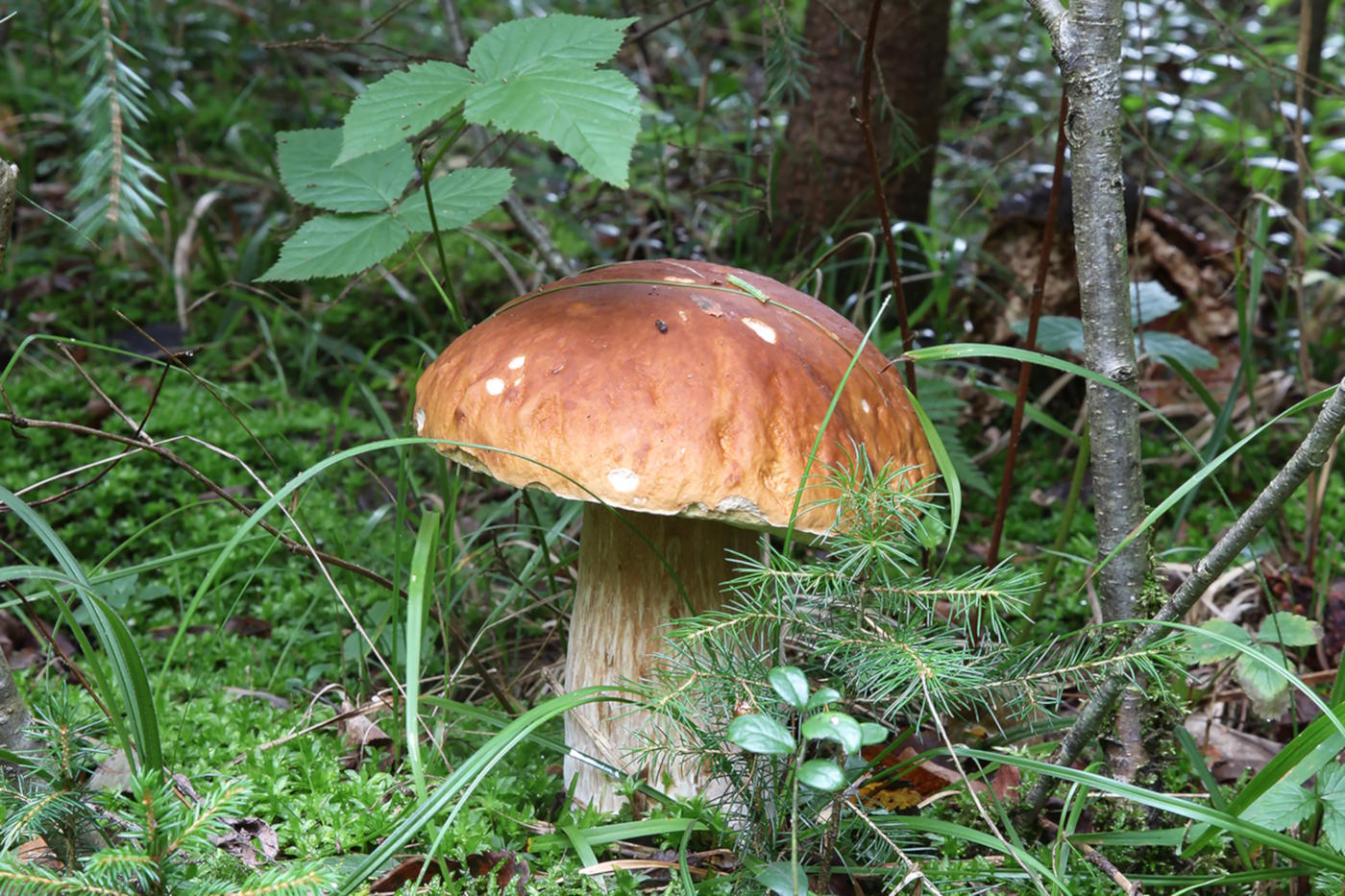
    Der Steinpilz (Boletus edulis) gehört zu den bekanntesten Pilzen in Deutschland und wird von vielen Sammlern gezielt gesucht. Sein kräftiger Stiel, der braune Hut und die helle Röhrenschicht machen ihn zwar vergleichsweise charakteristisch, trotzdem gibt es mehrere ähnliche Röhrlinge, mit denen er verwechselt werden kann.

    Wer einen Steinpilz bestimmen möchte, sollte sich deshalb nicht nur auf die Hutfarbe verlassen. Besonders wichtig sind die Röhren unter dem Hut, die feine Netzzeichnung am Stiel, die Fleischfarbe und der Standort. Wenn du einen unbekannten Fund fotografiert hast, kannst du ihn zunächst mit unserer Pilzbestimmung per Foto eingrenzen. Eine Fotoanalyse sollte jedoch immer nur als Hinweis dienen und niemals allein darüber entscheiden, ob ein Pilz gegessen werden kann.

    Wie sieht ein Steinpilz aus?

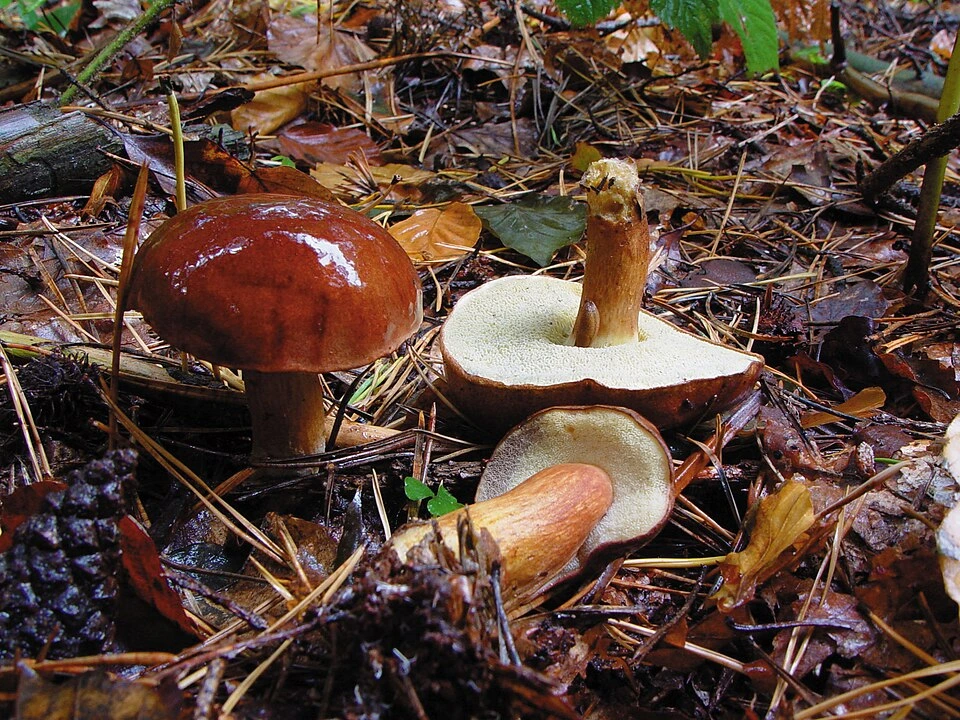
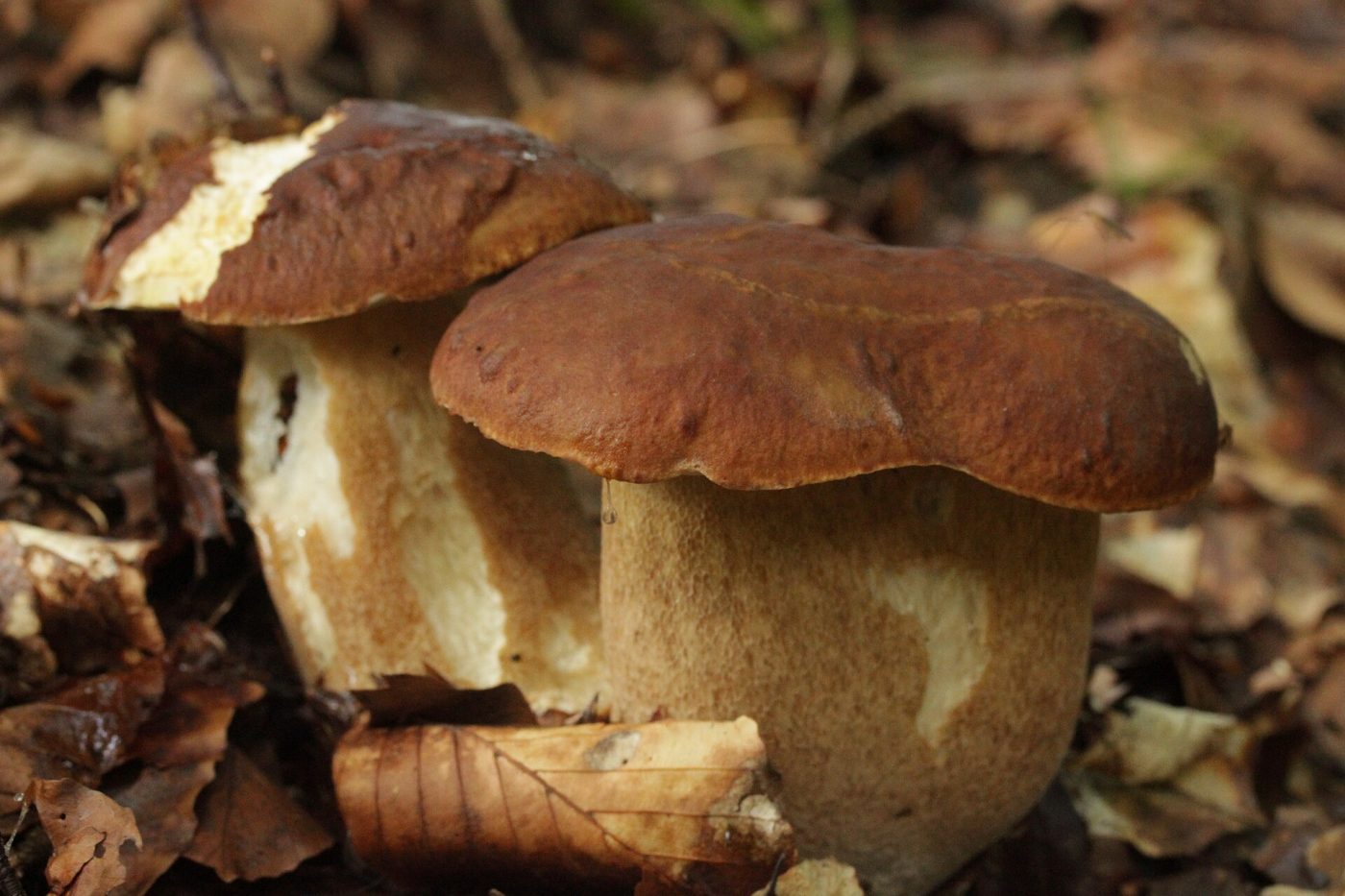
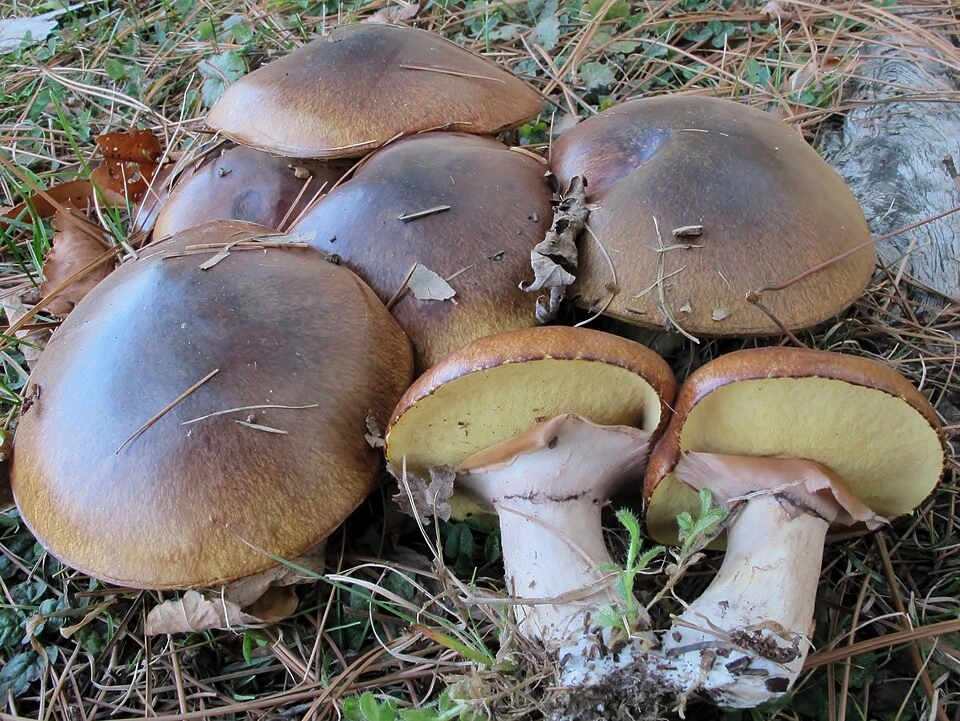
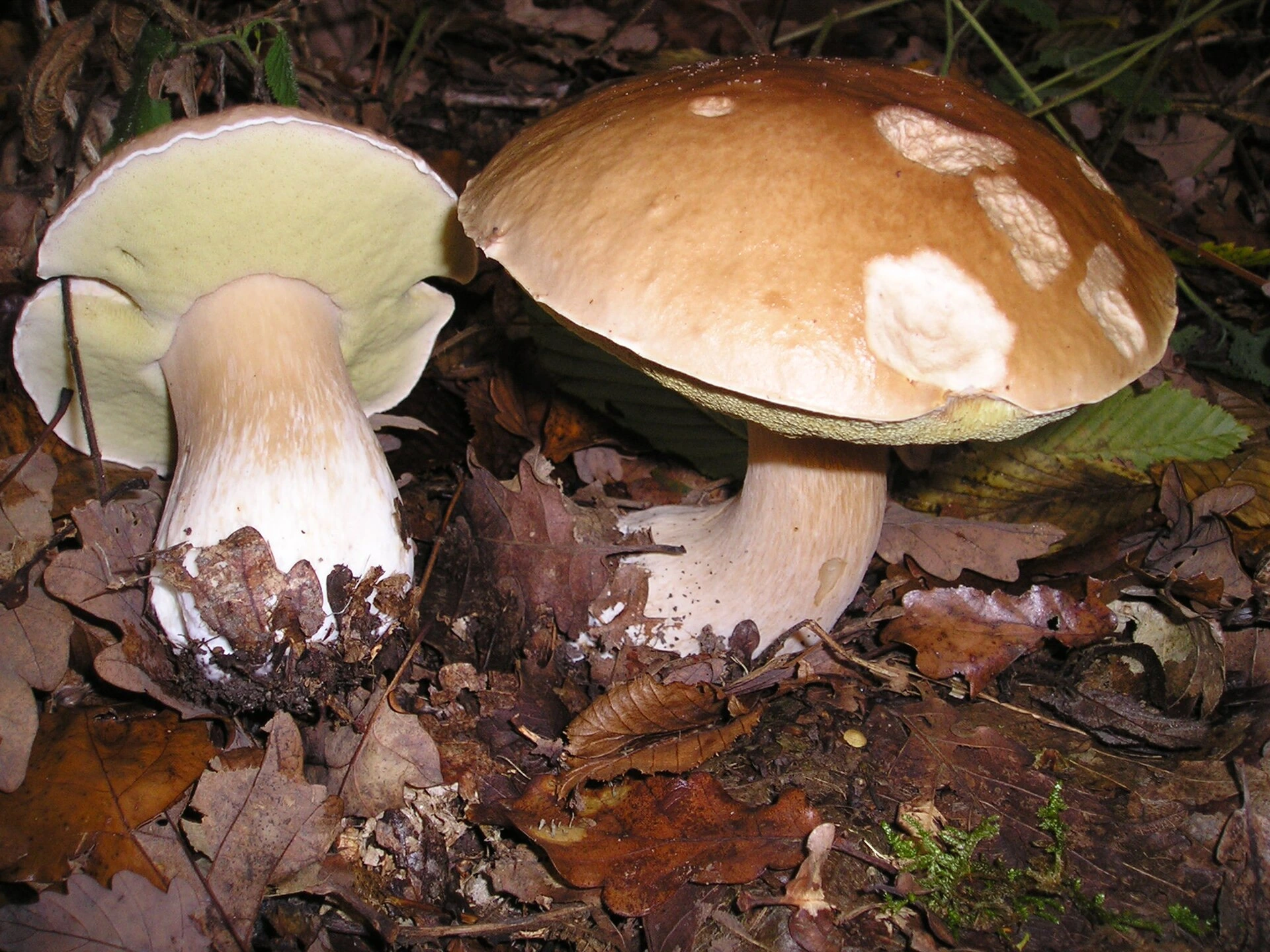
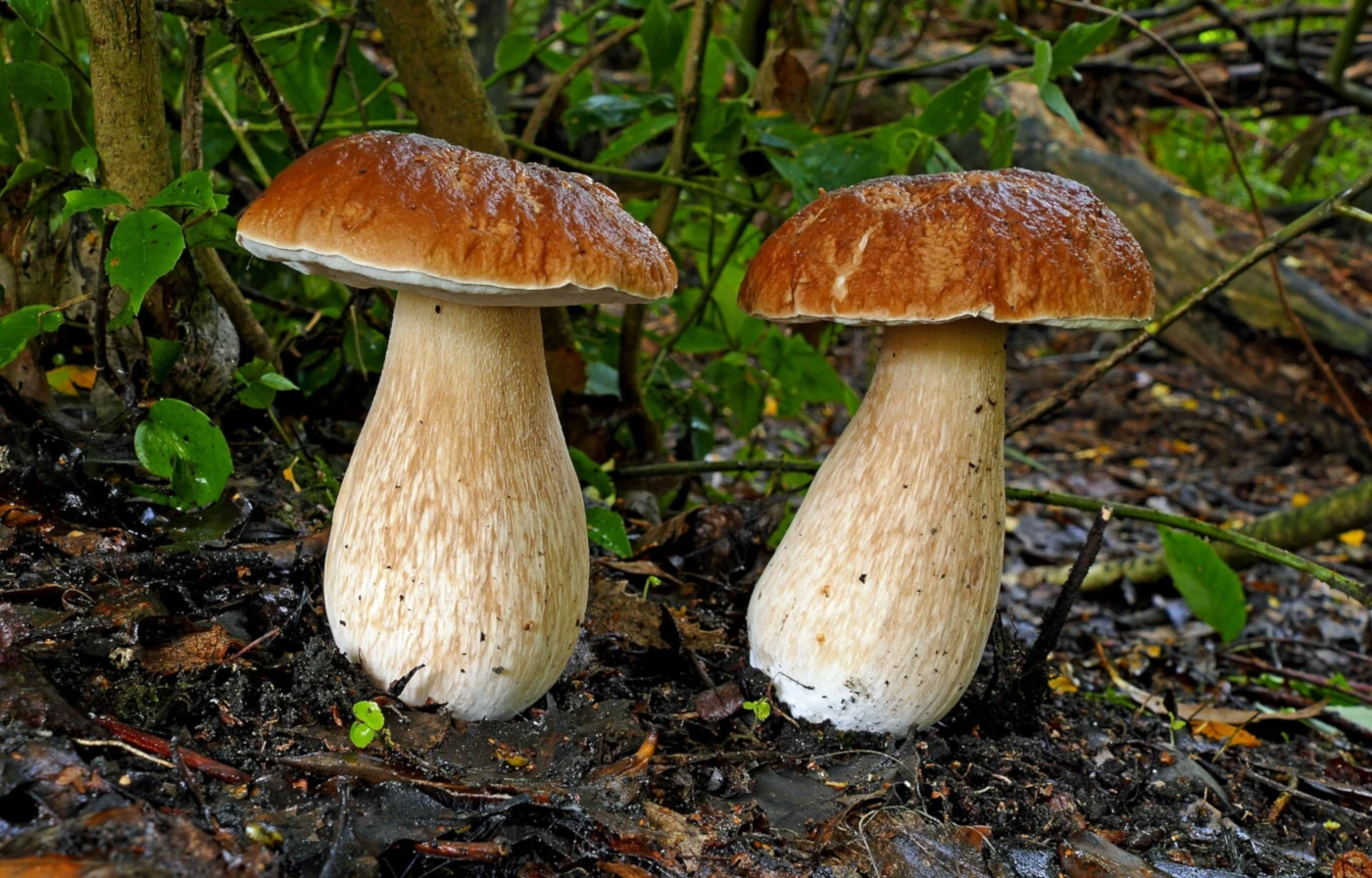
    Der Gemeine Steinpilz besitzt meist einen kräftigen und kompakten Fruchtkörper. Junge Exemplare wirken oft gedrungen und besitzen einen deutlich verdickten Stiel, während ältere Steinpilze flacher und schlanker erscheinen können.

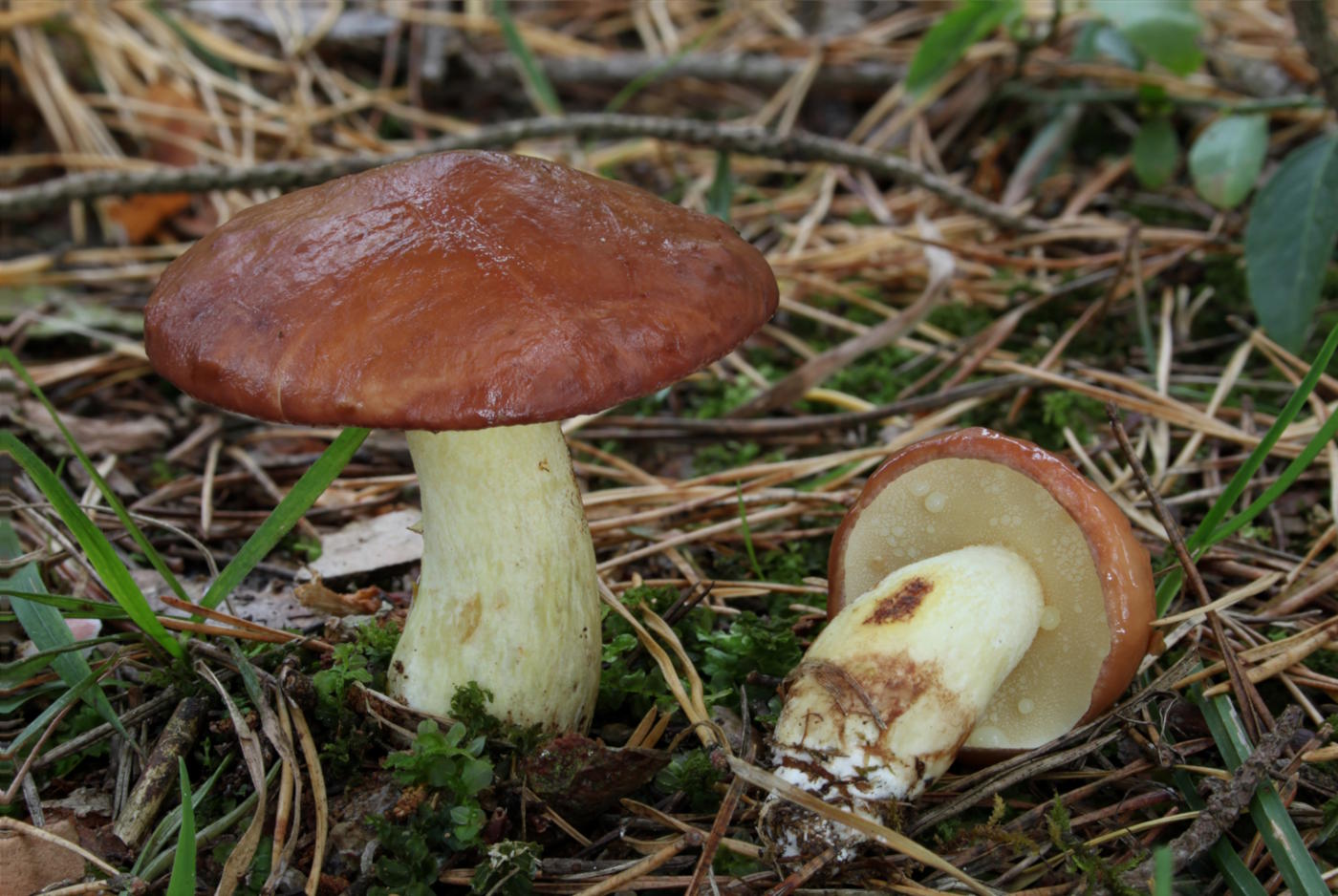
    Typisch ist die Kombination aus braunem Hut, weißlicher bis später olivgelber Röhrenschicht und einem hellen Stiel mit feiner Netzzeichnung. Die einzelnen Merkmale können jedoch je nach Alter, Witterung und Standort unterschiedlich stark ausgeprägt sein.

    Hut

    Der Hut ist bei jungen Steinpilzen zunächst halbkugelig und wird mit zunehmendem Alter breiter und flacher. Ausgewachsene Exemplare können einen Durchmesser von mehr als 20 Zentimetern erreichen, wobei kleinere Fruchtkörper ebenso häufig vorkommen.

    Die Hutfarbe reicht von hellbraun bis dunkel kastanienbraun. Bei manchen Exemplaren ist der Rand etwas heller als die Hutmitte, während andere nahezu gleichmäßig gefärbt sind. Bei feuchtem Wetter kann die Oberfläche leicht klebrig wirken, bei trockener Witterung erscheint sie meist eher matt.

    Die Hutfarbe allein eignet sich nicht zur sicheren Bestimmung, weil zahlreiche andere Röhrlinge ebenfalls braune Hüte besitzen. Sie sollte daher immer zusammen mit Röhren, Stiel und Fleisch beurteilt werden.

    Röhren und Poren

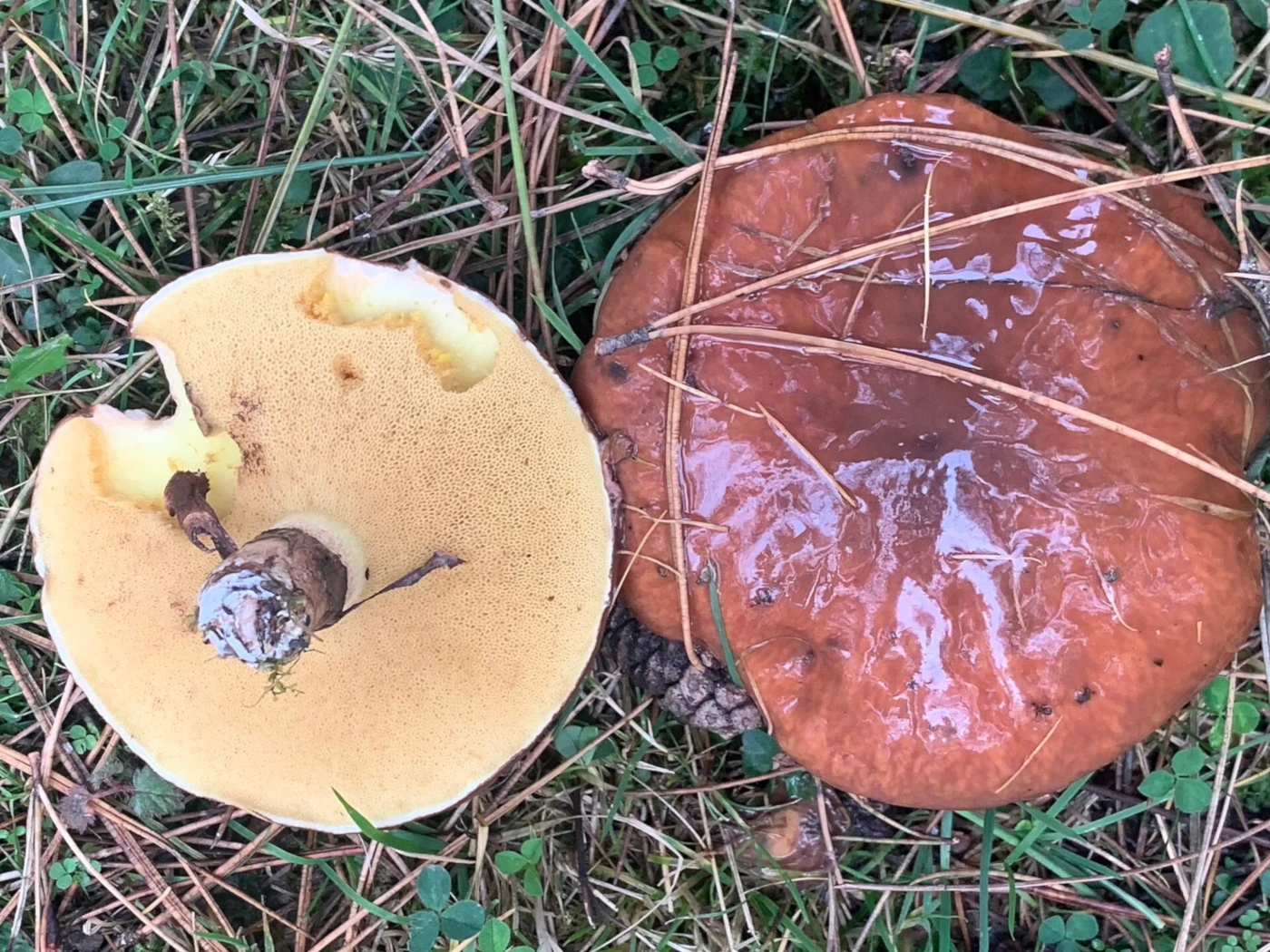
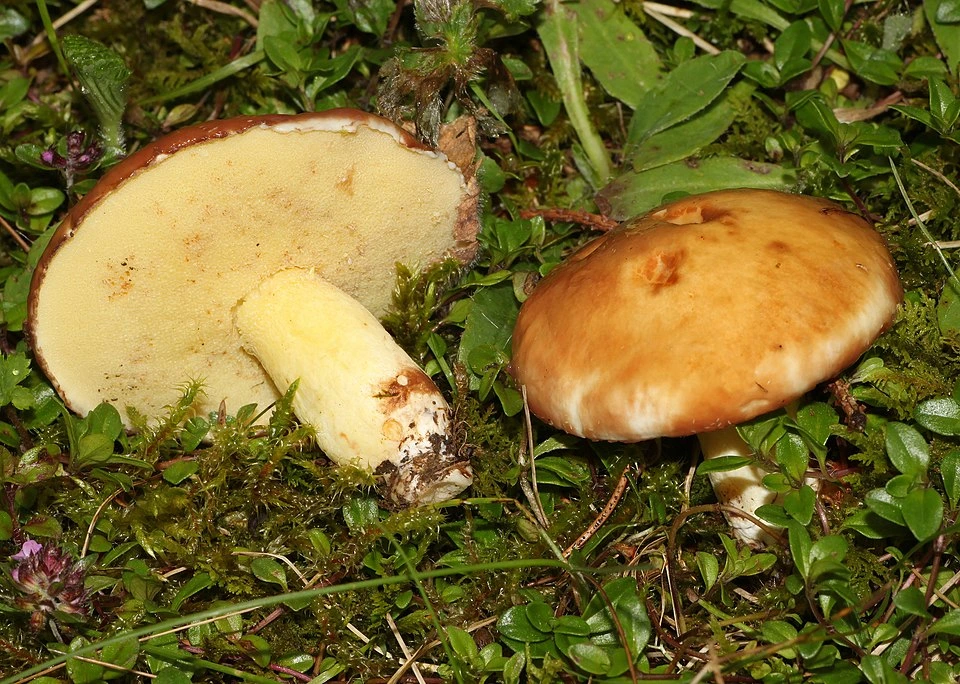
    Unter dem Hut besitzt der Steinpilz keine Lamellen, sondern eine Röhrenschicht. Bei jungen Exemplaren ist diese zunächst weißlich und verändert sich mit zunehmendem Alter zu gelblichen und später olivgrünen Tönen.

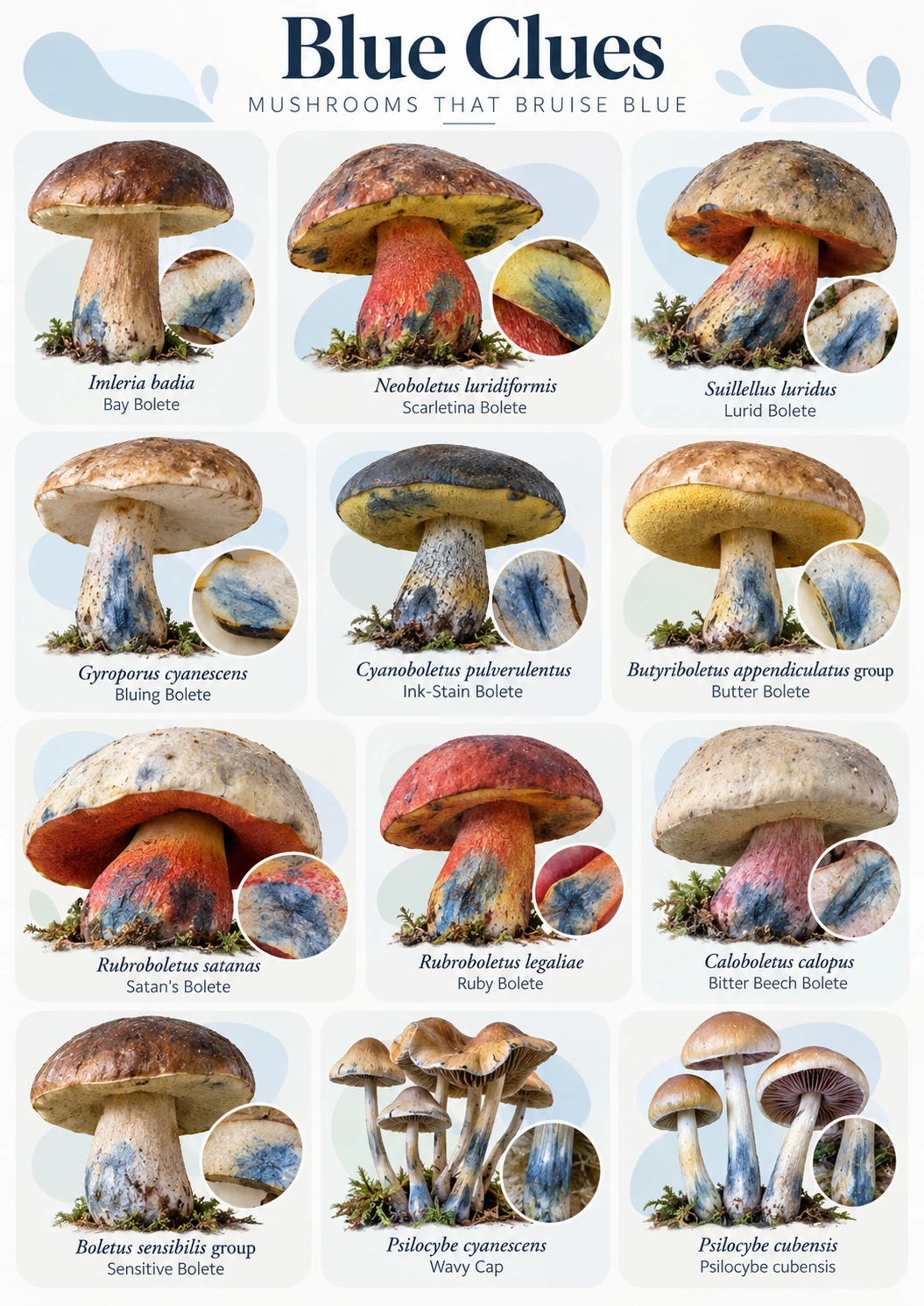
    Die Poren sind vergleichsweise fein und verfärben sich bei Druck normalerweise nicht auffällig blau. Eine deutliche Blaufärbung kann deshalb ein Hinweis darauf sein, dass es sich um eine andere Röhrlingsart handelt.

    Gerade bei älteren Steinpilzen ist die Röhrenfarbe ein wichtiges Merkmal, weil sich ihre Entwicklung gut beobachten lässt. Weiße Röhren sprechen eher für ein junges Exemplar, während olivgrüne Töne typisch für ältere Fruchtkörper sind.

    Stiel

    Der Stiel des Steinpilzes ist meist kräftig und bei jungen Exemplaren oft deutlich bauchig. Mit zunehmendem Alter kann er zylindrischer werden, bleibt aber in der Regel stabil und kompakt.

    Seine Farbe reicht von weißlich bis hellbraun. Besonders wichtig ist die feine Netzzeichnung im oberen Stielbereich. Dieses Netz ist beim Gemeinen Steinpilz meist hell und hebt sich nur leicht vom Untergrund ab.

    Die Netzzeichnung ist eines der wichtigsten Merkmale zur Abgrenzung vom Gallenröhrling. Bei diesem wirkt das Netz häufig deutlich dunkler und gröber.

    Fleisch

    Das Fleisch des Steinpilzes ist weiß und bei jungen Exemplaren relativ fest. Mit zunehmendem Alter wird es häufig weicher und kann besonders im Hut schwammiger wirken.

    Beim Anschneiden bleibt das Fleisch normalerweise weiß und verfärbt sich nicht deutlich blau. Diese fehlende Blaufärbung ist bei der Bestimmung hilfreich, weil mehrere andere Röhrlinge nach Druck oder Verletzung starke Farbveränderungen zeigen.
    Wo wächst der Steinpilz?

    Steinpilze gehören zu den Mykorrhizapilzen. Sie leben in enger Verbindung mit den Wurzeln bestimmter Bäume und können daher nur dort wachsen, wo geeignete Partnerbäume vorhanden sind.

    In Deutschland findet man sie sowohl in Laub- als auch in Nadelwäldern. Besonders häufig treten sie in der Nähe von Fichten, Buchen, Eichen und Kiefern auf. Der genaue Standort kann jedoch sehr unterschiedlich sein, sodass Steinpilze sowohl in moosreichen Nadelwäldern als auch in lichten Laubwäldern vorkommen.

    Ein einzelner Fund ist oft ein Hinweis darauf, dass sich in der Umgebung weitere Fruchtkörper befinden. Das unterirdische Pilzgeflecht kann eine deutlich größere Fläche einnehmen als die sichtbaren Pilze.

    Wann findet man Steinpilze in Deutschland?

    Die Hauptsaison des Steinpilzes liegt in Deutschland meist zwischen Sommer und Herbst. Erste Exemplare können je nach Wetter bereits ab Juni oder Juli erscheinen, besonders häufig werden Steinpilze jedoch im August, September und Oktober gefunden.

    Wie stark eine Saison ausfällt, hängt vor allem von Temperatur und Niederschlag ab. Nach warmen Perioden mit ausreichend Regen können innerhalb kurzer Zeit viele Fruchtkörper erscheinen, während längere Trockenphasen das Wachstum deutlich bremsen.

    In milden Jahren sind regional auch noch spätere Funde möglich. Wer wissen möchte, welche weiteren Arten zur gleichen Zeit häufig erscheinen, findet in Pilze im Oktober in Deutschland eine Übersicht typischer Herbstpilze.

    Woran erkennt man einen echten Steinpilz?

    Für eine sichere Einordnung sollte immer die Kombination mehrerer Merkmale betrachtet werden. Ein typischer Steinpilz besitzt einen braunen Hut, weiße bis später gelblich-olivfarbene Röhren, einen kräftigen hellen Stiel mit feiner Netzzeichnung und weißes Fleisch ohne deutliche Blaufärbung.

    Keines dieser Merkmale sollte isoliert bewertet werden. Besonders bei alten, beschädigten oder ungewöhnlich gefärbten Exemplaren können typische Eigenschaften weniger deutlich ausgeprägt sein. Wer sich allgemein mit solchen Bestimmungsmerkmalen beschäftigen möchte, findet unter Pilze bestimmen: So erkennst du Pilzarten richtig eine ausführlichere Einführung.

    Welche Pilze sehen dem Steinpilz ähnlich?

    Mehrere Röhrlinge können auf den ersten Blick einem Steinpilz ähneln. Besonders für Einsteiger ist es wichtig, nicht nur auf den braunen Hut zu achten, sondern gezielt die Röhren, die Stielzeichnung und mögliche Farbveränderungen zu vergleichen.

    Zu den häufigsten Verwechslungspartnern gehören der Gallenröhrling, der Sommersteinpilz, der Kiefern-Steinpilz und der Maronen-Röhrling. Einige davon gehören zur engeren Steinpilzgruppe und ähneln dem Gemeinen Steinpilz sehr stark, andere lassen sich anhand bestimmter Merkmale relativ gut unterscheiden.

    Gallenröhrling

    Der Gallenröhrling (Tylopilus felleus) besitzt ebenfalls einen braunen Hut und einen kräftigen Stiel. Besonders junge Exemplare können einem Steinpilz so ähnlich sehen, dass eine oberflächliche Betrachtung nicht ausreicht.

    Mit zunehmendem Alter werden die Poren beim Gallenröhrling häufig rosa bis fleischfarben. Außerdem ist die Netzzeichnung am Stiel meist deutlich dunkler und gröber als beim Steinpilz.

    Der Gallenröhrling ist außerdem für seinen extrem bitteren Geschmack bekannt. Eine Geschmacksprobe sollte jedoch nicht als allgemeine Methode zur Pilzbestimmung verwendet werden, insbesondere nicht bei unbekannten Arten.

    Sommersteinpilz

    Der Sommersteinpilz (Boletus reticulatus) gehört eng zur gleichen Gruppe und ähnelt dem Gemeinen Steinpilz stark. Sein Hut wirkt häufig heller und trockener, während die Netzzeichnung oft deutlicher sichtbar ist und weiter über den Stiel reichen kann.

    Er erscheint häufig früher im Jahr als der Gemeine Steinpilz und wird besonders oft in Laubwäldern gefunden. Für Einsteiger ist die Unterscheidung nicht immer einfach, weil sich mehrere Merkmale überschneiden.

    Kiefern-Steinpilz

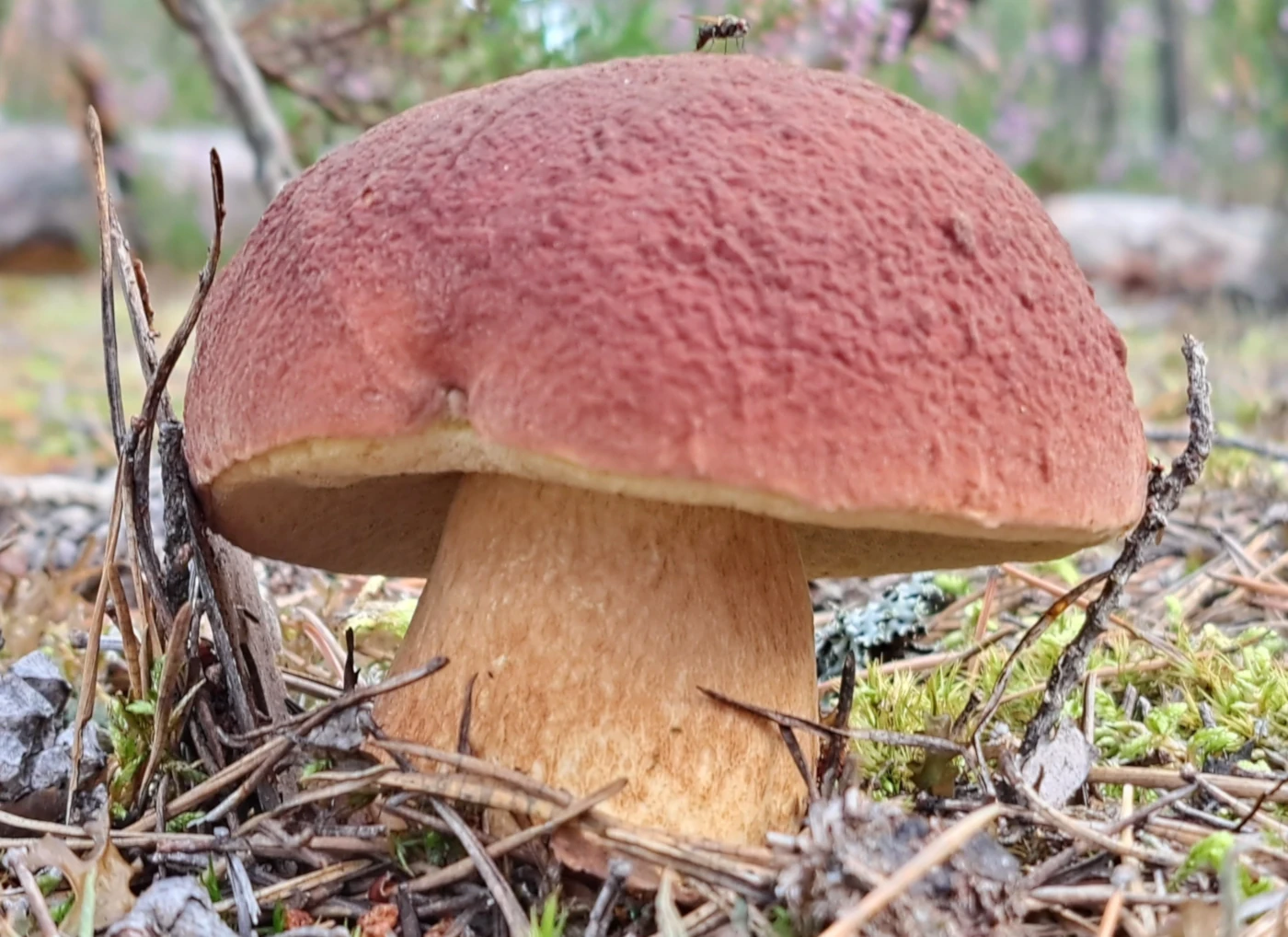
    Der Kiefern-Steinpilz (Boletus pinophilus) besitzt häufig einen dunkleren, teilweise rötlichbraunen Hut. Er wächst bevorzugt bei Kiefern und anderen Nadelbäumen und gehört ebenfalls zur engeren Steinpilzgruppe.

    Auch diese Art kann dem Gemeinen Steinpilz sehr ähnlich sehen. Standort, Hutfarbe und Gesamterscheinung liefern zwar Hinweise, sollten aber nicht allein zur Bestimmung verwendet werden.

    Maronen-Röhrling

    Der Maronen-Röhrling (Imleria badia) besitzt einen kastanienbraunen Hut und kann auf den ersten Blick ebenfalls an einen Steinpilz erinnern. Sein Stiel zeigt jedoch normalerweise keine typische Netzzeichnung.

    Ein weiteres Merkmal ist die mögliche Blaufärbung der Poren bei Druck. Auch das Fleisch kann nach Verletzung leicht blau anlaufen, was beim Gemeinen Steinpilz normalerweise nicht der Fall ist.

    Steinpilz oder Gallenröhrling?

    Die Verwechslung mit dem Gallenröhrling ist besonders häufig, weil beide Arten einen braunen Hut und helle Röhren besitzen können. Gerade bei jungen Exemplaren sind die Unterschiede weniger auffällig und sollten deshalb anhand mehrerer Merkmale geprüft werden.

    Ein hilfreiches Merkmal ist die Netzzeichnung am Stiel. Beim Steinpilz ist sie meist hell und fein, während sie beim Gallenröhrling häufig dunkler, gröber und stärker kontrastierend wirkt.

    Auch die Röhren unterscheiden sich im Alter. Beim Steinpilz entwickeln sie sich von weiß zu gelblich und später olivgrün, während sie beim Gallenröhrling mit zunehmendem Alter einen rosafarbenen bis fleischfarbenen Ton annehmen können.

    Da diese Unterscheidung für viele Sammler besonders relevant ist, lohnt sich ein direkter Vergleich mehrerer Merkmale statt einer Entscheidung anhand eines einzelnen Details.

    Gibt es giftige Doppelgänger des Steinpilzes?

    Der klassische Gallenröhrling gilt vor allem wegen seines extrem bitteren Geschmacks als problematischer Verwechslungspartner und nicht als typischer gefährlicher Giftpilz. Trotzdem bedeutet das nicht, dass jeder ähnlich aussehende Röhrling automatisch unbedenklich ist.

    Es gibt zahlreiche weitere Röhrlinge, darunter auch Arten, die gesundheitliche Beschwerden verursachen können. Besonders unbekannte Pilze mit roten Poren, starken Farbveränderungen oder auffälligen Stielzeichnungen sollten deshalb sorgfältig bestimmt werden.

    Ein Pilz sollte niemals allein deshalb als essbar betrachtet werden, weil er Röhren besitzt und einem Steinpilz ähnlich sieht. Eine Übersicht über wichtige problematische Arten findest du in unserem Artikel Giftige Pilze in Deutschland.

    Ist der Steinpilz essbar?

    Der Steinpilz zählt zu den bekannten Speisepilzen. Diese Information bedeutet jedoch nicht, dass ein einzelner Fund allein anhand eines Fotos sicher zum Verzehr bestimmt werden kann.

    Vor dem Essen muss zweifelsfrei feststehen, dass es sich tatsächlich um die entsprechende Art handelt. Auch Alter und Zustand des Fruchtkörpers spielen eine Rolle, denn stark überalterte, verschimmelte oder bereits deutlich zersetzte Pilze sollten unabhängig von der Art nicht verwendet werden.

    Eine automatische Fotoerkennung kann bei der Eingrenzung helfen, ersetzt aber keine sichere Bestimmung. Weitere bekannte Speisepilze findest du in unserer Übersicht Essbare Pilze in Deutschland: 20 häufige Arten erkennen.

    Wie fotografiert man einen Steinpilz zur Bestimmung?

    Für eine Fotoanalyse sollte der gesamte Fruchtkörper möglichst vollständig sichtbar sein. Eine Aufnahme von oben zeigt zwar Hutfarbe und Form, reicht aber für eine gute Einschätzung meist nicht aus.

    Besonders hilfreich sind zusätzliche Fotos der Röhrenschicht und des Stiels. Die Netzzeichnung am oberen Stiel sollte möglichst scharf zu erkennen sein, weil sie für die Unterscheidung ähnlicher Arten besonders wichtig ist.

    Auch ein Bild des natürlichen Standorts kann zusätzliche Hinweise liefern. Bäume in unmittelbarer Nähe sind bei Steinpilzen besonders relevant, weil die Art auf bestimmte Mykorrhizapartner angewiesen ist.

    Starke Filter oder nachträgliche Farbveränderungen sollten vermieden werden. Sie können wichtige Farbtöne verfälschen und dadurch die Bestimmung erschweren.

    Steinpilz per Foto bestimmen

    Wenn du einen möglichen Steinpilz gefunden hast, kannst du das Foto zunächst mit MushroomID analysieren. Die automatische Pilzerkennung kann mögliche Arten vorschlagen und dabei helfen, wichtige Merkmale gezielt zu vergleichen.

    Überprüfe anschließend insbesondere die Röhrenschicht, die Stielzeichnung, mögliche Farbveränderungen und den Standort. Bei Unsicherheit über die Essbarkeit sollte der Fund nicht verzehrt und von einer sachkundigen Stelle überprüft werden.

    Häufige Fragen zum Steinpilz

    Warum haben manche Steinpilze einen sehr dunklen Hut?

    Die Hutfarbe kann durch Standort, Alter, Feuchtigkeit und genetische Unterschiede beeinflusst werden. Dunkle Exemplare sind deshalb nicht automatisch eine andere Art.

    Für die Bestimmung sind Röhren, Stielzeichnung und weitere Merkmale deutlich aussagekräftiger als die Hutfarbe allein.

    Können Steinpilze von Schnecken stark beschädigt sein?

    Ja, Schnecken und Insekten fressen häufig an Fruchtkörpern. Ein beschädigter Hut bedeutet deshalb nicht automatisch, dass der Pilz untypisch oder krank ist.

    Bei starker Zersetzung können jedoch wichtige Merkmale fehlen, sodass eine sichere Bestimmung schwieriger wird.

    Wachsen Steinpilze immer einzeln?

    Nein, Steinpilze können sowohl einzeln als auch in kleinen Gruppen auftreten. Da das unterirdische Pilzgeflecht wesentlich größer ist als der sichtbare Fruchtkörper, können weitere Exemplare in unmittelbarer Umgebung erscheinen.

    Nach einem Fund lohnt es sich deshalb häufig, die Umgebung aufmerksam abzusuchen.

    Warum sind manche Steinpilze innen von Maden befallen?

    Pilzfruchtkörper dienen verschiedenen Insektenlarven als Nahrung. Besonders ältere Exemplare können zahlreiche Fraßgänge im Fleisch enthalten.

    Der Befall hat mit der eigentlichen Artbestimmung wenig zu tun, ist aber ein Hinweis auf den Zustand des Fruchtkörpers.

    Kann ein Steinpilz auch in Parks wachsen?

    Ja, entscheidend sind geeignete Partnerbäume und passende Bodenbedingungen, nicht ausschließlich ein geschlossener Wald. Steinpilze können daher grundsätzlich auch in parkartigen Bereichen auftreten.

    Besonders ältere Parks mit Buchen, Eichen, Kiefern oder anderen geeigneten Bäumen können passende Standorte bieten.
  • Essbare Pilze in Deutschland: 20 häufige Arten erkennen

    Essbare Pilze in Deutschland: 20 häufige Arten erkennen

    Deutschland bietet eine erstaunlich große Vielfalt essbarer Wildpilze. In Laub- und Nadelwäldern, auf Wiesen, an Totholz und sogar in Parks wachsen bekannte Arten wie Steinpilze, Pfifferlinge, Maronen-Röhrlinge und Austernseitlinge.

    Essbar bedeutet jedoch niemals automatisch leicht bestimmbar. Viele Speisepilze besitzen ungenießbare oder giftige Doppelgänger, weshalb immer mehrere Merkmale geprüft werden sollten. Wer bei der Bestimmung noch unsicher ist, findet in unserem Leitfaden Pilze bestimmen: So erkennst du Pilzarten richtig eine ausführliche Einführung.

    ⚠️ Wichtig: Iss niemals einen Wildpilz allein aufgrund eines Fotos, einer KI-Bestimmung oder eines einzelnen Merkmals. Eine Verwechslung kann schwere Vergiftungen verursachen, deshalb sollte die Bestimmung vor dem Verzehr unabhängig bestätigt werden.

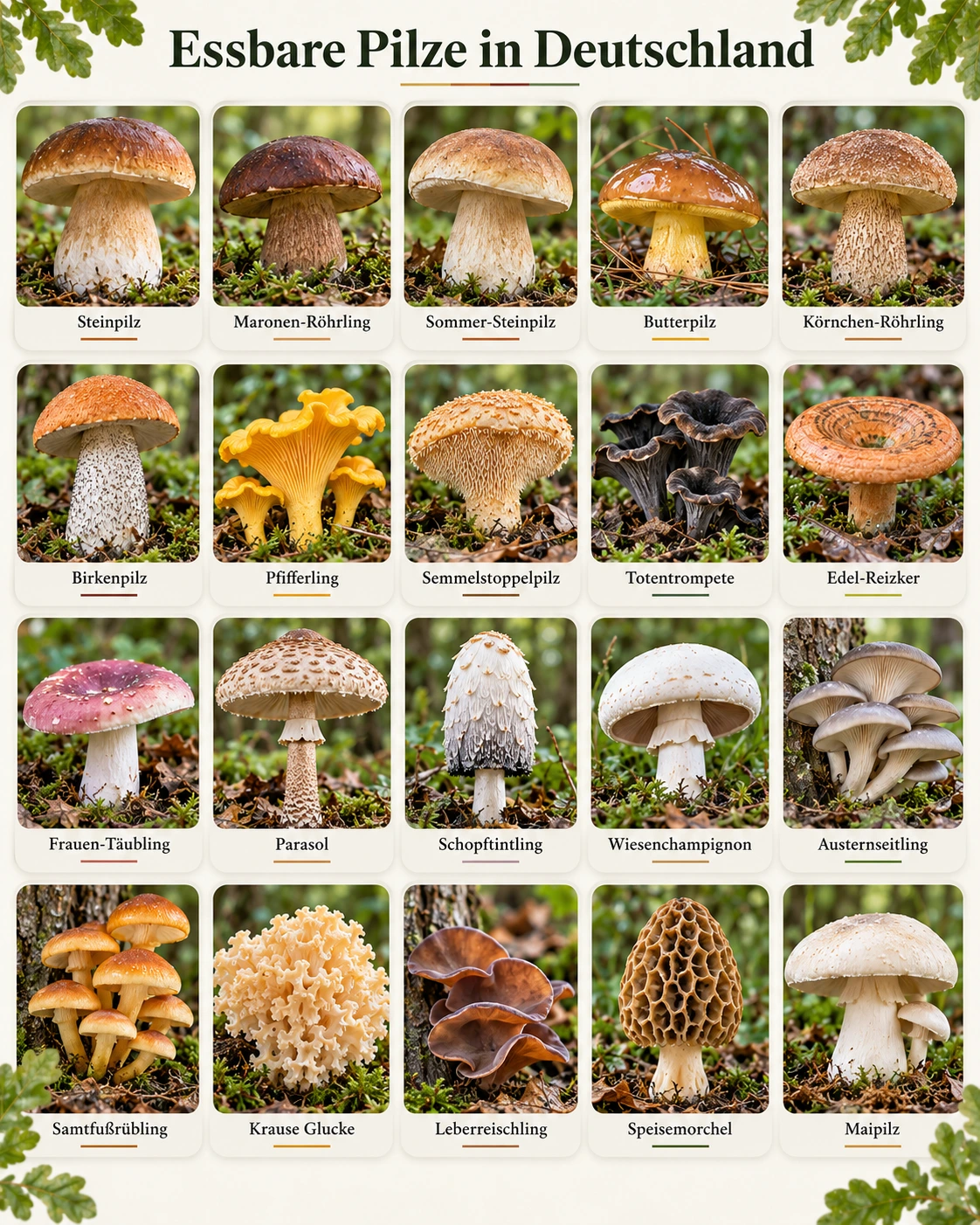
    20 essbare Pilze in Deutschland im Überblick

    Art Deutscher Name Typisches Merkmal Vorkommen
    Boletus edulis Steinpilz Dicke Keule, helle Röhren Laub- und Nadelwald
    Imleria badia Maronen-Röhrling Brauner Hut, Röhren blauen Nadel- und Mischwald
    Boletus reticulatus Sommer-Steinpilz Heller Hut, stark genetzter Stiel Eiche, Buche
    Suillus luteus Butterpilz Schleimiger Hut, Ring Unter Kiefern
    Suillus granulatus Körnchen-Röhrling Gelbe Poren, kein Ring Unter Kiefern
    Leccinum scabrum Birkenpilz Dunkle Schüppchen am Stiel Unter Birken
    Cantharellus cibarius Gruppe Pfifferling Leisten statt echter Lamellen Laub- und Nadelwald
    Hydnum repandum Gruppe Semmelstoppelpilz Stacheln unter dem Hut Wald
    Craterellus cornucopioides Totentrompete Schwarzer Trichter Laubwald
    Lactarius deliciosus Edel-Reizker Orange Milch, grünt bei Druck Unter Kiefern
    Russula cyanoxantha Frauen-Täubling Elastische Lamellen Laubwald
    Macrolepiota procera Parasol Großer Schirm, verschiebbarer Ring Waldränder, Wiesen
    Coprinus comatus Schopftintling Weißer zottiger Hut Wiesen, Wege
    Agaricus campestris Wiesenchampignon Rosa bis braune Lamellen Wiesen
    Pleurotus ostreatus Austernseitling Muschelförmig, wächst an Holz Totholz
    Flammulina velutipes Gruppe Samtfußrübling Dunkler samtiger Stiel Totholz
    Sparassis crispa Krause Glucke Blumenkohlartige Form An Kiefern
    Fistulina hepatica Leberreischling Rotes, fleischiges Fruchtfleisch An Eichen
    Morchella esculenta Gruppe Speisemorchel Wabenartige Hutoberfläche Frühjahr
    Calocybe gambosa Maipilz Weißlicher Hut, frühe Saison Wiesen, Waldränder

    Die Häufigkeit einzelner Arten unterscheidet sich regional deutlich. Ein Pilz, der in Süddeutschland regelmäßig vorkommt, kann im Norden selten sein und umgekehrt.

    1. Boletus edulis – Steinpilz

    Der Steinpilz gehört zu den bekanntesten Speisepilzen Deutschlands. Er besitzt einen braunen Hut, eine kräftige helle Stielbasis und auf der Unterseite keine Lamellen, sondern feine Röhren.

    Junge Röhren sind weiß und werden später gelblich bis olivgrün. Auf dem oberen Stiel befindet sich häufig ein helles Netz, während das weiße Fleisch beim Anschneiden normalerweise nicht blau wird.

    Wo wächst der Steinpilz?

    Steinpilze leben in Mykorrhiza mit Bäumen. Sie kommen sowohl unter Fichten und Kiefern als auch unter Buchen, Eichen und anderen Laubbäumen vor.

    Die Hauptsaison reicht meist vom Sommer bis in den Herbst. Feuchte Perioden nach warmem Wetter können besonders starke Fruchtungen auslösen.

    Wichtigster Doppelgänger

    Der Gallenröhrling kann einem Steinpilz überraschend ähnlich sehen. Seine Poren werden jedoch mit zunehmendem Alter rosa, während das Stielnetz häufig deutlich dunkler ist.

    2. Imleria badia – Maronen-Röhrling

    Der Maronen-Röhrling besitzt einen kastanienbraunen Hut und gelbe Röhren. Besonders charakteristisch ist, dass die Röhrenschicht bei Druck häufig blau anläuft.

    Der Stiel ist braun bis gelblich und besitzt nicht das typische helle Netz eines Steinpilzes. Das Fleisch kann beim Anschneiden ebenfalls leicht blau werden.

    Wo wächst der Maronen-Röhrling?

    Er ist besonders häufig in Nadelwäldern mit Fichten oder Kiefern. Auch Mischwälder können große Mengen hervorbringen.

    Die Art gehört zu den typischen Herbstpilzen Deutschlands. Sie kann je nach Wetter bereits im Sommer erscheinen.

    3. Boletus reticulatus – Sommer-Steinpilz

    Der Sommer-Steinpilz ähnelt dem klassischen Steinpilz, hat aber häufig einen helleren, trockeneren Hut. Sein Stiel trägt meist ein deutliches helles Netz, das weit nach unten reichen kann.

    Die Röhren beginnen weiß und werden später gelb bis oliv. Das Fleisch bleibt nach dem Anschneiden normalerweise weiß.

    Wo wächst der Sommer-Steinpilz?

    Besonders häufig findet man ihn unter Eichen und Buchen. Warme Laubwälder gehören zu seinen typischen Lebensräumen.

    Er kann bereits im späten Frühjahr oder Frühsommer erscheinen. Damit beginnt seine Saison oft früher als die des klassischen Steinpilzes.

    4. Suillus luteus – Butterpilz

    Der Butterpilz besitzt einen braunen Hut, der bei feuchtem Wetter ausgesprochen schleimig wird. Die Unterseite besteht aus gelben Poren.

    Besonders wichtig ist der Ring am Stiel. Dieses Merkmal hilft, den Butterpilz von mehreren ähnlichen Suillus-Arten zu unterscheiden.

    Wo wächst der Butterpilz?

    Die Art ist eng an Kiefern gebunden. Sie kommt sowohl in natürlichen Kiefernwäldern als auch in jungen Forsten, Parks und grasigen Bereichen unter gepflanzten Kiefern vor.

    Nach Herbstregen kann sie in großen Gruppen erscheinen. Mehrere Fruchtungswellen innerhalb einer Saison sind möglich.

    5. Suillus granulatus – Körnchen-Röhrling

    Der Körnchen-Röhrling hat einen gelbbraunen bis orangebraunen Hut und gelbe Poren. An jungen Pilzen können kleine milchige Tröpfchen aus der Porenschicht austreten.

    Der Stiel trägt feine Drüsenpunkte, besitzt jedoch keinen Ring. Genau dieses Merkmal trennt ihn besonders gut vom Butterpilz.

    Wo wächst der Körnchen-Röhrling?

    Auch diese Art lebt eng mit Kiefern zusammen. Besonders junge Kiefernbestände und grasige Bereiche können große Mengen hervorbringen.

    Die Art kann vom Sommer bis in den Herbst gefunden werden. Feuchte und relativ warme Perioden fördern die Fruchtbildung.

    6. Leccinum scabrum – Birkenpilz

    Der Birkenpilz hat einen hell- bis dunkelbraunen Hut und einen langen hellen Stiel mit dunklen Schüppchen. Diese kleinen dunklen Punkte verleihen dem Stiel ein raues Aussehen.

    Auf der Unterseite befinden sich helle Röhren. Das Fleisch ist weißlich und kann sich nach dem Anschneiden etwas verfärben.

    Wo wächst der Birkenpilz?

    Wie der Name verrät, ist er stark mit Birken verbunden. Wo keine Birken in der Nähe stehen, ist eine Bestimmung als Leccinum scabrum deutlich weniger wahrscheinlich.

    Er kommt in Wäldern, Moorgebieten, Parks und anderen Standorten mit Birken vor. Die Saison liegt überwiegend zwischen Sommer und Herbst.

    7. Cantharellus cibarius Gruppe – Pfifferling

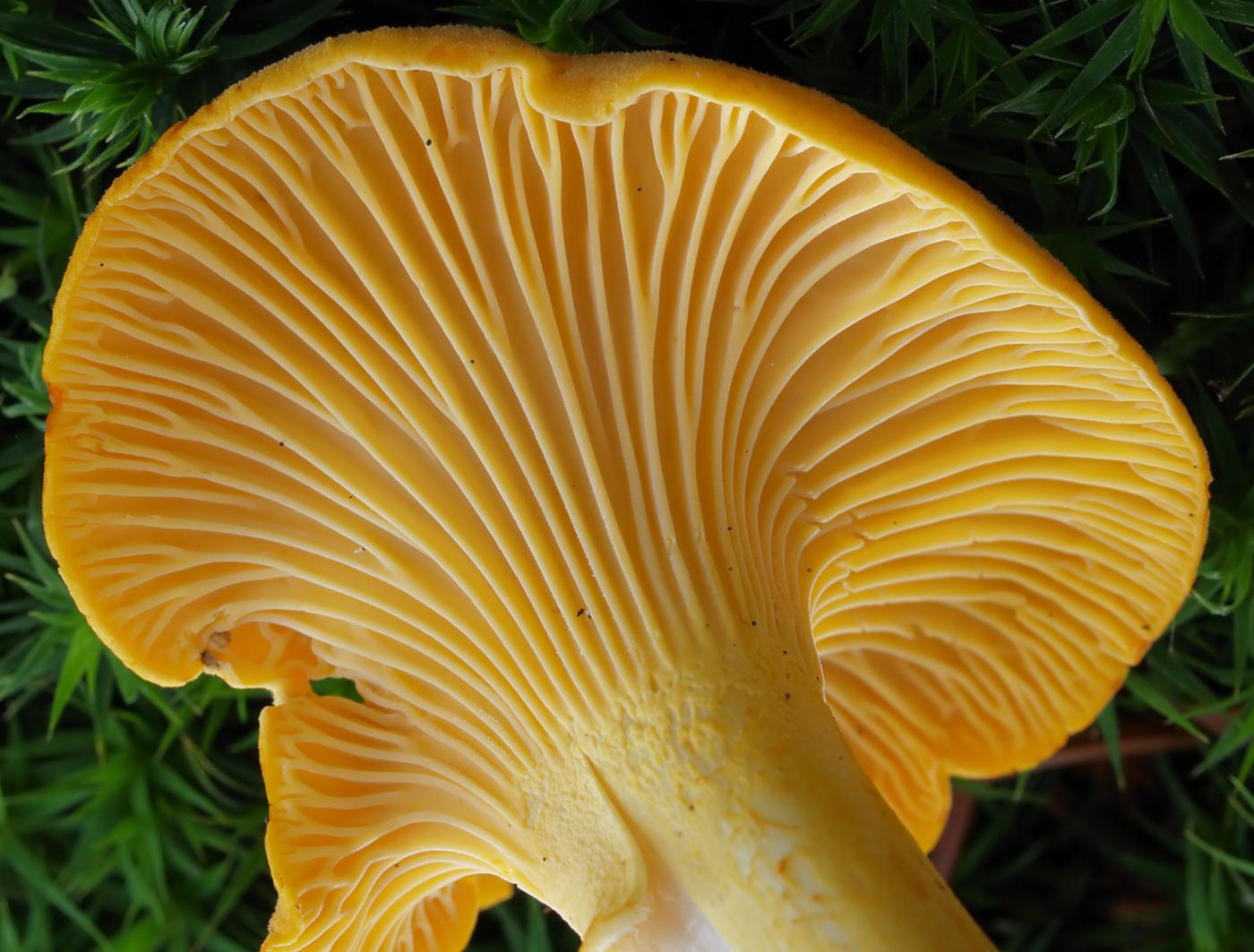
    Pfifferlinge sind gelb bis goldgelb und besitzen unter dem Hut keine dünnen echten Lamellen. Stattdessen verlaufen dicke, stumpfe und häufig gegabelte Leisten am Stiel hinunter.

    Das Fleisch ist relativ fest und innen meist heller als die Oberfläche. Viele Pfifferlinge besitzen einen angenehm fruchtigen Geruch.

    Wo wachsen Pfifferlinge?

    Sie können sowohl in Laub- als auch in Nadelwäldern vorkommen. Buche, Eiche, Fichte und andere Bäume können je nach Art und Region wichtige Partner sein.

    Pfifferlinge wachsen typischerweise auf dem Boden und nicht direkt aus Totholz. Häufig findet man sie verstreut oder in lockeren Gruppen.

    8. Hydnum repandum Gruppe – Semmelstoppelpilz

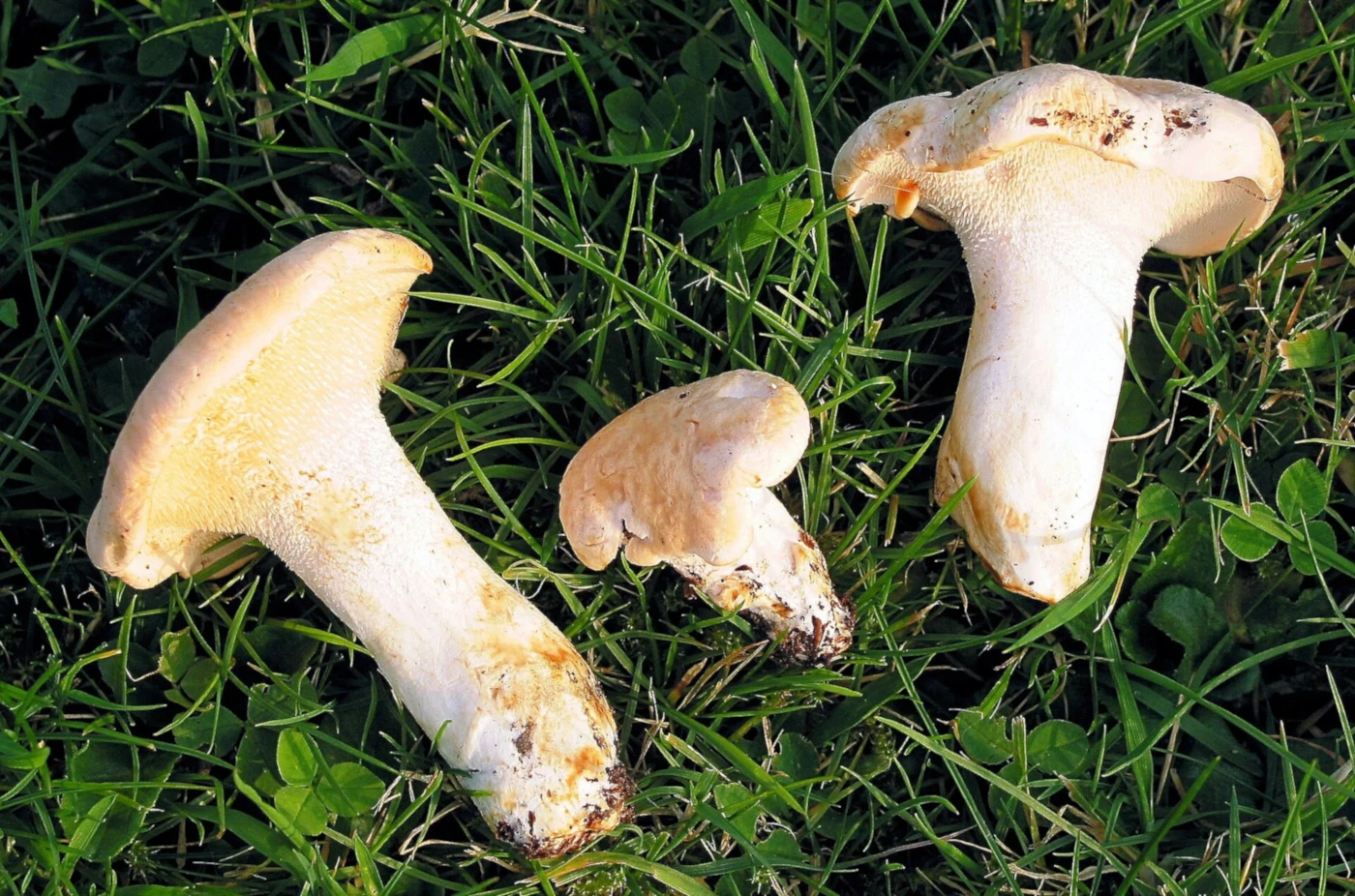
    Der Semmelstoppelpilz gehört zu den Pilzen, deren Unterseite besonders leicht zu erkennen ist. Statt Lamellen oder Röhren hängen zahlreiche weiche Stacheln unter dem Hut.

    Die Hüte sind cremefarben, gelblich oder hell apricotfarben. Ältere Fruchtkörper können unregelmäßig und stark gewellt werden.

    Wo wächst der Semmelstoppelpilz?

    Er wächst in Laub-, Misch- und Nadelwäldern. Verschiedene Hydnum-Arten können mit unterschiedlichen Bäumen verbunden sein.

    Die moderne Taxonomie unterscheidet mehrere sehr ähnliche Arten. Für die praktische Feldbestimmung ist daher manchmal eine Bestimmung als Hydnum-Gruppe genauer.

    9. Craterellus cornucopioides – Totentrompete

    Die Totentrompete sieht völlig anders aus als ein klassischer Hutpilz. Sie bildet graue bis fast schwarze, dünnwandige trichterförmige Fruchtkörper.

    Echte Lamellen fehlen. Die Außenseite ist relativ glatt oder nur schwach gefaltet.

    Wo wächst die Totentrompete?

    Sie kommt besonders in Laubwäldern vor und ist häufig mit Buche oder Eiche verbunden. Ihre dunkle Farbe macht sie im Herbstlaub überraschend schwer zu entdecken.

    Hat man jedoch einen Fruchtkörper gefunden, lohnt sich ein genauer Blick in die Umgebung. Häufig wachsen zahlreiche weitere Exemplare in der Nähe.

    10. Lactarius deliciosus – Edel-Reizker

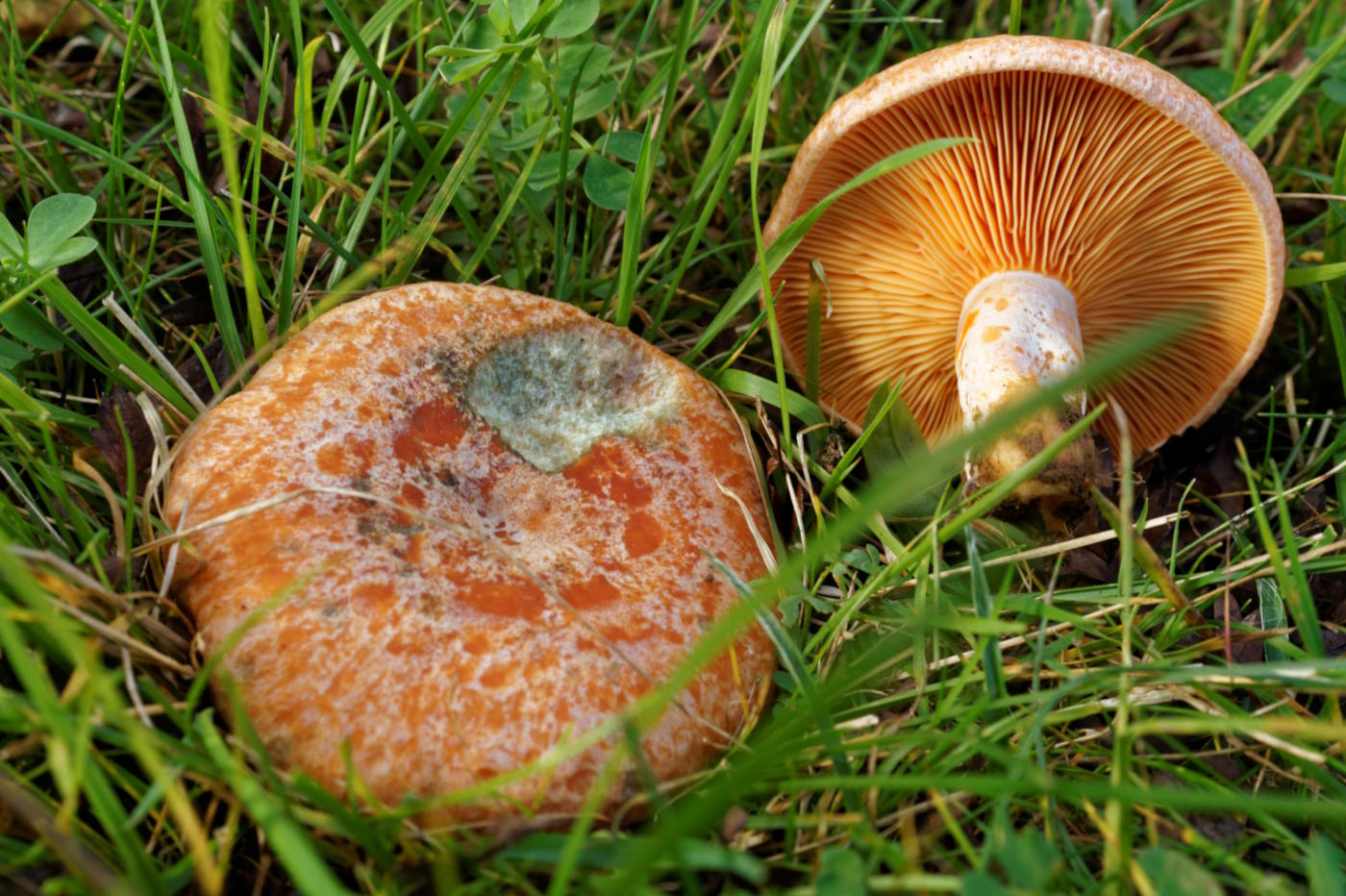
    Der Edel-Reizker besitzt einen orangefarbenen Hut mit deutlich sichtbaren konzentrischen Zonen. Die Lamellen sind ebenfalls orange.

    Wird der Pilz verletzt, tritt orangefarbene Milch aus. Druckstellen und ältere Bereiche können später grünlich anlaufen.

    Wo wächst der Edel-Reizker?

    Die Art ist eng mit Kiefern verbunden. Kiefernwälder und Kiefernplantagen gehören deshalb zu den besten Fundorten.

    Ähnliche orangefarbene Reizker kommen bei Fichte oder Tanne vor. Der Begleitbaum ist deshalb ein wichtiges Merkmal.

    11. Russula cyanoxantha – Frauen-Täubling

    Der Frauen-Täubling besitzt einen sehr variablen Hut. Violette, grüne, graue und bläuliche Farbtöne können sich auf einem einzigen Fruchtkörper mischen.

    Wie bei anderen Täublingen ist das Fleisch spröde. Die Lamellen sind jedoch ungewöhnlich elastisch und brechen deutlich weniger leicht als bei vielen anderen Russula-Arten.

    Wo wächst der Frauen-Täubling?

    Er kommt besonders in Laub- und Mischwäldern vor. Eichen und Buchen gehören zu den häufigen Begleitbäumen.

    Die Art erscheint vor allem vom Sommer bis in den Herbst. Exakte Täublingsbestimmung erfordert trotzdem mehr als nur die Hutfarbe.

    12. Macrolepiota procera – Parasol

    Der Parasol kann zu einem der größten klassischen Hutpilze im Wald werden. Sein breiter Hut trägt braune Schuppen, während der lange Stiel eine charakteristische schlangenartige Zeichnung zeigt.

    Ein weiteres wichtiges Merkmal ist der große Ring, der sich bei typischen Exemplaren am Stiel verschieben lässt. Der Stiel ist deutlich länger und schlanker als bei vielen kleineren Schirmlingen.

    Wo wächst der Parasol?

    Waldränder, lichte Wälder, Wiesen und grasige Wege gehören zu den typischen Standorten. Er wächst nicht ausschließlich in dichtem Wald.

    Kleine Schirmlinge sollten keinesfalls allein aufgrund der Ähnlichkeit mit Parasolen gesammelt werden. Unter ihnen befinden sich giftige Arten.

    13. Coprinus comatus – Schopftintling

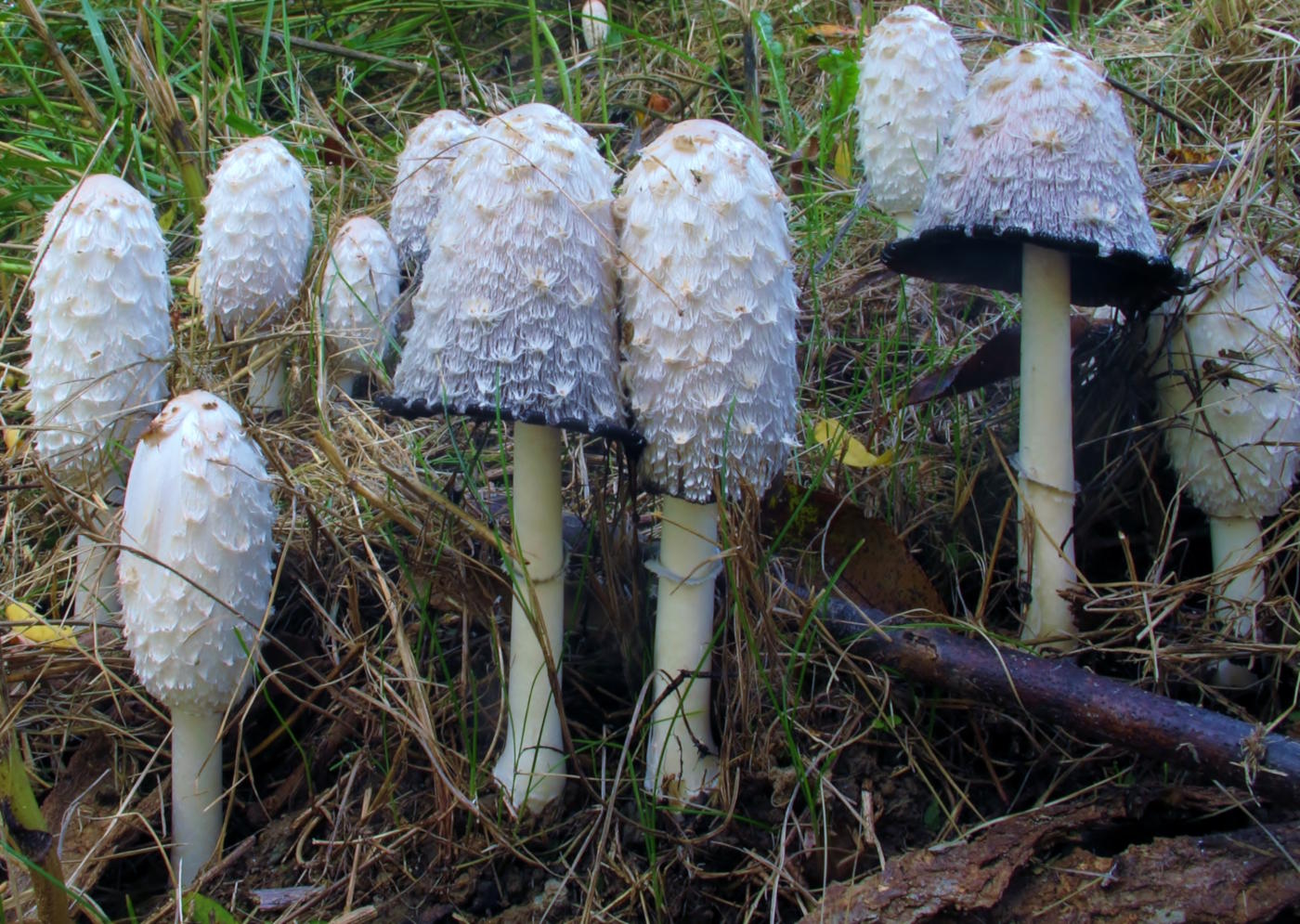
    Der Schopftintling besitzt zunächst einen länglichen weißen Hut mit zottigen Schuppen. Mit zunehmendem Alter öffnen sich die Hüte und die Lamellen wechseln von weiß über rosa zu schwarz.

    Schließlich beginnt der Fruchtkörper sich in eine schwarze tintenartige Flüssigkeit aufzulösen. Dieses Zerfließen ist sehr charakteristisch.

    Wo wächst der Schopftintling?

    Er wächst häufig auf Wiesen, an Wegen, in Parks und auf nährstoffreichen gestörten Böden. Große Gruppen sind keine Seltenheit.

    Junge Fruchtkörper sind die wichtigste Phase für eine sichere Erkennung. Sobald die Lamellen stark schwarz werden, verändert sich das Aussehen erheblich.

    14. Agaricus campestris – Wiesenchampignon

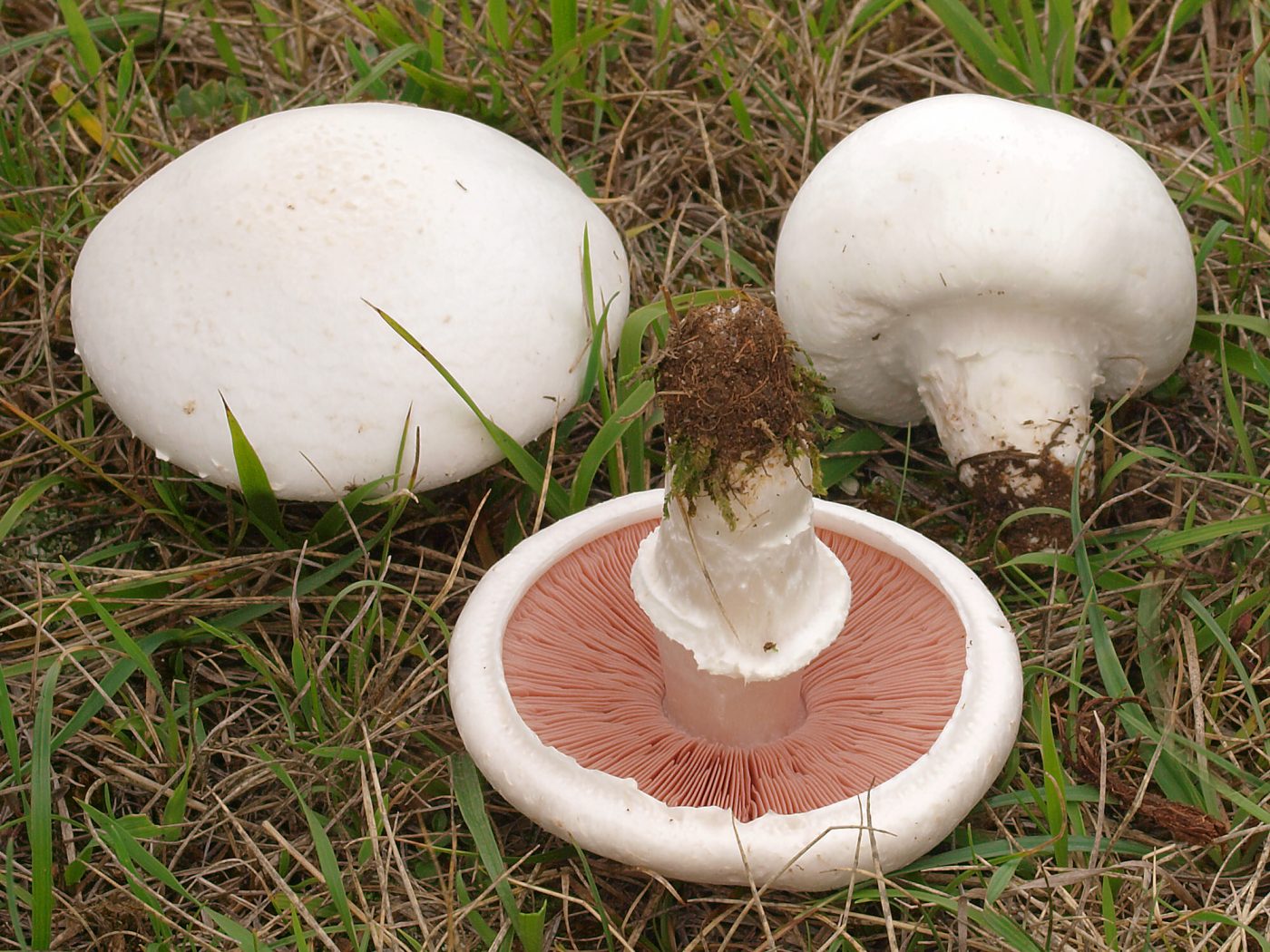
    Der Wiesenchampignon besitzt einen weißen bis cremefarbenen Hut und freie Lamellen. Diese sind jung rosa und werden mit zunehmender Sporenreife dunkel schokoladenbraun.

    Am Stiel befindet sich ein Ring, aber keine sackartige Volva. Die Farbentwicklung der Lamellen ist ein wichtiges Merkmal der Gattung Agaricus.

    Wo wächst der Wiesenchampignon?

    Die Art wächst vor allem auf Wiesen und Weiden. Sie ist kein typischer Waldpilz.

    Weiße Champignon-ähnliche Pilze müssen besonders sorgfältig bestimmt werden. Giftige Champignon-Arten und weiße Amanitas dürfen nicht verwechselt werden.

    15. Pleurotus ostreatus – Austernseitling

    Der Austernseitling bildet graue, beige oder graubraune fächerförmige Hüte. Die Lamellen laufen deutlich am kurzen seitlichen Stiel hinunter.

    Die Fruchtkörper wachsen meist in überlappenden Büscheln direkt aus Holz. Junge Pilze besitzen dickes, weißes Fleisch.

    Wo wächst der Austernseitling?

    Er wächst hauptsächlich an Laubholz, sowohl an toten Stämmen als auch an geschwächten Bäumen. Buche, Pappel und Weide können typische Wirte sein.

    Kühles Wetter begünstigt häufig die Fruchtbildung. Deshalb findet man Austernseitlinge oft noch spät im Jahr.

    16. Flammulina velutipes Gruppe – Samtfußrübling

    Der Samtfußrübling besitzt gelbe bis honig-orange Hüte und helle Lamellen. Besonders charakteristisch ist der dunkelbraune bis fast schwarze samtige untere Stiel.

    Die Art wächst in Büscheln auf Laubholz. Ein dauerhafter Ring fehlt.

    Wo wächst der Samtfußrübling?

    Stümpfe, abgestorbene Stämme und tote Äste gehören zu den typischen Substraten. Die Fruchtkörper können selbst während milder Winterperioden erscheinen.

    Eine Verwechslung mit dem tödlich giftigen Gifthäubling muss unbedingt ausgeschlossen werden. Der Gifthäubling besitzt rostbraune Sporen, während der Samtfußrübling weißes Sporenpulver hat.

    17. Sparassis crispa – Krause Glucke

    Die Krause Glucke bildet eine große cremefarbene bis gelbliche Masse aus zahlreichen gewellten, blattartigen Ästen. Ihre Form erinnert an einen großen Blumenkohl oder Schwamm.

    Die Struktur ist so ungewöhnlich, dass sie nur wenig an klassische Hutpilze erinnert. Ältere Exemplare können jedoch deutlich dunkler und schmutziger wirken.

    Wo wächst die Krause Glucke?

    Sie erscheint häufig am Fuß von Kiefern oder über deren Wurzeln. Auch an alten Baumstümpfen kann sie auftreten.

    Die Fruchtkörper können sehr groß werden. Beim Sammeln sollte besonders auf Schmutz und kleine Tiere zwischen den vielen Falten geachtet werden.

    18. Fistulina hepatica – Leberreischling

    Der Leberreischling besitzt einen dunkelroten bis rotbraunen, fleischigen Fruchtkörper. Seine Oberfläche und das Innere erinnern optisch tatsächlich etwas an rohes Fleisch oder Leber.

    Die Unterseite besteht aus feinen Röhren. Beim Anschneiden kann rötliche Flüssigkeit austreten.

    Wo wächst der Leberreischling?

    Die Art ist besonders mit alten Eichen verbunden. Sie wächst direkt am Stamm, an Stümpfen oder an geschädigten Bereichen des Holzes.

    Ihre ungewöhnliche Farbe und Konsistenz machen sie relativ auffällig. Ältere Fruchtkörper werden allerdings zäher.

    19. Morchella esculenta Gruppe – Speisemorchel

    Speisemorcheln besitzen einen charakteristischen wabenartigen Hut. Die Vertiefungen und Rippen ergeben ein Muster, das sich deutlich von normalen Lamellenpilzen unterscheidet.

    Der Fruchtkörper ist innen hohl. Dieses Merkmal ist bei der Abgrenzung von manchen problematischen Morchel-Doppelgängern wichtig.

    Wo wachsen Speisemorcheln?

    Morcheln sind typische Frühlingspilze. Je nach Art und Region können sie in Auwäldern, Gärten, Parks, an Waldrändern oder auf gestörten Böden vorkommen.

    Die Gattung ist taxonomisch komplex. Für die sichere Bestimmung sollte nicht allein die wabenartige Oberfläche verwendet werden.

    20. Calocybe gambosa – Maipilz

    Der Maipilz ist ein heller, kräftiger Lamellenpilz, der ungewöhnlich früh im Jahr erscheint. Der Hut ist weißlich bis cremefarben, während die Lamellen eng stehen und zunächst sehr hell bleiben.

    Viele Menschen beschreiben seinen Geruch als stark mehlig. Dieses Merkmal kann die Bestimmung unterstützen, ist aber subjektiv.

    Wo wächst der Maipilz?

    Wiesen, Waldränder, Gebüsche und lichte Bereiche gehören zu seinen typischen Lebensräumen. Oft wächst er in Bögen oder Gruppen.

    Die Hauptsaison liegt im Frühjahr. Durch seine frühe Erscheinungszeit hebt er sich von vielen klassischen Herbstpilzen ab.

    Welche essbaren Pilze findet man im Oktober?

    Der Oktober gehört in vielen Regionen Deutschlands zu den ergiebigsten Pilzmonaten. Steinpilze, Maronen-Röhrlinge, Pfifferlinge, Semmelstoppelpilze, Reizker und zahlreiche weitere Arten können dann gleichzeitig vorkommen.

    Welche Arten besonders typisch sind und welche Lebensräume sich im Herbst lohnen, findest du ausführlicher in Pilze im Oktober in Deutschland: Diese Arten haben jetzt Saison.

    Das tatsächliche Angebot hängt stark von Niederschlag, Temperatur, Höhenlage und Region ab. Ein trockener Oktober kann deutlich pilzärmer sein als ein feuchter September.

    Essbare und giftige Pilze können nebeneinander wachsen

    Ein Waldstück mit Steinpilzen oder Pfifferlingen ist nicht automatisch ein „sicherer“ Sammelplatz. Unter denselben Bäumen können gleichzeitig giftige Amanitas, Röhrlinge und andere problematische Arten wachsen.

    Besonders wichtig sind Arten wie Grüner Knollenblätterpilz, Pantherpilz und Gifthäubling. Eine Übersicht gefährlicher Arten findest du in Giftige Pilze in Deutschland: 15 Arten, die du kennen solltest.

    Die Entscheidung über die Essbarkeit muss deshalb immer für jeden einzelnen Pilz getroffen werden. Selbst Pilze, die direkt nebeneinander wachsen, können unterschiedlichen Arten angehören.

    Welche Merkmale sind bei Speisepilzen besonders wichtig?

    Beginne nicht mit der Frage, ob ein Pilz „essbar aussieht“. Bestimme zunächst, zu welcher strukturellen Gruppe er gehört.

    Röhren, echte Lamellen, Leisten, Stacheln und Milch führen zu völlig unterschiedlichen Pilzgruppen. Danach werden Stiel, Stielbasis, Verfärbungen, Begleitbäume, Geruch und Sporenfarbe geprüft.

    Die Unterseite zuerst ansehen

    Ein Steinpilz hat Röhren, ein Pfifferling Leisten und ein Semmelstoppelpilz Stacheln. Schon diese drei Merkmale trennen zahlreiche Arten voneinander.

    Die Unterseite ist deshalb häufig informativer als die Hutfarbe. Ein brauner Hut allein kann zu Dutzenden völlig verschiedenen Arten gehören.

    Den gesamten Stiel prüfen

    Ring, Netzzeichnung, Schuppen und Stielbasis können entscheidend sein. Bei Amanitas darf die Basis niemals einfach im Boden abgeschnitten werden.

    Auch bei Röhrlingen ist der Stiel wichtig. Helles oder dunkles Netz, rote Punkte oder kleine Drüsenpunkte helfen bei der Abgrenzung ähnlicher Arten.

    Wie fotografiert man einen Speisepilz zur Bestimmung?

    Fotografiere zunächst den kompletten Pilz an seinem Fundort. Die Umgebung sollte erkennen lassen, ob er auf Erde, Holz, Gras oder unmittelbar neben bestimmten Bäumen wächst.

    Anschließend sollte die Unterseite deutlich zu sehen sein. Ein weiteres Foto des vollständigen Stiels einschließlich Basis kann entscheidende Merkmale dokumentieren.

    Bei Röhrlingen können zusätzlich Druckstellen und ein Längsschnitt hilfreich sein. Bei Milchlingen sollte eine verletzte Lamelle fotografiert werden, damit die Farbe der austretenden Milch sichtbar bleibt.

    Kann KI essbare Pilze erkennen?

    Eine Bilderkennung kann mögliche Arten vorschlagen und dabei Farbe, Form, Unterseite und andere sichtbare Merkmale vergleichen. Besonders charakteristische Pilze lassen sich auf guten Fotos häufig recht gut einer Art oder Artengruppe zuordnen.

    Die Schwierigkeit beginnt bei ähnlichen Arten und Merkmalen, die auf dem Foto fehlen. Stielbasis, Geruch, Sporenpulver, Begleitbaum oder eine zeitabhängige Verfärbung können für eine sichere Trennung notwendig sein.

    KI sollte deshalb ein Werkzeug zur Bestimmung sein und keine alleinige Freigabe zum Verzehr. Die endgültige Entscheidung über die Essbarkeit benötigt eine unabhängige zuverlässige Bestätigung.

    Häufige Fehler beim Sammeln essbarer Pilze

    Ein häufiger Fehler ist die Annahme, dass ein bekannt aussehender Hut bereits für die Bestimmung genügt. Gerade junge Amanitas oder braune Röhrlinge können oberflächlich bekannten Speisepilzen ähneln.

    Ein weiterer Fehler ist, alle Pilze einer Gruppe im Korb für dieselbe Art zu halten. Selbst an einem einzigen Baum oder Stumpf können verschiedene Pilzarten unmittelbar nebeneinander wachsen.

    Auch alte oder stark beschädigte Exemplare sind schwieriger zu bestimmen. Für die Identifikation sind möglichst frische Pilze mit vollständigem Stiel und intakter Unterseite wesentlich hilfreicher.

    Häufig gestellte Fragen

    Warum finde ich an einem bekannten Steinpilzplatz plötzlich keine Pilze mehr?

    Das unterirdische Myzel kann weiterhin vorhanden sein, obwohl keine Fruchtkörper erscheinen. Niederschlag, Bodentemperatur und andere Wetterbedingungen bestimmen stark, ob in einem bestimmten Jahr Pilze sichtbar werden.

    Sind junge Pilze immer einfacher zu bestimmen?

    Nein. Junge Exemplare können wichtige Merkmale noch nicht vollständig entwickelt haben, etwa die endgültige Poren- oder Lamellenfarbe. Am besten lassen sich häufig mehrere Altersstufen gemeinsam vergleichen.

    Kann ein essbarer Pilz durch Frost ungenießbar werden?

    Frost und anschließendes Auftauen können das Gewebe stark beschädigen und den Verderb beschleunigen. Ein sicher bestimmter Pilz sollte deshalb zusätzlich frisch und in gutem Zustand sein.

    Sind Pilze aus Stadtparks genauso bestimmbar wie Waldpilze?

    Ja, die morphologischen Merkmale bleiben dieselben. In Parks können jedoch viele eingeführte Baumarten wachsen, weshalb die Bestimmung des möglichen Mykorrhizapartners schwieriger sein kann.

    Warum sind manche Speisepilze in einer Region häufig und in einer anderen selten?

    Baumarten, Bodenchemie, Höhenlage und Klima unterscheiden sich regional. Deshalb kann dieselbe Pilzart innerhalb Deutschlands sehr unterschiedlich verteilt sein.

    Kann ein Speisepilz in einer giftigen Pilzgruppe wachsen?

    Ja. Ökologisch geeignete Standorte können viele Arten gleichzeitig beherbergen. Die Anwesenheit eines bekannten Speisepilzes sagt nichts über die Sicherheit der Nachbarpilze aus.

    Warum sieht derselbe Pilz nach Regen völlig anders aus?

    Feuchtigkeit kann Hüte dunkler, glänzender oder schleimiger machen. Beim Trocknen können Farben verblassen und Oberflächen wieder matt werden.

    Sollte man sehr alte Speisepilze sammeln?

    Alte Exemplare sind häufig weich, von Insekten befallen oder bereits mikrobiell zersetzt. Auch bei sicherer Artbestimmung sind junge und frische Fruchtkörper normalerweise die bessere Wahl.

    Abschließende Hinweise zur Bestimmung

    Zu den bekanntesten essbaren Pilzen Deutschlands gehören Steinpilz, Maronen-Röhrling, Pfifferling, Semmelstoppelpilz, Edel-Reizker, Parasol, Austernseitling, Krause Glucke und Speisemorchel. Sie unterscheiden sich jedoch stark in Bau, Lebensraum und möglichen Doppelgängern.

    Die wichtigste Regel lautet deshalb: Erst die Art bestimmen, danach über Essbarkeit nachdenken. Eine Hutfarbe oder ein bekannter Fundort reicht niemals aus.

    Wer die grundlegenden Merkmale systematisch prüfen möchte, kann mit unserem ausführlichen Leitfaden Pilze bestimmen: So erkennst du Pilzarten richtig beginnen. Bei essbaren Arten ist eine zusätzliche unabhängige Bestätigung vor dem Verzehr trotzdem unverzichtbar.

  • Porcini vs Bitter Bolete: How to Tell Them Apart

    Porcini vs Bitter Bolete: How to Tell Them Apart

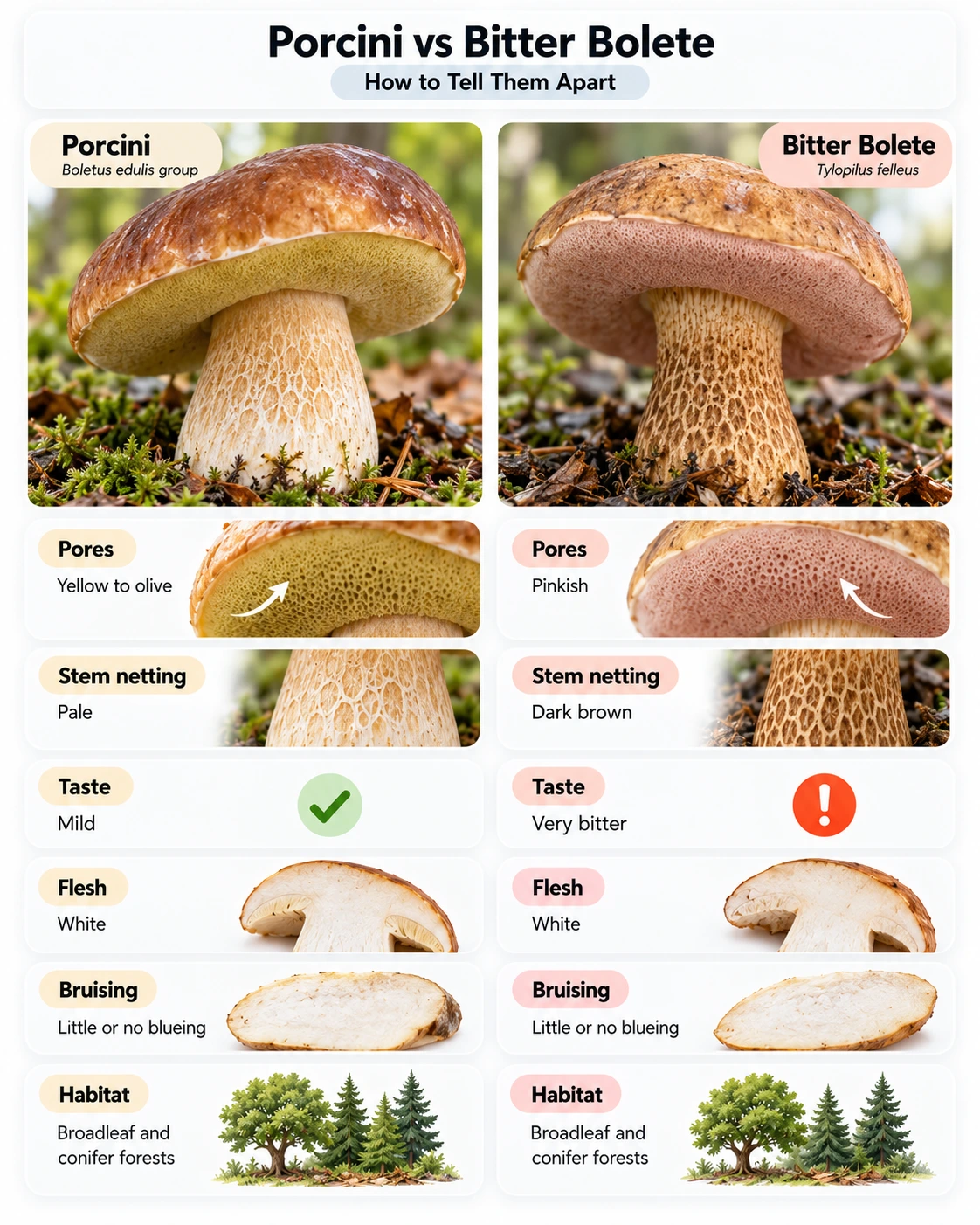
    Porcini and Bitter Bolete can look surprisingly similar at first glance. Both can have brown caps, thick stems, pale pore surfaces when young, and a classic bolete shape that makes them easy to confuse from above.

    The key differences are found underneath the cap and on the stem. Porcini develops yellow to olive pores and usually has pale reticulation, while Bitter Bolete develops pinkish pores and often has a darker brown network on the stem.

    ⚠️ Important: This guide is for identification and education only. Never eat a wild mushroom based solely on photographs, AI identification, or an online comparison.

    Quick Comparison

    Feature Porcini Bitter Bolete
    Typical species Boletus edulis group Tylopilus felleus
    Cap Brown to chestnut Brown to gray-brown
    Young pores White to cream White to pale
    Mature pores Yellow to olive Pink to pinkish-brown
    Stem reticulation Pale or whitish Dark brown
    Flesh White White
    Blue bruising Usually absent Usually absent
    Taste Mild Extremely bitter
    Spore print Olive-brown Pinkish-brown
    Habitat Broadleaf and conifer forests Broadleaf and conifer forests
    Edibility Edible when correctly identified Inedible due to extreme bitterness

    What Is Porcini?

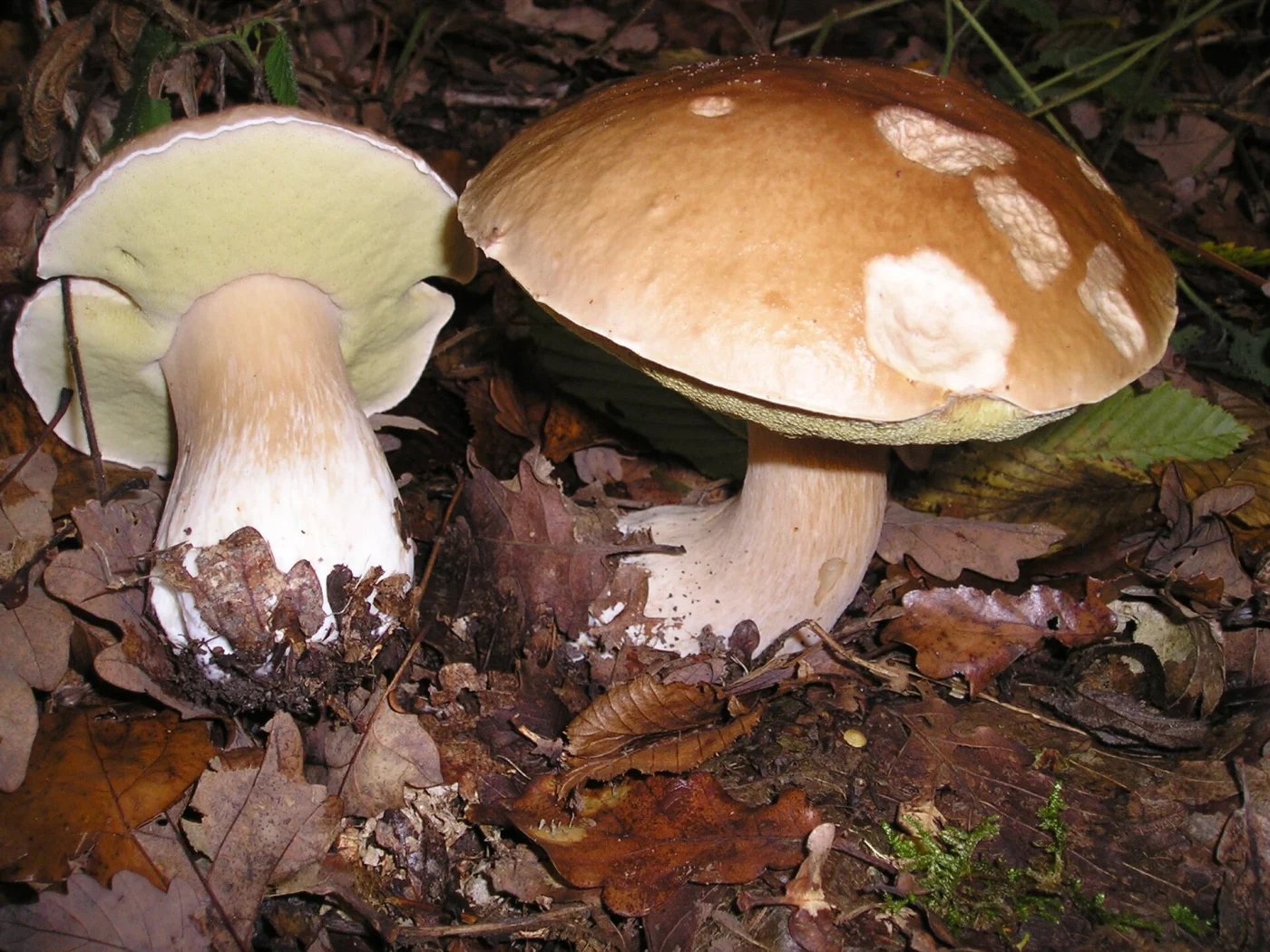
    Porcini usually refers to Boletus edulis and closely related king boletes. These mushrooms are robust, fleshy, and famous for their firm white flesh and excellent culinary reputation.

    The cap is usually brown to chestnut, while the stem is thick and pale with a fine net-like pattern. The underside has pores rather than gills.

    Porcini Pores

    Young Porcini has white pores. As the mushroom matures, the pore surface becomes yellow and later olive-green.

    This color progression is one of the most useful features. Pink pores are not typical of true Porcini.

    Porcini Stem

    The stem is thick, often bulbous when young, and usually shows pale reticulation. The net-like pattern is often easiest to see near the top of the stem.

    In some specimens the network extends farther down. It usually remains lighter than the stem background.

    What Is Bitter Bolete?

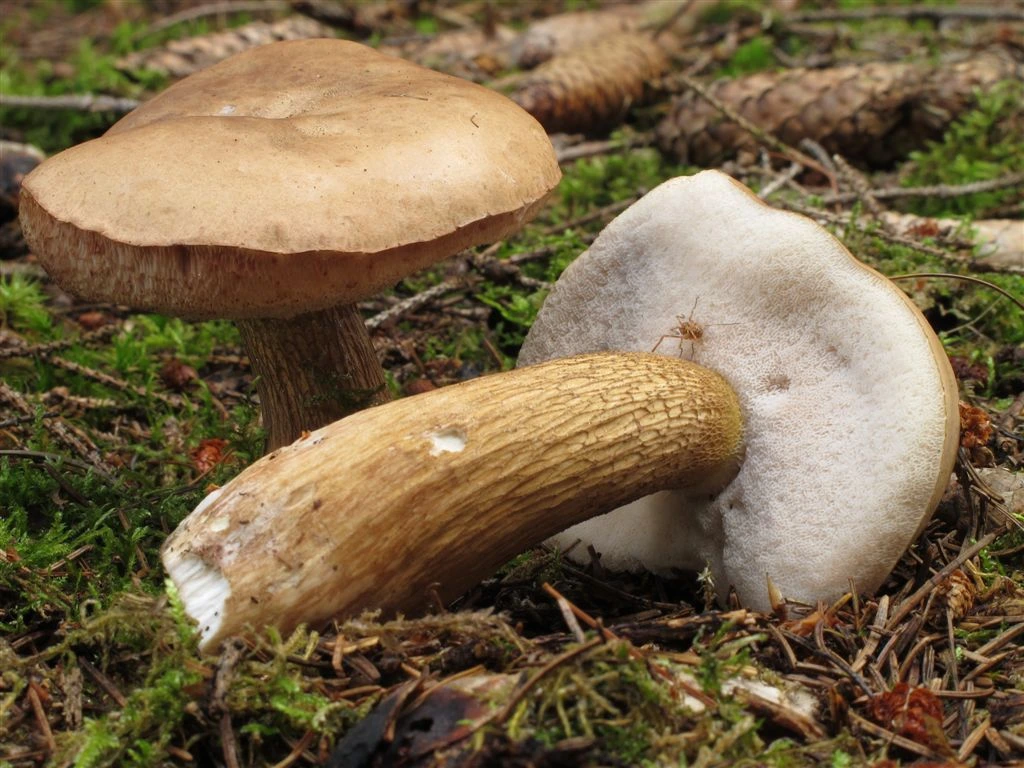
    Tylopilus felleus, commonly known as the Bitter Bolete, is a brown-capped bolete that can closely resemble Porcini. It has white flesh, a thick stem, and pale pores when young.

    The problem becomes clearer as the mushroom matures. The pores develop a pinkish tint, while the stem network often becomes dark and strongly contrasting.

    Bitter Bolete Pores

    Young pore surfaces can look almost white, which creates the strongest confusion with Porcini. As spores mature, the pores become distinctly pink or flesh-colored.

    This pinking is one of the best field clues. Mature Porcini pores should move toward yellow and olive instead.

    Bitter Bolete Stem

    The stem often shows a dark brown reticulation. This pattern may look bold and coarse compared with the pale network of a king bolete.

    The dark net can extend over much of the stem. In many specimens, it is visible even from a distance.

    Porcini vs Bitter Bolete: The Pore Color

    The pore surface is the fastest and most reliable first comparison. Young mushrooms can be difficult because both species may begin with pale pores.

    The difference becomes clearer with age. Porcini turns yellow to olive, while Bitter Bolete turns pinkish.

    Young Specimens

    Young Bitter Boletes may still have pale pores and can look very convincing. This is why identification from a single immature mushroom can be risky.

    If possible, compare several fruit bodies at different ages. Mature specimens often reveal the answer immediately.

    Porcini vs Bitter Bolete: The Stem Pattern

    Both mushrooms can have reticulation, but the color and character of the netting differ.

    Porcini usually has pale cream or whitish reticulation, especially on the upper stem. Bitter Bolete usually has dark brown reticulation that contrasts strongly with the stem.

    Pale Netting

    A pale network on a thick light-colored stem supports a king bolete identification. This is particularly useful when the pores are still young and white.

    It should still be combined with pore development and habitat. One feature alone is never enough.

    Dark Netting

    A dark brown network strongly suggests Tylopilus felleus. The pattern can look almost embossed on the stem.

    If dark reticulation and pinkish mature pores occur together, Bitter Bolete becomes very likely.

    Cap Differences

    Porcini usually has a warm brown to chestnut cap. Depending on weather and species within the king bolete group, it can be pale brown, dark brown, or even reddish-brown.

    Bitter Bolete often has a duller brown to gray-brown cap. Exact cap color overlaps too much to be used as the main distinction.

    Cap Texture

    Porcini caps may be smooth and slightly tacky when wet. Bitter Bolete caps can also be smooth or dry.

    This feature is much less useful than pore color or stem reticulation. Cap-only photographs are therefore especially weak for this comparison.

    Flesh

    Both mushrooms have pale or white flesh. Neither normally shows strong blue bruising after cutting.

    This similarity is one reason the two can be confusing. The absence of blueing does not separate them effectively.

    Why Cutting Still Helps

    A vertical cut can reveal insect damage, stem structure, and whether the flesh stays white. It also confirms that you are not dealing with a strongly blue-staining bolete.

    The cut surface is supporting evidence rather than the main distinction.

    Spore Print

    Porcini produces an olive-brown spore print. Bitter Bolete produces a pinkish-brown spore print.

    In practice, mature pore color often reveals the same distinction before a full spore print is needed. The print can still be useful when the specimen is ambiguous.

    Habitat

    Both species can grow in broadleaf and coniferous forests. They may appear under oak, beech, pine, spruce, and other compatible trees.

    Habitat therefore does not separate them reliably. It helps confirm that both are mycorrhizal woodland boletes, but morphology matters more.

    Can They Grow in the Same Forest?

    Yes. Porcini and Bitter Bolete can occur in similar habitats and even in the same woodland.

    This makes assumptions based on location especially risky. Each mushroom should be checked individually.

    Season

    Both species commonly fruit from summer through autumn. Exact timing depends on region, rainfall, and temperature.

    Season overlap is substantial. It is not a useful primary separator.

    Is Bitter Bolete Poisonous?

    Bitter Bolete is not usually considered dangerously poisonous, but it is regarded as inedible because of its extreme bitterness. Even a small amount can ruin an entire dish.

    The bitter compounds can remain strong after cooking. This is why correct identification matters even when the confusion is not medically dangerous.

    Why Bitter Bolete Is So Often Mistaken for Porcini

    The overall silhouette is extremely similar. Both can have a thick stem, brown cap, pale young pores, and white flesh.

    The mistake usually happens when people identify from above. Once the underside and stem network are examined carefully, the differences become much clearer.

    Porcini vs Bitter Bolete Step by Step

    Start with the pore surface. If the mushroom is mature, decide whether the pores are yellow-olive or pinkish.

    Then inspect the stem reticulation. Pale netting supports Porcini, while dark brown netting strongly favors Bitter Bolete.

    Step 1: Check Mature Pore Color

    Look at the underside in natural light. Yellow or olive tones favor Porcini.

    Pink or flesh-colored pores favor Bitter Bolete. This is the single most useful field difference.

    Step 2: Examine the Stem Network

    Look for the color of the reticulation. Pale cream netting supports a king bolete.

    Dark brown netting strongly suggests Tylopilus felleus. The more contrasting the network, the stronger the clue.

    Step 3: Check for Blue Bruising

    Neither species should show dramatic rapid blueing. If the mushroom turns strongly blue, another bolete group becomes more likely.

    This step is mainly useful for excluding alternatives rather than separating Porcini from Bitter Bolete.

    Step 4: Consider the Whole Mushroom

    Check cap color, stem proportions, pore age, habitat, and season together. Identification becomes strongest when all features agree.

    Do not force a species name from one ambiguous young specimen. Mixed-age groups are much easier to evaluate.

    Porcini vs Bitter Bolete in Young Mushrooms

    Young specimens are the hardest to separate because the pores of both can be white or cream. The pink tones of Bitter Bolete may not have developed yet.

    In these cases, stem reticulation becomes especially valuable. Dark network lines are an early warning sign.

    Why Young Mushrooms Cause Mistakes

    People often harvest king boletes when they are young because they are firm and less damaged by insects. Unfortunately, this is also when look-alikes can be least distinctive.

    A careful stem inspection is therefore essential. Mature nearby specimens can provide context.

    Porcini vs Bitter Bolete in Older Mushrooms

    Older mushrooms are usually easier. Porcini pores become olive, while Bitter Bolete pores become pinkish.

    The stem network also tends to become more obvious with age. This makes mature fruit bodies excellent comparison specimens.

    Old mushrooms may still be too damaged for culinary use. They can nevertheless be very useful for identification.

    Other Porcini Look-Alikes

    Bitter Bolete is one of the most common confusing species, but it is not the only one. Other king boletes and several brown-capped boletes can resemble Porcini.

    The broader identification should always check pore color, bruising, stem pattern, and host trees. Red pores or strong blue bruising point away from the classic Porcini group.

    Boletus pinophilus — Pine Bolete

    Pine Bolete is a true king bolete and closely related to Boletus edulis. It usually has a darker reddish-brown cap and strong conifer association.

    Its pores mature toward olive, not pink. The stem reticulation is pale.

    Boletus reticulatus — Summer Cep

    Summer Cep often has a paler, drier cap and more extensive pale reticulation. It is especially associated with oak and beech.

    Like Porcini, the pores mature from white to yellow or olive. Pink mature pores would point away from this group.

    Imleria badia — Bay Bolete

    Bay Bolete has a chestnut-brown cap and yellow pores that often bruise blue. The stem lacks the classic thick pale reticulation of Porcini.

    The blue reaction is especially useful. Porcini generally remains white when cut.

    How to Photograph Porcini and Bitter Bolete for Identification

    Take a full side image showing the cap and complete stem. The reticulation should be sharp enough to judge its color.

    Then photograph the pore surface in natural light. Avoid warm indoor lighting because it can make yellow pores look pinkish or brown.

    A cut section can document flesh color and bruising. If multiple ages are present, photograph young and mature specimens together.

    Can AI Tell Porcini From Bitter Bolete?

    AI can often separate mature specimens when the pore surface and stem are clearly visible. Pink pores plus dark reticulation are strong visual signals for Bitter Bolete.

    Young mushrooms are harder because pore color may still overlap. Cap-only images can easily produce a false Porcini identification.

    For better results, include the underside, close-up of the stem network, complete fruit body, and habitat. Multiple specimens of different ages are particularly useful.

    Common Identification Mistakes

    One common mistake is identifying every thick brown bolete as Porcini. The overall shape is not specific enough.

    Another mistake is checking only young pores. Bitter Bolete may still look pale underneath before the pink color develops.

    A third mistake is ignoring stem reticulation. The contrast between pale and dark netting is one of the best clues available.

    Frequently Asked Questions

    Can Bitter Bolete pores look almost white after heavy rain?

    Yes. Moisture, age, and lighting can make the pink tint less obvious. Look at several areas of the pore surface and compare with mature specimens if available.

    Can dirt make Porcini reticulation look dark?

    Yes. Soil and handling can stain a pale stem network. A gently cleaned section can help reveal the original color.

    Why can Bitter Bolete look more robust than Porcini?

    Individual fruit bodies vary greatly in size and proportion. Overall bulk is not a reliable separator.

    Can insect damage change pore color?

    Yes. Damaged areas may darken or discolor. Fresh undamaged pores provide the best evidence.

    Can the same patch produce both species in one season?

    Yes. Similar host trees and soil conditions can support multiple mycorrhizal boletes in the same area.

    Why do old Porcini pores sometimes look brownish instead of olive?

    Age, drying, and spore deposits can darken the pore surface. Fresh inner areas may still show the underlying olive tone.

    Can Bitter Bolete grow under pine?

    Yes. It can occur with conifers as well as broadleaf trees, so pine habitat does not automatically indicate Porcini.

    Should cap color be trusted if the pores are hidden?

    No. Cap color overlaps too strongly between the two. If the underside cannot be examined, the identification should remain uncertain.

    Final Identification Notes

    Porcini and Bitter Bolete are best separated by mature pore color and stem reticulation. Porcini develops yellow-to-olive pores and usually has pale netting, while Bitter Bolete develops pinkish pores and often has dark brown reticulation.

    Both can have brown caps, white flesh, and little or no blue bruising. This is why cap shape and general appearance are not enough.

    The most useful rule is simple: olive pores + pale netting favor Porcini; pink pores + dark netting favor Bitter Bolete.

  • Mushrooms Growing Under Oak Trees: 15 Common Species

    Mushrooms Growing Under Oak Trees: 15 Common Species

    Oak trees support some of the richest mushroom communities in temperate forests. Their roots form partnerships with many mycorrhizal fungi, while fallen leaves, buried roots, dead branches, and old wood create habitat for decomposers.

    A mushroom growing under an oak is not automatically associated with that oak, however. In mixed woodland, nearby beech, birch, pine, or other trees may also influence the fungal community, so identification should combine habitat with cap, underside, stem, bruising, latex, spore color, and growth pattern.

    ⚠️ Important: This guide is for identification and education only. Never eat a wild mushroom based solely on habitat, photographs, AI identification, or an online comparison.

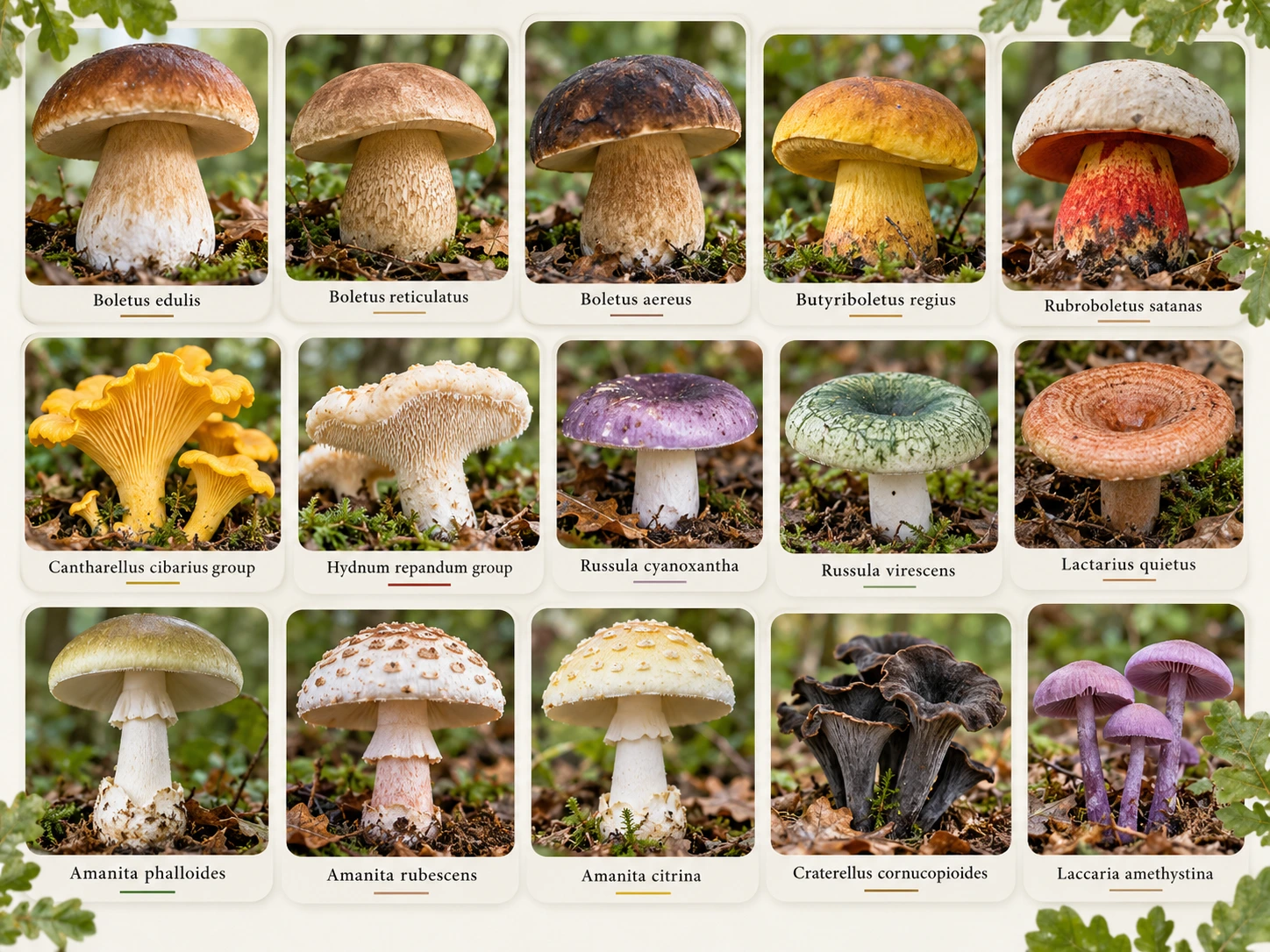
    Quick Guide to 15 Mushrooms Found Under Oak Trees

    Species Common name Main clue Safety
    Boletus edulis Porcini / Cep Brown cap, white-to-olive pores, pale reticulated stem Edible when correctly identified
    Boletus reticulatus Summer Cep Dry brown cap, strong stem reticulation Edible when correctly identified
    Boletus aereus Bronze Bolete Very dark cap, robust stem Edible when correctly identified
    Butyriboletus regius Royal Bolete Pink-red cap, yellow pores Edible when correctly identified
    Rubroboletus satanas Satan’s Bolete Pale cap, red pores, blue bruising Poisonous
    Cantharellus cibarius group Golden Chanterelles Yellow cap, false gills, fruity odor Edible when correctly identified
    Hydnum repandum group Wood Hedgehog Pale cap, teeth underneath Edible when correctly identified
    Russula cyanoxantha Charcoal Burner Variable purple-green cap, flexible gills Edible when correctly identified
    Russula virescens Green-Cracking Russula Green cracked cap Edible when correctly identified
    Lactarius quietus Oak Milkcap Brown zoned cap, white latex Inedible / low culinary value
    Amanita phalloides Death Cap Olive cap, white gills, ring, volva Deadly poisonous
    Amanita rubescens Blusher Brown cap, reddish bruising Edibility requires expert identification
    Amanita citrina False Death Cap Pale yellow cap, bulbous base Inedible / not recommended
    Craterellus cornucopioides Horn of Plenty Dark trumpet shape Edible when correctly identified
    Laccaria amethystina Amethyst Deceiver Purple cap and gills Edible when correctly identified, but not ideal for beginners

    Why Oak Trees Support So Many Mushrooms

    Oak roots form mycorrhizal relationships with many fungi. These fungi help the tree absorb water and nutrients, while the tree supplies them with sugars produced through photosynthesis.

    This relationship is especially important for boletes, Amanitas, Russulas, milkcaps, chanterelles, and Hedgehog Mushrooms. Oak woodland can therefore produce a very diverse mushroom community in a relatively small area.

    Oak Leaf Litter Creates a Stable Forest Floor

    Oak leaves decompose slowly and form a thick organic layer. This helps retain moisture and creates a stable habitat for fungi and other forest organisms.

    The soil beneath mature oaks can support both mycorrhizal species and decomposers. The exact mix depends on soil chemistry, moisture, climate, and surrounding trees.

    1. Boletus edulis — Porcini

    Identification

    Porcini has a brown to chestnut cap, a thick pale stem, and a sponge-like underside with pores instead of gills. The young pore surface is white and gradually becomes yellow to olive.

    The upper stem often shows pale reticulation. The flesh is white and usually does not turn blue when cut.

    Oak Association

    Boletus edulis can associate with both broadleaf and coniferous trees. Oak is one of several important hosts.

    In mixed woodland, the exact host may not always be obvious. Nearby beech, birch, spruce, or pine can also support the species.

    Safety

    It is highly valued as an edible mushroom when correctly identified. Bitter Bolete and other similar boletes should be excluded carefully.

    2. Boletus reticulatus — Summer Cep

    Identification

    Summer Cep usually has a warm brown, tan, or ochre-brown cap and a thick pale stem with a prominent net-like pattern. The cap surface is often dry and may crack in hot weather.

    The pores begin white and mature toward yellow-green. The flesh remains pale and generally does not bruise blue.

    Oak Association

    This species is strongly associated with warm broadleaf woodland, especially oak and beech. It often appears earlier in the season than classic autumn Porcini.

    Dry summer conditions followed by rain can trigger fruiting. Mature oak woodland is a classic habitat.

    Safety

    It is edible when correctly identified. Strong stem reticulation and broadleaf habitat are useful clues.

    3. Boletus aereus — Bronze Bolete

    Identification

    Bronze Bolete has a very dark brown to nearly blackish cap and a thick pale to brownish stem. The pore surface is white when young and later becomes yellow to olive.

    The flesh is dense, white, and usually non-blueing. The cap often has a dry, slightly velvety appearance.

    Oak Association

    It favors warm broadleaf forests and is especially associated with oak. Mediterranean and southern European regions are particularly suitable.

    It often grows in well-drained soil during warm weather. Host tree and climate are important supporting clues.

    Safety

    It is considered an excellent edible mushroom when correctly identified. Its dark cap can make it distinctive, but exact identification should still rely on the whole set of features.

    4. Butyriboletus regius — Royal Bolete

    Identification

    Royal Bolete is striking, with a pink to reddish cap, yellow pores, and a yellow stem that may show fine reticulation. The overall color contrast can be vivid.

    The flesh is pale yellow and may show little or mild blueing. Strong dark blue bruising is less typical than in many red-pored boletes.

    Oak Association

    The species is associated mainly with broadleaf trees, especially oak and beech. Warm woodland and calcareous soil are common settings.

    It is uncommon in some regions and may be protected or locally rare. Habitat conservation can therefore be more important than collecting.

    Safety

    It is generally considered edible when correctly identified. Because of rarity and similarity to other boletes, it is not a good beginner collection species.

    5. Rubroboletus satanas — Satan’s Bolete

    Identification

    Satan’s Bolete is a large heavy mushroom with a pale grayish cap, red pores, and a thick red-and-yellow stem. The yellow flesh often turns blue when cut.

    Young specimens may have less intense red pore coloration. Mature fruit bodies are usually much more dramatic.

    Oak Association

    It favors warm broadleaf woodland, often with oak and beech. Calcareous soils are especially typical.

    The species is more characteristic of warmer regions than cool acidic forests. Ecology helps distinguish it from other red-pored boletes.

    Safety

    It is poisonous and can cause severe gastrointestinal illness. Blue bruising does not make a bolete edible or poisonous by itself.

    6. Cantharellus cibarius Group — Golden Chanterelles

    Identification

    Golden Chanterelles have yellow to golden-orange caps and blunt forked ridges rather than true gills. The flesh is firm and pale inside.

    Many have a fruity smell often compared with apricot. Caps become wavy and irregular with age.

    Oak Association

    Chanterelles are mycorrhizal and can occur with oak, beech, birch, conifers, and other trees depending on species and region. Oak woodland is a classic habitat in many parts of Europe.

    They often grow scattered rather than from one dense central cluster. Moist mossy ground can be especially productive.

    Safety

    They are edible when correctly identified. False Chanterelle and Jack-o’-Lantern mushrooms must be excluded.

    7. Hydnum repandum Group — Wood Hedgehog

    Identification

    Wood Hedgehog has a pale cream to apricot cap and soft downward-pointing teeth underneath. It has no gills or pores.

    The cap often becomes irregular and lobed with age. The flesh is firm and pale.

    Oak Association

    Hydnum species are mycorrhizal and commonly occur in both broadleaf and coniferous woodland. Oak can be an important host.

    Modern taxonomy recognizes several similar species, so exact naming may depend on geography. Group-level identification is often more reliable.

    Safety

    Many common Hedgehog Mushrooms are edible when correctly identified. The toothed underside makes the group relatively distinctive.

    8. Russula cyanoxantha — Charcoal Burner

    Identification

    Charcoal Burner has a variable cap that may combine purple, green, gray, blue, or olive tones. Its gills are pale and unusually flexible for a Russula.

    Most Russulas have brittle gills that break easily, while R. cyanoxantha gills bend more than expected. This is one of its best field clues.

    Oak Association

    It grows in deciduous and mixed woodland and is commonly associated with oak and beech. It may occur singly or in scattered groups.

    Summer and autumn are the main seasons. Moist mature woodland is ideal.

    Safety

    It is considered edible when correctly identified. Russula identification can be difficult, so species-level confidence matters.

    9. Russula virescens — Green-Cracking Russula

    Identification

    Green-Cracking Russula has a pale green to gray-green cap with a distinctive cracked or mosaic-like surface. The gills and stem are pale.

    The flesh is brittle like other Russulas. Mature caps often develop a very characteristic patchwork pattern.

    Oak Association

    It commonly grows in warm deciduous woodland, especially with oak and beech. It is more frequent in some regions than others.

    The green cracked cap makes it one of the more recognizable Russulas. Habitat helps support the identification.

    Safety

    It is considered edible when correctly identified. Greenish Amanitas and other pale mushrooms should still be distinguished carefully.

    10. Lactarius quietus — Oak Milkcap

    Identification

    Oak Milkcap usually has a brown to reddish-brown cap with darker concentric zones. The gills are pale to tan and release white latex when damaged.

    The cap often has a dull, dry appearance. The odor can be distinctive but varies in how people perceive it.

    Oak Association

    As the common name suggests, it is strongly associated with oak. It is one of the more characteristic milkcaps of oak woodland.

    Finding a brown milkcap directly beneath oak is therefore useful ecological evidence. Latex color and cap pattern should still be checked.

    Safety

    It is generally considered inedible or of little culinary value. Its main interest is as a characteristic oak-associated species.

    11. Amanita phalloides — Death Cap

    Identification

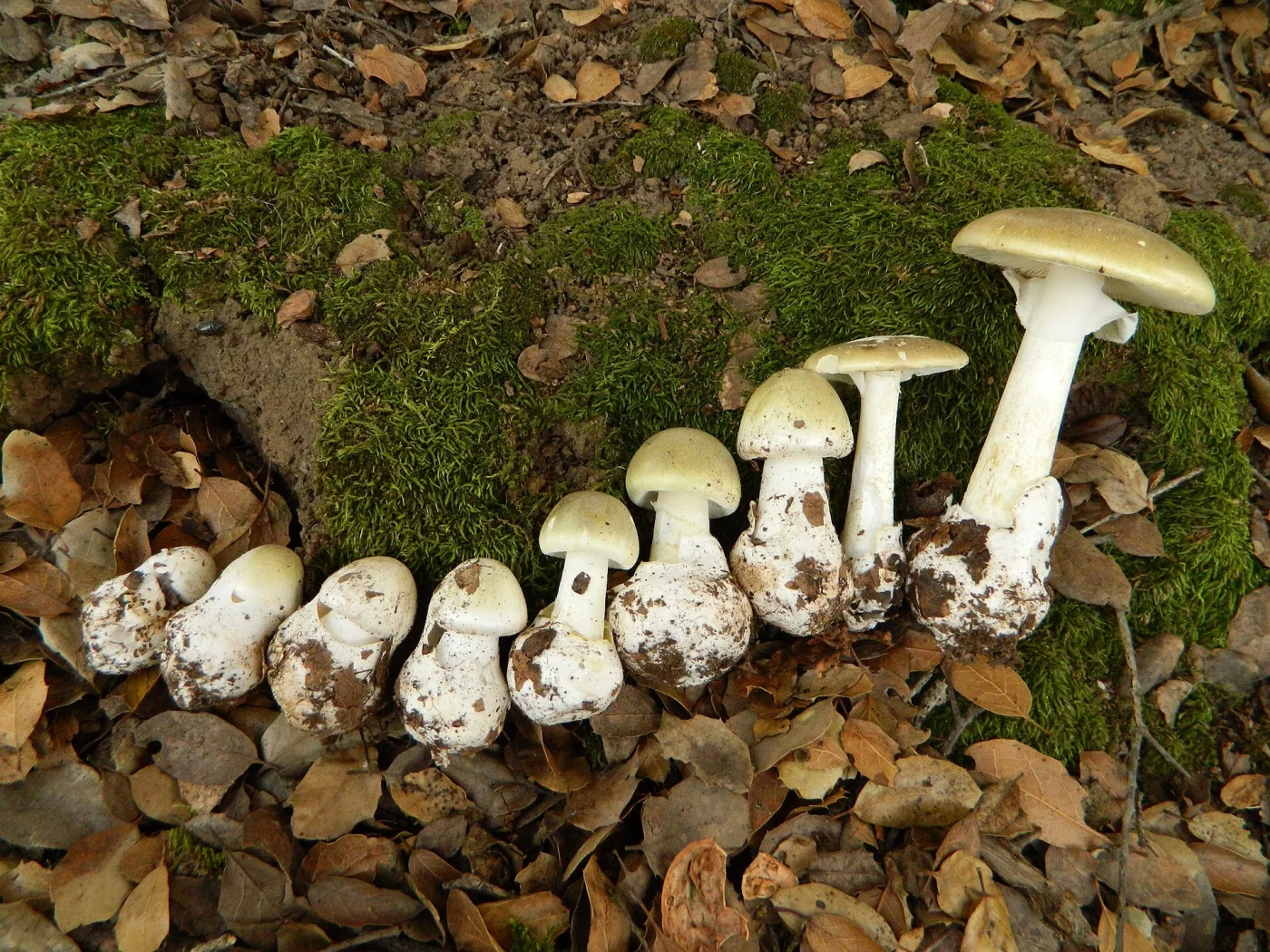
    Death Cap typically has an olive-green, yellow-green, brownish, or occasionally very pale cap. The gills are white and remain white with age.

    The stem has a ring and a sack-like volva at the base. The volva can be buried in soil, making the complete stem base essential for identification.

    Oak Association

    Death Cap forms mycorrhizal relationships with oak and several other broadleaf trees. Oak woodland is one of its classic habitats in Europe.

    It has also spread to other regions with planted host trees. Urban parks and landscaped areas can therefore support it.

    Safety

    Death Cap is deadly poisonous and contains amatoxins. Poisoning can cause delayed severe liver failure.

    12. Amanita rubescens — Blusher

    Identification

    The Blusher has a brown to reddish-brown cap with pale veil patches. The flesh, stem, and damaged areas often develop reddish or wine-colored staining.

    The stem has a ring and an enlarged base. Unlike some dangerous Amanitas, it lacks a free sack-like volva.

    Oak Association

    It occurs in both broadleaf and coniferous forests and can be common under oak. Summer through autumn is the main season.

    Its reddish bruising is an important clue. However, bruising can be weak in young or dry specimens.

    Safety

    It is eaten in some regions after correct identification and thorough cooking, but it has dangerous Amanita look-alikes. It is not a beginner edible.

    13. Amanita citrina — False Death Cap

    Identification

    False Death Cap has a pale yellow, yellow-green, or cream cap and white gills. The stem has a ring and a bulbous base with distinct veil remnants.

    The mushroom may have a raw potato-like odor. Color can overlap with pale forms of Death Cap, which makes the stem base important.

    Oak Association

    It occurs in deciduous and mixed woodland and can be associated with oak. Acidic soils are common habitats.

    It may fruit near other Amanitas at the same time. Each specimen should therefore be examined individually.

    Safety

    It is generally considered inedible or not recommended for consumption. Confusion with deadly Amanitas makes it especially unsuitable as a food mushroom.

    14. Craterellus cornucopioides — Horn of Plenty

    Identification

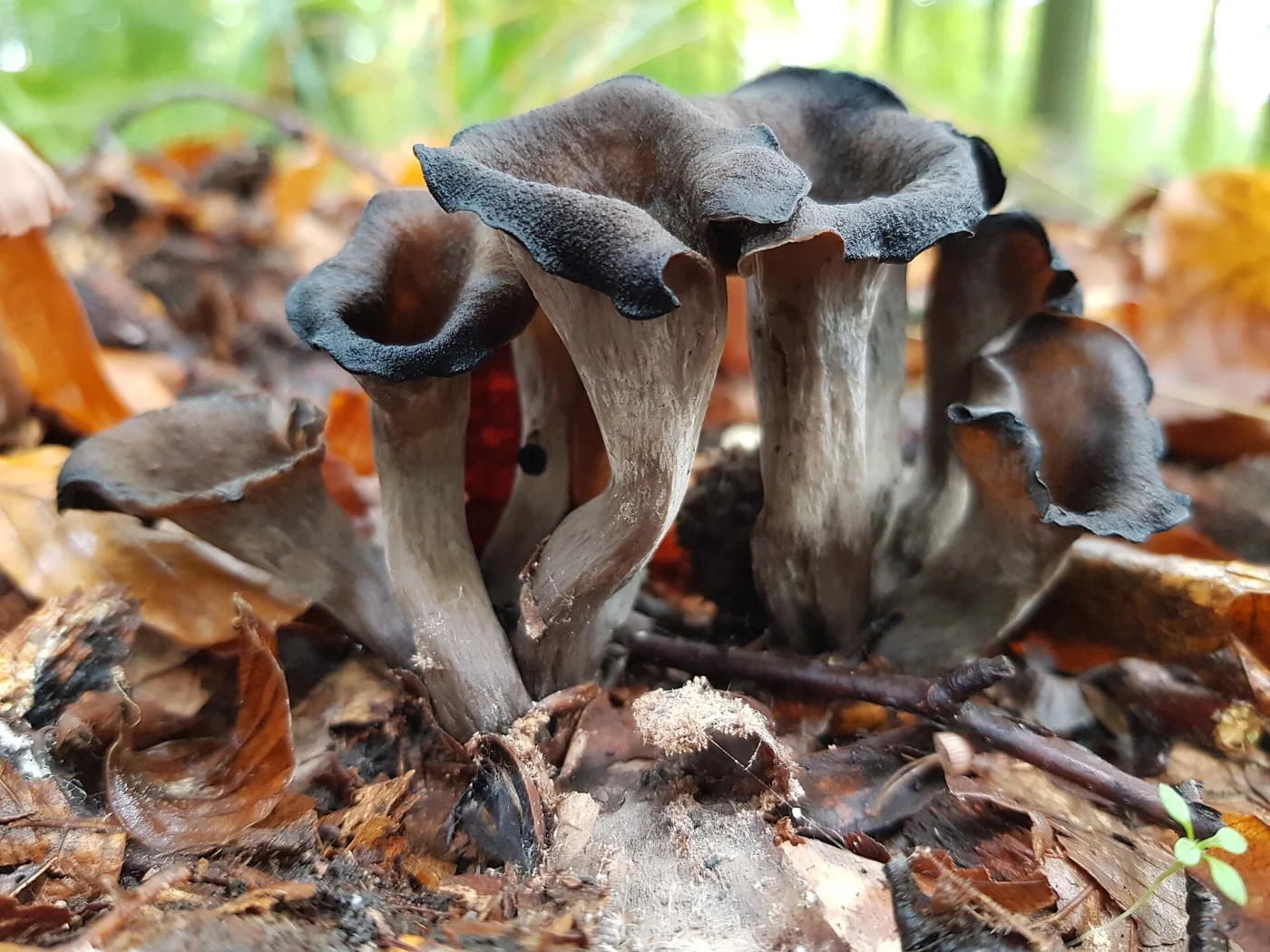
    Horn of Plenty forms dark gray to nearly black trumpet-shaped fruit bodies. There are no true gills underneath.

    The outer surface is gray and smooth to slightly wrinkled. The thin hollow trumpet shape is highly distinctive.

    Oak Association

    It often grows in deciduous woodland with oak and beech. Leaf litter can hide the dark fruit bodies surprisingly well.

    Large patches may appear after sustained wet weather. They can be difficult to notice until one specimen is spotted.

    Safety

    It is edible when correctly identified. Its structure is unusual enough that dangerous confusion is limited, though exact habitat and morphology should still match.

    15. Laccaria amethystina — Amethyst Deceiver

    Identification

    Amethyst Deceiver is a small purple mushroom with purple gills and a slender fibrous stem. Fresh young specimens can be intensely violet.

    The color fades strongly with age and dry weather. Old mushrooms may become pale lilac or almost brownish.

    Oak Association

    It grows in deciduous and mixed woodland and can associate with oak, beech, and other trees. Mossy shaded ground is a common habitat.

    Several purple mushrooms can occur in the same forests. Gills, stem texture, and spore characteristics help confirm the genus.

    Safety

    It is considered edible when correctly identified, but small purple mushrooms are not ideal beginner food species. Some can accumulate environmental contaminants depending on site.

    Boletes Under Oak Trees

    Oak woodland is especially rich in boletes. Porcini, Summer Cep, Bronze Bolete, Royal Bolete, and several red-pored species can all occur in similar habitats.

    Pore color is one of the fastest ways to separate them. White-to-olive pores suggest the king bolete group, while red pores lead toward a very different set of species.

    White Pores vs Red Pores

    King boletes usually begin with white pores that mature toward yellow or olive. Their flesh generally does not show dramatic blue bruising.

    Red-pored boletes often show stronger blue reactions and require much more careful identification. Some are edible, while others are poisonous.

    Russulas Under Oak Trees

    Oak woodland supports many Russula species. Their brittle flesh and pale gills make the genus relatively easy to recognize, but exact species identification can be much harder.

    Cap color is highly variable and should never be used alone. Gill behavior, taste, spore color, bruising, and habitat may all matter.

    Amanitas Under Oak Trees

    Oak is an important host for many Amanitas, including both edible and deadly species. This makes oak woodland especially important for careful stem-base examination.

    Any unknown Amanita should be removed with the full base intact for identification. Cutting it at ground level can remove the volva or bulb features needed to distinguish species.

    Milkcap Mushrooms Under Oak

    Milkcaps are another major oak-associated group. Damaging the gills releases latex, and the latex color can be highly useful.

    Oak Milkcap is one classic example, but many regional species occur. Host tree, cap zoning, latex color, and taste all help narrow the group.

    How to Identify a Mushroom Growing Under Oak

    Start by confirming that the nearby tree is actually oak. Fallen acorns, lobed leaves, and bark are often easier to inspect than the canopy.

    Then check the underside of the mushroom. Determine whether it has gills, pores, teeth, ridges, or another fertile surface.

    Next, examine the stem, base, bruising, ring, volva, latex, and spore color. Only then should oak association be used to narrow the likely species.

    Step 1: Identify the Oak

    Oak leaves vary by species, but many have characteristic lobes. Acorns are even more distinctive when present.

    In mixed forest, check whether beech, birch, hornbeam, or conifers are also nearby. The closest trunk is not always the true fungal host.

    Step 2: Check the Underside

    Pores suggest boletes. Teeth suggest Hydnum, while blunt ridges suggest chanterelles.

    White gills plus a ring and volva should immediately raise concern for Amanita. Underside structure is usually more useful than cap color.

    Step 3: Examine the Stem Base

    The stem base matters most when Amanita is possible. Carefully expose the whole base rather than cutting it off.

    Look for a bulb, sack-like volva, collar-like veil remnants, or reddish bruising. These details can completely change the identification.

    Step 4: Note Bruising and Latex

    Blue bruising is especially useful in boletes. Red staining can matter in Amanitas.

    White, orange, or differently colored latex points toward milkcaps. Record the reaction quickly because some color changes develop over time.

    Why Mushrooms Can Grow Far From the Oak Trunk

    Oak roots can spread well beyond the canopy. Mycorrhizal fungi connected to these roots may therefore fruit several meters from the visible trunk.

    In mature forest, several root systems can overlap. A mushroom appearing under one tree can actually be associated with another nearby host.

    This is why host identification is ecological evidence rather than proof. Morphology always comes first.

    Best Time to Find Mushrooms Under Oak Trees

    Summer through autumn is the most productive period in much of temperate Europe. Warm rain followed by mild weather can trigger strong fruiting.

    Some boletes appear early in summer, while Amanitas, Russulas, chanterelles, and Hedgehog Mushrooms may continue well into autumn. Season varies with region and altitude.

    Weather matters more than calendar date. Sustained moisture is usually more important than one short rainstorm.

    How to Photograph Oak-Forest Mushrooms for Identification

    Take a wide photo showing the complete mushroom and surrounding ground. Include oak leaves, acorns, or the tree trunk if possible.

    Then photograph the underside and full stem. Amanitas should always be documented with the entire base visible.

    A close-up can record bruising, latex, reticulation, teeth, or false gills. Multiple angles make identification much stronger than a single cap photo.

    Can AI Identify Mushrooms Growing Under Oak?

    AI can use oak habitat as useful context, especially for characteristic boletes, chanterelles, Russulas, Amanitas, and milkcaps. It performs best when the tree association is supported by clear structural photos.

    The main limitation is biodiversity. Oak forests can support dozens of similar species, and some require microscopic or regional information.

    For better results, include the underside, stem base, surrounding leaves, and host tree. Habitat should support the identification rather than determine it automatically.

    Common Identification Mistakes

    One common mistake is assuming every robust brown bolete under oak is Porcini. Summer Cep, Bronze Bolete, Bitter Bolete, and other species may occur in the same habitat.

    Another mistake is ignoring the stem base of Amanitas. This can hide the most important feature separating deadly and non-deadly species.

    A third mistake is assuming that all yellow woodland mushrooms are chanterelles. True chanterelles have blunt ridges rather than thin blade-like gills.

    Frequently Asked Questions

    Why do the same oak trees produce different mushrooms in different years?

    Rainfall, temperature, soil moisture, and competition between fungi change from year to year. The underground fungal community may stay similar even when the visible fruit bodies are completely different.

    Can a young oak support mycorrhizal mushrooms?

    Yes. Some fungi colonize oak roots relatively early, although mature woodland usually supports greater diversity and larger established mycelial networks.

    Do acorns influence where mushrooms appear?

    Not directly in most cases. Acorns indicate oak presence, but mycorrhizal fungi are connected to roots rather than fallen acorns.

    Can one oak tree support several bolete species at once?

    Yes. A single mature oak can associate with multiple fungal species, and several boletes may fruit around the same root zone during one season.

    Why do mushrooms sometimes appear more heavily on one side of an oak?

    Moisture, shade, soil depth, root density, and slope can create better fruiting conditions on one side of the tree. The fungal mycelium may also be distributed unevenly.

    Can oak woodland mushrooms survive drought years?

    Yes. The underground mycelium can persist even when no fruit bodies appear. Fruiting may return strongly once favorable moisture conditions return.

    Does removing mushrooms harm the oak tree?

    Removing fruit bodies usually does not remove the underground mycelium. The main fungal relationship with the tree remains in the soil and around the roots.

    Can mushrooms under oak appear after the leaves have fallen?

    Yes. Many autumn species continue fruiting after leaf fall, especially during mild wet weather. Fallen leaves can actually make mushrooms harder to spot.

    Final Identification Notes

    Oak woodland supports an exceptionally diverse mushroom community, including Porcini, Summer Cep, Bronze Bolete, chanterelles, Hedgehog Mushrooms, Russulas, milkcaps, Amanitas, and Horn of Plenty.

    The host tree is useful, but the underside and stem structure are more important. Pores, teeth, false gills, brittle flesh, latex, rings, and volvas lead toward very different identification groups.

    Most importantly, oak habitat contains both excellent edible mushrooms and deadly poisonous species. Each mushroom should therefore be identified from its full set of features rather than from tree association alone.

  • Pilze im Oktober in Deutschland: Diese Arten haben jetzt Saison

    Pilze im Oktober in Deutschland: Diese Arten haben jetzt Saison

    Der Oktober gehört in Deutschland zu den interessantesten Monaten für Pilzsammler. Die Nächte werden kühler, der Waldboden bleibt länger feucht und nach einigen Regentagen können innerhalb kurzer Zeit zahlreiche Fruchtkörper erscheinen. In Laub-, Misch- und Nadelwäldern findet man jetzt sowohl klassische Röhrlinge als auch Schirmlinge, Hallimasch und verschiedene späte Herbstpilze.

    Welche Pilze im Oktober tatsächlich wachsen, hängt allerdings stark von Region, Höhenlage und Wetter ab. Nach einem warmen und feuchten September kann die Hauptsaison bis weit in den Oktober reichen. Nach frühen Nachtfrösten nimmt die Vielfalt dagegen schnell ab.

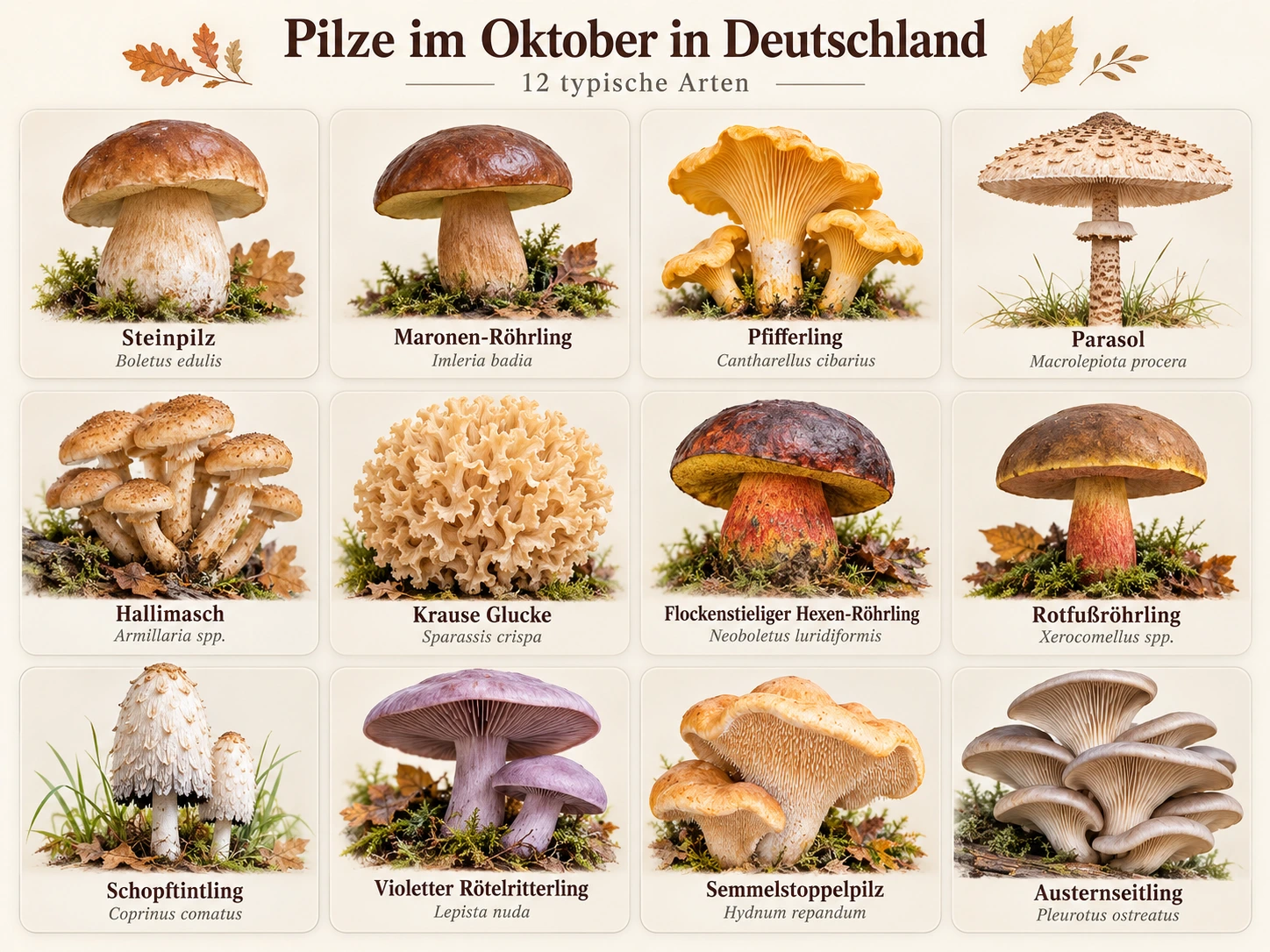
    Hier sind 12 Pilze, die man im Oktober in Deutschland besonders häufig finden kann.

    1. Steinpilz (Boletus edulis)

    Der Steinpilz gehört zu den bekanntesten Speisepilzen Deutschlands. Seine Saison beginnt oft bereits im Sommer, doch in vielen Regionen gibt es im September und Oktober noch einmal besonders gute Funde.

    Typisch sind der braune Hut, der kräftige helle Stiel mit einer feinen Netzzeichnung und die zunächst weißen, später gelblich bis olivfarbenen Röhren.

    Steinpilze wachsen in Verbindung mit Bäumen. Besonders häufig findet man sie unter:

    • Fichten
    • Buchen
    • Eichen
    • Kiefern

    Im Oktober lohnt sich die Suche vor allem in älteren Misch- und Nadelwäldern nach einigen milden Regentagen.

    Eine wichtige Verwechslungsmöglichkeit ist der Gallenröhrling (Tylopilus felleus). Er ist zwar nicht gefährlich giftig, schmeckt jedoch extrem bitter und kann ein ganzes Pilzgericht ungenießbar machen.

    2. Maronen-Röhrling (Imleria badia)

    Der Maronen-Röhrling ist einer der typischsten deutschen Herbstpilze und kann im Oktober stellenweise massenhaft auftreten.

    Sein kastanien- bis dunkelbrauner Hut erinnert farblich an eine Esskastanie. Die Röhren auf der Unterseite sind zunächst hellgelb und werden später olivgelb. Bei Druck verfärben sie sich häufig blau.

    Besonders gute Chancen bestehen in Nadelwäldern mit Fichten und Kiefern, häufig auf sauren, moosigen Böden.

    Nach feuchten Herbsttagen gehört die Marone vielerorts zu den Pilzen, die man bei einem Waldspaziergang am häufigsten sieht.

    3. Pfifferling (Cantharellus cibarius)

    Pfifferlinge verbindet man häufig mit dem Sommer, doch bei geeignetem Wetter kann ihre Saison in Deutschland bis in den Oktober reichen.

    Charakteristisch sind die gelbe bis goldgelbe Farbe und die deutlich am Stiel herablaufenden Leisten. Diese sind ein wichtiges Merkmal: Pfifferlinge besitzen keine echten Lamellen.

    Besonders in milden Regionen oder nach einem warmen September können Anfang Oktober noch gute Funde möglich sein.

    Verwechslungen sind unter anderem mit dem Falschen Pfifferling (Hygrophoropsis aurantiaca) möglich. Dieser besitzt deutlich dünnere, echte Lamellen. Das Bundesinstitut für Risikobewertung nennt ebenfalls die unterschiedlichen Strukturen auf der Hutunterseite als wichtiges Unterscheidungsmerkmal.

    4. Parasol (Macrolepiota procera)

    Der Parasol oder Riesenschirmling gehört zu den auffälligsten Pilzen des Herbstes. Voll entwickelte Exemplare können Hüte von mehr als 20 Zentimetern Durchmesser erreichen.

    Ein typischer Parasol besitzt einen hohen, schlanken Stiel mit einer braunen, schlangenartigen Zeichnung und einen verschiebbaren Ring. Der Hut ist hell und mit zahlreichen braunen Schuppen bedeckt.

    Man findet Parasole häufig nicht tief im Wald, sondern an:

    Waldrändern, Waldwegen, Lichtungen, Wiesen und grasigen Stellen.

    Bei jungen, noch geschlossenen Schirmlingen ist besondere Vorsicht angebracht, da verschiedene kleinere Schirmlingsarten giftig sein können.

    5. Hallimasch (Armillaria spp.)

    Im Oktober beginnt vielerorts die große Zeit des Hallimaschs. Er wächst meist nicht einzeln, sondern in größeren Büscheln an Baumstümpfen, Wurzeln und geschwächten oder abgestorbenen Bäumen.

    Die Hüte sind honiggelb bis braun und häufig mit kleinen dunkleren Schüppchen bedeckt.

    Hallimasch ist allerdings kein Pilz für unerfahrene Sammler. Mehrere ähnlich aussehende Holzbewohner können zu Verwechslungen führen, und Hallimasch muss ausreichend erhitzt werden. Roh oder unzureichend gegart kann er Beschwerden verursachen.

    Wer Hallimasch sammeln möchte, sollte deshalb besonders auf eine sichere Bestimmung achten.

    6. Krause Glucke (Sparassis crispa)

    Die Krause Glucke sieht kaum wie ein klassischer Pilz aus. Ihr großer, cremefarbener Fruchtkörper besteht aus zahlreichen gewellten und verzweigten Lappen und erinnert ein wenig an einen Badeschwamm oder Blumenkohl.

    Sie wächst überwiegend am Fuß älterer Kiefern oder an deren Wurzeln.

    September und Oktober gehören zu den besten Monaten für diese auffällige Art. Größere Exemplare können mehrere Kilogramm schwer werden.

    Der größte Aufwand beginnt oft erst nach dem Sammeln: Zwischen den vielen Verzweigungen sammeln sich Erde, Nadeln und kleine Insekten, weshalb die Reinigung vergleichsweise zeitaufwendig ist.

    7. Flockenstieliger Hexen-Röhrling (Neoboletus luridiformis)

    Dieser kräftige Röhrling kann bis weit in den Herbst hinein gefunden werden.

    Er besitzt meist einen dunkelbraunen Hut, gelbliches Fleisch und einen Stiel mit zahlreichen kleinen roten Punkten. Bei Verletzung verfärbt sich das Fleisch sehr schnell intensiv blau.

    Diese dramatische Farbveränderung bedeutet nicht automatisch, dass ein Pilz giftig ist.

    Trotzdem sollten Anfänger Hexen-Röhrlinge nicht allein anhand der Blaufärbung bestimmen. Innerhalb der ähnlichen Röhrlinge gibt es mehrere Arten, und für eine sichere Bestimmung müssen Hut, Poren, Stielzeichnung, Standort und weitere Merkmale zusammen betrachtet werden.

    8. Rotfußröhrling (Xerocomellus spp.)

    Rotfußröhrlinge gehören zu den häufigsten Röhrlingen in deutschen Wäldern. Mehrere ähnliche Arten werden umgangssprachlich unter diesem Namen zusammengefasst.

    Typisch sind gelbliche Röhren und rötliche Farbtöne am Stiel. Bei manchen Arten reißt die Hutoberfläche auf und zeigt darunter rötliches Gewebe.

    Im Oktober findet man sie häufig in Laub- und Mischwäldern.

    Ältere Exemplare werden allerdings schnell weich, von Insekten befallen oder von Schimmelpilzen besiedelt. Zum Sammeln sind deshalb vor allem junge, feste Fruchtkörper interessant.

    9. Schopftintling (Coprinus comatus)

    Der Schopftintling bevorzugt völlig andere Standorte als viele klassische Waldpilze. Er wächst häufig auf Wiesen, an Wegrändern, in Parks oder auf nährstoffreichen Böden.

    Junge Exemplare besitzen einen länglichen weißen Hut mit auffälligen Schuppen.

    Die Zeit zum Sammeln ist allerdings kurz. Mit zunehmendem Alter beginnt sich der Hut vom Rand her schwarz zu verfärben und schließlich in eine dunkle Flüssigkeit aufzulösen.

    Im Oktober können nach Regen plötzlich große Gruppen erscheinen und bereits wenige Tage später wieder verschwunden sein.

    10. Violetter Rötelritterling (Lepista nuda)

    Wenn die Temperaturen im Oktober sinken, beginnt für einige typische Spätherbstpilze erst die eigentliche Saison.

    Dazu gehört der Violette Rötelritterling. Hut, Lamellen und Stiel können mehr oder weniger deutlich violett gefärbt sein. Mit zunehmendem Alter verblassen die Farben häufig.

    Die Art wächst in Laub- und Nadelwäldern, aber auch in Laubstreu oder auf humusreichen Böden.

    Die violette Farbe allein reicht jedoch keinesfalls für eine Bestimmung aus. Auch verschiedene Schleierlinge können violette Farbtöne besitzen, darunter Arten, die nicht essbar oder giftig sind.

    11. Semmelstoppelpilz (Hydnum repandum)

    Der Semmelstoppelpilz lässt sich schon beim Blick unter den Hut von den meisten klassischen Speisepilzen unterscheiden.

    Statt Lamellen oder Röhren besitzt er zahlreiche kleine Stacheln.

    Der Hut ist meist cremefarben, gelblich oder blass orange. Die Fruchtkörper wachsen häufig in Gruppen oder Reihen in Laub- und Nadelwäldern.

    Die Hauptsaison reicht vom Spätsommer bis weit in den Herbst. Deshalb ist der Semmelstoppelpilz auch im Oktober noch ein typischer Fund.

    12. Austernseitling (Pleurotus ostreatus)

    Während viele andere Pilze nach den ersten kalten Nächten verschwinden, beginnt die Saison des Austernseitlings häufig erst richtig.

    Er wächst büschelig an abgestorbenem oder geschwächtem Laubholz, besonders häufig an Buchen.

    Die Hüte sind muschel- bis fächerförmig und meist grau, graubraun oder blaugrau. Die hellen Lamellen laufen deutlich am kurzen Stiel herab.

    Austernseitlinge können vom Herbst bis in den Winter erscheinen. Deshalb lohnt sich die Pilzsuche auch nach dem Ende der klassischen Steinpilzsaison.

    Wo findet man im Oktober besonders viele Pilze?

    Ein guter Pilzwald muss nicht unbedingt besonders dicht oder abgelegen sein. Viel wichtiger sind geeignete Baumarten, Bodenverhältnisse und ausreichend Feuchtigkeit.

    Nach längerer Trockenheit bringt ein einzelner Regentag meist noch keine große Pilzwelle. Das Pilzgeflecht im Boden benötigt Zeit und geeignete Temperaturen, bevor neue Fruchtkörper entstehen.

    Besonders interessant sind im Oktober ältere Mischwälder, moosige Fichten- und Kiefernwälder sowie Buchen- und Eichenbestände. Auch Waldränder, Lichtungen, alte Baumstümpfe und Totholz sollte man nicht ignorieren – dort wachsen Arten, die man mitten im geschlossenen Wald kaum findet.

    Welche Pilze sind im Oktober besonders gefährlich?

    Die große Artenvielfalt im Herbst bedeutet gleichzeitig ein erhöhtes Verwechslungsrisiko.

    Besonders wichtig ist in Deutschland der Grüne Knollenblätterpilz (Amanita phalloides). Er enthält Amatoxine, die schwere Leberschäden verursachen können. Das Bundesinstitut für Risikobewertung warnt ausdrücklich davor, dass bereits geringe Mengen hochgiftiger Pilze schwere oder sogar tödliche Vergiftungen verursachen können.

    Weitere Pilze, bei denen im Herbst besondere Vorsicht notwendig ist, sind beispielsweise Pantherpilz, verschiedene Schleierlinge und kleine Schirmlinge.

    Ein Pilz sollte deshalb niemals allein aufgrund von Hutfarbe oder eines Fotos als essbar eingestuft werden. Für eine Bestimmung sind unter anderem Hutunterseite, Stielbasis, Ring, Verfärbungen, Geruch, Substrat und Standort wichtig.

    Im Zweifel bleibt der Pilz im Wald.

    Darf man in Deutschland Pilze sammeln?

    Grundsätzlich dürfen wild wachsende Pilze an Orten ohne entsprechendes Betretungsverbot in geringen Mengen für den persönlichen Bedarf gesammelt werden. Genau diese sogenannte Handstraußregelung ist in § 39 des Bundesnaturschutzgesetzes geregelt.

    Für einige besonders geschützte Speisepilze gelten spezielle Ausnahmen. Dazu gehören unter anderem Steinpilze, heimische Pfifferlinge sowie Birkenpilze und Rotkappen, die in geringen Mengen für den eigenen Bedarf gesammelt werden dürfen.

    Zusätzlich können regionale Vorschriften gelten. In Naturschutzgebieten oder anderen geschützten Flächen kann das Sammeln vollständig untersagt sein.

    Pilze im Oktober richtig bestimmen

    Gerade im Herbst können innerhalb weniger Quadratmeter zahlreiche Arten nebeneinander wachsen. Deshalb sollte jeder Fruchtkörper einzeln überprüft werden.

    Für eine Bestimmung sind Fotos aus mehreren Perspektiven besonders hilfreich. Fotografiere nicht nur den Hut von oben, sondern auch die Unterseite und den vollständigen Stiel einschließlich Stielbasis. Notiere außerdem, ob der Pilz auf Erde, Holz oder direkt bei einer bestimmten Baumart gewachsen ist.

    Mit MushroomID kannst du Fotos eines Fundes analysieren und mögliche Arten vergleichen.

    Eine App oder Bilderkennung sollte jedoch nur als Bestimmungshilfe verwendet werden. Ob ein wild gesammelter Pilz gegessen werden kann, sollte bei Unsicherheit durch eine qualifizierte Pilzberatung bestätigt werden.

    Lohnt sich Pilzesammeln im Oktober?

    Ja. In vielen Regionen Deutschlands ist der Oktober sogar einer der abwechslungsreichsten Pilzmonate.

    Zu Beginn des Monats überschneiden sich häufig Arten des Spätsommers mit klassischen Herbstpilzen. Später verschwinden wärmeliebendere Arten langsam, während Hallimasch, Rötelritterlinge, Austernseitlinge und andere kälteverträgliche Pilze häufiger werden.

    Ein feuchter und milder Oktober kann deshalb hervorragende Bedingungen bieten.
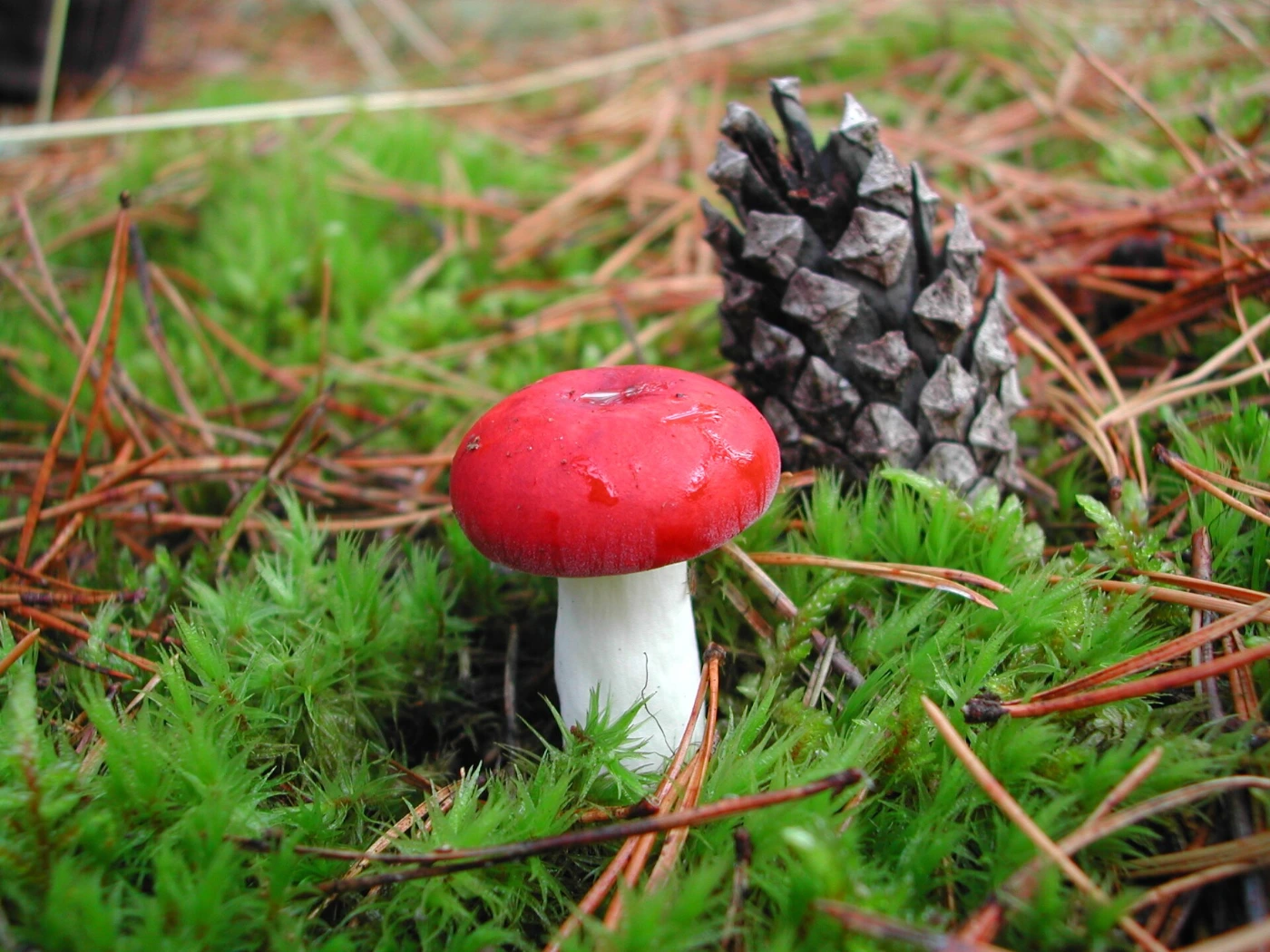
    Nach den ersten stärkeren Frösten endet die Pilzsaison übrigens nicht vollständig. Sie verändert sich lediglich – und die Suche verlagert sich zunehmend vom Waldboden auf Baumstämme, Stümpfe und Totholz.

    Häufige Fragen

    Wie lange nach Regen sollte man im Oktober nach Pilzen suchen?

    Oft lohnt sich ein Waldbesuch einige Tage nach einer längeren Regenperiode. Wie schnell neue Fruchtkörper erscheinen, hängt jedoch stark von Temperatur, Bodenfeuchtigkeit und Pilzart ab.

    Kann man nach dem ersten Frost noch Pilze sammeln?

    Ja. Einige Arten vertragen niedrige Temperaturen gut oder erscheinen sogar bevorzugt im späten Herbst und Winter. Stark durchgefrorene und anschließend wieder aufgetaute Speisepilze sollten jedoch nicht gesammelt werden.

    Ist morgens die beste Zeit zum Pilzesammeln?

    Für das Pilzwachstum spielt die Tageszeit kaum eine Rolle. Früh am Morgen sind beliebte Sammelgebiete allerdings oft noch weniger besucht, sodass die Chance auf unentdeckte Fruchtkörper größer sein kann.

    Soll man Pilze abschneiden oder herausdrehen?

    Für das unterirdische Myzel macht eine vorsichtige Entnahme in der Regel wenig Unterschied. Für die Bestimmung kann der vollständige Stiel einschließlich Basis jedoch entscheidende Merkmale enthalten. Die entstandene Stelle sollte anschließend möglichst wieder mit Laub oder Erde bedeckt werden.
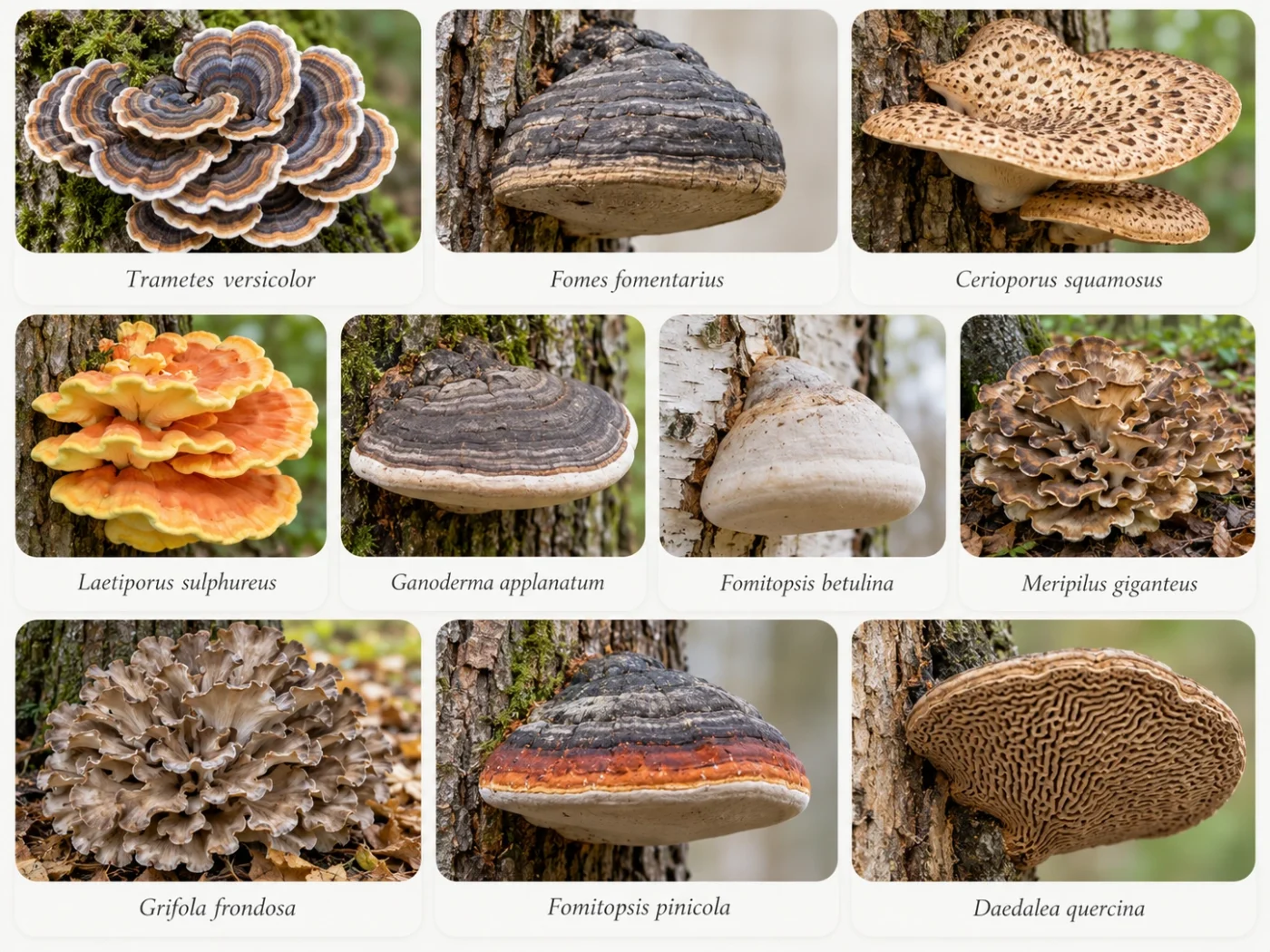
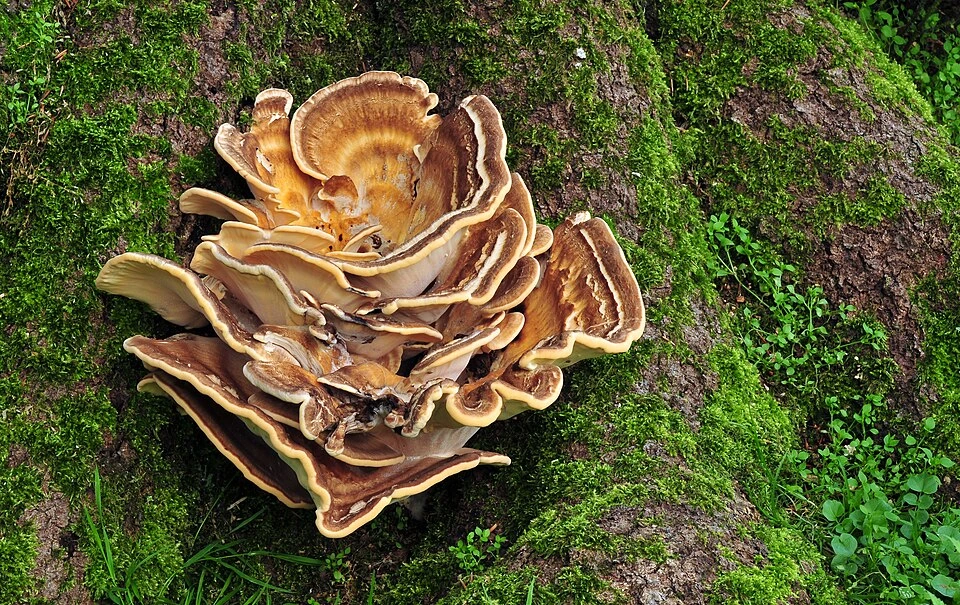
    Welche Pilze findet man Ende Oktober noch?

    Nach kühlen Nächten werden typische wärmere Arten oft seltener. Dafür steigen die Chancen auf Spätherbstpilze wie Violette Rötelritterlinge sowie auf holzbewohnende Arten wie Austernseitlinge. In milden Jahren können gleichzeitig weiterhin Maronen-Röhrlinge und andere klassische Herbstpilze wachsen.
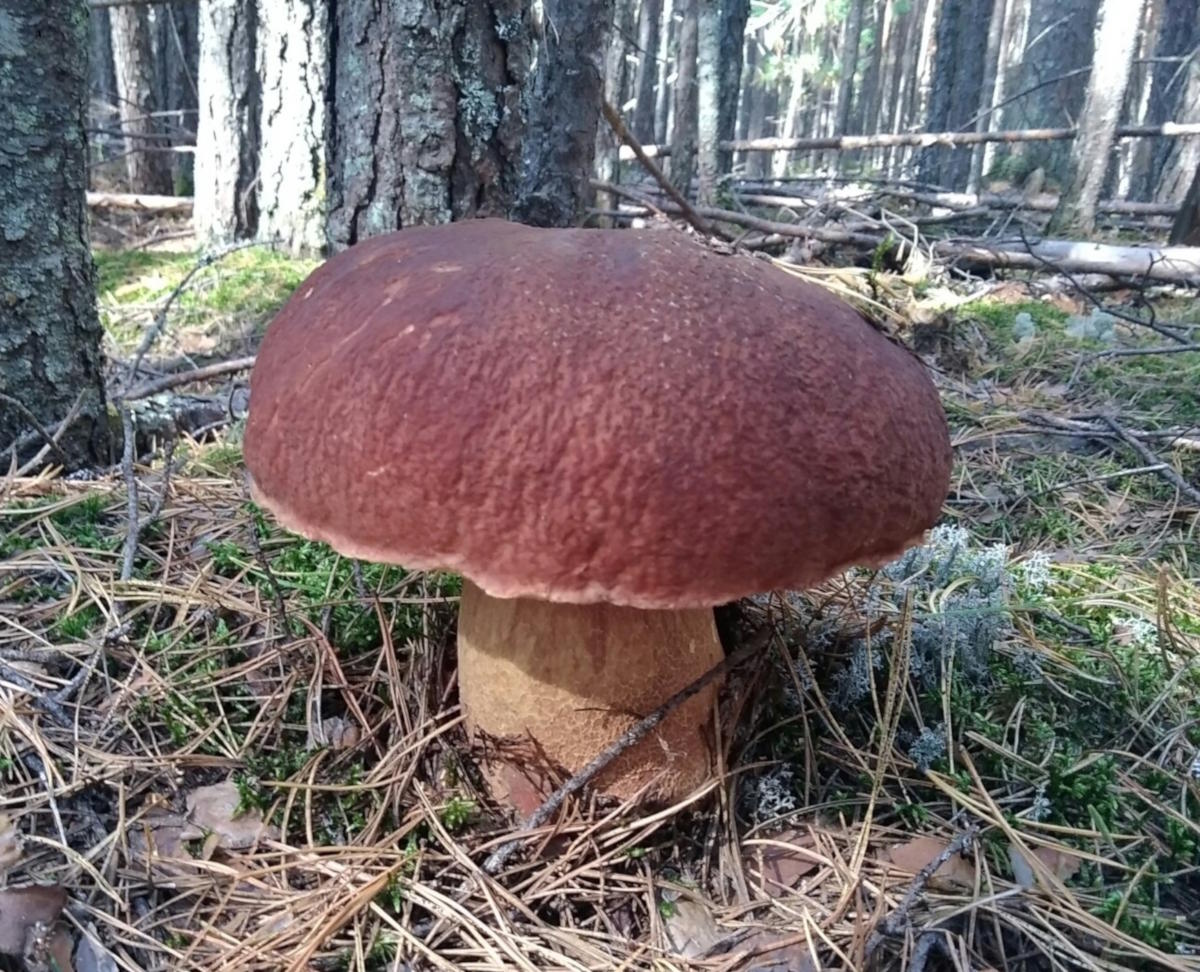
  • Mushrooms Growing on Dead Wood: 15 Common Species

    Mushrooms Growing on Dead Wood: 15 Common Species

    Dead wood is one of the richest mushroom habitats in forests. Fallen trunks, old stumps, buried roots, dead branches, and decaying logs support a huge range of fungi, from soft edible mushrooms to leathery brackets and deadly look-alikes.
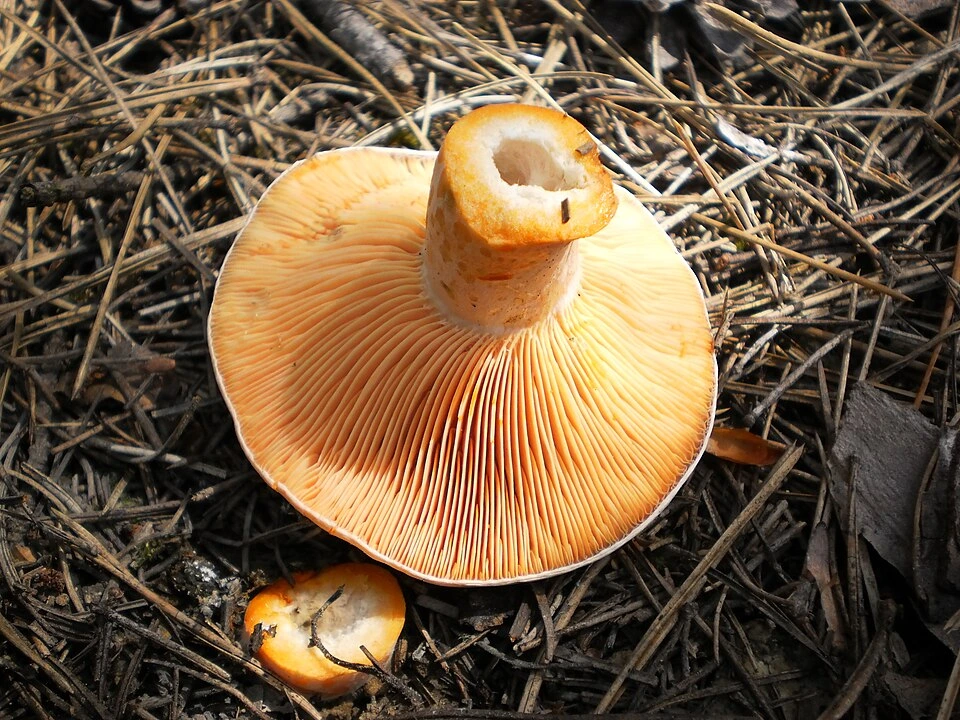
    A mushroom growing on dead wood is not automatically a wood-decay species, however. Some fungi fruit directly from visible timber, while others emerge from buried roots or wood hidden under soil and leaf litter. Identification should therefore combine substrate with gills, pores, teeth, stem structure, spore color, cap texture, and growth pattern.

    ⚠️ Important: This guide is for identification and education only. Never eat a wild mushroom based solely on where it grows, photographs, AI identification, or an online comparison.

    Quick Guide to 15 Mushrooms Found on Dead Wood

    Species Common name Main clue Safety
    Pleurotus ostreatus Oyster Mushroom Pale fan-shaped caps, decurrent gills Edible when correctly identified
    Flammulina velutipes group Velvet Shank / Wild Enoki Honey cap, dark velvety stem base Edible when correctly identified
    Galerina marginata Deadly Galerina Brown cap, rusty spores, ring zone Deadly poisonous
    Kuehneromyces mutabilis Sheathed Woodtuft Two-toned hygrophanous cap, clustered growth Edible only with expert ID
    Hypholoma fasciculare Sulphur Tuft Yellow clusters, greenish-yellow gills Poisonous
    Armillaria species Honey Mushrooms Dense clusters, white spores, often ringed Edibility varies
    Coprinellus micaceus Mica Cap Honey-brown clustered caps with mica-like granules Edible when young and correctly identified
    Mycena galericulata Common Bonnet Gray-brown bonnet caps on logs Inedible
    Pluteus cervinus group Deer Shield Free pinking gills, no ring Edibility varies
    Trametes versicolor Turkey Tail Thin multicolored brackets, tiny pores Inedible as food
    Cerioporus squamosus Dryad’s Saddle Large scaly fan, coarse pores Young specimens edible when correctly identified
    Laetiporus sulphureus Chicken of the Woods Bright orange-yellow shelves Edible when correctly identified
    Fomes fomentarius Tinder Fungus Hard gray hoof-shaped conk Inedible
    Schizophyllum commune Split Gill Small fan-shaped caps with split gills Not recommended as food
    Auricularia auricula-judae group Jelly Ear Brown gelatinous ear-shaped fruit bodies Edible when correctly identified

    Why Dead Wood Supports So Many Mushrooms

    Dead wood is packed with cellulose, hemicellulose, and lignin. Fungi are among the few organisms capable of breaking these compounds down efficiently, making them essential decomposers in forests. Different species specialize in different stages of decay. Some colonize fresh dead branches, while others prefer old soft logs that have already been partly decomposed by earlier fungi.

    White Rot and Brown Rot

    Some fungi cause white rot by breaking down lignin and leaving the wood pale and fibrous. Others cause brown rot, removing cellulose and leaving darker, crumbly wood behind. This distinction is ecologically important, but it is rarely enough for field identification by itself. Growth form and underside structure are usually more practical.

    1. Pleurotus ostreatus — Oyster Mushroom

    Identification

    Oyster Mushroom forms overlapping fan-shaped or shell-like caps that are gray, beige, brownish, or nearly white. The gills run clearly down the short lateral stem.

    Fruit bodies usually grow in dense shelves from dead hardwood. The flesh is white, soft when young, and relatively thick.

    Habitat

    Dead trunks, logs, and large branches of broadleaf trees are classic substrates. Beech, poplar, willow, and other hardwoods can all support it.

    The mushroom can also fruit from weakened living trees. Cool weather often produces especially good flushes.

    Safety

    It is considered edible when correctly identified and properly cooked. The decurrent gills and clustered fan-shaped growth are key features.

    2. Flammulina velutipes Group — Velvet Shank

    Identification

    Wild Enoki has smooth yellow, honey-orange, or orange-brown caps and pale gills. The lower stem becomes dark brown to almost black and has a distinctive velvety surface.

    It grows in clusters from hardwood. The spore print is white, and there is no persistent ring.

    Habitat

    Stumps, fallen trunks, and dead hardwood are common substrates. It is especially notable for fruiting in late autumn and winter.

    Cold weather does not necessarily stop it. Mild winter periods can produce large fresh clusters.

    Safety

    It is edible when correctly identified and cooked, but confusion with Deadly Galerina is a serious risk. Spore color, ring structure, and lower stem texture are critical.

    3. Galerina marginata — Deadly Galerina

    Identification

    Deadly Galerina is a small to medium brown mushroom growing on decaying wood. The cap is yellow-brown to reddish-brown, and mature gills become rusty brown.

    The stem often has a ring or ring zone. The spore print is rusty brown rather than white.

    Habitat

    It can grow on both conifer and hardwood debris. Fallen logs, buried wood, and heavily decayed stumps are common.

    Fruit bodies may appear singly or in groups. Its plain brown appearance makes it easy to underestimate.

    Safety

    Galerina marginata is deadly poisonous and contains amatoxins. It is one of the most important wood-growing species to recognize.

    4. Kuehneromyces mutabilis — Sheathed Woodtuft

    Identification

    Sheathed Woodtuft grows in dense clusters and often has a strongly hygrophanous cap. The wet cap may be dark brown toward the edge, while drying creates a paler central or outer zone.

    The stem commonly has a ring and darker scaly areas below it. Mature gills become brownish as spores develop.

    Habitat

    It grows on decaying hardwood, especially stumps and fallen trunks. Large clusters can return from the same wood repeatedly.

    The clustered habit and changing cap color are striking. Unfortunately, this can overlap with dangerous Galerina.

    Safety

    Although traditionally considered edible in some regions, it is not a suitable beginner mushroom because of the risk of confusion with Galerina marginata. Expert-level identification is recommended.

    5. Hypholoma fasciculare — Sulphur Tuft

    Identification

    Sulphur Tuft grows in dense clusters of bright yellow to sulfur-yellow mushrooms. The cap center is often darker orange-brown.

    Young gills are yellowish and later become greenish or olive-gray. The stems are slender and usually lack a persistent ring.

    Habitat

    Old stumps, buried wood, logs, and dead roots are typical substrates. Both hardwood and conifer wood may be colonized.

    Large clusters can emerge from apparently bare ground when buried wood is present. This can make the mushroom seem terrestrial.

    Safety

    Sulphur Tuft is poisonous and can cause gastrointestinal illness. Greenish mature gills are one of the most useful clues.

    6. Armillaria Species — Honey Mushrooms

    Identification

    Honey Mushrooms usually grow in large clusters with honey-brown, yellow-brown, or tan caps. Many species have a ring on the stem, although ringless species also exist.

    The gills are pale and the spore print is white. Caps may show fine scales, especially near the center.

    Habitat

    They grow from stumps, roots, buried wood, and living or dead trees. Dense clusters around tree bases are especially characteristic.

    Rhizomorphs, dark shoe-lace-like fungal strands under bark or in soil, may also be present.

    Safety

    Edibility varies among species and regions, and gastrointestinal reactions are common enough that careful identification matters. Honey Mushrooms should never be confused with brown-spored wood-growing species such as Galerina.

    7. Coprinellus micaceus — Mica Cap

    Identification

    Mica Caps form dense clusters of small honey-brown to amber caps. Fresh caps may carry sparkling veil granules that resemble tiny grains of mica.

    The gills begin pale, darken, and eventually collapse into dark inky tissue. The stem is thin, pale, and fragile.

    Habitat

    They commonly grow around stumps, buried roots, and decaying hardwood. Sometimes they appear to grow from lawn soil because the actual wood is underground.

    Warm wet weather can produce large clusters. The same site may fruit repeatedly.

    Safety

    Young specimens are generally considered edible when correctly identified, but they deteriorate quickly. Old blackening fruit bodies are not useful for identification or cooking.

    8. Mycena galericulata — Common Bonnet

    Identification

    Common Bonnet has a gray-brown to brown bell-shaped cap with a translucent striate margin. The stem is slender and pale to brownish.

    The gills are whitish to pale gray and attach to the stem. Clusters may contain many delicate fruit bodies.

    Habitat

    It grows on well-decayed hardwood logs, stumps, and buried woody debris. Large old trunks can host repeated flushes.

    The species is common but visually plain. It is best recognized as part of the general Mycena group rather than by cap color alone.

    Safety

    It is not generally regarded as a food mushroom. Small bonnet mushrooms are not suitable beginner edibles because many species look similar.

    9. Pluteus cervinus Group — Deer Shield

    Identification

    Deer Shield mushrooms have gray-brown to brown caps and free gills that do not attach directly to the stem. The gills begin pale and become pink as the spores mature.

    There is no ring or volva. The stem is usually whitish and relatively firm.

    Habitat

    Decaying hardwood, buried logs, and old stumps are classic substrates. Fruit bodies may appear singly rather than in dense clusters.

    Because buried wood can be invisible, the mushroom may look like it is growing directly from soil.

    Safety

    Edibility is treated differently across species and regions. Exact identification within the broader Pluteus cervinus group can be difficult.

    10. Trametes versicolor — Turkey Tail

    Identification

    Turkey Tail forms thin overlapping brackets with clear concentric zones of brown, cream, gray, blue-gray, and sometimes orange. The upper surface is finely velvety.

    The underside is white to cream and covered with very small round pores. True pores are essential for identification.

    Habitat

    Dead hardwood logs, fallen branches, and old stumps are common. Large colonies can cover extensive areas of a single trunk.

    It fruits over a long period and dried brackets may remain visible for months.

    Safety

    Turkey Tail is too tough and leathery to be treated as a normal edible mushroom. It is also frequently confused with smooth-undersided Stereum species.

    11. Cerioporus squamosus — Dryad’s Saddle

    Identification

    Dryad’s Saddle forms large fan-shaped caps with dark brown flattened scales on a pale tan background. The underside has large angular pores.

    A short lateral stem is often present. Fresh fruit bodies may have a cucumber-like or watermelon-rind odor.

    Habitat

    It grows on hardwood stumps, fallen logs, and damaged living trees. Elm, maple, willow, poplar, and several other hosts are possible.

    Spring and early summer are especially productive periods. Fruit bodies can become very large.

    Safety

    Young tender specimens are considered edible when correctly identified. Older caps become fibrous and tough.

    12. Laetiporus sulphureus — Chicken of the Woods

    Identification

    Chicken of the Woods produces bright orange and yellow shelves that grow in overlapping tiers. Young fruit bodies are thick, soft, and fleshy.

    The underside has fine pores rather than gills. Colors fade as the fungus ages.

    Habitat

    It grows on dead or living wood depending on species and region. Oak and other hardwoods are especially common hosts for some taxa.

    Old stumps and fallen trunks can produce large flushes. A single colony may weigh several kilograms.

    Safety

    It is widely eaten when correctly identified, young, and properly cooked. Regional species and host-tree differences still matter, so exact identification is important.

    13. Fomes fomentarius — Tinder Fungus

    Identification

    Tinder Fungus forms hard gray to brown hoof-shaped conks. The upper surface is concentrically zoned and can remain attached for many years.

    The underside has fine pale pores. Internally, the tissue is brownish, tough, and cork-like.

    Habitat

    Birch and beech are important hosts, although other hardwoods may also be used. The fungus occurs on both living and dead trees.

    Old conks can remain visible in every season. They may continue to persist long after active growth slows.

    Safety

    The fruit body is inedible because it is woody and extremely tough. Its historical importance comes from tinder and amadou rather than food use.

    14. Schizophyllum commune — Split Gill

    Identification

    Split Gill forms small fan-shaped gray-white to tan fruit bodies on dead wood. The underside has distinctive gill-like folds that split lengthwise.

    The caps are thin, dry, and often hairy or felted. They can shrink during dry weather and expand again when humidity rises.

    Habitat

    Dead branches, logs, and exposed wood are common substrates. The species is extremely widespread and tolerant of dry conditions.

    It can occur in forests, orchards, parks, and urban environments. Small fruit bodies may cover large sections of dead branches.

    Safety

    It is not recommended as a food mushroom. Its main value for field identification is the unusual split-gill structure.

    15. Auricularia auricula-judae Group — Jelly Ear

    Identification

    Jelly Ear produces brown to reddish-brown ear-shaped fruit bodies with a rubbery gelatinous texture. The upper surface may be slightly velvety, while the inner surface is smoother.

    Fresh specimens are flexible and translucent around the edges. Dry specimens shrink dramatically but can rehydrate after rain.

    Habitat

    Dead hardwood branches and trunks are typical. Elder is especially well known as a host in Europe, though related species occur on many other hardwoods.

    The fruit bodies often grow in groups. Mild wet weather can produce them outside the classic autumn season.

    Safety

    Several members of the broader group are considered edible when correctly identified. Regional taxonomy matters because similar jelly fungi occur on different continents.

    Gilled Mushrooms on Dead Wood

    Dead wood supports many gilled species, including Oyster Mushroom, Velvet Shank, Deadly Galerina, Honey Mushrooms, Mica Caps, and Sulphur Tuft. These fungi can look surprisingly similar when viewed only from above.

    Gill color at maturity, spore print, ring presence, stem texture, and clustering pattern are therefore important. Brown caps on wood deserve particular caution because both edible and deadly species occur in this group.

    White-Spored vs Brown-Spored Species

    Oyster Mushroom, Velvet Shank, and Honey Mushrooms produce pale or white spores. Deadly Galerina and Woodtuft species produce brown to rusty spores. This difference is highly useful when morphology overlaps. A spore print can therefore be one of the strongest secondary tests for brown wood-growing mushrooms.

    Bracket Fungi on Dead Wood

    Brackets are among the most visible fungi on dead logs. Turkey Tail, Dryad’s Saddle, Chicken of the Woods, and Tinder Fungus all grow on woody substrates but differ dramatically in texture and pore structure.

    Thin leathery fans point toward one group, while massive fleshy shelves or hard perennial conks point toward others. The underside should always be examined.

    Jelly Fungi on Dead Wood

    Jelly fungi thrive on damp dead wood and often appear after rain. Their gelatinous texture makes them easy to separate from gilled mushrooms and polypores.

    Jelly Ear is one of the best-known examples. Several unrelated jelly fungi can share brown or black colors, so shape and substrate still matter.

    Hardwood vs Conifer Wood

    The tree species can strongly influence which fungi appear. Oyster Mushrooms, Dryad’s Saddle, and Jelly Ear are strongly associated with broadleaf wood, while other species can colonize conifers as well.

    Deadly Galerina is less selective and can occur on both. This makes host wood useful but never sufficient for identification.

    How to Identify Dead Wood

    Bark is usually the easiest clue if it remains attached. Fallen leaves, cones, branch arrangement, and nearby living trees can also help.

    Very old logs may become difficult to identify. In those cases, it is better to record the substrate as unknown hardwood or unknown conifer than to guess.

    Mushrooms Growing From Buried Wood

    One of the most confusing situations is a mushroom that appears to grow directly from soil but is actually attached to buried roots or timber. Honey Mushrooms, Mica Caps, Pluteus, and several other wood decomposers can do this.

    Carefully tracing the base may reveal buried wood. This can completely change the likely identification.

    How to Identify a Mushroom Growing on Dead Wood

    Start by determining whether the fungus has gills, pores, teeth, a smooth surface, or gelatinous tissue. This immediately divides the possibilities into much smaller groups.

    Then examine the cap, stem, spore color, growth pattern, and wood type. Finally, consider season and region.

    Step 1: Check the Growth Pattern

    A dense cluster suggests different species from a solitary mushroom. Overlapping shelves point toward yet another group.

    Photograph the entire colony before removing anything. Growth architecture can be highly diagnostic.

    Step 2: Look Underneath

    Check whether you see gills, pores, split folds, or a smooth fertile surface. This is usually more useful than cap color.

    For brackets, photograph pore size closely. For gilled mushrooms, note mature gill color.

    Step 3: Examine the Stem

    Check for a ring, dark velvety base, scales, or complete absence of a stem. These features can separate dangerous look-alikes.

    With small brown mushrooms on wood, the stem deserves especially careful attention.

    Step 4: Consider the Spore Print

    White, pink, brown, rusty brown, and dark spores lead toward very different groups. Spore color is particularly helpful with clustered gilled mushrooms.

    It should be combined with morphology rather than used as a standalone test.

    Deadly Look-Alikes on Wood

    The most important dangerous species in this habitat is Galerina marginata. Its brown cap and clustered wood-growing habit can overlap with several edible species.

    The safest approach is not to identify a mushroom as edible from habitat alone. Rusty-brown spores, mature brown gills, and a ring zone should immediately raise concern for Galerina.

    Wild Enoki vs Deadly Galerina

    Wild Enoki has pale mature gills, white spores, no persistent ring, and a dark velvety lower stem. Deadly Galerina has rusty mature gills, rusty spores, and often a ring or ring zone.

    Both can fruit from the same kind of wood. Season alone cannot guarantee a safe distinction.

    How to Photograph Wood-Growing Mushrooms

    Take a wide photograph showing the whole log, stump, or branch and the arrangement of fruit bodies. This preserves information about growth pattern.

    Then photograph the underside and the complete stem. With small brown species, close-ups of the ring zone and stem surface are particularly useful.

    A separate image of the wood and bark can also help. For bracket fungi, include a side profile and close-up of the pore surface.

    Can AI Identify Mushrooms Growing on Dead Wood?

    AI can often recognize distinctive species such as Oyster Mushroom, Turkey Tail, Chicken of the Woods, Dryad’s Saddle, and Jelly Ear. Their shapes and growth patterns are visually strong.

    Small brown wood-growing mushrooms are much harder. Deadly Galerina, Velvet Shank, Woodtuft, and several other species can overlap strongly in photographs.

    For better results, include mature gills, stem details, underside, substrate, and spore color when possible. A single cap-only image is especially risky in this habitat.

    Common Identification Mistakes

    One common mistake is assuming that every cluster on a stump is Honey Mushroom. Several unrelated and sometimes poisonous species grow in dense clusters on wood.

    Another mistake is identifying every thin colorful bracket as Turkey Tail. The underside must have true tiny pores.

    A third mistake is ignoring buried wood. A mushroom that seems to grow from soil may still be a wood decomposer and belong to a completely different ecological group.

    Frequently Asked Questions

    Why do mushrooms keep appearing from the same dead log for years?

    The fungal mycelium can continue breaking down the wood long after the first fruiting. New mushrooms appear when moisture and temperature become suitable again.

    Can one dead tree support several mushroom species at once?

    Yes. Different fungi may colonize different parts of the wood or dominate at different stages of decay. One trunk can host brackets, gilled mushrooms, jelly fungi, and crusts simultaneously.

    Why do some mushrooms appear only after bark falls off?

    Exposed wood changes moisture, temperature, and accessibility for fungi. Some species fruit more readily once the bark loosens or internal decay reaches a suitable stage.

    Can a fungus continue fruiting after the log is moved?

    Sometimes. If enough colonized wood and moisture remain, the mycelium can continue producing fruit bodies even after the log changes position.

    Why are mushrooms more abundant on the underside of fallen logs?

    The shaded underside often stays wetter and experiences smaller temperature fluctuations. These conditions can favor both mycelial growth and fruiting.

    Can firewood produce mushrooms after being stacked?

    Yes. Wood that was already colonized before cutting may continue to fruit in a damp woodpile. Some species can also colonize stacked wood after storage begins.

    Do mushrooms growing on treated lumber belong to the same species as forest fungi?

    Some generalist decomposers can colonize processed wood if conditions allow, but preservatives and construction materials change the habitat considerably. Identification should be based on the fungus itself, not assumptions about the substrate.

    Why do some dead logs have no visible mushrooms at all?

    Fungal activity may still be occurring inside the wood without producing fruit bodies. Dryness, temperature, stage of decay, or competition with other organisms can suppress visible fruiting.

    Final Identification Notes

    Dead wood supports an enormous variety of fungi, including Oyster Mushrooms, Velvet Shank, Deadly Galerina, Honey Mushrooms, Turkey Tail, Dryad’s Saddle, Chicken of the Woods, Tinder Fungus, and Jelly Ear.

    The best first question is not “what color is the cap?” but what kind of fertile surface does it have? Gills, pores, split folds, gelatinous tissue, and leathery brackets each lead toward different groups.

    Most importantly, wood habitat does not imply edibility. Edible, inedible, poisonous, and deadly mushrooms can all grow from the same log, so each fruit body should be identified independently.

  • Mushrooms With Red Caps: 12 Common Species, Edible and Poisonous

    Mushrooms With Red Caps: 12 Common Species, Edible and Poisonous

    Red-capped mushrooms are some of the most eye-catching fungi in forests, parks, lawns, and woodland edges. Unfortunately, red is one of the least reliable identification features because edible, inedible, poisonous, and even deadly species can all have red or reddish caps.

    The safest way to identify a red mushroom is to look beyond color and examine the underside, stem, stem base, bruising, latex, spore color, host trees, and habitat. A red cap can be useful as a starting clue, but it should never be used as evidence that a mushroom is safe to eat.

    ⚠️ Important: This guide is for identification and education only. Never eat a wild mushroom based solely on cap color, photographs, AI identification, or an online comparison.

    Quick Guide to 12 Common Red-Capped Mushrooms

    Species Common name Main clue Safety
    Amanita muscaria Fly Agaric Red cap, white veil remnants Poisonous
    Russula emetica group Sickener Bright red cap, white brittle gills Poisonous / irritating
    Russula xerampelina group Shrimp Russula Red-purple cap, shrimp-like odor Edible when correctly identified
    Hygrocybe coccinea Scarlet Waxcap Bright scarlet cap, waxy gills Not recommended for beginners
    Hygrocybe punicea Crimson Waxcap Deep red cap, robust waxcap shape Edibility uncertain / not recommended
    Lactarius deliciosus Saffron Milk Cap Orange-red cap, orange latex, green staining Edible when correctly identified
    Lactarius rufus Rufous Milkcap Brick-red cap, white acrid latex Inedible / irritating
    Sarcodon squamosus group Scaly Hedgehog Brown-red scaly cap, teeth underneath Edibility varies
    Rubroboletus satanas Satan’s Bolete Pale cap, red pores, blue bruising Poisonous
    Neoboletus luridiformis Scarletina Bolete Dark cap, red pores, fast blueing Edibility requires expert ID and preparation
    Butyriboletus regius Royal Bolete Pink-red cap, yellow pores Edible when correctly identified
    Leratiomyces ceres Chip Cherry / Redlead Roundhead Red-orange cap on wood chips Inedible / possibly toxic

    Why Red Caps Are Misleading

    Red coloration appears in many unrelated mushroom groups. Amanitas, Russulas, waxcaps, milkcaps, boletes, and wood-chip fungi can all produce red caps for completely different evolutionary reasons.

    This means that “red mushroom” is a visual category rather than a taxonomic one. Two red mushrooms growing side by side may be less closely related than a red mushroom and a brown one.

    Color Changes With Age and Weather

    A bright scarlet cap can fade to orange, pink, yellowish, or brown after sun exposure and rain. Some species become patchy or washed out enough that the original red color is hard to recognize.

    Young mushrooms may also be much more intensely colored than old specimens. For this reason, exact shade should always be treated as supporting evidence rather than a decisive feature.

    1. Amanita muscaria — Fly Agaric

    Identification

    Fly Agaric is probably the world’s most famous red mushroom. It usually has a vivid red to orange-red cap covered with white veil remnants, along with white gills, a pale stem, a ring, and a bulbous base.

    The white cap spots can be washed away by heavy rain. Older specimens may therefore look like smooth red or orange mushrooms rather than the classic storybook form.

    Habitat

    It grows in mycorrhizal association with birch, pine, spruce, and other trees. Forest edges, parks, and planted landscapes can all support it.

    The species is especially common in temperate and boreal regions. Fruiting is usually strongest from late summer through autumn.

    Safety

    Fly Agaric is poisonous and contains ibotenic acid and muscimol. Poisoning can cause confusion, altered perception, poor coordination, nausea, and other neurological symptoms.

    It does not contain the amatoxins associated with Death Caps. Its poisoning syndrome is different, although serious illness can still occur.

    2. Russula emetica Group — The Sickener

    Identification

    The Sickener group includes bright red Russulas with white to cream gills and very brittle flesh. The cap surface can be glossy when wet and may peel partly from the margin.

    Like other Russulas, the stem breaks cleanly rather than bending fibrously. There is no ring or volva.

    Habitat

    These mushrooms are commonly associated with conifers and acidic soils. Damp spruce, pine, and mixed forests are typical habitats.

    Exact species identification within the red Russula complex can be difficult. Several similar taxa have historically been grouped under familiar names.

    Safety

    The Sickener is considered poisonous or strongly irritating when eaten raw or improperly prepared. It can cause nausea, vomiting, and gastrointestinal distress.

    Bright red Russulas should not be judged by color alone. Several edible species can look very similar.

    3. Russula xerampelina Group — Shrimp Russulas

    Identification

    Shrimp Russulas often have red, wine-red, purple-red, or brownish-red caps. Their white to cream gills and brittle flesh place them clearly in the Russula group.

    Mature specimens frequently develop a distinctive shrimp-like, seafood-like, or fishy odor. The stem may slowly stain brownish when handled.

    Habitat

    Different members of the group associate with conifers and broadleaf trees. Pine and spruce forests can be especially productive.

    Modern taxonomy recognizes several closely related species rather than one universal mushroom. Geography and host tree can therefore matter.

    Safety

    Many members of the group are considered edible when correctly identified. Exact species confidence is still important because red Russulas can be difficult to separate visually.

    4. Hygrocybe coccinea — Scarlet Waxcap

    Identification

    Scarlet Waxcap has a small to medium scarlet or orange-red cap with thick, waxy-looking gills. The cap is often smooth and slightly greasy rather than scaly.

    The stem is slender and usually red, orange, or yellowish. The entire mushroom often looks unusually clean and bright.

    Habitat

    Waxcaps are famous for old grasslands, meadows, lawns, and other low-nutrient habitats. They are less strongly associated with trees than many woodland mushrooms.

    Healthy waxcap communities can indicate long-established undisturbed grassland. Their ecology differs greatly from Amanitas and boletes.

    Safety

    Scarlet Waxcap is not generally treated as a beginner edible. Several waxcaps are poorly studied from a culinary perspective, and exact identification can be difficult.

    5. Hygrocybe punicea — Crimson Waxcap

    Identification

    Crimson Waxcap is one of the largest red waxcaps. It has a deep red to crimson cap that may fade toward orange or yellowish tones with age.

    The gills are thick and waxy, while the stem is comparatively robust. Older caps can split or become irregular.

    Habitat

    It is associated mainly with unimproved grasslands and similar habitats. It is especially notable in places where waxcap diversity is high.

    Its presence can be ecologically interesting even when the mushroom itself is not collected. Grassland habitat is therefore a major clue.

    Safety

    Edibility is uncertain or inconsistently treated in field guides. It is better regarded as an identification species rather than a food mushroom.

    6. Lactarius deliciosus — Saffron Milk Cap

    Identification

    Saffron Milk Cap has an orange to reddish-orange cap, often with darker concentric zones. The gills are orange and release orange latex when damaged.

    Green staining develops on bruised areas and old tissue. This orange-and-green combination is one of the most characteristic features of the group.

    Habitat

    The species is strongly associated with pine. It grows from soil in pine forests, plantations, and grassy areas influenced by pine roots.

    Related orange milkcaps may associate with spruce or fir instead. Host tree is therefore useful for species-level identification.

    Safety

    It is edible when correctly identified. The orange latex, green staining, and pine association should all agree before assigning the name.

    7. Lactarius rufus — Rufous Milkcap

    Identification

    Rufous Milkcap has a reddish-brown to brick-red cap, often with a small central bump. The gills are pale and release white latex when damaged.

    The latex and flesh are strongly acrid. The mushroom usually has the brittle texture typical of milkcaps.

    Habitat

    It is common in acidic conifer forests and often grows beneath pine and spruce. Mossy forest floors can produce large numbers.

    The relatively plain cap makes it easy to overlook. Latex is the fastest way to recognize it as a milkcap.

    Safety

    It is generally considered inedible or irritating without specialized traditional preparation. Beginners should not collect acrid milkcaps for food.

    8. Sarcodon squamosus Group — Scaly Hedgehogs

    Identification

    Scaly Hedgehogs have broad brown to reddish-brown caps covered with coarse dark scales. The underside has downward-pointing teeth rather than gills or pores.

    The fruit bodies are usually robust and can become large. The cap often looks rough, dry, and heavily patterned.

    Habitat

    Several species are associated with conifer forests, especially pine. Modern taxonomy has separated older broad species concepts into more regional taxa.

    Host tree and geography are therefore useful for narrowing the exact species. Group-level identification is often more reliable from photographs.

    Safety

    Edibility varies within the group. Some species are bitter or tough, particularly when old.

    9. Rubroboletus satanas — Satan’s Bolete

    Identification

    Satan’s Bolete is a large heavy bolete with a pale grayish cap, red pores, and a thick red-and-yellow stem. Although the cap itself is not always bright red, the mushroom belongs in red-themed identification because the pore surface and stem can be intensely crimson.

    The yellow flesh can turn blue when cut. The combination of pale cap, red pores, and blue bruising is highly distinctive.

    Habitat

    It is associated mainly with warm broadleaf woodland, often on calcareous soil. Oak and beech are common host trees in Europe.

    It is less typical of cold acidic conifer forests. Habitat can therefore help exclude it from similar boletes.

    Safety

    Satan’s Bolete is poisonous and can cause severe gastrointestinal illness. It should not be confused with edible red-pored boletes.

    10. Neoboletus luridiformis — Scarletina Bolete

    Identification

    Scarletina Bolete has a dark brown to reddish-brown cap, red to orange-red pores, and a stem covered with red dots rather than strong reticulation. The flesh turns dark blue rapidly when damaged.

    This intense blue reaction can occur within seconds. It is one of the most dramatic bruising reactions among European boletes.

    Habitat

    It grows with both conifers and broadleaf trees depending on region. Woodland soil is the typical setting.

    The species often appears from summer through autumn. Acidic forests can be particularly productive.

    Safety

    The species has a history of culinary use after thorough cooking in some regions, but correct identification is essential. Red-pored boletes are not suitable beginner mushrooms because poisonous look-alikes exist.

    11. Butyriboletus regius — Royal Bolete

    Identification

    Royal Bolete is an attractive species with a pink, rose-red, or reddish cap and bright yellow pores. The stem is yellow and may show fine reticulation.

    The flesh is pale yellow and may show little or limited blue staining depending on the specimen. The overall color combination can be striking.

    Habitat

    It is associated mainly with broadleaf trees such as oak and beech. Warm woodland on suitable soils is typical.

    The species is uncommon or locally rare in some regions. Habitat protection can therefore be more important than collecting it.

    Safety

    It is considered edible when correctly identified. Because of rarity and confusion with other red-capped boletes, collecting may be inappropriate in some areas.

    12. Leratiomyces ceres — Chip Cherry

    Identification

    Leratiomyces ceres has a bright red, orange-red, or brick-red cap and grayish to darkening gills. The stem is pale and may retain fragments of veil tissue.

    The mushroom often appears in groups. Its vivid caps stand out strongly against pale wood chips.

    Habitat

    Wood-chip beds, landscaped gardens, parks, and urban planting areas are typical habitats. It is especially common where fresh woody mulch is used.

    This substrate is one of the strongest identification clues. A red mushroom growing from wood chips belongs in a very different identification path from a woodland Amanita.

    Safety

    It is generally regarded as inedible and may cause gastrointestinal illness. It should not be confused with edible woodland species simply because of cap color.

    Red Caps With White Gills

    A red cap combined with white gills occurs in several groups, especially Amanita and Russula. The stem structure is the fastest way to separate them.

    Fly Agaric usually has a ring, veil remnants, and a bulbous stem base. Russulas lack both ring and volva and have brittle, chalk-like flesh.

    Check the Stem Base

    Never cut an unknown Amanita off at ground level. The base may contain important veil structures needed for identification.

    Russulas do not have a volva. Their stems are generally clean, solid-looking, and brittle.

    Red Caps With Pores

    If the underside is spongy rather than gilled, you are likely dealing with a bolete or related fungus. Red-pored boletes deserve particular caution because edible and poisonous species can look similar.

    Pore color, bruising, stem pattern, and cap color should all be checked. Rapid blue bruising by itself does not indicate whether the species is edible.

    Red Caps With Latex

    Milkcap mushrooms release latex when the gills or flesh are damaged. Latex color can be extremely useful.

    Saffron Milk Cap has orange latex and often turns green after bruising. Rufous Milkcap releases white latex and has a much more acrid character.

    Red Caps With Teeth

    Toothed fungi have downward-pointing spines instead of gills or pores. Scaly Sarcodon species can have dark reddish-brown caps and are often associated with conifers.

    The toothed underside instantly separates them from red Russulas, Amanitas, and boletes. Cap texture then helps narrow the group.

    Edible Red-Capped Mushrooms

    Several red or reddish mushrooms are edible when correctly identified, including Saffron Milk Cap, Shrimp Russulas, Royal Bolete, and some carefully identified boletes.

    Their red coloration has no relationship to edibility. Each belongs to a different group and requires different identification features.

    This is why general rules such as “bright colors mean poisonous” are unreliable. Many dangerous mushrooms are pale, while many edible species are vivid.

    Poisonous Red-Capped Mushrooms

    Fly Agaric, Sickener-type Russulas, Satan’s Bolete, and some other red or red-marked mushrooms can cause poisoning. The symptoms and toxins differ greatly between species.

    There is no single “red mushroom toxin.” Some cause neurological effects, others gastrointestinal irritation, and completely different deadly mushrooms may not be red at all.

    How to Identify a Red-Capped Mushroom Step by Step

    Start with the underside. Decide whether the mushroom has gills, pores, teeth, ridges, or another structure. Then examine the stem for a ring, volva, reticulation, dots, or brittleness. Finally, check bruising, latex, habitat, nearby trees, and spore color if needed.

    Step 1: Ignore the Red Color for a Moment

    Pretend the cap is brown and ask what structural group the mushroom belongs to. This prevents the bright color from dominating the identification. A red bolete should first be recognized as a bolete. A red Russula should first be recognized as a brittle-gilled mushroom.

    Step 2: Check the Underside

    White gills, red pores, waxy gills, orange gills, and teeth all point toward different groups. This is usually the most useful first observation. Photograph the underside clearly. Cap-only photographs are especially weak for red mushroom identification.

    Step 3: Examine the Stem and Base

    Look for rings, volvas, reticulation, dots, color changes, and texture. The full stem base is essential when Amanita is possible. A missing stem base can turn an otherwise useful specimen into an incomplete identification.

    Step 4: Test for Latex or Bruising

    Milkcap gills can be lightly damaged to check for latex. Boletes can be pressed or cut to document bruising. Record how quickly colors change. Reaction speed can be as useful as the final color.

    Step 5: Check Habitat

    Wood chips, old grassland, pine forest, oak woodland, and mixed woodland support very different red mushrooms. Substrate and host trees can quickly narrow the possibilities. Habitat should confirm morphology rather than replace it. A mushroom with the wrong underside is not the right species simply because it grows in the expected place.

    How to Photograph Red Mushrooms for Identification

    Take the first image before touching the mushroom so the habitat and natural color remain visible. Include enough background to show whether it grows from soil, wood, grass, or mulch.

    Then photograph the underside and complete stem. For Amanitas, carefully expose the entire stem base without cutting it off.

    A final close-up should document special features such as latex, bruising, pores, scales, or veil remnants. Natural daylight gives more reliable red tones than strongly warm indoor lighting.

    Can AI Identify Red-Capped Mushrooms?

    AI can often narrow a red mushroom to the correct major group when the underside and stem are visible. It performs much worse when given only a bright red cap. The problem is that color creates superficial similarity between unrelated fungi. A Scarlet Waxcap, Fly Agaric, and red Russula can all appear “small red mushroom” in a poorly framed photograph. For better identification, provide several views and include habitat. The underside, stem base, and surrounding trees usually add more useful information than cap color.

    Common Identification Mistakes

    One common mistake is assuming red means poisonous. This fails because several edible mushrooms are red or orange-red.

    Another mistake is assuming a familiar red mushroom must be Fly Agaric. Rain can remove Fly Agaric’s spots, but many unrelated smooth red mushrooms also exist.

    A third mistake is ignoring the underside because the cap seems distinctive. In practice, the underside is often the fastest way to avoid major identification errors.

    Frequently Asked Questions

    Why do some red mushrooms turn orange after heavy rain?

    Pigments can fade or wash out as the cap ages and becomes waterlogged. A scarlet cap may therefore become orange, pinkish, or yellowish without representing a different species.

    Can sunlight bleach only one side of a red cap?

    Yes. Mushrooms exposed unevenly to direct sunlight can fade asymmetrically. One side may remain dark red while the exposed side becomes orange or pale.

    Why do red mushrooms sometimes stain nearby leaves or grass?

    Wet pigments, spores, and damaged tissue can transfer color onto surrounding material. This staining is not necessarily a diagnostic feature of the species.

    Can young red mushrooms look completely different from mature ones?

    Yes. Young caps may be strongly rounded, more intensely colored, and partly covered by veil tissue. Mature mushrooms can flatten, fade, split, or lose surface decorations.

    Are red mushrooms more common in autumn?

    Many woodland species are, because autumn moisture and temperature favor fruiting. Waxcaps and some other groups can also peak later in the season depending on climate.

    Can frost make a red cap appear darker?

    Yes. Freezing and thawing can damage tissue and create darker, translucent, or brownish patches. Fresh unfrozen areas usually show the most reliable color.

    Why do several unrelated red mushroom species grow in the same forest?

    Color is not tied to one ecological strategy. Mycorrhizal Amanitas, Russulas, milkcaps, and boletes can all share the same woodland because they associate with the same trees in different ways.

    Should I use a phone camera’s enhanced color mode for identification?

    Prefer natural or neutral color settings. Heavy saturation and automatic enhancement can shift red toward orange or purple and make subtle identification features less reliable.

    Final Identification Notes

    A red cap is an excellent reason to look closer, but it is a poor reason to name a mushroom. Fly Agaric, red Russulas, milkcaps, waxcaps, boletes, and wood-chip fungi can all be red while differing completely in structure, ecology, and toxicity.

    Start with the underside, then examine the stem and stem base. Latex, bruising, pore color, gill texture, host trees, and habitat are far more informative than the exact shade of red.

    The most useful rule is simple: identify the mushroom first and the color second. Red can narrow the visual search, but the complete set of structural features determines what the mushroom actually is.

  • Polypore Mushroom Identification: How to Identify Bracket Fungi

    Polypore Mushroom Identification: How to Identify Bracket Fungi

    Polypores are some of the most distinctive fungi in forests, parks, and old woodlands. Instead of conventional gills, most have a surface covered with tiny pores, and many grow as shelves, brackets, rosettes, or hard hoof-shaped conks directly from wood.

    They can be soft and fleshy, thin and leathery, or so hard that they persist for years. Learning to identify polypores means paying attention to pore shape, cap texture, growth form, host tree, bruising, thickness, and whether the fruit body is annual or perennial.

    ⚠️ Important: This guide is for identification and education only. Never eat or use a wild fungus medicinally based solely on photographs, AI identification, or an online comparison.

    Quick Guide to Common Polypore Features

    Feature What to Check
    Growth form Shelf, bracket, rosette, hoof, crust
    Underside Round pores, angular pores, maze-like pores
    Cap texture Soft, leathery, corky, woody
    Cap surface Smooth, zoned, scaly, varnished, hairy
    Stem Usually absent, sometimes lateral or central
    Substrate Living tree, stump, log, buried wood
    Host tree Hardwood, conifer, specific tree species
    Bruising No change, brown, black, red
    Age Annual or perennial
    Flesh White, cream, brown, corky
    Spore print Usually pale, but varies
    Main season Depends strongly on species

    What Is a Polypore?

    Polypores are fungi that usually produce spores from tubes opening as pores on the underside of the fruit body. The word “polypore” literally refers to this many-pored structure.

    Many polypores grow directly from wood and play important roles as decomposers or parasites. Some break down dead logs, while others colonize weakened living trees and continue fruiting after the tree dies.

    Are All Polypores Bracket Fungi?

    No. Many polypores form brackets, but not every polypore has a shelf-like shape, and not every bracket fungus has typical round pores.

    Some form large rosettes at tree bases, while others grow as crusts or irregular masses. A few bracket fungi even have elongated, maze-like, or gill-like fertile surfaces.

    The Underside Is the Best Place to Start

    The pore surface is often the fastest way to narrow a polypore identification. Pores can be tiny and almost invisible, large and angular, stretched into slots, or arranged in maze-like patterns.

    Looking only at the top of a bracket is risky because several unrelated fungi share the same brown, gray, or zoned cap colors. The underside often reveals far more.

    Tiny Round Pores

    Turkey Tail, Tinder Fungus, Artist’s Conk, and many other classic polypores have very fine pores. From a distance, the underside may look nearly smooth.

    A hand lens can help when the pores are extremely small. Fine pore size is especially useful for separating these species from coarser annual polypores.

    Large Angular Pores

    Dryad’s Saddle has relatively large, angular pores that can be seen easily without magnification. The openings become even more stretched as the fruit body expands.

    This makes the underside look almost honeycomb-like. Large pores are one of the strongest clues for this species.

    Maze-Like Pores

    Some polypores develop elongated or labyrinth-like pores. These can look surprisingly similar to gills at first glance.

    Birch Mazegill is a classic example. The fertile surface forms long slot-like structures rather than ordinary round pores.

    Teeth or Gills Instead of Pores

    Not every shelf fungus is a true polypore in the narrow sense. Some wood-growing fungi have teeth, smooth fertile surfaces, or gill-like folds.

    This is why “bracket fungus” is a broader visual description than “polypore.” Always check what is actually happening underneath.

    Cap Shape

    Growth form can immediately narrow the possibilities. Some polypores form thin overlapping fans, while others produce massive hoof-shaped conks or multi-layered rosettes.

    The shape also reflects how long the fungus lives. Annual fruit bodies are often softer and thinner, while perennial conks become thick and woody over time.

    Thin Fan-Shaped Brackets

    Turkey Tail forms numerous thin flexible fans, often layered over one another. The fruit bodies are only a few millimeters thick.

    Other thin brackets can look similar from above, so pore structure remains essential. False Turkey Tail, for example, lacks true pores.

    Thick Hoof-Shaped Conks

    Tinder Fungus and several Phellinus species form hard hoof-shaped structures. These conks may remain on a tree for many years.

    Growth zones often build up season after season. Their toughness immediately separates them from soft annual species.

    Large Rosettes

    Giant Polypore and Hen of the Woods can form large rosettes composed of many overlapping caps. These usually appear around the base of trees or from buried roots.

    Rosette form is useful, but individual cap texture and bruising reactions help distinguish species. Large size alone is never enough.

    Cap Surface

    The upper surface can be smooth, scaly, zoned, hairy, varnished, or cracked. These textures are often more useful than exact color.

    A brown bracket with clear flat scales belongs in a different identification path from a glossy lacquered bracket or a gray hoof-shaped conk.

    Concentric Zoning

    Turkey Tail is famous for narrow concentric bands in multiple colors. Gray, cream, brown, orange, and blue-gray zones can all occur.

    Other species are also zoned, so banding by itself is not conclusive. The underside must still match.

    Scaly Caps

    Dryad’s Saddle has obvious brown flattened scales over a pale background. The pattern often resembles pheasant feathers.

    Scaly texture is much less common than plain zoning, making it a useful clue. Large pores underneath reinforce the identification.

    Varnished Caps

    Some Ganoderma species have shiny reddish-brown lacquered surfaces. The appearance can be almost polished.

    This “varnished” look is distinctive but not universal across the genus. Other Ganoderma species are duller and flatter.

    Annual vs Perennial Polypores

    One of the most useful questions is whether the fruit body lasts one season or several years. Annual species usually grow, release spores, and decay within months.

    Perennial fungi keep the same conk and add new growth layers over time. These fruit bodies become increasingly hard and thick.

    Annual Species

    Turkey Tail, Dryad’s Saddle, Chicken of the Woods, and many other polypores produce annual fruit bodies. Their exact durability varies, but they do not build massive multi-year conks.

    Fresh annual brackets often have softer margins and cleaner pore surfaces. Old ones may dry, fade, or fall apart.

    Perennial Species

    Tinder Fungus and several Phellinus and Ganoderma species can produce long-lived conks. Each growing season may add a new tube layer underneath.

    Cutting through an old fruit body can reveal multiple internal zones. This layered structure is a strong clue for perennial growth.

    Host Tree Is a Major Identification Clue

    Polypores often show strong preferences for certain trees or tree groups. Birch, beech, oak, willow, poplar, conifers, and fruit trees can each support different species.

    The host tree should never override morphology, but it can quickly eliminate unlikely options. A fungus known almost exclusively from birch is less likely on oak.

    Polypores on Birch

    Birch supports several famous bracket fungi, including Birch Polypore and Tinder Fungus. Their shapes and textures are very different despite sharing the same host.

    This is a good example of why host alone is not enough. The same trunk can even support multiple bracket species.

    Polypores on Oak

    Oak can support Artist’s Conk, Beefsteak Fungus, Chicken of the Woods, and several perennial decay fungi. Tree age and condition matter greatly.

    Fungi may appear on the trunk, at the base, or from buried roots. Large basal rosettes often indicate root or lower-trunk decay.

    Polypores on Conifers

    Some species specialize in conifer wood. Red-belted conks and related fungi are particularly associated with spruce, pine, and other conifers.

    Host identification becomes especially important in mixed forests. Bark, cones, and fallen needles can help when foliage is high above the ground.

    Living Trees vs Dead Wood

    A polypore on living wood may act as a parasite, a decomposer of already-dead tissue, or both. Fruiting from a living trunk can therefore indicate internal decay without proving that the fungus originally killed the tree.

    On dead wood, the ecological role is clearer: the fungus is decomposing the remaining material. Many species continue growing long after a host tree has fallen.

    Why This Matters

    Substrate condition helps narrow species and gives ecological context. Chicken of the Woods on a living oak tells a different story from Turkey Tail on a fallen branch.

    For tree health, repeated large conks on a living trunk can be more important than the mushroom’s exact common name. Internal decay may already be advanced.

    1. Trametes versicolor — Turkey Tail

    Identification

    Turkey Tail forms thin flexible brackets with sharply contrasting concentric color zones. The underside is white to cream and covered with very fine pores.

    The fruit bodies usually grow in overlapping rows on dead hardwood. A velvety upper surface is another useful clue.

    Main Look-Alike

    False Turkey Tail in the genus Stereum can look almost identical from above. The key difference is underneath, because Stereum has a smooth fertile surface without pores.

    2. Fomes fomentarius — Tinder Fungus

    Identification

    Tinder Fungus forms a hard gray to brown hoof-shaped conk on broadleaf trees. Birch and beech are especially common hosts.

    The underside has tiny pale pores, and the fruit body is perennial. Its corky internal tissue was historically used to make tinder material.

    Main Look-Alikes

    Hard Phellinus species can resemble it. Darker pore surfaces, host tree, and internal color help separate difficult specimens.

    3. Cerioporus squamosus — Dryad’s Saddle

    Identification

    Dryad’s Saddle has a large cream-to-brown fan-shaped cap covered with dark flat scales. The underside has large angular pores.

    A short lateral stem is often visible. Fresh specimens can have a cucumber-like or watermelon-rind odor.

    Main Look-Alikes

    Giant Polypore may form similarly large fans, but it lacks the strong pheasant-like scale pattern. Dryad’s Saddle also has much larger obvious pores.

    4. Laetiporus sulphureus — Chicken of the Woods

    Identification

    Chicken of the Woods forms bright yellow and orange shelves on trees and stumps. Young fruit bodies are thick, soft, and fleshy.

    The underside has fine yellowish pores. Older specimens fade and become tougher.

    Main Look-Alikes

    Other Laetiporus species can look very similar and differ by geography and host tree. Species-level identification is therefore partly regional.

    5. Ganoderma applanatum — Artist’s Conk

    Identification

    Artist’s Conk forms broad flat perennial brackets with brown upper surfaces. The pale underside bruises brown when scratched.

    This scratch-sensitive surface is so distinctive that drawings can remain visible. The fruit body is hard and long-lived.

    Main Look-Alikes

    Other Ganoderma species can share the same general shape. Surface texture, varnishing, host tree, and pore reaction help narrow them.

    6. Fomitopsis betulina — Birch Polypore

    Identification

    Birch Polypore forms pale rounded shelves almost exclusively on birch. Young specimens are relatively soft, while old ones become corkier.

    The underside has fine white pores. The cap is much smoother and paler than that of Tinder Fungus.

    Main Look-Alikes

    Tinder Fungus also grows on birch but is harder, darker, and strongly hoof-shaped. Growth habit separates them well.

    7. Meripilus giganteus — Giant Polypore

    Identification

    Giant Polypore forms enormous rosettes of overlapping brownish fans, usually near the base of broadleaf trees. Damaged tissue often darkens strongly.

    A single rosette can become very large. Basal growth is one of the strongest ecological clues.

    Main Look-Alikes

    Hen of the Woods can also form large rosettes. Cap size, pore structure, texture, and bruising help separate them.

    8. Grifola frondosa — Hen of the Woods

    Identification

    Hen of the Woods produces branching clusters of many gray-brown fan-shaped caps. The entire fruit body grows as a dense rosette from a shared base.

    It is especially associated with old oak roots and tree bases. The underside has fine white pores.

    Main Look-Alikes

    Giant Polypore is usually broader, heavier, and more prone to dark bruising. Hen of the Woods tends to have many smaller individual caps.

    9. Fomitopsis pinicola Group — Red-Belted Conks

    Identification

    Red-belted conks are hard perennial brackets often showing dark older zones, a reddish band, and a pale growing margin. They frequently occur on conifers.

    The underside has small pores. The contrast between the red-brown band and pale edge can be distinctive in fresh growth.

    Main Look-Alikes

    Other perennial conks can share dark surfaces. Host tree and the characteristic banding are particularly useful.

    10. Daedalea quercina — Oak Mazegill

    Identification

    Oak Mazegill produces thick corky brackets, usually on oak. The underside has large maze-like pores rather than ordinary round openings.

    This labyrinth pattern is immediately distinctive. Old fruit bodies become hard and persistent.

    Main Look-Alikes

    Other maze-pored fungi can look similar, but oak association is especially useful. Pore pattern should still be examined closely.

    Pore Size as an Identification Tool

    Pore size can range from almost microscopic to several millimeters wide. This simple characteristic is surprisingly useful for separating common bracket fungi.

    Tiny pores suggest groups such as Turkey Tail, Ganoderma, or Tinder Fungus. Large angular openings point toward fungi such as Dryad’s Saddle.

    Count Pores in a Small Area

    A hand lens and ruler can help estimate pore density. You do not need exact laboratory precision for this to be useful.

    The general difference between “many tiny pores” and “a few obvious pores” is often enough. Detailed counts become more important only for very similar species.

    Bruising and Color Changes

    Some polypores change color rapidly when touched. Giant Polypore often darkens strongly, while Artist’s Conk develops brown marks on its pale pore surface.

    These reactions can be highly diagnostic. Test a small area rather than damaging the entire fruit body.

    Photograph the Reaction

    Take a photograph before touching the surface and another a few minutes later. This helps document both color and speed of change.

    Older dried specimens may react less clearly. Fresh active pore surfaces usually provide better evidence.

    Flesh Texture and Color

    Cutting a bracket can reveal important internal features. Flesh may be white, cream, brown, corky, fibrous, or layered.

    Soft young flesh points toward very different species from a dense woody conk. Internal color can also separate look-alikes that seem similar outside.

    Hard vs Soft Polypores

    Chicken of the Woods and young Dryad’s Saddle are relatively soft. Tinder Fungus and Artist’s Conk are extremely hard and woody.

    Texture often reflects life strategy. Annual fungi tend to be softer, while perennial species invest in durable tissue.

    How to Identify a Polypore Step by Step

    Start by confirming that the fungus is growing from wood or buried woody material. Then examine the underside and decide whether you are seeing round pores, angular pores, maze-like pores, teeth, or a smooth surface.

    Next, study growth form, cap texture, bruising, and the host tree. Finally, decide whether the fruit body appears annual and soft or perennial and woody.

    Step 1: Check the Underside

    Do not identify a bracket from the top alone. The fertile surface often provides the most diagnostic feature.

    Photograph the pores closely. Pore size and shape can separate species that look almost identical from above.

    Step 2: Check the Growth Form

    Ask whether the fungus forms a single hoof, thin overlapping shelves, a basal rosette, or a broad flat conk. Overall architecture narrows the field quickly.

    Look at the entire colony rather than one isolated cap. Growth pattern is often visible only from a wider view.

    Step 3: Identify the Host

    Determine whether the fungus grows on birch, oak, beech, willow, conifer, or another tree. Bark and fallen leaves can help if the tree is dead.

    Do not assume the nearest tree is always the substrate. Buried roots and partially decomposed wood can complicate the picture.

    Step 4: Check Texture and Bruising

    Feel whether the fruit body is soft, leathery, corky, or woody. Then test a small area for color change if the species group is known to bruise.

    These features are especially helpful with large rosette-forming and perennial species.

    How to Photograph Bracket Fungi for Identification

    Take a side view that shows thickness, attachment, and overall shape. A top-down image alone often hides critical structure.

    Then photograph the underside closely enough to show pore size and shape. Include a ruler or coin if scale is unclear.

    A wider image should show the host tree or log. For basal fungi, include the tree base and surrounding roots.

    Can AI Identify Polypores?

    AI can often recognize distinctive species such as Turkey Tail, Dryad’s Saddle, Chicken of the Woods, and Tinder Fungus when multiple clear photos are available. Growth form and cap pattern are visually useful.

    The difficult cases are old gray or brown perennial conks. Several genera converge on very similar hoof-shaped forms, and host tree or microscopic features may be needed.

    For better results, include the underside, side profile, host tree, and any bruising reaction. A single photograph of the top surface is often insufficient.

    Common Polypore Identification Mistakes

    One common mistake is calling every shelf fungus Turkey Tail. Many thin brackets have colorful zones, but only true Turkey Tail has the correct fine porous underside.

    Another mistake is ignoring host tree. Birch, oak, and conifers support very different common species, even when the brackets look similar.

    A third mistake is assuming every hard conk is perennial. Some annual fungi become surprisingly tough after drying, so growth layers and internal structure should also be checked.

    Frequently Asked Questions

    Why do some bracket fungi grow upside down after a tree falls?

    New growth can reorient itself after the trunk changes position. The fungus tends to produce the active pore surface facing downward, so old and new growth may point in different directions.

    Can one log have several polypore species at once?

    Yes. Different fungi can occupy separate zones of the same log or colonize wood at different stages of decay. Each bracket should therefore be identified independently.

    Why are some old polypores covered with green algae?

    Long-lived fruit bodies remain exposed for months or years, giving algae and moss time to colonize them. Green surface growth can hide original cap colors without changing the underlying fungus.

    Do woodpecker holes or insect tunnels affect identification?

    They can. Old conks may be heavily damaged by insects or birds, making pore surfaces and edges harder to interpret. Fresher fruit bodies usually provide better diagnostic features.

    Can a polypore continue growing after its tree falls?

    Yes, especially if enough moisture remains in the wood. Some fungi continue producing new layers or fresh annual brackets on fallen trunks.

    Why do some brackets appear high above the ground?

    The fungus fruits where suitable colonized wood exists. Wounds, dead branches, and internal decay can occur several meters up the trunk.

    Can frost change the appearance of polypores?

    Yes. Repeated freezing and thawing can darken soft annual brackets, crack surfaces, and alter texture. Hard perennial conks are generally much less affected.

    Should a bracket on a living tree be removed?

    Removing the visible fruit body does not remove the fungus inside the wood. If tree stability is a concern, the condition of the tree should be assessed rather than simply removing the conk.

    Final Identification Notes

    Polypore identification becomes much easier once you stop focusing only on cap color. The most useful sequence is underside structure → growth form → texture → host tree → bruising → annual or perennial habit.

    Tiny pores, large angular pores, maze-like openings, flat scales, varnished surfaces, and hard hoof-shaped growth each point toward different groups. The host tree then provides another powerful layer of evidence.

    Bracket fungi can remain visible far longer than ordinary mushrooms, making them excellent species to study throughout the year. With a few structural clues, even an anonymous brown shelf on a log can become a much more manageable identification problem.

  • Mushrooms Growing Under Pine Trees: 15 Common Species

    Mushrooms Growing Under Pine Trees: 15 Common Species

    Pine forests are excellent places to look for mushrooms because many fungi form close relationships with pine roots. Others simply take advantage of the acidic soil, thick needle litter, fallen cones, buried wood, and relatively stable moisture found beneath mature trees.

    A mushroom growing under pine is not automatically a “pine mushroom,” however. Some species are strongly associated with pines, while others merely tolerate the habitat, so identification should combine tree association with cap, underside, stem, bruising, latex, spore color, and growth pattern.

    ⚠️ Important: This guide is for identification and education only. Never eat a wild mushroom based solely on habitat, photographs, AI identification, or an online comparison.

    Quick Guide to 15 Mushrooms Found Under Pine Trees

    Species Common name Key feature Safety
    Lactarius deliciosus Saffron Milk Cap Orange latex, green staining Edible when correctly identified
    Suillus luteus Slippery Jack Slimy brown cap, ring, yellow pores Edible when correctly identified
    Suillus granulatus Weeping Bolete Yellow pores, glandular dots, no ring Edible when correctly identified
    Boletus pinophilus Pine Bolete Reddish-brown cap, thick reticulated stem Edible when correctly identified
    Imleria badia Bay Bolete Brown cap, yellow pores, blue bruising Edible when correctly identified
    Amanita muscaria Fly Agaric Red cap, white veil remnants Poisonous
    Amanita pantherina Panther Cap Brown cap, white veil remnants Poisonous
    Tricholoma matsutake group Matsutake Firm white mushroom, strong spicy odor Edible when correctly identified
    Tricholoma terreum Grey Knight Gray fibrous cap, pale gills Edibility debated
    Russula xerampelina group Shrimp Russula Red-brown cap, shrimp-like odor Edible when correctly identified
    Lactarius rufus Rufous Milkcap Reddish-brown cap, white acrid latex Inedible / irritating
    Chroogomphus rutilus Copper Spike Copper-brown cap, darkening gills Edibility varies
    Gomphidius glutinosus Slimy Spike Gray-brown slimy cap Edible when correctly identified
    Sarcodon imbricatus group Scaly Hedgehog Brown scaly cap, teeth underneath Edibility varies
    Thelephora terrestris Earthfan Brown fan-shaped ground fungus Inedible

    Why So Many Mushrooms Grow Under Pines

    Pines support large communities of mycorrhizal fungi. These fungi connect with the tree’s roots and exchange mineral nutrients and water for sugars produced through photosynthesis.

    This partnership allows many mushroom species to return to the same forest year after year. Boletes, milkcaps, Amanitas, Russulas, and Tricholomas are especially well represented in pine habitats.

    Pine Needle Litter Creates a Distinct Habitat

    A thick layer of pine needles changes the forest floor. It retains moisture, reduces direct sunlight, and creates a relatively acidic organic layer.

    Some mushrooms thrive in these conditions even when they are not exclusively associated with pine. Others depend much more strongly on pine roots and are rarely found far from suitable host trees.

    1. Lactarius deliciosus — Saffron Milk Cap

    Identification

    Saffron Milk Cap is one of the most characteristic mushrooms of pine forests. It has an orange cap with darker concentric zones, orange gills, and orange latex that appears when the flesh or gills are damaged.

    Green staining develops after bruising or with age. The orange-and-green color combination is one of the easiest ways to recognize the group.

    Pine Association

    Lactarius deliciosus is strongly mycorrhizal with pines. It commonly grows in pine forests, plantations, and grassy areas where pine roots extend below the surface.

    The tree association is especially useful when separating it from similar orange milkcaps associated with spruce or fir.

    Safety

    It is considered edible when correctly identified. Similar orange milkcaps are usually separated by host tree, latex color, and staining reaction.

    2. Suillus luteus — Slippery Jack

    Identification

    Slippery Jack has a brown cap that becomes distinctly slimy or sticky in wet weather. The underside has yellow pores instead of gills.

    The stem usually carries a ring, which separates it from several other Suillus species. Mature pores often become darker yellow or olive.

    Pine Association

    This species is strongly linked with pine. It can appear in forests, young plantations, roadside plantings, and lawns beneath ornamental pines.

    Fruit bodies sometimes occur in large groups after autumn rain. The presence of nearby pines is one of the strongest ecological clues.

    Safety

    Slippery Jack is considered edible when correctly identified and prepared. Some people remove the slimy cap skin because it can be unpleasant and may contribute to gastrointestinal sensitivity.

    3. Suillus granulatus — Weeping Bolete

    Identification

    Weeping Bolete has a yellow-brown to orange-brown cap and yellow pores. Young pore surfaces may exude small milky droplets, which inspired the “weeping” common name.

    The stem lacks a ring but often has small glandular dots near the upper portion. This is an important difference from Suillus luteus.

    Pine Association

    The species is strongly associated with pine roots, particularly in warm and temperate regions. Young pine plantations and grassy pine edges can be especially productive.

    It often appears in groups rather than as isolated mushrooms. Moist conditions after dry weather can trigger large flushes.

    4. Boletus pinophilus — Pine Bolete

    Identification

    Pine Bolete is a robust king bolete with a dark reddish-brown to wine-brown cap. The stem is thick and usually shows pale reticulation.

    The pore surface begins white and later becomes yellow to olive. The flesh remains white and generally does not show strong blue bruising.

    Pine Association

    As the common name suggests, Boletus pinophilus is strongly associated with pine and other conifers. It can occur in mossy pine forests and mature mixed woodland with conifers.

    It resembles Boletus edulis closely, but the darker reddish cap and conifer association often provide useful clues.

    Safety

    The species is edible when correctly identified. It belongs to the highly valued king bolete group.

    5. Imleria badia — Bay Bolete

    Identification

    Bay Bolete has a smooth chestnut-brown cap, yellow pores, and a brownish stem. The pore surface commonly turns blue when pressed.

    The flesh may also blue slightly when cut. This reaction helps distinguish it from classic Porcini, whose flesh usually remains white.

    Pine Association

    Bay Bolete is common in coniferous and mixed forests, particularly beneath pine and spruce. It can grow among moss, needles, and decaying woody debris.

    It often appears later in the season than some summer boletes. Cool wet autumn weather can produce large numbers.

    6. Amanita muscaria — Fly Agaric

    Identification

    Fly Agaric usually has a red to orange-red cap with white veil remnants. The gills are white, and the pale stem carries a ring and an enlarged base.

    Rain can wash away many of the white cap spots. Older mushrooms may therefore look much plainer than the classic storybook version.

    Pine Association

    Fly Agaric forms mycorrhizal relationships with pine, birch, spruce, and other trees. Pine forests are one of its classic habitats.

    It can appear singly or in large scattered groups. Autumn is often the most productive season.

    Safety

    Fly Agaric is poisonous and contains ibotenic acid and muscimol. It can cause neurological symptoms, confusion, altered perception, and poor coordination.

    7. Amanita pantherina — Panther Cap

    Identification

    Panther Cap has a brown to gray-brown cap with white veil patches. The gills are white, and the stem usually has a ring and a bulbous base.

    The stem base often shows collar-like or rimmed veil remnants. The flesh generally does not redden strongly when damaged.

    Pine Association

    It can occur in pine and other coniferous forests as well as broadleaf woodland. Pine-associated specimens are often found on forest soil among needle litter.

    The species fruits mainly from summer through autumn. Heavy rain can remove cap patches and make identification harder.

    Safety

    Panther Cap is poisonous and contains ibotenic acid and muscimol. It should not be confused with amatoxin-containing Amanitas, although both groups can cause serious poisoning.

    8. Tricholoma matsutake Group — Matsutake

    Identification

    Matsutake are firm pale mushrooms with thick stems, white to cream gills, and a strong distinctive odor often described as spicy, aromatic, or cinnamon-like. Young specimens may remain partly buried beneath pine litter.

    The cap usually develops brown fibrous patches or scales with age. A ring-like veil zone may be visible on the upper stem.

    Pine Association

    Matsutake are famous for their association with conifer forests, especially pine. They often grow in nutrient-poor, well-drained soils with deep needle litter.

    Different regions contain related species rather than one universal matsutake. Geography therefore matters when assigning an exact species name.

    Safety

    Some members of the group are prized edible mushrooms when correctly identified. White Amanitas and other pale woodland mushrooms must be excluded carefully.

    9. Tricholoma terreum — Grey Knight

    Identification

    Grey Knight is a relatively small Tricholoma with a gray to charcoal cap covered in fine radial fibers or scales. The gills are white to grayish, and the stem is pale.

    The cap often looks dry rather than slimy. Several similar gray Tricholoma species can occur in the same habitats.

    Pine Association

    This mushroom is strongly associated with conifers, particularly pines. It often appears in groups on needle-covered forest floors.

    Late autumn can be especially productive. In mild regions, fruiting may continue well into the cool season.

    Safety

    The edibility of Tricholoma terreum has been treated differently in older and modern sources. For practical purposes, uncertain gray Tricholoma species should not be collected for food.

    10. Russula xerampelina Group — Shrimp Russulas

    Identification

    Shrimp Russulas typically have reddish, purple-brown, or wine-colored caps with pale to cream gills. Like other Russulas, their flesh is brittle and breaks rather than tearing into fibers.

    Mature specimens often develop a distinctive seafood-like or shrimp-like smell. The stem may discolor brownish when handled.

    Pine Association

    Several members of the broader group occur with conifers, including pine. They grow from soil and may appear scattered among needles and moss.

    Exact species-level identification can be difficult because the group contains multiple similar taxa. Host tree, cap color, odor, and spore characteristics may all matter.

    11. Lactarius rufus — Rufous Milkcap

    Identification

    Rufous Milkcap has a reddish-brown to brick-red cap, often with a small pointed bump in the center. The gills are pale and release white latex when damaged.

    The latex and flesh have a strongly acrid character. The mushroom has the brittle texture typical of milkcaps.

    Pine Association

    It is common in acidic conifer forests and frequently occurs beneath pine. Mossy, damp ground can produce large numbers.

    The plain reddish cap can make it look unremarkable from above. Checking for latex is the fastest way to recognize it as a milkcap.

    Safety

    It is generally treated as inedible or unsuitable without special regional preparation traditions. Beginners should not collect acrid milkcaps for food.

    12. Chroogomphus rutilus — Copper Spike

    Identification

    Copper Spike has a copper-brown to reddish-brown cap and thick decurrent gills. The gills darken as the spores mature.

    The stem is often yellowish near the base and may develop orange or reddish tones. Young mushrooms can have remnants of a veil.

    Pine Association

    The species is strongly associated with conifers and often occurs near pine. It can grow in the same habitats as Suillus species.

    This ecological overlap is not accidental, because fungi in this group have complex associations with conifer-root systems and other mycorrhizal fungi.

    Safety

    Edibility descriptions vary by region and source. It is not a good beginner food mushroom because related species and identification details can be confusing.

    13. Gomphidius glutinosus — Slimy Spike

    Identification

    Slimy Spike has a gray-brown to purplish-brown cap covered by a thick slimy layer in wet weather. The gills are pale when young and become darker with age.

    The stem is whitish above and often yellow near the base. A slimy veil can leave a ring-like zone.

    Pine Association

    It is more strongly associated with spruce than pine in many regions, but it can occur in mixed conifer habitats where pine is present nearby. This makes it a useful reminder that not every mushroom under a pine is actually partnered with that pine.

    Conifer identification should therefore include all nearby trees. A spruce hidden among pines can change the likely species considerably.

    14. Sarcodon imbricatus Group — Scaly Hedgehog

    Identification

    Scaly Hedgehog mushrooms have broad brown caps covered with dark coarse scales. Instead of gills or pores, the underside has numerous downward-pointing teeth.

    This toothed surface immediately separates them from most brown boletes and gilled mushrooms. Older specimens can become very large and strongly patterned.

    Pine Association

    Several Sarcodon species are associated with conifer forests. Pine habitat can be important for narrowing the exact taxon.

    Modern taxonomy has split older broadly used names into more specific species. Geography and host tree are therefore useful when working beyond the group level.

    Safety

    Edibility varies within the group, and older specimens can be bitter or tough. Species-level certainty is important before considering culinary use.

    15. Thelephora terrestris — Earthfan

    Identification

    Earthfan produces irregular brown fan-shaped or rosette-like fruit bodies close to the ground. The surface is tough, fibrous, and often blends almost perfectly with pine needles and soil.

    It does not look like a conventional cap-and-stem mushroom. Several fans may merge into a larger irregular cluster.

    Pine Association

    The species is frequently associated with conifers and is especially noticeable around young pine roots. It can sometimes grow around seedlings or partially cover debris.

    Its brown coloration provides excellent camouflage in needle litter. Once noticed, its unusual fan-shaped structure is distinctive.

    Safety

    Earthfan is not considered a food mushroom. Its tough leathery texture makes it unsuitable for ordinary culinary use.

    Pine-Associated Boletes

    Pine forests are especially good habitat for boletes. Pine Bolete, Slippery Jack, Weeping Bolete, Bay Bolete, and several regional species may all occur within the same woodland.

    The underside is the fastest way to recognize the group because boletes have pores instead of gills. Pore color, stem ornamentation, bruising, and cap texture then help separate individual species.

    Suillus and Pine

    Many Suillus species have particularly strong associations with pine. Sticky caps, glandular dots, and yellow pores are common features across the group.

    Some species prefer specific pine types or ages. Young plantations can therefore host different Suillus communities from mature natural pine forests.

    Orange Mushrooms Under Pine Trees

    Orange mushrooms beneath pine often lead people toward Saffron Milk Caps, but several other groups can also be orange or reddish. Cap color alone should never determine the identification.

    For milkcaps, damaging the gills is particularly useful. Orange latex combined with green staining strongly supports the Saffron Milk Cap group, while white latex or no latex leads in other directions.

    Brown Mushrooms Under Pine Trees

    Brown is probably the most common cap color in pine forests. Boletes, Tricholomas, milkcaps, Russulas, Amanitas, and many unrelated small fungi may all appear brown.

    The underside should therefore be checked immediately. Pores, teeth, pale gills, darkening gills, or latex each lead toward very different identification pathways.

    Poisonous Mushrooms Under Pine Trees

    Pine habitat includes both edible and poisonous species. Fly Agaric and Panther Cap are among the most recognizable poisonous examples.

    Other dangerous species may also occur depending on region. Habitat should never be interpreted as evidence that a mushroom belongs to an edible pine-associated group.

    Amanitas Beneath Pine

    Amanitas grow from soil in partnership with tree roots. Their cap colors range from red and brown to white, so there is no single “Amanita color.”

    Always inspect the complete stem base. Rings, bulbs, volvas, and veil remnants can be much more important than the cap.

    How to Identify a Mushroom Growing Under Pine

    Start by confirming that the nearby tree is actually a pine. Spruce, fir, larch, and other conifers can look similar from a distance but support different fungi.

    Then examine the mushroom from underneath. Determine whether it has pores, true gills, teeth, false gills, or another fertile surface.

    Next, check the stem, bruising reaction, latex, ring, and full stem base. Only after these features should pine association and season be used to narrow the species.

    How to Tell Pine From Other Conifers

    Pine needles grow in bundles, usually containing two, three, or five needles depending on species. Spruce needles attach individually to the twig, while fir needles are also single but usually flatter.

    This distinction can directly affect mushroom identification. An orange milkcap under pine may suggest one species, while an almost identical mushroom under spruce may suggest another.

    Check the Ground

    Cones and fallen needles are often easier to inspect than high branches. Pine cones and bundles of fallen needles can provide quick evidence of the host tree.

    In mixed woodland, look farther than the mushroom’s immediate surroundings. Fungal roots can connect with a tree several meters away.

    Why Mushrooms Can Grow Far From the Pine Trunk

    The visible mushroom grows from an underground mycelium that can spread through a large area of soil. Pine roots also extend far beyond the trunk.

    A mushroom growing several meters away can therefore still be associated with the same pine. The nearest tree is not automatically the host.

    This is especially important in mixed forests. Several potential host species may have overlapping root systems beneath one patch of ground.

    Best Time to Find Mushrooms Under Pines

    Late summer and autumn are the most productive periods in many temperate pine forests. Rainfall after a warm or dry period can trigger large fruitings.

    Some species appear earlier or later. Matsutake, Velvet Shank-like cold-weather fungi, and regional boletes can extend the useful season beyond the classic autumn peak.

    Weather usually matters more than the exact calendar date. Several days of consistent moisture are generally more important than one brief storm.

    How to Photograph Pine-Forest Mushrooms for Identification

    Take a photo of the complete mushroom before removing it. Include enough surrounding ground to show pine needles, cones, moss, or other habitat clues.

    Then photograph the underside and complete stem. Amanitas should always be documented with the entire stem base intact, while milkcaps are especially useful to photograph after the gills have been damaged to show latex.

    A separate photograph of the nearest conifer can be extremely useful. For difficult mycorrhizal species, host-tree evidence can change the identification substantially.

    Can AI Identify Mushrooms Growing Under Pine?

    AI can use pine habitat as useful context, especially for characteristic species such as Saffron Milk Cap, Slippery Jack, Fly Agaric, and Pine Bolete. Multiple images showing the mushroom and host tree make identification far stronger than a cap-only photo.

    The difficulty is that pine forests support hundreds of fungi, many of which overlap in color and shape. Some exact species also require microscopic or regional information.

    AI should therefore use tree association as one feature among many. It should never assume that a brown or orange mushroom is a particular species simply because pine needles are visible in the photograph.

    Common Identification Mistakes

    One common mistake is assuming the nearest conifer is a pine. Misidentifying spruce or fir can send the entire mushroom identification in the wrong direction.

    Another mistake is treating pine habitat as stronger evidence than morphology. If the mushroom has the wrong gills, stem, or spore color, the host tree cannot rescue the identification.

    A third mistake is identifying every orange milkcap as Lactarius deliciosus. Related species can look nearly identical but associate with different conifers.

    Frequently Asked Questions

    Why do mushrooms sometimes form rings around pine trees?

    The fungal mycelium can expand outward through the soil over time, producing fruit bodies near the actively growing edge. This can create arcs or partial rings even though the fungus is connected to tree roots beneath the surface.

    Can newly planted pine trees already have mushrooms around them?

    Yes, especially if the seedlings were planted with mycorrhizal fungi already associated with their roots. Some fungi also colonize young trees relatively quickly when compatible mycelium is present in the soil.

    Do pine needles stop other mushrooms from growing?

    No. Thick needle litter changes moisture, acidity, and organic matter, but many fungi are well adapted to those conditions. Some species are actually particularly successful in deep conifer litter.

    Can mushrooms under pine damage the tree?

    Most of the mycorrhizal species in this guide are partners rather than parasites and can benefit the tree. Other fungi may decompose buried roots or weakened wood, so the effect depends on the species.

    Why can two pine forests have completely different mushrooms?

    Pine species, tree age, soil chemistry, rainfall, elevation, understory vegetation, and nearby trees all influence the fungal community. Two forests that look similar from a distance can therefore support very different species.

    Do mushrooms appear immediately after pine needles are disturbed?

    Disturbance can expose hidden fruit bodies, but it does not usually cause mushrooms to develop instantly. Fruiting depends on conditions in the underground mycelium over a longer period.

    Can the same pine support several mycorrhizal mushroom species?

    Yes. One tree can maintain relationships with multiple fungi at the same time, and several species may fruit around it during the same season.

    Should pine plantations have fewer mushrooms than natural pine forests?

    Not necessarily. Some plantations can be extremely productive, especially for Suillus, milkcaps, and other pine-associated fungi, although overall fungal diversity may differ from older natural woodland.

    Final Identification Notes

    Pine forests support an impressive range of mushrooms, from Saffron Milk Caps and Slippery Jacks to Pine Boletes, Russulas, Matsutake, Fly Agarics, and Panther Caps. The host tree is useful, but it is only one part of the identification.

    The best approach is to determine the underside first, then examine the stem, stem base, bruising, latex, and spore characteristics. Pine association should then help narrow the remaining possibilities.

    Most importantly, do not assume that mushrooms growing together under the same trees belong to the same species or share the same edibility. A single patch of pine forest can contain edible, inedible, and poisonous mushrooms at exactly the same time.

  • Into the Blue: Mushrooms That Bruise Blue

    Into the Blue: Mushrooms That Bruise Blue

    Some mushrooms change color dramatically when they are cut, pressed, or damaged. Among the most striking reactions is blue bruising, which can appear within seconds on the cap, stem, pore surface, or exposed flesh.

    This color change is especially common in certain boletes, but it also occurs in other mushroom groups. Blue bruising can be a useful identification feature, yet it does not mean that a mushroom is automatically edible, poisonous, psychedelic, or safe to handle.

    ⚠️ Important: Blue bruising is only one identification feature. Never eat a wild mushroom based solely on a color change, photograph, AI identification, or online comparison.

    Quick Guide to Common Blue-Bruising Mushrooms

    Species or group Common name Where blue appears Typical reaction Safety
    Imleria badia Bay Bolete Pores and flesh Moderate blueing Edible when correctly identified
    Neoboletus luridiformis Scarletina Bolete Pores and flesh Rapid dark blueing Edibility depends on correct ID and preparation
    Suillellus luridus Lurid Bolete Flesh and pores Strong blueing Edibility requires caution
    Gyroporus cyanescens Bluing Bolete Flesh Rapid vivid blue Edible when correctly identified
    Cyanoboletus pulverulentus Ink-Stain Bolete Entire damaged surface Very rapid dark blueing Not generally recommended for beginners
    Butyriboletus appendiculatus group Butter Bolete Flesh, especially cap Mild to moderate blueing Edible when correctly identified
    Rubroboletus satanas Satan’s Bolete Flesh Blueing after cutting Poisonous
    Rubroboletus legaliae Ruby Bolete Flesh and pores Blueing Poisonous
    Caloboletus calopus Bitter Beech Bolete Flesh Blueing Inedible due to bitterness
    Boletus sensibilis group Sensitive Bolete Flesh and pores Rapid blueing Some related species cause illness
    Psilocybe cyanescens Wavy Cap Stem and damaged tissue Blue-green bruising Psychoactive; not a food mushroom
    Psilocybe cubensis — Stem and cap tissue Blue-green bruising Psychoactive; not a food mushroom

    Why Do Mushrooms Bruise Blue?

    Blue bruising is usually a chemical reaction caused when mushroom tissue is damaged and compounds inside the cells are exposed to oxygen. Enzymes can convert these compounds into new pigments that appear blue, blue-green, or almost black.

    Different mushroom groups use different chemical pathways. This means that two unrelated mushrooms can both turn blue for completely different biochemical reasons.

    Oxidation Is the Main Trigger

    Cutting, crushing, pressing, or even insect damage can break cells and expose their contents to air. The reaction may begin immediately or develop gradually over several minutes.

    Moisture and temperature can affect how clearly the color appears. A dry old specimen may show a weaker reaction than a fresh mushroom from the same species.

    Blue Bruising Is Especially Common in Boletes

    Boletes are the group most strongly associated with blue bruising. These mushrooms have pores rather than gills, and many species change color when the pore surface or flesh is damaged.

    The reaction can vary from a faint blue stain to an almost instant deep navy or black-blue transformation. Speed and intensity are often useful identification clues.

    1. Imleria badia — Bay Bolete

    Identification

    Bay Bolete has a chestnut-brown cap, yellow pores, and a relatively smooth brownish stem. The pore surface often turns blue when pressed.

    The flesh may also show some blueing, although the reaction is usually less dramatic than in strongly blue-staining boletes. The overall fruit body is typically more slender than classic Porcini.

    What the Blueing Means

    The reaction supports identification as a blue-bruising bolete but does not identify the species by itself. Cap color, stem structure, pore color, and habitat still matter.

    Bay Bolete is considered edible when correctly identified. Its blue bruising should not be interpreted as evidence of toxicity.

    2. Neoboletus luridiformis — Scarletina Bolete

    Identification

    Scarletina Bolete typically has a dark brown cap, yellow flesh, and orange-red to red pores. The stem is often covered with small red dots rather than a net-like pattern.

    When cut or bruised, the flesh can turn dark blue very quickly. The reaction can be dramatic enough to surprise anyone seeing it for the first time.

    What the Blueing Means

    Rapid blueing is a normal feature of this species. It does not automatically indicate that the mushroom is poisonous.

    Correct identification is still essential because several red-pored boletes can look similar. Some require careful preparation, while others are toxic.

    3. Suillellus luridus — Lurid Bolete

    Identification

    Lurid Bolete has a brown to olive cap, yellow flesh, and pores that can become orange or red with age. The stem often shows a visible red or brownish network.

    Cut flesh usually turns blue, often strongly. A reddish line may be visible between the pore layer and cap flesh in some specimens.

    What the Blueing Means

    Blue staining is useful when combined with the red-pored surface and reticulated stem. The mushroom belongs to a group where species-level identification can be difficult.

    For beginners, red-pored blueing boletes should be approached cautiously. Several look-alikes differ significantly in toxicity.

    4. Gyroporus cyanescens — Bluing Bolete

    Identification

    Bluing Bolete usually has a pale tan to yellow-brown cap and a brittle or chambered stem. The flesh is pale before being damaged.

    When cut, it can turn vivid cornflower blue or deep blue surprisingly quickly. The contrast between pale flesh and intense blue staining is especially striking.

    What the Blueing Means

    The reaction is one of the most characteristic features of the species. It is so strong that the mushroom’s common name directly refers to it.

    Even here, the blue color should be combined with the unusual stem structure and overall pale appearance. A color reaction alone is never enough for a secure identification.

    5. Cyanoboletus pulverulentus — Ink-Stain Bolete

    Identification

    Ink-Stain Bolete has a brown cap, yellow pores, and a yellowish stem that may show reddish tones. Almost any damaged part of the mushroom can turn dark blue rapidly.

    The reaction can become so intense that bruised areas look nearly black. This makes the species one of the most dramatic blue-staining boletes.

    What the Blueing Means

    Very rapid and widespread blueing is a useful clue. However, the species should not be identified only from the intensity of the stain.

    Other strongly blueing boletes can show similar reactions. Pore color, stem ornamentation, and habitat must also agree.

    6. Butyriboletus appendiculatus Group — Butter Boletes

    Identification

    Butter Boletes usually have brown caps, yellow pores, and thick yellowish stems. The upper stem may show fine reticulation.

    The flesh may bruise blue, especially in the cap or near the pore layer. The reaction is often milder than in intensely staining red-pored boletes.

    What the Blueing Means

    A weak or moderate reaction can help separate these mushrooms from non-blueing king boletes. The exact strength varies between species and individual specimens.

    Species-level identification within this group can be difficult. Geography and host tree may be important.

    7. Rubroboletus satanas — Satan’s Bolete

    Identification

    Satan’s Bolete is a large, heavy mushroom with a pale grayish cap, red pores, and a thick stem showing red and yellow tones. The flesh can turn blue after cutting.

    Its dramatic appearance makes it easier to notice than many brown boletes. Young specimens may still be confusing if the pore color is not yet fully developed.

    What the Blueing Means

    The blue reaction does not make it unique among toxic boletes. Several edible and poisonous species stain blue.

    Satan’s Bolete is poisonous and can cause severe gastrointestinal illness. Identification should focus on the combination of pale cap, red pores, thick colored stem, and bruising.

    8. Rubroboletus legaliae — Ruby Bolete

    Identification

    Ruby Bolete has a pale to pinkish cap, red or orange-red pores, and a stout stem with reddish coloration. The flesh can turn blue when cut.

    Its colors can change considerably with age and weather. Mature mushrooms often become more strongly reddish.

    What the Blueing Means

    The stain supports placement among red-pored boletes but does not separate it from related species. Several members of the group require expert-level comparison.

    The species is considered poisonous. This is another reminder that blueing can occur in dangerous mushrooms.

    9. Caloboletus calopus — Bitter Beech Bolete

    Identification

    Bitter Beech Bolete has a pale gray-brown cap, yellow pores, and a striking stem that is yellow near the top and red lower down. Fine reticulation may be visible on the stem.

    The yellow flesh can turn blue when cut. The mushroom also has an intensely bitter taste, although tasting unknown mushrooms is not recommended for beginners.

    What the Blueing Means

    The color change helps separate it from some non-blueing boletes but is not the main identifying feature. Stem coloration and extreme bitterness are equally characteristic.

    The species is generally treated as inedible. Blue bruising does not indicate whether it is safe or unsafe.

    10. Boletus sensibilis Group — Sensitive Boletes

    Identification

    Sensitive boletes are known for rapid blue bruising after handling. The cap is often brownish, while the pore surface is yellow before staining.

    The flesh can react almost immediately after cutting. This fast response explains the common name “Sensitive Bolete.”

    What the Blueing Means

    Rapid staining is useful but can overlap with several related North American boletes. Exact species identification can require careful attention to geography and microscopic features.

    Some species in this broader complex have been associated with gastrointestinal illness. For that reason, identification should not rely on the blue reaction alone.

    11. Psilocybe cyanescens — Wavy Cap

    Identification

    Wavy Cap is a small brown mushroom with a wavy mature cap and dark purplish-brown spores. Damaged tissue can develop blue or blue-green staining.

    The mushroom often grows on wood chips, mulch, and decaying woody debris. Its habitat differs strongly from typical blueing boletes.

    What the Blueing Means

    In Psilocybe, blue bruising is associated with oxidation of compounds related to psilocybin chemistry. This is a completely different pathway from the blueing seen in boletes.

    The color reaction alone is not sufficient for identification. Several small brown mushrooms can grow in the same habitat, including dangerous species.

    12. Psilocybe cubensis

    Identification

    Psilocybe cubensis typically has a tan to golden-brown cap, dark purplish-brown spores, and a ring on the stem. Damaged areas can develop blue-green staining.

    It is primarily associated with warmer climates and nutrient-rich substrates. Its ecology is very different from woodland boletes.

    What the Blueing Means

    Blueing is one supporting characteristic but should never be treated as proof of identity. Small brown mushrooms can be difficult to separate visually.

    The species is psychoactive rather than a conventional edible mushroom. Legal status also varies by jurisdiction.

    Does Blue Bruising Mean a Mushroom Is Poisonous?

    No. This is one of the most persistent mushroom myths. Some edible boletes bruise blue, while some poisonous boletes do the same. Many deadly mushrooms, including Death Caps, do not need to bruise blue at all. The color change describes chemistry, not toxicity. A mushroom must still be identified to species or a confidently understood species group.

    Does Blue Bruising Mean a Mushroom Is Psychedelic?

    No. Some psilocybin-containing mushrooms bruise blue, but many blue-bruising mushrooms contain no psilocybin at all. Boletes are the clearest example. Numerous species turn blue because of unrelated oxidative chemistry. Using blue bruising as a shortcut for identifying psychoactive mushrooms is therefore unreliable and potentially dangerous.

    Does Blue Bruising Mean the Mushroom Is Edible?

    No. Blueing occurs in edible, inedible, and poisonous species. Bay Bolete and several other correctly identified boletes are eaten, while toxic red-pored species can also turn blue. The reaction tells you something about the mushroom’s chemistry, not whether it belongs on a plate.

    How Fast Can a Mushroom Turn Blue?

    The speed varies greatly. Some species stain within a second or two, while others take several minutes to develop a visible reaction. Fast bruising can be useful when comparing similar boletes. However, age, dryness, temperature, and exactly where the mushroom is damaged can all change the speed.

    Instant Blueing

    Species such as Ink-Stain Bolete can react almost immediately. The color may spread rapidly across damaged flesh or pore surfaces. This dramatic response is visually memorable. It still needs to be combined with morphology.

    Slow Blueing

    Other species develop only faint blue tones after several minutes. A weak delayed reaction can be easy to miss. Photographing the cut surface immediately and again later is a good way to document the change.

    Where Should You Check for Blue Bruising?

    Different species react in different parts of the fruit body. The pore surface, cap flesh, stem flesh, and outer stem may each behave differently. Pressing the pore surface gently is often the easiest first test in boletes. A clean vertical cut through the mushroom provides more complete information.

    Pore Surface

    Many boletes stain blue when the pores are pressed. This can happen even when the deeper flesh reacts only weakly. Pore bruising is especially easy to photograph. Use natural light because artificial warm light can distort the color.

    Cut Flesh

    Cutting through the cap and stem shows whether the interior changes color. Some species blue only in selected zones. Observe the cut surface for several minutes. The final pattern can be as useful as the initial reaction.

    Stem Surface

    Handling alone may produce blue or dark marks on the stem. This can be particularly noticeable on yellow-stemmed boletes. Do not confuse old brown damage with fresh blue staining. A newly made pressure mark provides a clearer test.

    Blue Bruising vs Natural Blue Color

    A naturally blue mushroom and a mushroom that bruises blue are not the same thing. Some mushrooms are blue before being damaged and may show little additional color change. Bruising refers specifically to a new color developing after tissue injury. The before-and-after comparison is what matters. This distinction can be useful when looking at photographs. A single blue mushroom image does not tell you whether any bruising reaction occurred.

    Blue Bruising vs Blackening

    Some mushrooms first turn blue and later become nearly black. Others darken brown or black without ever showing a true blue stage. Timing matters. Watching the reaction from the first few seconds can reveal a color transition that would be invisible on an old damaged specimen. Strongly oxidized tissue can also lose the original blue tone. Fresh damage provides the clearest evidence.

    How to Test Blue Bruising Safely

    A gentle pressure on the pore surface is usually enough for many boletes. There is no need to crush the entire mushroom. For a more complete examination, cut one specimen vertically through the cap and stem. Photograph the tissue immediately and then again after one, five, and ten minutes if the reaction is slow. Avoid taste testing as a general beginner technique. Bruising can usually be documented without putting any mushroom tissue in the mouth.

    How Blue Bruising Helps Identify Boletes

    Blueing becomes most useful when combined with pore color and stem pattern. A yellow-pored bolete that blues points toward a different group from a red-pored bolete with the same reaction. Stem reticulation, red dots, smooth surfaces, and cap color can then narrow the possibilities further. Host trees and geography provide another layer of evidence.

    Yellow Pores + Blue Bruising

    This combination occurs in several species, including Bay Bolete and various other boletes. Stem structure becomes especially useful after the pore color and reaction are noted. A thick reticulated stem and a smooth slender stem can lead toward completely different taxa. The blue reaction alone does not resolve them.

    Red Pores + Blue Bruising

    Red-pored blueing boletes deserve extra caution. This group contains both edible and poisonous species, and some are difficult to separate. Beginners should not use the rule “blue means bad” or “blue means good.” Red pores plus blueing simply means a more careful identification is needed.

    Does Cooking Stop the Blue Color?

    Heat often changes or destroys the pigments responsible for blue bruising. A mushroom that turns deep blue when raw may lose much of that color during cooking. This has no value for identification once the mushroom has already been prepared. Structural features should be documented before cooking. Color loss also does not remove toxins. Cooking effects on pigments and cooking effects on toxic compounds are separate issues.

    How to Photograph Blue Bruising for Identification

    Take one image before damaging the mushroom. Then photograph the same area immediately after pressing or cutting it.

    If the reaction continues, take another image after several minutes. This sequence records both speed and intensity.

    A final photo should show the entire mushroom, including pores, stem, and habitat. Close-up color alone is not enough for species identification.

    Can AI Identify Blue-Bruising Mushrooms?

    AI can use bruising patterns as one part of the identification process, especially when before-and-after photographs are available. It can also compare cap color, pore surface, stem pattern, and overall shape.

    The main limitation is that blueing reactions are shared by many species. A single photograph of blue-stained flesh may match several unrelated mushrooms.

    For better results, include the undamaged mushroom, pore surface, cut section, complete stem, and nearby trees. Geography is especially important for closely related boletes.

    Common Blue-Bruising Mushroom Identification Mistakes

    One common mistake is treating the blue reaction as a direct test for poison. That shortcut fails because both edible and toxic mushrooms can turn blue.

    Another mistake is ignoring how quickly the color develops. Fast and slow reactions can be useful when combined with other morphology.

    A third mistake is judging from an old bruise. Brown, black, and faded damaged tissue can hide the original blue stage, so fresh observation is much more informative.

    Frequently Asked Questions

    Why does one mushroom in a group bruise strongly while another barely changes color?

    Age, moisture, temperature, and tissue condition can all influence the reaction. Even fruit bodies from the same mycelium may show different intensity if one is fresher or more hydrated.

    Can insect bites cause blue staining before I touch the mushroom?

    Yes. Insects, slugs, and other physical damage can break the tissue and trigger the same chemical reaction. Pre-existing blue patches may therefore mark earlier injuries.

    Does freezing affect a blue-bruising reaction?

    Yes. Frozen or repeatedly thawed tissue may react weakly or irregularly because cell structures have already been damaged. Fresh unfrozen tissue usually provides a clearer response.

    Can dried mushrooms still show a blue reaction?

    Usually much less clearly. Drying changes tissue chemistry and removes water needed for many visible reactions, so fresh specimens are far better for observing bruising.

    Why does a blue bruise sometimes fade after a while?

    The blue compounds can continue oxidizing into darker or less vivid products. A bright blue mark may therefore become gray, brown, or nearly black with time.

    Can blue staining transfer to nearby mushrooms in a basket?

    Pigments and damaged tissue can rub against neighboring specimens, creating misleading marks. Keeping uncertain mushrooms separate helps preserve useful identification evidence.

    Does washing a mushroom affect the bruising test?

    Yes. Water can dilute surface pigments, cool the tissue, and make subtle color changes harder to judge. Bruising reactions are best observed before washing.

    Is photographing the reaction better than relying on memory?

    Yes. A short sequence of images can capture the exact timing and color progression much more reliably than memory alone. This is especially useful when comparing similar bolete species.

    Final Identification Notes

    Blue bruising is a fascinating and useful mushroom feature, but it is not a shortcut to edibility, toxicity, or psychoactivity. The reaction simply shows that damaged tissue is undergoing a chemical change.

    For boletes, the best approach is to combine pore color, bruising speed, stem pattern, flesh color, cap features, habitat, host trees, and geography. A blue stain becomes meaningful only when the rest of the mushroom supports the same identification.

    The safest rule is simple: treat blue bruising as one clue among many. If the complete set of features does not fit a known species or species group, the mushroom should remain unidentified.