Europe is home to thousands of mushroom species, including many excellent edible fungi and a smaller number of seriously poisonous ones. Some dangerous species are visually distinctive, while others can resemble edible mushrooms closely enough to cause accidental poisoning.
The most important safety rule is simple: never identify a wild mushroom for food from cap color alone. Reliable identification usually requires the underside of the cap, stem base, spore color, bruising reactions, habitat, nearby trees, season and the complete fruit body.
⚠️ Important: This article is for identification and education only. Never eat a wild mushroom based solely on a photograph, AI result, or comparison with an online guide.
Quick Guide to 10 Poisonous European Mushrooms
| Species | Common name | Main danger |
|---|---|---|
| Amanita phalloides | Death Cap | Amatoxins, severe liver failure |
| Amanita virosa | Destroying Angel | Amatoxins, potentially fatal |
| Galerina marginata | Deadly Galerina | Amatoxins, deadly poisoning |
| Cortinarius rubellus | Deadly Webcap | Orellanine, kidney failure |
| Gyromitra esculenta | False Morel | Gyromitrin poisoning |
| Inocybe erubescens | Deadly Fibrecap | Muscarine poisoning |
| Clitocybe rivulosa | Fool’s Funnel | Muscarine poisoning |
| Paxillus involutus | Brown Roll-Rim | Severe immune-mediated hemolysis |
| Chlorophyllum molybdites | Green-Spored Parasol | Severe gastrointestinal poisoning |
| Amanita pantherina | Panther Cap | Neurotoxic poisoning |
1. Amanita phalloides — Death Cap
- Scientific name: Amanita phalloides
- Common name: Death Cap
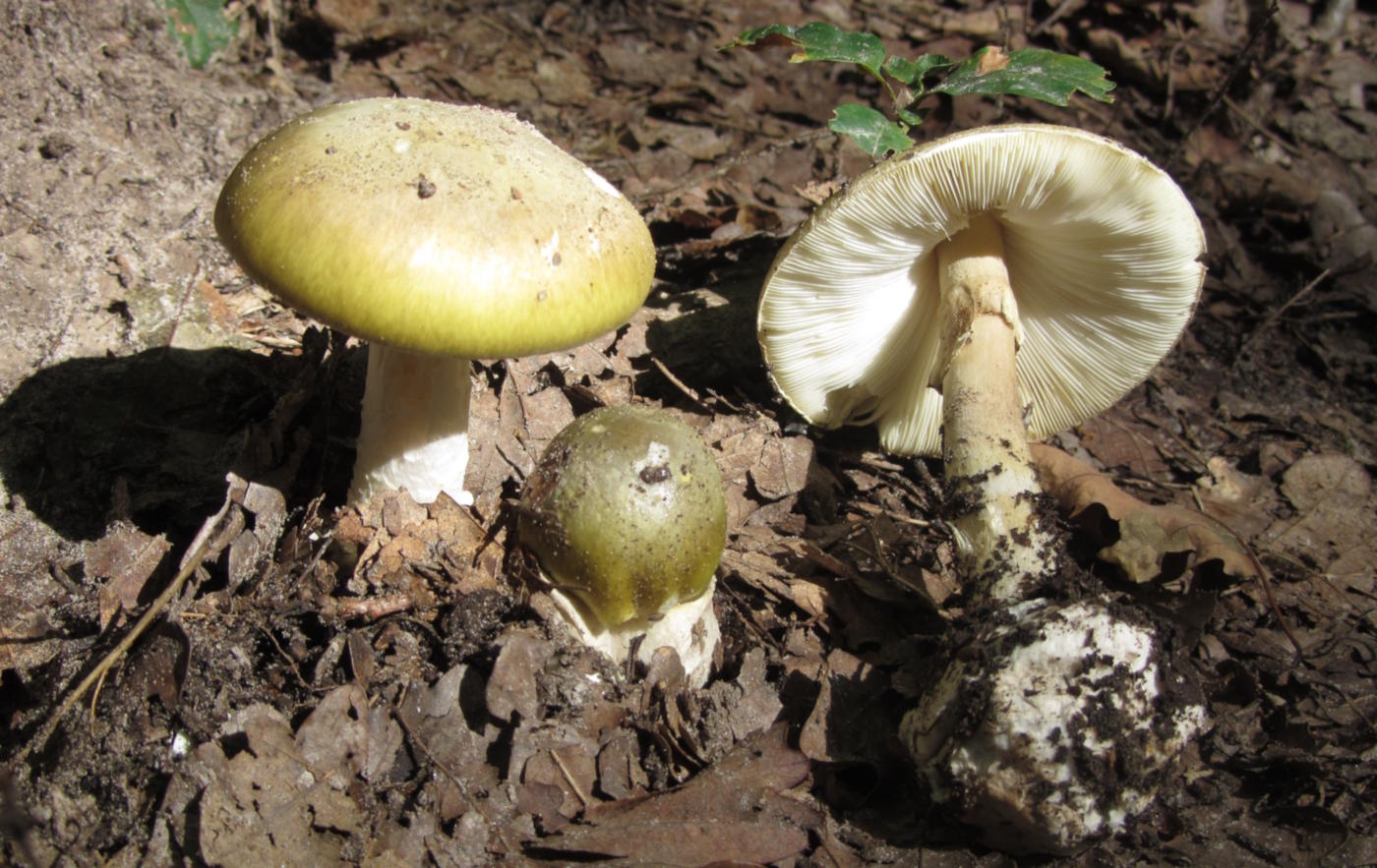
The Death Cap is one of the most dangerous mushrooms in Europe and is responsible for a large proportion of fatal mushroom poisonings. Its appearance can be deceptively ordinary, with a smooth cap ranging from olive green to yellowish, pale brown or almost white.
The gills remain white, the stem usually has a ring, and the base is enclosed in a sack-like volva. The volva may be partly buried, which makes the complete stem base essential for identification.
Why It Is Dangerous
The species contains amatoxins, which damage the liver and other organs. Symptoms are often delayed for many hours, which can create a dangerous false sense of security.
A patient may initially develop severe vomiting, diarrhea and abdominal pain, followed by an apparent improvement. Internal liver damage can continue during this temporary recovery phase.
Main Look-Alikes
Death Caps may be confused with edible Agaricus, some Russula species, Caesar’s Mushroom and other pale Amanitas. The combination of white gills, a ring and a volva should always trigger extreme caution.
2. Amanita virosa — Destroying Angel
- Scientific name: Amanita virosa
- Common name: Destroying Angel
The Destroying Angel is an almost entirely white Amanita found in European woodland. Its clean appearance can make it look harmless, but it contains the same class of deadly amatoxins associated with the Death Cap.
The cap is white, the gills are white, and the stem usually carries a ring. A distinct white volva surrounds the base.
Why It Is Dangerous
Poisoning can lead to catastrophic liver failure. Like Death Cap poisoning, symptoms may be delayed for several hours.
This delay is one of the reasons amatoxin-containing mushrooms are so dangerous. By the time severe gastrointestinal symptoms begin, substantial toxin absorption may already have occurred.
Main Look-Alikes
Young specimens may be confused with Field Mushrooms, Horse Mushrooms or other white fungi. Mature Agaricus species develop pink to brown gills, while Destroying Angel gills remain white.
3. Galerina marginata — Deadly Galerina
- Scientific name: Galerina marginata
- Common names: Deadly Galerina, Funeral Bell
The Deadly Galerina is a small brown mushroom that grows on decaying wood. Its ordinary appearance makes it especially dangerous because it can resemble several edible wood-growing mushrooms.
The cap is usually honey-brown, yellow-brown or reddish brown. Mature gills become rusty brown, and the slender stem may have a fragile ring or ring zone.
Why It Is Dangerous
Galerina marginata contains amatoxins and can cause the same type of severe liver injury associated with deadly Amanitas.
Its small size does not make it harmless. Several small fruit bodies can contain a medically significant toxin dose.
Main Look-Alikes
It may resemble Honey Mushrooms, Kuehneromyces mutabilis, wild enoki and other small brown fungi growing on logs and stumps.
Any small brown mushroom growing on wood should therefore be identified very carefully before it is considered for food.
4. Cortinarius rubellus — Deadly Webcap
- Scientific name: Cortinarius rubellus
- Common name: Deadly Webcap
The Deadly Webcap is an orange-brown to reddish-brown woodland mushroom. It belongs to the enormous genus Cortinarius, which contains many difficult-to-identify brown and rusty-colored species.
Young specimens may show a cobweb-like partial veil called a cortina between the cap and stem. As the mushroom matures, this veil disappears and may leave rusty fibers around the stem.
Why It Is Dangerous
The species contains orellanine, a toxin that can cause severe kidney damage. One of the most dangerous features of orellanine poisoning is the long delay before symptoms.
Signs of poisoning may not become obvious until days after ingestion. Kidney injury can already be advanced by that time.
Main Look-Alikes
It can be confused with other Cortinarius species and various brown woodland mushrooms. Rusty spores and cortina remnants can suggest the genus, but species-level identification can be difficult.
5. Gyromitra esculenta — False Morel
- Scientific name: Gyromitra esculenta
- Common name: False Morel
False Morels appear mainly in spring and can be confused with true morels by inexperienced collectors. Their caps are typically irregular, lobed and strongly wrinkled, often resembling a brown or reddish brain.
The interior is usually chambered rather than completely hollow. This contrasts with true Morchella, which has a honeycomb-like cap and a continuously hollow interior.
Why It Is Dangerous
Some Gyromitra species contain gyromitrin, which can be converted in the body into a highly toxic compound. Poisoning can affect the gastrointestinal tract, nervous system and liver.
Severe cases can involve seizures, liver injury and death.
Main Look-Alikes
The main confusion is with true morels. Cutting the mushroom lengthwise is one of the most useful checks because true morels are hollow while false morels are typically chambered.
6. Inocybe erubescens — Deadly Fibrecap
- Scientific name: Inocybe erubescens
- Common names: Deadly Fibrecap, Red-Staining Inocybe
This pale mushroom can appear in parks, woodland and grassy areas associated with trees. Young caps may be cream or pale beige before becoming more reddish or brown with age and handling.
The cap is fibrous rather than smooth, and damaged areas may develop reddish staining. The gills gradually darken as the spores mature.
Why It Is Dangerous
The species contains high levels of muscarine. This toxin affects the parasympathetic nervous system and can cause heavy sweating, salivation, abdominal cramps, vomiting, diarrhea and cardiovascular effects.
Serious poisoning can occur relatively quickly after ingestion.
Main Look-Alikes
Pale Inocybe species can resemble several small edible or harmless woodland mushrooms. The genus is difficult for beginners and often requires careful microscopic identification.
7. Clitocybe rivulosa — Fool’s Funnel
- Scientific name: Clitocybe rivulosa
- Common names: Fool’s Funnel, False Champignon
This small white to cream mushroom often grows in lawns, parks and grassland. The cap becomes flattened or shallowly funnel-shaped as it matures, while the pale gills run slightly down the stem.
Its plain appearance makes it easy to overlook. It may grow in arcs or rings among grass, sometimes in areas where edible lawn mushrooms also occur.
Why It Is Dangerous
Like the Deadly Fibrecap, Fool’s Funnel contains muscarine. Poisoning can cause sweating, salivation, nausea, vomiting, abdominal cramps and cardiovascular symptoms.
Because the mushroom is relatively small and pale, inexperienced collectors may underestimate its toxicity.
Main Look-Alikes
It may be confused with Fairy Ring Mushrooms and other pale grassland fungi. Gill structure, cap shape and overall texture are more useful than color alone.
8. Paxillus involutus — Brown Roll-Rim
- Scientific name: Paxillus involutus
- Common name: Brown Roll-Rim
The Brown Roll-Rim is a brown woodland mushroom with a strongly inrolled cap margin when young. Its gills run down the stem and can bruise or darken when handled.
Historically, this species was eaten in parts of Europe, which contributed to a dangerous reputation as an edible mushroom.
Why It Is Dangerous
Repeated consumption has been associated with a severe immune-mediated reaction that destroys red blood cells. This condition can cause acute hemolysis, kidney complications and potentially fatal illness.
The reaction is unpredictable and can occur even in people who have eaten the mushroom previously without obvious problems.
Main Look-Alikes
Brown funnel-shaped woodland mushrooms and some milkcaps can appear similar from above. The rolled margin and decurrent gills are important clues, but safe identification still requires the whole mushroom.
9. Chlorophyllum molybdites — Green-Spored Parasol
- Scientific name: Chlorophyllum molybdites
- Common names: Green-Spored Parasol, False Parasol
This large mushroom frequently grows in lawns, parks and gardens, especially in warmer parts of Europe and other temperate regions. The pale cap is covered with brownish scales and can become impressively large.
Young gills are pale but gradually develop gray-green or greenish coloration as the spores mature. The spore print is distinctly green.
Why It Is Dangerous
It is a well-known cause of severe gastrointestinal poisoning. Symptoms can include intense vomiting, diarrhea and abdominal pain.
Although this poisoning is not usually associated with the delayed organ failure seen in amatoxin poisoning, it can still be severe and require medical treatment.
Main Look-Alikes
The species is often confused with the edible Parasol Mushroom, Macrolepiota procera. A green spore print is a major warning sign.
10. Amanita pantherina — Panther Cap
- Scientific name: Amanita pantherina
- Common name: Panther Cap
The Panther Cap has a brown cap decorated with white veil remnants, white gills and a white stem with a ring. The stem base is bulbous and shows remnants of the universal veil.
Its appearance can resemble a brown version of Fly Agaric. In some regions, the two occur in similar woodland habitats.
Why It Is Dangerous
The mushroom contains ibotenic acid and muscimol, compounds that affect the central nervous system. Poisoning can cause confusion, agitation, poor coordination, hallucination-like effects and altered consciousness.
The exact severity can vary considerably between individuals and specimens.
Main Look-Alikes
It may be confused with Amanita rubescens, the Blusher, and other brown Amanitas. The Blusher typically develops characteristic reddish staining when damaged, while Panther Cap does not show the same pattern.
Why Poisonous Mushrooms Are Difficult to Recognize
There is no reliable visual rule that separates poisonous mushrooms from edible ones. Dangerous species can be white, brown, red, orange or green, and some look less unusual than many harmless mushrooms.
Folklore rules such as “poisonous mushrooms have bright colors” or “insects do not eat toxic mushrooms” are unreliable. Toxicity depends on chemistry, not on whether a mushroom looks threatening.
The best identification approach uses several independent features at once. Cap shape, gills or pores, stem base, spore color, staining reactions, substrate and habitat all provide pieces of the same puzzle.
The Most Dangerous Poisoning Syndromes
Different poisonous mushrooms contain very different toxins, so symptoms and timing vary considerably.
Amatoxin Poisoning
Death Caps, Destroying Angels and Deadly Galerina contain amatoxins. Symptoms are often delayed, beginning several hours after consumption, and severe liver injury can follow.
This delayed pattern makes amatoxin poisoning particularly dangerous because the patient may feel normal for a significant period after eating the mushroom.
Orellanine Poisoning
Deadly Webcap contains orellanine, which primarily damages the kidneys. Symptoms can be delayed for days, making the connection between the meal and illness less obvious.
The long delay means anyone who later realizes they may have eaten a Cortinarius species should not wait for symptoms before seeking professional advice.
Muscarine Poisoning
Fool’s Funnel and Deadly Fibrecap contain muscarine. Symptoms generally involve excessive parasympathetic activity, including sweating, salivation, gastrointestinal distress and cardiovascular changes.
This syndrome usually develops more rapidly than amatoxin or orellanine poisoning.
White Poisonous Mushrooms in Europe
White mushrooms deserve particular caution because several deadly Amanitas have an almost entirely white appearance.
Destroying Angels may have white caps, white gills, white stems, rings and volvas. Pale Death Caps can also appear nearly white.
By comparison, edible Agaricus species typically develop pink and then brown gills. Examining the complete stem base is especially important because a hidden volva strongly suggests Amanita.
Brown Poisonous Mushrooms in Europe
Brown is one of the most common mushroom colors, so it provides little safety information.
Deadly Galerina, Deadly Webcap and Brown Roll-Rim all demonstrate that ordinary brown mushrooms can be seriously poisonous. Several of them also grow in the same habitats as edible species.
Small brown mushrooms are particularly difficult to identify because unrelated genera can look remarkably similar.
Poisonous Mushrooms Growing on Lawns
Lawns can contain poisonous fungi as well as edible or harmless species. Fool’s Funnel and Green-Spored Parasol are two important examples.
Trees near lawns also allow mycorrhizal fungi such as Amanitas to appear in grass. A mushroom growing several meters from the nearest trunk may still be connected to tree roots underground.
This is why habitat should always be interpreted together with the physical structure of the mushroom.
Poisonous Mushrooms Growing on Wood
Deadly Galerina is one of the most important dangerous wood-growing mushrooms in Europe. It can fruit from logs, stumps and buried woody material.
The same wood can support several fungal species at once. A collector who correctly identifies an edible cluster on one part of a stump should never assume every nearby brown mushroom is identical.
This is especially relevant when collecting Honey Mushrooms or other clustered wood-growing species.
What to Do if a Poisonous Mushroom May Have Been Eaten
Suspected mushroom poisoning should be taken seriously even if the person currently feels well. Some of the most dangerous mushroom toxins produce delayed symptoms.
Contact emergency medical services or a poison center promptly and preserve any remaining mushrooms, food scraps and photographs. Information about the collection location and time of ingestion can help with identification and treatment.
Do not rely on home remedies or wait for symptoms to become severe.
How to Photograph a Suspected Poisonous Mushroom
A useful identification set should show the cap, underside, entire stem and complete stem base. Photographing the mushroom before cutting off the lower stem is particularly important for Amanita identification.
Also include the substrate and surrounding habitat. Nearby trees, dead wood and grassland can all provide important clues.
If several specimens are present, photograph young and mature examples because gill color, cap shape and veil structures often change with age.
Can AI Identify Poisonous Mushrooms?
AI can help suggest possible species and highlight dangerous candidates, especially when several clear photographs are available. It is useful as a screening and educational tool rather than a final safety decision.
The main limitation is that photographs may not show smell, microscopic features, staining reactions, hidden volvas or other critical characteristics. Closely related species can also look nearly identical in photographs.
For these reasons, an AI result should never be used as permission to eat an unknown wild mushroom.
Frequently Asked Questions
What is the deadliest mushroom in Europe?
The Death Cap, Amanita phalloides, is among the most dangerous European mushrooms because it contains amatoxins capable of causing severe and fatal liver failure.
Are all Amanita mushrooms poisonous?
No. The genus contains edible, poisonous and deadly species. However, because some Amanitas are extremely dangerous, identification within this genus requires particular care.
What poisonous mushroom looks like a field mushroom?
White Amanitas such as Destroying Angels can superficially resemble young Field Mushrooms. Agaricus gills usually turn pink and then brown, while Amanita gills remain white.
What poisonous mushrooms grow on wood?
Galerina marginata is an especially important example. It grows on decaying wood and contains deadly amatoxins.
Are red mushrooms always poisonous?
No. Color does not reliably indicate toxicity. Both poisonous and non-poisonous mushrooms can be brightly colored.
Can poisonous mushrooms grow in lawns?
Yes. Fool’s Funnel and Green-Spored Parasol are examples, and some Amanitas can also appear in lawns near suitable trees.
Can touching a poisonous mushroom poison you?
Ordinary handling of intact poisonous mushrooms is not the same as eating them. The major poisoning risk comes from ingestion, although washing hands after handling unknown fungi is sensible.
Does cooking destroy mushroom toxins?
Not reliably. Many dangerous toxins survive normal cooking, and cooking should never be used to make an unidentified mushroom safe.
How quickly do mushroom poisoning symptoms appear?
It depends on the toxin. Some syndromes begin within hours, while amatoxin or orellanine poisoning can have long delays.
What should I do if I ate an unknown wild mushroom?
Seek professional medical or poison-control advice promptly, especially if the species is uncertain. Keep mushroom samples and photographs if possible.
Final Identification Notes
Europe’s most dangerous mushrooms do not share one obvious appearance. Some are white Amanitas, some are small brown wood-growing fungi, and others are orange-brown woodland species that look relatively ordinary.
The most important groups to recognize include amatoxin-containing Amanitas and Galerina, orellanine-containing Cortinarius, toxic false morels and muscarine-containing lawn and woodland species. Learning these groups is often more useful than memorizing a single “poisonous mushroom look.”
Always examine the whole fruit body, especially the underside and stem base, and consider habitat, host trees, season and spore color. If there is uncertainty, leave the mushroom uneaten and seek expert identification rather than relying on appearance alone.