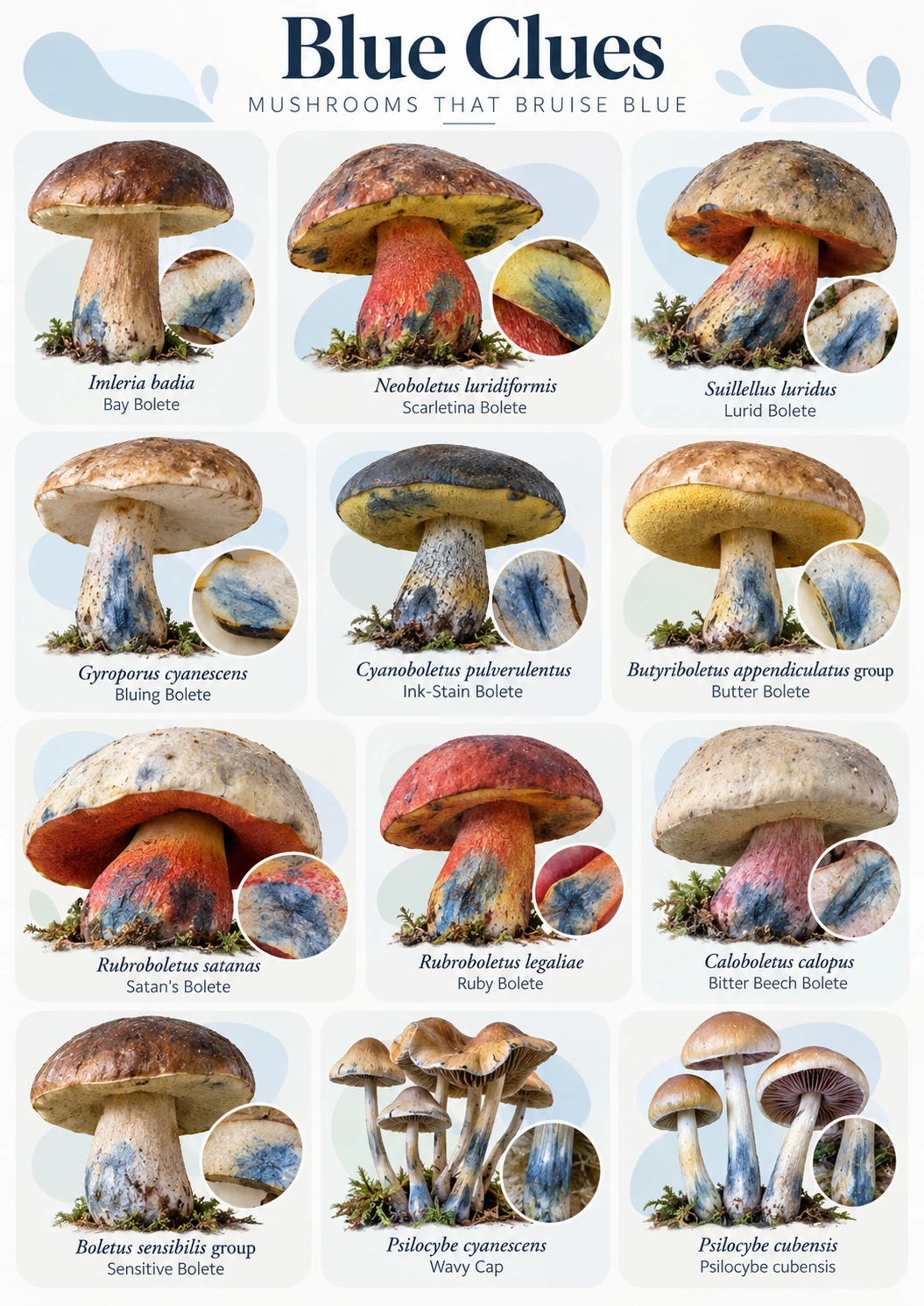
Some mushrooms change color dramatically when they are cut, pressed, or damaged. Among the most striking reactions is blue bruising, which can appear within seconds on the cap, stem, pore surface, or exposed flesh.
This color change is especially common in certain boletes, but it also occurs in other mushroom groups. Blue bruising can be a useful identification feature, yet it does not mean that a mushroom is automatically edible, poisonous, psychedelic, or safe to handle.
⚠️ Important: Blue bruising is only one identification feature. Never eat a wild mushroom based solely on a color change, photograph, AI identification, or online comparison.
Quick Guide to Common Blue-Bruising Mushrooms
| Species or group | Common name | Where blue appears | Typical reaction | Safety |
|---|---|---|---|---|
| Imleria badia | Bay Bolete | Pores and flesh | Moderate blueing | Edible when correctly identified |
| Neoboletus luridiformis | Scarletina Bolete | Pores and flesh | Rapid dark blueing | Edibility depends on correct ID and preparation |
| Suillellus luridus | Lurid Bolete | Flesh and pores | Strong blueing | Edibility requires caution |
| Gyroporus cyanescens | Bluing Bolete | Flesh | Rapid vivid blue | Edible when correctly identified |
| Cyanoboletus pulverulentus | Ink-Stain Bolete | Entire damaged surface | Very rapid dark blueing | Not generally recommended for beginners |
| Butyriboletus appendiculatus group | Butter Bolete | Flesh, especially cap | Mild to moderate blueing | Edible when correctly identified |
| Rubroboletus satanas | Satan’s Bolete | Flesh | Blueing after cutting | Poisonous |
| Rubroboletus legaliae | Ruby Bolete | Flesh and pores | Blueing | Poisonous |
| Caloboletus calopus | Bitter Beech Bolete | Flesh | Blueing | Inedible due to bitterness |
| Boletus sensibilis group | Sensitive Bolete | Flesh and pores | Rapid blueing | Some related species cause illness |
| Psilocybe cyanescens | Wavy Cap | Stem and damaged tissue | Blue-green bruising | Psychoactive; not a food mushroom |
| Psilocybe cubensis | — | Stem and cap tissue | Blue-green bruising | Psychoactive; not a food mushroom |
Why Do Mushrooms Bruise Blue?
Blue bruising is usually a chemical reaction caused when mushroom tissue is damaged and compounds inside the cells are exposed to oxygen. Enzymes can convert these compounds into new pigments that appear blue, blue-green, or almost black.
Different mushroom groups use different chemical pathways. This means that two unrelated mushrooms can both turn blue for completely different biochemical reasons.
Oxidation Is the Main Trigger
Cutting, crushing, pressing, or even insect damage can break cells and expose their contents to air. The reaction may begin immediately or develop gradually over several minutes.
Moisture and temperature can affect how clearly the color appears. A dry old specimen may show a weaker reaction than a fresh mushroom from the same species.
Blue Bruising Is Especially Common in Boletes
Boletes are the group most strongly associated with blue bruising. These mushrooms have pores rather than gills, and many species change color when the pore surface or flesh is damaged.
The reaction can vary from a faint blue stain to an almost instant deep navy or black-blue transformation. Speed and intensity are often useful identification clues.
1. Imleria badia — Bay Bolete
Identification
Bay Bolete has a chestnut-brown cap, yellow pores, and a relatively smooth brownish stem. The pore surface often turns blue when pressed.
The flesh may also show some blueing, although the reaction is usually less dramatic than in strongly blue-staining boletes. The overall fruit body is typically more slender than classic Porcini.
What the Blueing Means
The reaction supports identification as a blue-bruising bolete but does not identify the species by itself. Cap color, stem structure, pore color, and habitat still matter.
Bay Bolete is considered edible when correctly identified. Its blue bruising should not be interpreted as evidence of toxicity.
2. Neoboletus luridiformis — Scarletina Bolete
Identification
Scarletina Bolete typically has a dark brown cap, yellow flesh, and orange-red to red pores. The stem is often covered with small red dots rather than a net-like pattern.
When cut or bruised, the flesh can turn dark blue very quickly. The reaction can be dramatic enough to surprise anyone seeing it for the first time.
What the Blueing Means
Rapid blueing is a normal feature of this species. It does not automatically indicate that the mushroom is poisonous.
Correct identification is still essential because several red-pored boletes can look similar. Some require careful preparation, while others are toxic.
3. Suillellus luridus — Lurid Bolete
Identification
Lurid Bolete has a brown to olive cap, yellow flesh, and pores that can become orange or red with age. The stem often shows a visible red or brownish network.
Cut flesh usually turns blue, often strongly. A reddish line may be visible between the pore layer and cap flesh in some specimens.
What the Blueing Means
Blue staining is useful when combined with the red-pored surface and reticulated stem. The mushroom belongs to a group where species-level identification can be difficult.
For beginners, red-pored blueing boletes should be approached cautiously. Several look-alikes differ significantly in toxicity.
4. Gyroporus cyanescens — Bluing Bolete
Identification
Bluing Bolete usually has a pale tan to yellow-brown cap and a brittle or chambered stem. The flesh is pale before being damaged.
When cut, it can turn vivid cornflower blue or deep blue surprisingly quickly. The contrast between pale flesh and intense blue staining is especially striking.
What the Blueing Means
The reaction is one of the most characteristic features of the species. It is so strong that the mushroom’s common name directly refers to it.
Even here, the blue color should be combined with the unusual stem structure and overall pale appearance. A color reaction alone is never enough for a secure identification.
5. Cyanoboletus pulverulentus — Ink-Stain Bolete
Identification
Ink-Stain Bolete has a brown cap, yellow pores, and a yellowish stem that may show reddish tones. Almost any damaged part of the mushroom can turn dark blue rapidly.
The reaction can become so intense that bruised areas look nearly black. This makes the species one of the most dramatic blue-staining boletes.
What the Blueing Means
Very rapid and widespread blueing is a useful clue. However, the species should not be identified only from the intensity of the stain.
Other strongly blueing boletes can show similar reactions. Pore color, stem ornamentation, and habitat must also agree.
6. Butyriboletus appendiculatus Group — Butter Boletes
Identification
Butter Boletes usually have brown caps, yellow pores, and thick yellowish stems. The upper stem may show fine reticulation.
The flesh may bruise blue, especially in the cap or near the pore layer. The reaction is often milder than in intensely staining red-pored boletes.
What the Blueing Means
A weak or moderate reaction can help separate these mushrooms from non-blueing king boletes. The exact strength varies between species and individual specimens.
Species-level identification within this group can be difficult. Geography and host tree may be important.
7. Rubroboletus satanas — Satan’s Bolete
Identification
Satan’s Bolete is a large, heavy mushroom with a pale grayish cap, red pores, and a thick stem showing red and yellow tones. The flesh can turn blue after cutting.
Its dramatic appearance makes it easier to notice than many brown boletes. Young specimens may still be confusing if the pore color is not yet fully developed.
What the Blueing Means
The blue reaction does not make it unique among toxic boletes. Several edible and poisonous species stain blue.
Satan’s Bolete is poisonous and can cause severe gastrointestinal illness. Identification should focus on the combination of pale cap, red pores, thick colored stem, and bruising.
8. Rubroboletus legaliae — Ruby Bolete
Identification
Ruby Bolete has a pale to pinkish cap, red or orange-red pores, and a stout stem with reddish coloration. The flesh can turn blue when cut.
Its colors can change considerably with age and weather. Mature mushrooms often become more strongly reddish.
What the Blueing Means
The stain supports placement among red-pored boletes but does not separate it from related species. Several members of the group require expert-level comparison.
The species is considered poisonous. This is another reminder that blueing can occur in dangerous mushrooms.
9. Caloboletus calopus — Bitter Beech Bolete
Identification
Bitter Beech Bolete has a pale gray-brown cap, yellow pores, and a striking stem that is yellow near the top and red lower down. Fine reticulation may be visible on the stem.
The yellow flesh can turn blue when cut. The mushroom also has an intensely bitter taste, although tasting unknown mushrooms is not recommended for beginners.
What the Blueing Means
The color change helps separate it from some non-blueing boletes but is not the main identifying feature. Stem coloration and extreme bitterness are equally characteristic.
The species is generally treated as inedible. Blue bruising does not indicate whether it is safe or unsafe.
10. Boletus sensibilis Group — Sensitive Boletes
Identification
Sensitive boletes are known for rapid blue bruising after handling. The cap is often brownish, while the pore surface is yellow before staining.
The flesh can react almost immediately after cutting. This fast response explains the common name “Sensitive Bolete.”
What the Blueing Means
Rapid staining is useful but can overlap with several related North American boletes. Exact species identification can require careful attention to geography and microscopic features.
Some species in this broader complex have been associated with gastrointestinal illness. For that reason, identification should not rely on the blue reaction alone.
11. Psilocybe cyanescens — Wavy Cap
Identification
Wavy Cap is a small brown mushroom with a wavy mature cap and dark purplish-brown spores. Damaged tissue can develop blue or blue-green staining.
The mushroom often grows on wood chips, mulch, and decaying woody debris. Its habitat differs strongly from typical blueing boletes.
What the Blueing Means
In Psilocybe, blue bruising is associated with oxidation of compounds related to psilocybin chemistry. This is a completely different pathway from the blueing seen in boletes.
The color reaction alone is not sufficient for identification. Several small brown mushrooms can grow in the same habitat, including dangerous species.
12. Psilocybe cubensis
Identification
Psilocybe cubensis typically has a tan to golden-brown cap, dark purplish-brown spores, and a ring on the stem. Damaged areas can develop blue-green staining.
It is primarily associated with warmer climates and nutrient-rich substrates. Its ecology is very different from woodland boletes.
What the Blueing Means
Blueing is one supporting characteristic but should never be treated as proof of identity. Small brown mushrooms can be difficult to separate visually.
The species is psychoactive rather than a conventional edible mushroom. Legal status also varies by jurisdiction.
Does Blue Bruising Mean a Mushroom Is Poisonous?
No. This is one of the most persistent mushroom myths. Some edible boletes bruise blue, while some poisonous boletes do the same. Many deadly mushrooms, including Death Caps, do not need to bruise blue at all. The color change describes chemistry, not toxicity. A mushroom must still be identified to species or a confidently understood species group.
Does Blue Bruising Mean a Mushroom Is Psychedelic?
No. Some psilocybin-containing mushrooms bruise blue, but many blue-bruising mushrooms contain no psilocybin at all. Boletes are the clearest example. Numerous species turn blue because of unrelated oxidative chemistry. Using blue bruising as a shortcut for identifying psychoactive mushrooms is therefore unreliable and potentially dangerous.
Does Blue Bruising Mean the Mushroom Is Edible?
No. Blueing occurs in edible, inedible, and poisonous species. Bay Bolete and several other correctly identified boletes are eaten, while toxic red-pored species can also turn blue. The reaction tells you something about the mushroom’s chemistry, not whether it belongs on a plate.
How Fast Can a Mushroom Turn Blue?
The speed varies greatly. Some species stain within a second or two, while others take several minutes to develop a visible reaction. Fast bruising can be useful when comparing similar boletes. However, age, dryness, temperature, and exactly where the mushroom is damaged can all change the speed.
Instant Blueing
Species such as Ink-Stain Bolete can react almost immediately. The color may spread rapidly across damaged flesh or pore surfaces. This dramatic response is visually memorable. It still needs to be combined with morphology.
Slow Blueing
Other species develop only faint blue tones after several minutes. A weak delayed reaction can be easy to miss. Photographing the cut surface immediately and again later is a good way to document the change.
Where Should You Check for Blue Bruising?
Different species react in different parts of the fruit body. The pore surface, cap flesh, stem flesh, and outer stem may each behave differently. Pressing the pore surface gently is often the easiest first test in boletes. A clean vertical cut through the mushroom provides more complete information.
Pore Surface
Many boletes stain blue when the pores are pressed. This can happen even when the deeper flesh reacts only weakly. Pore bruising is especially easy to photograph. Use natural light because artificial warm light can distort the color.
Cut Flesh
Cutting through the cap and stem shows whether the interior changes color. Some species blue only in selected zones. Observe the cut surface for several minutes. The final pattern can be as useful as the initial reaction.
Stem Surface
Handling alone may produce blue or dark marks on the stem. This can be particularly noticeable on yellow-stemmed boletes. Do not confuse old brown damage with fresh blue staining. A newly made pressure mark provides a clearer test.
Blue Bruising vs Natural Blue Color
A naturally blue mushroom and a mushroom that bruises blue are not the same thing. Some mushrooms are blue before being damaged and may show little additional color change. Bruising refers specifically to a new color developing after tissue injury. The before-and-after comparison is what matters. This distinction can be useful when looking at photographs. A single blue mushroom image does not tell you whether any bruising reaction occurred.
Blue Bruising vs Blackening
Some mushrooms first turn blue and later become nearly black. Others darken brown or black without ever showing a true blue stage. Timing matters. Watching the reaction from the first few seconds can reveal a color transition that would be invisible on an old damaged specimen. Strongly oxidized tissue can also lose the original blue tone. Fresh damage provides the clearest evidence.
How to Test Blue Bruising Safely
A gentle pressure on the pore surface is usually enough for many boletes. There is no need to crush the entire mushroom. For a more complete examination, cut one specimen vertically through the cap and stem. Photograph the tissue immediately and then again after one, five, and ten minutes if the reaction is slow. Avoid taste testing as a general beginner technique. Bruising can usually be documented without putting any mushroom tissue in the mouth.
How Blue Bruising Helps Identify Boletes
Blueing becomes most useful when combined with pore color and stem pattern. A yellow-pored bolete that blues points toward a different group from a red-pored bolete with the same reaction. Stem reticulation, red dots, smooth surfaces, and cap color can then narrow the possibilities further. Host trees and geography provide another layer of evidence.
Yellow Pores + Blue Bruising
This combination occurs in several species, including Bay Bolete and various other boletes. Stem structure becomes especially useful after the pore color and reaction are noted. A thick reticulated stem and a smooth slender stem can lead toward completely different taxa. The blue reaction alone does not resolve them.
Red Pores + Blue Bruising
Red-pored blueing boletes deserve extra caution. This group contains both edible and poisonous species, and some are difficult to separate. Beginners should not use the rule “blue means bad” or “blue means good.” Red pores plus blueing simply means a more careful identification is needed.
Does Cooking Stop the Blue Color?
Heat often changes or destroys the pigments responsible for blue bruising. A mushroom that turns deep blue when raw may lose much of that color during cooking. This has no value for identification once the mushroom has already been prepared. Structural features should be documented before cooking. Color loss also does not remove toxins. Cooking effects on pigments and cooking effects on toxic compounds are separate issues.
How to Photograph Blue Bruising for Identification
Take one image before damaging the mushroom. Then photograph the same area immediately after pressing or cutting it.
If the reaction continues, take another image after several minutes. This sequence records both speed and intensity.
A final photo should show the entire mushroom, including pores, stem, and habitat. Close-up color alone is not enough for species identification.
Can AI Identify Blue-Bruising Mushrooms?
AI can use bruising patterns as one part of the identification process, especially when before-and-after photographs are available. It can also compare cap color, pore surface, stem pattern, and overall shape.
The main limitation is that blueing reactions are shared by many species. A single photograph of blue-stained flesh may match several unrelated mushrooms.
For better results, include the undamaged mushroom, pore surface, cut section, complete stem, and nearby trees. Geography is especially important for closely related boletes.
Common Blue-Bruising Mushroom Identification Mistakes
One common mistake is treating the blue reaction as a direct test for poison. That shortcut fails because both edible and toxic mushrooms can turn blue.
Another mistake is ignoring how quickly the color develops. Fast and slow reactions can be useful when combined with other morphology.
A third mistake is judging from an old bruise. Brown, black, and faded damaged tissue can hide the original blue stage, so fresh observation is much more informative.
Frequently Asked Questions
Why does one mushroom in a group bruise strongly while another barely changes color?
Age, moisture, temperature, and tissue condition can all influence the reaction. Even fruit bodies from the same mycelium may show different intensity if one is fresher or more hydrated.
Can insect bites cause blue staining before I touch the mushroom?
Yes. Insects, slugs, and other physical damage can break the tissue and trigger the same chemical reaction. Pre-existing blue patches may therefore mark earlier injuries.
Does freezing affect a blue-bruising reaction?
Yes. Frozen or repeatedly thawed tissue may react weakly or irregularly because cell structures have already been damaged. Fresh unfrozen tissue usually provides a clearer response.
Can dried mushrooms still show a blue reaction?
Usually much less clearly. Drying changes tissue chemistry and removes water needed for many visible reactions, so fresh specimens are far better for observing bruising.
Why does a blue bruise sometimes fade after a while?
The blue compounds can continue oxidizing into darker or less vivid products. A bright blue mark may therefore become gray, brown, or nearly black with time.
Can blue staining transfer to nearby mushrooms in a basket?
Pigments and damaged tissue can rub against neighboring specimens, creating misleading marks. Keeping uncertain mushrooms separate helps preserve useful identification evidence.
Does washing a mushroom affect the bruising test?
Yes. Water can dilute surface pigments, cool the tissue, and make subtle color changes harder to judge. Bruising reactions are best observed before washing.
Is photographing the reaction better than relying on memory?
Yes. A short sequence of images can capture the exact timing and color progression much more reliably than memory alone. This is especially useful when comparing similar bolete species.
Final Identification Notes
Blue bruising is a fascinating and useful mushroom feature, but it is not a shortcut to edibility, toxicity, or psychoactivity. The reaction simply shows that damaged tissue is undergoing a chemical change.
For boletes, the best approach is to combine pore color, bruising speed, stem pattern, flesh color, cap features, habitat, host trees, and geography. A blue stain becomes meaningful only when the rest of the mushroom supports the same identification.
The safest rule is simple: treat blue bruising as one clue among many. If the complete set of features does not fit a known species or species group, the mushroom should remain unidentified.
Upload a photo and get possible matches in seconds.