Mushrooms Growing on Trees: 15 Common Species and How to Identify Them
Mushrooms growing on trees can belong to many very different groups. Some form large shelf-like brackets, others grow in clusters with caps and stems, and a few appear as crusts, teeth, or gelatinous masses attached directly to bark or dead wood.
The first step in identifying a tree-growing mushroom is to determine whether it is growing on living wood, dead wood, a stump, or buried roots. The shape of the fruit body, the underside, texture, host tree, and whether the fungus causes visible decay can then narrow the possibilities much further.
⚠️ Important: This guide is for identification and education only. Never eat a wild mushroom based solely on a photograph, AI result, or comparison with an online guide.
Quick Guide to 15 Mushrooms That Grow on Trees
| Species | Common name | Typical growth | Main clue |
|---|---|---|---|
| Laetiporus sulphureus | Chicken of the Woods | Large orange shelves | Bright orange-yellow brackets |
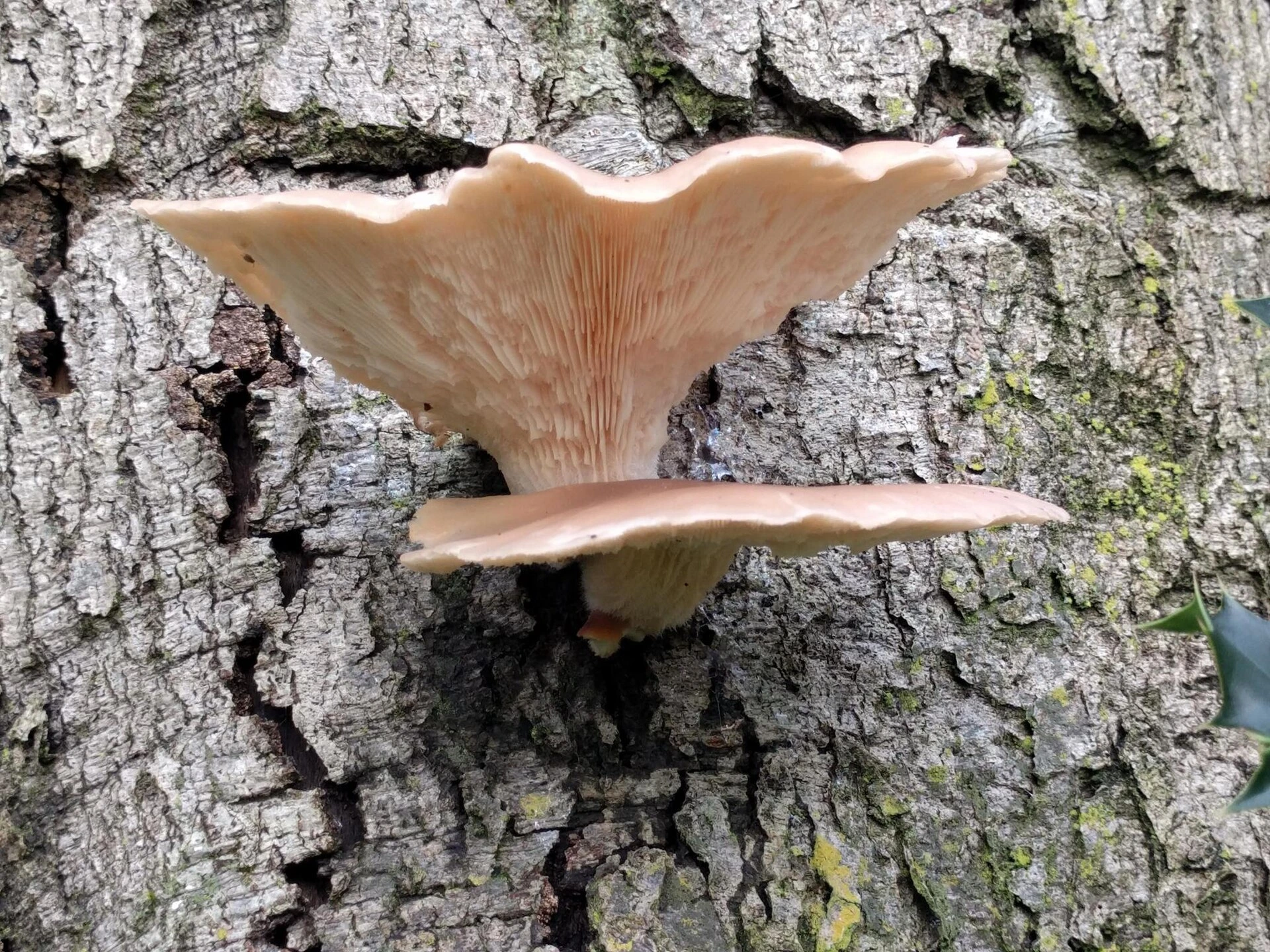
| Pleurotus ostreatus | Oyster Mushroom | Layered clusters | Pale fan-shaped caps with decurrent gills |
| Armillaria species | Honey Mushrooms | Dense clusters | Honey-brown caps, white spores |
| Galerina marginata | Deadly Galerina | Small clusters on dead wood | Rusty spores, deadly poisonous |
| Trametes versicolor | Turkey Tail | Thin layered brackets | Multicolored concentric bands |
| Fomes fomentarius | Tinder Fungus | Hoof-shaped bracket | Hard gray hoof-like body |
| Ganoderma applanatum | Artist’s Conk | Large perennial bracket | White pore surface bruises brown |
| Hericium erinaceus | Lion’s Mane | Hanging white mass | Long white teeth |
| Hericium coralloides | Coral Tooth Fungus | Branched clusters | Coral-like branches with teeth |
| Cerioporus squamosus | Dryad’s Saddle | Large scaly shelves | Brown scales and large pores |
| Schizophyllum commune | Split Gill | Small gray fans | Split-looking gills |
| Flammulina velutipes | Velvet Shank | Small winter clusters | Dark velvety stem base |
| Kuehneromyces mutabilis | Sheathed Woodtuft | Dense clusters | Two-toned hygrophanous cap |
| Pholiota squarrosa | Shaggy Scalycap | Clusters on trunks and stumps | Coarse scales on cap and stem |
| Meripilus giganteus | Giant Polypore | Massive basal rosettes | Pale brackets that blacken when bruised |
Why Do Mushrooms Grow on Trees?
Tree-growing mushrooms use wood in different ways. Some are decomposers that break down dead trunks, branches and stumps, while others can infect living trees and contribute to internal decay.
A few species can behave as both parasites and decomposers. They may begin on living wood and continue fruiting after the tree dies.
This ecological role is important for identification because the same-looking mushroom growing on a living oak may suggest a different group than one growing on a fallen conifer log.
1. Laetiporus sulphureus — Chicken of the Woods
- Scientific name: Laetiporus sulphureus
- Common name: Chicken of the Woods
Chicken of the Woods forms large overlapping shelves that are bright orange above and yellow underneath. Fresh young fruit bodies are soft and fleshy, while older brackets become pale, dry, and tough.
The underside has pores rather than gills. It commonly grows on hardwood trunks, stumps, and large branches.
How to Identify It
Look for vivid orange-yellow shelves growing directly from wood. The pore surface underneath should be yellow, and the brackets should be thick and fleshy when young.
Older specimens can fade dramatically, so color becomes less reliable with age.
2. Pleurotus ostreatus — Oyster Mushroom
- Scientific name: Pleurotus ostreatus
- Common name: Oyster Mushroom
Oyster Mushrooms form overlapping fan-shaped caps on dead or weakened hardwood. Colors range from white and cream to gray or brown.
The gills are white to cream and run down the short, off-center stem or attachment point. Caps often grow in layered clusters resembling oyster shells.
How to Identify It
The combination of fan-shaped caps, decurrent pale gills and direct attachment to wood is characteristic.
Several related Pleurotus species look similar, so exact species-level identification may require geography and season.
3. Armillaria Species — Honey Mushrooms
- Common name: Honey Mushrooms
Honey Mushrooms often grow in large dense clusters around tree bases, stumps and buried roots. Their caps are usually honey-yellow, tan or brown and may have small darker scales.
Many species have a ring on the stem and produce a white spore print. The stems are generally robust and fibrous.
How to Identify Them
Large clustered growth, pale gills, a robust stem and white spores are useful clues.
Care is essential because deadly brown wood-growing mushrooms can occur in similar habitats.
4. Galerina marginata — Deadly Galerina
- Scientific name: Galerina marginata
- Common name: Deadly Galerina
Deadly Galerina is a small brown mushroom that grows on decaying wood. It may occur singly, scattered or in small groups.
The cap is yellow-brown to reddish brown, the mature gills become rusty brown, and the stem is slender with a fragile ring or ring zone.
Why It Matters
This species contains deadly amatoxins and can be confused with edible wood-growing mushrooms.
Its rusty-brown spore print is an important distinction from white-spored Honey Mushrooms.
5. Trametes versicolor — Turkey Tail
- Scientific name: Trametes versicolor
- Common name: Turkey Tail
Turkey Tail forms thin, semicircular brackets arranged in overlapping layers on dead hardwood.
The upper surface shows concentric zones of brown, gray, cream, rust, blue-gray and other subtle colors. The underside is pale and covered with tiny pores.
How to Identify It
The combination of thin flexible brackets, multicolored concentric bands and a finely pored white underside is characteristic.
Many crust fungi resemble Turkey Tail from above, so checking the pore surface is important.
6. Fomes fomentarius — Tinder Fungus
- Scientific name: Fomes fomentarius
- Common names: Tinder Fungus, Hoof Fungus
This perennial bracket fungus forms thick gray to brown fruit bodies shaped like a horse’s hoof.
It is hard and woody rather than soft and fleshy. The underside has a pale pore surface that darkens with age.
Habitat
Tinder Fungus commonly grows on birch, beech and other broadleaf trees.
The fruit body can remain attached for years and develop additional growth layers each season.
7. Ganoderma applanatum — Artist’s Conk
- Scientific name: Ganoderma applanatum
- Common name: Artist’s Conk
Artist’s Conk produces large, hard brackets with brown upper surfaces and a white underside.
The white pore surface bruises brown when scratched, which allows lines and drawings to remain visible after the surface dries. This feature explains the common name.
How to Identify It
Large woody brackets with a pale underside that immediately darkens when marked strongly suggest this species or a close relative.
It commonly grows on dead or weakened hardwood.
8. Hericium erinaceus — Lion’s Mane
- Scientific name: Hericium erinaceus
- Common name: Lion’s Mane
Lion’s Mane looks unlike a typical mushroom. It forms a rounded white mass covered in long hanging teeth.
Young fruit bodies are white to cream, becoming yellowish or brownish with age. It grows on hardwood trunks, wounds and fallen wood.
How to Identify It
The long unbranched teeth hanging from a compact central body are the key feature.
Other Hericium species are more strongly branched and coral-like.
9. Hericium coralloides — Coral Tooth Fungus
- Scientific name: Hericium coralloides
- Common name: Coral Tooth Fungus
This species forms intricate white branching fruit bodies with numerous small hanging teeth.
It resembles underwater coral more than a conventional cap-and-stem mushroom. It usually grows on dead hardwood logs and trunks.
Main Difference From Lion’s Mane
Lion’s Mane is more compact and rounded with long teeth emerging from a central mass.
Hericium coralloides is highly branched, with shorter teeth distributed across many branches.
10. Cerioporus squamosus — Dryad’s Saddle
- Scientific name: Cerioporus squamosus
- Common names: Dryad’s Saddle, Pheasant Back
Dryad’s Saddle forms large fan-shaped brackets with tan caps covered in darker brown scales.
The underside has large angular pores, and the fruit body may have a short lateral stem. It often grows from broadleaf trees, stumps and logs.
How to Identify It
Large scale-patterned caps combined with large visible pores are highly characteristic.
The mushroom often appears in spring and can form impressive stacked clusters.
11. Schizophyllum commune — Split Gill
- Scientific name: Schizophyllum commune
- Common name: Split Gill
Split Gill produces small gray-white fan-shaped fruit bodies on dead wood.
From above, it can resemble a tiny bracket fungus, but the underside has distinctive gill-like folds that appear split along their edges.
How to Identify It
The fruit bodies are usually small, tough and hairy above.
The unusual split gills underneath are the best feature for confirming the identification.
12. Flammulina velutipes — Velvet Shank
- Scientific name: Flammulina velutipes
- Common name: Velvet Shank
Velvet Shank grows in clusters on stumps and dead wood, often during cool weather when many other mushrooms are absent.
The caps are honey-yellow to orange-brown and can become sticky when wet. The lower stem develops a distinctive dark velvety texture.
How to Identify It
Look for clustered orange-brown caps, pale gills and a dark velvety stem base.
Extra caution is required because it can occur in the same habitat as Deadly Galerina.
13. Kuehneromyces mutabilis — Sheathed Woodtuft
- Scientific name: Kuehneromyces mutabilis
- Common name: Sheathed Woodtuft
This clustered wood-growing mushroom has yellow-brown to cinnamon caps that change color significantly as they dry.
The cap is often darker around the margin when wet and lighter toward the center after drying. The lower stem is usually darker and covered with small scales beneath the ring.
How to Identify It
The strongly hygrophanous two-toned cap and scaly lower stem are useful clues.
Because it can resemble Deadly Galerina, identification should be made with extreme care.
14. Pholiota squarrosa — Shaggy Scalycap
- Scientific name: Pholiota squarrosa
- Common name: Shaggy Scalycap
Shaggy Scalycap forms conspicuous clusters around trunks, roots and stumps.
The yellow-brown caps are covered in coarse dark scales, and similar scales continue down the stem. The gills become brownish as the spores mature.
How to Identify It
The heavy rough scales on both cap and stem make this species relatively distinctive.
It can grow on living or dead trees and may appear around the base in dense groups.
15. Meripilus giganteus — Giant Polypore
- Scientific name: Meripilus giganteus
- Common name: Giant Polypore
Giant Polypore forms massive clusters of overlapping pale brown brackets, usually around the base of mature broadleaf trees.
Individual shelves can be broad and thin, while the complete cluster can become enormous. Damaged areas often darken or blacken.
How to Identify It
The combination of a huge basal rosette and strong blackening after bruising is very useful.
It can indicate significant root or lower-trunk decay in living trees.
Mushrooms Growing on Living Trees
A mushroom on a living tree does not necessarily mean the tree is immediately dying, but it can indicate internal decay.
Species such as Chicken of the Woods, Giant Polypore, Artist’s Conk and Honey Mushrooms may occur on living trees or their roots.
The location of fruit bodies can sometimes indicate where decay is concentrated. Brackets high on a trunk suggest different internal damage than large rosettes emerging from the root zone.
Mushrooms Growing on Dead Trees
Dead wood supports an enormous diversity of fungi.
Oyster Mushrooms, Turkey Tail, Lion’s Mane, Coral Tooth Fungus, Split Gill and many small brown mushrooms can all occur on dead trunks and branches.
The host tree can be a useful clue because some fungi strongly prefer hardwood while others are associated with conifers.
Mushrooms Growing on Tree Stumps
Stumps are particularly rich habitats because they retain moisture and large amounts of woody material.
Honey Mushrooms, Velvet Shank, Sheathed Woodtuft, Oyster Mushrooms and Deadly Galerina are all possible.
Several species may fruit from the same stump, so never assume every nearby mushroom belongs to one cluster or species.
Shelf Mushrooms on Trees
Shelf or bracket fungi grow outward from wood without the conventional central stem found in many ground mushrooms.
Chicken of the Woods, Turkey Tail, Artist’s Conk, Tinder Fungus and Giant Polypore all produce bracket-like forms, but they differ greatly in thickness and texture.
The underside is particularly useful. Some have tiny pores, some large pores, and others have different fertile surfaces entirely.
White Mushrooms Growing on Trees
White tree-growing fungi include Oyster Mushrooms, Lion’s Mane, Coral Tooth Fungus and several smaller wood decomposers.
Their shapes differ dramatically. Oyster Mushrooms have caps and gills, while Hericium species have hanging teeth.
A white color therefore says very little without examining structure.
Orange Mushrooms Growing on Trees
Chicken of the Woods is one of the most conspicuous orange fungi on wood, but it is not the only possibility.
Jack-o’-Lantern mushrooms can also appear orange and may seem to grow from tree bases or buried roots. Unlike Chicken of the Woods, they have true gills.
Orange color should therefore always be combined with underside structure.
Brown Mushrooms Growing on Trees
Brown wood-growing mushrooms are among the hardest to identify because so many unrelated species share similar colors.
Honey Mushrooms, Deadly Galerina, Sheathed Woodtuft, Velvet Shank and various Pholiota can all be brown or honey-colored.
Spore print, gill color, stem texture and ring structure become particularly important in this group.
How to Identify a Mushroom Growing on a Tree
Start by determining whether the fruit body has gills, pores, teeth or a smooth surface. This immediately separates major groups.
Next, check whether the mushroom is attached to living wood, dead wood, a stump or buried roots. Record the tree species if possible.
Then examine texture, cap shape, color, bruising reactions and whether the fungus grows singly, in shelves or in dense clusters.
Why the Host Tree Matters
Some fungi have strong host preferences.
Chicken of the Woods often occurs on hardwoods, while certain other Laetiporus species favor conifers. Lion’s Mane and many Oyster Mushrooms are strongly associated with hardwood.
Knowing whether the tree is oak, birch, beech, willow, pine or another species can therefore narrow the possibilities substantially.
Can Tree Mushrooms Harm the Tree?
Some can.
Parasitic or pathogenic fungi can decay heartwood, roots or living tissues and weaken structural integrity over time. Giant Polypore, Honey Mushrooms and several large bracket fungi can be associated with significant decay.
Other fungi appear mainly after the wood has already died and simply decompose the remains.
A fruit body alone does not reveal the full structural condition of a tree, but large perennial brackets on living trees can justify further inspection.
How to Photograph Tree-Growing Mushrooms for Identification
Photograph the complete fruit body and include its attachment to the tree.
Take a close-up of the underside so gills, pores or teeth are visible. A wider photo should show the trunk, stump or log and enough bark to help identify the host tree.
If the fungus forms a large cluster, photograph both the entire group and individual specimens.
Can AI Identify Mushrooms Growing on Trees?
AI can perform well with distinctive tree-growing fungi such as Chicken of the Woods, Turkey Tail or Lion’s Mane when clear photos are available.
Identification becomes harder with small brown mushrooms or old brackets that have lost their normal color and shape.
The best results come from combining several photographs with host tree, substrate and geographic information.
Common Identification Mistakes
One common mistake is focusing only on color. Orange, brown and white all occur in many unrelated wood-growing fungi.
Another is photographing only the top of a bracket. The underside may contain the most important identification feature.
A third mistake is assuming all mushrooms on one stump are the same species. Mixed fruitings are common and can be dangerous when edible and poisonous species grow close together.
Frequently Asked Questions
What mushrooms commonly grow on trees?
Common examples include Oyster Mushrooms, Chicken of the Woods, Turkey Tail, Honey Mushrooms, Lion’s Mane, Artist’s Conk and Dryad’s Saddle.
Are mushrooms growing on trees edible?
Some are edible and some are poisonous. Growth on wood does not indicate safety.
What orange mushroom grows on trees?
Chicken of the Woods is a common example, but Jack-o’-Lantern mushrooms can also grow from wood or buried roots.
What white mushroom grows on trees?
Oyster Mushroom and Lion’s Mane are two well-known examples, though their structures are very different.
What brown mushrooms grow on stumps?
Honey Mushrooms, Deadly Galerina, Velvet Shank and Sheathed Woodtuft are several possibilities.
What is the large flat mushroom growing on a tree trunk?
It may be a bracket fungus such as Artist’s Conk, Tinder Fungus or another polypore. The underside and host tree are needed for closer identification.
Can mushrooms kill trees?
Some fungi can weaken or kill living trees by causing root or heartwood decay, while others only decompose wood after the tree dies.
Why do mushrooms keep growing on the same tree?
The visible mushroom is only the fruit body. The fungus itself can remain inside the wood or roots for many years and produce new fruit bodies when conditions are suitable.
Can several mushroom species grow on one tree?
Yes. A single dead trunk or stump can support multiple fungi simultaneously or at different stages of decay.
What should I photograph for identification?
Photograph the cap or upper surface, the underside, the attachment point and the entire tree or log when possible.
Final Identification Notes
Mushrooms growing on trees include everything from soft edible Oyster Mushrooms to hard perennial conks and deadly small brown fungi. Their shared habitat does not mean they are closely related.
The fastest way to narrow an identification is to check what the underside looks like, whether the wood is living or dead, the host tree, texture and growth pattern.
Large brackets, layered shelves, hanging teeth and clustered gilled mushrooms each point toward different groups. For difficult brown mushrooms on wood, details such as spore print and gill color can become essential.
Upload a photo and get possible matches in seconds.