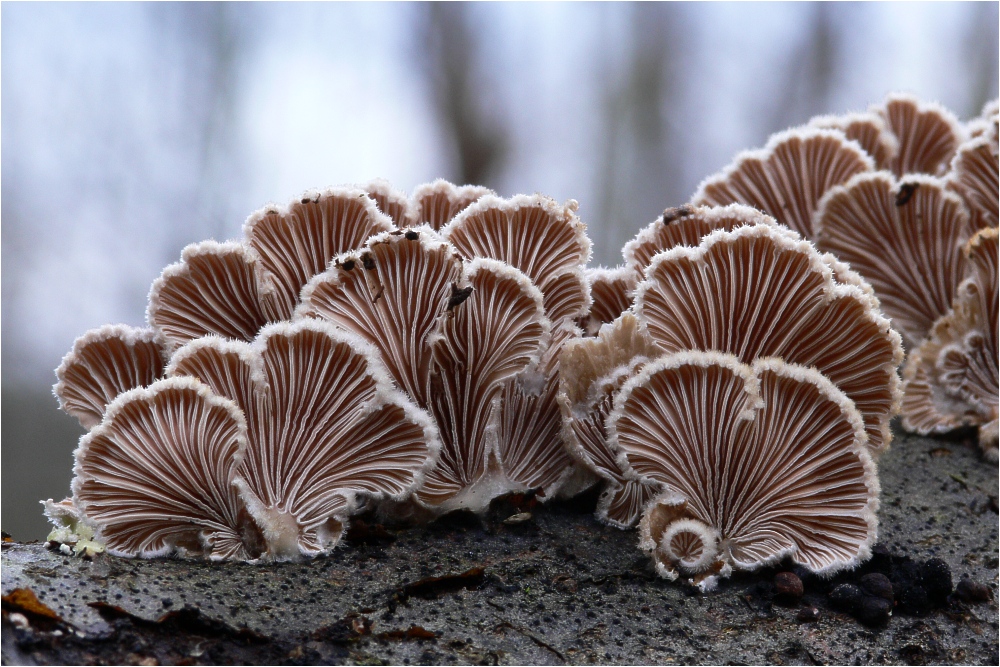
Winter does not mean the end of mushroom season. In many temperate regions, cold-tolerant fungi continue to fruit on logs, stumps, fallen branches, and even frozen-looking woodland floors long after most autumn mushrooms have disappeared.
Some winter species actually prefer cool weather, while others simply persist for months because their fruit bodies are tough and leathery. Learning to recognize these mushrooms makes winter walks far more interesting and can reveal fungi that are easy to overlook during the crowded autumn season.
⚠️ Important: This guide is for identification and education only. Never eat a wild mushroom based solely on photographs, AI identification, or an online comparison.
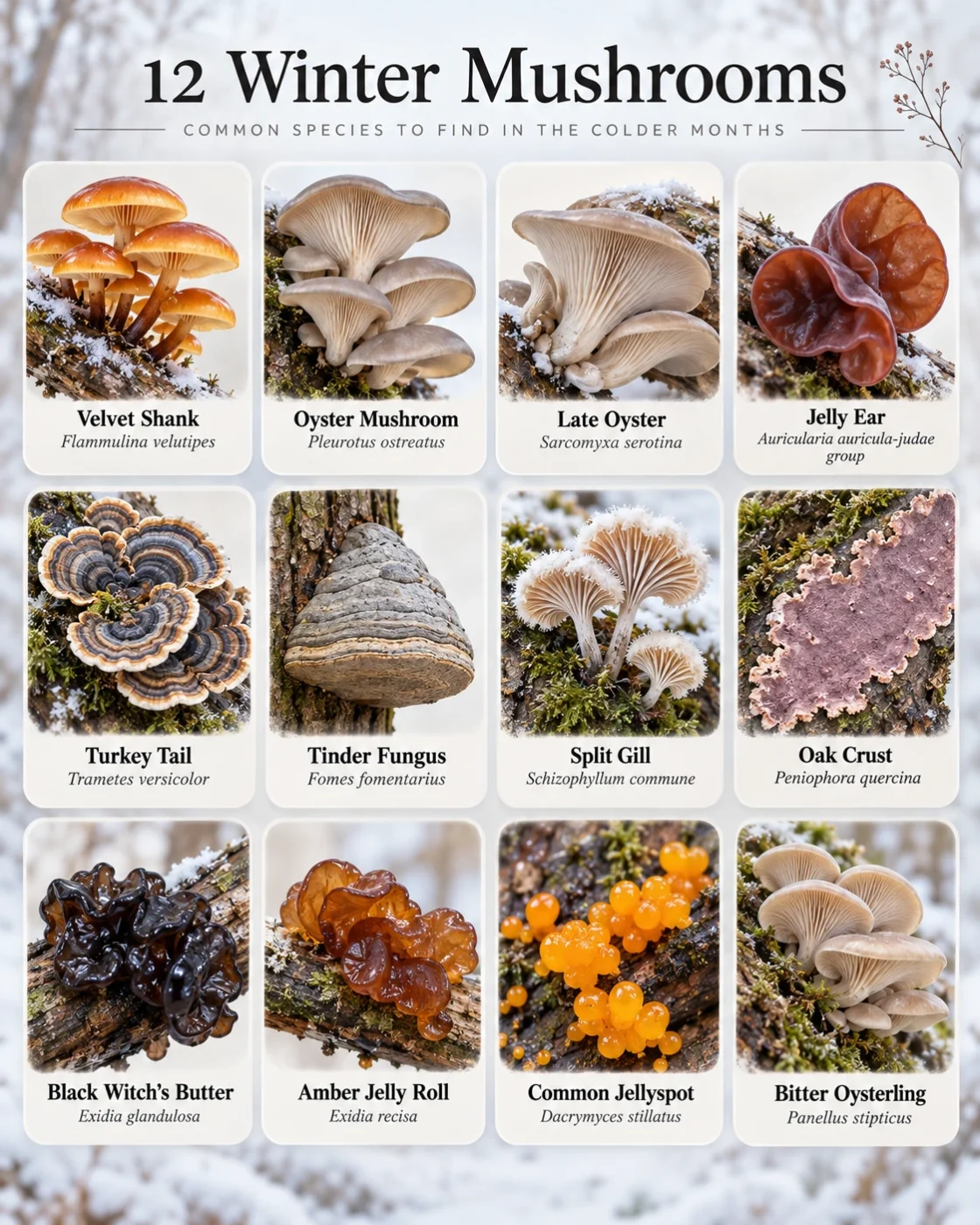
Quick Guide to 12 Winter Mushrooms
| Species | Common name | Typical habitat | Winter clue | Safety |
|---|---|---|---|---|
| Flammulina velutipes complex | Velvet Shank | Dead hardwood | Fruits in cold weather | Edible when correctly identified |
| Pleurotus ostreatus | Oyster Mushroom | Dead hardwood | Common after cool weather | Edible when correctly identified |
| Sarcomyxa serotina | Late Oyster | Dead hardwood | Late autumn into winter | Edibility debated |
| Auricularia auricula-judae group | Jelly Ear | Dead or weakened hardwood | Persists in damp winter weather | Edible when correctly identified |
| Trametes versicolor | Turkey Tail | Dead wood | Persistent brackets | Not a conventional food mushroom |
| Fomes fomentarius | Tinder Fungus | Birch, beech and other trees | Perennial conk | Inedible |
| Schizophyllum commune | Split Gill | Dead wood | Tough and persistent | Not generally eaten |
| Peniophora quercina | Oak Crust | Dead oak branches | Winter crust fungus | Inedible |
| Exidia glandulosa | Black Witch’s Butter | Dead hardwood | Gelatinous in wet cold weather | Not commonly eaten |
| Exidia recisa | Amber Jelly Roll | Dead willow and other hardwood | Amber gelatinous fruit bodies | Not generally used as food |
| Dacrymyces stillatus | Common Jellyspot | Dead wood | Orange jelly spots in winter | Not a food mushroom |
| Panellus stipticus | Bitter Oysterling | Dead hardwood | Small persistent clusters | Inedible |
Why Mushrooms Can Grow in Winter
Cold weather slows fungal activity, but it does not stop every species. Some fungi remain active at temperatures that suppress many typical autumn mushrooms, especially when daytime temperatures rise above freezing.
Wood also creates a more stable environment than exposed soil. Logs and stumps retain moisture and can buffer temperature changes, which is why so many winter mushrooms are wood-growing species.
Frost Does Not Always End Fruiting
A light frost can damage delicate mushrooms, but several cold-tolerant species survive freezing surprisingly well. Some fruit bodies pause during cold periods and continue developing when temperatures rise again.
This is especially true for Velvet Shank and Oyster Mushrooms. Both can appear during mild winter spells when snow has melted and wood remains moist.
1. Flammulina velutipes — Velvet Shank
Identification
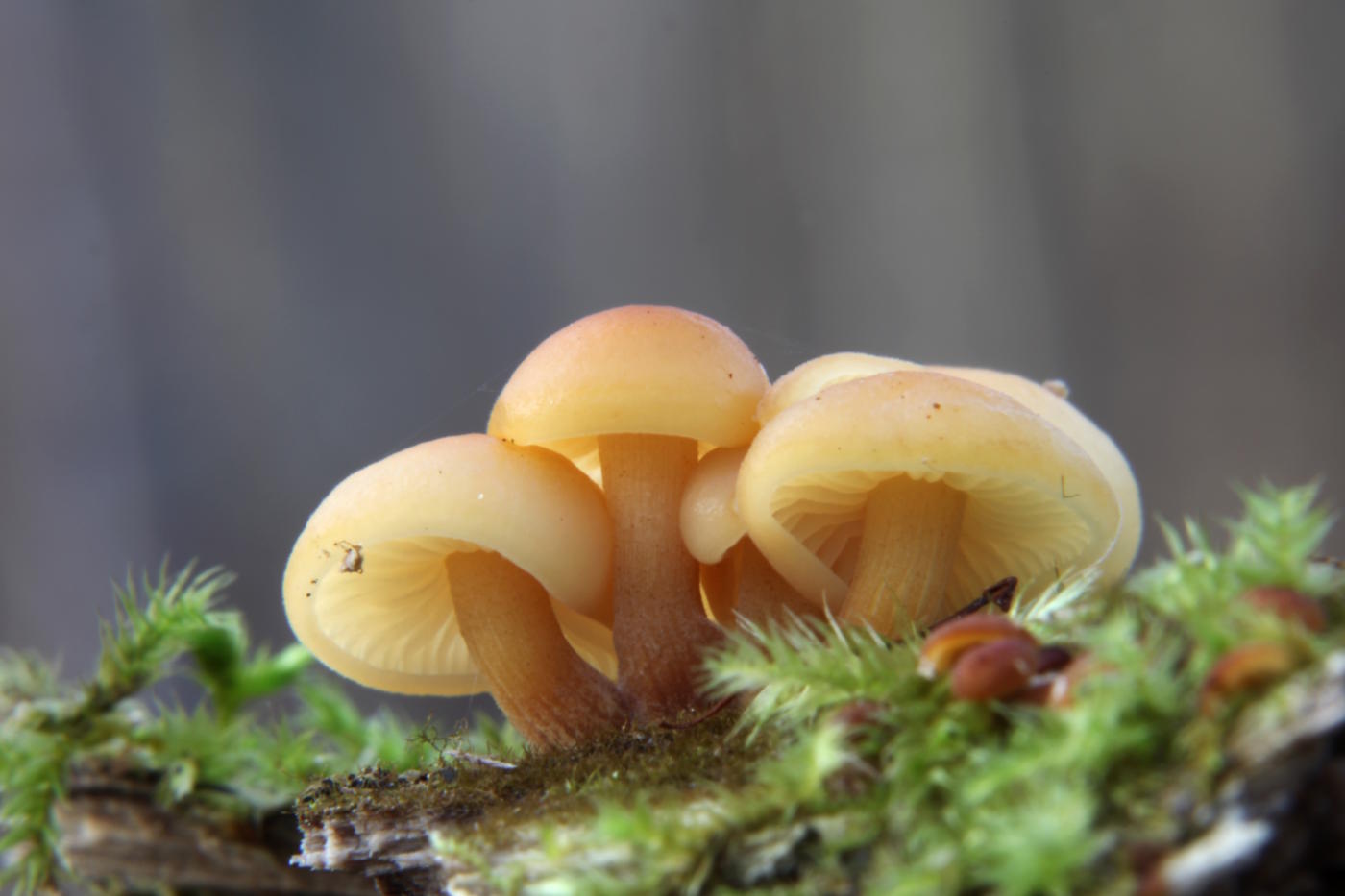
Velvet Shank has smooth yellow to orange-brown caps, pale gills, and a distinctive dark velvety lower stem. It usually grows in clusters from dead or weakened hardwood.
Fresh caps may look glossy or sticky in wet weather. Mature stems become increasingly dark toward the base, which is one of the strongest identification clues.
Why It Is a Classic Winter Mushroom
Velvet Shank is unusually cold tolerant and often fruits from late autumn through winter. It may continue growing after frost and can reappear during mild periods.
This makes it one of the most reliable mushrooms to search for when many other gilled species have disappeared.
Important Look-Alike
Deadly Galerina can also grow on wood and may share similar brown-orange cap colors. Velvet Shank has a white spore print, pale mature gills, no ring, and a dark velvety stem base, while Galerina marginata produces rusty-brown spores and often has a ring zone.
2. Pleurotus ostreatus — Oyster Mushroom
Identification
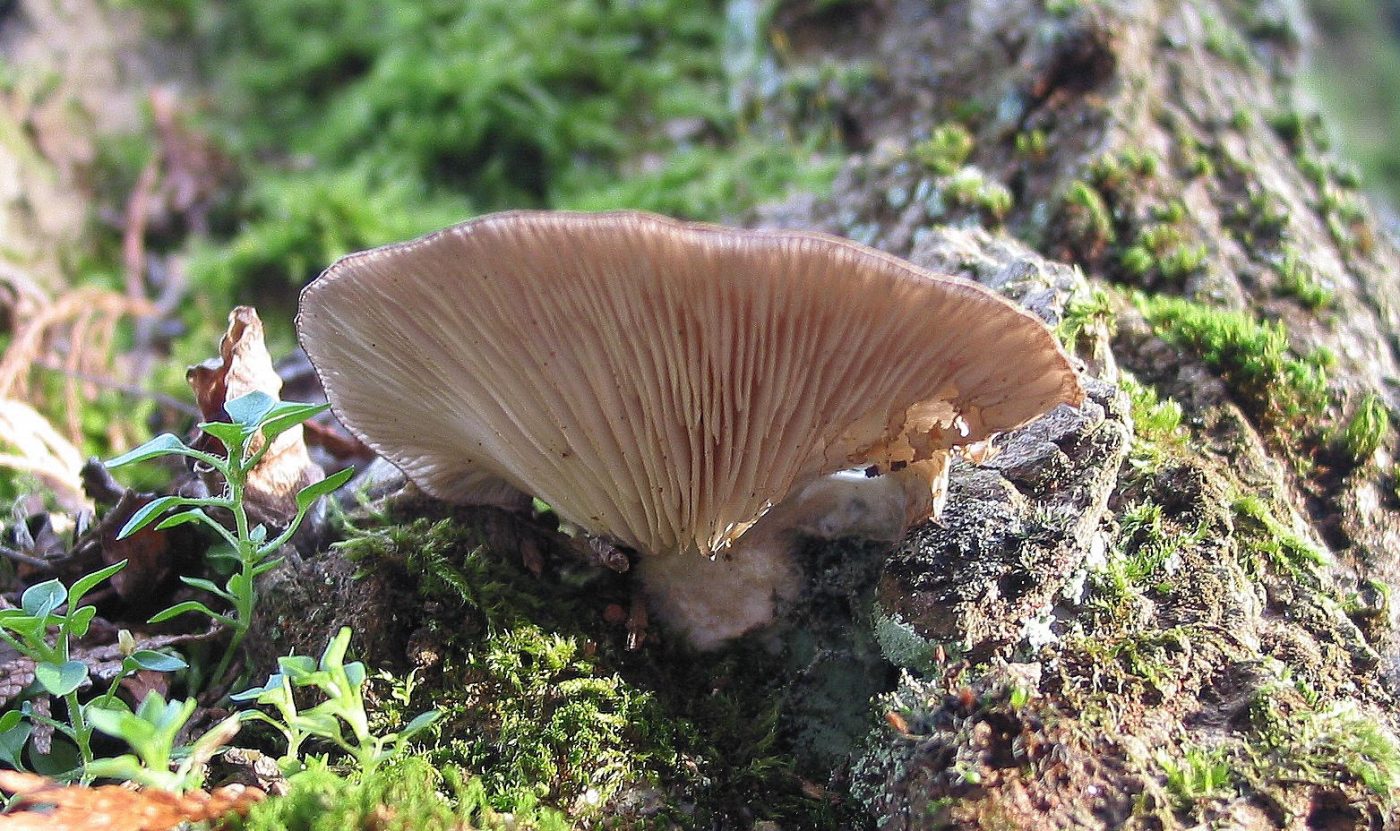
Oyster Mushrooms form overlapping clusters of fan-shaped caps on dead or weakened hardwood. Their white to cream gills run down toward a short lateral stem or attachment point.
Cap color varies from pale gray to darker brown depending on temperature and conditions. Cold-weather specimens can be particularly dark and thick.
Winter Habitat
Fallen logs, standing dead trees, and large hardwood branches are good places to search. Beech, poplar, willow, and other hardwoods can all support Oyster Mushrooms.
Late autumn and winter fruiting is common in temperate regions. Mild periods after rain or snowmelt can trigger fresh clusters.
3. Sarcomyxa serotina — Late Oyster
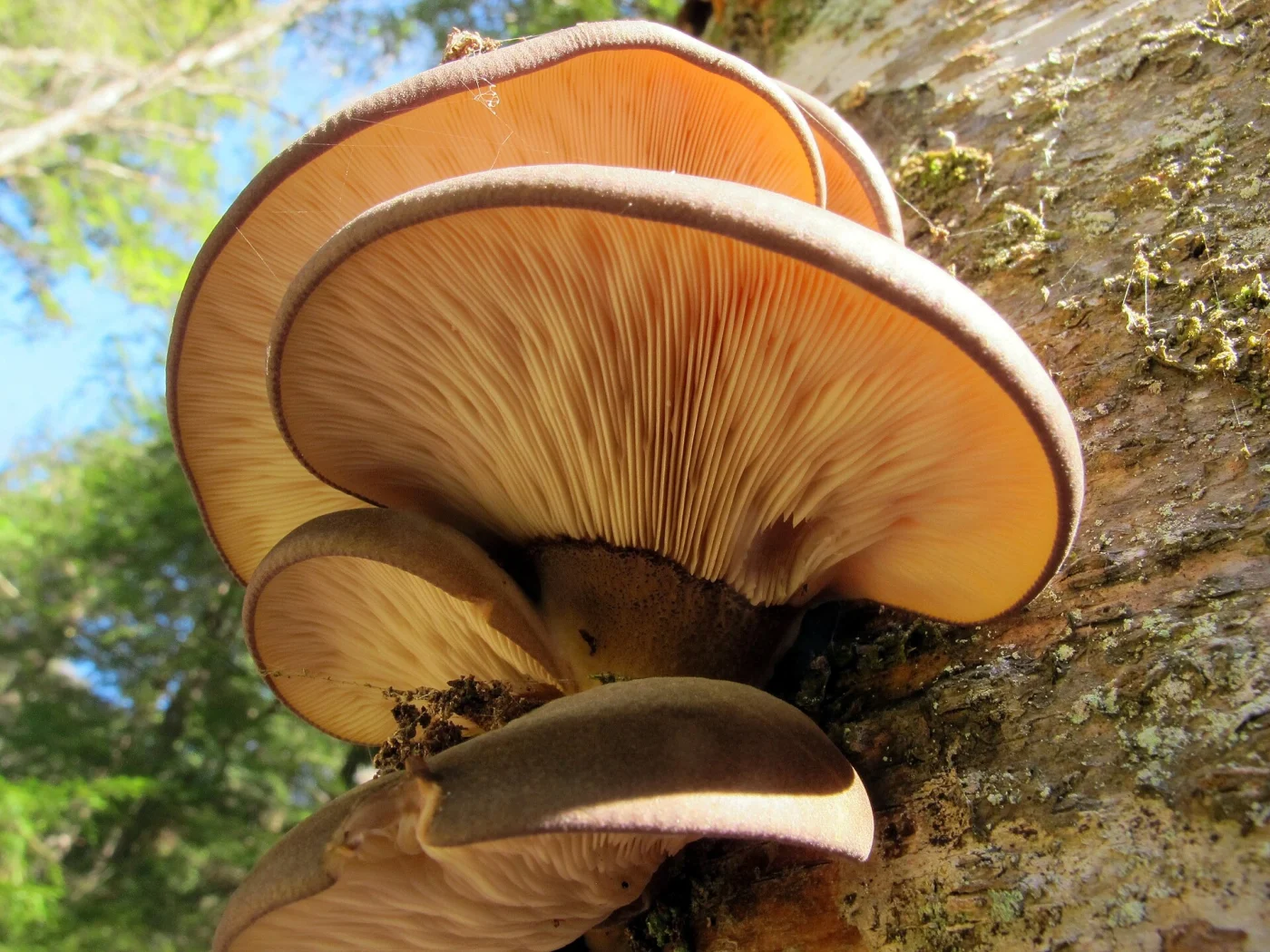
Identification
Late Oyster has olive, yellow-green, brownish, or gray-green caps with pale gills beneath. The caps are often fan-shaped and attach laterally to wood.
The fruit body can look superficially similar to a true Oyster Mushroom. Its greener tones and different texture often become more obvious in mature specimens.
Winter Season
As the common name suggests, this species appears late in the year. It can fruit from late autumn into winter during cool damp weather.
Dead hardwood logs are the main substrate. It often occurs when many summer and autumn mushrooms are already gone.
Safety
Its edibility has been treated inconsistently in different sources and regions. For practical purposes, it is better treated as a species for identification rather than as a target for food collection.
4. Auricularia Species — Jelly Ear
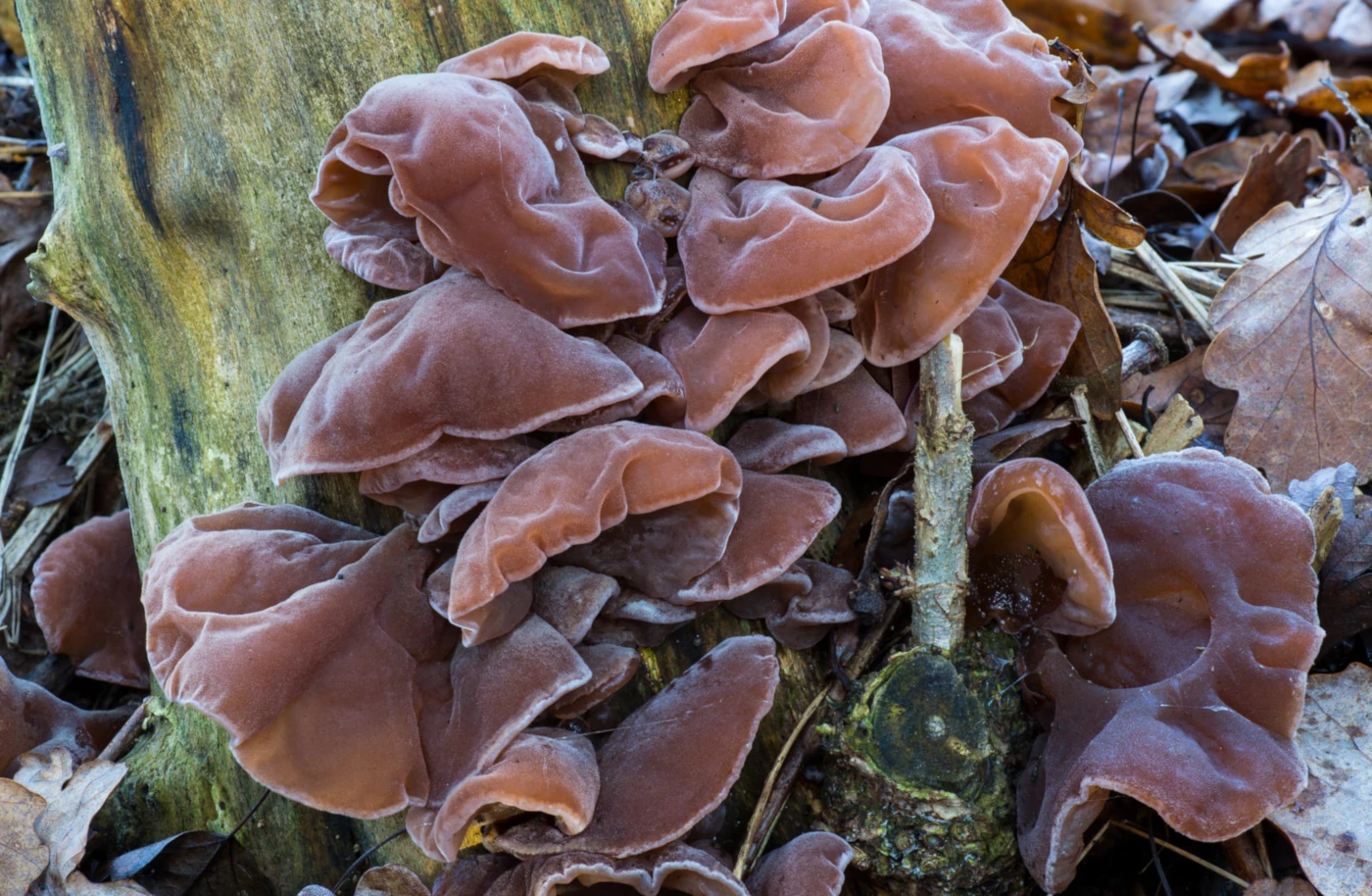
Identification
Jelly Ear fungi produce brown to reddish-brown, ear-shaped fruit bodies with a rubbery or gelatinous texture. The surface may be smooth on one side and slightly hairy or textured on the other.
The fruit bodies become softer and more translucent in wet weather. During dry periods, they can shrink dramatically and later rehydrate.
Why It Is Easy to Find in Winter
Jelly fungi tolerate repeated drying and rehydration better than many fleshy mushrooms. This allows them to remain visible through long stretches of cold weather.
They are especially common on dead or weakened hardwood. Elder is a classic host in Europe, although related species occur on other trees and in other regions.
5. Trametes versicolor — Turkey Tail
Identification
Turkey Tail forms thin fan-shaped brackets with strongly contrasting concentric zones. Brown, gray, cream, orange, blue-gray, and nearly black bands may all occur.
The underside is pale and covered with numerous tiny round pores. This separates true Turkey Tail from smooth-bottomed False Turkey Tail fungi.
Why It Persists Through Winter
Turkey Tail fruit bodies are thin but leathery and durable. Unlike soft gilled mushrooms, they can remain attached to wood for many months.
Fresh growth is more common during wet periods, but older fruit bodies stay visible through winter. This makes Turkey Tail one of the easiest bracket fungi to encounter in cold weather.
6. Fomes fomentarius — Tinder Fungus
Identification
Tinder Fungus forms large hoof-shaped brackets with gray, brown, or almost black zoned surfaces. The fruit body is hard and woody rather than soft.
The underside contains fine pores. Mature conks can remain attached to the tree for years.
Winter Habitat
Birch and beech are classic hosts, although other broadleaf trees can also support the fungus. Both dead and weakened living trees may carry fruit bodies.
Because the conks are perennial, winter does not limit visibility. In leafless forests, they can actually be easier to spot from a distance.
7. Schizophyllum commune — Split Gill
Identification
Split Gill forms small fan-shaped fruit bodies on dead wood. The upper surface is pale gray to white and often finely hairy.
The underside contains distinctive gill-like folds that split lengthwise when dry. These structures can curl and close during dry weather, then reopen when humidity returns.
Winter Survival
The fruit bodies are remarkably resistant to drying. They can persist through cold and dry periods and reactivate when moisture increases.
Dead branches, logs, and cut wood are typical habitats. The species is widespread and often overlooked because of its small size.
8. Peniophora quercina — Oak Crust
Identification
Oak Crust is a thin crust fungus that spreads directly across the surface of dead oak branches. Fresh fruit bodies may appear pinkish, lilac, grayish, or flesh-colored.
Unlike bracket fungi, it does not project far from the wood. The fungus looks more like a colored skin growing over the branch surface.
Winter Habitat
Dead oak twigs and branches are the best places to search. Fallen material on the forest floor can carry extensive patches.
Winter is a good time to notice crust fungi because leaves no longer hide smaller branches. Their subtle colors also stand out more clearly against wet bark.
9. Exidia glandulosa — Black Witch’s Butter
Identification
Black Witch’s Butter forms dark brown to black gelatinous lobes on dead wood. In wet weather, the fruit bodies become shiny, swollen, and rubbery.
During dry or freezing conditions, they shrink and become much less conspicuous. Moisture can restore their jelly-like appearance quickly.
Why It Appears in Winter
Cool wet weather is ideal for many jelly fungi. Rain, fog, and snowmelt keep dead wood damp and allow the fruit bodies to remain hydrated.
The black gelatinous texture makes this species easy to recognize once you know what to look for. It is particularly noticeable on pale or mossy wood.
10. Exidia recisa — Amber Jelly Roll
Identification
Amber Jelly Roll produces small amber, yellow-brown, or reddish gelatinous fruit bodies. They often have a folded or irregular shape rather than forming smooth round blobs.
The fruit bodies become translucent when wet. As they dry, they shrink and darken.
Habitat
Dead willow branches are a particularly typical substrate, although related jelly fungi can occur on other hardwoods. Damp woodland edges and riverbanks can be productive places to search.
Winter moisture makes these small fungi easier to notice. Several fruit bodies may occur along the same branch.
11. Dacrymyces stillatus — Common Jellyspot
Identification
Common Jellyspot forms tiny bright yellow to orange gelatinous spots on dead wood. Individual fruit bodies are small, but groups can create conspicuous colorful patches.
They often look like tiny drops of orange jelly. The surface is smooth and shiny when wet.
Winter Habitat
The fungus grows on dead woody material, including cut timber and fallen branches. It can appear throughout much of the year when moisture is available.
Winter rain and reduced evaporation often create good conditions. Its vivid color makes it one of the easiest tiny jelly fungi to notice.
12. Panellus stipticus — Bitter Oysterling
Identification
Bitter Oysterling forms small fan-shaped caps in clusters on dead hardwood. Caps are usually tan, buff, or cinnamon-brown, with pale gills radiating from a lateral attachment point.
The fruit bodies are much smaller than typical Oyster Mushrooms. Their clustered shelf-like growth can still create a similar overall impression from a distance.
Cold-Weather Appearance
The species can persist into cold weather because of its relatively tough fruit bodies. Dead logs and stumps provide the most likely habitat.
North American populations are also famous because some strains can show bioluminescence in the gills. This glow is not universal and should not be expected in every specimen.
Winter Mushrooms by Habitat
Dead Hardwood
Dead hardwood is the most productive winter substrate. Oyster Mushrooms, Velvet Shank, Jelly Ear, Turkey Tail, Split Gill, Bitter Oysterling, and various jelly fungi can all occur there.
Logs retain moisture longer than exposed soil. This creates a relatively stable microclimate even when surrounding ground freezes.
Standing Dead Trees
Standing dead trunks and branches can support bracket fungi, Oyster Mushrooms, and persistent crust fungi. Leafless winter forests make these elevated fruit bodies easier to see.
Always inspect damaged sections and old branch wounds. Dead tissue can host fungi even while another part of the tree remains alive.
Fallen Branches
Small fallen branches are particularly good for jelly fungi and crust fungi. Turning over damp sticks can reveal species that are almost invisible from above.
Oak, willow, elder, beech, and other hardwoods each support different fungal communities. Tree identification can therefore help narrow the possibilities.
Gilled Mushrooms in Winter
Winter has fewer gilled mushrooms than autumn, but several important species remain. Velvet Shank and Oyster Mushrooms are among the best-known examples.
The limited number of cold-tolerant gilled species can make winter identification feel easier. Dangerous look-alikes still exist, however, so season should never replace structural examination.
Why Small Brown Winter Mushrooms Need Caution
Small brown wood-growing mushrooms are especially difficult because many unrelated species share similar colors. Moisture can make caps darker and shinier, increasing the resemblance further.
Deadly Galerina is the most important comparison for Velvet Shank. Mature gill color, ring presence, stem texture, and spore print should all be checked.
Bracket Fungi in Winter
Bracket fungi become especially noticeable after leaves fall from the trees. Turkey Tail, Tinder Fungus, and many other polypores remain visible when soft terrestrial mushrooms are gone.
Some brackets are annual and gradually decay, while others are perennial. A hard woody conk may represent several years of growth.
The underside remains important for identification. Tiny pores, smooth surfaces, teeth, and maze-like structures can separate superficially similar species.
Jelly Fungi in Winter
Winter is an excellent season for jelly fungi because cool wet conditions keep their fruit bodies hydrated. Black, amber, yellow, and orange gelatinous fungi can all appear on fallen wood.
Many can dry almost completely and later expand again after rain. This ability allows them to survive weather changes that would destroy softer mushrooms.
Their strange texture makes them easy to recognize as a group. Species-level identification still requires attention to color, shape, substrate, and microscopic features in difficult cases.
Can Mushrooms Grow Under Snow?
Yes, fungi can remain active beneath snow when temperatures close to the ground are relatively stable. Snow can actually insulate soil and wood from more extreme air temperatures.
Visible mushroom growth is less common during continuous deep snow cover, but existing fruit bodies may survive underneath. Fresh growth can appear rapidly during thaw periods.
Wood-growing species are especially likely to persist. A stump or fallen log can remain biologically active even when the surrounding landscape looks fully dormant.
What Happens to Mushrooms When They Freeze?
Freezing damages many soft fruit bodies because ice crystals disrupt their tissues. After thawing, these mushrooms may become watery, soft, or discolored.
Cold-tolerant species cope better, especially when freezing is brief. Velvet Shank can sometimes survive repeated frost-and-thaw cycles surprisingly well.
Persistent brackets and jelly fungi use very different strategies. Their tougher or gelatinous tissues allow them to remain present long after delicate autumn mushrooms have collapsed.
Are Winter Mushrooms Easier to Identify?
In one sense, yes, because fewer species are fruiting simultaneously. A cold-weather mushroom on a hardwood log has a smaller range of likely candidates than a random mushroom found during peak autumn season.
However, many winter fungi are small crusts, brackets, or brown wood-growing mushrooms that can be difficult at species level. Reduced diversity does not automatically mean every identification is simple.
The key advantage is that winter lets you focus on a smaller ecological set. Wood type, fruit-body structure, and cold tolerance become especially useful clues.
How to Photograph Winter Mushrooms for Identification
Photograph the whole fruiting group before moving anything. Winter species often have distinctive clustering patterns or attachment points that help with identification.
Take close-ups of the underside, stem, or pore surface depending on the species. For jelly and crust fungi, include enough surrounding bark to show scale and growth pattern.
A habitat photograph is particularly useful in winter because the host tree may be easier to identify without leaves if bark, buds, or fallen leaves are visible nearby.
Can AI Identify Winter Mushrooms?
AI can work well with distinctive winter fungi such as Turkey Tail, Oyster Mushroom, Velvet Shank, or Jelly Ear when multiple clear photographs are available. Their growth forms and substrates provide useful visual context.
Small crust fungi and weathered brackets are much more difficult because many species look similar. Important microscopic features may not be visible in ordinary photographs.
Winter images should therefore emphasize substrate and structure. A cap-only photograph is especially weak for wood-growing species.
Common Winter Mushroom Identification Mistakes
One common mistake is assuming any mushroom found after frost must be a cold-weather edible species. Season can narrow the possibilities, but it cannot confirm identity.
Another mistake is ignoring old fruit bodies. Turkey Tail, Tinder Fungus, and other persistent fungi may have been present for months before being noticed in winter.
A third mistake is treating all jelly fungi as one species. Black, amber, orange, and brown gelatinous fruit bodies belong to several different genera and should be examined separately.
Frequently Asked Questions
Why do some winter mushrooms look fresh after several freezing nights?
Cold-tolerant fungi can withstand short freezing periods better than many soft autumn species. Their tissues may temporarily stop developing and then continue when temperatures rise above freezing again.
Is snowmelt a good time to look for winter mushrooms?
Yes, especially on logs and stumps. Melting snow provides moisture while mild temperatures can briefly reactivate cold-tolerant fungi and rehydrate jelly species.
Why do jelly fungi disappear during dry winter weather?
Many jelly fungi lose water and shrink dramatically when conditions become dry. They can look almost absent until rain or melting snow rehydrates the fruit bodies.
Can the same log produce several different winter fungi?
Yes. One piece of wood can support bracket fungi, jelly fungi, crusts, and gilled mushrooms at the same time or in different stages of decay.
Are winter mushrooms more common in forests or parks?
Both can be productive if enough dead wood is present. Old parks with mature trees, fallen branches, and untreated stumps can support surprisingly diverse winter fungi.
Does a warm winter increase mushroom activity?
Often it does, especially when mild temperatures are combined with frequent moisture. Long hard freezes reduce active fruiting, while repeated thaw periods can extend the season.
Can winter mushrooms be damaged by road salt?
Yes, salt and other environmental stressors can affect fungi growing near roads or treated paths. Mushrooms from heavily contaminated roadside areas are also poor candidates for food collection.
Why are bracket fungi easier to see in winter?
Leafless trees expose trunks and branches, while reduced ground vegetation makes dead wood more visible. Persistent brackets that were hidden during summer can become obvious from a considerable distance.
Final Identification Notes
Winter mushroom hunting is less about searching the forest floor for hundreds of soft species and more about examining logs, stumps, dead branches, damaged trees, and damp woody debris. Velvet Shank, Oyster Mushrooms, jelly fungi, Turkey Tail, and persistent brackets are among the most rewarding cold-weather finds.
The most useful winter identification clues are substrate, fruit-body texture, underside structure, stem features, and tolerance of freezing conditions. Season helps narrow the possibilities, but morphology still determines the identification.
Cold weather also offers a different way to learn fungi. With fewer distractions from peak autumn diversity, winter is an excellent time to become familiar with wood-decaying mushrooms, bracket fungi, jelly fungi, and the ecological role they play throughout the year.
Upload a photo and get possible matches in seconds.