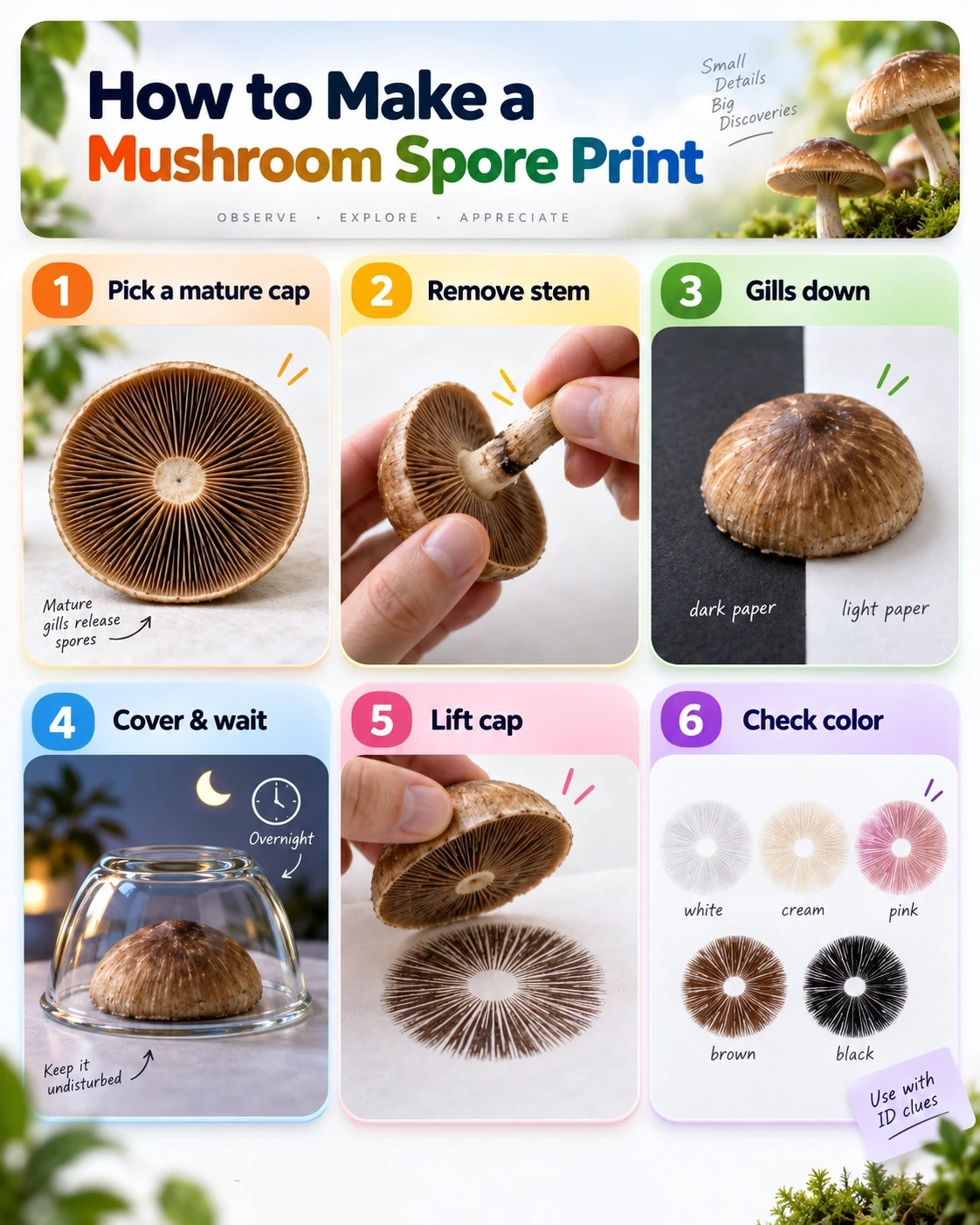
A mushroom spore print is one of the simplest and most useful tools for narrowing down an identification. By allowing mature spores to fall from the cap onto a surface, you can see their overall color, which helps separate mushroom groups that may otherwise look very similar.
Spore prints are especially useful for gilled mushrooms. White, cream, pink, rusty brown, chocolate brown, purple-brown and black spore colors can point toward different genera, but a spore print should always be combined with cap shape, gills, stem features, habitat and other characteristics.
⚠️ Important: A spore print can support identification, but it should never be used alone to decide whether a wild mushroom is safe to eat.
What Is a Mushroom Spore Print?
A spore print is the visible deposit left when microscopic mushroom spores fall from the underside of a mature cap.
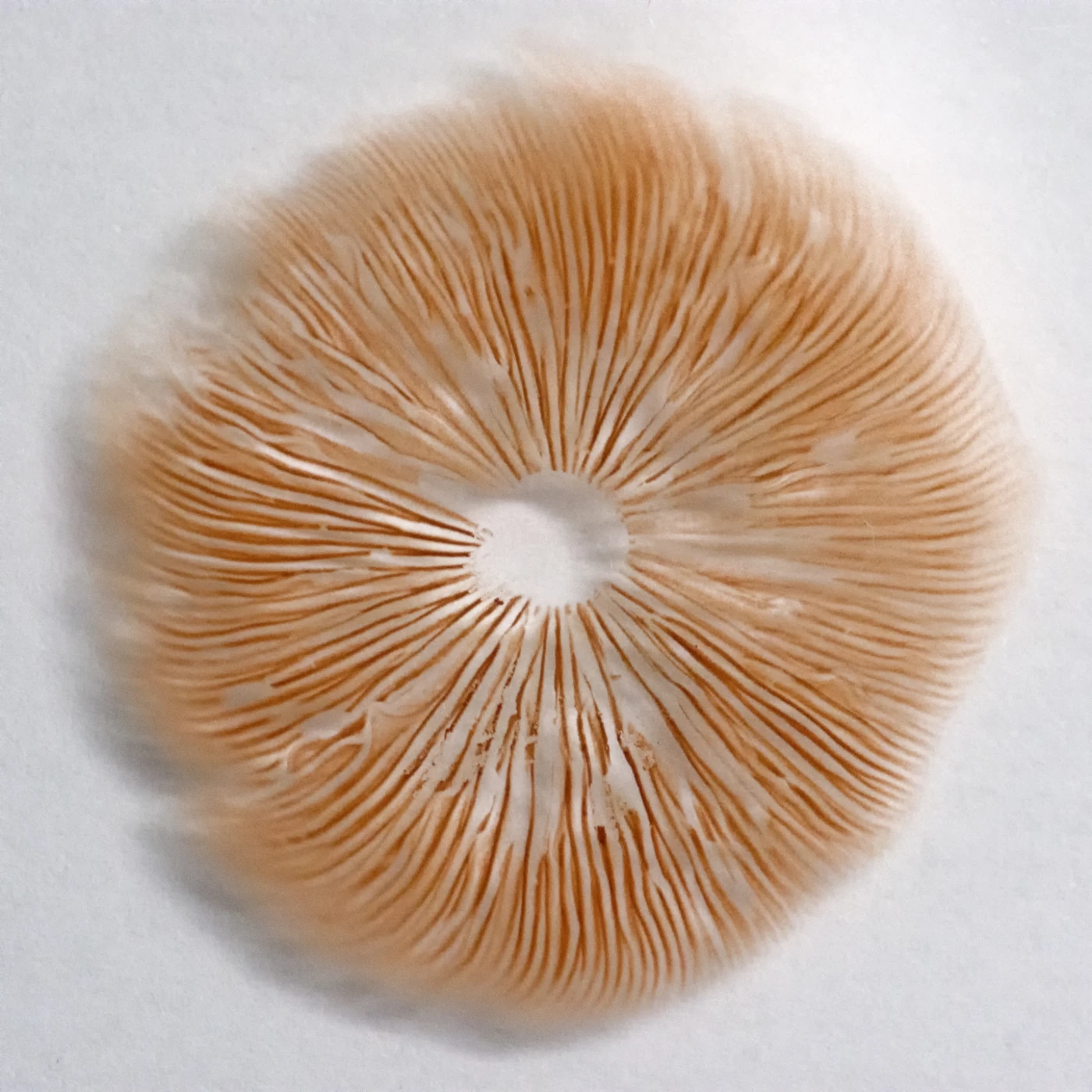
The spores are individually too small to see clearly without magnification, but thousands or millions of them together create a colored pattern that often mirrors the arrangement of the gills, pores or other spore-producing structures.
This makes the spore print both useful and visually distinctive. In many mushrooms, it looks like a radiating fan of fine lines.
Why Spore Color Matters
Spore color is an important identification feature because different mushroom groups tend to produce characteristic colors.
For example, many Amanita species have white spore prints, Agaricus species usually produce chocolate-brown spores, Galerina often produces rusty-brown spores, and many inkcaps produce very dark brown to black prints.
The key is that spore color helps narrow possibilities rather than prove a species by itself.
What You Need to Make a Spore Print
You only need a mature mushroom cap, a flat surface and something to cover the specimen while the spores fall.
A useful surface is half white and half dark paper because pale spores are easier to see on the dark side while dark spores stand out on the white side.
Foil or clear glass can also work well, especially when you are unsure what color to expect.
How to Make a Spore Print Step by Step
Choose a mature mushroom with fully developed gills or pores. Very young specimens may not yet be releasing enough spores to produce a clear result.
Remove the stem carefully and place the cap with the underside facing downward. Cover it with a bowl, cup or other container to reduce air movement and help maintain humidity.
Leave the cap undisturbed for several hours, often overnight. When you lift it, a visible spore deposit may remain underneath.
Step 1: Choose a Mature Mushroom
A spore print works best with a specimen that is mature but not badly decayed.
If the cap has only just opened, the spores may not be fully developed. If the mushroom is old and collapsing, contamination or moisture can make the print difficult to interpret.
Look for a specimen with exposed, intact gills or pores and a cap that still holds its shape.
Step 2: Remove the Stem
Cut or twist off the stem close to the underside of the cap.
The goal is to allow the gills, pores or other fertile surface to sit close to the paper or glass. If the stem keeps the cap elevated too far above the surface, fewer spores may land in a concentrated pattern.
Try not to damage the underside unnecessarily while removing the stem.
Step 3: Place the Cap Face Down
Set the cap with the gills or pores facing the surface.
For uncertain spore colors, place part of the cap over white paper and part over black or dark paper. This makes both pale and dark spores easier to see.
If the mushroom is large, one half of the cap may be enough.
Step 4: Cover the Cap
Cover the cap with a bowl, cup or container.
This reduces air currents that could blow spores away and also helps prevent the cap from drying too rapidly.
A stable environment often produces a denser, cleaner print.
Step 5: Wait
Several hours may be enough for strongly sporulating mushrooms, but leaving the specimen overnight often gives a clearer result.
Avoid moving the setup during this period.
When ready, lift the cap vertically so you do not smear the deposit.
Step 6: Check the Spore Color
Examine the deposit in natural or neutral light if possible.
Artificial warm lighting can make white spores look cream, cream spores look yellowish and brown spores appear more reddish than they really are.
Look at the densest part of the print rather than a few isolated spores.
Common Mushroom Spore Print Colors
| Spore print color | Common groups where it may occur |
|---|---|
| White | Amanita, Lepiota, many Tricholoma |
| Cream | Russula, Lactarius, some chanterelle-like fungi |
| Pink | Pluteus, Entoloma |
| Rusty brown | Galerina, Cortinarius |
| Chocolate brown | Agaricus |
| Purple-brown | Psilocybe, Stropharia |
| Black | Many inkcaps, Panaeolus |
| Olive-brown | Some boletes |
These categories are approximate. Spore colors can vary subtly, and precise interpretation may require experience.
White Spore Prints
White spore prints occur in many mushroom groups, including Amanita, Lepiota, Tricholoma and numerous other genera.
This means white spores are useful but not very specific. A white-spored mushroom still requires careful attention to rings, volvas, gill attachment and habitat.
White prints are easiest to see on dark paper or glass placed over a dark background.
Brown Spore Prints
Brown spores occur in several important groups, but the exact shade matters.
Agaricus typically produces dark chocolate-brown spores, while Galerina produces rusty-brown spores. Cortinarius also produces rusty to cinnamon-brown spore deposits.
These differences can be highly useful when separating dangerous look-alikes.
Black Spore Prints
Black or nearly black spore prints are common among many inkcaps and some grassland mushrooms.
Coprinus comatus, the Shaggy Mane, produces a black print, as do many related inkcap-like fungi.
Because very dark brown and true black can look similar, lighting and print density matter when interpreting the result.
Pink Spore Prints
Pink spore prints are characteristic of several genera, including Pluteus and Entoloma.
The distinction between salmon-pink, flesh-pink and pinkish brown can sometimes help further, but this becomes more advanced.
Pink spores can be especially useful for ruling out white- or brown-spored look-alikes.
Purple-Brown Spore Prints
Purple-brown or purplish black prints occur in genera such as Stropharia and Psilocybe.
These colors may appear nearly black in a dense print, so checking thinner areas can reveal the underlying purple or brown tone.
As always, spore color alone is not enough for species-level identification.
How Spore Prints Help Separate Look-Alikes
Spore prints are most valuable when two mushrooms look similar but belong to groups with very different spore colors.
One classic example is Honey Mushroom versus Deadly Galerina. Honey Mushrooms usually produce white spores, while Galerina marginata produces rusty-brown spores.
Another example is edible Agaricus versus white-gilled Amanita. Agaricus produces brown spores, while Amanita produces white spores.
Honey Mushroom vs Deadly Galerina
Honey Mushrooms and Deadly Galerina can both grow on wood and have brownish caps, sometimes with rings.
The spore print provides a strong difference: Armillaria generally produces white spores, while Galerina marginata produces rusty-brown spores.
This does not make spore printing a complete safety test, but it can reveal a major mismatch in an identification.
Agaricus vs Amanita
Some pale Agaricus can superficially resemble white Amanitas when young.
A mature Agaricus typically produces dark brown spores, while Amanita produces a white spore print.
Other features such as a volva, gill color and stem base remain essential, but the spore print can strongly support the distinction.
Shaggy Mane vs Other Lawn Mushrooms
Coprinus comatus produces a black spore print.
This can help separate it from pale-spored lawn mushrooms, although many other inkcaps also produce very dark spores.
Cap texture, deliquescence and habitat should still be checked.
Can You Make a Spore Print From a Mushroom With Pores?
Yes, but the result may be less visually obvious than with gilled mushrooms.
Boletes and polypores release spores through pores, and the print can appear as a more uniform powdery deposit rather than a radiating gill pattern.
Spore color can still be useful, especially with boletes.
Can You Make a Spore Print From Chanterelles?
True chanterelles do produce spores, but they can be harder to print than many gilled mushrooms.
Their false gills or smooth fertile surfaces may release fewer visible spores under indoor conditions, and the result can be faint.
For chanterelles, underside structure, habitat and growth pattern are usually more immediately useful than spore printing.
Why Is My Spore Print Empty?
An empty print does not necessarily mean the mushroom lacks spores.
The specimen may be too young, too old, too dry or no longer actively releasing spores. Air movement, low humidity or placing the cap too far above the surface can also reduce deposition.
Trying a second mature specimen often solves the problem.
How Long Should a Spore Print Take?
Many mushrooms produce a visible print within a few hours.
Leaving the cap overnight usually gives a denser result, but extremely wet mushrooms can begin to decay or stain the paper if left too long.
The ideal time depends on species, maturity and moisture.
Paper, Glass or Foil?
Each surface has advantages.
Paper is easy and inexpensive, but moisture from the mushroom can stain it. Glass lets you move the print over light or dark backgrounds, while foil provides good contrast for many spore colors and resists moisture better than paper.
For general identification, using both a light and dark background remains one of the simplest methods.
Can You Preserve a Spore Print?
Yes. A dry spore print on paper can be protected with a clear fixative or carefully covered.
However, preserving the print is usually more useful for reference or display than for identification itself.
If you want to compare colors accurately later, avoid coatings that may darken or alter the spores.
How to Photograph a Spore Print
Photograph the print under neutral daylight or color-balanced lighting.
Include both the spore deposit and a reference surface if possible. Avoid strong yellow indoor lighting because it can shift the apparent color.
For identification apps or AI tools, a photo of the spore print should supplement images of the whole mushroom rather than replace them.
Can AI Use Spore Print Color?
Yes. Spore color can be valuable input when combined with photographs and habitat information.
If an identification tool allows text notes, include a simple description such as “white spore print,” “rusty brown,” or “black.”
The more independent features available, the easier it becomes to eliminate visually similar species.
Common Spore Print Mistakes
One common mistake is judging the color from only a few loose spores. Sparse deposits can appear much lighter than the true spore color.
Another is using only white paper, which makes white and cream spores nearly invisible.
A third mistake is treating spore color as proof of species. Many unrelated mushrooms share the same broad spore color.
Spore Print vs Gill Color
Gill color and spore print color are related but not identical.
Young gills may be white even when the mature spores are brown, rusty or black. This is common in several groups.
For example, young Agaricus gills can be pale before turning pink and then brown, while the final spore print is dark brown.
Spore Print vs Microscopy
A spore print shows the mass color of spores, but microscopy reveals their individual size, shape, ornamentation and other features.
For many difficult genera, spore color alone is not enough and microscopic examination becomes necessary.
A spore print is therefore a useful first-level identification tool rather than a replacement for advanced methods.
Frequently Asked Questions
What is a mushroom spore print?
It is a visible deposit of spores released from the underside of a mushroom cap onto paper, glass or another surface.
How long does a spore print take?
Several hours may be enough, but overnight usually produces a stronger result.
What is the best surface for a spore print?
Half white and half dark paper is useful because it shows both pale and dark spores. Glass and foil also work well.
Can a spore print identify a mushroom?
It can narrow the possibilities but usually cannot identify a species by itself.
What color is an Amanita spore print?
Most Amanita species produce white spores.
What color is a Galerina spore print?
Galerina marginata produces a rusty-brown spore print.
What color is an Agaricus spore print?
Mature Agaricus species usually produce dark chocolate-brown spores.
What color is a Shaggy Mane spore print?
Coprinus comatus produces a black spore print.
Why can’t I see my spore print?
The spores may be too pale for the background, or the mushroom may be immature, dry or no longer releasing spores.
Can I eat a mushroom if its spore print matches an edible species?
No. Many species share similar spore colors, so a matching print does not prove edibility.
Final Identification Notes
A spore print is one of the easiest ways to add another layer of evidence to mushroom identification. The process requires little equipment and can reveal a feature that is often impossible to judge accurately from the cap alone.
The most useful approach is to combine spore color with gill or pore structure, stem features, habitat, substrate, bruising and overall morphology. A spore print is strongest when it confirms several other characteristics rather than when it is used in isolation.
For difficult look-alikes, especially brown wood-growing mushrooms or pale gilled species, spore color can be one of the clues that prevents a dangerous misidentification.