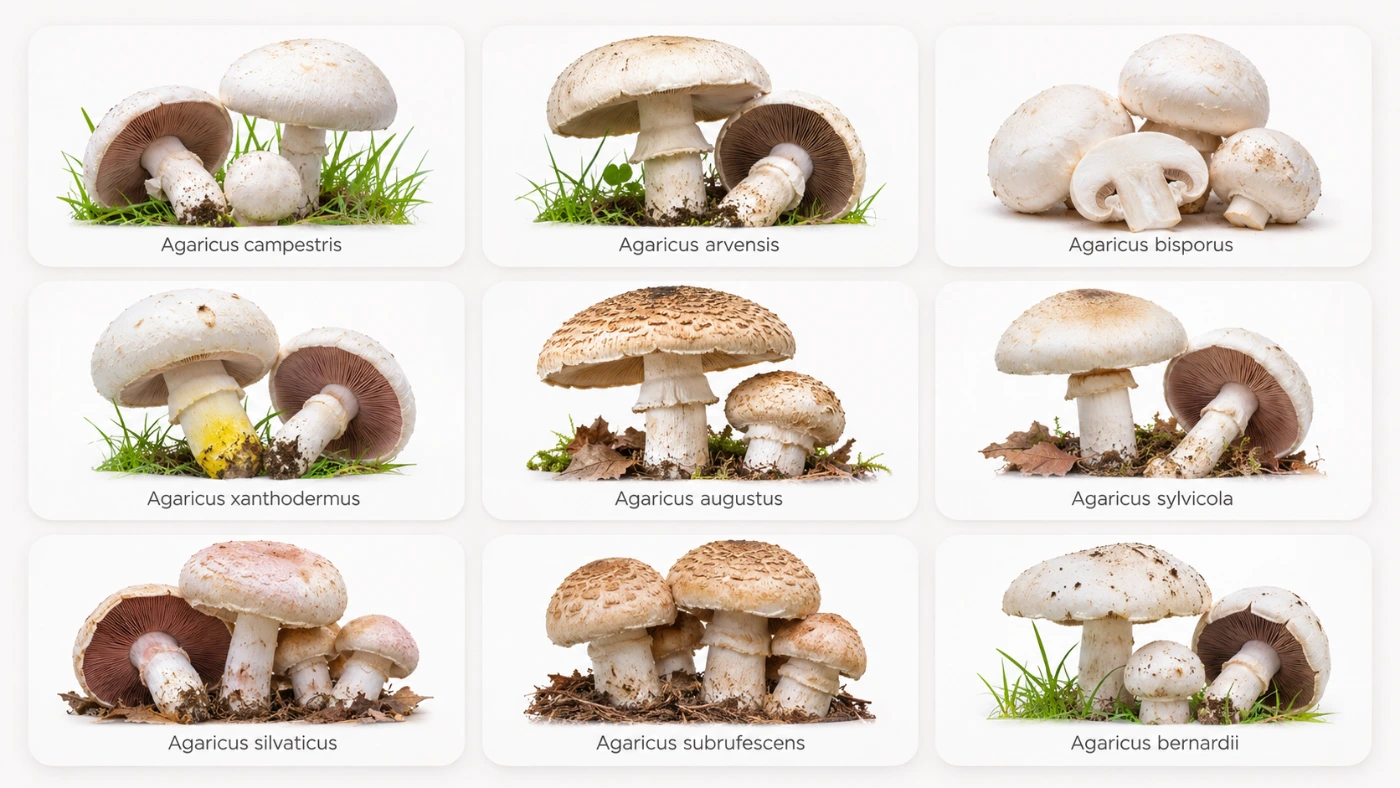
Agaricus is a large genus of gilled mushrooms that includes familiar species such as the Field Mushroom, Horse Mushroom, and the cultivated Button Mushroom. Many species have pale caps, free gills, a stem ring, and gills that change from pink to chocolate-brown as the spores mature.
That combination makes the genus fairly recognizable, but exact species identification can be much harder. Cap color, odor, bruising reactions, habitat, ring structure, and the color change at the stem base all become important when separating edible, inedible, and toxic species.
⚠️ Important: Never identify a white mushroom as Agaricus from cap color alone. Deadly white Amanita species can also have pale caps and stem rings, but they retain white gills and have a volva at the stem base.
Quick Identification
| Feature | Agaricus |
|---|---|
| Cap | White, cream, brown, scaly, or fibrillose |
| Gills | Free from the stem |
| Young gills | Pink, gray-pink, or pale |
| Mature gills | Chocolate-brown to dark brown |
| Stem | Usually central and firm |
| Ring | Usually present |
| Volva | Absent |
| Spore print | Dark brown |
| Flesh | White, sometimes bruising yellow or reddish |
| Latex | Absent |
| Ecology | Mostly saprotrophic |
| Habitat | Grassland, woodland, gardens, compost, roadsides |
| Main identification clues | Gill color change, dark spores, ring, no volva |
| Main dangerous look-alikes | White Amanita species |
What Are Agaricus Mushrooms?
Agaricus is one of the best-known mushroom genera because it includes both wild species and several major cultivated mushrooms. The common supermarket Button Mushroom, Cremini, and Portobello all belong to Agaricus bisporus.
Wild species are much more diverse. Some grow in meadows and lawns, others in woodland, and some prefer rich soils, compost, parks, gardens, or disturbed ground.
The Most Important Agaricus Feature: Gills That Change Color
Young Agaricus gills are usually pinkish, gray-pink, or pale flesh-colored. As the spores mature, the gills become progressively darker until they are chocolate-brown or very dark brown.
This color change is one of the most useful characters in the genus. It separates Agaricus from many white-gilled mushrooms, especially Amanita.
Free Gills
The gills are normally free from the stem. This means they stop just before reaching the stem rather than running directly into it.
Free gills are useful, but they are not unique to Agaricus. Several other genera, including Amanita and Volvopluteus, can also have free gills.
Spore Print
Agaricus produces a dark brown spore print. Depending on the species and the density of the print, it may appear chocolate-brown, purple-brown, or very dark brown.
This is one of the strongest genus-level characters. White Amanita species, by contrast, produce white spores.
Stem
The stem is usually central, white to pale, and fairly robust. It may be smooth, fibrous, or slightly scaly depending on the species.
The base may be straight, slightly bulbous, or enlarged, but there is no true sac-like volva. That absence is extremely important when separating Agaricus from dangerous Amanita.
Ring
Most Agaricus species have a ring on the stem. It develops from the partial veil that protects the young gills.
The ring can be thin, thick, skirt-like, double, cogwheel-shaped, or fragile. Ring structure is often important when separating closely related species.
Cap
Cap color varies from pure white to cream, tan, brown, reddish-brown, or gray-brown. Some species are smooth, while others develop scales or fibrillose patches.
Young caps are usually convex and later flatten. Mature caps can become broad and sometimes crack in dry weather.
Flesh
The flesh is usually white when cut, but many species show a color reaction. Yellow staining and reddish bruising are especially important identification features.
The speed and location of the reaction matter. A mushroom that turns bright chrome-yellow immediately at the stem base belongs to a different group from one that slowly reddens in the cap flesh.
Smell
Odor is unusually important in Agaricus identification. Some species smell pleasantly mushroom-like, almond-like, or anise-like, while others have a phenolic, chemical, ink-like, or medicinal odor.
This character should be checked in fresh specimens. Odor can weaken with age or dry weather.
Yellow-Staining Agaricus
One important group contains species that turn yellow when bruised or cut. The reaction is often strongest around the stem base.
Not all yellow-staining Agaricus are toxic, so the exact pattern matters. Strong yellow staining combined with a phenolic or chemical odor is a major warning sign.
Red-Staining Agaricus
Other species develop pink, reddish, or reddish-brown tones after cutting or bruising. This reaction may occur slowly and can be strongest in the cap or stem flesh.
Red staining is useful, but it still needs to be combined with habitat and odor. Several species share similar reactions.
Almond and Anise Odors
Some Agaricus species have a sweet almond, marzipan, or anise-like smell. This is especially noticeable in several larger woodland and grassland species.
A pleasant odor can help narrow the identification, but it is not an edibility test. Species-level identification still matters.
Phenolic Odor
Some Agaricus have a sharp chemical smell often compared with ink, phenol, disinfectant, or carbolic soap. This odor is especially important in the yellow-staining group.
The smell may become stronger when the stem base is crushed or when the mushroom is cooked. Combined with rapid yellow staining, it is a strong caution signal.
Where Do Agaricus Mushrooms Grow?
Agaricus species occur in many different habitats. Unlike mycorrhizal mushrooms such as many Amanita, Russula, and Lactarius, most Agaricus are saprotrophic and feed on decaying organic matter.
This allows them to thrive in grassland, gardens, woodland litter, compost-rich soils, roadside verges, horse pastures, and urban parks. Habitat can be one of the fastest ways to narrow the species group.
Agaricus in Lawns and Meadows
Grassland is a classic Agaricus habitat. Field Mushroom and several related species can form scattered groups, arcs, or fairy rings in pastures and lawns.
These species usually appear after rain during warm or mild periods. Rich, undisturbed grassland can support repeated fruiting over many years.
Agaricus in Woodland
Some large Agaricus species occur in deciduous or coniferous woodland. They may grow in leaf litter, along paths, or in nutrient-rich areas.
Woodland species are often more robust and can have pronounced scales or strong odors. Several can be difficult to separate without careful attention to bruising reactions.
Agaricus in Gardens and Compost
Rich soil, compost, manure, and disturbed ground can support several Agaricus species. Cultivated Button Mushrooms also belong to a genus naturally adapted to nutrient-rich organic substrates.
Garden species may appear in flower beds, lawns, compost heaps, or mulched areas. They should not be assumed edible simply because they grow close to homes.
Main Agaricus Species
The genus contains many species, but several are especially useful for field identification and SEO because they represent major ecological or morphological groups.
Agaricus campestris — Field Mushroom
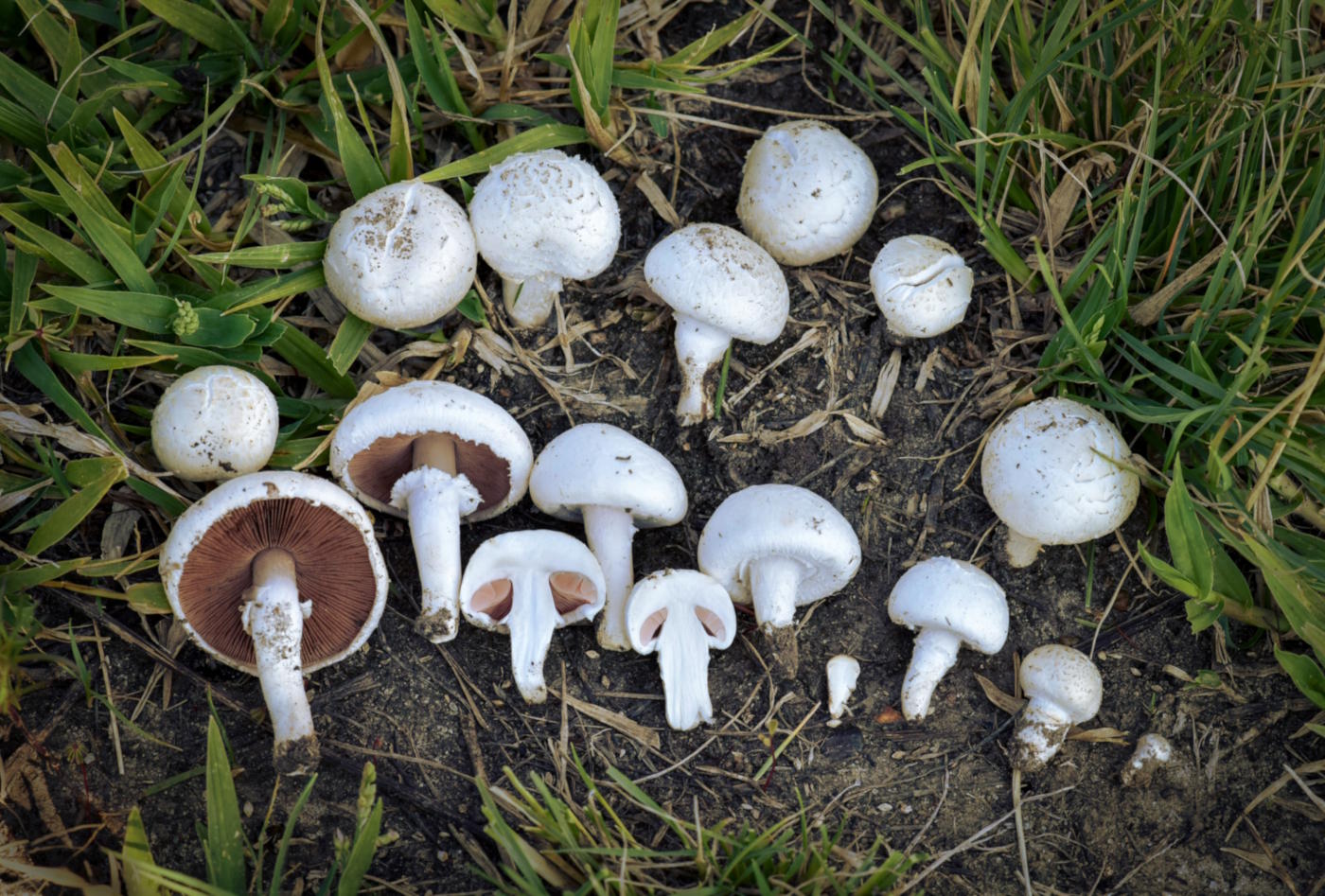
Field Mushroom is one of the best-known wild Agaricus species. It usually has a white to cream cap, pink young gills, brown mature gills, and a relatively simple ring.
It is strongly associated with grassland, pastures, and lawns. The flesh does not normally show a dramatic bright yellow reaction at the stem base.
Agaricus arvensis — Horse Mushroom
Horse Mushroom is usually larger and more robust than Field Mushroom. It often develops a pale yellow reaction and may have a sweet anise or almond-like odor.
A thick ring is characteristic, often with a cogwheel-like pattern underneath. It frequently occurs in grassland, roadsides, parks, and nutrient-rich open areas.
Agaricus bisporus — Button Mushroom
Agaricus bisporus is the species sold commercially as Button Mushroom, Cremini, and Portobello. These are different maturity or color forms of the same cultivated species.
Wild populations also exist. The cap may be white or brown, while mature gills become chocolate-brown like those of other Agaricus.
Agaricus xanthodermus — Yellow Stainer
Yellow Stainer is one of the most important toxic Agaricus species to recognize. It can look very similar to edible white Agaricus from above.
The key characters are rapid bright yellow staining, especially at the stem base, and a phenolic or chemical smell. It commonly grows in lawns, gardens, parks, and disturbed ground.
Agaricus augustus — The Prince
The Prince is a large distinctive species with a brown-scaled cap and a strong almond-like odor. It usually grows in woodland, parks, and near trees.
The cap can become very large and robust. Its patterned brown scales make it more visually distinctive than many pale Agaricus.
Agaricus sylvicola — Wood Mushroom
Wood Mushroom is a pale woodland species with a sweet anise-like odor. It often shows yellow staining, particularly on the cap or stem.
It grows in deciduous and coniferous woodland. The combination of woodland habitat, pleasant odor, and yellowing helps separate it from grassland species.
Agaricus silvaticus — Blushing Wood Mushroom
This woodland species often has a brown-scaled cap and flesh that turns reddish after damage. The reddish reaction is one of its most useful characters.
It typically grows in coniferous or mixed woodland. The cap can resemble other scaly Agaricus, so bruising reaction and habitat are important.
Agaricus subrufescens — Almond Mushroom
Agaricus subrufescens is known for its almond-like odor and brownish to reddish-scaled cap. It has been cultivated in some regions and is sometimes marketed under several common names.
Wild and cultivated forms can vary in appearance. Exact identification should still rely on gills, ring, odor, bruising, and ecology.
Agaricus bernardii — Salt-Loving Agaricus
This species is associated with salty or compacted soils and can occur near roads, coastal grassland, and other disturbed habitats. It often develops reddish or brownish staining and can have an unpleasant odor with age.
Its ecology makes it especially interesting. Habitat becomes a major clue in addition to standard Agaricus characters.
How to Identify Agaricus Step by Step
Start with the gills. Pink or gray-pink young gills that become dark chocolate-brown are a strong sign of Agaricus.
Then examine the stem base carefully. There should be no sac-like volva, although the stem may still be bulbous or enlarged.
Next check bruising and odor. These two characters often provide the fastest route toward the correct species group.
Agaricus vs Amanita
This is the most important comparison because some white Amanitas are deadly poisonous. Both groups can have white caps, free gills, and a ring on the stem.
The major differences are mature gill color, spore print, and volva. Agaricus develops brown gills and brown spores, while Amanita usually retains white gills and has white spores.
| Feature | Agaricus | White Amanita |
|---|---|---|
| Young gills | Often pink or pale | White |
| Mature gills | Chocolate-brown | White |
| Spore print | Dark brown | White |
| Ring | Usually present | Often present |
| Volva | Absent | Often present |
| Ecology | Mostly saprotrophic | Mycorrhizal |
| Main danger | Some toxic species | Some species deadly |
A white mushroom with white mature gills and a volva should never be treated as Agaricus. This pattern strongly suggests Amanita instead.
Look-Alikes
Several genera can resemble Agaricus, especially when mushrooms are young. The most useful distinctions usually involve gill color, spore color, ring structure, and the stem base.
Amanita Species
Identification
Amanita can have white caps, free gills, and a stem ring. Deadly destroying angels are particularly dangerous because they can look superficially like large white Agaricus.
Their gills remain white and their spore print is white. Many also have a sac-like volva at the base.
Main Difference
Brown mature gills and a brown spore print favor Agaricus. White mature gills plus a volva strongly favor Amanita.
Leucoagaricus Species
Identification
Leucoagaricus species can have white caps, white gills, and a stem ring. Some resemble small or medium white Agaricus from above.
Their spores remain pale rather than turning dark brown. Mature gill color therefore becomes one of the easiest distinctions.
Main Difference
White mature gills favor Leucoagaricus, while chocolate-brown mature gills favor Agaricus.
Volvopluteus gloiocephalus
Identification
Volvopluteus has free gills and a volva at the base. Young gills can begin pale and later become pink.
It lacks the typical Agaricus ring and produces a pink spore print. Disturbed soil, gardens, fields, and compost-rich habitats are common.
Main Difference
Volva plus pink spores and no ring favor Volvopluteus. Agaricus has brown spores, usually a ring, and no volva.
Pluteus Species
Identification
Pluteus also has free gills and pink spores. Many species grow directly from wood rather than from soil.
A stem ring is absent. The substrate alone can often provide a strong clue when the mushroom is clearly growing from a log or stump.
Main Difference
Pink spores plus growth from wood favor Pluteus. Brown spores and a ring favor Agaricus.
Chlorophyllum Species
Identification
Large parasol-like Chlorophyllum mushrooms can resemble large Agaricus from above. They often have broad pale caps with scales and a prominent stem ring.
Their gill color and spore print differ depending on species. Some, including Chlorophyllum molybdites, are toxic and produce a greenish spore print.
Main Difference
Large movable ring, scaly parasol structure, and non-brown spores suggest Chlorophyllum rather than Agaricus.
Agaricus vs Destroying Angel
Destroying angels are among the most dangerous mushrooms to confuse with white Agaricus. Young specimens can look especially similar before gill color becomes obvious.
The complete stem base should always be examined. A sac-like volva is a major warning feature and does not belong in Agaricus.
Agaricus vs Yellow Stainer
This is a different kind of comparison because Yellow Stainer itself is an Agaricus. The challenge is separating it from edible-looking white species in the same genus.
Bright yellow staining at the stem base plus a phenolic odor strongly supports Agaricus xanthodermus. A pleasant mushroom or almond odor suggests a different group.
Agaricus vs Field Mushroom
Field Mushroom usually has a relatively simple white or cream cap, pink young gills, and little dramatic bruising. It grows mainly in grassland.
Other Agaricus may look very similar but differ in odor, staining, or ring structure. A grassland habitat alone is not enough for a confident species identification.
Agaricus vs Horse Mushroom
Horse Mushroom is typically larger and more robust than Field Mushroom. It often shows some yellowing and has a sweet anise-like odor.
Its ring is usually more substantial and complex. These characters together separate it from simpler grassland Agaricus.
Yellow Staining: Safe or Dangerous?
Yellow staining does not automatically mean toxic. Several edible Agaricus species can develop yellow tones, especially on the cap surface.
The warning pattern is rapid bright yellow staining at the stem base combined with a phenolic chemical odor. This combination is much more suggestive of the toxic Yellow Stainer group.
Red Staining: What Does It Mean?
Red or reddish staining is another useful grouping character. Several woodland Agaricus develop this reaction after cutting.
The exact speed, location, and intensity of the color change should be recorded. Habitat and odor then help narrow the identification further.
Why Some Agaricus Smell Like Almonds
Sweet almond or anise odors are caused by volatile aromatic compounds in the fruit body. These odors can be surprisingly strong in fresh specimens.
They are especially useful in several larger Agaricus groups. The smell should still be treated as one character among several rather than as a safety test.
Why Some Agaricus Smell Like Chemicals
Phenolic Agaricus contain compounds that produce a sharp medicinal or ink-like odor. This may be strongest at the stem base or after heating.
The smell often accompanies rapid yellow staining. Together, these characters are much more useful than cap appearance alone.
Can Agaricus Form Fairy Rings?
Yes. Grassland Agaricus can fruit in circles or arcs because the underground mycelium expands outward through the soil.
A fairy ring does not identify the species. Other genera can produce the same pattern.
Can Agaricus Grow on Wood?
Most Agaricus grow from soil or organic-rich ground rather than directly from intact wood. A mushroom clearly attached to a log is therefore more likely to belong to another genus.
Buried organic material can sometimes create confusion. A mushroom appearing terrestrial may still be feeding on decomposed material below the surface.
Young Agaricus Can Be Harder to Identify
Very young specimens may have closed caps and gills hidden behind a veil. At this stage, the distinctive pink-to-brown gill progression cannot yet be seen.
Young white mushrooms are therefore particularly risky to identify for food. Waiting for mature features or examining several ages from the same group can make identification much safer.
How Weather Changes Agaricus Appearance
Rain can wash scales from the cap and make the surface appear smoother. Dry weather can cause cracking, fading, or stronger discoloration.
Bruising reactions may also become weaker in old or dehydrated specimens. Fresh mushrooms provide the clearest identification characters.
How to Photograph Agaricus for Identification
Photograph the entire mushroom before cutting it. Include the habitat and surrounding vegetation because grassland, woodland, and disturbed ground can suggest different species groups.
Then take clear images of the gills, ring, and complete stem base. A cut section through the stem base can also document yellow or red staining.
Can AI Identify Agaricus Species?
AI can often recognize Agaricus at genus level when pink-to-brown gills, a ring, and a pale cap are visible. Exact species identification is more difficult because many members of the genus overlap visually.
Images of bruising reactions, the stem base, cap surface, and habitat improve the result significantly. Odor cannot be inferred reliably from a photograph, so the user must provide that information separately.
Common Identification Mistakes
One common mistake is calling every white meadow mushroom a Field Mushroom. Several Agaricus species can grow in grassland and look similar from above.
Another mistake is ignoring the stem base. This can hide a volva and create a dangerous confusion with Amanita.
A third mistake is assuming yellow staining means poisonous. The reaction has to be interpreted together with odor, speed, and exact location.
A fourth mistake is using only cap color. Agaricus species can change dramatically with age and weather, while gill color and bruising reactions are usually more stable.
Interesting Facts
The cultivated Button Mushroom, Cremini, and Portobello are all forms of Agaricus bisporus. Their different commercial names mainly reflect color and maturity rather than different species.
Agaricus gills are among the most visibly changing structures in common mushrooms. The progression from pale or pink to dark brown reflects the maturation and accumulation of spores.
The genus also demonstrates why smell can matter in mushroom identification. Sweet almond odors and harsh phenolic odors can separate species that otherwise look nearly identical.
Many Agaricus species thrive in human-modified environments. Parks, lawns, gardens, roadsides, compost-rich soil, and pastures can all support large fruitings.
Frequently Asked Questions
How do you know if a mushroom is Agaricus?
Look for free gills that begin pale or pink and mature to chocolate-brown, along with a stem ring and dark brown spore print. There should be no sac-like volva at the stem base.
Are all Agaricus mushrooms edible?
No. The genus contains edible, inedible, and toxic species, including Yellow Stainer and related mushrooms.
Do all Agaricus have pink gills?
Young gills are often pinkish, but the exact shade varies. Mature gills become dark brown as the spores develop.
Do Agaricus mushrooms have a volva?
No true sac-like volva is present. A volva should immediately raise concern for another genus, especially Amanita or Volvopluteus.
Why do some Agaricus turn yellow?
Chemical compounds in the flesh oxidize after damage. The speed and intensity of yellowing vary between species.
Why do some Agaricus turn red?
Some species develop red or pinkish oxidation reactions after cutting or bruising. This is especially useful in several woodland groups.
What is the most dangerous Agaricus look-alike?
White Amanita species are the most important dangerous comparison. Destroying angels can be deadly and retain white gills and white spores.
Can Agaricus grow in fairy rings?
Yes. Several grassland species can form arcs or rings as their underground mycelium expands outward.
Final Notes
Agaricus mushrooms are best recognized by the combination of free gills that darken from pink or pale tones to chocolate-brown, a stem ring, dark brown spores, and the absence of a volva.
Exact species identification depends heavily on bruising reactions, odor, habitat, ring structure, and the appearance of the stem base. Yellow staining, red staining, almond odors, and phenolic smells can divide the genus into useful identification groups.
The most important safety rule is simple: brown mature gills + brown spores + no volva fit Agaricus; white mature gills + white spores + volva suggest Amanita and require extreme caution.
Upload a photo and get possible matches in seconds.