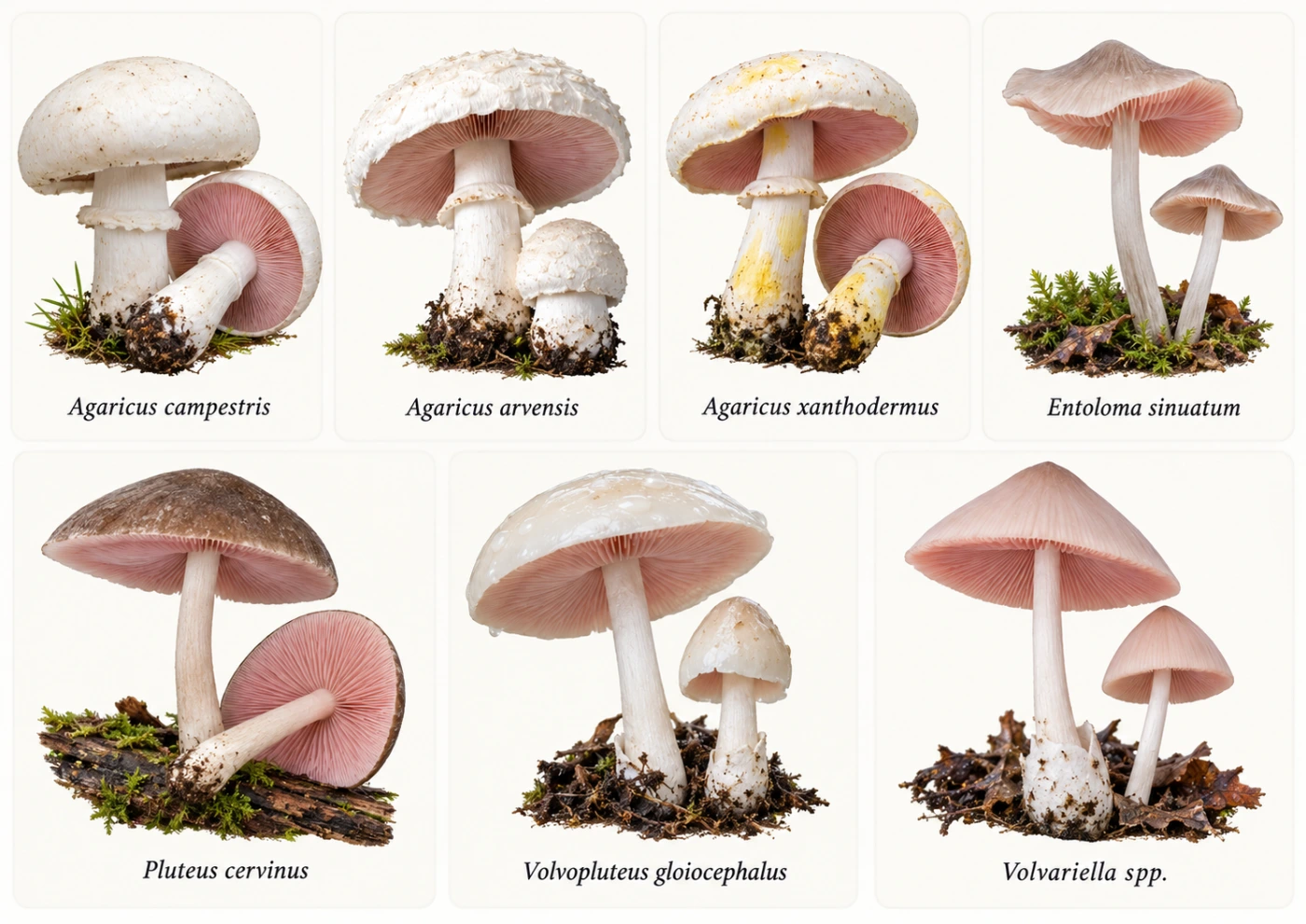
Pink gills can be an important clue when identifying a mushroom, but they do not point to one single species or even one single genus. In some mushrooms, the gills start white and later become pink as spores mature, while in others the pink color is present earlier or develops in a different way.
The key is to combine gill color with spore print, stem base, ring, cap shape, habitat, and age. Pink gills are especially useful for separating some harmless mushrooms from dangerous white-gilled look-alikes, but they should never be used alone.
⚠️ Important: Pink gills do not mean a mushroom is edible. Always identify the complete mushroom, including the stem base, spore print, and habitat.
Quick Identification
| Feature | What Pink Gills Can Suggest |
|---|---|
| Young gills | Often white or pale before turning pink |
| Mature gills | Pink, salmon, flesh-colored, or pink-brown |
| Common spore color | Pink to salmon |
| Important genera | Agaricus, Entoloma, Pluteus, Volvopluteus, Volvariella |
| Ring | Present in some groups, absent in others |
| Volva | Present in some groups such as Volvopluteus |
| Habitat | Soil, grass, wood, compost, disturbed ground |
| Main caution | Pink gills occur in both edible and toxic mushrooms |
| Best next step | Check spore print and stem base |
Why Do Mushroom Gills Turn Pink?
In many mushrooms, gill color changes as spores develop. Young gills may start white or pale, then become pink, salmon, brown, or dark as the spores mature.
This means age matters. A young mushroom and a mature mushroom of the same species can have very different-looking undersides.
Pink Gills vs Pink Spore Print
Pink gills often suggest a pink spore print, but the two are not exactly the same thing. Gill color can be influenced by age, tissue color, bruising, and lighting.
A spore print gives more direct information about spore color. If the gills are pink but the spore print is dark brown, another group may be involved.
Agaricus and Pink Gills
Many Agaricus species begin with pale pink gills that become progressively darker with age. Mature gills often turn chocolate-brown as the spores develop.
This is a classic and useful pattern. A mushroom with free pink gills, a ring, and no volva may belong to Agaricus.
Agaricus campestris — Field Mushroom
Identification
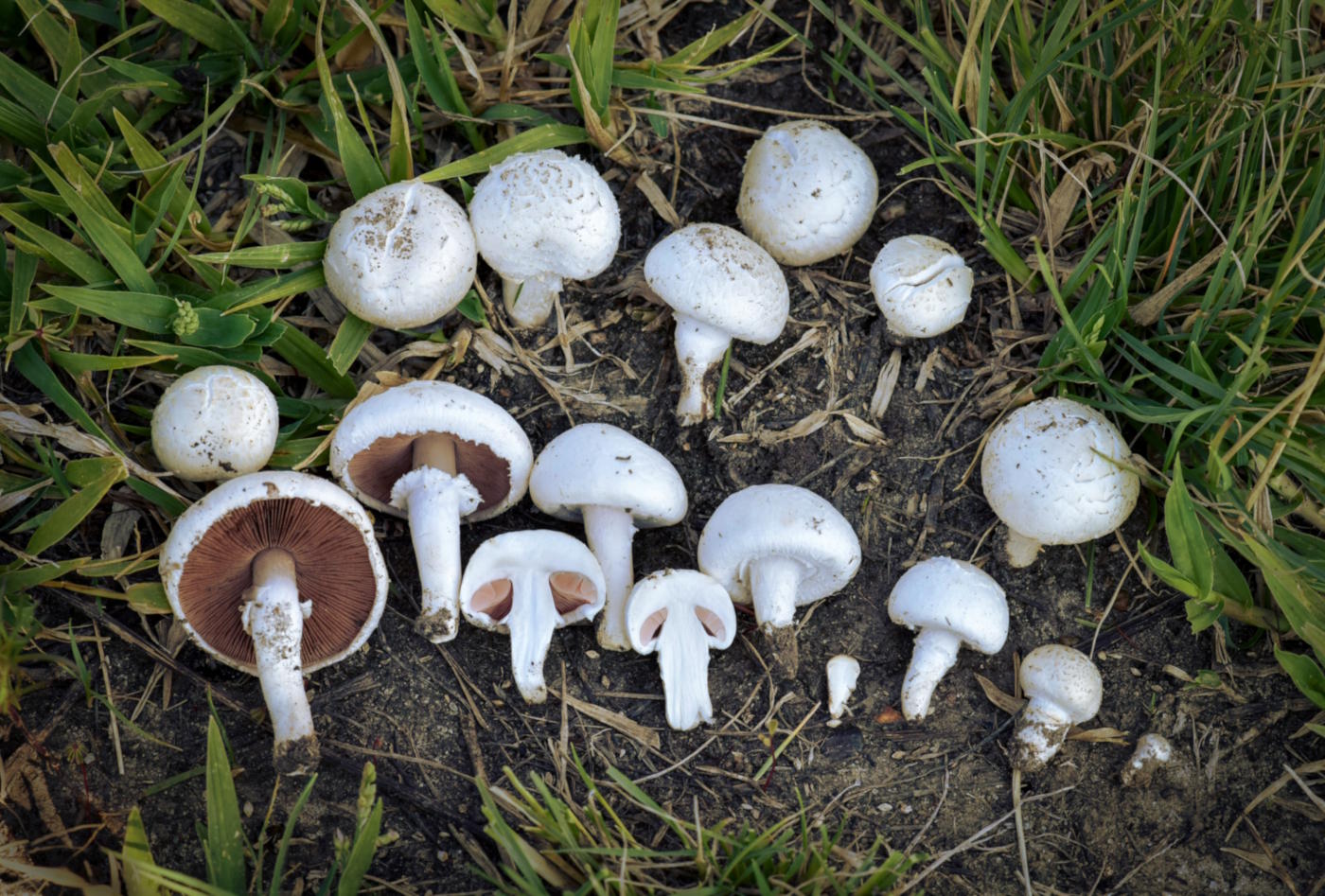
Field Mushroom has a white to cream cap, pink young gills, a ring, and a white stem. The gills darken from pink toward brown as the mushroom matures.
It commonly grows in grassland, lawns, pastures, and meadows rather than directly from wood.
Main Identification Clue
The combination of pink-to-brown free gills + ring + grassland habitat + no volva strongly supports an Agaricus identification.
Agaricus arvensis — Horse Mushroom
Identification
Horse Mushroom is a larger Agaricus with pale cap, free gills that begin pinkish and later become brown, and a prominent ring. It often grows in grassland or rich soil.
The mushroom may show yellowing on the cap or stem base in some specimens. Smell and staining can help with exact identification.
Main Identification Clue
Large size, pink-to-brown gills, and a substantial ring are useful clues, but exact Agaricus identification can be difficult.
Agaricus xanthodermus — Yellow Stainer
Identification
Yellow Stainer can look like an edible Agaricus at first. It has pink young gills, a ring, and a pale cap, but damaged tissue can turn bright yellow, especially near the stem base.
It is associated with gastrointestinal poisoning and should not be confused with edible field mushrooms.
Main Identification Clue
Strong yellow staining, especially at the stem base, combined with an unpleasant phenolic odor points toward Yellow Stainer.
Entoloma and Pink Gills
Many Entoloma species produce pink spores, and their gills often become pinkish as they mature. The group includes both harmless and poisonous species.
This makes pink gills especially important as a warning that an unknown mushroom should not be assumed edible.
Entoloma sinuatum — Livid Pinkgill
Identification
Entoloma sinuatum is a large pale mushroom with cream to yellowish cap and gills that become pink with maturity. It can grow in woodland and grassy areas near trees.
The species is poisonous and can cause severe gastrointestinal symptoms.
Main Identification Clue
Large pale fruit body plus maturing pink gills without an Agaricus-style ring should make Entoloma an important possibility.
Pluteus and Pink Gills
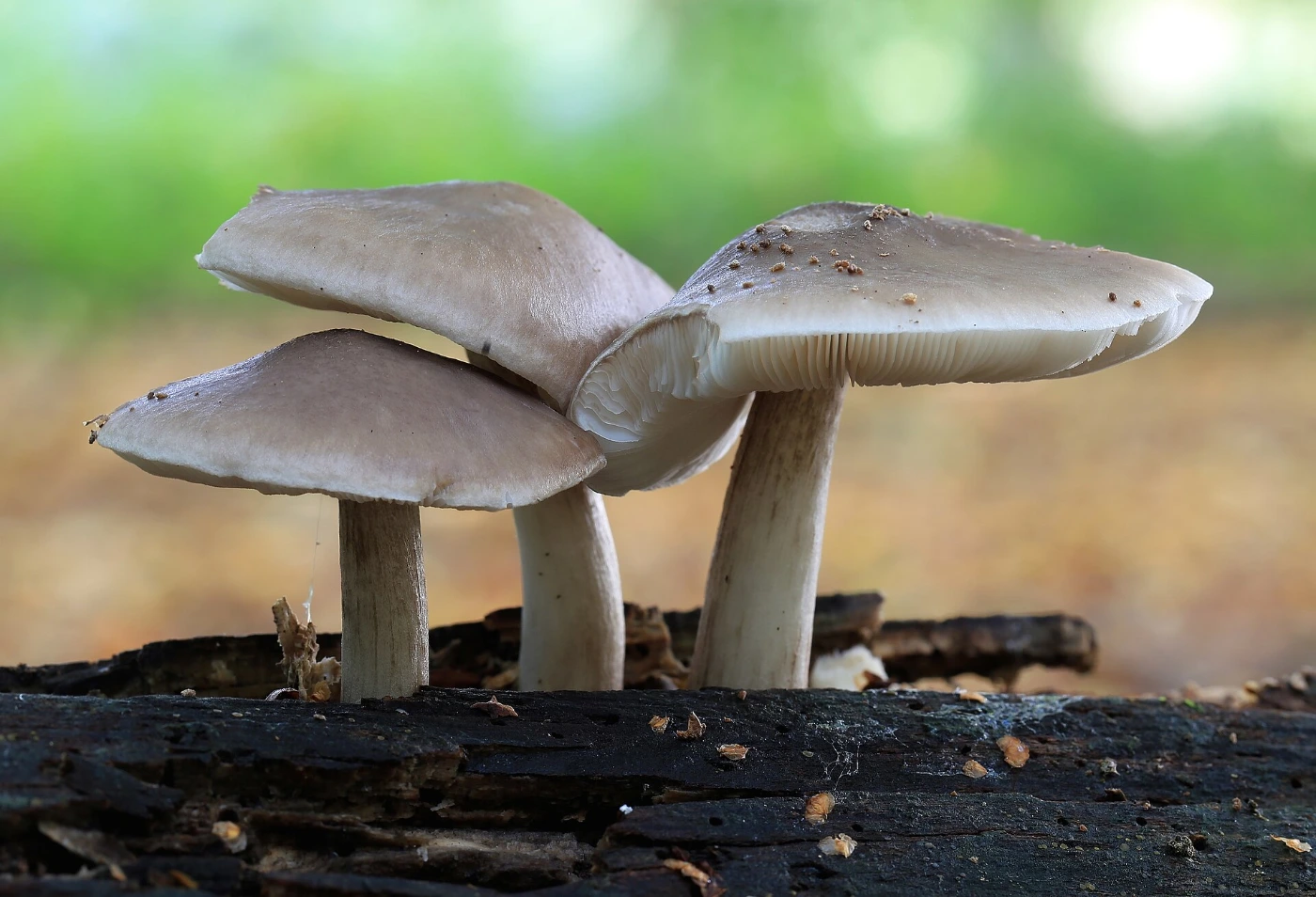
Pluteus species grow on wood and typically have free gills that become pink as spores mature. They usually lack both ring and volva.
Their growth directly from logs, stumps, or buried wood is one of the strongest ecological clues.
Pluteus cervinus — Deer Shield
Identification
Deer Shield usually has a brown to gray-brown cap, pale stem, and free gills that begin pale and later turn pink. It grows from dead wood or buried woody debris.
The lack of ring and volva helps separate it from several other pink-gilled groups.
Main Identification Clue
Pink free gills + no ring + no volva + wood growth strongly suggests Pluteus.
Volvopluteus and Pink Gills
Volvopluteus combines pink mature gills with a volva at the stem base. This is especially important because it can be confused with Amanita when young.
Unlike typical Amanitas, however, Volvopluteus has pink spores rather than white spores.
Volvopluteus gloiocephalus — Stubble Rosegill
Identification
Stubble Rosegill has a pale gray to whitish cap, free gills that become pink, a long pale stem, and a bag-like volva at the base.
It often grows in fields, gardens, compost, disturbed soil, or rich grassy places.
Main Identification Clue
The combination of pink mature gills + free gills + volva + no true Amanita-style white spore print is highly important.
Volvariella Species
Volvariella species also have pink spores and a volva. They can occur on plant debris, compost, wood, or rich organic substrates depending on species.
They lack a ring in many cases, which can make the volva even more visually important.
Pink Gills vs White Gills
Young pink-spored mushrooms may still have white or pale gills before the spores mature. This is why a single young specimen can be misleading.
Amanitas often retain white gills, while Volvopluteus and Volvariella may gradually become pink. Age and spore print therefore matter greatly.
Pink Gills vs Brown Gills
Some mushrooms pass through a pink stage before becoming brown. Agaricus is the classic example.
If the gills become chocolate-brown with age, Agaricus becomes more likely than a true pink-spored genus such as Pluteus or Entoloma.
Pink Gills vs Salmon Gills
Pink, salmon, and flesh-colored shades can overlap visually. Camera white balance and forest lighting can also change how the color appears.
It is better to describe the actual tone and confirm it with a spore print than rely on one photograph.
Pink Gills With a Ring
A ring plus pink young gills often suggests Agaricus. The next checks should be the absence of a volva, eventual darkening of gills, smell, and staining reactions.
A ringed mushroom with persistent white gills belongs to a different identification path.
Pink Gills Without a Ring
No ring broadens the possibilities. Pluteus, Entoloma, Volvariella, and other groups should be considered.
Habitat becomes especially useful. Growth on wood points toward Pluteus, while a volva points toward Volvopluteus or Volvariella.
Pink Gills With a Volva
This is a very important combination. A mushroom with a volva and pink mature gills should not be treated like a typical white-spored Amanita.
The stem base should be photographed intact because the volva can be the strongest structural clue.
Pink Gills on Wood
Pink gills combined with growth directly from wood strongly suggest Pluteus or related wood-growing pink-spored mushrooms.
The absence of a ring and volva adds support. Buried wood can make a specimen appear terrestrial even when the fungus is actually wood-decaying.
Pink Gills in Grass
Grassland pink-gilled mushrooms can include Agaricus, Entoloma, and Volvopluteus. The presence of ring, volva, and gill attachment becomes essential.
This is one of the situations where habitat narrows the possibilities but does not solve the identification by itself.
Pink Gills in Woodland
Woodland pink-gilled mushrooms may include Entoloma, Pluteus, and other genera. Nearby trees and whether the mushroom is growing from soil or wood are both useful.
A pale woodland mushroom with pink mature gills and no ring deserves special caution because some Entoloma species are toxic.
Pink-Gilled Mushroom Comparison
| Group | Ring | Volva | Spore Color | Typical Habitat |
|---|---|---|---|---|
| Agaricus | Usually yes | No | Brown | Grass, soil |
| Entoloma | Usually no | No | Pink | Soil, woodland, grassland |
| Pluteus | No | No | Pink | Wood |
| Volvopluteus | No | Yes | Pink | Soil, compost, disturbed ground |
| Volvariella | Usually no | Yes | Pink | Organic debris, wood, compost |
This table is a useful starting point, but exact identification still requires species-level features.
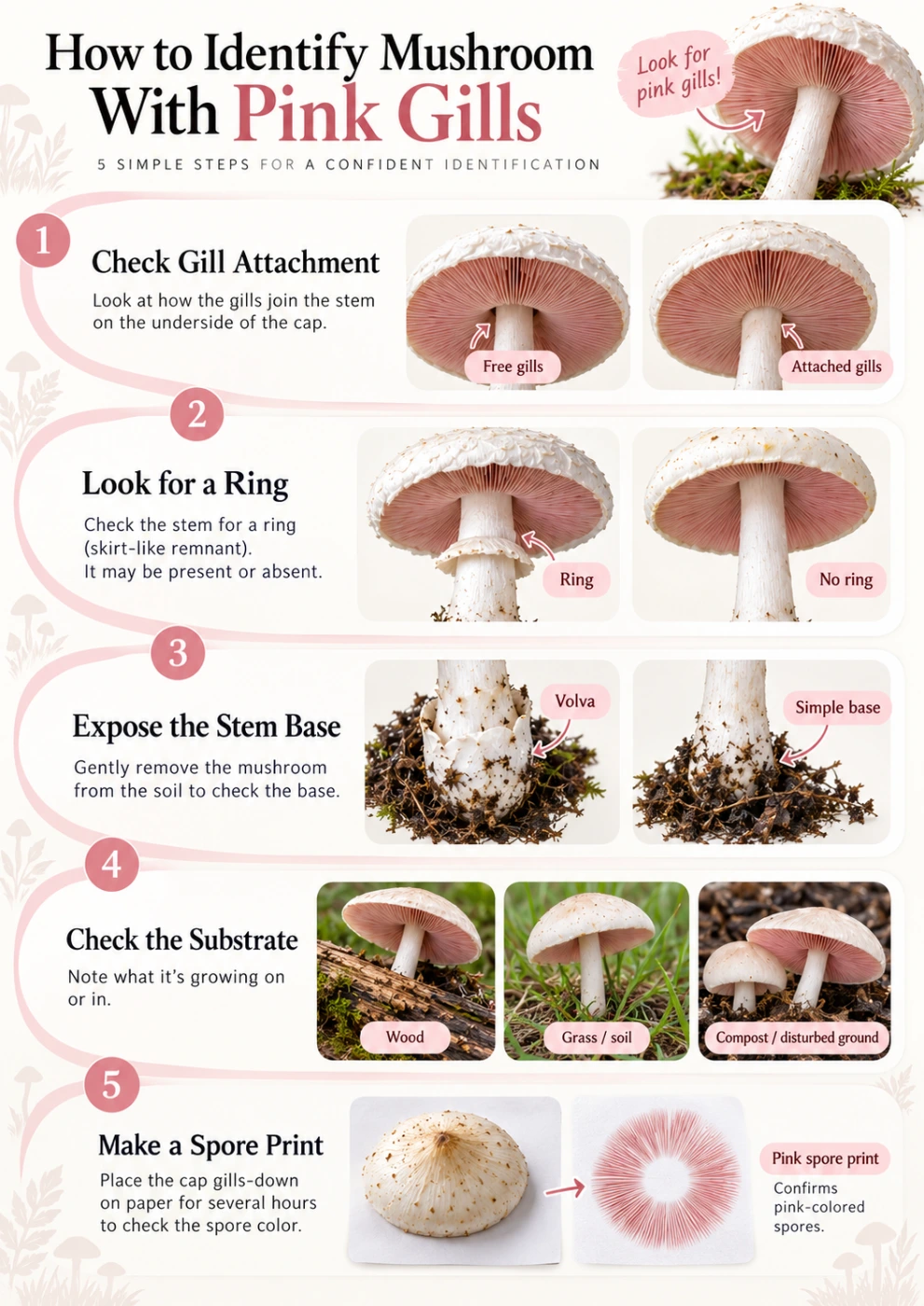
How to Identify a Mushroom With Pink Gills Step by Step
Start by checking whether the mushroom is young or mature. Then look at the stem base, ring, gill attachment, and substrate. This sequence is more reliable than starting with cap color.
Step 1: Check Gill Attachment
Determine whether the gills are free from the stem, attached, notched, or decurrent. Free pink gills strongly narrow the possibilities. A side view is usually better than a top-down image.
Step 2: Look for a Ring
A ring supports Agaricus or another ringed group. No ring points toward Pluteus, Entoloma, or volva-bearing pink-spored genera. Older specimens may lose fragile ring tissue, so absence should be interpreted cautiously.
Step 3: Expose the Stem Base
Look for a volva, sac, bulb, or simple straight base. A true volva dramatically changes the identification. Never cut off the stem base before examining it.
Step 4: Check the Substrate
Growth on wood strongly favors Pluteus. Grassland and disturbed soil can support Agaricus or Volvopluteus. Buried wood can complicate this, so inspect the immediate substrate carefully.
Step 5: Make a Spore Print
A pink spore print supports Pluteus, Entoloma, Volvopluteus, and related groups. Brown spores point more toward Agaricus. This is especially useful when gill color alone is ambiguous.
How to Photograph Pink-Gilled Mushrooms
Take one photograph of the whole mushroom in habitat before disturbing it. Then expose and photograph the complete stem base.
A close side image should show the gill color and attachment clearly. If possible, include both young and mature specimens because gill color can change dramatically with age.
A spore print photograph can also be very useful. It adds information that cap images alone cannot provide.
Can AI Identify Mushrooms With Pink Gills?
AI can often narrow the mushroom to a useful group when gills, ring, stem base, and habitat are visible. Exact species-level identification is harder because several pink-spored genera overlap strongly in appearance.
A top-only photograph is especially weak. Pink-gilled mushrooms are a good example of why underside and stem-base images matter so much.
A cautious result such as “pink-spored mushroom, likely Pluteus or Entoloma” can be more accurate than forcing a species name.
Common Identification Mistakes
One common mistake is assuming that pink gills mean Agaricus. Several unrelated genera also produce pink spores.
Another mistake is ignoring age. A young Agaricus may have pale pink gills, while an older one can have dark brown gills.
A third mistake is cutting off the stem base. This can hide a volva and remove the strongest clue separating Volvopluteus from other groups.
Interesting Facts About Pink Gills
Pink gills often reflect spore development rather than permanent tissue color. As spores accumulate, the underside can gradually shift from white to pink or salmon.
This makes pink-gilled mushrooms a good example of why mushroom age matters for identification. The same species can look completely different when young and mature.
Several unrelated fungal groups have independently evolved pink spores. That means pink gills are useful for narrowing the field, but they do not prove close evolutionary relationship.
The color can also reveal hidden structure. A mushroom that looks like a white-gilled Amanita when young may later develop pink gills and reveal that it belongs to a completely different group.
Frequently Asked Questions
Can pink gills turn brown later?
Yes. This is common in Agaricus, where gills often move from pale pink to dark chocolate-brown as spores mature.
Can a young pink-spored mushroom have white gills?
Yes. Before enough spores develop, the gills may still look white or cream.
Do all pink-gilled mushrooms have pink spore prints?
No. Some species have pinkish tissue or temporary color changes without a truly pink spore print. A spore print helps confirm the group.
Can rain change gill color?
Moisture can make colors appear darker or more saturated. Aging and bruising usually have a larger effect than rain itself.
Can pink gills fade in old mushrooms?
Yes. Old gills can become dirty, brownish, faded, or damaged by insects and weather.
Are mushrooms with pink gills safe to eat?
No general rule exists. Some are edible, some are inedible, and some are poisonous. Species identification is essential.
Can a mushroom with a volva have pink gills?
Yes. Volvopluteus and Volvariella are important examples.
Why does habitat matter so much?
Pink-spored groups can look similar but occupy different substrates. Wood, grass, compost, and woodland soil each point toward different possibilities.
Final Identification Notes
Pink gills are an important clue, but their meaning depends on age, spore color, ring, volva, gill attachment, and habitat. The same pink tone can appear in very different mushroom groups.
Agaricus often develops pink gills that later become brown, Pluteus combines pink spores with wood growth, Entoloma includes many soil-growing pink-spored species, and Volvopluteus adds a distinctive volva at the stem base.
The simplest field rule is: pink gills are the start of the identification, not the end. Check the ring, stem base, substrate, and spore print next.
Upload a photo and get possible matches in seconds.