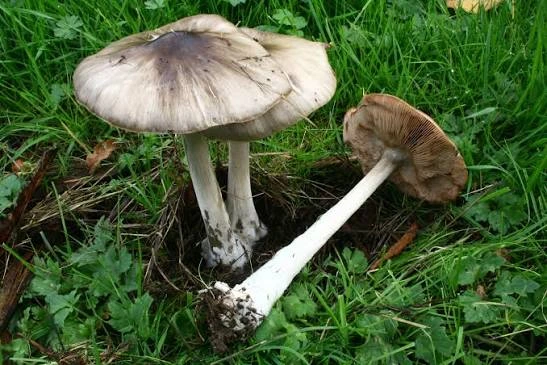
Volvopluteus gloiocephalus, commonly known as the Stubble Rosegill, is a large pale mushroom with free gills that gradually turn pink, a long white stem, and a distinctive sac-like volva around the stem base. It often grows in fields, gardens, compost-rich soil, disturbed ground, and other nutrient-rich habitats.
The combination of pink mature gills, pink spores, no ring, and a volva makes it unusual and relatively distinctive when mature. Young specimens can be much harder to identify because their gills may still look white, creating possible confusion with pale Amanita species.
⚠️ Important: Never identify a pale mushroom with a volva as edible from a single photograph. Some deadly Amanitas also have white gills and a sac-like volva, so mature gill color, spore print, ring structure, and the complete stem base must all be checked.
Quick Identification
| Feature | Volvopluteus gloiocephalus |
|---|---|
| Scientific name | Volvopluteus gloiocephalus |
| Common name | Stubble Rosegill |
| Family | Pluteaceae |
| Cap color | White, cream, pale gray to gray-brown |
| Cap shape | Bell-shaped to convex, later flatter |
| Cap surface | Smooth, often sticky or greasy when wet |
| Gills | Free, white when young, pink when mature |
| Stem | Long, white to pale |
| Ring | Absent |
| Volva | Present, sac-like |
| Spore print | Pink to salmon-pink |
| Flesh | White, soft to firm |
| Ecology | Saprotrophic |
| Habitat | Fields, gardens, compost, disturbed soil |
| Substrate | Rich soil, plant debris, straw, compost |
| Season | Often summer to autumn |
| Edibility | Reported as edible by some sources, but not recommended for beginners |
| Main look-alikes | Pale Amanita, Volvariella, Pluteus, Agaricus |
What Does Volvopluteus gloiocephalus Look Like?
Stubble Rosegill is usually a medium to large mushroom with a pale cap and relatively long stem. Mature specimens often look elegant and slender compared with the heavier build of many Amanitas.
The most important features are found underneath and at the stem base. Mature gills become distinctly pink, while the base remains enclosed by a loose, bag-like volva.
Cap
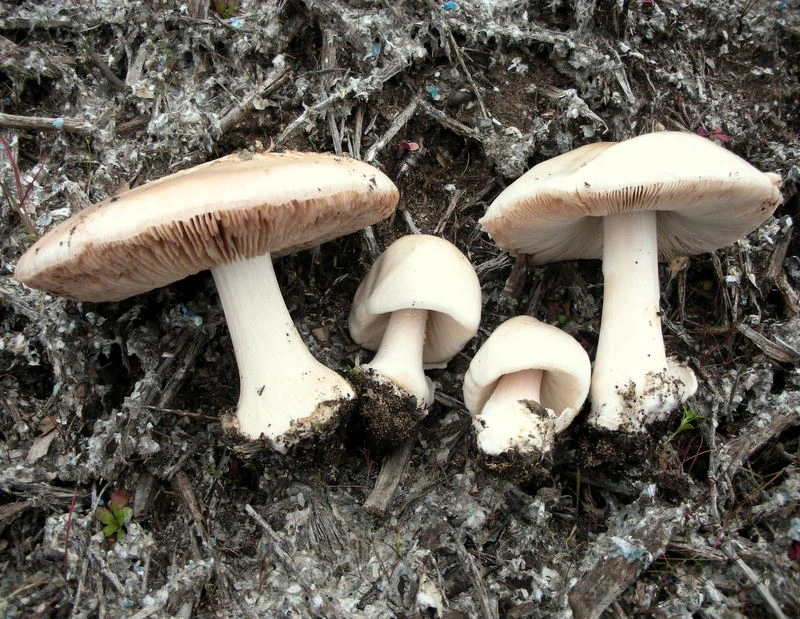
The cap begins bell-shaped to convex and gradually expands until it is broadly convex or almost flat. It can become fairly large in favorable conditions.
Color ranges from white and cream to pale gray, gray-brown, or slightly darker in the center. Older fruit bodies may become more grayish or beige.
Cap Surface
The surface is generally smooth and may feel sticky, slippery, or slightly greasy when fresh and wet. In dry weather, the same cap can look much more matte.
There are usually no prominent white warts like those seen on some Amanitas. A smooth pale cap is therefore typical, although this feature alone is not enough for identification.
Gills
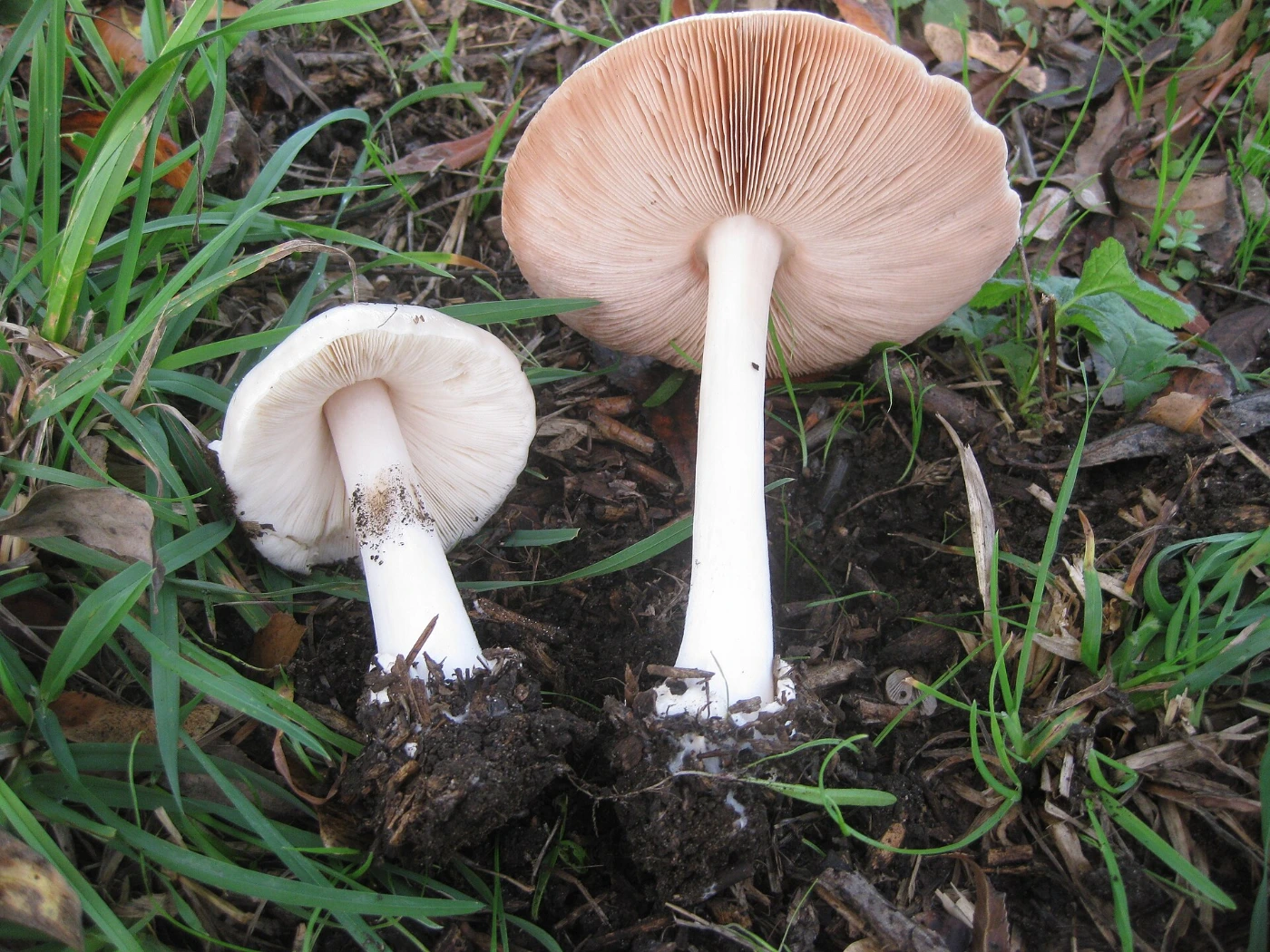
The gills are free from the stem, meaning they stop before reaching it. This creates a visible gap around the upper stem when the cap is viewed from underneath.
Young gills are white or very pale. As spores mature, they gradually turn flesh-pink, salmon-pink, or dull pink.
Why Gill Color Is So Important
The change from white to pink is one of the strongest clues for this species. It also explains why young Stubble Rosegills can be much more difficult to identify than mature ones.
A pale mushroom with a volva and completely white immature gills can resemble an Amanita. Waiting for mature characters or making a spore print can therefore be extremely useful.
Stem
The stem is usually long, cylindrical, and white to cream. It can appear slightly broader toward the base but is generally more slender than the thick stems of many large Amanitas.
There is no ring. The absence of a ring becomes useful when combined with the pink mature gills and volva.
Volva
The base of the stem emerges from a loose membranous sac called a volva. This structure is a remnant of tissue that surrounded the young mushroom.
The volva may be white, cream, grayish, or stained by soil. It can remain partly buried, so the entire stem base should be carefully exposed before identification.
Why the Volva Matters
A volva immediately narrows the identification possibilities. However, it does not automatically mean the mushroom is an Amanita.
The important question is what other features occur with it. Pink mature gills + pink spores + volva + no ring strongly point toward Volvopluteus rather than a typical Amanita.
Flesh
The flesh is white and relatively soft to firm. It does not show dramatic red, blue, or black bruising reactions.
Cap flesh is usually thinner toward the margin. Large mature specimens can become soft or waterlogged after prolonged wet weather.
Smell
The smell is usually mild and not especially distinctive. Some specimens may have a slightly earthy, radish-like, or ordinary mushroom odor.
Odor is much less useful than mature gill color and the volva. It should be treated only as supporting information.
Spore Print
The spore print is pink to salmon-pink. This is one of the best ways to separate Stubble Rosegill from white-spored Amanitas.
A white spore print from a pale volva-bearing mushroom should immediately make you reconsider a Volvopluteus identification.
Where Does Stubble Rosegill Grow?
Unlike mycorrhizal Amanitas, Volvopluteus gloiocephalus is saprotrophic. It feeds on decomposing organic material rather than living in a partnership with tree roots.
It often appears in open or disturbed habitats rather than deep forest. Fields, gardens, compost-rich soil, vegetable beds, roadsides, parks, and agricultural ground can all provide suitable conditions.
Fields and Stubble
The common name Stubble Rosegill refers to its frequent occurrence in agricultural land, including fields with plant residues. It can fruit among straw, crop debris, or rich soil.
This open-field habitat is useful when separating it from woodland Amanitas. Habitat is not absolute, but it can strengthen the identification considerably.
Gardens and Compost
Stubble Rosegill can also grow in gardens, compost-enriched beds, and places containing decomposing plant material. Rich disturbed soil is especially suitable.
A mushroom may appear to grow directly from ordinary soil even when buried straw or plant debris is feeding the mycelium underneath.
When Does Volvopluteus gloiocephalus Grow?
Fruiting often occurs from summer into autumn, although the exact season depends on climate and rainfall. Mild regions may produce mushrooms outside the classic autumn period.
Warm weather followed by rain can trigger sudden appearances in fields and gardens. The fruit bodies can develop relatively quickly.
Distribution
Volvopluteus gloiocephalus is widely distributed and has been reported from many temperate regions. It is especially associated with human-modified habitats, agriculture, and disturbed ground.
Its broad distribution can make it more familiar around cities and farmland than many purely woodland mushrooms.
Is Volvopluteus gloiocephalus Edible?
Stubble Rosegill has been reported as edible in some field guides, but it is not a good beginner food mushroom. Its pale cap and volva create a potentially dangerous identification problem with Amanitas.
For practical purposes, correct identification should come before any consideration of food use. A young specimen with white gills should never be treated as safely identified only because it was found in a field.
Volvopluteus gloiocephalus Look-Alikes
The most important look-alikes are pale Amanitas, other volva-bearing pink-spored mushrooms, and Pluteus species. Agaricus can also enter the comparison because many species develop pink gills.
The most useful characters are the combination of ring, volva, spore color, gill attachment, and habitat.
Pale Amanita Species
Identification
Many pale Amanitas have white gills, a ring, and a volva or other universal-veil structures at the stem base. Some deadly species can be almost completely white.
Young Stubble Rosegill also has pale gills, making this comparison particularly important.
Main Difference
Mature Volvopluteus gills turn pink and produce a pink spore print. Typical Amanitas retain white gills and produce white spores.
Amanitas also commonly possess a ring, whereas Stubble Rosegill lacks one.
Volvopluteus vs Amanita
| Feature | Stubble Rosegill | Typical Pale Amanita |
|---|---|---|
| Mature gills | Pink | White |
| Spore print | Pink | White |
| Volva | Present | Often present |
| Ring | Absent | Often present |
| Ecology | Saprotrophic | Mycorrhizal |
| Typical habitat | Fields, gardens, disturbed soil | Woodland near trees |
| Main clue | Pink spores | White spores |
The comparison becomes hardest with very young fruit bodies before the pink spore color develops.
Volvariella Species
Identification
Volvariella species also have a volva, free gills, and pink spores. Historically, several mushrooms now placed in Volvopluteus were classified near this group.
Exact separation can require more detailed morphology and sometimes microscopic features.
Main Difference
Habitat, cap structure, size, and regional taxonomy can help. For a typical large pale mushroom in rich open soil, Volvopluteus gloiocephalus is an important candidate.
Volvariella bombycina — Silky Rosegill
Identification
Silky Rosegill is a striking pale mushroom with a silky to finely hairy white cap, pink mature gills, and a volva. It typically grows directly from dead or damaged hardwood.
The cap surface can look distinctly fibrous or silky rather than smooth and greasy.
Main Difference
Substrate is particularly useful. Wood growth + silky cap favors Volvariella bombycina, while rich soil + smooth sticky cap favors Volvopluteus gloiocephalus.
Pluteus cervinus — Deer Shield
Identification
Deer Shield has free gills that become pink and produces a pink spore print. It usually has a brown to gray-brown cap and pale stem.
The species grows directly from dead wood or buried woody material. It has neither a ring nor a volva.
Main Difference
The stem base solves much of the comparison. Pluteus cervinus has no volva, whereas Stubble Rosegill emerges from a distinct sac.
Volvopluteus vs Pluteus
| Feature | Volvopluteus gloiocephalus | Pluteus cervinus |
|---|---|---|
| Mature gills | Pink | Pink |
| Spore print | Pink | Pink |
| Ring | No | No |
| Volva | Yes | No |
| Cap | Pale, often sticky | Usually brown to gray-brown |
| Habitat | Rich soil, fields | Dead wood |
| Best clue | Sac-like volva | Wood growth, no volva |
Both groups show why pink gills need to be interpreted together with the stem base.
Agaricus Species
Identification
Many Agaricus species have pink gills when young. With maturity, those gills usually become dark chocolate-brown as brown spores accumulate.
Agaricus normally has a ring but no volva. Grassland habitat can overlap with Stubble Rosegill.
Main Difference
Stubble Rosegill keeps its gills in the pink-to-salmon range and produces pink spores. Agaricus eventually develops dark brown gills and a brown spore print.
Volvopluteus vs Agaricus
| Feature | Stubble Rosegill | Agaricus |
|---|---|---|
| Young gills | Pale | Pink to pale pink |
| Mature gills | Pink | Dark chocolate-brown |
| Spore print | Pink | Brown |
| Ring | No | Usually yes |
| Volva | Yes | No |
| Habitat | Rich soil, fields | Grassland, soil |
| Best clue | Volva + pink spores | Ring + brown mature spores |
A mature specimen is therefore generally much easier to separate than a very young one.
How to Identify Volvopluteus gloiocephalus Step by Step
Start with the complete stem base rather than the cap. Once a volva is confirmed, check mature gill color, ring presence, and spore print.
This order is especially useful because several pale mushrooms look similar from above.
Step 1: Expose the Volva
Carefully loosen soil around the base and remove the complete mushroom. Look for a loose membranous sac surrounding the stem.
Do not cut the stem at ground level because the volva may remain entirely underground.
Step 2: Check the Gills
Determine whether the gills are still white or have matured to pink. Pink free gills strongly support a pink-spored group.
If the specimen is very young, identification should remain more cautious.
Step 3: Look for a Ring
Stubble Rosegill should not have a true ring. A clear membranous ring together with white gills should raise concern for Amanita.
Ring remnants can sometimes be damaged, so the absence of a ring should not be judged from one broken specimen alone.
Step 4: Check the Spore Print
A pink to salmon-pink spore print strongly supports Volvopluteus. White spores point toward Amanita, while dark brown spores suggest Agaricus.
This is one of the most useful tests when morphology is ambiguous.
Step 5: Examine the Habitat
Fields, garden beds, compost-rich ground, and disturbed soil fit Stubble Rosegill well. Deep woodland associated with trees makes Amanita more plausible.
Habitat should confirm rather than replace structural identification.
How to Photograph Stubble Rosegill
Take one photograph of the complete mushroom before removing it. Include enough surroundings to show whether it is growing in grass, rich soil, compost, straw, or woodland.
Then expose the complete volva and photograph the mushroom from the side. A close-up of the mature pink gills and another of the stem base provide the two most useful images.
If young and mature fruit bodies occur together, photograph both. The transition from pale to pink gills can be especially informative.
Can AI Identify Volvopluteus gloiocephalus?
AI can often recognize mature specimens when pink gills and the volva are both clearly visible. A complete side photograph is much more useful than a cap-only image.
Young mushrooms are substantially harder because their gills may remain white. A cautious system should keep pale Amanita among the possibilities until spore color and mature gill color are known.
For a broader explanation of this feature, see the guide to Mushrooms With Pink Gills: What the Color Means.
Common Identification Mistakes
One common mistake is identifying the mushroom from its pale cap alone. White and gray caps occur across many unrelated genera.
Another mistake is assuming that any mushroom with a volva must be an Amanita. Volvopluteus demonstrates why mature gill and spore color are essential.
The most dangerous error is ignoring age. Young Stubble Rosegill can still have nearly white gills and may look much more Amanita-like than an older pink-gilled specimen.
Interesting Facts About Volvopluteus gloiocephalus
The name “Rosegill” refers to the pink color that develops as spores mature. The mushroom can therefore change dramatically in appearance during its relatively short fruiting period.
The volva is a remnant of a universal veil that surrounded the young fruit body. This is structurally similar to what happens in Amanita, even though the two groups differ strongly in spore color and other features.
Stubble Rosegill also shows how human activity can create fungal habitat. Agricultural residues, compost, gardens, and disturbed nutrient-rich soils provide environments where the species can thrive.
Its changing gill color makes it a useful example of why mushroom age matters. A young white-gilled specimen and a mature pink-gilled specimen can look like completely different mushrooms even though they are the same species.
Frequently Asked Questions
Can Stubble Rosegill have completely white gills?
Yes, when young. The pink color develops as the spores mature, which is why immature specimens require extra caution.
Can the volva be hidden underground?
Yes. Much or all of the sac may remain below the soil surface, so the complete base should be carefully excavated.
Can the cap become gray or brownish?
Yes. Cap color varies from white and cream to pale gray or gray-brown, especially toward the center or with age.
Can Stubble Rosegill grow in a lawn?
Yes, particularly where the soil is rich or disturbed. Compost, buried organic matter, and agricultural debris can make lawns or grassy ground suitable.
Why is the cap sticky after rain?
The surface can become viscid or greasy when wet. Once dry, the same fruit body may look much less glossy.
Can several fruit bodies grow together?
Yes. Multiple mushrooms can appear in the same patch of nutrient-rich soil when conditions are favorable.
Does a pink spore print guarantee Volvopluteus?
No. Several genera produce pink spores. The volva, free gills, ring absence, and habitat must also fit.
Can an old specimen lose its volva?
The sac can tear or become damaged during growth or collection. Remaining fragments at the stem base may still reveal its presence.
Final Identification Notes
Volvopluteus gloiocephalus is best recognized by the combination of free gills that mature from white to pink, a pink spore print, a smooth pale cap, no ring, and a distinct sac-like volva at the stem base.
The most important safety comparison is with pale Amanitas. Mature Stubble Rosegill develops pink gills and pink spores, while typical Amanitas retain white gills and white spores and often have a ring.
The simplest field pattern is: pink mature gills + pink spores + no ring + sac-like volva + rich disturbed soil = strong Stubble Rosegill candidate.
Upload a photo and get possible matches in seconds.