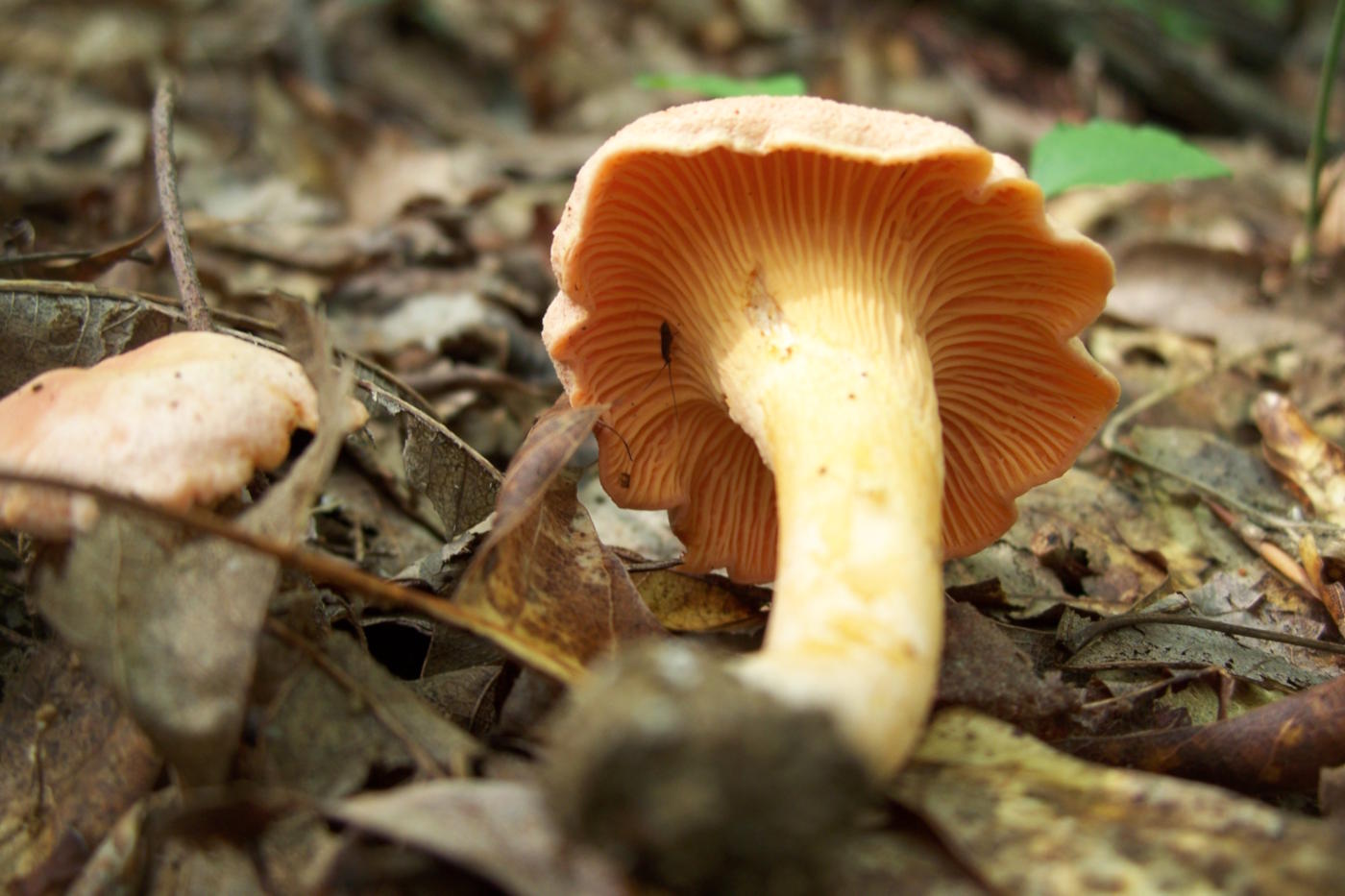
The underside of a mushroom is often more useful for identification than the color of its cap. One of the first things to check is whether the mushroom has true gills, false gills, pores, teeth, or another type of fertile surface.
True gills are thin, blade-like structures attached beneath the cap, while false gills are thicker folds or ridges that are part of the mushroom’s flesh. Learning this difference is especially important when identifying chanterelles and separating them from orange look-alikes such as False Chanterelles and Jack-o’-Lantern mushrooms.
⚠️ Important: This guide is for identification and education only. Gill structure can help narrow an identification, but no mushroom should be eaten based on a single feature, photograph, or AI result.
Quick Comparison: True Gills vs False Gills
| Feature | True Gills | False Gills |
|---|---|---|
| Structure | Thin blade-like plates | Thick folds or ridges |
| Edge | Usually sharp and distinct | Rounded or blunt |
| Attachment | Separate structures attached beneath cap | Integrated into cap flesh |
| Spacing | Often regular and repeated | More irregular |
| Forking | May fork in some species | Often fork and merge |
| Cross-veins | Sometimes present | Common in chanterelles |
| Texture | Delicate or brittle in many species | Thick and fleshy |
| Main examples | Amanita, Agaricus, Galerina, Omphalotus | Cantharellus |
| Best field clue | Looks like separate blades | Looks like wrinkles molded from flesh |
What Are Mushroom Gills?
Mushroom gills are thin plates of tissue arranged beneath the cap. Their main role is to provide a large surface area where microscopic spores are produced and released.
The scientific term for gills is lamellae. They are found in many familiar mushroom groups, including Amanita, Agaricus, Galerina, Mycena, Russula, and countless others.
What Do True Gills Look Like?
True gills resemble many thin blades radiating outward from the stem toward the cap margin. They usually have clearly defined edges and can often be seen individually from the side.
Depending on the species, the gills may be closely packed or widely spaced. They can also vary dramatically in color, from white and pink to brown, purple, black, or rusty orange.
Are True Gills Separate From the Cap?
Structurally, true gills project downward from the cap as distinct plates. If you look at a cut section from the side, each gill appears as a separate blade rather than a simple fold in the cap surface.
In some mushrooms, the gills may break away from the cap flesh relatively easily. In others, they are more firmly attached, so this should not be used as the only test.
What Are False Gills?
False gills are raised folds or ridges rather than true blade-like gills. They are most famously associated with chanterelles in the genus Cantharellus.
These ridges are part of the mushroom’s outer surface and blend smoothly into the cap and stem. They often fork, merge, and form cross-connections, creating a network-like pattern.
What Do False Gills Look Like?
False gills usually look thicker and more rounded than true gills. Their edges are blunt rather than sharp, and the folds often appear uneven in height and spacing.
Instead of looking like hundreds of separate plates, they resemble wrinkles or veins running down the underside of the cap. This difference becomes much easier to recognize after comparing several mushrooms side by side.
Why Are They Called False Gills?
The term “false gills” is used because the structures look superficially similar to gills but are anatomically different. They still form part of the spore-producing surface, but they are folds rather than separate lamellae.
The name is especially useful in field identification because it immediately distinguishes chanterelles from many orange gilled mushrooms. It is not meant to suggest that the structures are unimportant or nonfunctional.
The Fastest Way to Tell True Gills From False Gills
Turn the mushroom over and look at the underside from an angle rather than straight on. True gills should appear as thin plates with clearly separated edges, while false gills should look like thick ridges molded into the mushroom.
Then examine how the structures branch. False gills often fork irregularly and reconnect, while true gills usually retain a more blade-like appearance even when they branch.
Check the Edge
The edge of a true gill is usually thin and sharp. It may look almost like the edge of a sheet of paper, especially in delicate mushrooms.
A false gill is more rounded and blunt. Instead of ending in a thin edge, it rises gradually from the flesh and blends back into it.
Check the Thickness
True gills are generally much thinner than the surrounding cap flesh. Even thick-gilled species still show clearly separate plates.
False gills are broader and less sharply defined. Their thickness makes them look more like low ridges than conventional mushroom gills.
Check Whether They Merge
False gills frequently fork, split, rejoin, and form short cross-veins between neighboring ridges. This irregular network is particularly common in chanterelles.
True gills can also fork in some species, so forking alone does not prove that a mushroom has false gills. The thickness and blade-like structure remain more important.
True Gills in Common Mushrooms
Many mushroom groups have true gills, so recognizing them is only the first step. Gill color, attachment, spacing, and changes with age can then help narrow the identification further.
A white-gilled mushroom may belong to a completely different group from a pink- or rusty-gilled species. This is why the underside can provide several identification features at once.
Amanita Gills
Amanita species usually have pale or white true gills. In many species, the gills do not attach directly to the stem and are described as free.
Other important Amanita features include a ring, volva, bulbous stem base, or universal veil remnants depending on species. Gill structure should therefore be combined with stem-base examination.
Agaricus Gills
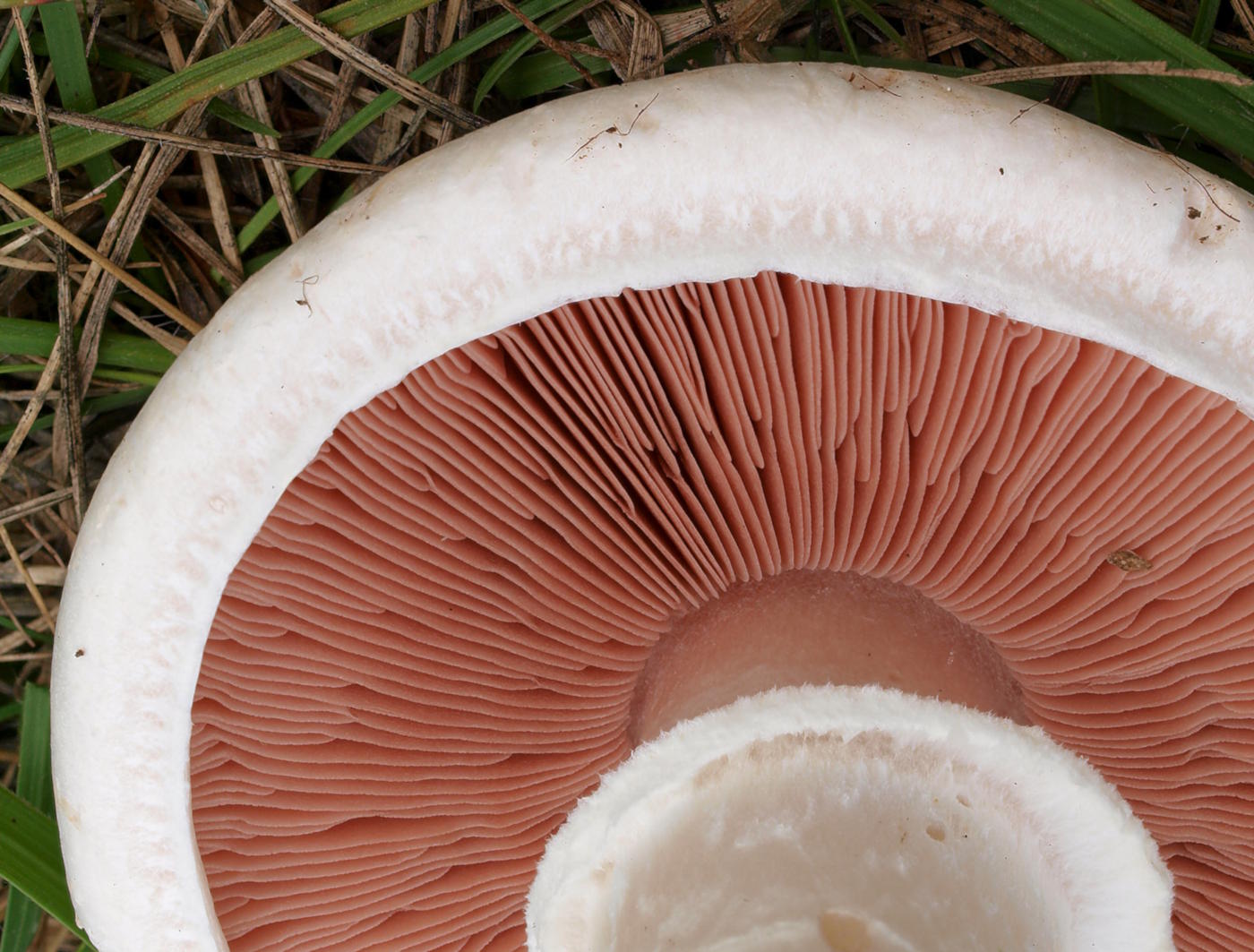
Agaricus mushrooms have true gills that change color as the mushroom matures. Young gills are often pink and gradually become chocolate brown as the spores develop.
This age-related change is a useful identification feature. It also helps distinguish Agaricus from white-gilled Amanitas, which keep pale gills as they mature.
Galerina Gills
Galerina marginata, the Deadly Galerina, has true gills that become rusty brown with age. The mature spore print is also rusty brown.
This is important when comparing it with wood-growing mushrooms such as Velvet Shank, which has pale gills and a white spore print. Gill color can therefore have direct safety value.
Jack-o’-Lantern Gills
Jack-o’-Lantern mushrooms in the genus Omphalotus have true, well-developed orange gills. These gills run down the stem and can look superficially similar to chanterelle ridges from a distance.
The difference becomes obvious on close inspection. Jack-o’-Lantern gills are thin blades, while chanterelle false gills are thick, blunt folds.
False Gills in Chanterelles
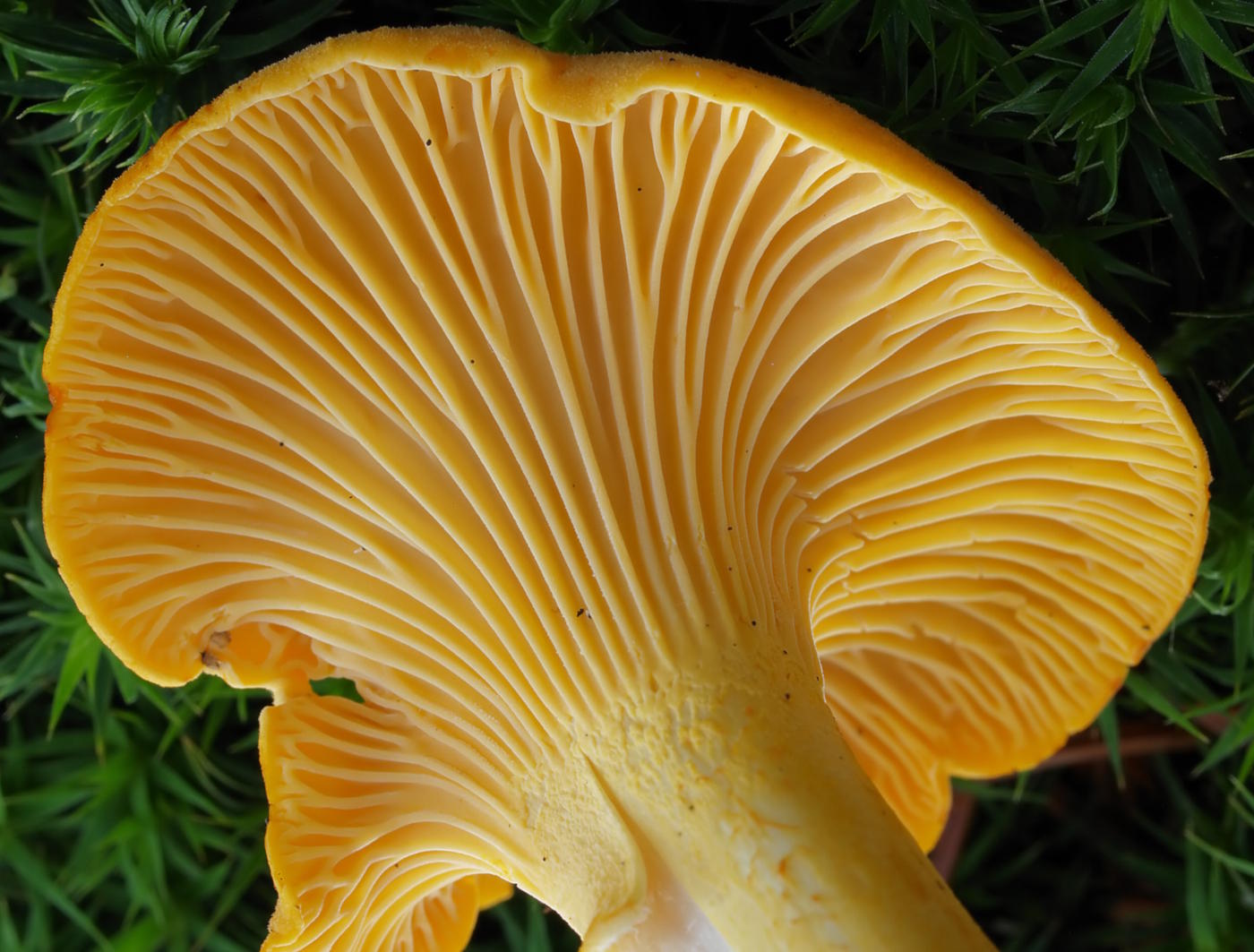
Chanterelles are the best-known example of mushrooms with false gills. Their ridges are thick, irregular, often forked, and usually run from the underside of the cap onto the stem.
The folds may be shallow in some species and strongly developed in others. This variation is one reason beginners sometimes mistake chanterelle ridges for true gills.
Cantharellus Species
Golden chanterelles in the genus Cantharellus typically have obvious false gills. These structures are often the most reliable feature for separating them from orange gilled look-alikes.
Different chanterelle species vary in ridge depth, color, and branching pattern. Some show very prominent ridges, while others have a much smoother underside.
Cantharellus lateritius
The Smooth Chanterelle, Cantharellus lateritius, may have an underside that is almost smooth when young. Older specimens can develop shallow wrinkles, but the structures remain much less prominent than those of many golden chanterelles.
This demonstrates that not all chanterelles have strongly developed false gills. Geography and overall morphology remain important when the underside is unusually smooth.
True Gills vs False Gills in Chanterelle Identification
Chanterelles are a perfect example of why the distinction matters. From above, a true chanterelle, False Chanterelle, and Jack-o’-Lantern can all appear yellow or orange and funnel-shaped.
The underside separates them much more effectively. True chanterelles have blunt false gills, while the other two have actual blade-like gills.
Chanterelle vs False Chanterelle
False Chanterelle, Hygrophoropsis aurantiaca, has many thin, forked true gills. Because these gills branch extensively, they may initially look similar to chanterelle ridges.
The key difference is structure rather than branching. False Chanterelle gills remain thin plates, while chanterelle folds are thicker and integrated into the flesh.
Quick Comparison
| Feature | Chanterelle | False Chanterelle |
|---|---|---|
| Underside | False gills | True gills |
| Structure | Thick ridges | Thin blades |
| Edge | Blunt | Sharp |
| Flesh | Firm and pale | Thinner, often more orange |
| Ecology | Mycorrhizal | Saprobic |
| Safety | Edible when correctly identified | Best treated as inedible |
The underside provides the fastest distinction. Habitat and flesh texture can then support the identification.
Chanterelle vs Jack-o’-Lantern
Jack-o’-Lantern mushrooms have true orange gills and often grow in dense clusters associated with wood. Chanterelles grow from soil in partnership with living trees and are usually more scattered.
This difference is particularly important because Jack-o’-Lantern mushrooms are poisonous. A bright orange mushroom with conventional blade-like gills should not be treated as a chanterelle.
Are Forked Gills Always False Gills?
No. This is one of the most common identification mistakes.
True gills can fork, branch, or develop cross-connections in several mushroom groups. False Chanterelle is a good example because its true gills can branch repeatedly.
The correct question is not “Do the gills fork?” but “Are these structures thin blades or thick folds?” Shape and thickness matter more than branching alone.
Are Decurrent Gills the Same as False Gills?
No. “Decurrent” describes how true gills attach to the stem, not whether they are real or false.
Decurrent gills run down the stem rather than stopping abruptly beneath the cap. Oyster Mushrooms, Jack-o’-Lantern mushrooms, and many other species have true decurrent gills.
Chanterelle false gills also run down the stem, which is why the two structures can be confused. The difference remains blade-like versus ridge-like anatomy.
Other Types of Mushroom Undersides
Not every mushroom has gills or false gills. Learning the main underside types makes identification much faster because it immediately narrows the number of possible groups.
Pores, teeth, smooth surfaces, and maze-like structures are all common. They can often be recognized without any special equipment.
Pores
Boletes and many bracket fungi have pores instead of gills. The underside may look like a sponge or like a smooth surface covered with thousands of tiny holes.
Porcini, Bay Bolete, Turkey Tail, and Chicken of the Woods are familiar examples. Pore size, color, and bruising reactions can provide further identification clues.
Teeth
Hedgehog Mushrooms and several wood-growing fungi have downward-pointing teeth or spines. These can range from tiny bristles to long hanging structures.
Hydnum species are particularly easy to recognize because their cap undersides are covered with soft teeth. Lion’s Mane and related Hericium species also produce spores on tooth-like structures.
Smooth Undersides
Some fungi have fertile surfaces that look almost completely smooth. False Turkey Tail fungi in Stereum are a good example.
A smooth underside can be an important diagnostic feature when comparing them with true Turkey Tail, which has numerous tiny pores.
Maze-Like or Gill-Like Pores
Some bracket fungi have elongated pores that form maze-like patterns. These can look surprisingly similar to gills at first glance.
Birch Mazegill is a good example because its underside forms long slots rather than conventional round pores. Looking closely at how the structures connect reveals that they are not typical gills.
Why Gill Color Matters
Once you have established that a mushroom has true gills, color becomes one of the next useful features. Gill color may remain constant or change dramatically as spores mature.
White, pink, rusty brown, chocolate brown, purple-brown, gray-green, and black gills can all point toward different groups. Always check mature mushrooms because very young specimens may not yet show their final gill color.
Why Gill Attachment Matters
True gills can attach to the stem in several different ways. They may be free, attached directly, notched, or decurrent down the stem.
These attachment patterns are useful for narrowing identification. For example, Agaricus typically has free gills, while Oyster Mushrooms have strongly decurrent gills.
Gill attachment can be subtle, so it is most useful once the mushroom has already been placed into a general group.
Why Gill Spacing Matters
Some mushrooms have extremely crowded gills, while others have large gaps between them. This can be useful when comparing similar species.
Spacing should not be judged from a single damaged specimen because age can change the apparent distance between gills. Comparing several fruit bodies provides a more reliable impression.
How to Examine Mushroom Gills Correctly
Hold the mushroom sideways in good natural light and look across the underside rather than directly at it. This viewing angle makes the thickness of the structures much easier to judge.
A hand lens can help with very small mushrooms, but it is usually unnecessary for distinguishing chanterelle false gills from conventional true gills. Good lighting and a clear side view are often enough.
Do Not Remove the Stem Base Too Early
The underside is important, but it should not distract from the rest of the mushroom. Pulling or cutting the fruit body carelessly can destroy important stem-base features.
This is particularly dangerous with Amanitas because a buried volva may be essential for identification. Examine the entire mushroom, not just the gills.
How to Photograph Gills for Identification
A photograph taken directly upward beneath the cap can show color but often hides thickness. A slightly angled side view is usually better because individual gills or ridges become easier to distinguish.
Take one wider image showing the complete underside and one close-up of a small section. For chanterelles, try to capture the points where the ridges fork and run down the stem.
A third photograph of the cut mushroom can reveal whether the underside structures are thin blades or folds continuous with the flesh.
Can AI Tell True Gills From False Gills?
AI can often recognize obvious false gills when photographs are sharp and taken from the correct angle. The task becomes much harder when the image shows only the cap or when the underside is blurred.
False Chanterelles are particularly challenging because their forked gills can visually imitate chanterelle ridges. Multiple close-up photographs usually improve the result considerably.
AI should therefore help narrow possibilities rather than replace structural examination. Gill type is a useful feature precisely because it can be inspected directly by the person holding the mushroom.
Common Mistakes When Identifying Gills
One common mistake is assuming that anything running down the stem must be a false gill. Many mushrooms have true decurrent gills, including Oyster Mushrooms and Jack-o’-Lanterns.
Another mistake is using forking as the deciding feature. Both true and false gills can branch, so thickness and structure must also be examined.
A third mistake is ignoring age. Young, damaged, or weathered mushrooms may have structures that look different from mature textbook examples, which is why several specimens are helpful whenever possible.
Frequently Asked Questions
What is the difference between true gills and false gills?
True gills are thin blade-like plates attached beneath the cap, while false gills are thicker ridges or folds integrated into the mushroom flesh. False gills usually have more rounded edges and a less regular structure.
Do chanterelles have real gills?
No. True chanterelles have false gills or ridges rather than conventional blade-like gills. These folds often fork and run down the stem.
Does a False Chanterelle have false gills?
No. Despite its name, Hygrophoropsis aurantiaca has true gills. They are thin, crowded, and strongly forked, which is why they can resemble chanterelle ridges.
Do Jack-o’-Lantern mushrooms have true gills?
Yes. Jack-o’-Lantern mushrooms have thin orange true gills that usually run down the stem. This is one of the easiest ways to distinguish them from true chanterelles.
Can true gills fork?
Yes. Forking does not automatically mean a mushroom has false gills. Several species with genuine blade-like gills show branching or cross-connections.
Are decurrent gills false gills?
No. Decurrent simply means the gills run down the stem. Both true gills and false gills can appear to descend along the stem.
What is the easiest way to recognize false gills?
Look at their thickness and edge. False gills are broad, blunt ridges that blend into the cap, while true gills look like separate thin plates.
Why are mushroom gills important for identification?
Gill structure, color, attachment, spacing, and changes with age can all narrow the number of possible species. In some comparisons, such as Chanterelle versus Jack-o’-Lantern, the underside provides one of the most important safety clues.
Do all mushrooms have gills?
No. Many mushrooms have pores, teeth, smooth fertile surfaces, or other structures instead. Checking the underside type is one of the fastest ways to divide mushrooms into broad groups.
Can I identify a mushroom from its gills alone?
Usually not. Gills are highly useful, but reliable identification should also consider the cap, stem, stem base, substrate, spore color, habitat, season, and geographic region.
Final Identification Notes
The simplest distinction is that true gills look like thin blades, while false gills look like thick folds or wrinkles. This difference is particularly important when identifying chanterelles, because False Chanterelles and poisonous Jack-o’-Lantern mushrooms both have genuine gills.
Do not rely on forking, color, or whether the structures run down the stem. True gills can fork and can also be decurrent, so thickness, edge shape, and how the structure connects to the cap are much more useful.
Once you learn to recognize the underside, mushroom identification becomes much easier. Gills versus false gills is only the beginning, but it is one of the most practical structural features to learn in the field.
Upload a photo and get possible matches in seconds.