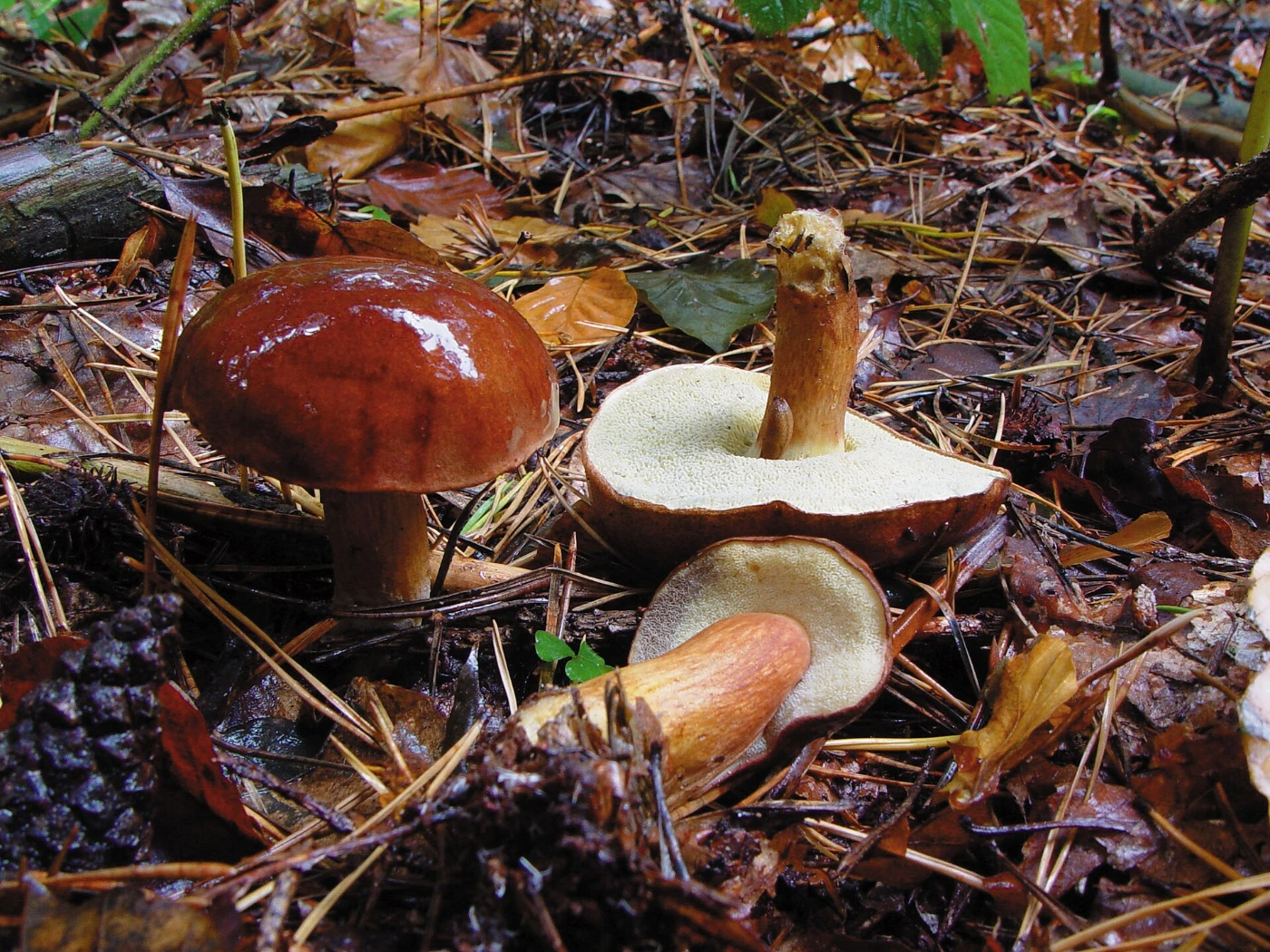
Imleria badia, commonly known as the Bay Bolete, is a common brown-capped bolete found in coniferous and mixed forests. It is recognized by its chestnut-brown cap, yellow pores that often bruise blue when pressed, and a comparatively smooth brownish stem without the strong pale reticulation typical of Porcini.
The species is widespread across Europe and parts of Asia and is especially common under spruce and pine. Because it can resemble several other brown boletes, the best identification comes from combining pore color, bruising, stem structure, cap texture, host trees, and overall proportions.
⚠️ Important: This guide is for identification and education only. Never eat a wild mushroom based solely on photographs, AI identification, or an online comparison.
Quick Identification
| Feature | Imleria badia |
|---|---|
| Scientific name | Imleria badia |
| Common name | Bay Bolete |
| Family | Boletaceae |
| Cap color | Chestnut-brown to dark brown |
| Cap surface | Smooth, slightly sticky when wet |
| Underside | Yellow pores |
| Bruising | Pores often turn blue when pressed |
| Stem | Brownish, usually smooth to finely fibrous |
| Reticulation | Absent or weak |
| Flesh | Pale, may blue slightly in places |
| Spore print | Olive-brown |
| Ecology | Mycorrhizal |
| Main hosts | Spruce, pine, other conifers |
| Season | Summer through autumn |
| Edibility | Edible when correctly identified |
| Main look-alikes | Porcini, Chestnut Bolete, red-cracking boletes, other brown boletes |
What Does Imleria badia Look Like?
Bay Bolete has a classic bolete shape, with a rounded brown cap and a sponge-like pore layer underneath instead of gills. Young fruit bodies are compact, while mature specimens become broader and more open.
The cap is usually richer and more uniformly chestnut-brown than many pale Porcini-type boletes. The pore surface is yellow and commonly develops blue staining after pressure.
The stem is relatively plain compared with king boletes. It is usually brownish or yellow-brown and lacks a strong net-like pattern.
Cap
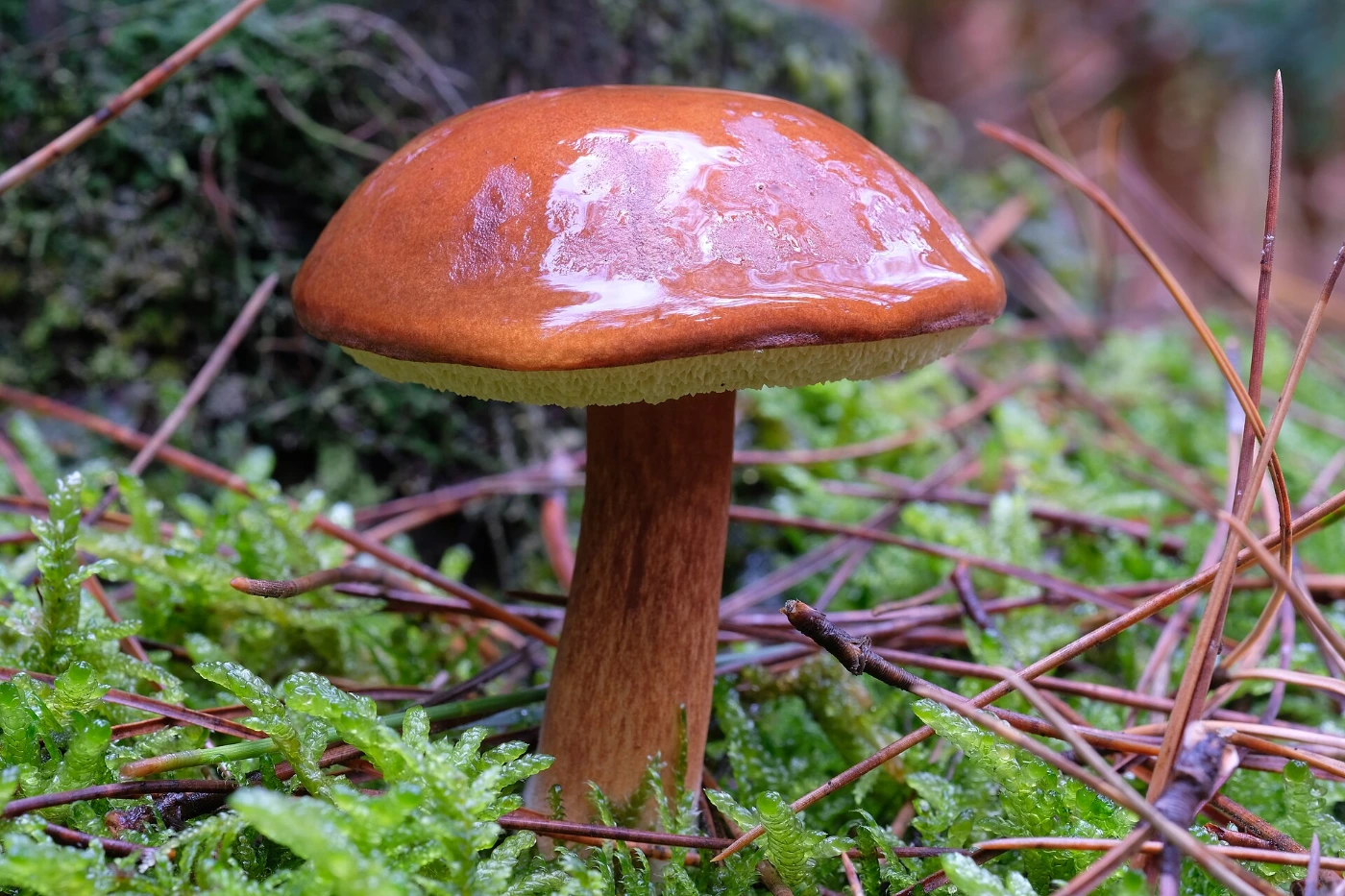
The cap begins hemispherical or convex and gradually flattens with age. Typical colors range from warm chestnut to dark reddish-brown.
Fresh wet specimens can look glossy or slightly sticky. Dry caps are usually smoother and more matte.
Cap Surface
The surface is generally even and lacks prominent scales. It may feel slightly tacky after rain.
Older caps can become wrinkled or develop small cracks, especially in dry weather. These changes should not be confused with the pronounced cracking seen in some Xerocomellus species.
Pores
The underside is yellow to yellow-olive. Young pores are finer and paler, while mature pores become broader and more olive.
When pressed, the pore surface often turns blue. This is one of the most recognizable features of the species.
Blue Bruising
The reaction can appear within seconds and may vary from pale blue to darker blue-green. It is often more obvious on the pore surface than in the internal flesh.
Bruising intensity can vary with age, moisture, and temperature. A weak reaction does not automatically exclude the species.
Stem
The stem is usually cylindrical or slightly thickened toward the base. It is often more slender than the massive stems of classic Porcini.
Color ranges from pale brown to yellow-brown, sometimes with darker longitudinal fibers. The surface is usually plain rather than strongly netted.
Lack of Strong Reticulation
This is an important clue. Boletus edulis and related king boletes often show a pale net-like reticulation on the upper stem.
Bay Bolete normally lacks that distinct network. The stem may look fibrous or subtly streaked instead.
Flesh
The flesh is pale cream to yellowish. It may remain mostly pale after cutting or develop slight blue staining, especially near the tubes.
The reaction is usually weaker than in strongly blue-staining boletes. The pore layer often provides a much clearer bruise.
Texture
Young fruit bodies are firm and dense. Older mushrooms become softer and more spongy, particularly underneath the cap.
Insect damage can be common in mature specimens. Young intact mushrooms are easier to identify.
Smell
The smell is mild and mushroom-like. It is not considered an important diagnostic feature.
Odor varies with age and condition. Pore bruising and stem structure are much more reliable.
Spore Print
The spore print is olive-brown. This is typical of many boletes and confirms the broader group. It is not especially useful for separating Bay Bolete from similar species. Morphology and ecology are more practical in the field.
Where Does Imleria badia Grow?
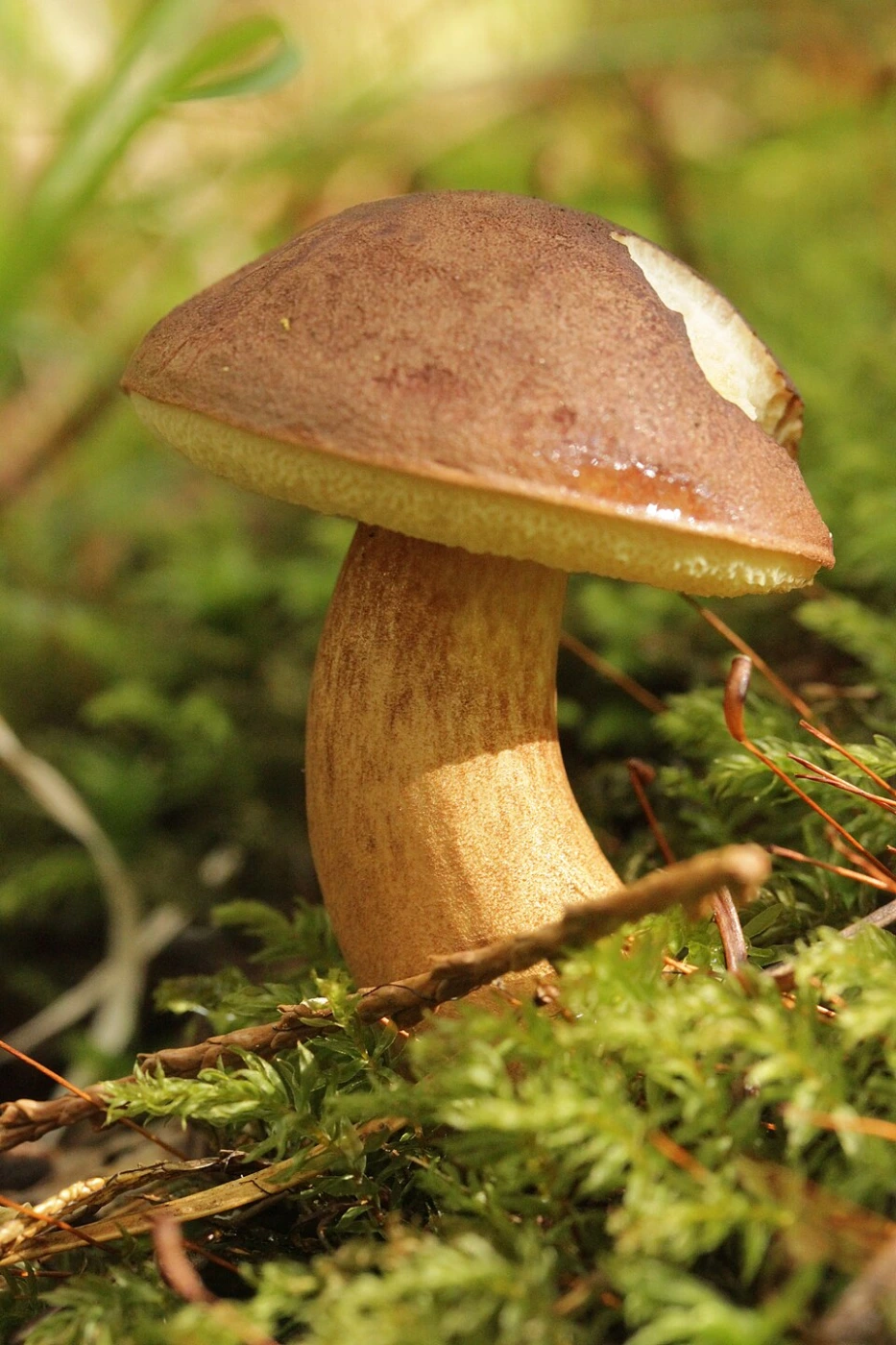
Bay Bolete grows from soil in association with living tree roots. It is especially common in coniferous forests.
Spruce and pine are among the most important hosts. The species can also occur in mixed woodland where conifers are present.
Conifer Association
Spruce forests are particularly classic habitat in Europe. Pine woodland can also be productive.
The species often appears among moss, needles, and acidic forest litter. It may fruit several meters from the nearest visible trunk because tree roots extend widely underground.
When Does Bay Bolete Grow?
The main season is summer through autumn. Fruiting often becomes strongest after sustained rainfall. In many regions, Bay Bolete is especially common later in the season. Cool wet autumn weather can produce large numbers.
Weather and Fruiting
Dry periods can suppress visible mushrooms even while the underground mycelium remains active. After rain, several fruit bodies may appear in the same patch. The same woodland can produce repeated flushes within one season. Productive sites may also return in later years.
Distribution
Imleria badia is widespread across Europe and parts of Asia. It is particularly common in temperate and boreal forests. The species is strongly associated with conifer-rich regions. Exact abundance varies with soil chemistry, climate, and forest composition.
Is Imleria badia Edible?
Bay Bolete is considered edible when correctly identified and properly prepared. It is widely collected in Europe.
Young specimens are generally preferred because older fruit bodies become soft and frequently insect-damaged. The blue bruising does not make the species poisonous.
Correct identification is still important because brown boletes can be difficult to separate. Pore color, bruising, and stem structure should all agree.
Imleria badia Look-Alikes
The main look-alikes are other brown-capped boletes with yellow pores. Some are edible, while others are bitter or difficult to identify confidently.
The most useful differences involve stem reticulation, pore bruising, cap texture, and host trees.
Boletus edulis — Porcini
Identification
Porcini usually has a thick pale stem with visible reticulation. The pore surface begins white and becomes yellow to olive with age.
The flesh usually remains white after cutting and does not show strong blue bruising. The overall fruit body is often more robust.
Main Difference
Bay Bolete usually has a smoother, less reticulated stem and pores that turn blue when pressed. Porcini generally has pale netting and little or no blueing.
The stem and pore reaction together are especially useful.
Imleria badia vs Porcini
| Feature | Bay Bolete | Porcini |
|---|---|---|
| Cap | Chestnut-brown | Brown to chestnut |
| Pores | Yellow to olive | White → yellow → olive |
| Blue bruising | Common on pores | Usually absent |
| Stem | Smooth to fibrous | Thick, pale, reticulated |
| Reticulation | Usually absent | Usually present |
| Habitat | Mainly conifer forests | Conifer and broadleaf forests |
Pore bruising is the fastest difference. Stem reticulation provides confirmation.
Xerocomellus chrysenteron — Red Cracking Bolete
Identification
Red Cracking Bolete has a brown to olive-brown cap that often develops cracks. Reddish tissue may show through those cracks.
The pores are yellow and can turn blue when bruised. The stem often contains yellow and red tones.
Main Difference
Bay Bolete usually has a smoother chestnut cap without the characteristic red cracking. The stem is also generally less colorful.
Old dry Bay Boletes can crack slightly, so the full combination of features should be checked.
Gyroporus castaneus — Chestnut Bolete
Identification
Chestnut Bolete has a reddish-brown to chestnut cap and a relatively slender stem. The stem is often brittle and may become hollow or chambered inside.
The pores are pale cream to yellowish. Strong blue bruising is generally absent.
Main Difference
The hollow or chambered stem is one of the strongest clues for Gyroporus castaneus. Bay Bolete has a more solid stem and typically blue-bruising pores.
Suillus Species
Identification
Several Suillus species have brown caps and yellow pores. Many are strongly associated with pine.
Their caps are often slimier, and the stems may have rings or glandular dots. These features are not typical of Bay Bolete.
Main Difference
A clear ring, strongly slimy cap, or glandular stem dots point more toward Suillus. Bay Bolete is simpler in structure.
Caloboletus calopus — Bitter Beech Bolete
Identification
Bitter Beech Bolete has a pale cap, yellow pores, and a thick stem with strong red coloration. The flesh turns blue when damaged.
The overall color combination is much more dramatic than in Bay Bolete.
Main Difference
A strongly red-yellow stem points away from Imleria badia. Bay Bolete is predominantly brown and yellow.
Bay Bolete vs Red Cracking Bolete
| Feature | Imleria badia | Xerocomellus chrysenteron |
|---|---|---|
| Cap | Smooth chestnut-brown | Often cracked brown cap |
| Tissue beneath cracks | Not characteristically red | Often reddish |
| Pores | Yellow, blue-bruising | Yellow, often blue-bruising |
| Stem | Brownish, relatively plain | Yellow and red tones common |
| Overall build | Moderate to robust | Often smaller and more slender |
Cap structure is particularly useful in this comparison.
How to Identify Imleria badia Step by Step
Start by confirming that the underside has pores rather than gills. Then check for a chestnut-brown cap and yellow pore surface.
Press the pores gently and watch for blue bruising. Finally, examine the stem for the absence of strong reticulation and confirm a conifer-rich habitat.
Step 1: Check the Cap
Look for an even chestnut to dark brown cap. The surface should be relatively smooth.
Strong scales, vivid red cracks, or a very pale cap suggest other species.
Step 2: Check the Pores
The pores should be yellow to olive-yellow. Press a small area with a finger.
A blue reaction strongly supports Bay Bolete when the rest of the mushroom also fits.
Step 3: Examine the Stem
Look for a brownish, relatively plain stem. Strong pale reticulation would be more typical of Porcini.
A ring or glandular dots would point toward Suillus. A red-yellow stem suggests another bolete group.
Step 4: Check the Flesh
Cut the mushroom vertically and observe any color change. The flesh may remain mostly pale or show limited blueing.
Very strong dark blue staining throughout the mushroom would suggest a more reactive bolete.
Step 5: Check the Trees
Look for spruce, pine, or other conifers nearby. This ecology strongly supports the identification.
In mixed woodland, check all possible host trees. The nearest trunk is not always the actual mycorrhizal partner.
Why Blue Bruising Is Useful but Not Enough
The blue reaction is visually memorable, but many boletes show it. Some are edible, some inedible, and some poisonous.
For Bay Bolete, the reaction becomes meaningful only when combined with the chestnut cap, yellow pores, plain stem, and conifer habitat.
This is a good example of why mushroom identification should use several independent features rather than one dramatic clue.
How to Photograph Bay Bolete for Identification
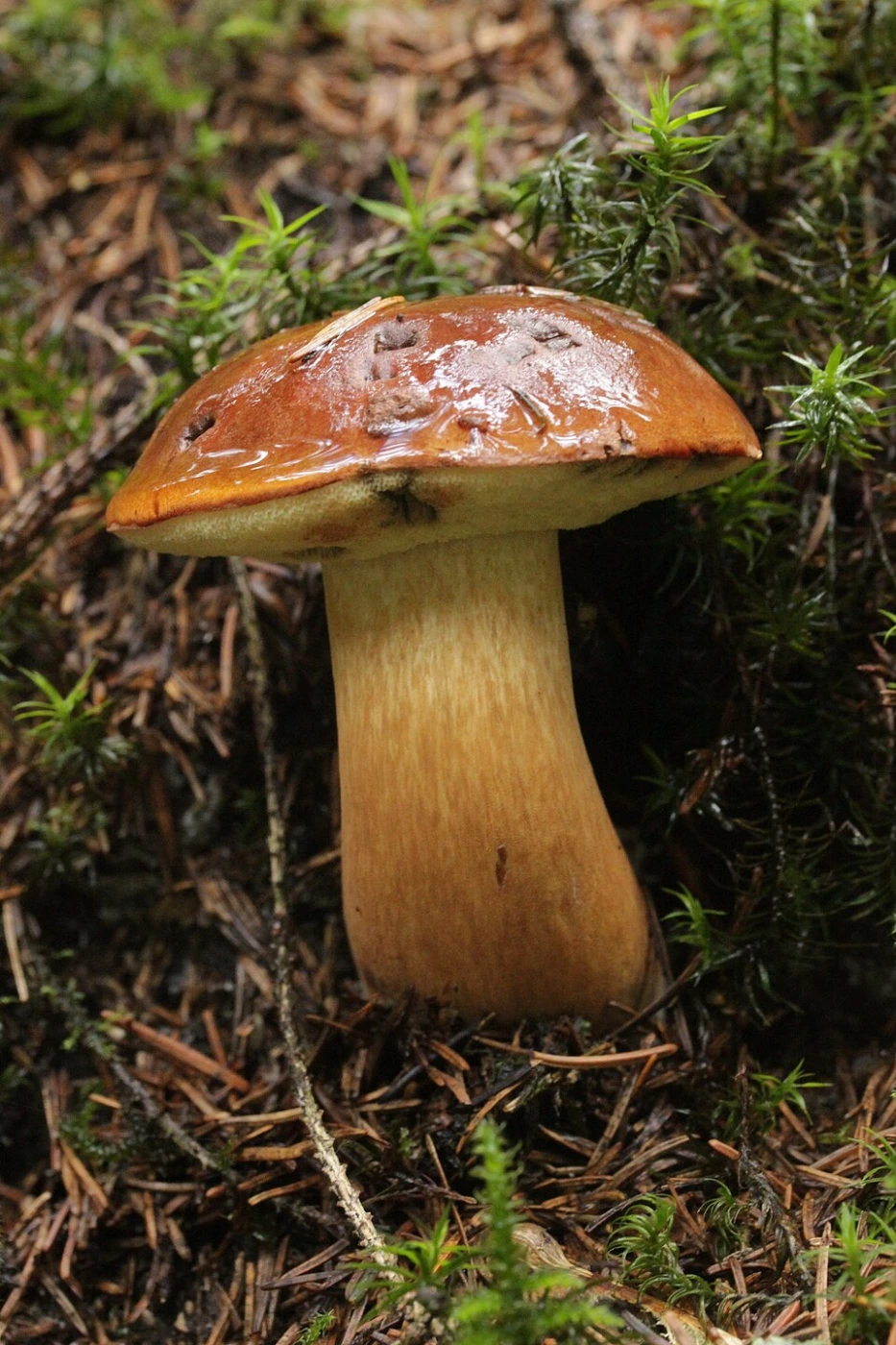
Take a side photograph showing the complete mushroom and stem. Include surrounding conifer needles or moss if possible.
Then photograph the pore surface before and after pressing it. This records both the original yellow color and the blue bruising reaction.
A close-up of the stem can show the absence of strong reticulation. A cut section can document flesh color and internal bruising.
Can AI Identify Imleria badia?
AI can often recognize Bay Bolete when the brown cap, yellow pores, and blue bruising are all visible. Accuracy improves when the stem and habitat are also shown.
The main challenge is separating it from other brown yellow-pored boletes. A cap-only image is not enough.
Before-and-after bruising photos are particularly useful. They provide information that a single static image cannot show.
Common Identification Mistakes
One common mistake is calling every brown bolete with yellow pores Porcini. Bay Bolete differs strongly in pore bruising and stem structure.
Another mistake is assuming blue bruising means the mushroom is poisonous. Bay Bolete is a clear example of why that rule fails.
A third mistake is ignoring the cap surface. Strong cracking or scales may point toward other species.
Interesting Facts About Imleria badia
Bay Bolete was historically placed in the genus Boletus, and older field guides may list it as Boletus badius. Modern classification places it in the genus Imleria.
The common name “Bay Bolete” refers to the rich bay or chestnut-brown color of the cap. This warm brown tone is one of the species’ most consistent visual features.
Its blue bruising is caused by oxidation reactions in damaged tissue. The reaction is most visible on the pore surface, which is why a gentle press can reveal so much identification information.
Bay Bolete is also a good example of how closely fungal ecology follows trees. Its abundance in spruce and pine forests reflects a mycorrhizal relationship that continues underground even when no mushrooms are visible.
Frequently Asked Questions
Why do some Bay Boletes barely turn blue?
Moisture, age, temperature, and tissue condition all influence the reaction. Fresh hydrated mushrooms usually show stronger bruising than old dry specimens.
Can the pore surface turn almost green with age?
Yes. Yellow pores can become olive or olive-green as the mushroom matures and spores develop.
Why are some caps much darker after rain?
Water darkens the surface and can make the cap look almost chocolate-brown. Dry specimens usually appear lighter and more matte.
Can Bay Bolete grow in very mossy forest floors?
Yes. Mossy conifer forests are a classic habitat, especially where spruce or pine roots are present beneath the moss.
Why do older specimens often have soft pore layers?
The tubes expand and retain more moisture as the mushroom matures. This creates the spongy texture common in old boletes.
Can several bolete species fruit in the same patch?
Yes. One forest area can support multiple mycorrhizal boletes at the same time. Each mushroom should therefore be checked individually.
Can insects change the bruising reaction?
Yes. Old insect-damaged tissue may already be oxidized and react less clearly than fresh intact areas.
Can Bay Bolete appear far from the nearest conifer?
Yes. Tree roots and fungal mycelium extend well beyond the trunk, so fruit bodies can appear several meters away.
Final Identification Notes
Imleria badia is best recognized by the combination of a smooth chestnut-brown cap, yellow pores that often bruise blue, a relatively plain brownish stem without strong reticulation, and growth in conifer-rich woodland.
The most important comparisons are Porcini and other brown yellow-pored boletes. Porcini usually has pale stem reticulation and little blue bruising, while Red Cracking Bolete often develops obvious cap cracks with reddish tissue beneath.
For reliable identification, use the complete pattern rather than one feature. The pore reaction, stem surface, cap texture, and host trees together make Bay Bolete much easier to recognize.
Upload a photo and get possible matches in seconds.