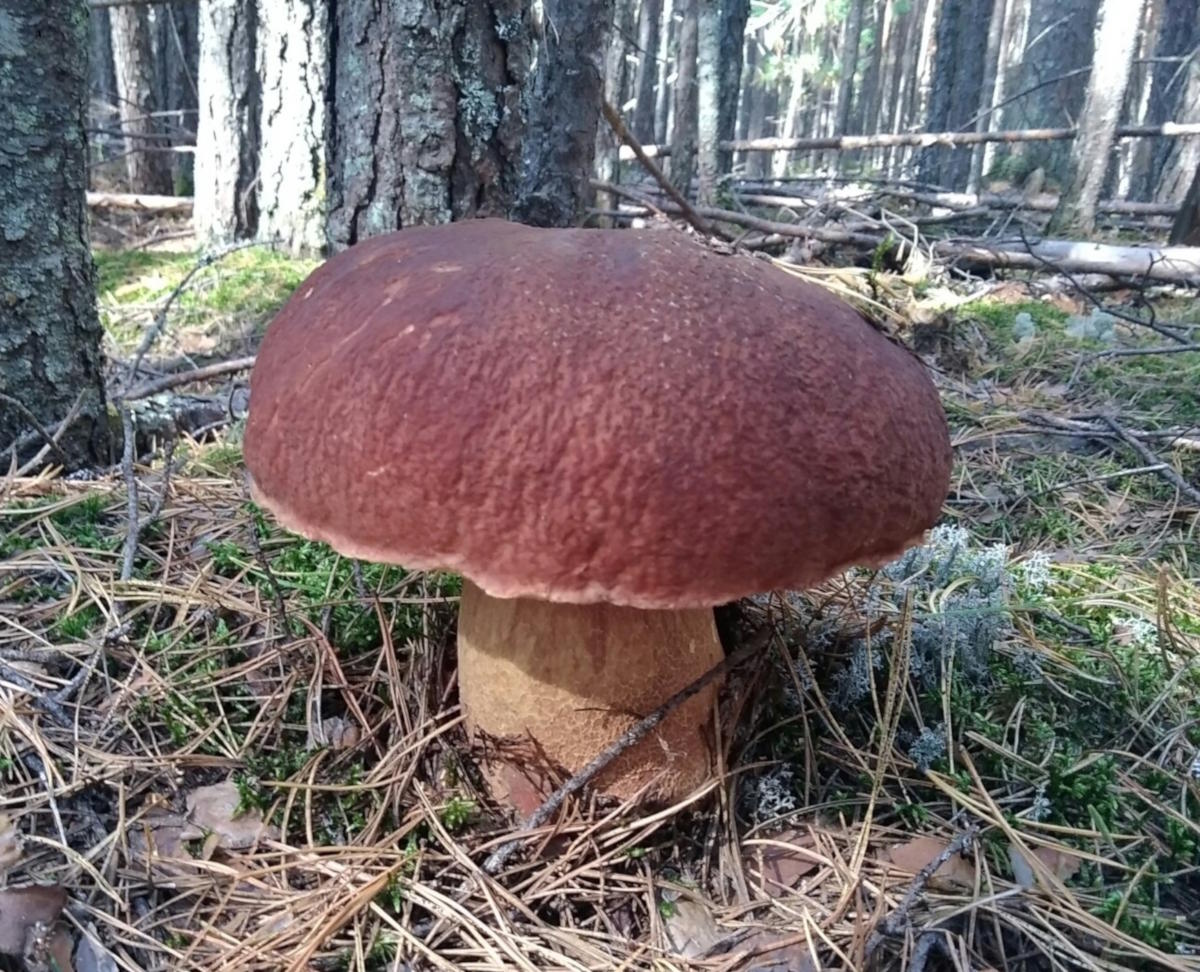
Pine forests are excellent places to look for mushrooms because many fungi form close relationships with pine roots. Others simply take advantage of the acidic soil, thick needle litter, fallen cones, buried wood, and relatively stable moisture found beneath mature trees.
A mushroom growing under pine is not automatically a “pine mushroom,” however. Some species are strongly associated with pines, while others merely tolerate the habitat, so identification should combine tree association with cap, underside, stem, bruising, latex, spore color, and growth pattern.
⚠️ Important: This guide is for identification and education only. Never eat a wild mushroom based solely on habitat, photographs, AI identification, or an online comparison.
Quick Guide to 15 Mushrooms Found Under Pine Trees
| Species | Common name | Key feature | Safety |
|---|---|---|---|
| Lactarius deliciosus | Saffron Milk Cap | Orange latex, green staining | Edible when correctly identified |
| Suillus luteus | Slippery Jack | Slimy brown cap, ring, yellow pores | Edible when correctly identified |
| Suillus granulatus | Weeping Bolete | Yellow pores, glandular dots, no ring | Edible when correctly identified |
| Boletus pinophilus | Pine Bolete | Reddish-brown cap, thick reticulated stem | Edible when correctly identified |
| Imleria badia | Bay Bolete | Brown cap, yellow pores, blue bruising | Edible when correctly identified |
| Amanita muscaria | Fly Agaric | Red cap, white veil remnants | Poisonous |
| Amanita pantherina | Panther Cap | Brown cap, white veil remnants | Poisonous |
| Tricholoma matsutake group | Matsutake | Firm white mushroom, strong spicy odor | Edible when correctly identified |
| Tricholoma terreum | Grey Knight | Gray fibrous cap, pale gills | Edibility debated |
| Russula xerampelina group | Shrimp Russula | Red-brown cap, shrimp-like odor | Edible when correctly identified |
| Lactarius rufus | Rufous Milkcap | Reddish-brown cap, white acrid latex | Inedible / irritating |
| Chroogomphus rutilus | Copper Spike | Copper-brown cap, darkening gills | Edibility varies |
| Gomphidius glutinosus | Slimy Spike | Gray-brown slimy cap | Edible when correctly identified |
| Sarcodon imbricatus group | Scaly Hedgehog | Brown scaly cap, teeth underneath | Edibility varies |
| Thelephora terrestris | Earthfan | Brown fan-shaped ground fungus | Inedible |
Why So Many Mushrooms Grow Under Pines
Pines support large communities of mycorrhizal fungi. These fungi connect with the tree’s roots and exchange mineral nutrients and water for sugars produced through photosynthesis.
This partnership allows many mushroom species to return to the same forest year after year. Boletes, milkcaps, Amanitas, Russulas, and Tricholomas are especially well represented in pine habitats.
Pine Needle Litter Creates a Distinct Habitat
A thick layer of pine needles changes the forest floor. It retains moisture, reduces direct sunlight, and creates a relatively acidic organic layer.
Some mushrooms thrive in these conditions even when they are not exclusively associated with pine. Others depend much more strongly on pine roots and are rarely found far from suitable host trees.
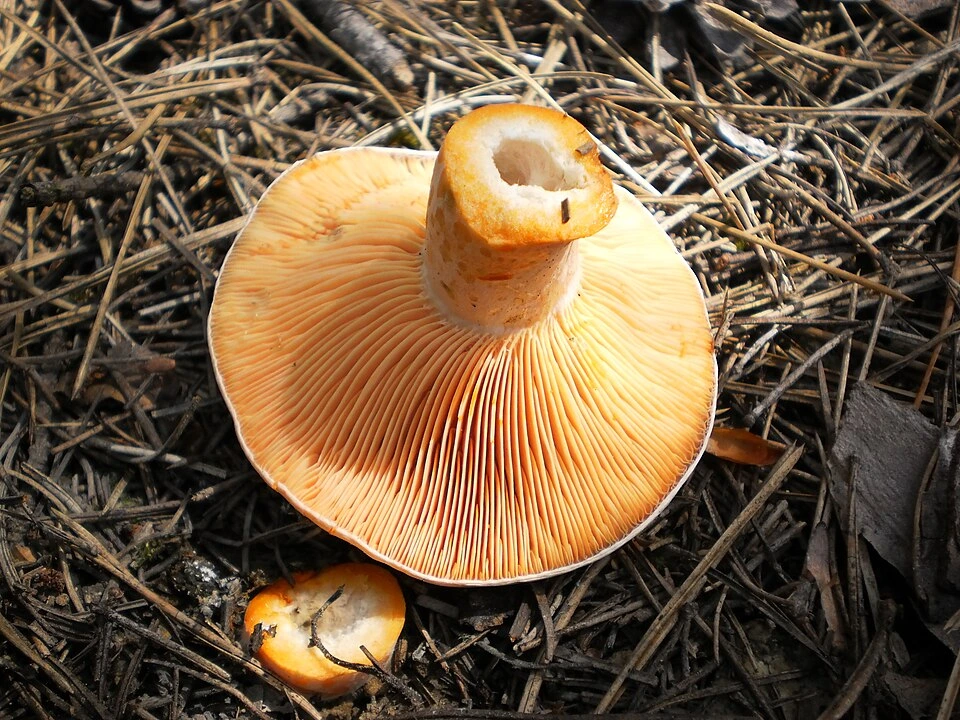
1. Lactarius deliciosus — Saffron Milk Cap
Identification
Saffron Milk Cap is one of the most characteristic mushrooms of pine forests. It has an orange cap with darker concentric zones, orange gills, and orange latex that appears when the flesh or gills are damaged.
Green staining develops after bruising or with age. The orange-and-green color combination is one of the easiest ways to recognize the group.
Pine Association
Lactarius deliciosus is strongly mycorrhizal with pines. It commonly grows in pine forests, plantations, and grassy areas where pine roots extend below the surface.
The tree association is especially useful when separating it from similar orange milkcaps associated with spruce or fir.
Safety
It is considered edible when correctly identified. Similar orange milkcaps are usually separated by host tree, latex color, and staining reaction.
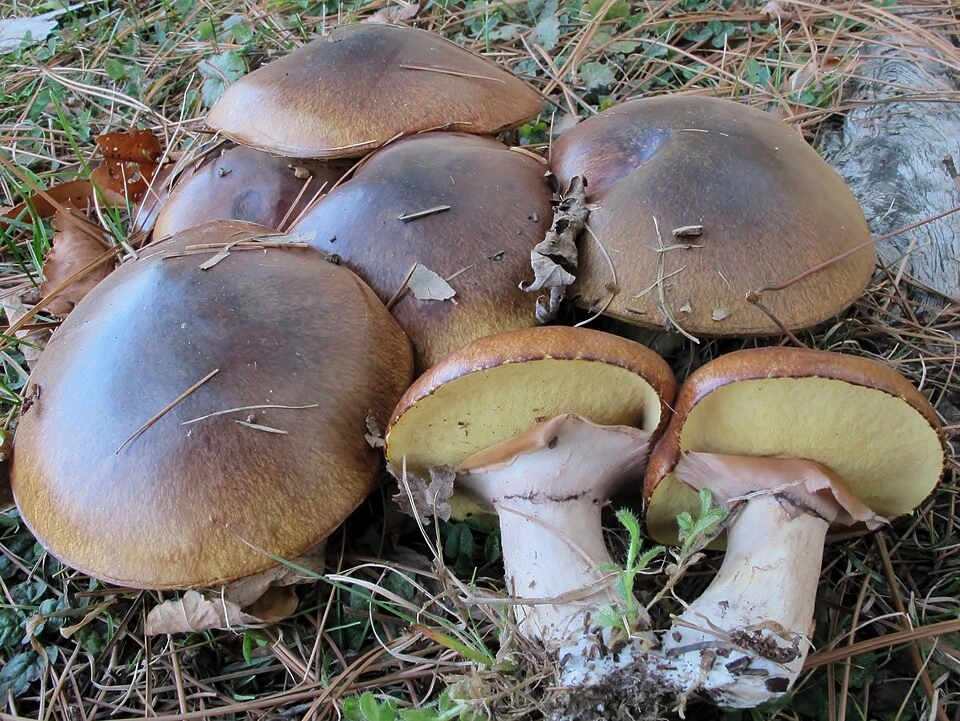
2. Suillus luteus — Slippery Jack
Identification
Slippery Jack has a brown cap that becomes distinctly slimy or sticky in wet weather. The underside has yellow pores instead of gills.
The stem usually carries a ring, which separates it from several other Suillus species. Mature pores often become darker yellow or olive.
Pine Association
This species is strongly linked with pine. It can appear in forests, young plantations, roadside plantings, and lawns beneath ornamental pines.
Fruit bodies sometimes occur in large groups after autumn rain. The presence of nearby pines is one of the strongest ecological clues.
Safety
Slippery Jack is considered edible when correctly identified and prepared. Some people remove the slimy cap skin because it can be unpleasant and may contribute to gastrointestinal sensitivity.
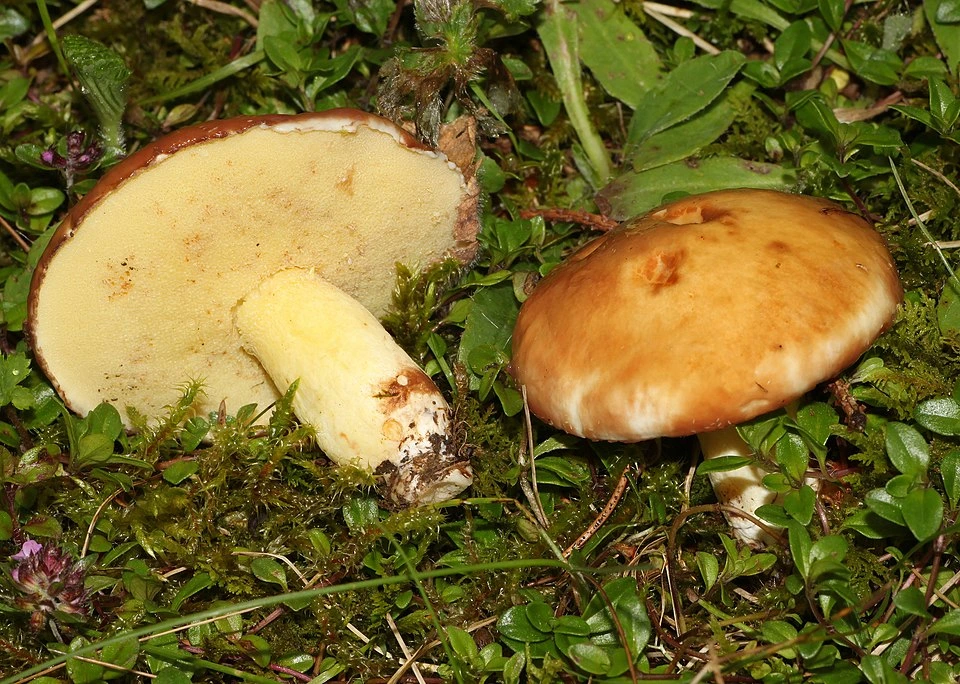
3. Suillus granulatus — Weeping Bolete
Identification
Weeping Bolete has a yellow-brown to orange-brown cap and yellow pores. Young pore surfaces may exude small milky droplets, which inspired the “weeping” common name.
The stem lacks a ring but often has small glandular dots near the upper portion. This is an important difference from Suillus luteus.
Pine Association
The species is strongly associated with pine roots, particularly in warm and temperate regions. Young pine plantations and grassy pine edges can be especially productive.
It often appears in groups rather than as isolated mushrooms. Moist conditions after dry weather can trigger large flushes.
4. Boletus pinophilus — Pine Bolete
Identification
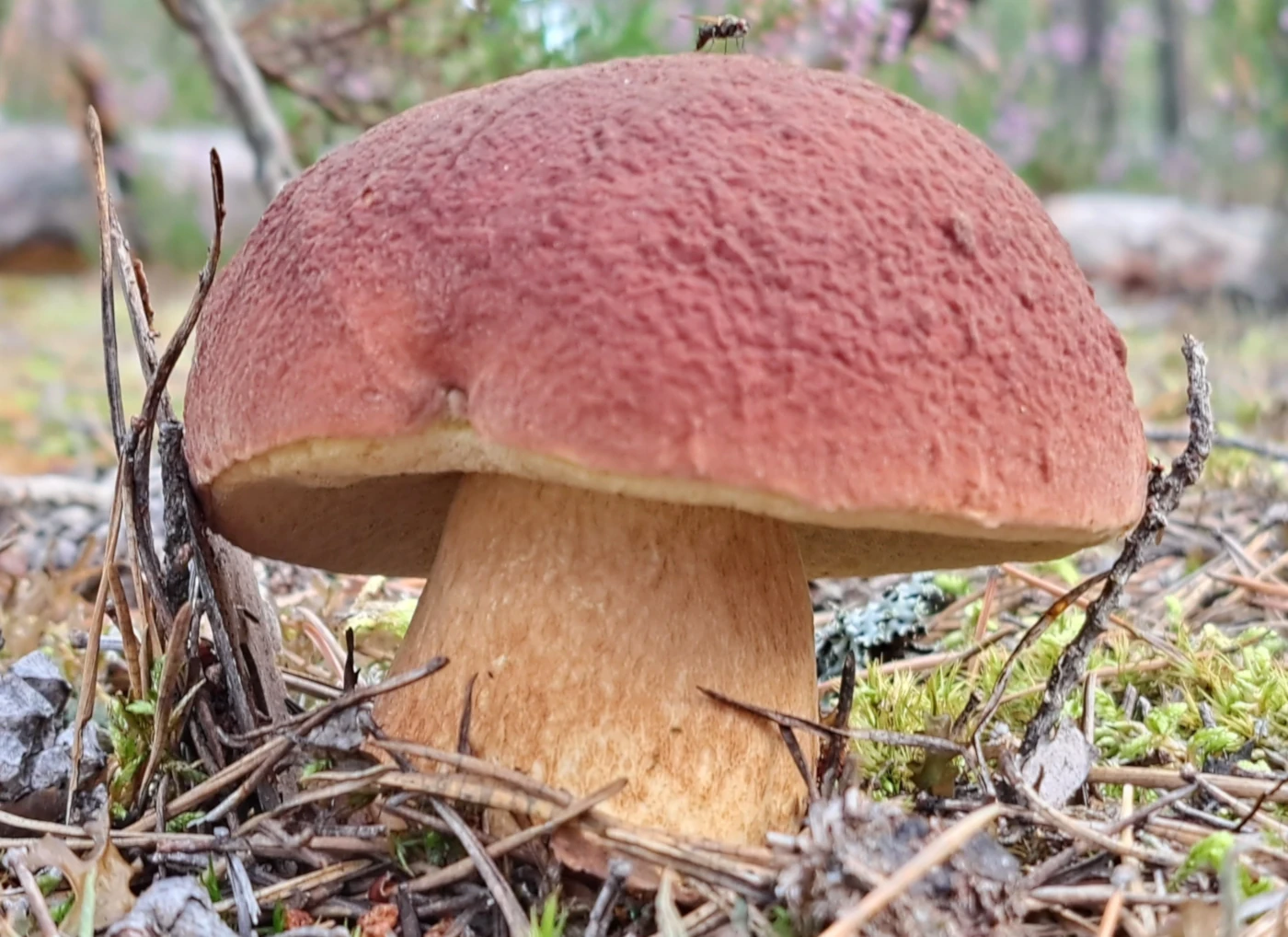
Pine Bolete is a robust king bolete with a dark reddish-brown to wine-brown cap. The stem is thick and usually shows pale reticulation.
The pore surface begins white and later becomes yellow to olive. The flesh remains white and generally does not show strong blue bruising.
Pine Association
As the common name suggests, Boletus pinophilus is strongly associated with pine and other conifers. It can occur in mossy pine forests and mature mixed woodland with conifers.
It resembles Boletus edulis closely, but the darker reddish cap and conifer association often provide useful clues.
Safety
The species is edible when correctly identified. It belongs to the highly valued king bolete group.
5. Imleria badia — Bay Bolete
Identification
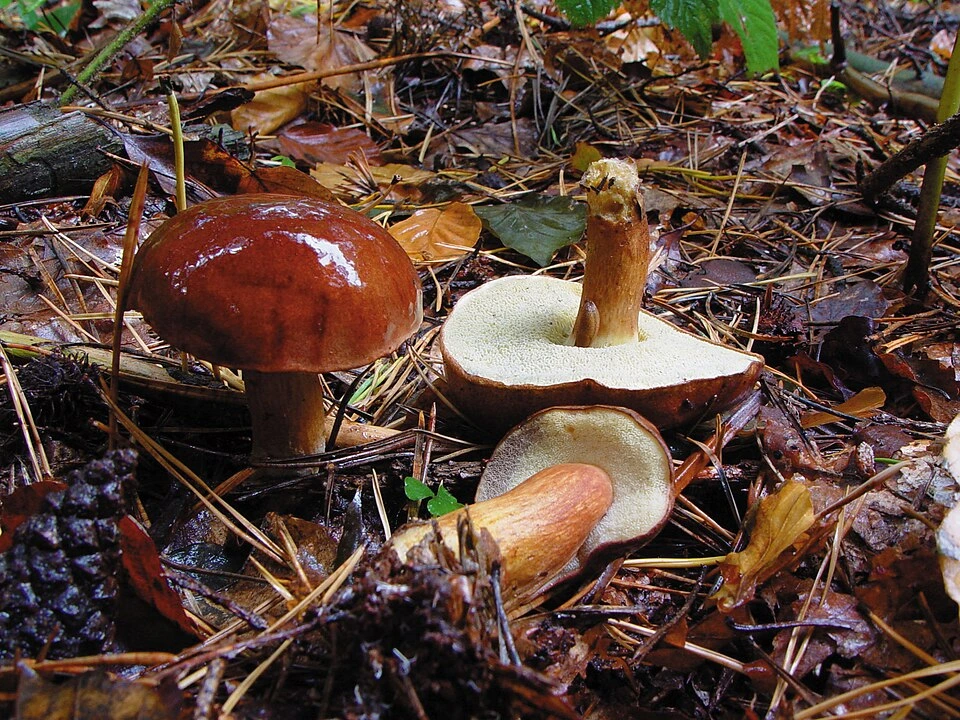
Bay Bolete has a smooth chestnut-brown cap, yellow pores, and a brownish stem. The pore surface commonly turns blue when pressed.
The flesh may also blue slightly when cut. This reaction helps distinguish it from classic Porcini, whose flesh usually remains white.
Pine Association
Bay Bolete is common in coniferous and mixed forests, particularly beneath pine and spruce. It can grow among moss, needles, and decaying woody debris.
It often appears later in the season than some summer boletes. Cool wet autumn weather can produce large numbers.
6. Amanita muscaria — Fly Agaric
Identification
Fly Agaric usually has a red to orange-red cap with white veil remnants. The gills are white, and the pale stem carries a ring and an enlarged base.
Rain can wash away many of the white cap spots. Older mushrooms may therefore look much plainer than the classic storybook version.
Pine Association
Fly Agaric forms mycorrhizal relationships with pine, birch, spruce, and other trees. Pine forests are one of its classic habitats.
It can appear singly or in large scattered groups. Autumn is often the most productive season.
Safety
Fly Agaric is poisonous and contains ibotenic acid and muscimol. It can cause neurological symptoms, confusion, altered perception, and poor coordination.
7. Amanita pantherina — Panther Cap
Identification
Panther Cap has a brown to gray-brown cap with white veil patches. The gills are white, and the stem usually has a ring and a bulbous base.
The stem base often shows collar-like or rimmed veil remnants. The flesh generally does not redden strongly when damaged.
Pine Association
It can occur in pine and other coniferous forests as well as broadleaf woodland. Pine-associated specimens are often found on forest soil among needle litter.
The species fruits mainly from summer through autumn. Heavy rain can remove cap patches and make identification harder.
Safety
Panther Cap is poisonous and contains ibotenic acid and muscimol. It should not be confused with amatoxin-containing Amanitas, although both groups can cause serious poisoning.
8. Tricholoma matsutake Group — Matsutake
Identification
Matsutake are firm pale mushrooms with thick stems, white to cream gills, and a strong distinctive odor often described as spicy, aromatic, or cinnamon-like. Young specimens may remain partly buried beneath pine litter.
The cap usually develops brown fibrous patches or scales with age. A ring-like veil zone may be visible on the upper stem.
Pine Association
Matsutake are famous for their association with conifer forests, especially pine. They often grow in nutrient-poor, well-drained soils with deep needle litter.
Different regions contain related species rather than one universal matsutake. Geography therefore matters when assigning an exact species name.
Safety
Some members of the group are prized edible mushrooms when correctly identified. White Amanitas and other pale woodland mushrooms must be excluded carefully.
9. Tricholoma terreum — Grey Knight
Identification
Grey Knight is a relatively small Tricholoma with a gray to charcoal cap covered in fine radial fibers or scales. The gills are white to grayish, and the stem is pale.
The cap often looks dry rather than slimy. Several similar gray Tricholoma species can occur in the same habitats.
Pine Association
This mushroom is strongly associated with conifers, particularly pines. It often appears in groups on needle-covered forest floors.
Late autumn can be especially productive. In mild regions, fruiting may continue well into the cool season.
Safety
The edibility of Tricholoma terreum has been treated differently in older and modern sources. For practical purposes, uncertain gray Tricholoma species should not be collected for food.
10. Russula xerampelina Group — Shrimp Russulas
Identification
Shrimp Russulas typically have reddish, purple-brown, or wine-colored caps with pale to cream gills. Like other Russulas, their flesh is brittle and breaks rather than tearing into fibers.
Mature specimens often develop a distinctive seafood-like or shrimp-like smell. The stem may discolor brownish when handled.
Pine Association
Several members of the broader group occur with conifers, including pine. They grow from soil and may appear scattered among needles and moss.
Exact species-level identification can be difficult because the group contains multiple similar taxa. Host tree, cap color, odor, and spore characteristics may all matter.
11. Lactarius rufus — Rufous Milkcap
Identification
Rufous Milkcap has a reddish-brown to brick-red cap, often with a small pointed bump in the center. The gills are pale and release white latex when damaged.
The latex and flesh have a strongly acrid character. The mushroom has the brittle texture typical of milkcaps.
Pine Association
It is common in acidic conifer forests and frequently occurs beneath pine. Mossy, damp ground can produce large numbers.
The plain reddish cap can make it look unremarkable from above. Checking for latex is the fastest way to recognize it as a milkcap.
Safety
It is generally treated as inedible or unsuitable without special regional preparation traditions. Beginners should not collect acrid milkcaps for food.
12. Chroogomphus rutilus — Copper Spike
Identification
Copper Spike has a copper-brown to reddish-brown cap and thick decurrent gills. The gills darken as the spores mature.
The stem is often yellowish near the base and may develop orange or reddish tones. Young mushrooms can have remnants of a veil.
Pine Association
The species is strongly associated with conifers and often occurs near pine. It can grow in the same habitats as Suillus species.
This ecological overlap is not accidental, because fungi in this group have complex associations with conifer-root systems and other mycorrhizal fungi.
Safety
Edibility descriptions vary by region and source. It is not a good beginner food mushroom because related species and identification details can be confusing.
13. Gomphidius glutinosus — Slimy Spike
Identification
Slimy Spike has a gray-brown to purplish-brown cap covered by a thick slimy layer in wet weather. The gills are pale when young and become darker with age.
The stem is whitish above and often yellow near the base. A slimy veil can leave a ring-like zone.
Pine Association
It is more strongly associated with spruce than pine in many regions, but it can occur in mixed conifer habitats where pine is present nearby. This makes it a useful reminder that not every mushroom under a pine is actually partnered with that pine.
Conifer identification should therefore include all nearby trees. A spruce hidden among pines can change the likely species considerably.
14. Sarcodon imbricatus Group — Scaly Hedgehog
Identification
Scaly Hedgehog mushrooms have broad brown caps covered with dark coarse scales. Instead of gills or pores, the underside has numerous downward-pointing teeth.
This toothed surface immediately separates them from most brown boletes and gilled mushrooms. Older specimens can become very large and strongly patterned.
Pine Association
Several Sarcodon species are associated with conifer forests. Pine habitat can be important for narrowing the exact taxon.
Modern taxonomy has split older broadly used names into more specific species. Geography and host tree are therefore useful when working beyond the group level.
Safety
Edibility varies within the group, and older specimens can be bitter or tough. Species-level certainty is important before considering culinary use.
15. Thelephora terrestris — Earthfan
Identification
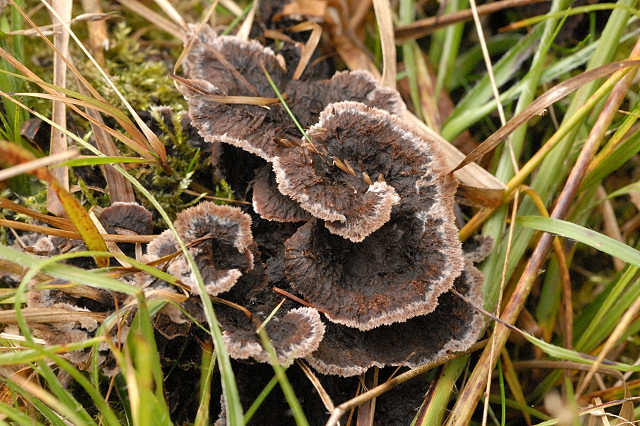
Earthfan produces irregular brown fan-shaped or rosette-like fruit bodies close to the ground. The surface is tough, fibrous, and often blends almost perfectly with pine needles and soil.
It does not look like a conventional cap-and-stem mushroom. Several fans may merge into a larger irregular cluster.
Pine Association
The species is frequently associated with conifers and is especially noticeable around young pine roots. It can sometimes grow around seedlings or partially cover debris.
Its brown coloration provides excellent camouflage in needle litter. Once noticed, its unusual fan-shaped structure is distinctive.
Safety
Earthfan is not considered a food mushroom. Its tough leathery texture makes it unsuitable for ordinary culinary use.
Pine-Associated Boletes
Pine forests are especially good habitat for boletes. Pine Bolete, Slippery Jack, Weeping Bolete, Bay Bolete, and several regional species may all occur within the same woodland.
The underside is the fastest way to recognize the group because boletes have pores instead of gills. Pore color, stem ornamentation, bruising, and cap texture then help separate individual species.
Suillus and Pine
Many Suillus species have particularly strong associations with pine. Sticky caps, glandular dots, and yellow pores are common features across the group.
Some species prefer specific pine types or ages. Young plantations can therefore host different Suillus communities from mature natural pine forests.
Orange Mushrooms Under Pine Trees
Orange mushrooms beneath pine often lead people toward Saffron Milk Caps, but several other groups can also be orange or reddish. Cap color alone should never determine the identification.
For milkcaps, damaging the gills is particularly useful. Orange latex combined with green staining strongly supports the Saffron Milk Cap group, while white latex or no latex leads in other directions.
Brown Mushrooms Under Pine Trees
Brown is probably the most common cap color in pine forests. Boletes, Tricholomas, milkcaps, Russulas, Amanitas, and many unrelated small fungi may all appear brown.
The underside should therefore be checked immediately. Pores, teeth, pale gills, darkening gills, or latex each lead toward very different identification pathways.
Poisonous Mushrooms Under Pine Trees
Pine habitat includes both edible and poisonous species. Fly Agaric and Panther Cap are among the most recognizable poisonous examples.
Other dangerous species may also occur depending on region. Habitat should never be interpreted as evidence that a mushroom belongs to an edible pine-associated group.
Amanitas Beneath Pine
Amanitas grow from soil in partnership with tree roots. Their cap colors range from red and brown to white, so there is no single “Amanita color.”
Always inspect the complete stem base. Rings, bulbs, volvas, and veil remnants can be much more important than the cap.
How to Identify a Mushroom Growing Under Pine
Start by confirming that the nearby tree is actually a pine. Spruce, fir, larch, and other conifers can look similar from a distance but support different fungi.
Then examine the mushroom from underneath. Determine whether it has pores, true gills, teeth, false gills, or another fertile surface.
Next, check the stem, bruising reaction, latex, ring, and full stem base. Only after these features should pine association and season be used to narrow the species.
How to Tell Pine From Other Conifers
Pine needles grow in bundles, usually containing two, three, or five needles depending on species. Spruce needles attach individually to the twig, while fir needles are also single but usually flatter.
This distinction can directly affect mushroom identification. An orange milkcap under pine may suggest one species, while an almost identical mushroom under spruce may suggest another.
Check the Ground
Cones and fallen needles are often easier to inspect than high branches. Pine cones and bundles of fallen needles can provide quick evidence of the host tree.
In mixed woodland, look farther than the mushroom’s immediate surroundings. Fungal roots can connect with a tree several meters away.
Why Mushrooms Can Grow Far From the Pine Trunk
The visible mushroom grows from an underground mycelium that can spread through a large area of soil. Pine roots also extend far beyond the trunk.
A mushroom growing several meters away can therefore still be associated with the same pine. The nearest tree is not automatically the host.
This is especially important in mixed forests. Several potential host species may have overlapping root systems beneath one patch of ground.
Best Time to Find Mushrooms Under Pines
Late summer and autumn are the most productive periods in many temperate pine forests. Rainfall after a warm or dry period can trigger large fruitings.
Some species appear earlier or later. Matsutake, Velvet Shank-like cold-weather fungi, and regional boletes can extend the useful season beyond the classic autumn peak.
Weather usually matters more than the exact calendar date. Several days of consistent moisture are generally more important than one brief storm.
How to Photograph Pine-Forest Mushrooms for Identification
Take a photo of the complete mushroom before removing it. Include enough surrounding ground to show pine needles, cones, moss, or other habitat clues.
Then photograph the underside and complete stem. Amanitas should always be documented with the entire stem base intact, while milkcaps are especially useful to photograph after the gills have been damaged to show latex.
A separate photograph of the nearest conifer can be extremely useful. For difficult mycorrhizal species, host-tree evidence can change the identification substantially.
Can AI Identify Mushrooms Growing Under Pine?
AI can use pine habitat as useful context, especially for characteristic species such as Saffron Milk Cap, Slippery Jack, Fly Agaric, and Pine Bolete. Multiple images showing the mushroom and host tree make identification far stronger than a cap-only photo.
The difficulty is that pine forests support hundreds of fungi, many of which overlap in color and shape. Some exact species also require microscopic or regional information.
AI should therefore use tree association as one feature among many. It should never assume that a brown or orange mushroom is a particular species simply because pine needles are visible in the photograph.
Common Identification Mistakes
One common mistake is assuming the nearest conifer is a pine. Misidentifying spruce or fir can send the entire mushroom identification in the wrong direction.
Another mistake is treating pine habitat as stronger evidence than morphology. If the mushroom has the wrong gills, stem, or spore color, the host tree cannot rescue the identification.
A third mistake is identifying every orange milkcap as Lactarius deliciosus. Related species can look nearly identical but associate with different conifers.
Frequently Asked Questions
Why do mushrooms sometimes form rings around pine trees?
The fungal mycelium can expand outward through the soil over time, producing fruit bodies near the actively growing edge. This can create arcs or partial rings even though the fungus is connected to tree roots beneath the surface.
Can newly planted pine trees already have mushrooms around them?
Yes, especially if the seedlings were planted with mycorrhizal fungi already associated with their roots. Some fungi also colonize young trees relatively quickly when compatible mycelium is present in the soil.
Do pine needles stop other mushrooms from growing?
No. Thick needle litter changes moisture, acidity, and organic matter, but many fungi are well adapted to those conditions. Some species are actually particularly successful in deep conifer litter.
Can mushrooms under pine damage the tree?
Most of the mycorrhizal species in this guide are partners rather than parasites and can benefit the tree. Other fungi may decompose buried roots or weakened wood, so the effect depends on the species.
Why can two pine forests have completely different mushrooms?
Pine species, tree age, soil chemistry, rainfall, elevation, understory vegetation, and nearby trees all influence the fungal community. Two forests that look similar from a distance can therefore support very different species.
Do mushrooms appear immediately after pine needles are disturbed?
Disturbance can expose hidden fruit bodies, but it does not usually cause mushrooms to develop instantly. Fruiting depends on conditions in the underground mycelium over a longer period.
Can the same pine support several mycorrhizal mushroom species?
Yes. One tree can maintain relationships with multiple fungi at the same time, and several species may fruit around it during the same season.
Should pine plantations have fewer mushrooms than natural pine forests?
Not necessarily. Some plantations can be extremely productive, especially for Suillus, milkcaps, and other pine-associated fungi, although overall fungal diversity may differ from older natural woodland.
Final Identification Notes
Pine forests support an impressive range of mushrooms, from Saffron Milk Caps and Slippery Jacks to Pine Boletes, Russulas, Matsutake, Fly Agarics, and Panther Caps. The host tree is useful, but it is only one part of the identification.
The best approach is to determine the underside first, then examine the stem, stem base, bruising, latex, and spore characteristics. Pine association should then help narrow the remaining possibilities.
Most importantly, do not assume that mushrooms growing together under the same trees belong to the same species or share the same edibility. A single patch of pine forest can contain edible, inedible, and poisonous mushrooms at exactly the same time.
Upload a photo and get possible matches in seconds.