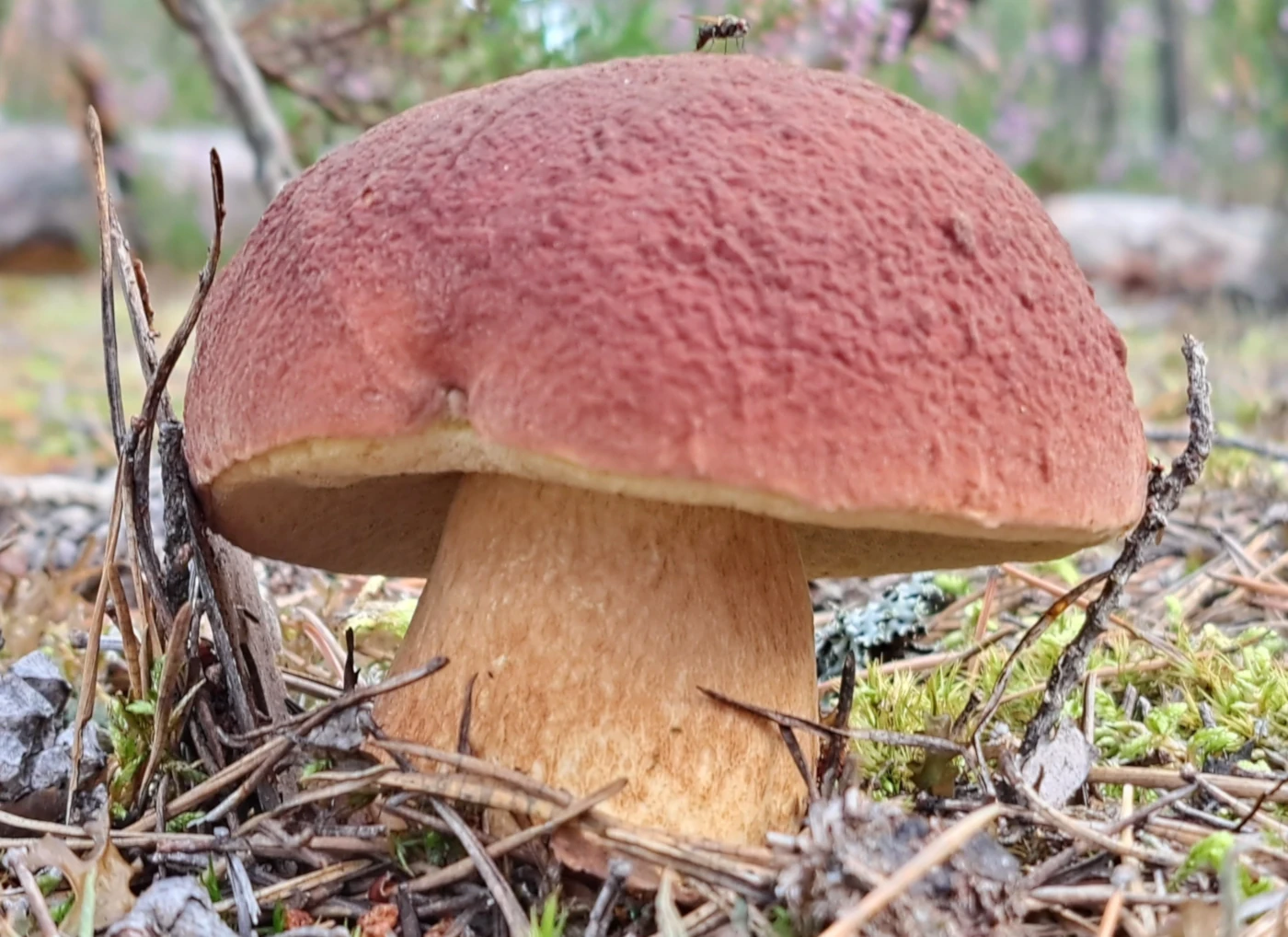
Boletus pinophilus, commonly known as the Pine Bolete, Pine Cep, or Pine Porcini, is a robust member of the king bolete group. It is especially associated with pine and other conifers and is recognized by its dark reddish-brown to wine-brown cap, thick pale stem, white-to-olive pores, and firm flesh that usually does not turn blue when cut.
It is closely related to Boletus edulis and can look very similar, especially in mixed forests where both may occur. The best identification comes from combining cap color, pale stem reticulation, pore development, lack of strong blue bruising, and conifer habitat.
⚠️ Important: This guide is for identification and education only. Never eat a wild mushroom based solely on photographs, AI identification, or an online comparison.
Quick Identification
| Feature | Boletus pinophilus |
|---|---|
| Scientific name | Boletus pinophilus |
| Common names | Pine Bolete, Pine Cep, Pine Porcini |
| Family | Boletaceae |
| Cap color | Dark reddish-brown, wine-brown, chestnut |
| Cap surface | Smooth to slightly uneven |
| Underside | Pores, not gills |
| Young pores | White to cream |
| Mature pores | Yellow to olive |
| Stem | Thick, pale, often bulbous when young |
| Stem pattern | Pale reticulation, especially near the top |
| Flesh | White, firm |
| Bruising | Usually little or no blueing |
| Spore print | Olive-brown |
| Ecology | Mycorrhizal |
| Main hosts | Pine and other conifers |
| Season | Summer through autumn |
| Edibility | Edible when correctly identified |
| Main look-alikes | Boletus edulis, Boletus reticulatus, Tylopilus felleus, other king boletes |
What Does Boletus pinophilus Look Like?
Pine Bolete has the classic heavy-set appearance of a king bolete. Young mushrooms often have a thick swollen stem and a rounded cap, giving them a compact, almost bun-like shape.
The cap is usually darker and redder than that of classic Boletus edulis. Shades can include reddish brown, chestnut, wine-brown, and deep mahogany, especially in fresh specimens.
The underside has a sponge-like pore layer rather than gills. Young pores are white, then gradually turn yellow and finally olive as the mushroom matures.
Cap
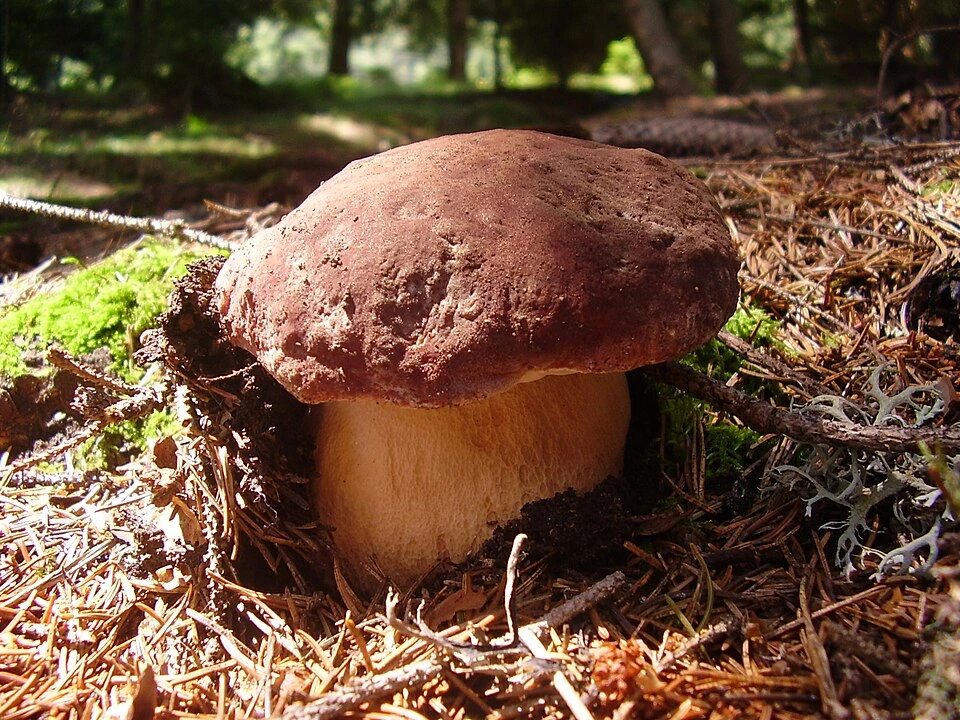
The cap is initially hemispherical and expands with age. Mature specimens can become broad and slightly flattened while retaining a thick fleshy appearance.
The color is often one of the best visual clues. Pine Bolete tends to show richer reddish or wine-brown tones than many other king boletes.
Cap Surface
The surface is usually smooth and dry to slightly tacky. After rain, it can appear darker and more glossy.
Dry weather may make the cap paler or slightly cracked. Color alone should therefore never be used as the only identification feature.
Pores
The underside begins white to cream in young specimens. As spores mature, the pore surface turns yellow and then olive-yellow or olive-green.
The pores are fine and tightly packed. They do not begin bright red or orange.
Bruising of the Pores
Strong blue bruising is not typical of Boletus pinophilus. Slight discoloration may occur with age or handling, but dramatic rapid blueing should suggest another bolete group.
This makes bruising useful when separating Pine Bolete from strongly blue-staining species. It should still be interpreted together with pore color and stem structure.
Stem
The stem is thick, solid, and often strongly swollen when young. Older specimens can become more cylindrical, though they usually remain robust.
Color is pale cream to light brown. A fine pale network, known as reticulation, is often visible on the upper part of the stem.
Stem Reticulation
The reticulation is usually light-colored rather than dark. It may be especially clear just below the pore surface.
This feature helps separate Pine Bolete from Bitter Bolete, which often has stronger and darker netting. The exact visibility of the reticulation can vary between individual mushrooms.
Flesh
The flesh is white, thick, and firm in fresh specimens. It generally remains white after cutting and does not show strong blue oxidation.
This stable white flesh is one of the characteristic features of the king bolete group. Older specimens may become softer, especially near the pores.
Texture
Young fruit bodies are dense and heavy for their size. The stem can feel especially compact and solid.
As the mushroom ages, the pore layer becomes increasingly soft and spongy. Insect damage also becomes more common in older specimens.
Smell
The smell is usually pleasant and mushroom-like. Some people describe it as nutty or slightly earthy.
Odor is not distinctive enough to confirm the species. Cap color, pore development, host tree, and stem pattern are much more useful.
Spore Print
The spore print is olive-brown. This is typical of many boletes and confirms the broader group rather than the exact species.
Spore color is therefore less useful than morphology for separating Boletus pinophilus from Boletus edulis. Host association and cap tone are more practical.
Where Does Boletus pinophilus Grow?
Boletus pinophilus is mycorrhizal and grows from soil in association with living trees. It is especially associated with pine and other conifers.
Mature pine forests, mixed conifer woodland, mossy slopes, and areas with deep needle litter can all provide suitable habitat. The mushroom may appear several meters from the trunk because tree roots extend far through the soil.
Pine Association
Pine is one of the strongest ecological clues. The species is particularly well known from forests dominated by Pinus. It can also associate with other conifers depending on region. This is why exact host identification can improve confidence when separating similar king boletes.
When Does Boletus pinophilus Grow?
The main season is summer through autumn. Fruiting often follows sustained rainfall during warm or mild weather. In mountain or northern regions, the season can begin earlier and end quickly after frost. In milder areas, fruiting may continue well into autumn.
Early Fruiting
Pine Bolete can sometimes appear relatively early compared with other autumn boletes. This varies strongly with region and weather. Season is therefore helpful but never decisive. The mushroom should still match the structural features of the species.
Distribution
Boletus pinophilus is widespread in Europe and parts of Eurasia. It is especially familiar in northern, central, and montane conifer forests. Closely related king boletes occur in North America, but not every pine-associated porcini-like mushroom there should automatically be called B. pinophilus. Regional taxonomy matters.
Is Boletus pinophilus Edible?
Yes, Pine Bolete is widely regarded as edible when correctly identified and properly prepared. It is valued similarly to other king boletes. Its flesh is firm when young and suitable for fresh or dried use. Older specimens are usually less desirable because the pore layer becomes soft and insect damage increases. Accurate identification remains essential because Bitter Bolete and other brown-pored look-alikes can occur in similar habitats.
Boletus pinophilus Look-Alikes
The most likely look-alikes are other king boletes. These mushrooms share thick stems, pale pores when young, and white flesh. The main differences involve cap color, host trees, season, and stem pattern. Bitter Bolete deserves special attention because it can imitate the same overall shape.
Boletus edulis — Porcini
Identification
Boletus edulis usually has a lighter brown to chestnut cap. The stem is thick and often shows pale reticulation near the top.
Like Pine Bolete, it has white young pores, olive mature pores, and white non-blueing flesh. The two can be extremely similar.
Main Difference
Pine Bolete generally has a darker, redder, more wine-brown cap and is strongly associated with conifers. Boletus edulis can occur with a wider range of coniferous and deciduous hosts.
The distinction can sometimes be subtle. Habitat and overall cap tone are often more useful than one isolated feature.
Boletus pinophilus vs Boletus edulis
| Feature | Boletus pinophilus | Boletus edulis |
|---|---|---|
| Cap | Dark reddish-brown to wine-brown | Brown to chestnut |
| Main host | Pine and other conifers | Conifers and broadleaf trees |
| Stem | Thick, pale, reticulated | Thick, pale, reticulated |
| Young pores | White | White |
| Mature pores | Yellow to olive | Yellow to olive |
| Bruising | Usually little or none | Usually little or none |
These species overlap heavily in morphology. The combination of cap tone and tree association is especially useful.
Boletus reticulatus — Summer Cep
Identification
Boletus reticulatus generally has a paler, warmer brown cap and often a more extensive net-like pattern on the stem. It is frequently associated with oak and beech.
Its cap can also look drier or more velvety. Fruiting often begins relatively early in summer.
Main Difference
Broadleaf habitat is one of the strongest clues. A pale reticulated bolete under oak or beech is more consistent with B. reticulatus than Pine Bolete.
Pine Bolete usually has a darker reddish cap and stronger conifer association.
Boletus aereus — Bronze Bolete
Identification
Bronze Bolete has a very dark brown to almost blackish cap. It is especially characteristic of warmer broadleaf forests.
The stem is pale to brownish and reticulated. The flesh remains white and firm.
Main Difference
Boletus aereus is more strongly associated with warm oak and other broadleaf habitats. Its cap is often darker and more bronze-black than that of Pine Bolete.
Climate and host trees are particularly useful in this comparison.
Tylopilus felleus — Bitter Bolete
Identification
Bitter Bolete can look deceptively similar, with a brown cap and thick stem. Mature pores often develop a pinkish tint rather than yellow or olive.
The stem usually has a more pronounced dark brown reticulation. The mushroom is famous for its extremely bitter flesh.
Main Difference
Pinkish pores and dark netting point toward Tylopilus felleus. Pine Bolete has pale netting and pores that mature toward olive rather than pink.
This is one of the most important practical look-alike comparisons.
Boletus pinophilus vs Bitter Bolete
| Feature | Pine Bolete | Bitter Bolete |
|---|---|---|
| Young pores | White | White to pale |
| Mature pores | Yellow to olive | Pinkish |
| Stem netting | Pale | Dark brown |
| Flesh | Mild | Extremely bitter |
| Bruising | Little or none | Little dramatic blueing |
| Safety | Edible when correctly identified | Inedible due to bitterness |
The mature pore color is especially useful. Strong pink tones should make you reconsider a Porcini identification.
Pine Bolete vs Red-Pored Boletes
Red-pored boletes belong to a different visual group. Their pore surfaces become orange-red to deep red, and many show strong blue bruising.
Pine Bolete should have white young pores that age to yellow or olive. Bright red pores are inconsistent with Boletus pinophilus.
This distinction is important because some red-pored boletes are poisonous. Underside color should always be checked before identifying a brown-capped bolete as edible.
How to Identify Boletus pinophilus Step by Step
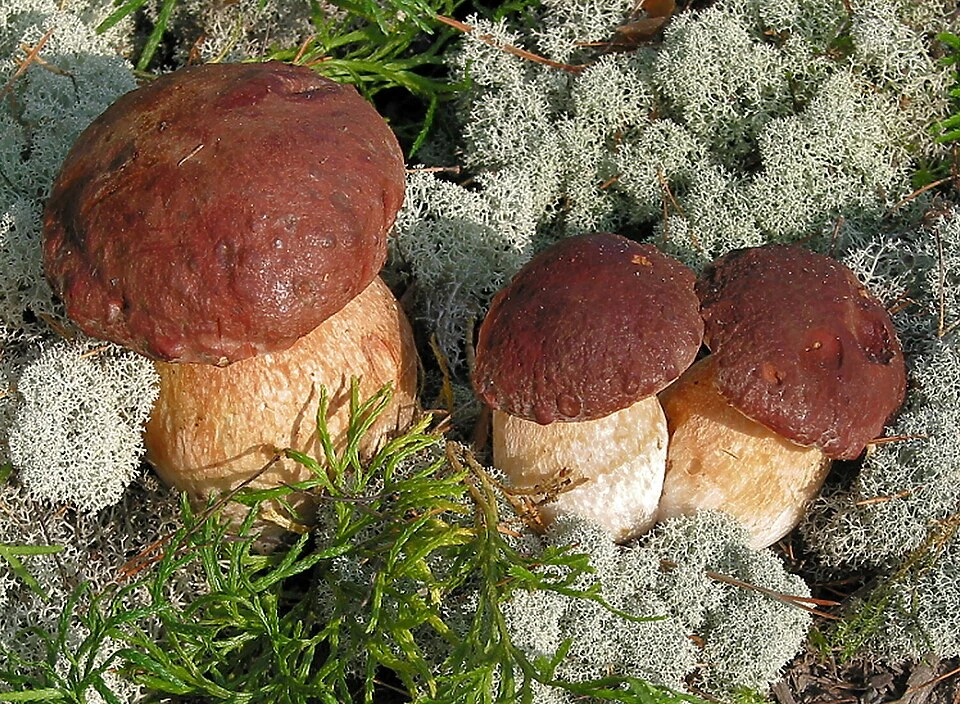
Begin with the underside and confirm that the mushroom has pale pores rather than gills. Then examine the thick stem for pale reticulation.
Next, cut the flesh and check that it remains white without strong blueing. Finally, look at the dark reddish-brown cap and confirm a pine or other conifer habitat.
Step 1: Check the Cap
Look for a dark chestnut, reddish-brown, or wine-brown cap. The color is often deeper than that of classic Boletus edulis.
Do not rely on shade alone, because moisture can dramatically alter cap appearance. Wet mushrooms often look darker.
Step 2: Check the Pores
Young pores should be white to cream. Mature pores should become yellow or olive.
Pink pores suggest Bitter Bolete, while red pores suggest a different bolete group. This makes underside color one of the fastest exclusion tests.
Step 3: Examine the Stem
Look for a thick solid stem with pale netting, especially near the top. Dark reticulation should raise suspicion for another species.
The stem may be especially bulbous in young specimens. Older mushrooms often become more elongated.
Step 4: Cut the Flesh
The flesh should remain broadly white. Strong immediate blue bruising is not characteristic.
A clean vertical cut through cap and stem is useful. It also reveals insect tunnels and internal deterioration.
Step 5: Confirm the Trees
Look for pine needles, cones, and bark around the site. In mixed woodland, identify all nearby conifers rather than assuming the nearest tree is the host.
Ecology should support the physical identification. It should not override contradictory pore or stem features.
Why Pine Bolete Can Look Different With Age
Young fruit bodies are often extremely stout, with thick stems and rounded caps. Mature specimens become broader and sometimes much less compact. The cap can also change from reddish-brown to darker chestnut as moisture conditions vary. Old specimens may fade, crack, or become irregular. Pore color changes are especially important. The shift from white to yellow and olive is a normal part of maturation.
How to Photograph Boletus pinophilus for Identification
Take a side photograph showing the full cap and stem proportions. This helps document the robust king-bolete shape. Then photograph the pore surface in natural light. A close-up of the upper stem should show the reticulation clearly. A cut section is also useful for confirming white non-blueing flesh. Finally, include the surrounding pine needles, cones, or host trees.
Can AI Identify Boletus pinophilus?
AI can often recognize a king bolete from its brown cap, thick stem, and pale pores. Distinguishing Boletus pinophilus from Boletus edulis is much harder because the species overlap strongly in appearance. Cap tone, host trees, location, and season can improve the result. Multiple views are far more useful than a single top-down image. AI should therefore be especially cautious about exact species naming within the king bolete group. A confident group-level identification may be more accurate than an overconfident species label.
Common Identification Mistakes
One common mistake is calling every dark Porcini-like mushroom Boletus edulis. Pine Bolete can have a distinctly redder cap and stronger conifer association.
Another mistake is ignoring the mature pore color. Pink tones suggest Bitter Bolete rather than a king bolete.
A third mistake is assuming pine habitat alone proves Boletus pinophilus. Several other boletes grow beneath pine and can share brown caps.
Frequently Asked Questions
Why do some Pine Boletes have almost black-brown caps?
Wet weather, age, and natural individual variation can produce very dark caps. The mushroom may still belong to the same species if pores, stem, flesh, and habitat all agree.
Can Pine Bolete grow far from the nearest pine trunk?
Yes. Tree roots and fungal mycelium extend far through the soil, so fruit bodies can appear several meters from the visible trunk.
Why are some specimens heavily eaten by insects?
King boletes are particularly attractive to insect larvae. Older mushrooms in warm weather are usually more affected than young compact specimens.
Can several king bolete species occur in the same forest?
Yes, especially in mixed woodland containing both conifers and broadleaf trees. Each fruit body should therefore be examined independently rather than identified from the general location alone.
Does frost immediately end the Pine Bolete season?
A hard prolonged freeze can end fruiting, but light early frost may not destroy all existing mushrooms. Local microclimates can keep sheltered forest patches productive for longer.
Why can the stem reticulation be hard to see?
Dirt, moisture, age, and insect damage can obscure the fine network. Cleaning a small section gently may make the pattern easier to examine.
Can young pore surfaces look almost completely solid?
Yes. The pores are extremely fine when the mushroom is young and may look like a smooth white layer from a distance. They become more obvious as the fruit body expands.
Can Pine Boletes appear in planted pine forests?
Yes. Compatible mycorrhizal fungi can occur in managed or planted conifer forests as well as natural woodland, provided suitable host trees and soil conditions are present.
Final Identification Notes
Boletus pinophilus is best recognized by the combination of a dark reddish- to wine-brown cap, thick pale reticulated stem, white young pores becoming olive with age, firm white flesh, little or no blue bruising, and strong association with pine and other conifers.
The closest comparison is usually Boletus edulis, which shares nearly all major structural features. Pine Bolete tends to be darker and redder and is more strongly tied to conifer habitats.
For reliable identification, use the entire pattern rather than cap color alone. Pore development, stem reticulation, bruising, host trees, geography, and age together provide a much stronger result.
Upload a photo and get possible matches in seconds.