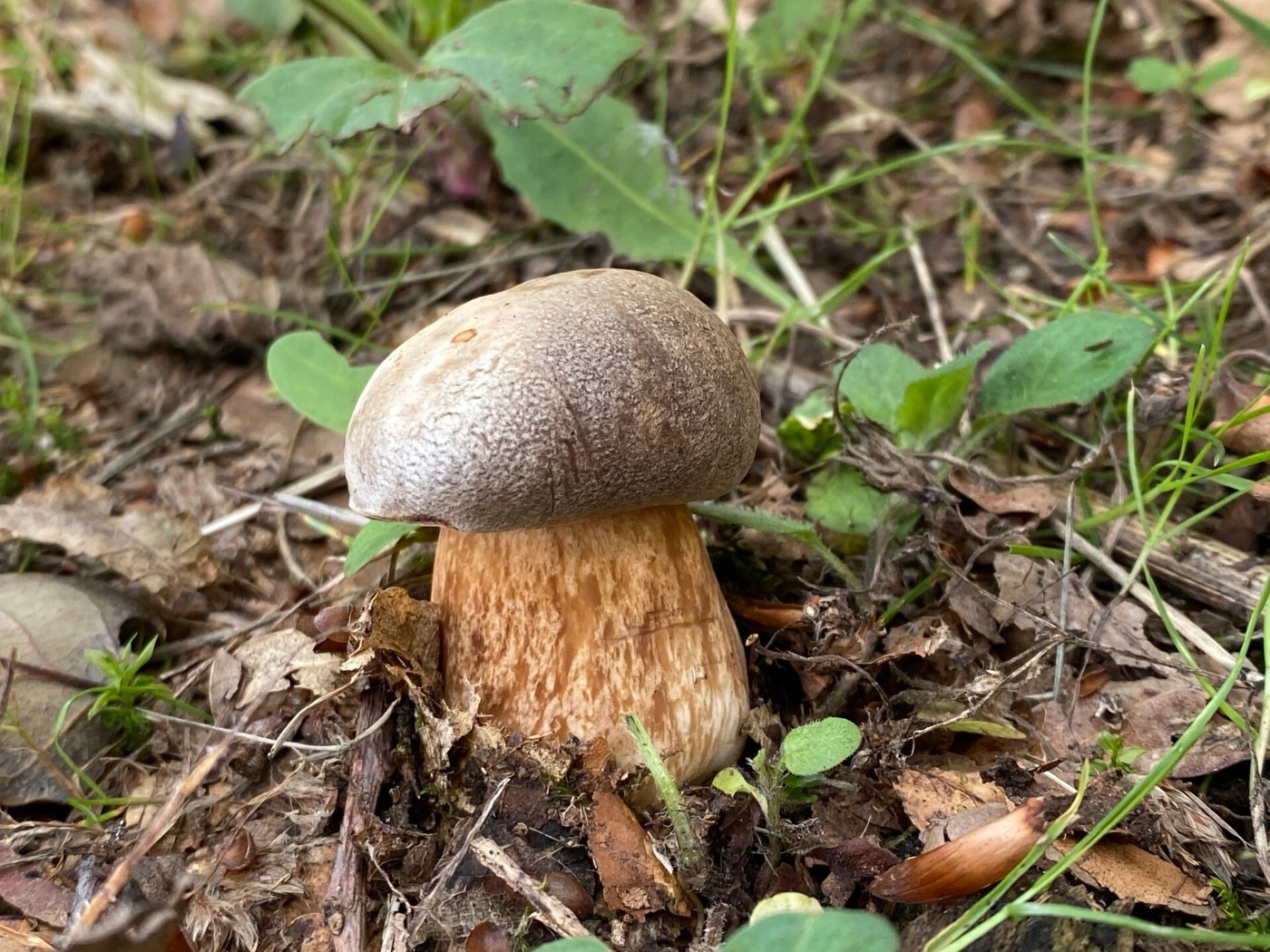
Boletus aereus, commonly known as the Bronze Bolete, is one of the darkest members of the king bolete group. It is recognized by its deep brown to almost black cap, stout pale stem with fine reticulation, white flesh that usually does not turn blue, and a pore surface that changes from white to yellow and eventually olive with age.
The species is especially associated with warm broadleaf woodland in Europe and the Mediterranean region, where it forms mycorrhizal relationships with trees such as oak, beech, and chestnut. Because several other king boletes share the same general shape and pore development, identification should rely on the complete combination of cap color, stem netting, host trees, season, and geography.
⚠️ Important: Boletus aereus is considered edible when correctly identified and properly prepared, but wild mushrooms should never be eaten based only on photographs, AI identification, or one visible feature.
Quick Identification
| Feature | Boletus aereus |
|---|---|
| Scientific name | Boletus aereus |
| Common name | Bronze Bolete |
| Family | Boletaceae |
| Cap color | Dark brown, bronze-brown, sometimes nearly black |
| Cap surface | Dry, often velvety |
| Young pores | White |
| Mature pores | Yellow to olive |
| Stem | Thick, pale to brownish |
| Reticulation | Fine pale netting, especially upper stem |
| Flesh | White, firm |
| Blue bruising | Usually absent |
| Spore print | Olive-brown |
| Ecology | Mycorrhizal |
| Main hosts | Oak, beech, chestnut and other broadleaf trees |
| Season | Summer to early autumn |
| Main range | Europe and Mediterranean regions |
| Edibility | Edible when correctly identified |
| Main look-alikes | Boletus edulis, B. reticulatus, B. pinophilus, Tylopilus felleus |
What Does Boletus aereus Look Like?
Bronze Bolete has the classic robust build associated with king boletes. Young specimens often have a strongly rounded cap and a thick bulbous stem, while mature fruit bodies become broader but usually retain a powerful, compact appearance.
The cap is generally darker than in most other European king boletes. Combined with the pale reticulated stem and white non-blueing flesh, this gives the species a distinctive appearance in good condition.
Cap
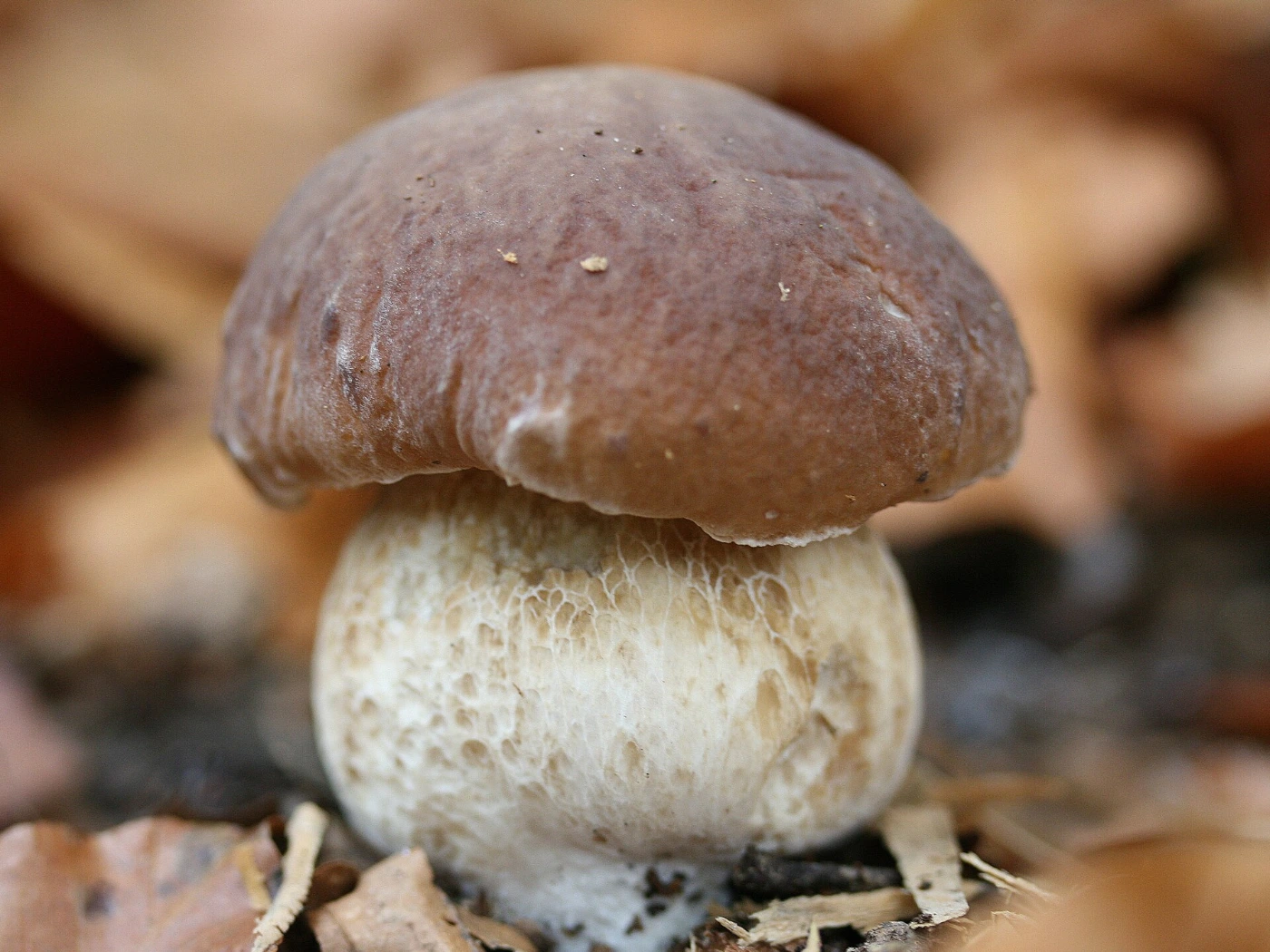
The cap ranges from dark brown and chocolate-brown to deep bronze or almost black. Some specimens have warmer chestnut areas, especially toward the margin or where the surface has been exposed to sunlight.
Young caps are convex and may appear almost hemispherical. With age they broaden and flatten, although they usually remain thick and substantial.
Cap Surface
The surface is typically dry and often finely velvety. In hot or dry conditions, the cap may become slightly cracked, particularly in older fruit bodies.
Unlike some sticky or viscid boletes, Boletus aereus normally has a dry appearance. This becomes a useful supporting clue when separating it from other brown boletes.
Pores
Young Bronze Boletes have a white pore surface. As the mushroom matures, the pores become cream, then yellow, and eventually olive-yellow or olive-green.
This development is typical of the king bolete group. A mature specimen with clearly pink pores should therefore raise suspicion for another genus, particularly Tylopilus.
Bruising
The pore surface usually does not show strong blue bruising when pressed. Minor discoloration can occur in old or damaged specimens, but dramatic blue staining is not characteristic.
If the pores or flesh rapidly become deep blue after damage, another bolete species should be considered.
Stem
The stem is thick, firm, and often bulbous when young. It may become more cylindrical as the mushroom matures, though it usually retains a robust appearance.
Color ranges from cream and pale beige to tan or light brown. The upper part is commonly covered with fine pale reticulation.
Reticulation
The reticulation forms a net-like pattern across the stem surface. It is usually pale rather than dark and can be particularly visible near the top.
This is an important feature of the king bolete group. Dark coarse reticulation combined with pink mature pores would instead suggest Bitter Bolete.
Flesh
The flesh is white, thick, and firm in young specimens. It generally remains white after cutting and does not show strong blue staining.
The flesh beneath the cap skin can sometimes be slightly darker or tinted by the cap pigment, but the main interior remains pale.
Texture
Young fruit bodies are dense and solid. Older specimens become softer, especially in the pore layer, and are more likely to be damaged by insects.
Fresh firm specimens provide the most useful identification features.
Smell
The smell is mild and pleasantly mushroom-like. It is not usually distinctive enough to identify the species by itself.
Odor can vary with freshness and environmental conditions. Cap color, stem reticulation, pores, and habitat are much more useful.
Spore Print
The spore print is olive-brown, as expected in many members of the bolete family.
Spore print color helps confirm the broader group but is rarely needed for field identification when the other features are clear.
Where Does Boletus aereus Grow?
Bronze Bolete is a mycorrhizal species associated mainly with broadleaf trees. It grows from soil rather than directly from wood.
Warm oak woodland is particularly characteristic, although beech and chestnut can also be important partners.
Oak Association
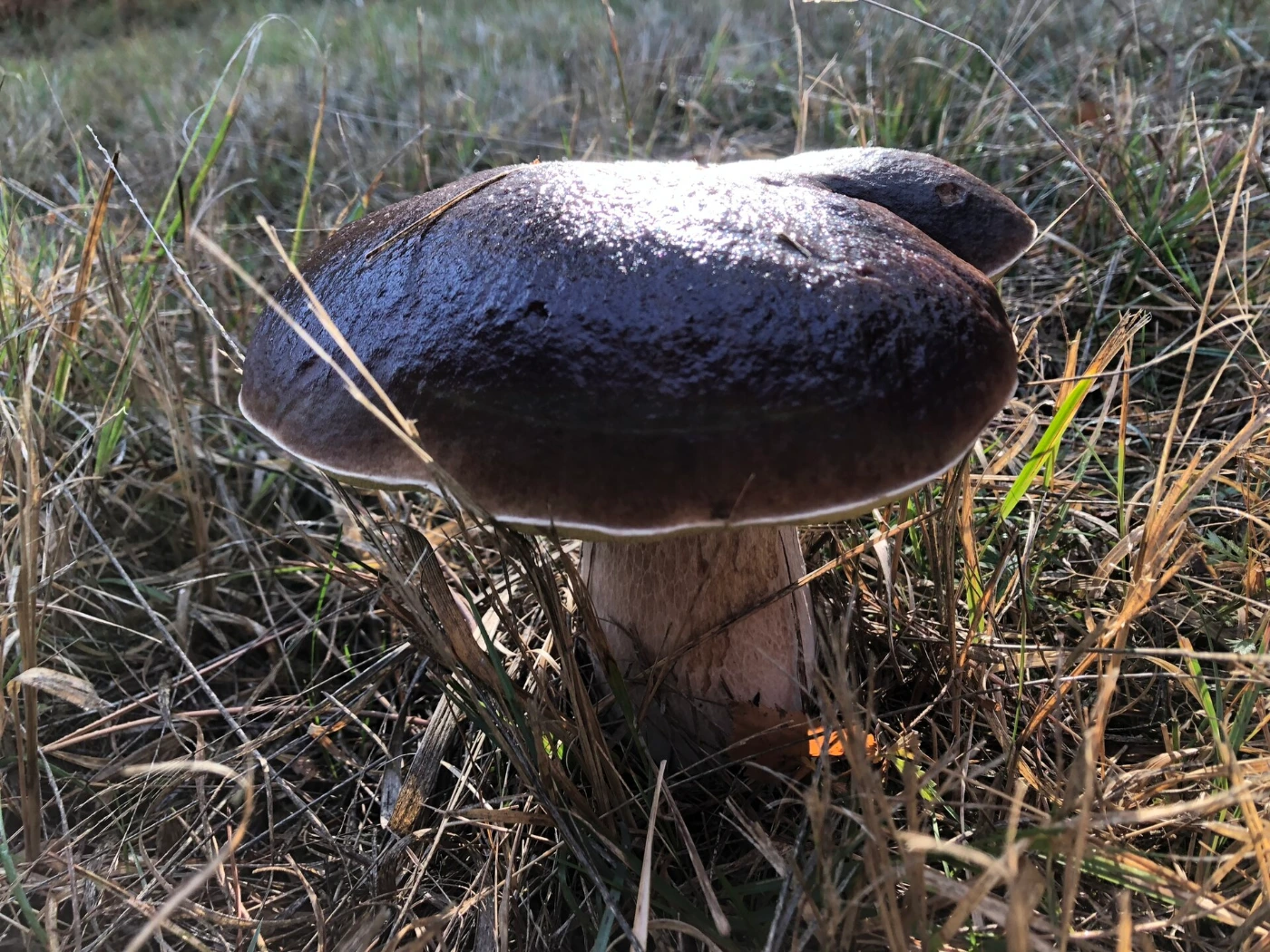
Oak is one of the strongest ecological clues. Mature oak woodland on warm, relatively dry soils can be especially productive.
The mushroom may appear several meters from the visible trunk because the tree’s roots extend widely underground.
Beech and Chestnut
Beech and chestnut are also important hosts in parts of Europe. Mixed broadleaf forests can therefore support Boletus aereus even when oak is not the dominant tree.
The surrounding tree community should always be considered rather than assuming the nearest trunk is the host.
Preferred Climate
Bronze Bolete generally favors warmer conditions than Boletus edulis. It is especially characteristic of southern and central Europe and Mediterranean-influenced regions.
Warm summers followed by suitable rainfall can produce strong fruitings.
When Does Bronze Bolete Grow?
The main season is usually summer through early autumn. In warmer regions, fruiting can begin relatively early compared with classic autumn Porcini.
Weather has a major influence, and dry periods can suppress fruit bodies completely even when the underground mycelium remains established.
Distribution
Boletus aereus is primarily a European and Mediterranean species. It is especially associated with southern and central Europe, though its exact distribution depends on suitable host trees and climate.
Brown king boletes found in North America should not automatically be identified as B. aereus. Regional taxa and species complexes there may look similar but belong to different species.
Is Boletus aereus Edible?
Bronze Bolete is considered edible when correctly identified and properly prepared. It is highly valued in parts of Europe and belongs to the same culinary group as other king boletes.
However, identification should be secure before edibility is considered. Dark brown boletes can include bitter, inedible, or otherwise unsuitable species.
Boletus aereus Look-Alikes
The closest look-alikes are other members of the king bolete group. They share white young pores, pale reticulation, and usually non-blueing white flesh.
The most useful differences involve cap color, cap texture, host trees, and seasonal preference.
Boletus edulis — Porcini
Identification
Boletus edulis usually has a medium to dark brown cap, often with a paler margin. The cap can be slightly sticky in damp conditions.
The stem is pale and reticulated, while the pores develop from white to yellow and olive.
Main Difference
Boletus aereus usually has a darker, drier, more velvety cap and a stronger preference for warm broadleaf woodland.
Boletus edulis is more widely distributed across both coniferous and broadleaf forests and often has a less uniformly dark cap.
Boletus reticulatus — Summer Cep
Identification
Summer Cep commonly has a tan to warm brown cap and strong pale reticulation extending well down the stem.
The cap is usually dry and can crack in hot weather.
Main Difference
Boletus reticulatus is usually lighter overall. Bronze Bolete tends toward much darker brown or near-black cap tones.
Both can grow under oak and beech, so habitat alone may not separate them.
Boletus pinophilus — Pine Bolete
Identification
Pine Bolete often has a reddish-brown to wine-brown cap and a thick reticulated stem.
It is strongly associated with pine and other conifers.
Main Difference
Host tree is especially useful. A dark reddish king bolete under pine fits B. pinophilus better than B. aereus.
Bronze Bolete is primarily associated with broadleaf trees.
Tylopilus felleus — Bitter Bolete
Identification
Bitter Bolete can have a brown cap and reticulated stem, making it one of the most important practical look-alikes.
Its mature pores become pink to pinkish brown, and the reticulation is usually darker and more contrasting.
Main Difference
The most useful combination is pink pores + dark stem netting for Bitter Bolete versus yellow-to-olive pores + pale reticulation for Bronze Bolete.
Boletus aereus vs Boletus edulis
| Feature | Boletus aereus | Boletus edulis |
|---|---|---|
| Cap | Very dark brown to nearly black | Brown to chestnut |
| Surface | Dry, often velvety | Smooth, sometimes slightly sticky |
| Pores | White → yellow → olive | White → yellow → olive |
| Stem netting | Pale | Pale |
| Flesh | White, non-blueing | White, non-blueing |
| Main habitat | Warm broadleaf woodland | Broadleaf and conifer woodland |
| Typical hosts | Oak, beech, chestnut | Spruce, pine, oak, beech, birch |
| Climate tendency | Warmer regions | Broad temperate range |
The two species overlap strongly in structure, so ecology and cap appearance become particularly important.
Boletus aereus vs Boletus reticulatus
| Feature | Boletus aereus | Boletus reticulatus |
|---|---|---|
| Cap color | Dark bronze-brown to blackish | Tan to medium brown |
| Cap texture | Velvety, dry | Dry, often cracked |
| Reticulation | Pale, usually clear | Often very extensive |
| Habitat | Warm oak/beech woodland | Warm broadleaf woodland |
| Season | Summer–early autumn | Late spring–summer |
| Main clue | Very dark cap | Lighter cap and strong netting |
These two can occur in similar forests and are sometimes more difficult to separate than their typical illustrations suggest.
How to Identify Boletus aereus Step by Step
Start by confirming that the mushroom belongs to the king bolete type. Look for a thick brown cap, pale pores, a robust reticulated stem, and white flesh that does not strongly turn blue.
Then use cap color, host trees, and climate to narrow the identification.
Step 1: Check the Pores
Young pores should be white, becoming yellow and eventually olive with age.
Pink mature pores point away from Boletus aereus.
Step 2: Examine the Stem
Look for pale net-like reticulation rather than dark coarse markings or isolated dots.
A stem covered with scabers would instead suggest Leccinum.
Step 3: Check the Flesh
Cut the mushroom vertically and observe the flesh. It should remain mostly white without strong rapid blue staining.
Dramatic blueing suggests another bolete group.
Step 4: Examine the Cap
A very dark brown, bronze, or blackish dry cap strongly supports Boletus aereus when the other king bolete features agree.
Avoid relying on darkness alone, since moisture and age can change cap color.
Step 5: Identify the Host Trees
Oak, beech, or chestnut strongly support the identification. Pine-dominated habitat points more toward Boletus pinophilus or another conifer-associated species.
Tree association becomes especially useful when comparing members of the king bolete group.
How to Photograph Bronze Bolete for Identification
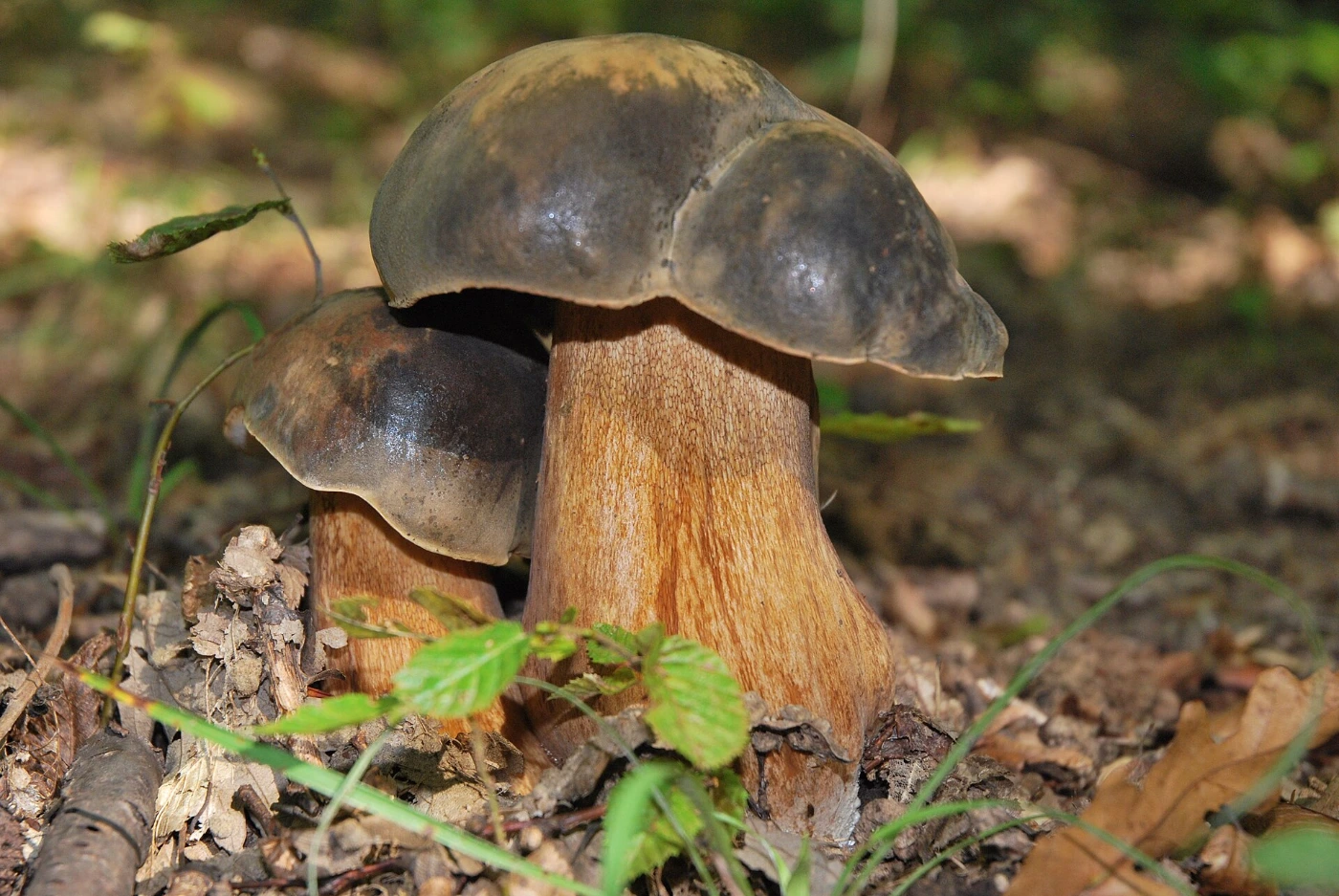
Take one photograph of the complete mushroom in habitat, ideally with nearby broadleaf trees visible. A second image should clearly show the pore surface.
Then photograph the stem closely enough to reveal the reticulation. A cut section can confirm whether the flesh remains white.
Several specimens at different ages are especially useful because they show how the pores change from white to yellow and olive.
Can AI Identify Boletus aereus?
AI can often recognize a dark king-bolete-type mushroom as belonging to the Boletus edulis group. Exact separation of B. aereus, B. edulis, and B. reticulatus is harder because their structures overlap substantially.
Accuracy improves when habitat, host trees, cap texture, and geography are included. A dark cap photographed alone is not enough for a reliable species-level identification.
A cautious system should sometimes return “king bolete group” rather than forcing Boletus aereus when the ecological context is missing.
Common Identification Mistakes
One common mistake is calling every very dark Porcini-like bolete Boletus aereus. Cap color varies within several related species, and wet B. edulis can also appear very dark.
Another mistake is ignoring host trees. A dark reticulated bolete under pine should not automatically be treated as Bronze Bolete.
A third mistake is overlooking pore color. Pink mature pores are a strong warning that the mushroom may be Bitter Bolete rather than any true king bolete.
Interesting Facts About Boletus aereus
The common name Bronze Bolete refers to the deep metallic brown or bronze appearance of many caps. In particularly dark specimens, the surface can look almost black from a distance.
The species belongs to the group of classic European “porcini” mushrooms, but it tends to favor warmer broadleaf habitats than Boletus edulis. This ecological difference is one of the reasons it is especially associated with Mediterranean and southern European mushroom traditions.
The name aereus comes from Latin and refers to a bronze or copper-like color. It is an unusually fitting scientific name because the dark cap is one of the species’ most memorable characteristics.
Like other mycorrhizal boletes, most of the organism remains underground in association with tree roots. The visible mushroom is only the temporary reproductive structure produced when temperature and moisture conditions are favorable.
Frequently Asked Questions
Can Boletus aereus have a lighter brown cap?
Yes. Not every specimen is nearly black, and young or sun-exposed fruit bodies may be noticeably lighter. The identification should still rely on the full combination of king bolete structure, host trees, and geography.
Can the cap crack during hot weather?
Yes. Dry conditions can cause the surface to develop cracks, especially in older mushrooms. This may make it resemble Boletus reticulatus more closely.
Why are the pores white on one mushroom and olive on another?
Pore color changes as the mushroom matures. White indicates a younger fruit body, while yellow and olive tones appear later as spores develop.
Can Bronze Bolete grow far from an oak trunk?
Yes. Mycorrhizal roots extend several meters from the visible trunk, so fruit bodies can appear at a considerable distance.
Can several king bolete species grow in the same forest?
Yes. Warm mixed broadleaf forests can potentially support more than one closely related Boletus species, especially when several host trees are present.
Why are insects often found inside older specimens?
The thick fleshy fruit bodies provide abundant food for insect larvae. Damage becomes increasingly common as the mushroom matures.
Does a very dark cap mean the mushroom is old?
Not necessarily. Boletus aereus can be extremely dark even when young. Age should be judged from overall structure and pore development rather than cap color alone.
Can North American dark king boletes be called Boletus aereus?
Usually that identification should be treated cautiously. Similar-looking North American boletes may belong to different regional taxa, so geography is essential.
Final Identification Notes
Boletus aereus is best recognized by the combination of a very dark bronze-brown to almost black dry cap, white pores that mature through yellow to olive, a thick pale reticulated stem, white non-blueing flesh, and growth with broadleaf trees such as oak, beech, and chestnut.
Its closest look-alikes are other king boletes, especially Boletus edulis, B. reticulatus, and B. pinophilus. Bitter Bolete becomes particularly important when the pores turn pink and the stem netting appears dark.
The simplest identification pattern is: dark dry cap + pale reticulation + white-to-olive pores + no strong blueing + warm broadleaf habitat = strong Bronze Bolete candidate.
Upload a photo and get possible matches in seconds.