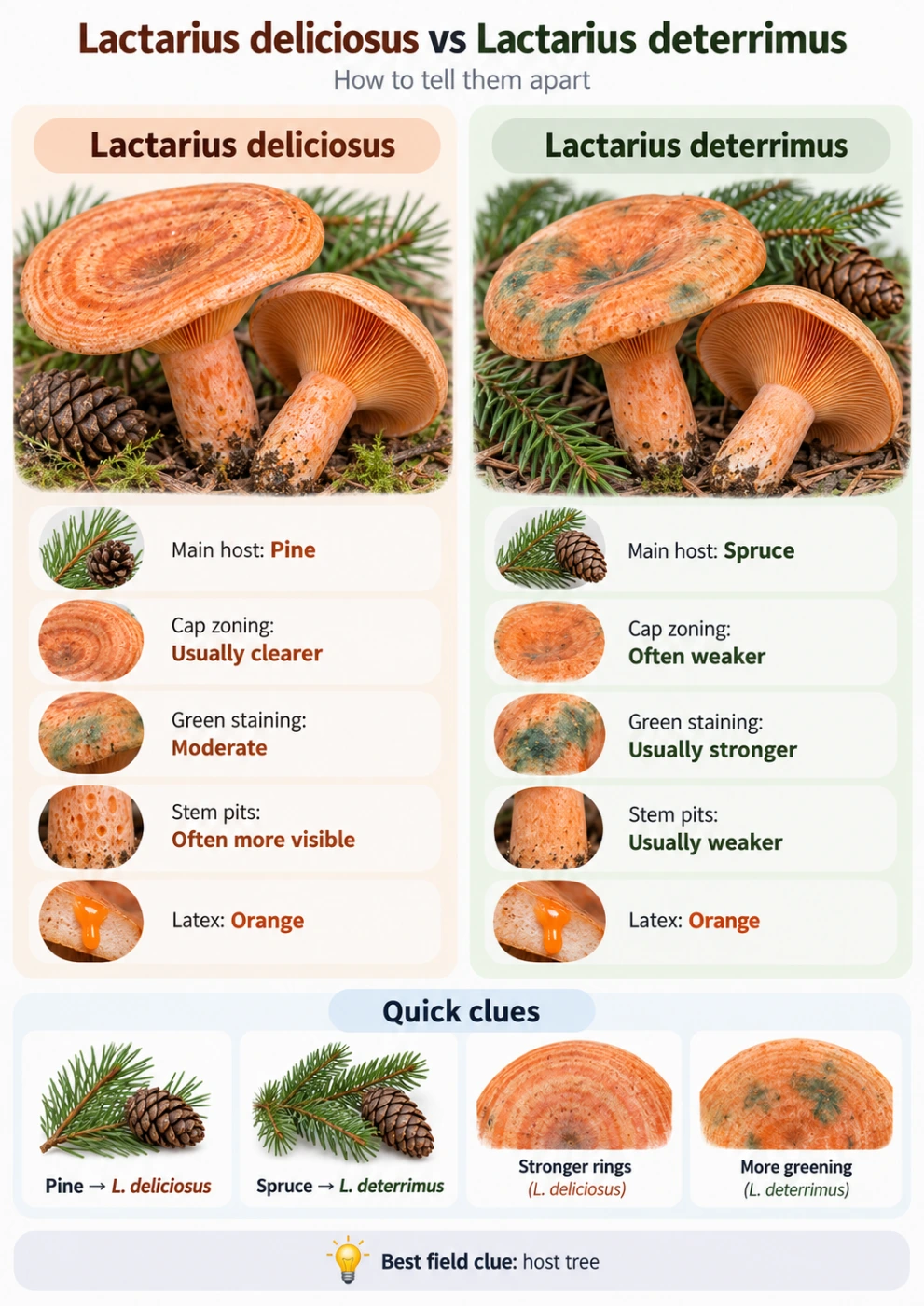
Lactarius deliciosus and Lactarius deterrimus are two closely related orange milkcaps that can look extremely similar in the field. Both have orange caps, orange to carrot-colored gills, orange latex, and green staining that becomes more obvious after damage or with age.
The most useful difference is usually the host tree. Lactarius deliciosus is primarily associated with pine, while Lactarius deterrimus is strongly associated with spruce, especially in Europe.
⚠️ Important: Orange latex is a useful clue, but it does not prove that a mushroom is safe to eat. Identification should combine latex color, host tree, cap pattern, staining, gill structure, and regional distribution.
Quick Comparison
| Feature | Lactarius deliciosus | Lactarius deterrimus |
|---|---|---|
| Common name | Saffron Milk Cap | False Saffron Milk Cap |
| Main host | Pine | Spruce |
| Cap color | Orange to carrot-orange | Orange to salmon-orange |
| Cap zoning | Often clearly zoned | Often weaker or less distinct |
| Latex | Orange | Orange |
| Green staining | Usually moderate | Often stronger and more extensive |
| Gills | Orange, decurrent | Orange, decurrent |
| Stem | Orange, often with pits | Orange, usually less strongly pitted |
| Flesh | Orange-pale, may green | Orange-pale, often greens strongly |
| Spore print | Cream to pale ochre | Cream to pale ochre |
| Habitat | Pine woodland | Spruce woodland |
| Edibility | Edible when correctly identified | Edible in some traditions when correctly identified |
| Best clue | Pine + stronger zoning | Spruce + stronger greening |
Why These Two Mushrooms Are So Easy to Confuse
Both species belong to the saffron milkcap group and share the same general orange color palette. A cap-only photograph can make them look almost identical, especially when weather has faded the surface or green staining has already developed.
The problem becomes easier once the surrounding trees are included in the identification. In many cases, knowing whether the mushroom grows with pine or spruce is more useful than trying to judge a slight difference in orange color.
Lactarius deliciosus — Saffron Milk Cap
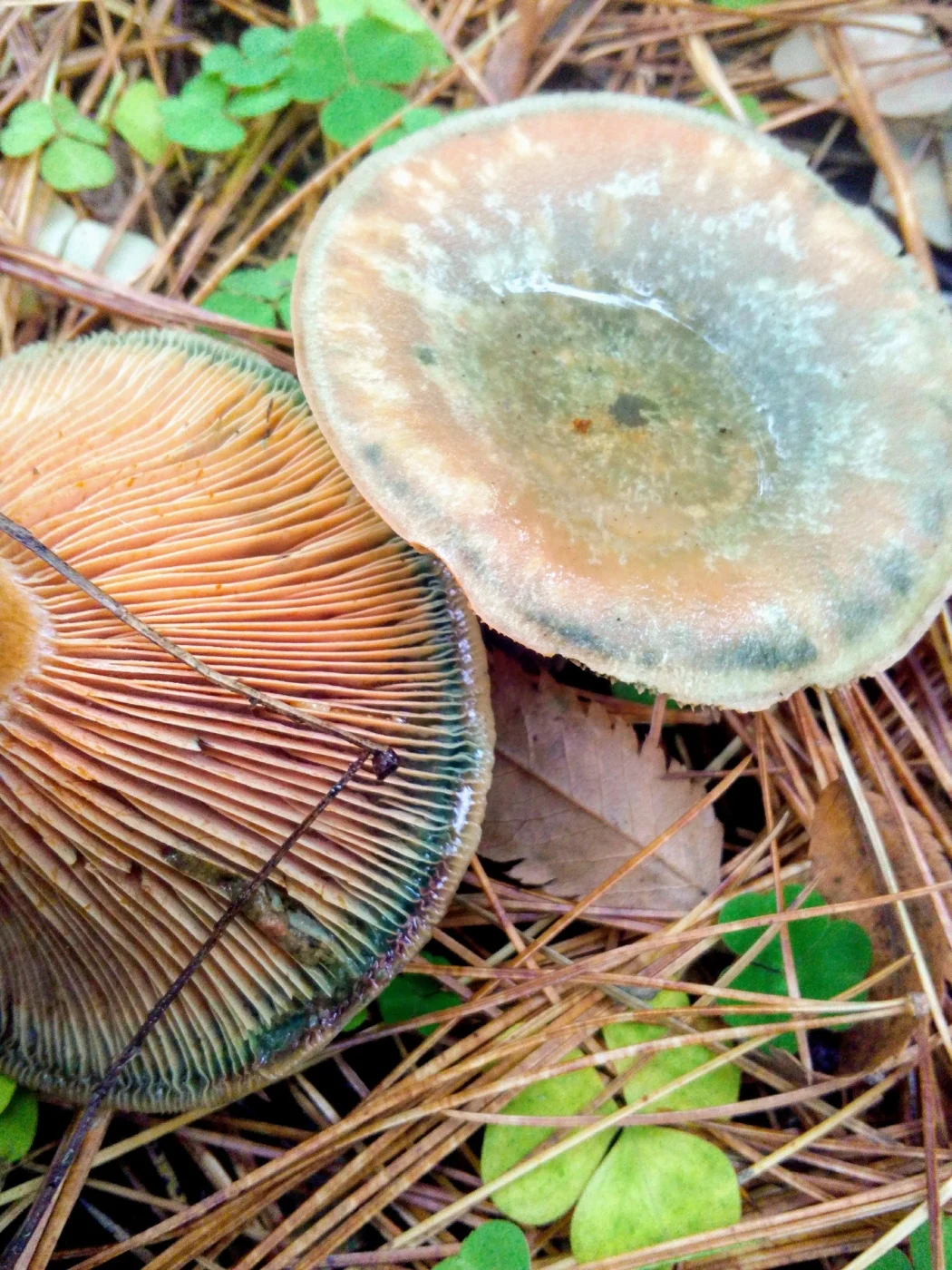
Lactarius deliciosus is one of the best-known orange milkcaps and is widely associated with pine. It often develops attractive concentric rings on the cap and produces orange latex when the gills or flesh are damaged.
The species is best identified by combining the orange latex with pine habitat and the typical zoned cap. Older fruit bodies may develop green patches, but the staining is often less extensive than in L. deterrimus.
Cap
The cap is orange to carrot-orange and often shows visible concentric bands or zones. Young caps are convex, while older specimens become flatter and may develop a central depression.
The surface can be slightly sticky when fresh, especially in damp weather. Age and exposure can cause irregular green patches to appear on the cap.
Gills
The gills are orange to salmon-orange and run down the stem. When damaged, they release orange latex and may later develop green staining.
The gills are usually fairly close together and can become darker or more spotted with age. Green bruising often appears most clearly where the gills have been handled.
Stem
The stem is orange and may show small darker pits or depressions known as scrobicules. These pits are often useful in mature specimens, although their visibility varies.
The stem can become hollow with age. Green staining may develop where the surface has been bruised or damaged.
Lactarius deterrimus — False Saffron Milk Cap
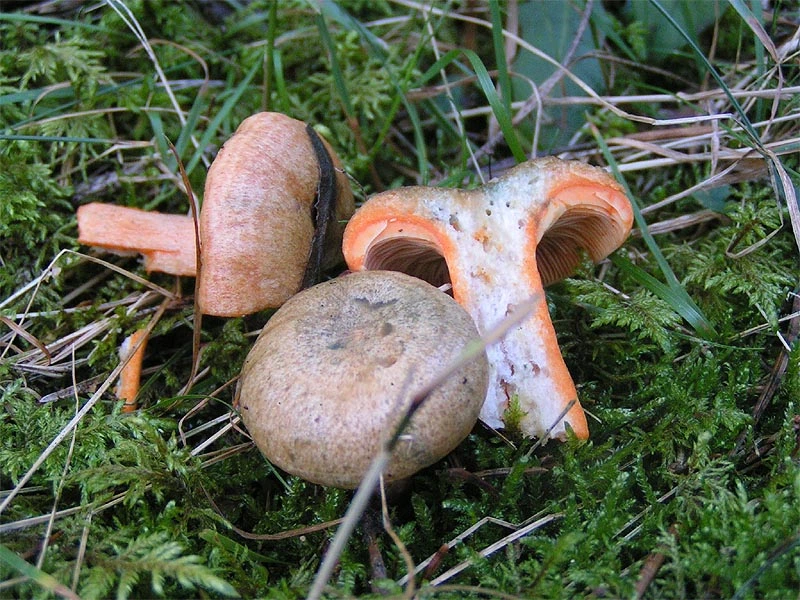
Lactarius deterrimus is another orange milkcap that closely resembles L. deliciosus. It is especially associated with spruce and often develops stronger green staining across the cap, gills, and stem.
The cap pattern is frequently less strongly zoned than in L. deliciosus. In some specimens, the overall surface looks more evenly orange before the green discoloration begins.
Cap
The cap is usually orange, salmon-orange, or carrot-orange and may have weak concentric zones. The pattern can be visible, but it is often less clearly marked than in L. deliciosus.
Green patches can become extensive with age or after handling. Older specimens may develop large blue-green or dark green areas.
Gills
The gills are orange and run distinctly down the stem. When cut or scratched, they produce orange latex that can contribute to later green staining.
The green reaction can become very obvious on damaged gills. This stronger staining tendency is one of the most useful visual clues for L. deterrimus.
Stem
The stem is orange to pale orange and usually lacks the strong pit pattern sometimes seen in L. deliciosus. It may nevertheless show small spots or irregular surface markings.
The lower stem and damaged areas often develop green discoloration. In older fruit bodies, this can become one of the most conspicuous features.
Lactarius deliciosus vs Lactarius deterrimus: Main Differences
The most reliable difference is the tree association, not the cap color. Pine strongly supports L. deliciosus, while spruce strongly supports L. deterrimus.
Cap zoning and green staining provide useful secondary clues. L. deliciosus often has stronger concentric zones, while L. deterrimus tends to develop heavier and more widespread green staining.
Host Tree
Host tree should be checked before fine visual differences are considered. Milkcaps are mycorrhizal, so their relationship with a particular tree can be highly informative.
If the mushroom is growing among pine needles beneath a clear pine canopy, L. deliciosus becomes much more likely. If it is growing under spruce, L. deterrimus becomes the stronger candidate.
Cap Zoning
Lactarius deliciosus often shows clear orange rings radiating outward from the center. These zones can give the cap a patterned or banded appearance.
Lactarius deterrimus may also show zones, but they are often weaker or less regular. Weathering can blur these differences, so zoning should never be used alone.
Green Staining
Both species can turn green after damage. The difference is mostly one of degree rather than an absolute presence-or-absence character.
Lactarius deterrimus often greens more strongly and across a larger part of the fruit body. L. deliciosus can also develop green patches, especially when old or bruised, so green color alone does not identify either species.
Stem Surface
The stem of L. deliciosus may show more obvious scrobicules or small pits. These can look like shallow darker orange depressions.
L. deterrimus often has a more evenly colored stem. However, this character is variable and should be treated as supporting evidence rather than a decisive test.
Habitat
Both species occur in coniferous woodland, but they usually follow different tree partners. This ecological difference is one of the most practical identification tools in the field.
Open conifer plantations, mossy forest floors, needle litter, and forest edges can all support these milkcaps. The important step is to identify the dominant nearby tree correctly.
Pine Habitat
Pine woodland strongly favors Lactarius deliciosus. The mushroom may grow in sandy soil, moss, grass, or needle litter beneath pine.
Several fruit bodies can appear in scattered groups after rain. In productive habitats, the species may return to the same general area year after year.
Spruce Habitat
Spruce woodland strongly favors Lactarius deterrimus. The species commonly fruits among moss, fallen needles, and damp forest litter.
The orange caps can be very conspicuous against green moss. Older mushrooms often become heavily mottled with green.
Season
Both species usually fruit from late summer through autumn. The exact timing depends on rainfall, temperature, altitude, and local climate.
A wet period after warm weather can trigger large flushes. In mild conditions, fruiting may continue late into the autumn season.
Distribution
Both species are widespread in Europe, although their exact distributions follow their preferred hosts. They are especially common where pine or spruce woodland is extensive.
Outside Europe, saffron milkcap taxonomy becomes more complicated. Similar orange milkcaps in North America and other regions may belong to related but different species, so European names should not automatically be applied worldwide.
Are Lactarius deliciosus and Lactarius deterrimus Edible?
Lactarius deliciosus is widely regarded as edible when correctly identified and properly prepared. It has a long culinary history in parts of Europe and the Mediterranean region.
Lactarius deterrimus is also eaten in some regions, although it is often considered less desirable in texture or flavor. Correct identification remains essential because orange milkcaps form a broader group with regional variation.
Look-Alikes
Several orange and reddish milkcaps can resemble both species. Host tree, latex color, and color changes are the most useful features for separating them.
Lactarius salmonicolor
Identification
Lactarius salmonicolor is another orange milkcap with orange latex and a similar general appearance. It is particularly associated with fir rather than pine or spruce.
The cap is often salmon-orange and may remain relatively clean-looking without the strong green staining seen in L. deterrimus.
Main Difference
The host tree is the best clue. Fir strongly favors L. salmonicolor, while pine suggests L. deliciosus and spruce suggests L. deterrimus.
Lactarius sanguifluus
Identification
Lactarius sanguifluus belongs to the same broader group but produces latex that becomes red, blood-red, or wine-colored rather than remaining simply orange. The fruit body may also show deeper reddish tones.
It is commonly associated with pine in parts of Europe. Mature specimens can look darker than typical L. deliciosus.
Main Difference
The latex color is the strongest feature. Red or wine-colored latex points away from both L. deliciosus and L. deterrimus.
Lactarius semisanguifluus
Identification
Lactarius semisanguifluus can begin with orange latex that later changes toward wine-red. The cap can also develop green staining.
This makes it especially confusing because the mushroom may initially resemble a typical saffron milkcap.
Main Difference
Watching the latex over time is useful. A change from orange toward red or wine-colored tones supports L. semisanguifluus.
Lactarius torminosus
Identification
Lactarius torminosus has a pinkish to salmon-colored cap with obvious woolly hairs around the margin. It usually produces white latex rather than orange.
The species is strongly associated with birch. This ecological difference is very useful in mixed woodland.
Main Difference
White latex and a hairy cap margin separate it from the orange-latex saffron milkcap group. Birch habitat provides additional confirmation.
Hygrophoropsis aurantiaca — False Chanterelle
Identification
False Chanterelle is orange and can sometimes be mistaken for orange milkcaps at a glance. It has thin, forked true gills and does not produce latex when damaged.
The cap is often softer and more finely textured than a milkcap. It frequently grows on conifer litter or decomposing woody material.
Main Difference
No latex is the simplest clue. Cutting or scratching the gills quickly separates False Chanterelle from Lactarius.
Lactarius deliciosus vs Lactarius deterrimus Comparison
| Feature | L. deliciosus | L. deterrimus |
|---|---|---|
| Main host | Pine | Spruce |
| Cap zoning | Often strong | Often weaker |
| Green staining | Moderate to strong | Often very strong |
| Latex | Orange | Orange |
| Stem pits | Often more visible | Usually weaker |
| Typical cap | Orange with rings | Orange, often less zoned |
| Best clue | Pine association | Spruce association |
These characters work best together. A single difference, especially green staining, is not reliable enough on its own.
How to Tell Them Apart Step by Step
The easiest identification sequence starts with ecology and then moves to the mushroom itself. This avoids trying to separate two very similar species by cap color alone.
Step 1: Identify the Tree
Determine whether the mushroom grows with pine, spruce, or another conifer. Pine strongly favors L. deliciosus, while spruce strongly favors L. deterrimus.
In mixed forest, check several nearby trees because fungal roots can extend beyond the closest trunk. A mushroom beside one tree may actually be connected to another nearby species.
Step 2: Check the Latex
Scratch the gills and look for fresh orange milk. Both species should produce orange latex when young and fresh.
If the latex is white, red from the start, or absent, another species becomes more likely. Dry specimens may produce little visible latex, so fresh fruit bodies are easier to identify.
Step 3: Look at the Cap Pattern
Strong concentric orange zones support L. deliciosus. A more evenly colored orange cap with weaker zoning fits L. deterrimus better.
Weathered caps can lose much of their pattern. This feature should therefore be combined with tree association rather than used independently.
Step 4: Check the Green Staining
Look at damaged gills, the cap edge, and the stem. Heavy widespread green staining supports L. deterrimus.
Moderate or patchy green staining is common in L. deliciosus too. The presence of green alone is not enough to choose between them.
Step 5: Examine the Stem
Look for scrobicules or shallow darker pits on the stem surface. More obvious pitting can support L. deliciosus.
A smoother or less clearly pitted stem is more typical of L. deterrimus. This difference varies between specimens, so it is best treated as the final supporting clue.
How to Photograph These Mushrooms
Take one photograph that shows the mushroom together with the surrounding trees. Pine or spruce needles, cones, bark, and lower branches can be extremely useful for identification.
Then photograph the cap, underside, full stem, and fresh latex from a scratched gill. A close-up of green staining can provide another useful comparison feature.
Can AI Tell Lactarius deliciosus from Lactarius deterrimus?
AI can usually recognize the saffron milkcap group when orange latex and orange decurrent gills are visible. Exact separation between these two species becomes much harder if the host tree is not shown.
A photo set that includes pine or spruce habitat greatly improves the result. Cap-only images often do not contain enough information for reliable species-level separation.
Common Identification Mistakes
The most common mistake is identifying every orange milkcap as Lactarius deliciosus. Several closely related species share orange caps, orange latex, and green staining.
Another mistake is using green staining as a single deciding feature. Both species can turn green, and the difference is mainly how strongly and extensively the reaction develops.
The third mistake is ignoring the host tree. In this particular comparison, ecology is often more informative than subtle differences in cap color.
Interesting Facts
The orange latex produced by these mushrooms comes from specialized cells in the fungal tissue. The color can change after exposure to air because of chemical reactions in the latex and damaged flesh.
Green staining is therefore not a sign that the mushroom is moldy or spoiled. It is a natural chemical response that often becomes stronger as the fruit body ages or is bruised.
The difference in tree association also reflects the hidden biology of these fungi. Their underground mycelium forms mycorrhizal partnerships with specific tree roots, exchanging nutrients with the host.
This is why two almost identical orange mushrooms can occupy neighboring forests but prefer different trees. The tree above the ground can reveal what is happening in the fungal network below it.
Frequently Asked Questions
Can Lactarius deliciosus grow under spruce?
It is primarily associated with pine, so a typical orange milkcap under spruce should make you consider L. deterrimus first. Mixed woodland can complicate this because pine roots may still be present nearby.
Can Lactarius deterrimus grow under pine?
It is strongly associated with spruce, making pure pine woodland less typical. If an orange milkcap grows only with pine, other members of the saffron milkcap group should be considered.
Can both species have green caps?
Yes. Green staining can become extensive in older fruit bodies of either species, although it is often especially strong in L. deterrimus.
Does stronger cap zoning always mean Lactarius deliciosus?
No. Zoning is useful but variable, and L. deterrimus can also show visible bands. Host tree remains the stronger clue.
Can the latex become green?
The latex itself begins orange, but surrounding tissue can develop green discoloration after damage. The reaction may become increasingly obvious over time.
Can both species grow in the same forest?
Yes, especially where pine and spruce occur together. In such situations, each mushroom should be evaluated together with the nearest likely host trees.
Are old green specimens still identifiable?
Often yes, but heavy staining can obscure the original cap pattern. Host tree, gill structure, stem features, and remaining orange latex become more important.
Why are these species so often confused?
They are close relatives with overlapping colors and nearly identical structures. Their ecological association with different conifers is one of the strongest practical ways to separate them.
Final Identification Notes
The simplest way to separate Lactarius deliciosus from Lactarius deterrimus is to start with the tree. Pine strongly favors L. deliciosus, while spruce strongly favors L. deterrimus.
After that, compare cap zoning, green staining, and stem surface. L. deliciosus often has clearer concentric zones and more visible stem pits, while L. deterrimus often shows heavier green staining and weaker zoning.
The practical field pattern is: pine + orange latex + strongly zoned cap = more likely L. deliciosus; spruce + orange latex + strong green staining = more likely L. deterrimus.
Upload a photo and get possible matches in seconds.