Category: Compare

  • Honey Mushroom vs Deadly Galerina: How to Tell Them Apart

    Honey Mushroom vs Deadly Galerina: How to Tell Them Apart

    Honey mushrooms and Deadly Galerina can both grow on wood, form brownish caps, and appear in clusters, which makes them one of the more dangerous look-alike pairs for mushroom foragers. The risk is especially serious because Galerina marginata contains amatoxins, the same class of toxins associated with deadly Amanita poisoning.

    The safest way to separate these mushrooms is not to rely on cap color or the presence of a ring. Spore print, gill color, stem structure, growth pattern, and the exact substrate are much more useful when considered together.

    ⚠️ Important: This guide is for identification and education only. Never eat a wild mushroom based solely on a photograph, AI result, or comparison with an online guide.

    Quick Comparison

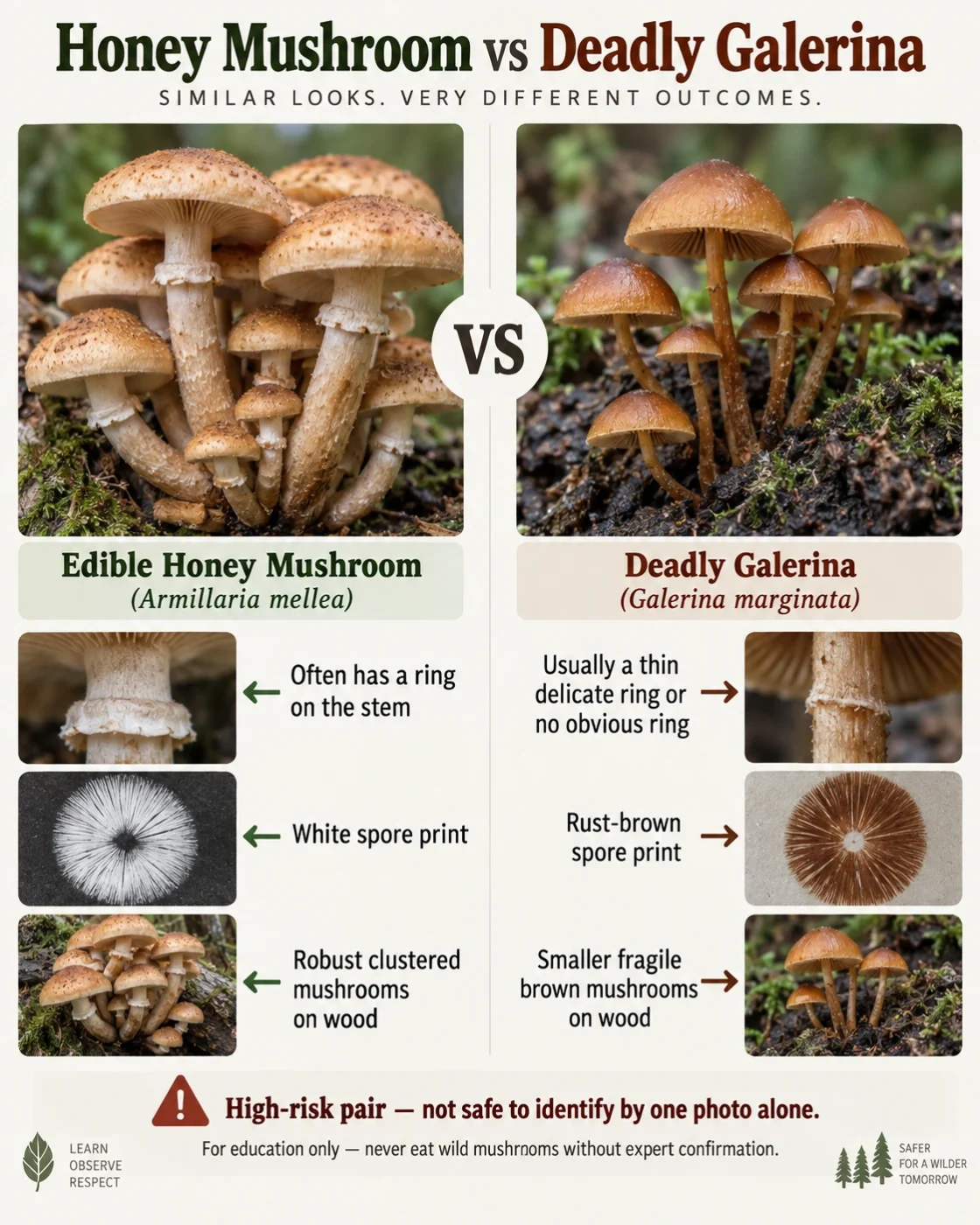
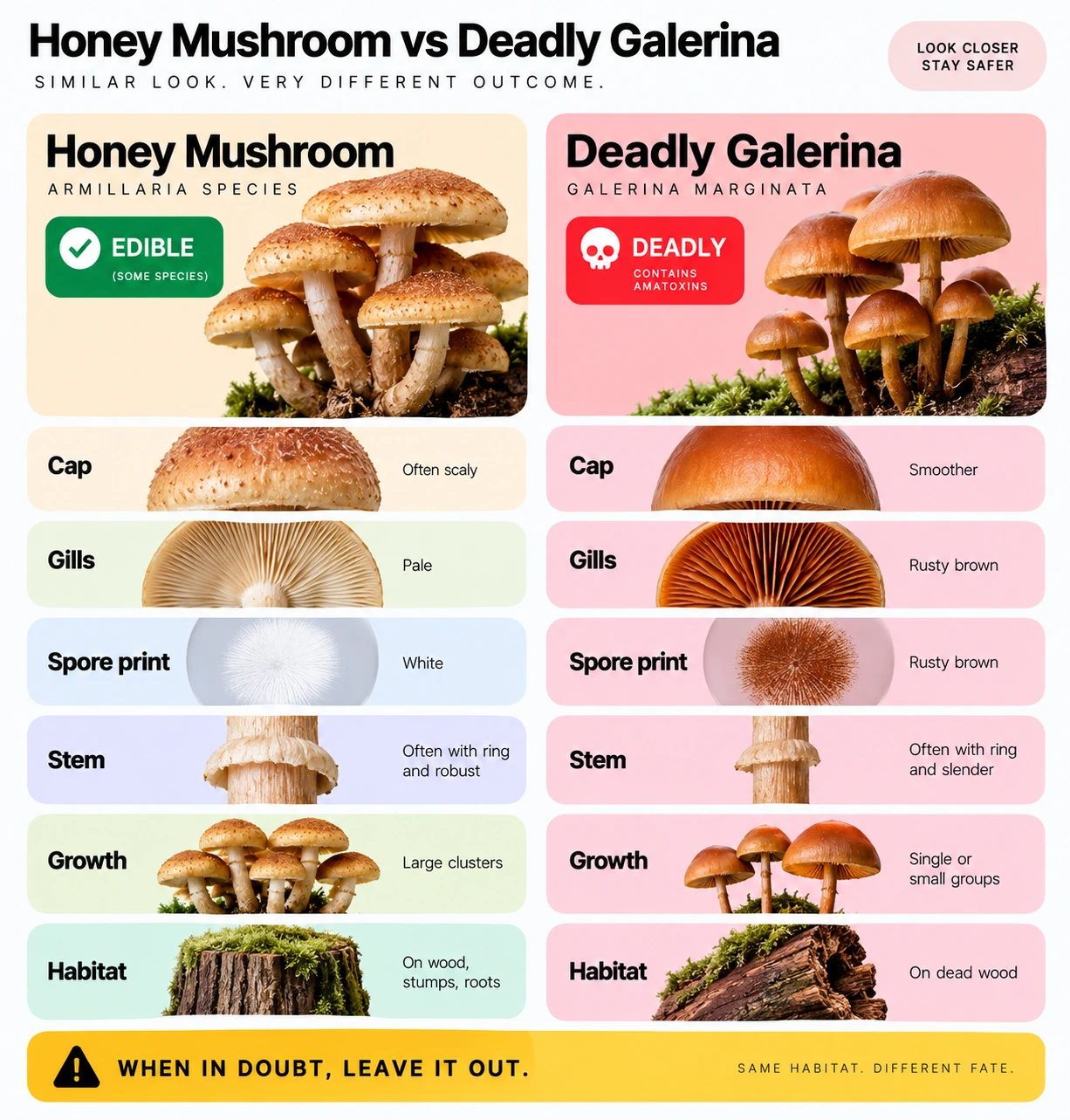
    Feature Honey Mushroom Deadly Galerina
    Main group Armillaria species Galerina marginata
    Cap Honey-brown to tan, often scaly Yellow-brown to reddish brown
    Gills Pale, usually cream to whitish Pale when young, rusty brown with age
    Spore print White Rusty brown
    Stem Usually robust Usually slender
    Ring Often present in ringed species May be present, often fragile
    Growth Often large dense clusters Single, scattered, or small clusters
    Habitat Wood, roots, stumps, buried wood Dead and decaying wood
    Toxicity Some species traditionally eaten after proper ID and preparation Deadly poisonous
    Main danger Confusion with toxic wood-growing mushrooms Amatoxins

    What Do Honey Mushrooms Look Like?

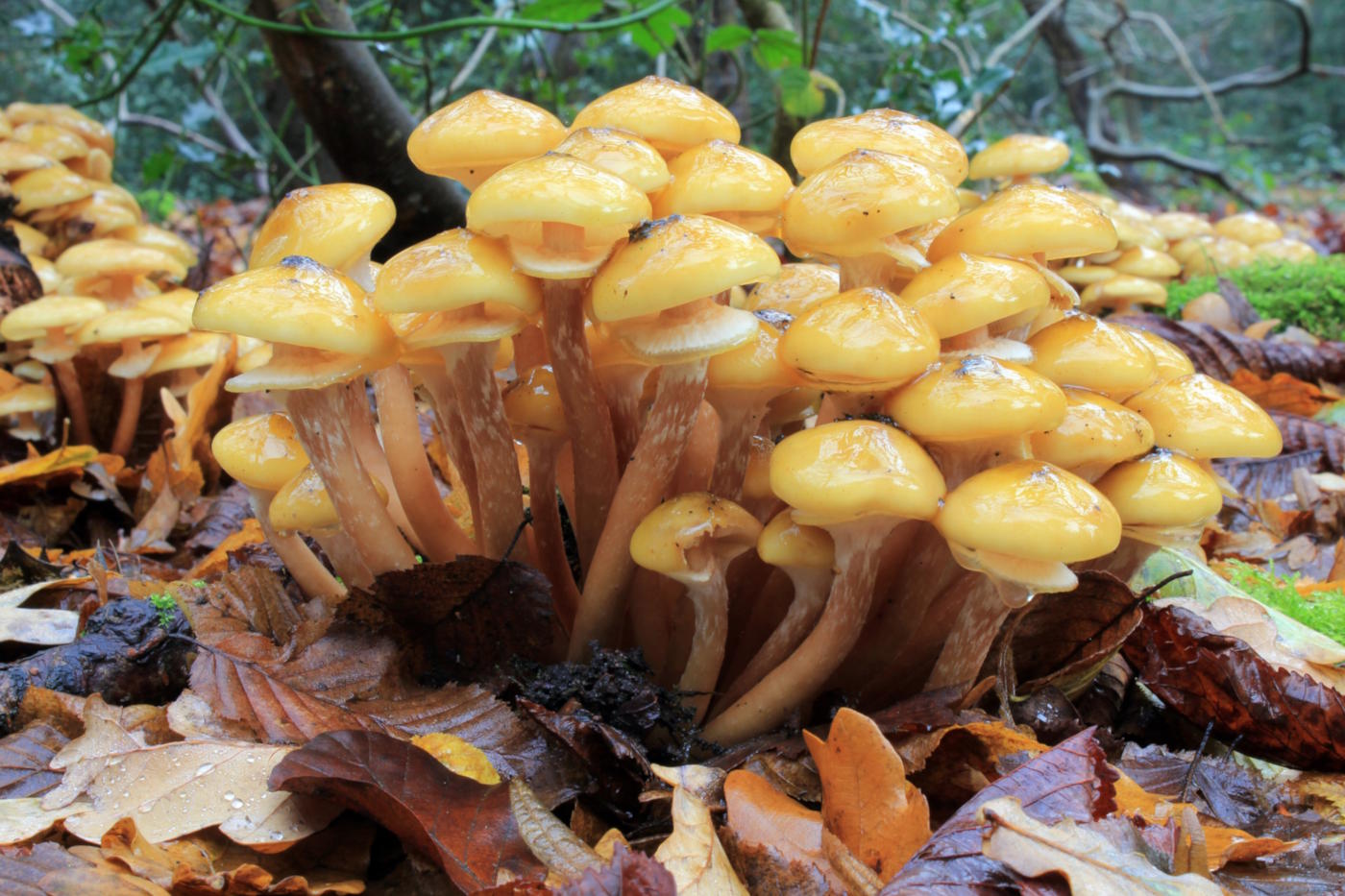
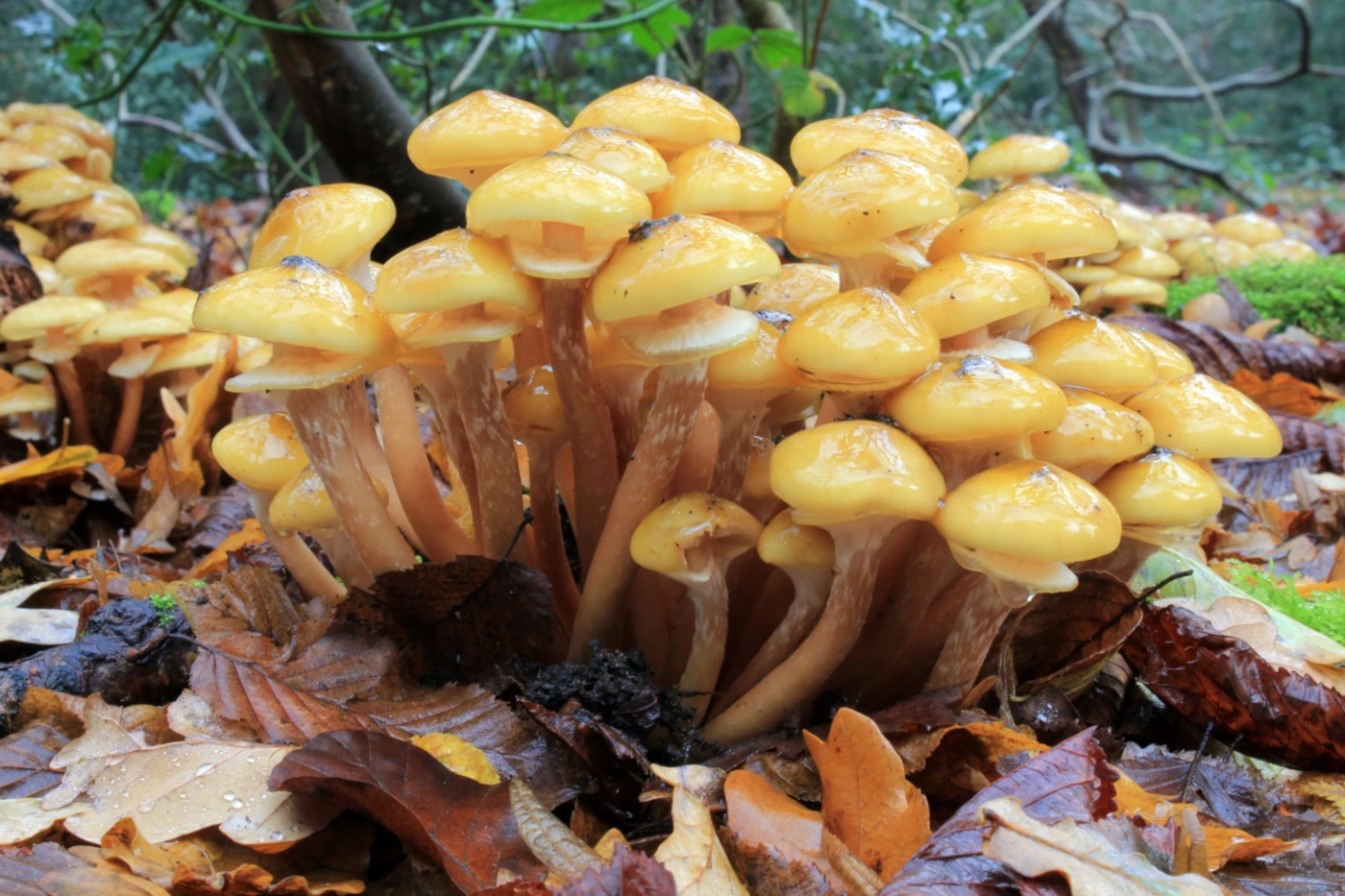
    Honey mushrooms belong to the genus Armillaria, which includes several closely related species. Their caps are commonly honey-yellow, tan, brown, or reddish brown and may carry small darker scales, especially when young.

    Many species grow in dense clusters around stumps, tree bases, buried roots, or weakened trees. Their stems are usually more substantial than those of Deadly Galerina and often appear pale above and darker toward the base.

    Some Armillaria species have a distinct ring around the upper stem, while others do not. This is one reason the phrase “Honey Mushroom” refers to a group rather than one simple visual form.

    What Does Deadly Galerina Look Like?
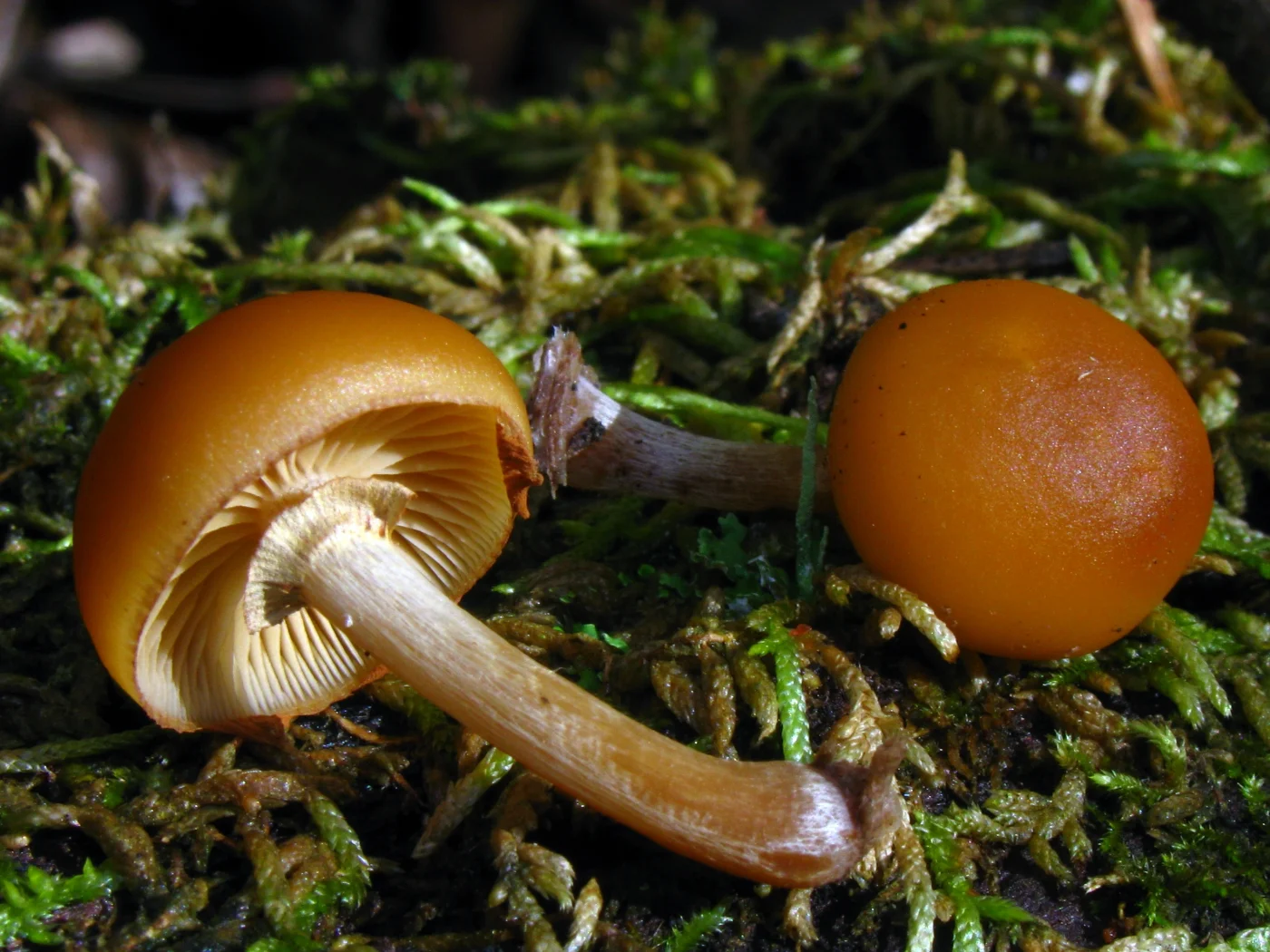
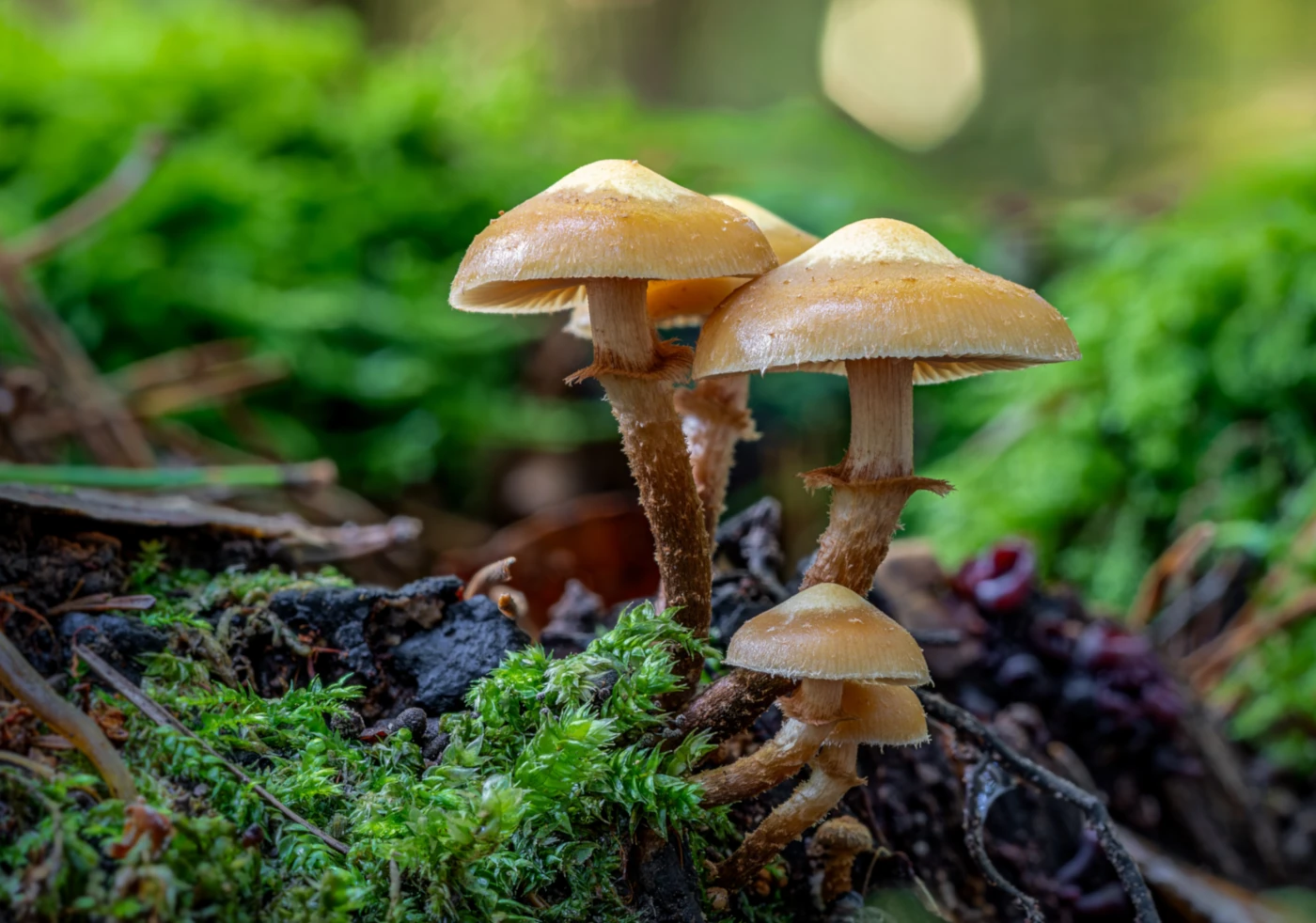
    Galerina marginata is usually smaller and more delicate. The cap can range from honey-brown and yellow-brown to cinnamon or reddish brown, and it often changes color as it dries.

    The gills may begin pale but become rusty brown as the spores mature. The stem is slender, fibrous, and may show a fragile ring or ring zone.

    Because the ring can be damaged or disappear, its absence does not rule out Galerina. This is an important safety point.

    Cap Differences

    Cap color overlaps too much to be reliable on its own. Both Honey Mushrooms and Deadly Galerina can be brown, tan, or honey-colored.

    Honey Mushroom caps are often broader and more robust and may show small scales. Deadly Galerina caps are usually smoother, thinner, and more hygrophanous, meaning the color can change noticeably as the cap loses moisture.

    A wet Galerina cap may look darker and richer brown, then fade toward tan as it dries.

    Gill Color

    Gill color is much more useful than cap color.

    Honey Mushroom gills are generally pale, cream, or whitish and usually remain relatively light. Deadly Galerina gills may start pale but gradually become rusty brown as the spores mature.

    This change is especially important in older specimens. A small brown wood-growing mushroom with clearly rust-colored mature gills deserves immediate caution.

    Spore Print

    Spore print is one of the strongest practical differences between the two groups.

    Honey Mushrooms typically produce a white spore print, while Galerina marginata produces a rusty-brown spore print.

    This distinction can be very helpful when several other features overlap. However, spore print should still be treated as one part of the identification rather than as a complete safety test.

    Stem Structure

    Honey Mushroom stems are usually relatively thick and tough. In dense clusters, several stems may arise closely together from the same woody base.

    Deadly Galerina stems are generally thinner, more fragile, and more fibrous. The lower stem may appear darker than the upper portion.

    A robust clustered stem structure favors Armillaria, while a delicate slender structure fits Galerina better.

    The Ring

    The ring is a useful feature, but it is not enough by itself.

    Many ringed Honey Mushrooms have a noticeable pale ring around the upper stem. Some species in the Honey Mushroom group, however, are ringless.

    Deadly Galerina may also have a ring, but it is often thinner, more fragile, and less persistent. Older specimens may show only a ring zone rather than a clear skirt-like structure.

    This is why the rule “ring means Honey Mushroom” is unsafe.

    Growth Pattern

    Honey Mushrooms often grow in large, dense clusters, sometimes with dozens of fruit bodies packed together around a stump or tree base.

    Deadly Galerina can also grow in groups, but the clusters are often smaller and more scattered. It may also occur singly.

    Growth pattern is useful as supporting evidence, but there is too much overlap to use it alone.

    Where Do Honey Mushrooms Grow?

    Honey Mushrooms are associated with wood, roots, and trees. They may grow around living trees, dead trees, stumps, buried roots, and decaying wood.

    Some species act as pathogens on living trees, while others behave more as decomposers. Fruiting bodies often emerge at the tree base or from ground where buried roots are present.

    This can make them appear to grow from soil even when the fungus is actually connected to woody material underground.

    Where Does Deadly Galerina Grow?

    Galerina marginata grows on dead and decaying wood. It is commonly found on logs, stumps, fallen branches, and buried woody debris.

    It can occur on both conifer and hardwood substrates, depending on region and local conditions.

    A brown mushroom growing from wood should never automatically be assumed to be a Honey Mushroom, even if nearby specimens look similar.

    Can They Grow on the Same Log?

    Yes. This is one of the most important safety points.

    Different fungal species can fruit from the same stump, log, or root system. A correctly identified edible cluster in one part of the substrate does not guarantee that every nearby brown mushroom belongs to the same species.

    Each group should be checked individually.

    Why Deadly Galerina Is So Dangerous

    Galerina marginata contains amatoxins capable of causing severe liver damage. Poisoning can be fatal.

    One of the most dangerous features is the delayed onset of symptoms. A person may feel normal for many hours after eating the mushroom.

    Severe vomiting, diarrhea, and abdominal pain may then appear, sometimes followed by a temporary period of improvement while liver injury continues.

    Suspected Galerina ingestion is a medical emergency.

    Honey Mushroom Edibility

    Several Armillaria species have a long history of culinary use in some regions, but Honey Mushrooms require confident identification and proper preparation. Some people experience gastrointestinal upset even from correctly identified specimens.

    The larger issue for beginners is the risk of confusion with poisonous wood-growing mushrooms. Because Deadly Galerina can occupy the same habitat, uncertain brown clusters should not be treated casually as food.

    Regional species differences also matter, because the name “Honey Mushroom” covers multiple Armillaria species.

    Honey Mushroom vs Deadly Galerina at a Glance

    Feature Honey Mushroom Deadly Galerina
    Spore print White Rusty brown
    Mature gills Pale Rusty brown
    Stem Robust Slender
    Ring Often strong in ringed species Often fragile or faint
    Cluster size Often large and dense Often smaller or scattered
    Cap Often scaly Often smoother
    Substrate Wood and roots Dead wood
    Risk Edibility varies by species Deadly poisonous

    The spore print and mature gill color are among the most useful differences, but safe identification should combine several features.

    Honey Mushroom vs Kuehneromyces mutabilis

    Kuehneromyces mutabilis, or Sheathed Woodtuft, is another edible brown mushroom that grows on wood and can resemble both Honey Mushrooms and Deadly Galerina.

    It often has a two-toned hygrophanous cap and a more scaly lower stem beneath the ring. However, it also produces brown spores, so spore print alone does not separate it from Galerina.

    This is a more advanced identification pair and demonstrates why small brown wood-growing mushrooms require caution.

    Honey Mushroom vs Jack-o’-Lantern

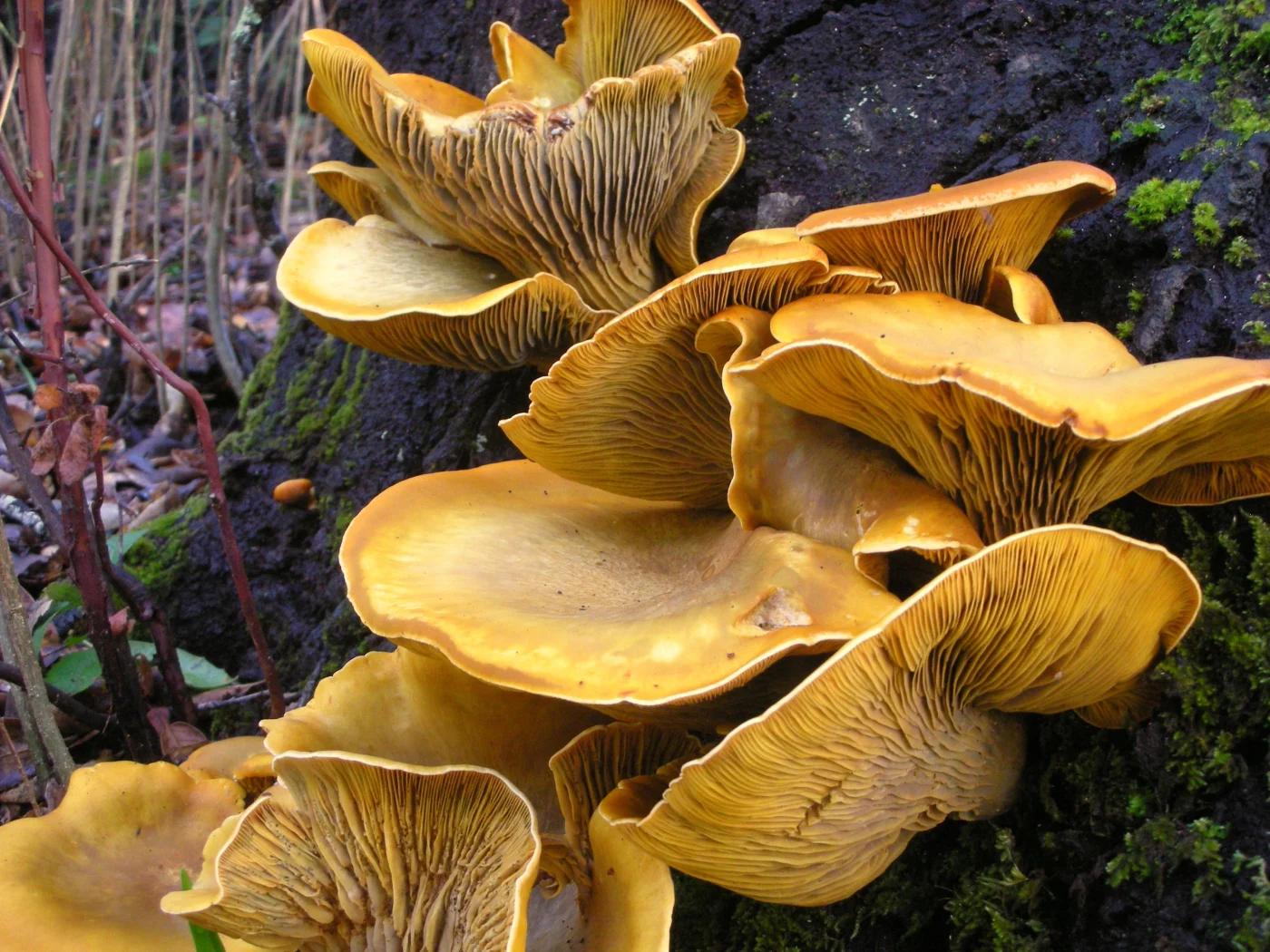
    Jack-o’-Lantern mushrooms can also grow in dense clusters around stumps and buried roots.

    They are usually brighter orange and have strongly colored true gills. Honey Mushrooms are generally paler and less vividly orange.

    Jack-o’-Lantern mushrooms are poisonous and can cause severe gastrointestinal symptoms, making clustered wood-growing mushrooms a group where careful identification is especially important.

    How to Tell Them Apart Step by Step

    Start with the gills and spore print. Pale gills with a white spore print strongly support Honey Mushroom, while rusty mature gills with a rusty-brown spore print strongly support Galerina.

    Then examine the stem. A thick, robust stem and large dense cluster favor Armillaria, while a slender fibrous stem fits Galerina better.

    Finally, check the cap texture, ring, substrate, and growth pattern. None of these should override the spore and gill evidence.

    How to Make a Spore Print

    Choose a mature cap and remove the stem. Place the cap gill-side down on a surface where both pale and dark spores will be visible, or use half white and half dark paper.

    Cover the cap to reduce air movement and leave it long enough for spores to deposit. Honey Mushroom spores should appear white, while Deadly Galerina spores appear rusty brown.

    A spore print is useful, but never use it as the only test.

    How to Photograph Honey Mushrooms for Identification

    Photograph the entire cluster, then take close-ups of the cap, gills, ring, and complete stem.

    Include both young and mature specimens if possible, because gill color and ring appearance may change with age. A wider image showing the stump, log, or root system also provides important habitat information.

    If you suspect Deadly Galerina, photograph individual specimens separately rather than assuming the whole cluster is one species.

    Can AI Tell Honey Mushroom From Deadly Galerina?

    AI can help narrow the possibilities, especially when several clear photos are available. It may recognize differences in cap texture, stem proportions, and clustering.

    However, some of the most useful characteristics are difficult or impossible to judge from one photograph. Spore print, subtle gill color, microscopic features, and hidden substrate details may be missing.

    AI should therefore be treated as an identification aid rather than a final safety decision.

    Common Identification Mistakes

    A common mistake is assuming that clustered brown mushrooms are automatically Honey Mushrooms. Deadly Galerina and several other genera can also grow in groups on wood.

    Another mistake is relying too heavily on the ring. Both groups may show a ring, and rings can disappear with age.

    A third mistake is ignoring the possibility of mixed species on the same stump. This is one of the most dangerous assumptions when collecting wood-growing mushrooms.

    Frequently Asked Questions

    What is the easiest way to tell Honey Mushroom from Deadly Galerina?

    Spore print is one of the most useful differences. Honey Mushrooms usually have white spores, while Deadly Galerina has rusty-brown spores.

    Does Deadly Galerina always have a ring?

    No. The ring may be fragile, damaged, or almost absent in older specimens.

    Are Honey Mushroom gills brown?

    They are generally pale, cream, or whitish rather than rusty brown.

    Can Deadly Galerina grow in clusters?

    Yes. It may grow singly, scattered, or in groups, so clustering does not rule it out.

    Can Honey Mushrooms and Galerina grow on the same stump?

    Yes. Different fungal species can share the same woody substrate.

    What color is the Deadly Galerina spore print?

    Rusty brown.

    What color is the Honey Mushroom spore print?

    Typically white.

    Are all Honey Mushrooms edible?

    The group contains several species, and culinary use varies by region. Correct identification and preparation are essential, and some people experience gastrointestinal reactions.

    Is Deadly Galerina really deadly?

    Yes. It contains amatoxins capable of causing severe and potentially fatal liver poisoning.

    Can you identify them from cap color alone?

    No. Brown, tan, and honey-colored caps occur in both groups and in many unrelated mushrooms.

    Final Identification Notes

    Honey Mushrooms and Deadly Galerina can share the same general brown coloration, wood-growing habitat, and even a stem ring. These similarities make superficial identification unsafe.

    The strongest field differences are usually white spores and pale gills in Honey Mushrooms versus rusty-brown spores and rusty mature gills in Deadly Galerina. Stem robustness, cluster size, and cap texture provide additional support.

    Never assume that every brown mushroom on the same stump belongs to one species. If there is any uncertainty between Armillaria and Galerina marginata, do not eat the mushrooms.
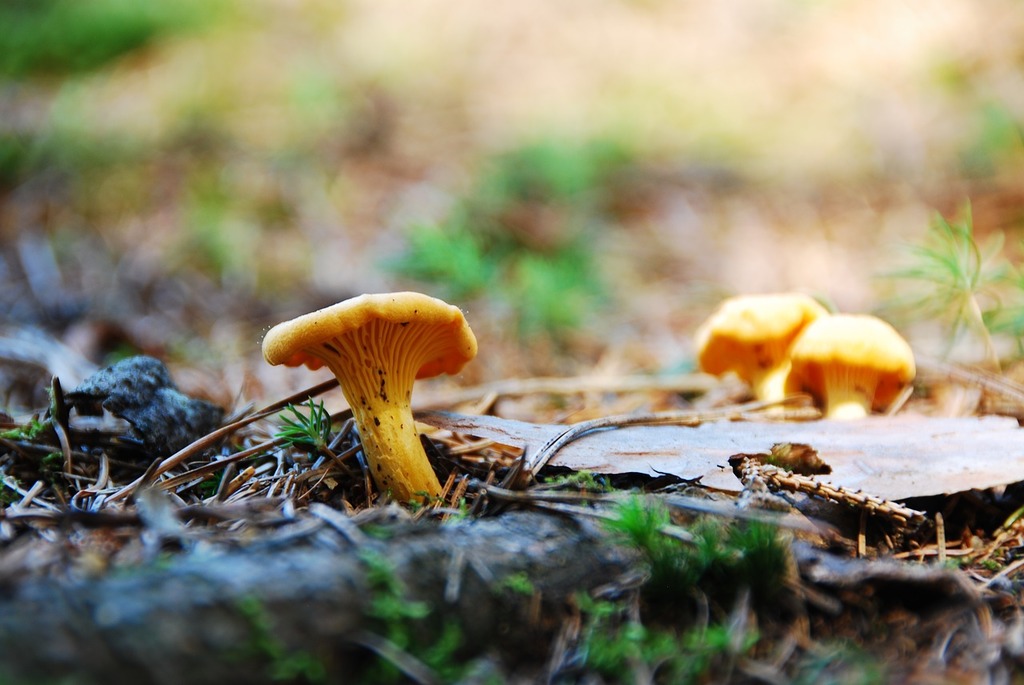
  • Orange Mushroom Identification: Common Species, Edible and Poisonous

    Orange Mushroom Identification: Common Species, Edible and Poisonous

    Orange mushrooms are among the most eye-catching fungi in forests, lawns and woodland edges, but color alone is a poor identification feature. Bright orange caps can belong to edible chanterelles, poisonous Jack-o’-Lantern mushrooms, toxic Amanitas, milkcaps, waxcaps, boletes and many other unrelated groups.

    The safest way to identify an orange mushroom is to look beyond the cap. The underside, stem, bruising reactions, latex, habitat, substrate and growth pattern usually tell you far more than color does.

    ⚠️ Important: This guide is for identification and education only. Never eat a wild mushroom based solely on a photograph, AI result, or cap color.

    Quick Orange Mushroom Identification Guide

    Species Typical appearance Habitat Risk
    Cantharellus cibarius group Golden-orange, blunt ridges Forest soil Edible when correctly identified
    Omphalotus species Bright orange, true gills Wood and buried roots Poisonous
    Amanita muscaria Red-orange cap, white warts Near trees Poisonous
    Lactarius deliciosus group Orange cap, orange latex Near pines Edible when correctly identified
    Hygrocybe species Bright orange waxy caps Grassland Usually not food species
    Laetiporus sulphureus Orange-yellow shelves Wood Edible when young and correctly identified
    Aleuria aurantia Bright orange cup fungus Bare soil Generally not collected as food
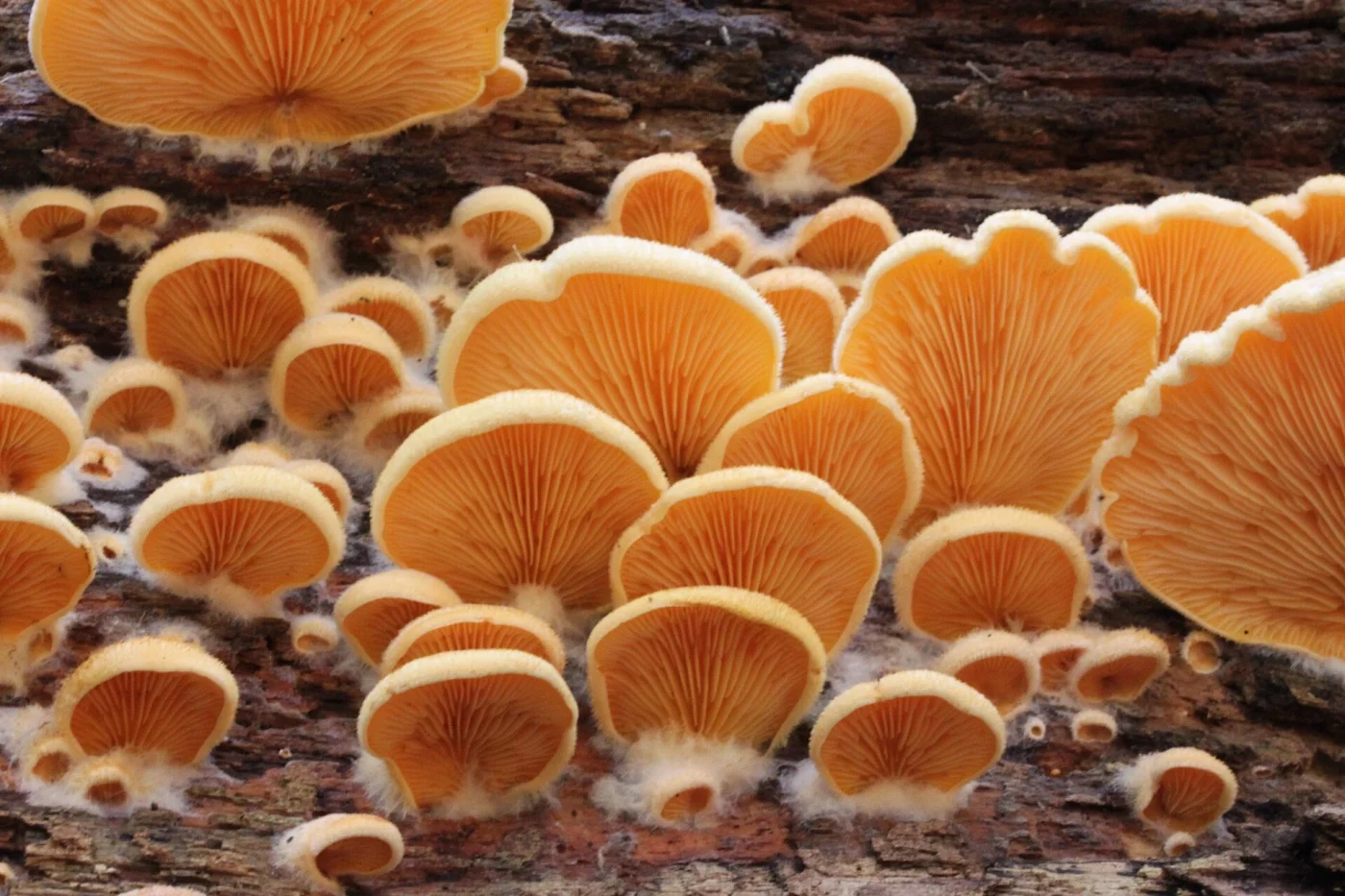
    Phyllotopsis nidulans Orange shelf-like cap Dead wood Not recommended
    Cortinarius species Orange-brown cap, rusty spores Woodland soil Some dangerously poisonous
    Orange boletes Orange-red cap or pores Near trees Edibility varies by species

    First: Look Under the Cap

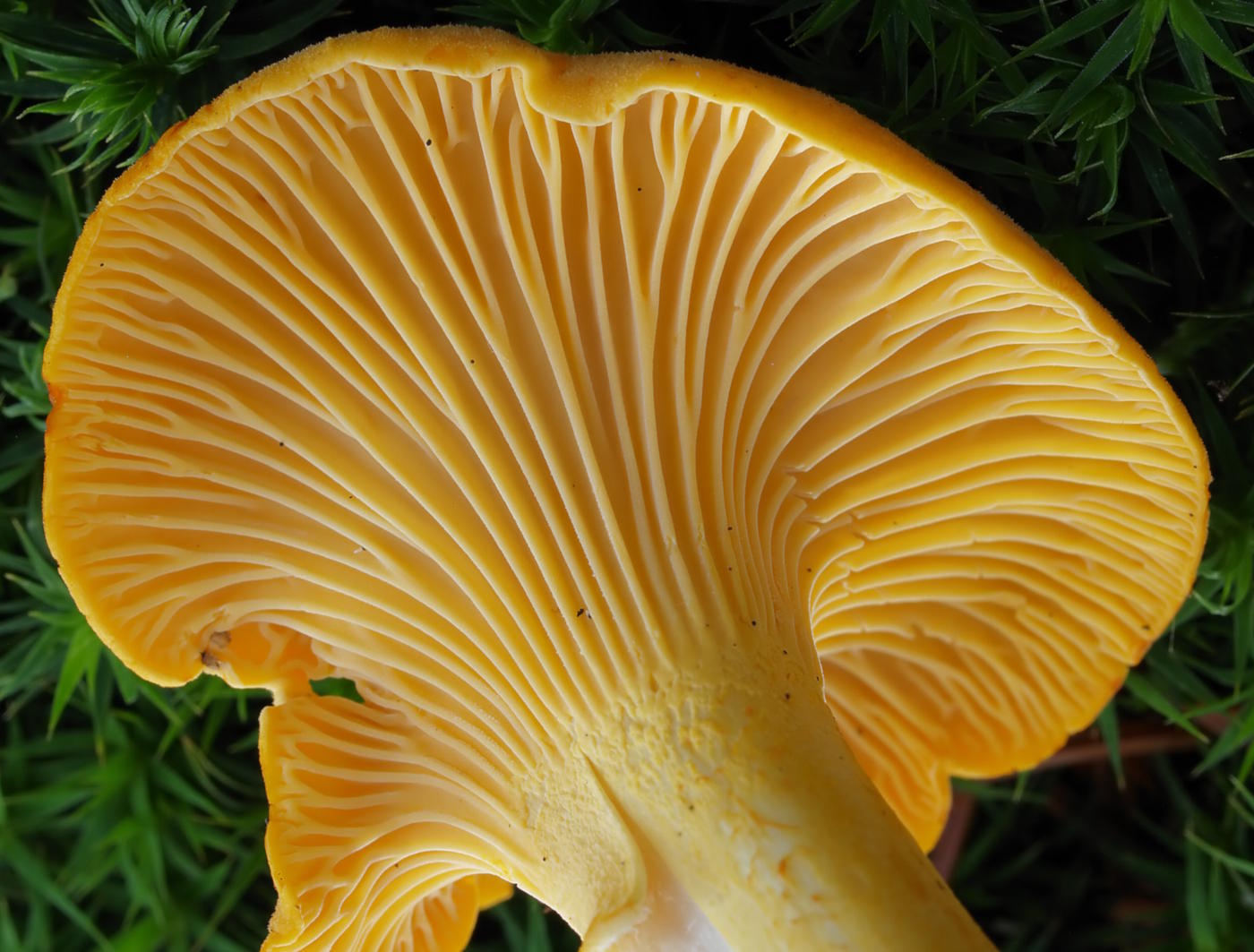
    The underside immediately separates many orange mushrooms into different groups. If you see blunt folds or ridges rather than thin blade-like gills, a chanterelle becomes more likely. True gills suggest a different group, while pores indicate a bolete or polypore.

    Some orange mushrooms have no classic underside at all. Shelf fungi such as Chicken of the Woods have pores, while cup fungi like Orange Peel Fungus form an open cup-shaped fruit body without a cap-and-stem structure.

    Before trying to match color, determine the basic mushroom type.

    1. Chanterelles — Cantharellus Species

    • Scientific group: Cantharellus species
    • Common name: Chanterelles

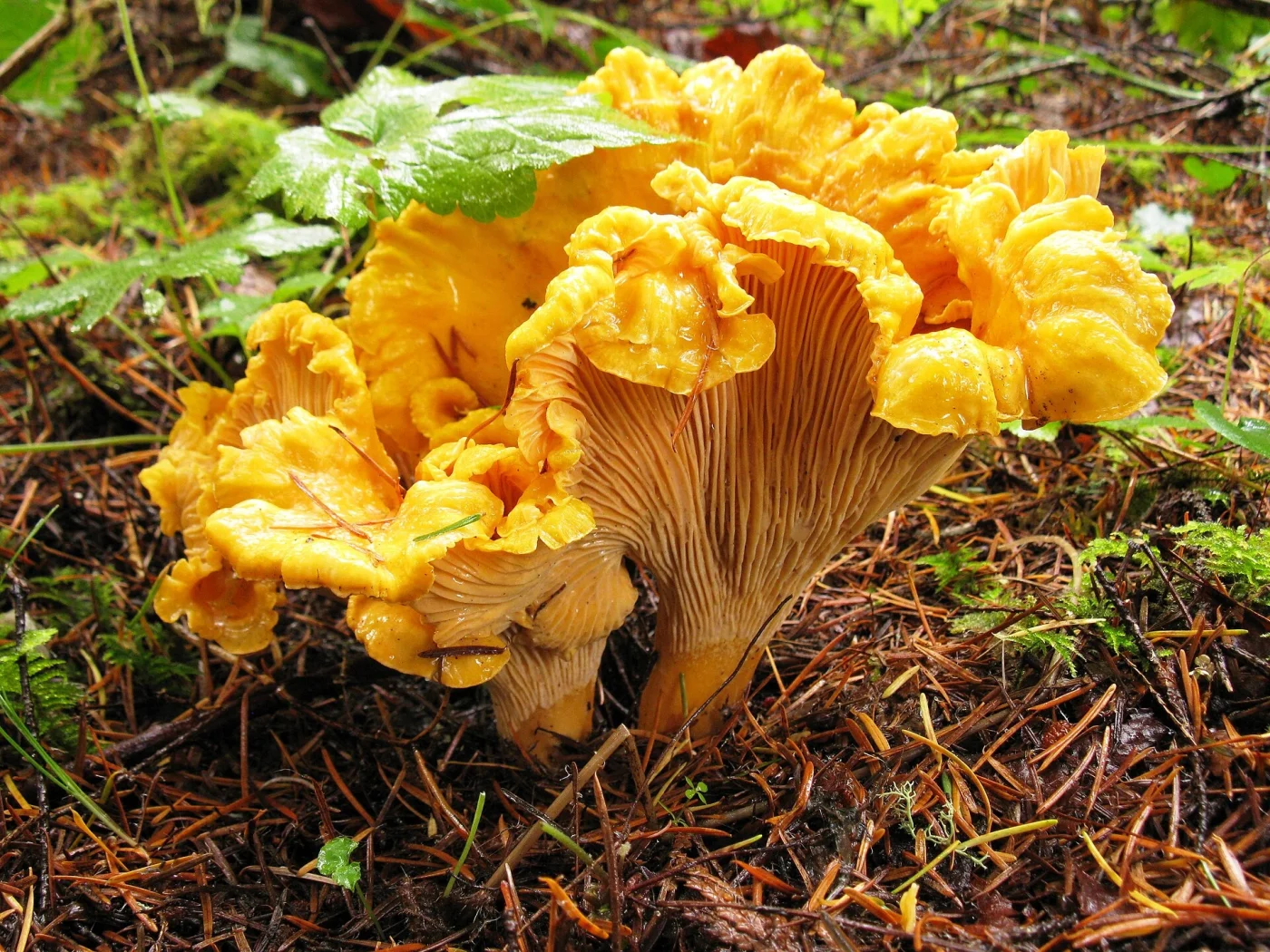
    Chanterelles are among the best-known edible orange mushrooms. Their caps range from yellow to golden-orange and often become irregular or funnel-shaped with age.
    The underside does not have true gills. Instead, chanterelles have blunt, forked ridges that run down the stem.

    This structure is one of the most important identification clues.

    Habitat

    Chanterelles grow from soil in association with tree roots. They are typically found in forests and woodland edges rather than directly from stumps or logs.

    Tree partners vary by region, but hardwoods and conifers can both support different chanterelle species.

    Main Look-Alike: Jack-o’-Lantern

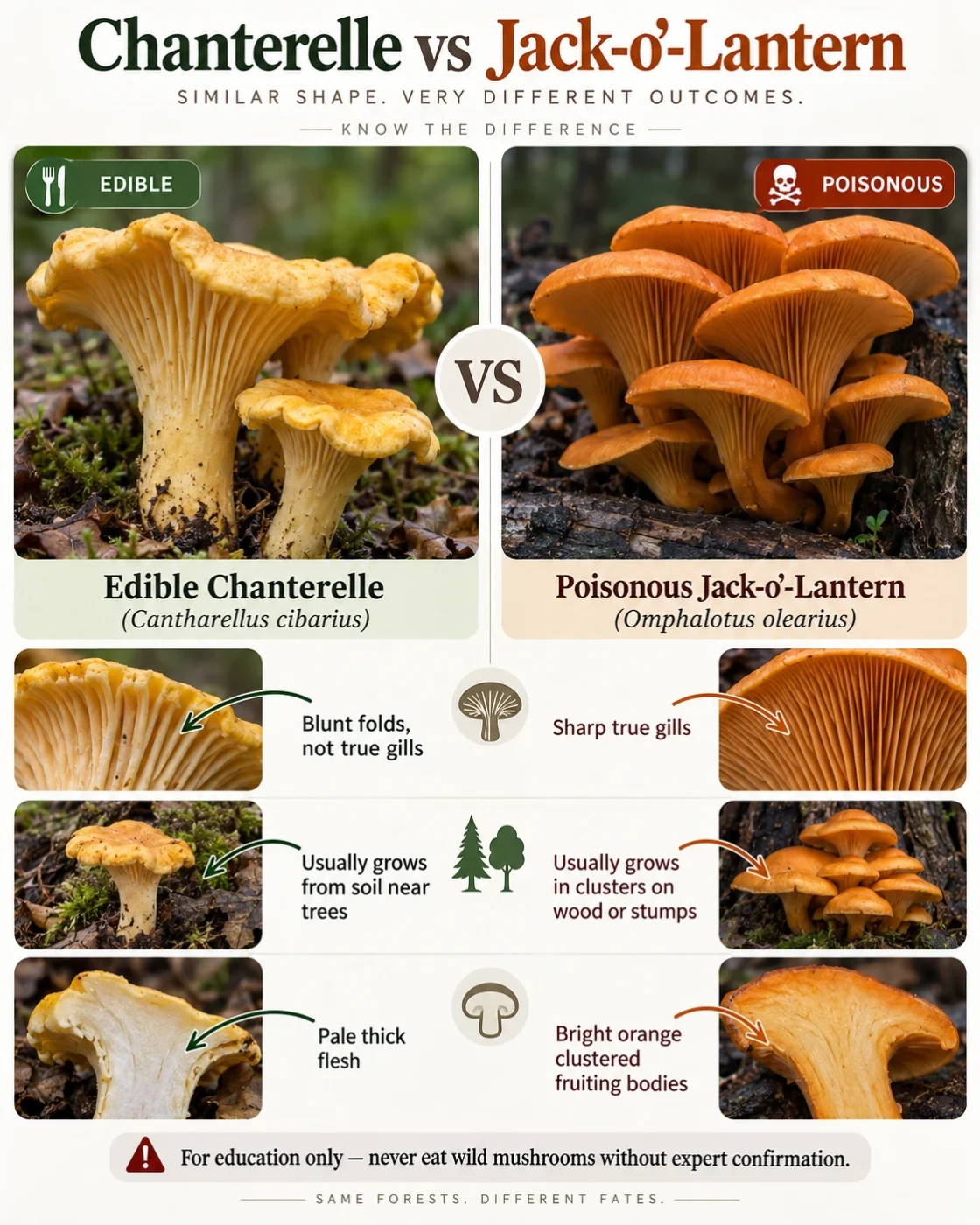
    Jack-o’-Lantern mushrooms are brighter orange and have true thin gills. They also commonly grow from wood, stumps or buried roots and often form dense clusters.

    The difference between ridges and true gills is far more useful than cap color.

    2. Omphalotus Species — Jack-o’-Lantern Mushrooms

    • Scientific group: Omphalotus species
    • Common name: Jack-o’-Lantern Mushroom

    Jack-o’-Lantern mushrooms are among the most important poisonous orange mushrooms to recognize. They form orange to deep orange clusters and often grow on decaying wood or from buried roots.

    The gills are true, thin, blade-like and run down the stem. The entire mushroom can be orange, including the stem and gills.

    Why They Are Dangerous

    Jack-o’-Lantern mushrooms can cause severe gastrointestinal poisoning. Symptoms may include vomiting, diarrhea and significant abdominal pain.

    Their resemblance to chanterelles makes them especially important for beginners.

    Main Difference From Chanterelles

    Chanterelles usually grow from soil and have blunt folds. Jack-o’-Lantern mushrooms usually grow from wood or roots and have sharp true gills.

    Growth pattern also helps. Chanterelles are often scattered or loosely grouped, while Jack-o’-Lantern mushrooms frequently appear in dense clusters.

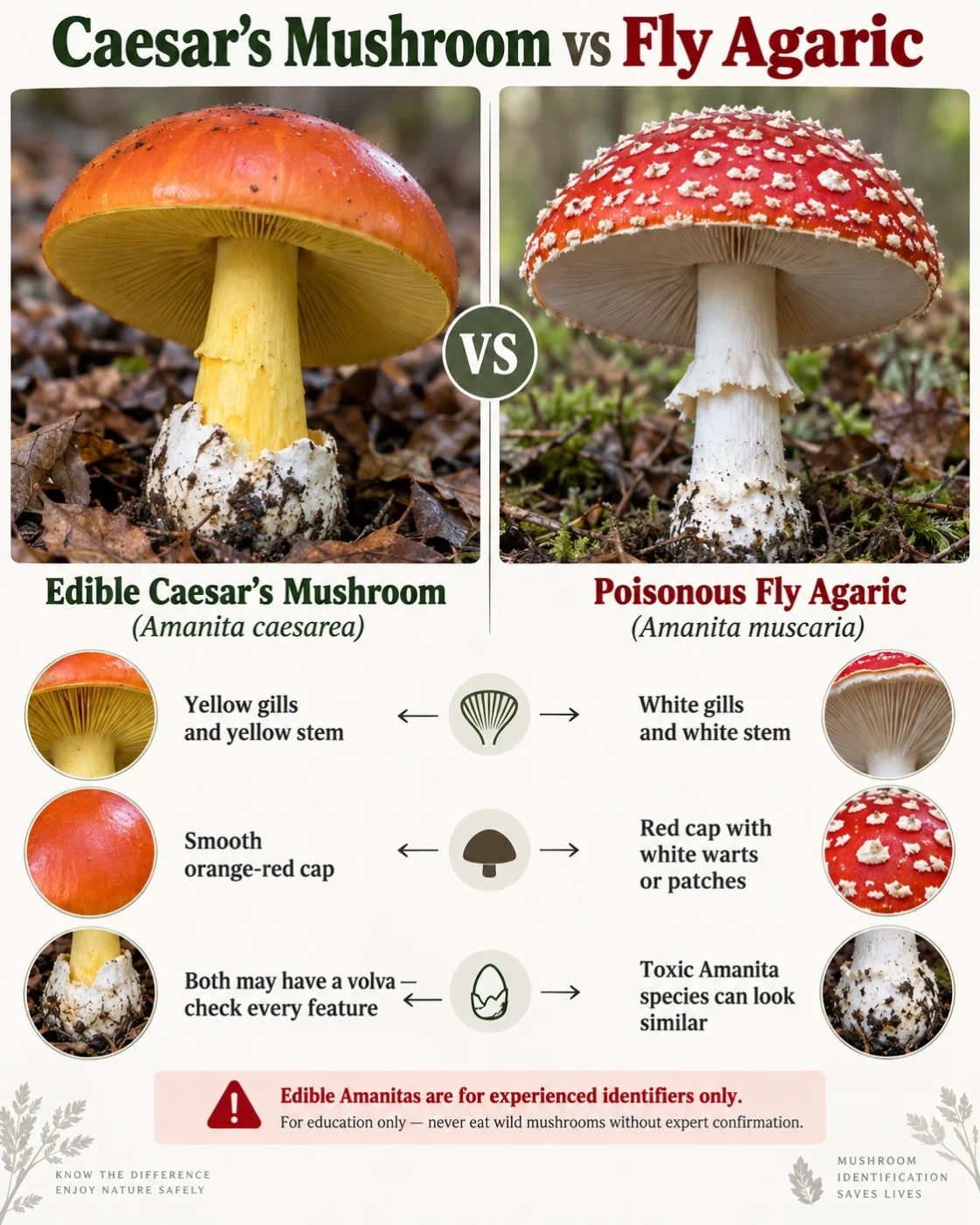
    3. Amanita muscaria — Fly Agaric

    • Scientific name: Amanita muscaria
    • Common name: Fly Agaric

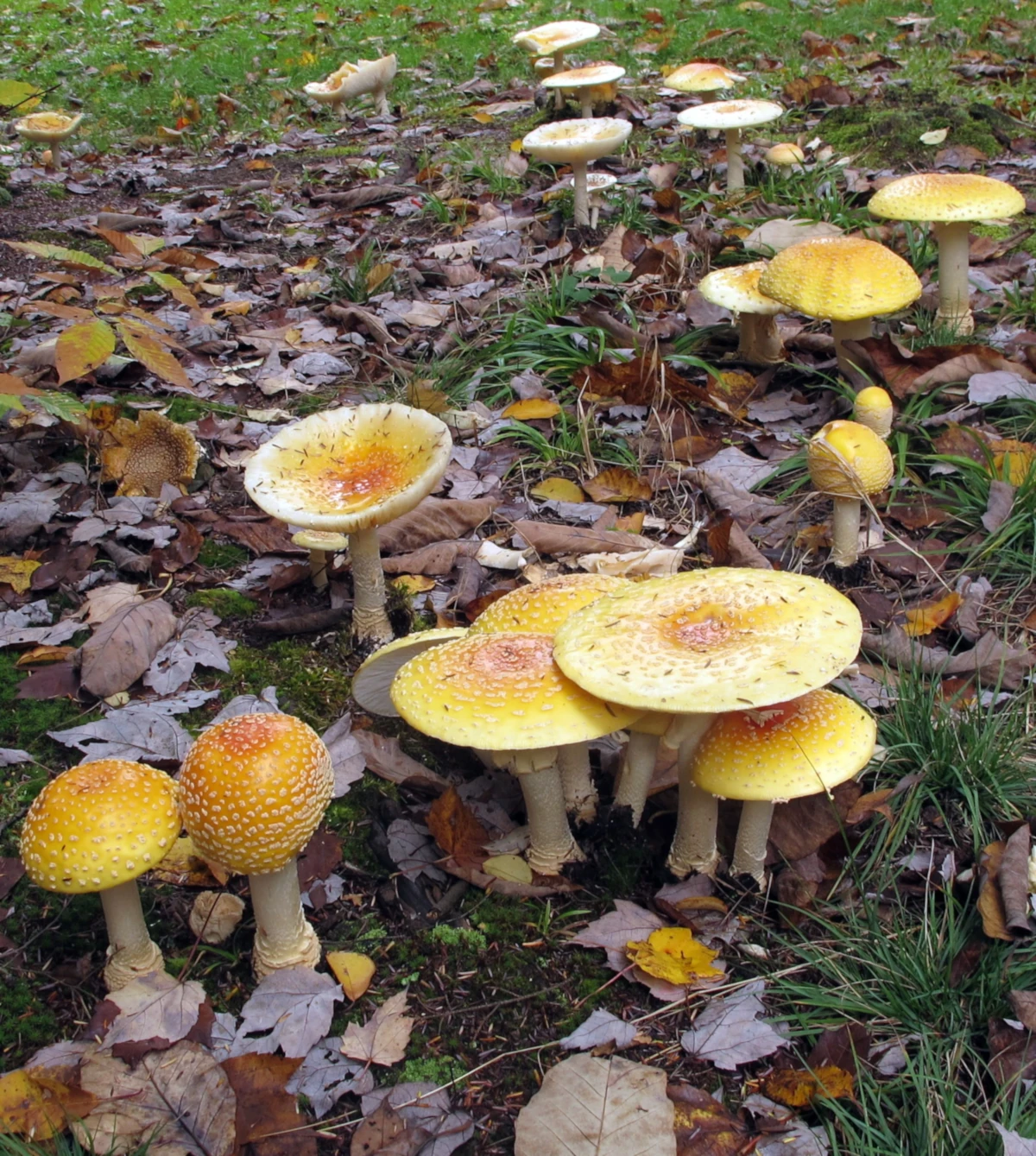
    Fly Agaric is famous for its red cap with white spots, but many specimens are orange-red rather than deep red. Rain can also wash away the white veil remnants, leaving a smooth orange cap.

    The gills are white, the stem is white and usually bears a ring, while the base is swollen with veil remnants.

    Toxicity

    Fly Agaric is poisonous and contains psychoactive compounds including muscimol and ibotenic acid. It can cause gastrointestinal and neurological symptoms.

    The orange form is especially important because a faded or rain-washed specimen may no longer look like the classic fairy-tale mushroom.

    Identification Clue

    A bright orange cap with white gills, white stem and Amanita structures at the base should never be mistaken for a chanterelle or milkcap.

    4. Lactarius deliciosus Group — Saffron Milk Caps

    • Scientific group: Lactarius deliciosus and close relatives
    • Common name: Saffron Milk Cap

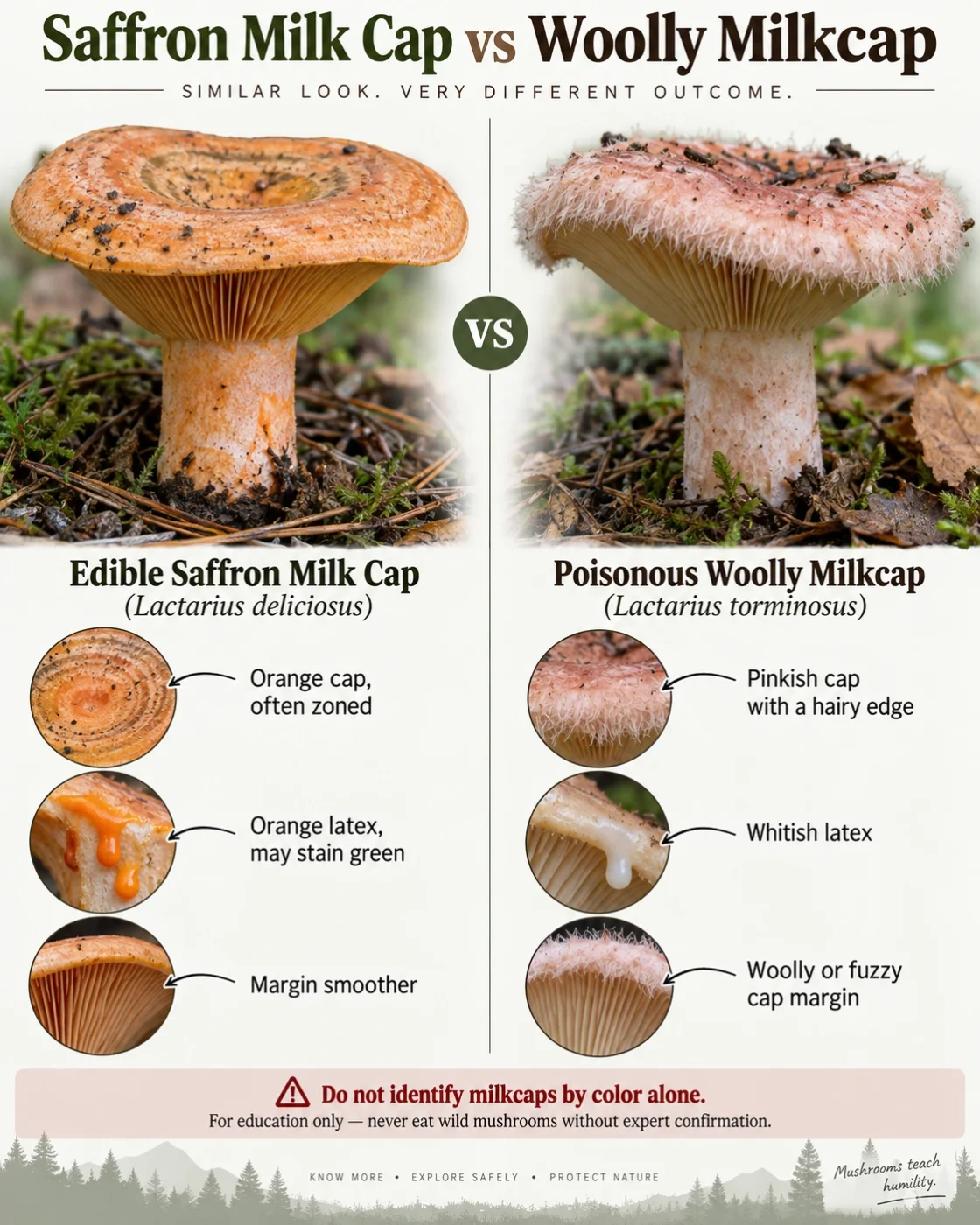
    Saffron Milk Caps are orange to carrot-colored mushrooms commonly associated with pine trees. Their caps often show concentric zones and may develop greenish stains with age or damage.

    When the gills or flesh are cut, the mushroom releases colored latex. In the classic Lactarius deliciosus group, this latex is orange or carrot-colored and may later turn greenish.

    Habitat

    These mushrooms usually grow on soil near pines and other suitable conifers. They do not normally grow from wood.

    Look-Alikes

    Other milkcaps can be pink, orange or brownish and may have different latex colors. Some are inedible or irritating, so latex color, host tree and cap texture should be checked together.

    5. Hygrocybe Species — Waxcaps

    • Scientific name: Hygrocybe Species
    • Common name: Waxcaps

    Waxcaps are small to medium grassland mushrooms that often have striking yellow, orange or red caps. Many have a waxy or slippery surface and thick, widely spaced gills.

    They are especially associated with old, nutrient-poor grasslands and can be good indicators of relatively undisturbed habitat.

    Identification

    Orange waxcaps often look very different from woodland mushrooms because they grow in open grass rather than under trees. Their caps may be conical, bell-shaped or broadly convex.

    Species-level identification can be difficult because several Hygrocybe species have similar colors and shapes.

    Edibility

    Most waxcaps are not generally collected as food. Their ecological value and identification difficulty make them better appreciated in place.

    6. Laetiporus sulphureus — Chicken of the Woods

    • Scientific name: Laetiporus sulphureus
    • Common name: Chicken of the Woods

    Chicken of the Woods forms large bright orange and yellow shelves on living or dead wood. It has no true gills; instead, the underside is covered with small pores.

    Young fruit bodies are soft and fleshy, while older brackets become dry, pale and tough.

    Habitat

    It grows directly from wood, especially hardwoods. Large clusters can cover a significant area of a trunk or stump.

    Edibility

    Young correctly identified specimens are widely regarded as edible. Older fruit bodies become much less desirable because of their fibrous texture.

    The bright color and shelf-like form make this one of the easier orange fungi to recognize, but it should still be distinguished from other bracket fungi.

    7. Aleuria aurantia — Orange Peel Fungus

    • Scientific name: Aleuria aurantia
    • Common name: Orange Peel Fungus

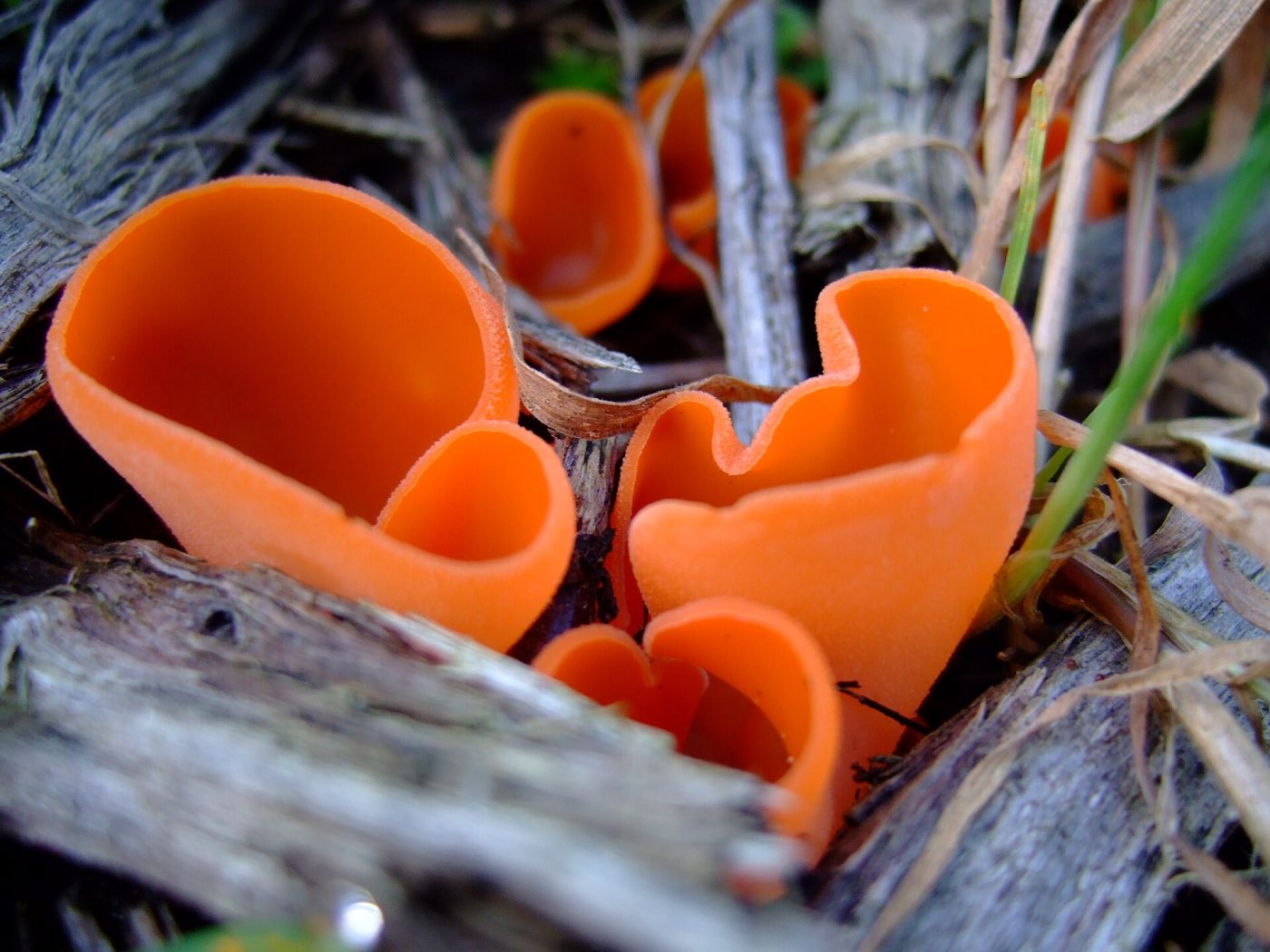
    This unusual fungus looks more like a piece of orange peel than a conventional mushroom. It forms vivid orange cups or irregular discs on bare soil.

    The inner surface is smooth and intensely orange, while the outside is usually paler.

    Habitat

    Orange Peel Fungus often appears on disturbed soil, paths, road banks and recently exposed ground. It can grow in groups and sometimes covers surprisingly large patches.

    Identification

    Its open cup shape separates it quickly from gilled orange mushrooms. There is no conventional stem-and-cap structure.

    8. Phyllotopsis nidulans — Orange Oyster-Like Mushroom

    • Scientific name: Phyllotopsis nidulans

    This orange wood-growing mushroom has a fan-shaped or shelf-like cap and can resemble a small Oyster Mushroom.

    The cap surface is often fuzzy or hairy, while the gills are orange to yellow-orange. It grows directly from dead wood.

    Why It Can Be Confusing

    From a distance, it may resemble an orange Pleurotus or another shelf fungus. Closer examination reveals its stronger coloration and different texture.

    It is generally not considered a desirable edible species.

    9. Orange Cortinarius Species

    • Genus: Cortinarius

    The genus Cortinarius contains many orange, rust-colored and orange-brown woodland mushrooms. Young specimens may show a fine cobweb-like veil called a cortina between the cap and stem.

    As spores mature, rusty-brown material often accumulates on the stem where the veil was attached.

    Why They Matter

    Some Cortinarius species contain orellanine and can cause severe kidney damage. Others are harmless or of uncertain edibility.

    Because the genus is difficult to identify and includes dangerous species, orange Cortinarius-like mushrooms should not be collected for food casually.

    Identification Clue

    Rusty spores combined with a cortina or rusty veil remnants on the stem strongly suggest Cortinarius.

    10. Orange Boletes

    Several boletes can have orange, red-orange or orange-brown caps. Others may have pale caps but strongly orange or red pore surfaces.

    Boletes have pores rather than gills, and many species show bruising reactions when cut or pressed.

    Edibility Varies

    Some orange-capped boletes are edible, while others can cause gastrointestinal illness. There is no reliable rule that says orange or red boletes are automatically poisonous or edible.

    Identification should consider pore color, stem pattern, bruising, host trees and geography.

    Orange Mushrooms Growing on Wood

    Orange mushrooms on wood include Jack-o’-Lantern mushrooms, Chicken of the Woods, Phyllotopsis and several other shelf fungi.

    The first question is whether the mushroom has true gills, pores or another surface underneath. This immediately separates many possible groups.

    Jack-o’-Lantern mushrooms have true gills, Chicken of the Woods has pores, and Phyllotopsis has orange gills and a shelf-like growth habit.

    Orange Mushrooms Growing on the Ground

    Ground-growing orange mushrooms include chanterelles, Saffron Milk Caps, waxcaps, Fly Agaric and various Cortinarius species.

    Nearby trees become especially important here. Chanterelles, Amanitas, milkcaps and Cortinarius are all mycorrhizal and can be strongly associated with particular hosts.

    Grassland orange mushrooms point toward a different set of possibilities, especially waxcaps.

    Orange Mushrooms With Gills

    True gills occur in many unrelated orange mushrooms. Jack-o’-Lantern mushrooms, milkcaps, Fly Agaric and some Cortinarius all have gills, but the details differ.

    Gill color, attachment and texture matter. Jack-o’-Lantern gills are orange and run down the stem, while Fly Agaric gills are white.

    Milkcap gills release latex when damaged, and Cortinarius gills often mature toward rusty brown.

    Orange Mushrooms Without Gills

    Chanterelles have blunt ridges rather than true gills. Chicken of the Woods has pores, while Orange Peel Fungus lacks a conventional cap underside entirely.

    This is why “orange mushroom” is far too broad to be useful on its own. The reproductive surface is often the fastest way to narrow the identification.

    Chanterelle vs Jack-o’-Lantern

    Feature Chanterelle Jack-o’-Lantern
    Underside Blunt folds or ridges True thin gills
    Growth Usually soil Wood or buried roots
    Pattern Often scattered Often dense clusters
    Flesh Pale and firm Orange throughout
    Edibility Edible when correctly identified Poisonous

    This is one of the most important orange mushroom comparisons because the two can share similar overall coloration.

    Saffron Milk Cap vs Other Orange Milkcaps

    Feature Saffron Milk Cap Other orange/pink milkcaps
    Latex Orange, may turn green May be white, cream or different colors
    Cap Orange, often zoned Variable
    Staining Often greenish with age Species-dependent
    Habitat Usually near pines Depends on species
    Edibility Edible when correctly identified Varies

    Latex color and host tree are often more useful than the cap alone.

    How to Identify an Orange Mushroom Step by Step

    Begin with the underside. Determine whether the mushroom has true gills, blunt ridges, pores, teeth or a smooth cup-like surface.

    Next, check the substrate. Decide whether it is growing from soil, wood, grass or buried roots.

    Then examine the stem and any special features such as a ring, volva, latex or bruising reaction. Finally, note nearby trees and growth pattern.

    This sequence usually narrows the possibilities much more efficiently than trying to match an orange shade.

    How to Photograph an Orange Mushroom for Identification

    Take a clear image of the cap, but always include the underside. Gills, ridges and pores are often the most important structures.

    Photograph the entire stem and its base, especially if the mushroom could be an Amanita. A wider image should show whether the mushroom is growing from soil, wood or grass.

    If several specimens are present, photograph both young and mature examples because coloration and shape often change with age.

    Can AI Identify an Orange Mushroom?

    AI can often narrow down distinctive orange species such as Fly Agaric, Chicken of the Woods or chanterelles. The result becomes much more reliable when the underside and habitat are visible.

    Problems arise when the photo shows only the cap. Several unrelated orange mushrooms can look almost identical from above.

    AI should therefore be used as an identification aid rather than a final decision about edibility.

    Are Orange Mushrooms Poisonous?

    Some are poisonous and some are edible. Orange color has no reliable relationship with toxicity. Jack-o’-Lantern mushrooms and Fly Agaric are poisonous, while chanterelles, Saffron Milk Caps and young Chicken of the Woods include well-known edible species when correctly identified. The contrast between these groups is a good reminder that color should never be used as a safety rule.

    Frequently Asked Questions

    What is the most common orange mushroom?

    There is no single answer because it depends on region and habitat. Chanterelles, Fly Agaric, Saffron Milk Caps and Jack-o’-Lantern mushrooms are all commonly encountered in suitable areas.

    Are all orange mushrooms edible?

    No. Some orange mushrooms are poisonous, including Jack-o’-Lantern mushrooms and Fly Agaric.

    What orange mushroom looks like a chanterelle?

    Jack-o’-Lantern mushrooms are one of the most important look-alikes. The key difference is that chanterelles have blunt ridges while Jack-o’-Lantern mushrooms have true gills.

    What orange mushrooms grow on trees?

    Chicken of the Woods, Jack-o’-Lantern mushrooms and Phyllotopsis are examples of orange fungi associated with wood.

    What orange mushrooms grow under pine trees?

    Saffron Milk Caps, Fly Agaric, some boletes and various Cortinarius can occur near pines, depending on region.

    What orange mushroom has white spots?

    An orange-red mushroom with white veil remnants may be Amanita muscaria, the Fly Agaric.

    What orange mushroom releases orange milk?

    Saffron Milk Caps in the Lactarius deliciosus group release orange latex when damaged.

    What orange mushroom has no gills?

    Chanterelles have blunt folds rather than true gills, while Chicken of the Woods has pores.

    Can orange mushrooms be identified by color?

    No. Orange appears in many unrelated mushroom groups and should only be treated as one clue.

    Are orange lawn mushrooms poisonous?

    Some may be harmless, while others can be difficult to identify. Grassland habitat plus cap color is not enough to determine edibility.

    Final Identification Notes

    Orange mushroom identification starts with structure, not color. A golden-orange mushroom with blunt ridges growing from forest soil points in a very different direction from a bright orange cluster with true gills growing from a stump.

    The most useful questions are whether the mushroom has gills, ridges or pores, whether it grows from soil or wood, and whether it has special features such as latex, a ring, a volva or bruising reactions.

    Some orange mushrooms are excellent edible species, while others can cause serious poisoning. If there is uncertainty, do not use color or a single photograph to decide whether the mushroom is safe to eat.

  • True Morel vs False Morel: How to Tell Them Apart

    True Morel vs False Morel: How to Tell Them Apart

    True morels are among the most sought-after spring mushrooms, but their unusual wrinkled appearance can lead to confusion with several so-called false morels. The most important distinction is that true morels belong to the genus Morchella, while false morels usually belong to genera such as Gyromitra and can contain dangerous toxins.

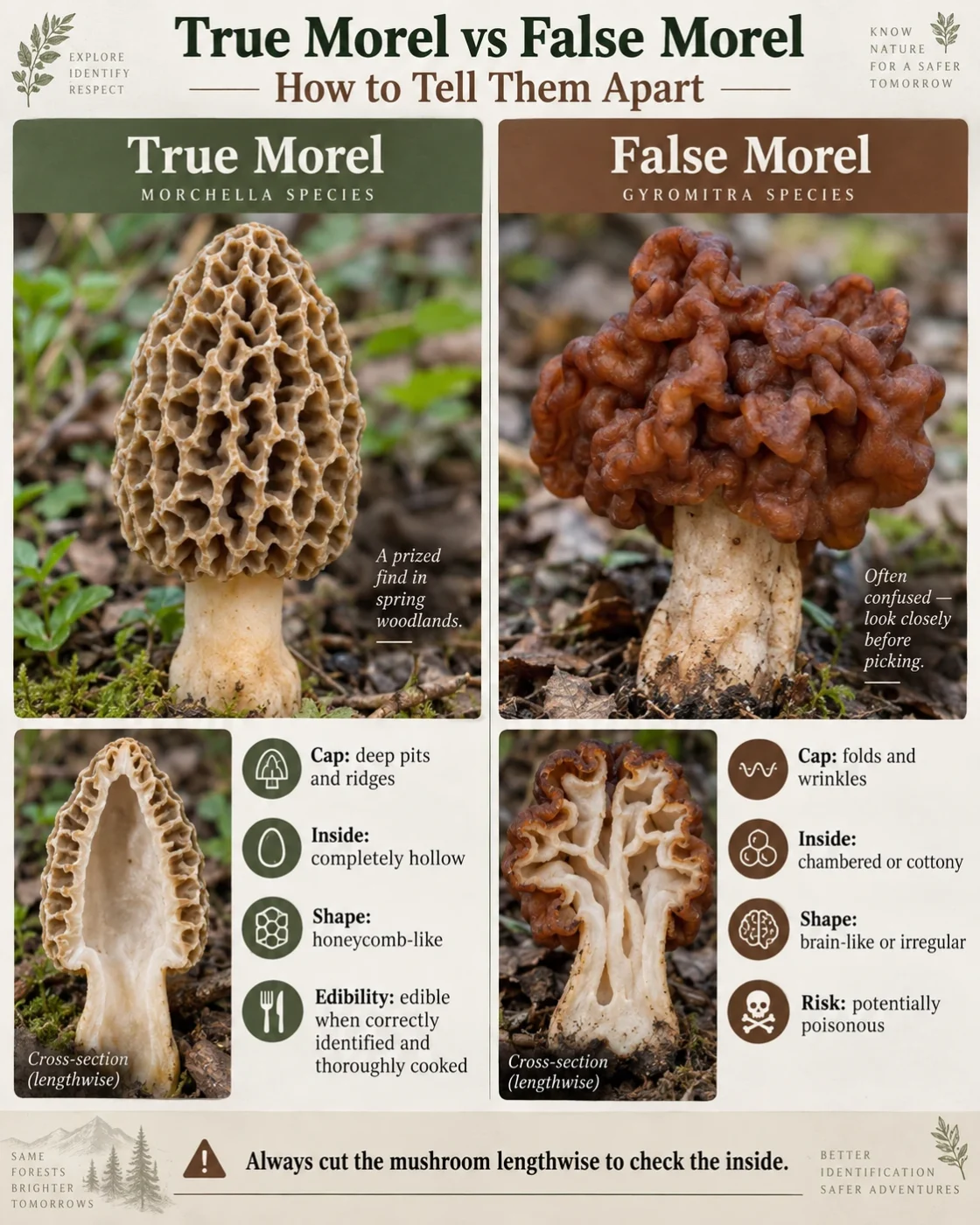
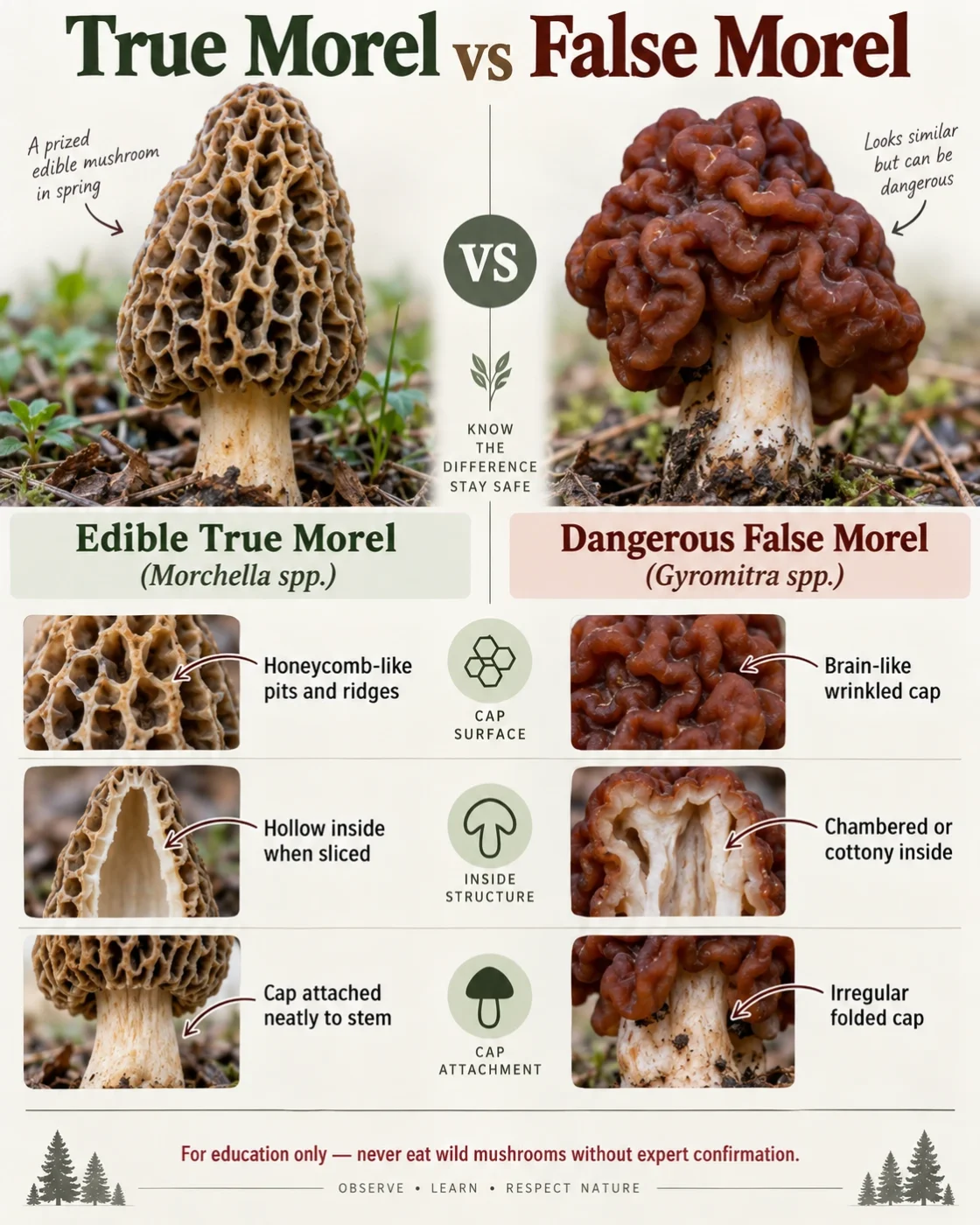
    The differences are often visible once the mushroom is examined carefully. True morels have a clearly pitted, honeycomb-like cap and are hollow inside from top to bottom, while false morels usually have lobed, wrinkled or brain-like caps and a chambered interior.

    ⚠️ Important: This guide is for identification and education only. Never eat a wild mushroom based solely on a photograph, AI result, or comparison with an online guide.

    Quick Comparison

    Feature True Morel False Morel
    Main genus Morchella Usually Gyromitra
    Cap surface Deep pits and ridges Lobes, folds and wrinkles
    Overall cap shape Honeycomb-like Brain-like, saddle-shaped or irregular
    Interior Completely hollow Chambered or cottony
    Cap attachment Usually attached directly to stem Often irregular or partly free
    Typical season Mainly spring Often spring, sometimes other periods
    Edibility Edible when correctly identified and thoroughly cooked Potentially poisonous; should be avoided
    Main risk Confusion with false morels Some species contain gyromitrin

    What Does a True Morel Look Like?

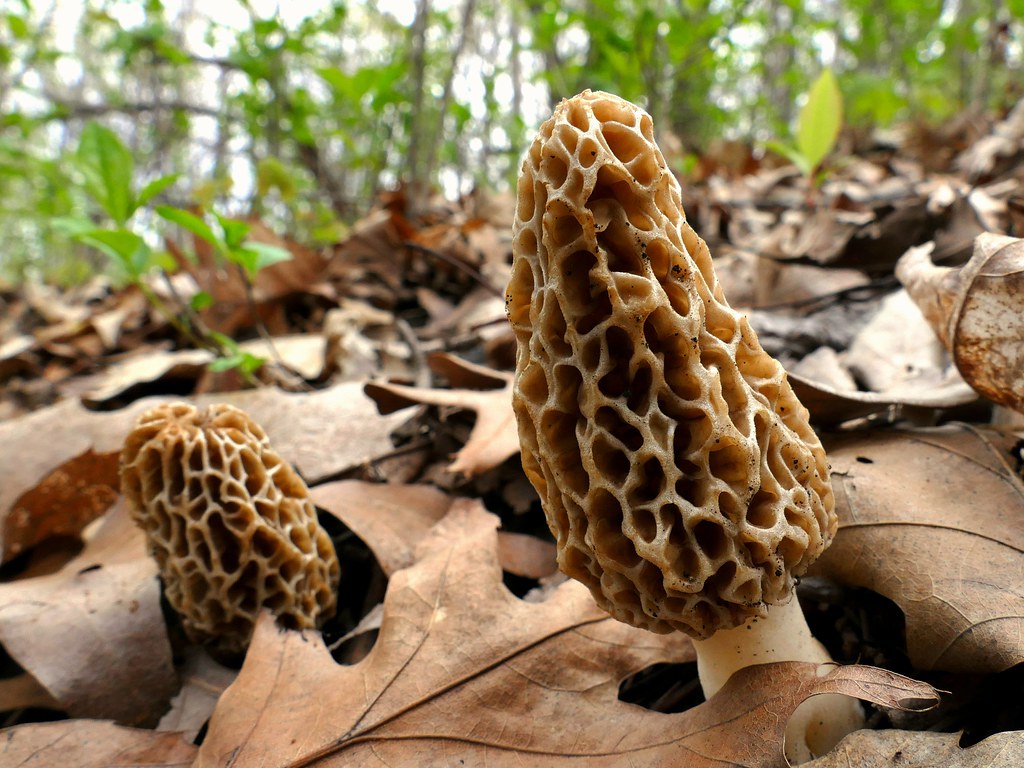
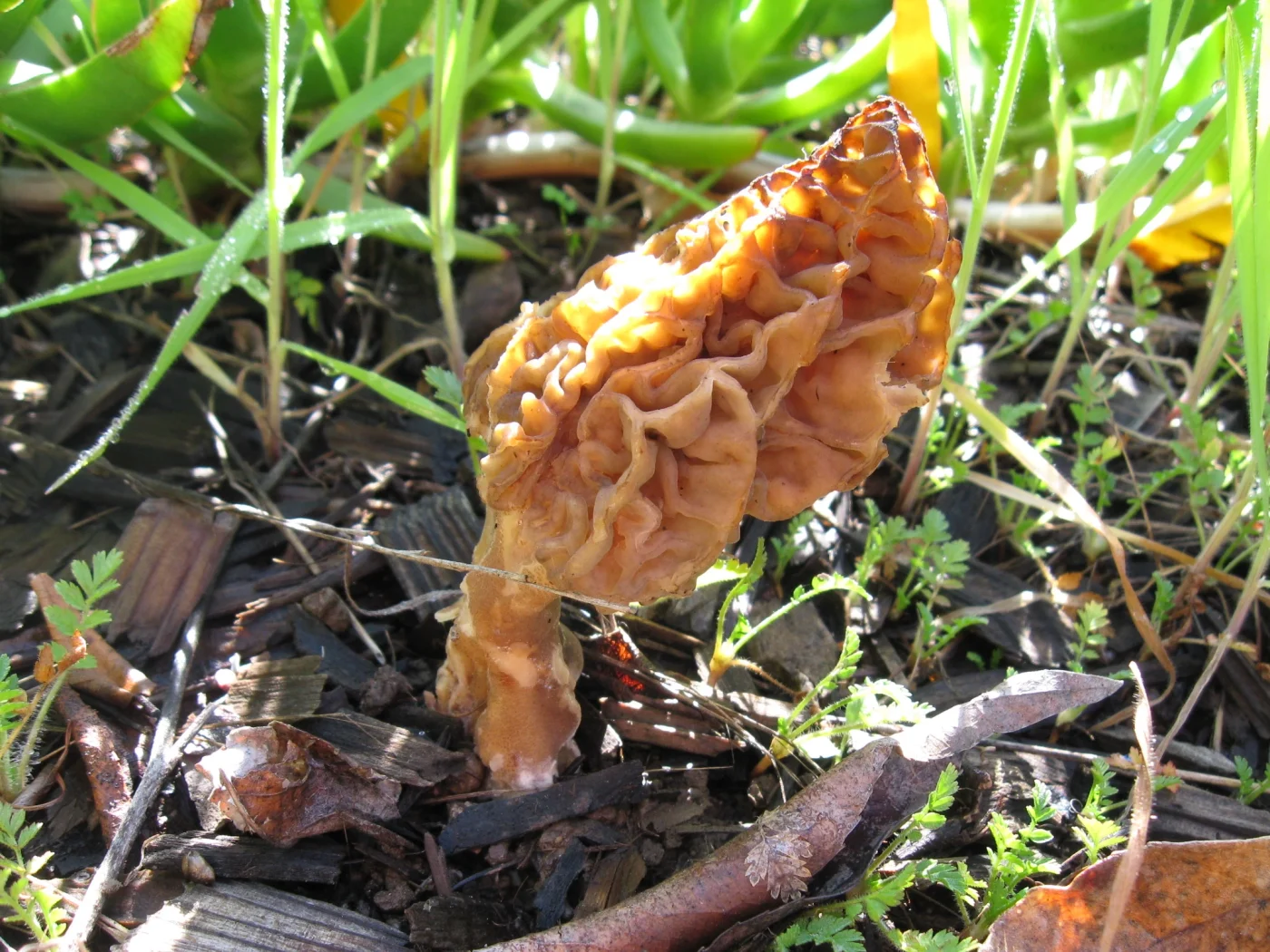
    True morels belong to the genus Morchella. Their most characteristic feature is the cap surface, which is covered with a network of deep pits separated by raised ridges.

    This pattern gives the mushroom a honeycomb, sponge or pinecone-like appearance. The pits are true depressions in the cap rather than simple wrinkles lying on the surface.

    Cap color varies considerably among morel species and with age. Depending on species, the mushroom may be gray, yellow-brown, tan, dark brown or nearly black.

    Because color is so variable, structure is far more useful than shade when trying to identify a true morel.

    The Hollow Interior of a True Morel

    One of the most useful features of true morels is their hollow interior. If a mature morel is cut lengthwise from the top of the cap through the bottom of the stem, the inside should form a continuous hollow cavity.

    The stem is not filled with dense tissue, and the cap should not contain a maze of internal chambers. This characteristic is consistent across the true morels commonly collected for food.

    The hollow test is extremely useful, but it should not be used by itself. A correct identification should also include the characteristic pitted cap and the way the cap connects to the stem.

    What Does a False Morel Look Like?

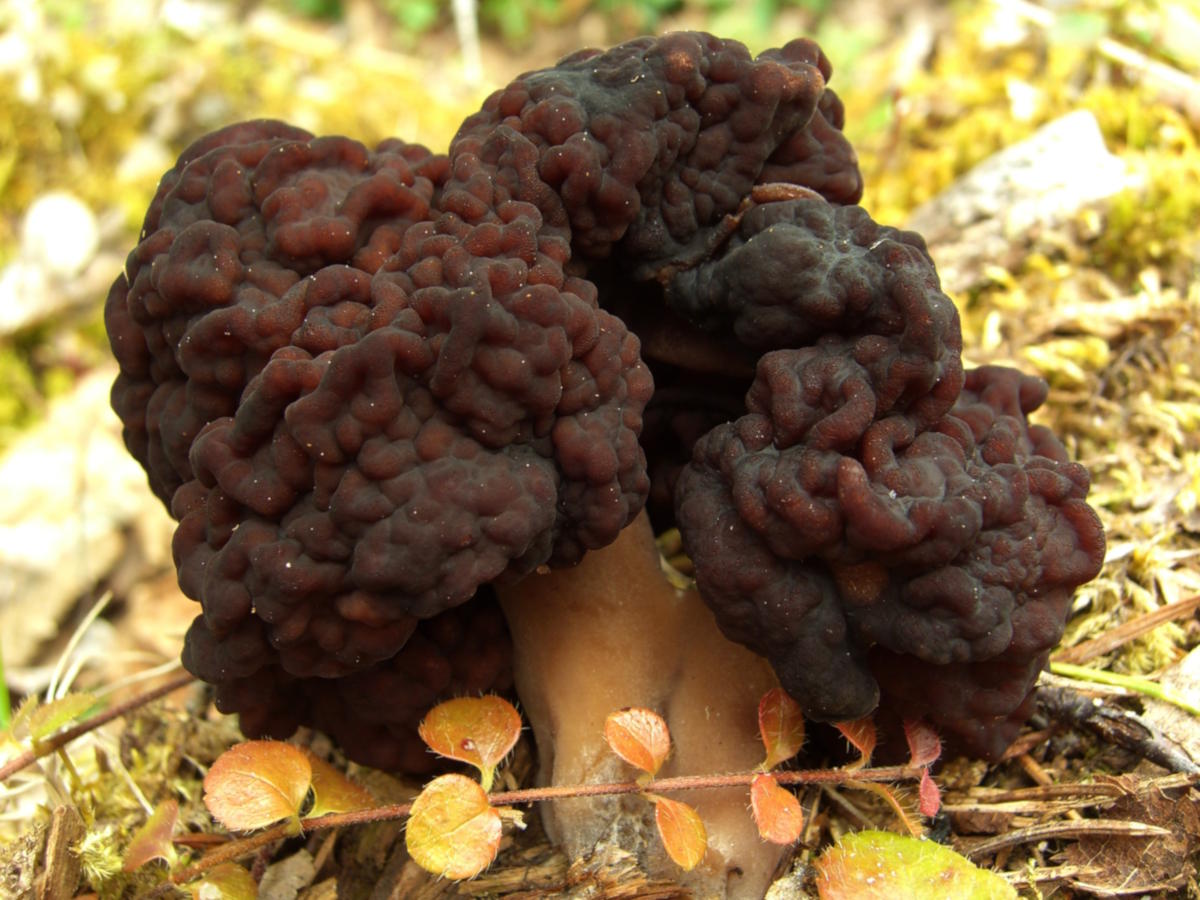
    The name “false morel” is applied to several mushrooms that resemble true morels superficially. The species most often discussed belong to the genus Gyromitra.

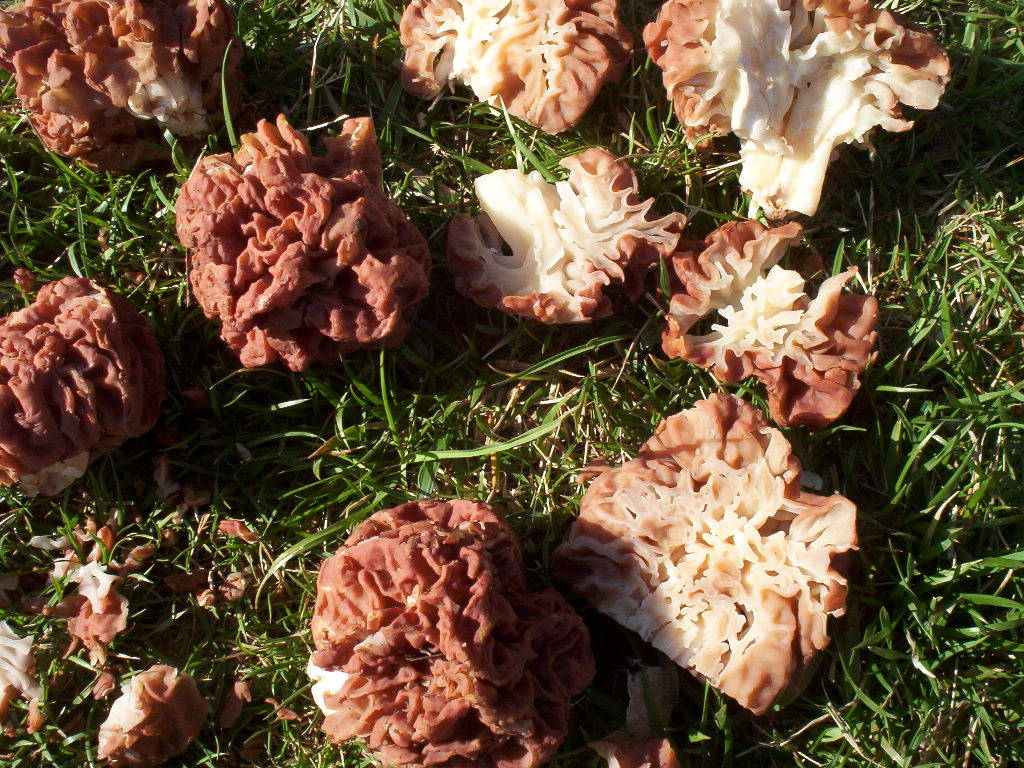
    Instead of a regular honeycomb pattern, false morel caps usually have broad folds, lobes, wrinkles or saddle-like structures. Some species develop a deeply convoluted cap that resembles the surface of a brain.

    The colors often range from tan and brown to reddish brown or dark chestnut. Some false morels can become large and heavy, making them look impressive even though their structure is very different from that of a true morel.

    The Chambered Interior of False Morels

    Cutting the mushroom lengthwise is one of the easiest ways to see the structural difference. False morels are usually not completely hollow from cap to stem.

    Instead, the interior may contain chambers, folds, partitions or cottony tissue. The stem can appear irregular and divided internally rather than forming one clean empty cavity.

    This difference is particularly obvious in well-developed specimens. A cross-section is often more informative than several photographs of the cap surface.

    Cap Surface: Pits vs Wrinkles

    The cap is usually the first feature people notice, but the important distinction is not simply whether the mushroom looks wrinkled.

    A true morel has deep pits surrounded by raised ridges. The surface resembles a structured honeycomb, with many clearly defined depressions extending inward.

    A false morel usually has folds that bulge outward. The cap may resemble a folded cloth, brain, saddle or irregular mass rather than a network of individual pits.

    This is one of the best visual differences once you know what to look for.

    Cap Attachment

    In many common true morels, the lower edge of the cap is attached directly to the stem. The cap and stem form a fairly continuous structure.

    There are exceptions, particularly half-free morels, in which the lower portion of the cap hangs away from the stem. Even these mushrooms still retain the characteristic pitted cap and completely hollow interior of true morels.

    False morels often have a more irregular relationship between cap and stem. Their lobed caps may hang loosely, attach in several places or fold around the stem in unpredictable ways.

    For this reason, cap attachment is useful as supporting evidence but should not be used alone.

    True Morel vs Gyromitra esculenta

    Gyromitra esculenta is one of the best-known false morels and one of the most important species to distinguish from true Morchella.

    Its cap is usually reddish brown to dark brown and strongly folded or brain-like. The surface lacks the deep regular pits typical of true morels.

    Inside, the mushroom is chambered rather than forming one continuous hollow cavity. This combination of a convoluted cap and irregular interior separates it from true morels even when both are found during the same season.

    Main Difference

    A true morel looks like a structured honeycomb and is completely hollow inside. Gyromitra esculenta looks more like a folded brain and contains internal chambers.

    True Morel vs Gyromitra caroliniana

    Gyromitra caroliniana, sometimes called the Big Red False Morel, can grow considerably larger than many true morels. It has a thick reddish-brown cap covered with deep convolutions.

    The stem is pale and can become very robust, but the interior is chambered rather than hollow. Its large size can make it particularly striking on the forest floor.

    This species may fruit during the same general spring period as true morels. Season alone therefore cannot separate the two.

    True Morel vs Gyromitra brunnea

    Gyromitra brunnea, sometimes called the Gabled False Morel, often has a cap divided into broad saddle-shaped or irregular lobes. It may be reddish brown to chestnut brown.

    The cap surface is wrinkled rather than pitted, and the stem and cap contain internal chambers. In some specimens the lobes can look less obviously brain-like than those of other Gyromitra, making careful examination important.

    The basic distinction remains the same: true morels have real pits and a hollow interior, while Gyromitra brunnea has folds and chambers.

    Half-Free Morels

    Half-free morels can confuse beginners because their caps are not fully attached along the lower edge. In these species, only the upper portion of the cap is attached to the stem, leaving the lower edge hanging free.

    Despite this difference, they are still true morels. The cap has genuine pits and ridges, and the inside of the mushroom remains hollow.

    This is a good example of why a single identification rule such as “the cap must be attached all the way around” is too simple.

    Elfin Saddles and Other Morel-Like Mushrooms

    Species of Helvella can also be mistaken for morels, especially by people unfamiliar with spring fungi. Their caps may be folded, saddle-shaped, lobed or irregular.

    Many Helvella species also have unusual stems that may be deeply grooved, ribbed or hollow in complicated ways. They do not display the typical honeycomb pattern of true morels.

    Other wrinkled cup fungi can create similar confusion. The more unusual the cap structure appears, the more important it becomes to cut the mushroom open and inspect the whole fruit body.

    Where Do True Morels Grow?

    True morels grow from soil rather than directly from logs or standing wood. They are most often found in woodland, forest edges, old orchards, disturbed areas and other habitats where suitable soil conditions occur.

    Tree associations vary by region and species. Morel hunters often search near elm, ash, apple, cottonwood, oak and other trees, but there is no universal host tree that guarantees morels.

    Recently disturbed ground can also be productive. In some regions, large flushes appear after forest fires or other ecological disturbances.

    Habitat is helpful, but it should be treated as one clue among several.

    Where Do False Morels Grow?

    False morels also frequently occur on the ground in woodland, which is one reason habitat alone cannot separate them from true morels.

    They may grow near stumps, fallen wood, conifers or mixed forest depending on species. Some appear very early in spring and can overlap with the true morel season.

    Finding a mushroom in a classic morel habitat therefore does not make it a true morel. The physical structure still has to be examined.

    When Do Morels Appear?

    True morels are strongly associated with spring in temperate climates. Fruiting usually begins as soil temperatures rise and moisture becomes suitable.

    The exact season varies by latitude, altitude and weather. In some regions they appear in March, while farther north or at higher elevations they may not fruit until April or May.

    False morels can appear during the same period, and some species fruit slightly earlier. Because their seasons overlap, timing is useful for finding mushrooms but not for proving identity.

    Are False Morels Poisonous?

    False morels should be regarded as potentially poisonous. Several Gyromitra species contain gyromitrin, a compound that can be converted in the body to monomethylhydrazine.

    Poisoning can cause gastrointestinal and neurological symptoms and, in severe cases, liver damage, seizures or death. Toxin concentration can vary between species, populations and individual mushrooms.

    Some false morels have historically been eaten in certain regions after special preparation, but this does not make them reliably safe. The toxin level cannot be judged from appearance, and incomplete preparation can leave dangerous amounts behind.

    For a general identification guide, the safest approach is to treat false morels as mushrooms that should not be eaten.

    Are True Morels Safe to Eat Raw?

    No. Even correctly identified true morels should be thoroughly cooked before eating.

    Raw or undercooked morels can cause gastrointestinal symptoms and other adverse reactions. Cooking is part of normal preparation for true morels, but cooking cannot transform an incorrectly identified false morel into a safe true morel.

    Correct species identification always comes first.

    True Morel vs False Morel at a Glance

    Feature True Morel False Morel
    Cap texture Honeycomb pits and ridges Wrinkles, folds or lobes
    Cap appearance Structured and regular Brain-like or irregular
    Interior Continuously hollow Chambered or partly filled
    Stem Hollow Often chambered
    Color Gray, tan, yellow-brown, dark brown Tan, brown, reddish brown
    Season Spring Often spring, overlapping
    Safety Edible when correctly identified and cooked Potentially poisonous

    The hollow interior and pitted cap are the most useful combination of features. Neither should be considered in isolation.

    How to Identify a Morel Step by Step

    Begin with the cap surface. A true morel should have clearly defined pits surrounded by raised ridges rather than broad folds or brain-like lobes.

    Next, cut the mushroom lengthwise. The inside should be hollow from the top of the cap through the stem.

    Then examine the cap attachment and habitat. These additional features help confirm that the mushroom fits a true Morchella rather than one of several spring look-alikes.

    If the interior is chambered or the cap lacks true pits, the mushroom should not be treated as a true morel.

    How to Photograph Morels for Identification

    A useful identification set should include the cap from several angles, the whole stem and the exact place where the mushroom is growing. Cap structure is easier to judge when side lighting reveals the depth of the pits and ridges.

    The most useful additional image is a lengthwise cross-section. This immediately shows whether the mushroom is completely hollow or contains chambers.

    A photograph of nearby trees and the surrounding habitat can also provide useful context, but habitat should not replace structural examination.

    Can Morels Be Identified From a Photo?

    Typical true morels can often be recognized with good photographs, especially when the cap pattern and complete fruit body are clearly visible.

    However, a single photograph from above may hide the features that matter most. Brain-like false morels can look deceptively similar when the image is small, blurred or taken from an unusual angle.

    AI identification becomes much more useful when photographs include the underside, stem and interior. A cross-section can provide information that no cap-only image can reproduce.

    Common Morel Identification Mistakes

    One common mistake is focusing too heavily on color. True and false morels both occur in various shades of brown, tan and gray, so color is much less useful than cap structure.

    Another mistake is assuming that all mushrooms found in spring are true morels. False morels can fruit at the same time and in similar habitats.

    A third mistake is checking only whether the stem seems hollow. The correct pattern is a mushroom that is completely hollow through both cap and stem, combined with a genuinely pitted cap.

    Frequently Asked Questions

    What is the easiest way to tell a true morel from a false morel?

    Look at the cap and then cut the mushroom lengthwise. True morels have deep honeycomb-like pits and are completely hollow inside, while false morels usually have wrinkled or brain-like caps and chambered interiors.

    Are all false morels poisonous?

    Several species contain potentially dangerous toxins, and toxin concentration is variable. For practical safety, false morels should be treated as potentially poisonous and not collected for food.

    Are true morels hollow?

    Yes. A true morel should be hollow through the cap and stem when sliced vertically.

    Do false morels have hollow stems?

    They are usually chambered rather than completely hollow. Internal partitions, folds or cottony tissue may be visible.

    What does a false morel cap look like?

    The cap is often lobed, wrinkled, saddle-shaped or brain-like. It does not have the regular network of deep pits and raised ridges seen in true morels.

    Can true and false morels grow in the same habitat?

    Yes. Their habitats and fruiting seasons can overlap, so location alone cannot determine which one you found.

    What color are true morels?

    Depending on species and age, they can be gray, tan, yellow-brown, brown or very dark. Color is not a reliable standalone identification feature.

    Can you eat true morels raw?

    No. Correctly identified true morels should be thoroughly cooked before consumption.

    What is the most dangerous false morel?

    Several Gyromitra species are associated with poisoning, including Gyromitra esculenta. It is safer not to attempt to rank unknown false morels by apparent risk.

    Does a brain-like cap mean it is a false morel?

    A strongly brain-like or lobed cap is characteristic of several false morels. A true morel should instead have clear pits and ridges forming a honeycomb-like surface.

    Final Identification Notes

    The safest visual distinction between true and false morels comes from combining two features. A true morel has a genuinely pitted honeycomb cap and is completely hollow from top to bottom.

    False morels usually replace those pits with broad wrinkles, folds or brain-like lobes, and their interiors are typically chambered rather than forming one continuous hollow cavity. Habitat and season can support an identification, but they overlap too much to be used as deciding factors.

    When uncertainty remains, do not eat the mushroom. Found a morel-like mushroom? Photograph the entire specimen and cut one lengthwise for identification, because the inside can be just as important as the cap.

  • White Mushroom Identification: Common Species and Dangerous Look-Alikes

    White Mushroom Identification: Common Species and Dangerous Look-Alikes

    White mushrooms are among the most difficult wild mushrooms to identify safely. A smooth white cap can belong to a common edible species, an inedible lawn mushroom, or one of the most dangerous fungi in the world.

    Color alone is almost useless for reliable identification. The most important features are the gills or pores, stem base, presence of a ring or volva, spore print, habitat, bruising reactions and changes that occur as the mushroom matures.

    This is especially important with white Amanitas. Some deadly species can look remarkably ordinary, particularly when they are young.

    ⚠️ Important: This guide is for education and identification only. Never eat a wild mushroom based only on a photograph, AI result, cap color, or comparison with an online guide.

    Quick White Mushroom Identification Guide

    Species Key appearance Typical habitat Risk
    Agaricus campestris White cap, pink to dark brown gills Meadows and lawns Edible when correctly identified
    Agaricus arvensis Large white cap, gills darken with age Grassland and pastures Edible when correctly identified
    Amanita virosa White cap, white gills, ring and volva Woodland Deadly poisonous
    Amanita verna White cap, white gills and volva Woodland Deadly poisonous
    Amanita phalloides pale forms Pale to white cap, white gills, volva Woodland Deadly poisonous
    Chlorophyllum molybdites Large white scaly cap, greenish mature gills Lawns and parks Poisonous
    Leucoagaricus leucothites Smooth white cap and white gills Lawns and grassy areas Not recommended
    Clitocybe rivulosa Small white funnel-shaped cap Lawns and grassland Poisonous
    Lepista personata pale forms Pale cap, lilac tones on stem Grassland Edibility requires confident ID
    Coprinus comatus Tall white shaggy cap Lawns, paths and disturbed soil Edible when young and correctly identified
    Calocybe gambosa Cream-white thick cap Grassland and woodland edges Edible when correctly identified
    White puffballs Round, white and solid inside Lawns and woodland Some edible when young, but Amanita confusion is dangerous

    First: Look Under the Cap

    The underside of the mushroom usually tells you more than the white cap itself. If the mushroom has gills, note their color when young and old, whether they touch the stem, and whether they change color as spores mature.

    Pink gills that turn chocolate brown strongly suggest an Agaricus species. Gills that remain white throughout maturity deserve more caution because this pattern occurs in several Amanitas, as well as in many unrelated white mushrooms.

    If the underside has pores rather than gills, you are dealing with a different group altogether. White-capped boletes exist, but they are less commonly mistaken for the classic white lawn and woodland mushrooms discussed here.

    1. Agaricus campestris — Field Mushroom

    • Scientific name: Agaricus campestris
    • Common name: Field Mushroom

    The Field Mushroom is one of the best-known edible white mushrooms of lawns, meadows and pastures. Its cap is usually white to cream and may remain fairly smooth or develop small scales with age.

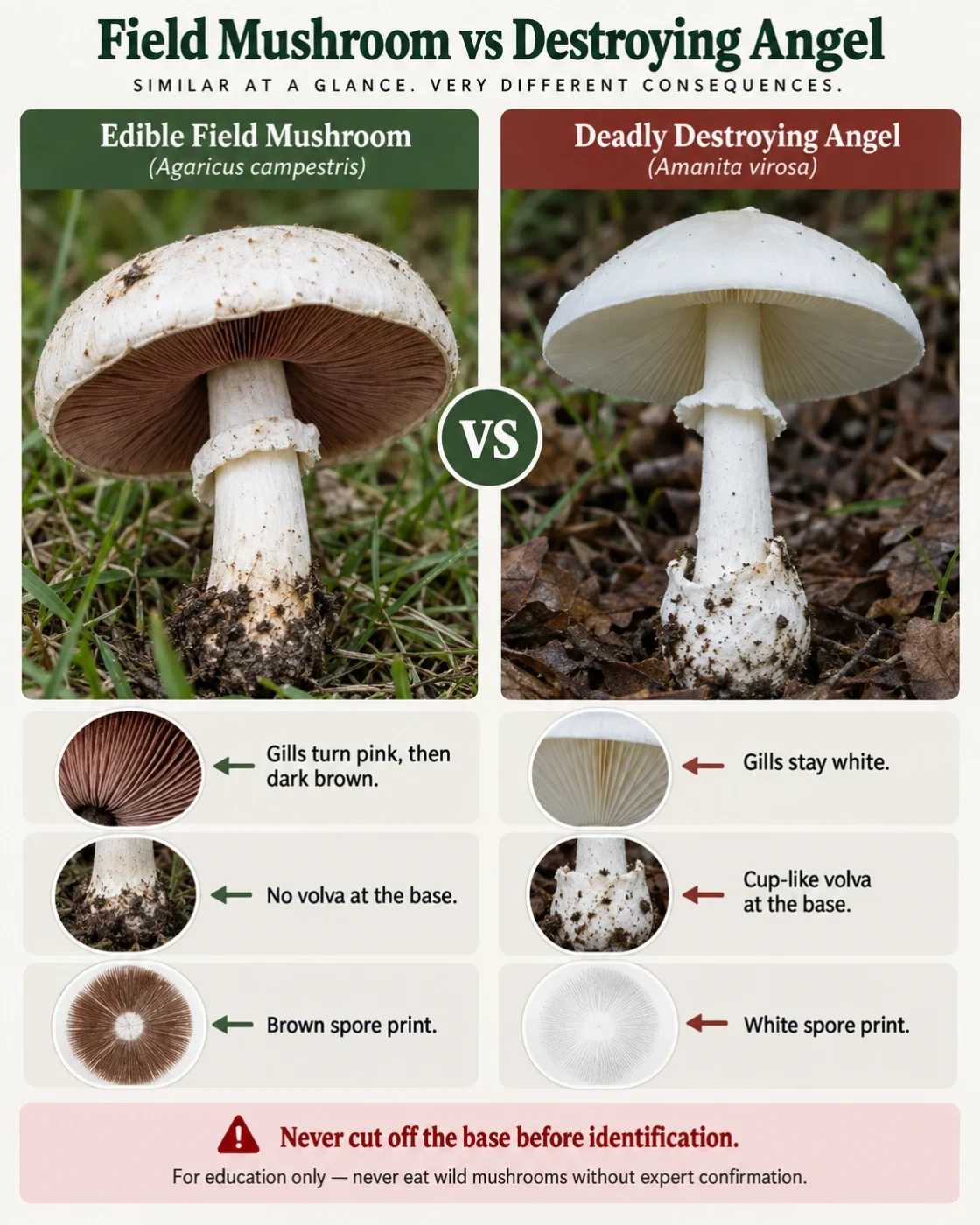
    The gills are the most useful feature. They begin pink, become deeper reddish brown and eventually mature to dark chocolate brown. The spore print is also dark brown.

    The stem is pale and usually carries a relatively delicate ring, while the base lacks the sack-like volva found in many dangerous Amanitas.

    Dangerous look-alike: White Amanita

    A young white Amanita can superficially resemble a Field Mushroom from above. The main difference is that Amanita gills remain white, while Agaricus gills progressively darken.

    The complete stem base is also crucial. Amanitas may have a volva surrounding the base, sometimes hidden below soil or leaf litter. A mushroom cut off at ground level may therefore lose one of its most important identification features.

    2. Agaricus arvensis — Horse Mushroom

    • Scientific name: Agaricus arvensis
    • Common name: Horse Mushroom

    The Horse Mushroom is a large pale species often found in fields, pastures and grassy areas. The cap is white to cream when young and may become yellowish with age or handling.

    As with other Agaricus, the gills begin pale and gradually turn through pinkish tones to dark brown. The mushroom often has a substantial ring and can develop yellow staining, particularly near the stem base.

    This species can be confused with other white Agaricus species, including some that cause gastrointestinal illness. Smell, staining reactions and habitat can all be useful, but they should be considered together rather than separately.

    3. Amanita virosa — Destroying Angel

    • Scientific name: Amanita virosa
    • Common name: Destroying Angel

    The Destroying Angel is one of the most important deadly white mushrooms to recognize. It has a white cap, white gills, a white stem and typically a ring around the upper stem.

    The base usually sits inside a distinct white volva. This structure may be partly buried, which is why removing the whole mushroom rather than cutting the stem is essential during identification.

    Amanita virosa contains amatoxins capable of causing severe liver failure. Early symptoms may be delayed for many hours, and a temporary period of apparent recovery can occur even while internal damage continues.

    Main identification warning

    A pure white mushroom with white gills and a volva at the base should be treated with extreme caution. Even experienced foragers are careful around white Amanitas because several deadly species share this general appearance.

    4. Amanita verna — Fool’s Mushroom

    • Scientific name: Amanita verna
    • Common names: Fool’s Mushroom, Spring Destroying Angel

    Amanita verna is another deadly white Amanita. It typically has a smooth white cap, white gills, a white stem, a ring and a sack-like volva at the base.

    It is particularly associated with warmer regions and may appear earlier in the year than some other deadly Amanitas. Its clean white appearance can make it look deceptively harmless.

    The species contains amatoxins and should never be confused with edible white grassland mushrooms. The combination of persistently white gills and a volva should always trigger caution.

    5. Pale Amanita phalloides — Death Cap

    • Scientific name: Amanita phalloides
    • Common name: Death Cap

    The Death Cap is usually associated with olive, greenish or yellowish caps, but some specimens can be unusually pale and may approach cream or nearly white.

    The gills remain white, the stem is pale, and a ring is generally present. At the base is a prominent sack-like volva, although this may be hidden in the soil.

    Because cap color varies, a mushroom should never be ruled out as a Death Cap merely because it lacks the familiar greenish appearance. Stem-base structures and gill color are far more important than cap shade.

    6. Chlorophyllum molybdites — Green-Spored Parasol

    • Scientific name: Chlorophyllum molybdites
    • Common names: Green-Spored Parasol, False Parasol

    This large white mushroom is especially common in lawns, parks and gardens in warm climates. It often forms fairy rings and can appear in large numbers after rain.

    The cap is pale and typically covered with brownish scales. Young gills may look white or cream, but mature specimens develop a gray-green or greenish cast as the spores mature.

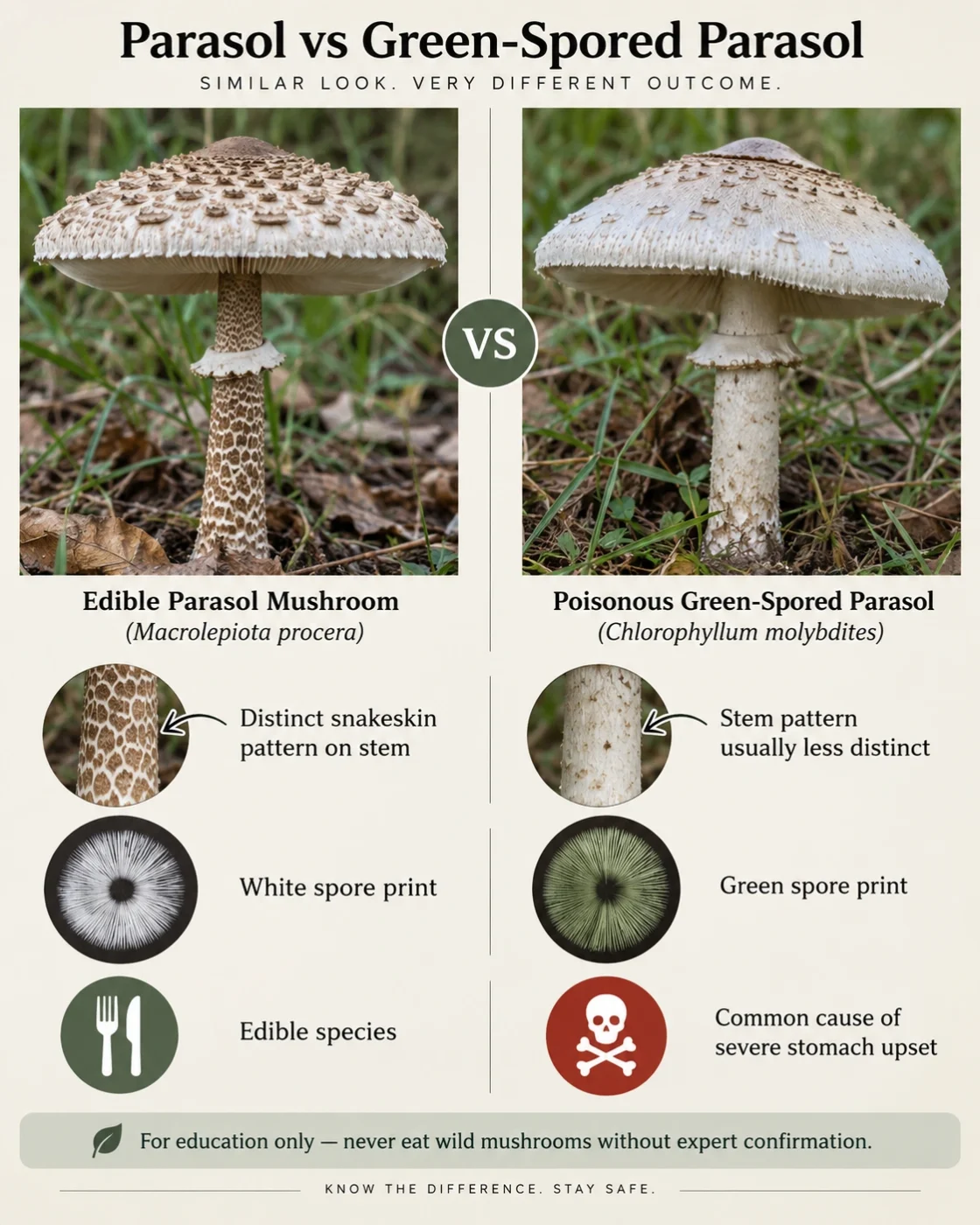
    Its spore print is distinctly green, one of the most useful characteristics of the species. The mushroom can cause severe gastrointestinal poisoning and is a common source of accidental ingestion.

    Look-alike: Parasol Mushroom

    The edible Parasol Mushroom can look similar, especially when viewed from above. The true Parasol typically has a more obvious snakeskin pattern on the stem and a pale spore print rather than green spores.

    Large parasol-like lawn mushrooms should therefore never be identified from cap pattern alone.

    7. Leucoagaricus leucothites — White Dapperling

    • Scientific name: Leucoagaricus leucothites
    • Common names: White Dapperling, Smooth Parasol

    This mushroom has a smooth white to cream cap and white gills. It often grows in lawns, parks, roadside grass and disturbed ground.

    The stem usually has a ring, and the overall appearance can resemble a small pale parasol. Unlike Agaricus, its gills remain light rather than becoming chocolate brown.

    The species is particularly important because it can resemble young white Amanitas. For that reason, casual identification for food is not advisable.

    8. Clitocybe rivulosa — Fool’s Funnel

    • Scientific name: Clitocybe rivulosa
    • Common names: Fool’s Funnel, False Champignon

    This small white mushroom commonly grows in lawns, parks and other grassy habitats. The cap is usually white to pale cream and becomes flatter or shallowly funnel-shaped as it matures.

    The gills are pale and run slightly down the stem. The cap surface may develop faint concentric markings, particularly as it dries.

    The species contains muscarine and can cause serious poisoning. Symptoms may include sweating, salivation, nausea, vomiting, abdominal cramps and cardiovascular effects.

    Why it is easy to overlook

    Fool’s Funnel does not look dramatic or obviously dangerous. Its small size and plain white appearance make it a good example of why mushroom toxicity cannot be judged by how threatening a species looks.

    9. Lepista personata — Field Blewit

    • Scientific name: Lepista personata
    • Common name: Field Blewit

    Field Blewits are usually associated with lilac or violet coloration on the stem, but pale specimens can appear cream-white from above. They occur in grassland, pasture and open habitats, sometimes forming rings.

    The cap is relatively fleshy and pale, while the gills are crowded and light in color. The lower stem often retains violet or lilac tones, which can be an important clue.

    Several pale grassland mushrooms can appear similar, so complete identification is necessary before considering edibility.

    10. Coprinus comatus — Shaggy Mane

    • Scientific name: Coprinus comatus
    • Common names: Shaggy Mane, Lawyer’s Wig

    The Shaggy Mane is one of the more distinctive white mushrooms commonly found in lawns, roadside grass and disturbed soil. Young specimens have tall cylindrical caps covered with shaggy white scales.

    As the mushroom matures, the cap opens and the gills progress from white to pink and then black. Eventually, the cap begins to dissolve into a dark ink-like liquid.

    Young Shaggy Manes are traditionally considered edible when correctly identified and consumed before the gills darken. However, the unusual aging process makes mature specimens unsuitable.

    11. Calocybe gambosa — St. George’s Mushroom

    • Scientific name: Calocybe gambosa
    • Common name: St. George’s Mushroom

    This pale cream to white mushroom is typically associated with spring. It grows in grassland, woodland edges, hedgerows and sometimes fairy rings.

    The cap is thick and fleshy, while the gills are crowded, pale and relatively narrow. The mushroom is also known for a strong mealy or flour-like smell.

    Several toxic pale mushrooms can occur in similar habitats, so season and smell are supporting clues rather than definitive proof.

    12. White Puffballs

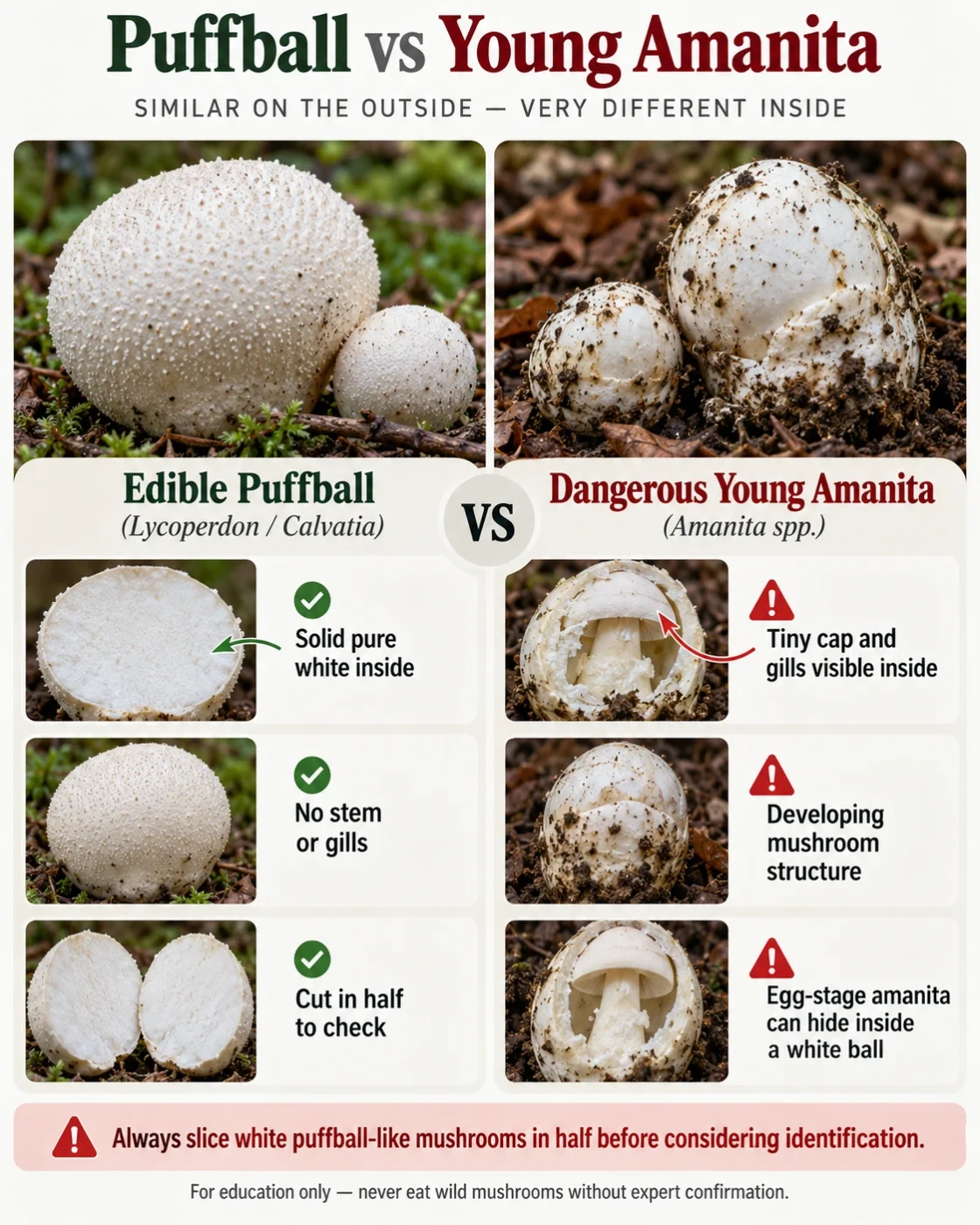
    Several true puffballs produce round white fruit bodies in lawns, meadows and woodland. Young edible species are typically uniformly white inside and contain no visible gills, stem or developing cap.

    The most important danger is confusion with a young Amanita still enclosed inside its universal veil.

    Puffball vs Young Amanita

    A suspected puffball should always be cut vertically through the center. A genuine young puffball should be solid and uniformly white inside.

    A young Amanita may reveal the outline of a cap, gills and stem hidden within the outer tissue. This difference is critical because some white Amanitas are deadly.

    White Mushrooms Growing on Lawns

    Lawns can support several white species, including Field Mushrooms, Horse Mushrooms, Green-Spored Parasols, White Dapperlings and Fool’s Funnel.

    The first useful question is what happens to the gills as the mushroom ages. Pink-to-brown gills suggest Agaricus, greenish mature gills point toward Chlorophyllum molybdites, while persistently pale gills require consideration of several other genera.

    Nearby trees also matter. An Amanita may appear in an apparently open lawn if suitable tree roots extend below the grass.

    White Mushrooms Growing in Forests

    White woodland mushrooms deserve particular caution because this habitat includes several deadly Amanitas.

    If the mushroom has white gills, a ring and a volva at the base, identification should focus immediately on Amanita species. The entire stem base is essential and should never be discarded before identification.

    Other white woodland fungi exist, but no white-gilled mushroom should be treated as edible simply because its cap resembles a familiar supermarket mushroom.

    White Mushrooms With Pink Gills

    Pink gills are commonly associated with young Agaricus mushrooms. As the mushroom matures, those gills usually become reddish brown and eventually dark chocolate brown.

    This progression can help distinguish Agaricus from deadly white Amanitas, whose gills remain pale. However, gill color alone is not enough for a safe identification because age, lighting and immature development can make colors difficult to interpret.

    White Mushrooms With White Gills

    White cap plus white gills is a broad and potentially dangerous combination.

    It occurs in Amanitas, white dapperlings, some funnel mushrooms and numerous other groups. The next features to inspect are the ring, stem base, volva, gill attachment, spore print and habitat.

    A white mushroom with white gills and a volva should be treated as potentially dangerous until confidently identified.

    White Mushrooms With Brown Gills

    A mature white mushroom with dark brown gills is often an Agaricus species, but not every Agaricus is edible.

    Some species produce strong yellow staining and unpleasant chemical odors and can cause gastrointestinal symptoms. Correct identification therefore requires more than simply confirming brown gills.

    How to Check the Stem Base

    The stem base can be the difference between recognizing an edible Agaricus and overlooking a deadly Amanita.

    Carefully loosen the surrounding soil and remove the entire mushroom intact. Look for a bulbous base, a sack-like volva or rings of veil material around the lower stem.

    Never identify an unknown white mushroom after cutting the stem at ground level because essential structures may remain buried.

    How to Photograph a White Mushroom for Identification

    White mushrooms are difficult to photograph because bright surfaces can lose detail in direct sunlight. Use soft natural light when possible and avoid overexposure.

    Photograph the cap, underside, full stem, stem base and surrounding habitat. Include younger and older specimens if several are present, since gill color and cap shape can change dramatically with age.

    A single top-down image of a white cap provides very little reliable information.

    Can AI Identify a White Mushroom?

    AI can help narrow the possibilities, especially when several clear photographs are available. It may recognize general groups such as Agaricus, Amanita or Chlorophyllum and suggest likely species.

    However, white mushrooms are precisely the kind of identification problem where missing details can be critical. A hidden volva, immature gill color or damaged ring can completely change the interpretation.

    AI identification should therefore be treated as a hypothesis rather than proof, especially when a potentially deadly Amanita is among the possible matches.

    Are White Mushrooms Poisonous?

    Some are edible and some are extremely poisonous. White coloration has no reliable relationship with toxicity.

    Field Mushrooms and Shaggy Manes are examples of edible white species when correctly identified. Destroying Angels and pale Death Caps demonstrate the opposite extreme, since they contain toxins capable of causing fatal liver failure.

    This wide range is why folklore rules based on color should never be used.

    Frequently Asked Questions

    What is the white mushroom growing in my lawn?

    Common possibilities include Field Mushroom, Horse Mushroom, Green-Spored Parasol, White Dapperling and Fool’s Funnel. The underside, gill color, stem base and spore print are more useful than cap color.

    What white mushrooms are deadly?

    Several white Amanitas are deadly, including Destroying Angels such as Amanita virosa and Amanita verna. Pale forms of Amanita phalloides can also appear almost white.

    How can I tell a white Amanita from a Field Mushroom?

    A mature Field Mushroom normally develops pink and then dark brown gills, while Amanita gills remain white. Amanitas may also have a volva at the stem base.

    Are all white mushrooms with brown gills edible?

    No. Brown mature gills may suggest Agaricus, but some Agaricus species are inedible or can cause gastrointestinal illness.

    Is a large white mushroom in the lawn poisonous?

    It may be. Chlorophyllum molybdites, the Green-Spored Parasol, is a common large lawn mushroom that can cause severe gastrointestinal poisoning.

    What is a small white funnel-shaped mushroom in grass?

    One possibility is Clitocybe rivulosa, the poisonous Fool’s Funnel. Several other pale grassland species can look similar, so complete identification is necessary.

    How do I identify a white puffball?

    Cut it completely through the center. A young true puffball should be uniformly white inside without any developing cap, gills or stem.

    Final Identification Notes

    White mushroom identification should begin with structures rather than color. Check whether the gills remain white or darken, whether a ring is present, and most importantly whether the stem base has a volva or other veil remnants.

    A particularly important warning combination is white cap + white gills + ring + volva. This pattern is characteristic of several dangerous Amanitas and should always be treated seriously.

    By contrast, pink gills that mature to chocolate brown suggest Agaricus, while greenish mature gills point toward Chlorophyllum molybdites. These clues narrow the possibilities, but none should be used alone to decide whether a mushroom is edible.

    Found a white mushroom? Photo identification can help generate possible matches, but any decision involving consumption should be independently confirmed by an experienced local mushroom expert.

  • Brown Mushroom Identification: 12 Common Species and Their Look-Alikes

    Brown Mushroom Identification: 12 Common Species and Their Look-Alikes

    Brown mushrooms are among the most common — and often the most difficult — wild mushrooms to identify. A brown cap can belong to an excellent edible bolete, an ordinary decomposer growing on a stump, or a dangerously poisonous species. This is why “brown mushroom identification” cannot be based on color alone. To identify a brown mushroom, examine the underside of the cap, stem, stem base, spore color, habitat, substrate, bruising reactions, and growth pattern. Small brown mushrooms growing on wood deserve particular caution because deadly Galerina marginata can resemble several edible species.

    ⚠️ Important: This guide is for identification and education only. Never eat a wild mushroom based only on a photograph, AI result, or comparison with an online guide.

    Quick Brown Mushroom Identification Guide

    Species Typical appearance Where it grows Edibility / risk
    Boletus edulis Brown cap, thick pale stem, pores Soil near trees Edible
    Imleria badia Chestnut-brown cap, yellow pores Woodland soil Edible
    Armillaria spp. Honey-brown caps, clustered Wood and tree roots Some species traditionally eaten; careful ID required
    Galerina marginata Small yellow-brown cap Dead wood Deadly poisonous
    Kuehneromyces mutabilis Two-toned brown cap, clusters Dead wood Edible but high-risk identification
    Flammulina velutipes Orange-brown cap, dark velvety stem Dead hardwood Edible when correctly identified
    Pluteus cervinus Gray-brown cap, pink mature gills Dead wood Generally regarded as edible but not highly valued
    Coprinellus micaceus Honey-brown clustered caps Buried or exposed wood Usually considered edible young, but not recommended here
    Pholiota squarrosa Brown-yellow cap with scales Tree trunks and stumps Not recommended for consumption
    Paxillus involutus Brown rolled cap margin Woodland soil Poisonous
    Cortinarius rubellus Orange-brown to reddish cap Woodland soil Deadly poisonous
    Tylopilus felleus Brown bolete with pinkish pores Woodland soil Not poisonous, but extremely bitter

    First: What Kind of Brown Mushroom Did You Find?

    Before trying to identify the species, turn the mushroom over. The underside is often far more useful than the cap color.

    If it has pores

    A sponge-like surface rather than gills suggests a bolete. Possible brown species include:

    • Boletus edulis;
    • Imleria badia;
    • Tylopilus felleus;
    • various Suillus and other boletes.

    If it has gills

    Look at gill color, attachment, spacing, stem ring, stem base and spore print. Brown mushrooms with gills belong to many unrelated genera, including Galerina, Armillaria, Cortinarius, Pluteus, Pholiota and others.

    If it grows directly from wood

    Pay special attention. Several edible brown mushrooms grow on logs and stumps, but so does Deadly Galerina (Galerina marginata), an amatoxin-containing species associated with severe and fatal poisonings. Research has confirmed amatoxins in the Galerina marginata species complex.

    1. Boletus edulis — Porcini

    • Scientific name: Boletus edulis
    • Common names: Porcini, Penny Bun, Cep

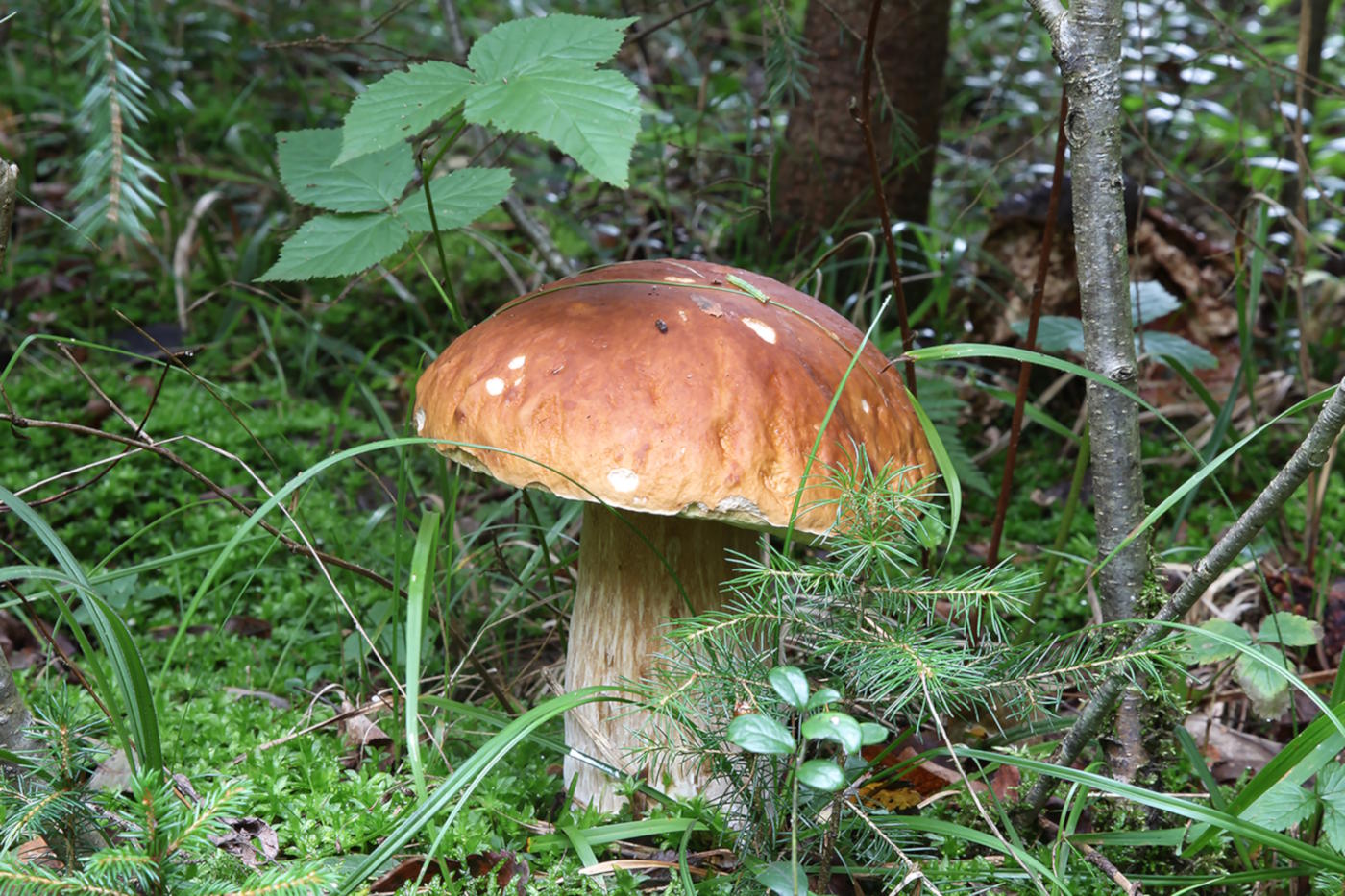
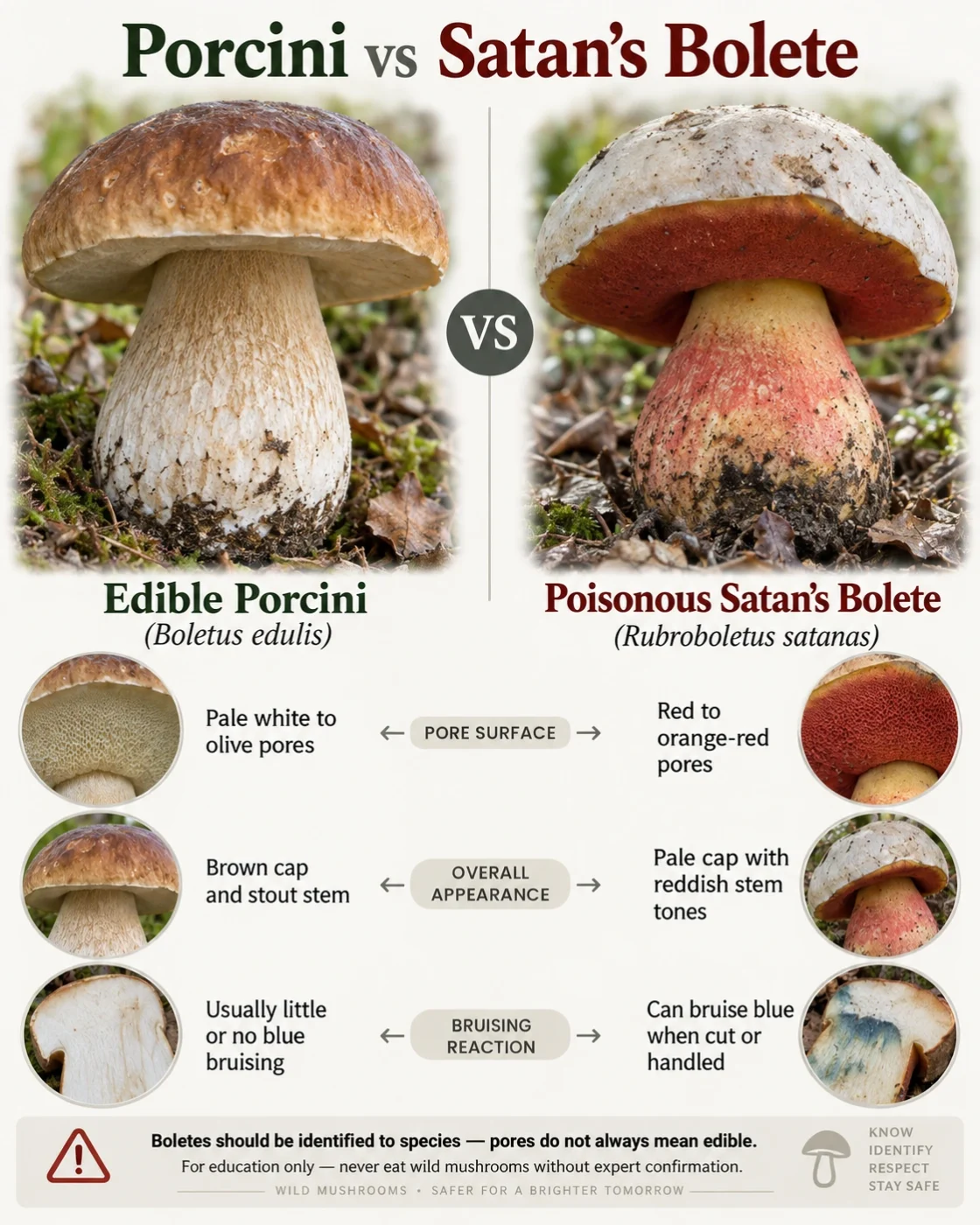
    Porcini is one of the best-known edible brown mushrooms. A mature specimen typically has a smooth brown cap above a thick, pale, club-shaped stem. Instead of gills, the underside contains thousands of small pores. Young pores are whitish and gradually become yellowish to olive as the mushroom ages. One particularly useful characteristic is the pale net-like reticulation often visible around the upper portion of the stem.

    Where it grows

    Porcini grows from soil in association with living trees rather than directly from dead wood. It forms mycorrhizal relationships with trees such as:

    • spruce;
    • pine;
    • beech;
    • oak;
    • birch.

    Main look-alike: Tylopilus felleus

    The Bitter Bolete can look remarkably similar to porcini. It usually develops pinkish or flesh-colored pores, while its stem often has a darker, coarser network. It is not considered a deadly mushroom, but its flesh can be intensely bitter and can ruin an entire meal.

    Key clue

    Porcini: pale-to-olive pores + stout reticulated stem. But never classify an unknown bolete as edible simply because it has a brown cap and pores.

    2. Imleria badia — Bay Bolete

    • Scientific name: Imleria badia
    • Common name: Bay Bolete

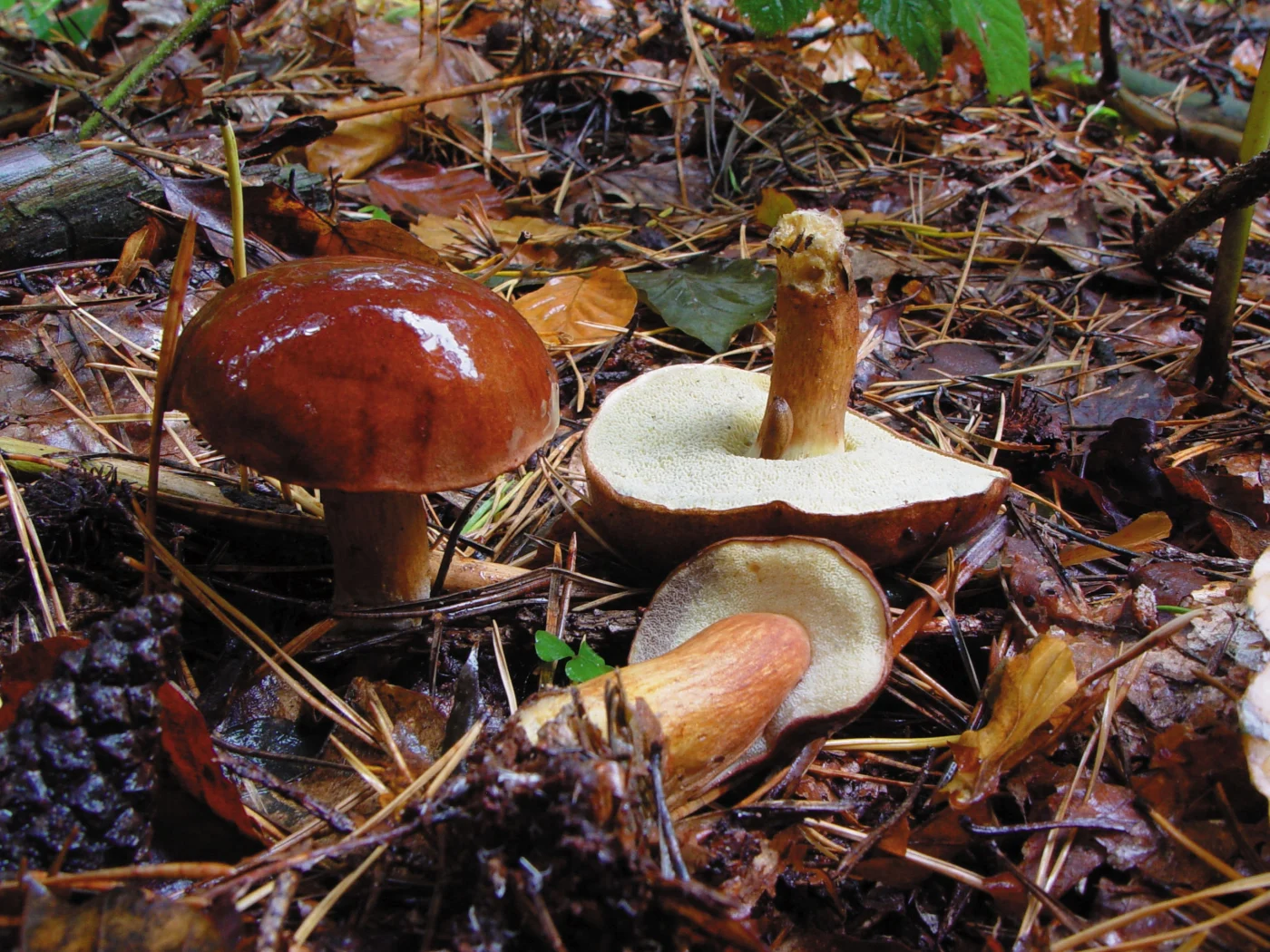
    The Bay Bolete is another common brown-capped woodland mushroom. Its cap is usually chestnut, reddish brown, or dark bay brown and may become slightly sticky when wet. The underside has yellowish pores.

    A useful characteristic is that the pores may turn blue or blue-green when bruised or pressed. The flesh can also show some blue staining after cutting.

    Where it grows

    Bay boletes are usually found on woodland soil, especially beneath conifers, although they can also occur with deciduous trees.

    Possible confusion

    Several other brown boletes can occupy similar habitats. Some poisonous bolete species develop reddish pores or strongly colored stems, but there is no safe rule such as “Blue-staining boletes are poisonous.” That rule is false. Some edible boletes bruise blue, while toxicity depends on species rather than a single color reaction.

    Key clue

    Look at pore color + bruising + stem structure + associated trees, not simply the brown cap.

    3. Armillaria species — Honey Mushrooms

    • Common name: Honey Mushroom
    • Genus: Armillaria

    Honey mushrooms commonly have honey-yellow, tan or brown caps and often grow in large clusters.

    They usually occur around:

    • tree trunks;
    • stumps;
    • roots;
    • buried woody material.

    Many forms develop small scales on the cap, particularly when young. Some species have a prominent ring around the stem.

    Why identification is difficult

    Several Armillaria species exist, and their appearances vary. Even more importantly, other brown wood-growing mushrooms can occur in exactly the same habitat.

    Dangerous look-alike: Galerina marginata

    This is one of the most important mushroom comparisons for anyone collecting honey mushrooms. Both can grow on dead wood and both may have brown caps and stem rings.

    The difference in spore color can help:

    • Armillaria: generally white spores.
    • Galerina marginata: rusty-brown spores.

    A mushroom guide describing the group likewise notes the white-versus-brown spore-print distinction between honey mushrooms and the deadly Galerina complex.

    Key warning

    Never assume every mushroom growing in the same cluster belongs to the same species. Different fungi can fruit from the same stump or log.

    4. Galerina marginata — Deadly Galerina

    • Scientific name: Galerina marginata
    • Common names: Deadly Galerina, Funeral Bell

    Among all small brown mushrooms, this is one of the most important species to recognize. The cap is typically yellow-brown, honey-brown, cinnamon or reddish brown. It may become noticeably paler as it dries. The mushroom grows primarily on decaying wood and may appear singly, in small groups, or in clusters.

    Gills

    Young gills can be relatively pale but become rusty brown as the spores mature. That age-related change is important because pale young gills do not rule out Galerina. Cornell’s mushroom-safety guidance similarly notes that young Galerina gills may appear pale before darkening and recommends using additional characters rather than gill color alone.

    Stem

    The stem is slender and may have a ring or ring zone. The ring can become damaged or disappear in older specimens.

    Why it is dangerous

    The Galerina marginata complex contains amatoxins. Scientific analysis has detected amatoxins in specimens belonging to the G. marginata complex, and documented poisoning reports include fatalities.

    Common look-alikes

    It can be confused with Honey Mushrooms, Kuehneromyces mutabilis, wild enoki and other small wood-growing brown mushrooms.

    If an edible mushroom might plausibly be a Galerina, do not eat it without expert confirmation.

    5. Kuehneromyces mutabilis — Sheathed Woodtuft

    • Scientific name: Kuehneromyces mutabilis
    • Common names: Sheathed Woodtuft, Two-Toned Pholiota

    This edible wood-growing mushroom can form large clusters on deciduous logs and stumps. Its cap is strongly hygrophanous, which means it changes color as it dries. The result is often a conspicuous two-toned appearance — one part of the cap may be darker brown while another section has already faded.

    Stem

    The lower stem commonly shows small scales beneath the ring. This can be an important identification feature.

    Deadly look-alike: Galerina marginata

    This is an advanced identification pair.

    Both species:

    • have brown caps;
    • grow on wood;
    • can have rings;
    • may grow in groups;
    • produce rusty-brown spores.

    That final point is particularly important: a spore print does not safely separate these two species. Identification resources emphasize the darker scales below the ring on Kuehneromyces as one useful macroscopic difference from Galerina.

    Key warning

    Because the consequences of confusion are so serious, Kuehneromyces mutabilis is a poor beginner mushroom for food identification.

    6. Flammulina velutipes — Velvet Shank

    • Scientific name: Flammulina velutipes
    • Common names: Velvet Shank, Wild Enoki

    Wild enoki looks very different from the long white cultivated enoki mushrooms commonly sold in shops.

    Wild specimens develop:

    • yellow-brown to orange-brown caps;
    • pale gills;
    • slender stems.

    The lower part of a mature stem becomes dark brown and noticeably velvety, giving the species its common name.

    Habitat

    It grows in clusters on dead or weakened hardwood trees. It often fruits in cool conditions, including late autumn and winter.

    Dangerous look-alike

    Again, Galerina marginata must be considered. One major difference is the spore print:

    • Flammulina: white.
    • Galerina: rusty brown.

    But identification should incorporate the complete mushroom rather than relying only on a spore print.

    7. Pluteus cervinus — Deer Shield

    • Scientific name: Pluteus cervinus
    • Common names: Deer Shield, Deer Mushroom

    The Deer Shield typically has a smooth gray-brown to dark brown cap. It grows on rotting logs, stumps, buried dead wood.

    The gills are initially whitish and become pinkish as the spores mature.

    Important identification feature

    The gills are free from the stem, meaning they stop just before reaching it. The mushroom has no true ring and no volva.

    Look-alikes

    Numerous Pluteus species have similar brown caps, and identification may sometimes require microscopic examination.

    The pink mature gills can help distinguish Pluteus from several other brown wood-growing mushrooms, but again they are not sufficient on their own.

    8. Coprinellus micaceus — Mica Cap

    • Scientific name: Coprinellus micaceus
    • Common name: Mica Cap

    Mica Caps frequently appear in dense clusters around:

    • tree stumps;
    • buried roots;
    • decaying wood.

    Their caps range from honey-brown to amber or cinnamon brown. Young specimens frequently show tiny reflective particles on the cap surface that resemble grains of mica — hence the name. Rain can wash these particles away.

    As the mushroom ages

    The cap becomes strongly grooved and the gills darken. Like many ink-cap relatives, old specimens may begin to break down.

    Look-alikes

    Related Coprinellus species may be difficult to distinguish. A brown clustered mushroom growing near a stump should also prompt consideration of other wood-growing genera, including Galerina. This is another example of why habitat alone never identifies a species.

    9. Pholiota squarrosa — Shaggy Scalycap

    • Scientific name: Pholiota squarrosa
    • Common name: Shaggy Scalycap

    This striking species has a yellowish to brown cap covered in prominent darker scales. The stem can also be conspicuously scaly. It commonly grows in clusters around the bases of trees and on dead or dying wood.

    Identification clues

    Compared with many “little brown mushrooms,” this species tends to be:

    • larger;
    • more robust;
    • much more heavily scaled.

    Look-alikes

    Honey mushrooms can sometimes grow in a similar clustered manner around tree bases. Other Pholiota species can be particularly difficult to distinguish from one another. Because edibility reports and reactions within this group are inconsistent, unknown Pholiota-like mushrooms should not be treated as food based on appearance.

    10. Paxillus involutus — Brown Roll-Rim

    • Scientific name: Paxillus involutus
    • Common name: Brown Roll-Rim

    The Brown Roll-Rim is a particularly important example of why historical claims about mushroom edibility can be dangerous. Its cap is typically yellow-brown, olive-brown or rusty brown. Young specimens have a strongly inrolled cap margin, which explains the common name. The gills run down the stem and may bruise darker when handled.

    Habitat

    It occurs on soil in woodland and forms relationships with trees.

    Is Brown Roll-Rim edible?

    No. It should be regarded as poisonous. The mushroom was historically eaten in parts of Europe, but repeated consumption has been associated with a severe immune-mediated hemolytic syndrome.

    This is a good reminder that “People used to eat it” does not mean a mushroom is safe.

    Look-alikes

    Various brown funnel-shaped mushrooms can look superficially similar, particularly from photographs taken only from above. Always photograph the gills and stem attachment.

    11. Cortinarius rubellus — Deadly Webcap

    • Scientific name: Cortinarius rubellus
    • Common name: Deadly Webcap

    Cortinarius is one of the largest and most challenging mushroom genera. Many species have brown, orange-brown or reddish-brown caps. The Deadly Webcap typically has a warm orange-brown to reddish-brown appearance and occurs in woodland.

    The cortina

    Young Cortinarius mushrooms often have a delicate, cobweb-like partial veil known as a cortina connecting the cap and stem. As the mushroom matures, the veil disappears but may leave rusty-colored fibers around the stem.

    Spore color

    Cortinarius mushrooms typically produce rusty-brown spores.

    Why this mushroom matters

    Some Cortinarius species contain orellanine, a toxin capable of causing severe kidney damage. One of the particularly dangerous aspects of orellanine poisoning is that symptoms can be significantly delayed.

    Look-alikes

    Brown Cortinarius species can resemble many unrelated woodland mushrooms. For beginners, a combination of brown cap + rusty spores + cortina or rusty veil remnants should be a strong reason for caution rather than a final identification.

    12. Tylopilus felleus — Bitter Bolete

    • Scientific name: Tylopilus felleus
    • Common names: Bitter Bolete, Bitter Tylopilus

    The Bitter Bolete is important because it can closely resemble porcini.

    It has:

    • a brown cap;
    • thick stem;
    • pores rather than gills.

    Young pore surfaces can initially appear pale, becoming increasingly pinkish with age.

    The stem frequently develops a relatively dark, coarse net-like pattern.

    Main look-alike: Boletus edulis

    At first glance, a young Bitter Bolete can easily be mistaken for porcini.

    Useful differences include:

    • Porcini: usually whitish → yellow/olive pores.
    • Bitter Bolete: pores often become distinctly pinkish.

    The Bitter Bolete is famous for its extremely bitter flavor. Never taste an unidentified wild mushroom as a shortcut to identification.

    How to Identify an Unknown Brown Mushroom

    When you find an unidentified brown mushroom, work through the specimen systematically.

    1. Look Under the Cap

    Determine whether the underside has gills, pores, teeth, folds or another structure. This immediately eliminates huge numbers of possibilities.

    2. Check Where It Is Growing

    Ask whether it is growing directly from soil, from a stump, from a fallen log, from buried wood, from living tree roots or in grass.

    For example, a brown mushroom apparently growing “from soil” may actually be attached to buried roots.

    3. Photograph the Whole Stem

    Do not cut the stem off at ground level before identification. The base can contain important structures.

    4. Examine the Gills or Pores

    Record:

    • color;
    • attachment;
    • spacing;
    • bruising;
    • changes with age.

    5. Look for a Ring or Cortina

    Check for:

    • a substantial ring;
    • a fragile ring zone;
    • cobweb-like veil remnants;
    • colored fibers on the stem.

    Remember that rings can disappear as mushrooms age.

    6. Check the Spore Print

    Spore color can dramatically narrow the possibilities. Common colors include white, cream, pink, brown, rusty brown, purple-brown and black.

    But a spore print is one piece of evidence, not proof of edibility.

    Why Small Brown Mushrooms Are So Difficult to Identify

    Mycologists and mushroom enthusiasts often jokingly refer to small brown mushrooms as LBMs — Little Brown Mushrooms. The joke reflects a real identification problem. Species from completely different genera can share similar brown caps, similar sizes, brownish gills, thin stems and woodland habitats.

    Some can only be reliably separated by examining microscopic characters such as spores, cystidia or cap structure.

    The difference between two superficially similar brown mushrooms can also be enormous from a safety perspective.

    Kuehneromyces mutabilis and Galerina marginata, for example, can occupy essentially the same ecological niche and appear remarkably similar. Yet G. marginata belongs to a complex scientifically demonstrated to contain deadly amatoxins.

    Brown Mushrooms Growing on Wood

    If your brown mushroom is growing on a stump or log, common possibilities include:

    • Honey Mushrooms
    • Deadly Galerina
    • Velvet Shank
    • Sheathed Woodtuft
    • Mica Caps
    • Pholiota species
    • Deer Shield

    Take extra care with small brown specimens. Do not assume a mushroom is safe because you previously collected edible mushrooms from the same tree. Two or more species can fruit together.

    Brown Mushrooms Growing in Gras

    Brown mushrooms in lawns and meadows may belong to entirely different groups.

    Useful identification features include:

    • whether a ring is present;
    • gill color;
    • spore-print color;
    • whether the mushroom grows in fairy rings;
    • whether the cap changes color when wet;
    • whether the stem base is enlarged.

    A lawn mushroom should never be classified simply as a “field mushroom” based on its location.

    For example, genuine Agaricus campestris typically develops gills that progress from pink to chocolate brown as the mushroom matures.

    Other grassland fungi can look completely different underneath while appearing similar from above.

    Brown Mushrooms With Pores

    A brown mushroom with a sponge-like underside is most likely some kind of bolete.

    Common possibilities include:

    • Boletus edulis
    • Imleria badia
    • Tylopilus felleus
    • Suillus species

    and numerous other genera.

    Do not rely on folklore rules such as:

    “All boletes are edible if they don’t have red pores.”

    Mushroom identification does not work that way. Use the complete combination of: cap + pores + stem + bruising + habitat + trees + geographic region.

    Brown Mushrooms With Gills

    A brown cap with gills is far less specific.

    Possible genera include Galerina, Cortinarius, Armillaria, Pluteus, Pholiota, Coprinellus, Paxillus and many more.

    For gilled brown mushrooms, some of the most useful characteristics are: spore color, gill attachment and veil structure. These features are usually far more informative than brown cap color.

    Can You Identify a Brown Mushroom From a Photo?

    A good series of photographs can help narrow the possibilities dramatically.

    For useful mushroom identification, photograph:

    1. the cap from above;
    2. the underside;
    3. the entire stem;
    4. the complete stem base;
    5. a specimen cut lengthwise when appropriate;
    6. several mushrooms at different ages;
    7. the substrate;
    8. nearby trees and habitat.

    One top-down image of a brown cap is often insufficient.

    An AI mushroom identifier can suggest likely species, but it cannot make an unknown mushroom safe to eat.

    Frequently Asked Questions

    What is the most common brown mushroom?

    There is no single answer. Brown coloration occurs in thousands of mushroom species across many unrelated genera. The most likely species depends on location, habitat, substrate and season.

    How do I identify a small brown mushroom?

    Start with the underside, spore color, stem, substrate and veil structures. Small brown mushrooms are notoriously difficult to identify and sometimes require microscopy.

    Are brown mushrooms poisonous?

    Some are edible, some are inedible, and some are dangerously poisonous.

    Color does not predict toxicity.

    What deadly mushroom is small and brown?

    One especially important species is Galerina marginata, which grows on decaying wood and contains amatoxins. Scientific studies have confirmed amatoxins within the G. marginata species complex.

    What brown mushroom looks like a porcini?

    Tylopilus felleus, the Bitter Bolete, is a common porcini look-alike. Its pores often develop pinkish tones and its flesh is intensely bitter.

    What brown mushrooms grow on tree stumps?

    Possible species include Honey Mushrooms, Deadly Galerina, Sheathed Woodtuft, Velvet Shank, Mica Caps and various Pholiota species.

    Is a brown mushroom with pores edible?

    Not necessarily. Having pores rather than gills tells you that the mushroom probably belongs to a bolete or related group, but it does not establish edibility.

    Can brown mushrooms be identified by cap color?

    No. Brown is one of the least useful mushroom characteristics when considered alone. Moisture, age, sunlight and natural variation can all alter cap color.

    Final Identification Rule

    When identifying a brown mushroom, stop asking: “Which mushroom has this brown cap?”

    Instead ask:

    • Does it have gills or pores?
    • What color are the spores?
    • Does it grow from soil or wood?
    • Is there a ring, cortina or volva?
    • Does it bruise or change color?
    • Which trees are nearby?

    Those observations transform a generic “brown mushroom” into a much smaller set of possible species. And if the mushroom is a small brown species growing on wood, always consider Galerina marginata among the possibilities until it has been reliably ruled out. Found a brown mushroom? Use photo identification to narrow down possible species, but confirm the result independently with an experienced local mushroom expert before making any decision about edibility.

  • Mushroom Look-Alike Guide: 10 Edible Mushrooms and Their Dangerous Doubles

    Mushroom Look-Alike Guide: 10 Edible Mushrooms and Their Dangerous Doubles

    Wild mushroom foraging can be rewarding, but appearance alone is not enough to determine whether a mushroom is safe to eat. Some prized edible species have poisonous — and occasionally deadly — look-alikes growing in the same forests and during the same seasons.

    Color is especially unreliable. Accurate mushroom identification may require examining the underside of the cap, stem base, gills or pores, flesh, spore print, habitat, host trees, bruising reactions, and other features. Poison Control warns that wild mushrooms should not be eaten unless they have been reliably identified by an expert. Some serious mushroom poisonings also have delayed symptoms, which can make them particularly dangerous.

    This guide compares ten well-known edible mushrooms with species that can be confused with them.

    Important: This article is for educational purposes only. Never use a photograph, mobile app, AI identification, or a single visual feature as the sole basis for deciding whether a wild mushroom is edible.

    Quick Mushroom Look-Alike Comparison

    Edible mushroom Dangerous or poisonous look-alike One important difference
    Chanterelle Jack-o’-lantern Chanterelles have blunt folds; jack-o’-lanterns have true gills
    True morel False morel True morels are hollow inside
    Honey mushroom Galerina marginata Galerina can contain deadly amatoxins
    Puffball Young Amanita Puffballs should be uniformly solid white inside
    Parasol mushroom Green-spored parasol Look-alike develops a greenish spore print
    Porcini Satan’s bolete and related toxic boletes Toxic boletes often show combinations of red pores and strong color changes
    Matsutake Amanita smithiana Amanita may have structures around the stem base hidden in soil
    Field mushroom Death cap / destroying angel Amanitas may have a volva at the stem base
    Caesar’s mushroom Fly agaric and other Amanitas Young Amanitas can look surprisingly similar
    Saffron milk cap Woolly milkcap Cap texture and latex characteristics differ

    1. Chanterelle vs Jack-o’-Lantern

    Edible mushroom: Cantharellus species
    Poisonous look-alike: Omphalotus species

    Chanterelles are among the most popular wild mushrooms. Their yellow to orange coloration and funnel-shaped caps are distinctive, but inexperienced foragers can confuse them with jack-o’-lantern mushrooms.

    The underside is one of the most useful clues. Chanterelles have blunt, forked folds or ridges that run down the stem rather than thin, blade-like true gills. Jack-o’-lanterns have numerous sharp-edged true gills.

    Habitat also provides an important clue. Chanterelles usually emerge from soil in association with trees, while jack-o’-lanterns grow from wood, including buried roots, stumps, and decaying trees. Jack-o’-lanterns also frequently occur in dense clusters.

    The Missouri Department of Conservation specifically identifies jack-o’-lantern mushrooms as poisonous chanterelle look-alikes and notes their true gills and tendency to grow in clusters from wood.

    Eating jack-o’-lantern mushrooms can cause significant gastrointestinal poisoning, including nausea, vomiting, abdominal pain, and diarrhea.

    Key distinction

    Chanterelle: blunt ridges, usually growing from soil.
    Jack-o’-lantern: sharp true gills, commonly growing in clusters from wood.

    2. True Morel vs False Morel

    Edible mushroom: Morchella species
    Dangerous look-alike: Gyromitra species

    Morels are famous spring mushrooms with deeply pitted caps that resemble a honeycomb. Several so-called false morels, particularly species of Gyromitra, appear during similar seasons and can cause serious poisoning.

    A true morel has a cap covered with clearly defined pits and ridges. When the mushroom is cut lengthwise from top to bottom, the interior is essentially hollow.

    False morels tend to have irregular, folded, lobed, or brain-like caps rather than a regular network of pits. Their interior is often chambered rather than completely hollow.

    Some Gyromitra species contain gyromitrin, which can cause severe gastrointestinal symptoms as well as liver, kidney, neurological, and blood-cell damage. Serious and fatal poisonings have occurred.

    Even true morels should not be eaten raw or inadequately cooked.

    Key distinction

    True morel: clearly pitted cap and hollow interior.
    False morel: wrinkled or brain-like cap and often chambered interior.

    3. Honey Mushroom vs Galerina marginata

    Edible mushroom: Armillaria species
    Deadly look-alike: Galerina marginata

    Honey mushrooms often fruit in large groups around trees, stumps, roots, and buried wood. Unfortunately, deadly Galerina marginata can occupy similar habitats.

    This is one of the mushroom comparisons where relying on general cap color is particularly dangerous. Both can appear brownish or honey-colored and may occur on dead wood.

    Galerina marginata is especially important because it contains amatoxins — the same class of toxins associated with deadly Amanita poisoning. NAMA includes Galerina marginata among mushrooms responsible for extremely serious amatoxin poisoning.

    Identification should incorporate several characteristics, including spore-print color, cap and stem structure, growth pattern, and microscopic characters when necessary.

    This is not a pair that beginners should attempt to separate using photographs alone.

    Key distinction

    There is no single beginner-friendly visual feature that makes this comparison safe. Any honey-colored mushroom growing on wood deserves careful identification before consumption.

    4. Puffball vs Young Amanita

    Edible mushroom: selected true puffballs
    Dangerous look-alike: immature Amanita species

    Young puffballs can appear as round white balls on the forest floor. Unfortunately, very young Amanitas can initially be enclosed in a universal veil and may also resemble a white ball.

    For that reason, edible puffballs should always be cut vertically through the center before identification is considered complete.

    A genuine edible puffball in suitable condition should have a uniform, solid white interior without the outline of a developing cap, gills, or stem.

    A young Amanita cut open may reveal a recognizable immature mushroom structure inside — including the beginnings of the cap, gills, and stem.

    This distinction is extremely important because some Amanitas contain amatoxins capable of causing fatal liver failure. NAMA identifies Amanita phalloides and several destroying-angel species among the mushrooms responsible for extremely serious amatoxin poisoning.

    Key distinction

    Puffball: uniformly white and homogeneous inside when young and edible.
    Young Amanita: internal mushroom structures may be visible when cut open.

    Never eat an unidentified white “egg-shaped” mushroom without cutting it completely through the center.

    5. Parasol Mushroom vs Green-Spored Parasol

    Edible mushroom: Macrolepiota procera
    Poisonous look-alike: Chlorophyllum molybdites

    The parasol mushroom is a large, elegant mushroom with a tall stem and broad, scaly cap. Several other large lawn mushrooms can look surprisingly similar.

    One important poisonous look-alike is Chlorophyllum molybdites, commonly known as the green-spored parasol or false parasol.

    Young specimens can have pale gills, making quick visual identification unreliable. As the spores mature, however, the gills of C. molybdites can develop a gray-green to greenish appearance, and its spore print is characteristically green.

    The species is a well-known cause of mushroom poisoning and can produce severe vomiting, diarrhea, and abdominal distress. NAMA poisoning reports repeatedly include Chlorophyllum molybdites.

    Key distinction

    True parasol: pale spore print.
    Green-spored parasol: greenish mature gills and green spore print.

    Large size and a scaly cap alone are not enough for identification.

    6. Porcini vs Toxic Boletes

    Edible mushroom: Boletus edulis and close edible relatives
    Dangerous look-alikes: toxic red-pored boletes, including species traditionally associated with the “Satan’s bolete” group

    Porcini are among the world’s most sought-after edible mushrooms. Instead of gills, the underside of the cap consists of a sponge-like layer of pores.

    That feature makes boletes relatively easy to recognize as a broad group — but it does not mean that every bolete is edible.

    Some poisonous boletes can produce intense gastrointestinal symptoms. Potential warning characters among certain toxic species include bright red or orange pores, red coloration on the stem, and strong blue staining after the flesh is cut or bruised.

    However, none of these characters should be treated as a universal rule. Some edible boletes stain blue, while coloration varies considerably with species, age, and condition.

    Key distinction

    Porcini: typically pale pores when young, becoming yellowish to olive with age, with a characteristic reticulated network often visible on the upper stem.
    Some toxic boletes: may combine red pores, strong red stem coloration, and rapid staining.

    Boletes should be identified to species rather than classified as edible simply because they have pores instead of gills.

    7. Matsutake vs Amanita smithiana

    Edible mushroom: matsutake group, including Tricholoma species harvested under this common name
    Dangerous look-alike: Amanita smithiana

    Matsutake mushrooms are highly prized, particularly in Japanese cuisine. In western North America, however, mushroom hunters have confused matsutake-like mushrooms with Amanita smithiana.

    NAMA reports that Amanita smithiana has caused numerous poisonings in the Pacific Northwest and notes that it may be mistaken for the locally harvested pine mushroom or matsutake. Poisoning can involve gastrointestinal symptoms and serious kidney damage.

    The problem is made more difficult because important Amanita structures can remain underground. Pulling or digging out the entire stem base rather than cutting the mushroom above ground can therefore be essential for identification.

    Key distinction

    Never identify a matsutake-like mushroom without examining the entire stem base and considering habitat, odor, gill attachment, veil structures, and other diagnostic characteristics.

    This is a particularly poor group for identification from cap photographs alone.

    8. Field Mushroom vs Death Cap or Destroying Angel

    Edible mushroom: Agaricus campestris and related edible Agaricus
    Deadly look-alikes: dangerous white or pale Amanita species

    Field mushrooms are familiar white mushrooms often found in grasslands and lawns. Young specimens can superficially resemble dangerous Amanitas.

    One useful distinction is gill development. Agaricus mushrooms typically have pinkish gills when young that become chocolate brown as the spores mature. Amanitas normally retain pale or white gills.

    The base of the stem is even more important. Deadly Amanitas can possess a cup-like volva around the stem base, which may be hidden below the soil or leaf litter.

    This is why mushroom hunters should never identify a potentially edible white mushroom after cutting the stem off at ground level.

    Death caps and destroying angels can contain amatoxins capable of causing catastrophic liver damage, and symptoms may not appear until many hours after the mushroom has been eaten.

    Key distinction

    Agaricus: gills generally progress from pink toward dark brown.
    Dangerous Amanita: typically pale gills and may have a volva at the stem base.

    A white cap alone tells you almost nothing about edibility.

    9. Caesar’s Mushroom vs Fly Agaric and Other Amanitas

    Edible mushroom: Amanita caesarea group
    Dangerous look-alikes: Amanita muscaria and other toxic Amanitas

    Caesar’s mushroom has been prized as an edible species since antiquity, particularly around the Mediterranean region. But it belongs to Amanita — the same genus that contains some of the world’s most dangerous mushrooms.

    Mature Caesar’s mushrooms typically show an orange to red-orange cap, yellow gills, a yellow stem and ring, and a prominent white sac-like volva around the stem base.

    Fly agarics may also have orange-red caps, particularly after rain has washed away some of their characteristic white patches. Young specimens enclosed in their veils can be especially challenging.

    Amanita muscaria contains neuroactive toxins and can produce serious poisoning. More importantly, a person unfamiliar with Amanita morphology risks confusing edible species with still more dangerous members of the genus.

    Key distinction

    Identification requires examination of cap, gills, stem, ring, volva, and the complete stem base together.

    For beginners, edible Amanitas are among the groups where a conservative approach is especially appropriate.

    10. Saffron Milk Cap vs Woolly Milkcap

    Edible mushroom: Lactarius deliciosus group
    Toxic or inedible look-alike: Lactarius torminosus

    Saffron milk caps are popular edible mushrooms in many parts of Europe. They commonly occur with pine trees and release colored latex when the gills or flesh are damaged.

    The woolly milkcap, Lactarius torminosus, can occur in similar northern habitats and has a superficially similar zoned cap.

    The surface of L. torminosus, however, tends to have a conspicuously woolly or hairy margin when young, while the cap is typically pinkish rather than the stronger orange coloration associated with saffron milk caps. Its latex and staining behavior also differ.

    Consumption of improperly identified toxic milkcaps can cause gastrointestinal illness.

    Key distinction

    Do not identify milkcaps by cap color alone. Examine the latex color, changes after exposure, cap margin, gills, bruising behavior, and associated tree species.

    Why Mushroom Look-Alikes Are So Difficult

    Mushroom identification is rarely based on a single feature.

    A photograph of the cap may exclude dozens of species while still leaving several possibilities that differ dramatically in edibility. Reliable identification can require seeing the underside, intact stem base, substrate, surrounding trees, flesh after cutting, spore color, odor, and sometimes microscopic structures.

    Geography matters as well. A mushroom familiar to a forager in Europe may have a different but similar-looking counterpart in North America. Poison Control specifically warns that knowledge learned in one region should not automatically be applied elsewhere.

    This is also why sayings such as “poisonous mushrooms turn silver black,” “insects only eat edible mushrooms,” or “cooking removes the poison” should never be used as identification rules. Cooking does not make many poisonous species safe.

    What to Photograph for Mushroom Identification

    If you find an unknown mushroom, photograph it before disturbing its surroundings. A useful identification set should show the cap from above, the underside with gills, pores, teeth, or folds, the entire stem including its base, a mushroom cut lengthwise, and the surrounding habitat.

    Whenever possible, record nearby trees and whether the mushroom is growing directly from soil, living wood, dead wood, buried roots, grass, or another substrate.

    A single attractive top-down photograph is often not enough to distinguish an edible mushroom from a poisonous look-alike.

    Can AI Identify Whether a Mushroom Is Safe to Eat?

    AI and photo-based mushroom identification tools can be useful for suggesting possible species and narrowing down a large number of candidates. They are best treated as an identification aid, not as proof of edibility.

    An image may fail to show critical characteristics such as a hidden volva, latex color, spore print, smell, microscopic structures, or the mushroom’s association with a particular tree.

    If an identification has consequences for eating a wild mushroom, verify it independently with an experienced local mushroom expert or mycological organization.

    Final Safety Rule

    The most important lesson from mushroom look-alikes is simple: similar appearance does not mean similar toxicity.

    A chanterelle can resemble a poisonous jack-o’-lantern. A morel can be confused with a toxic false morel. A honey mushroom can grow alongside an amatoxin-containing Galerina. A harmless-looking white mushroom can belong to the same general visual category as a deadly Amanita.

    When there is uncertainty, leave the mushroom uneaten.

    Use mushroom identification guides and photo-identification tools to learn which species might be present, then confirm the identification using multiple characteristics and appropriate local expertise.

    References

    Safety and toxicology information in this guide is based in part on resources from the North American Mycological Association, Poison Control, the Missouri Department of Conservation, and university or government mushroom-identification resources.