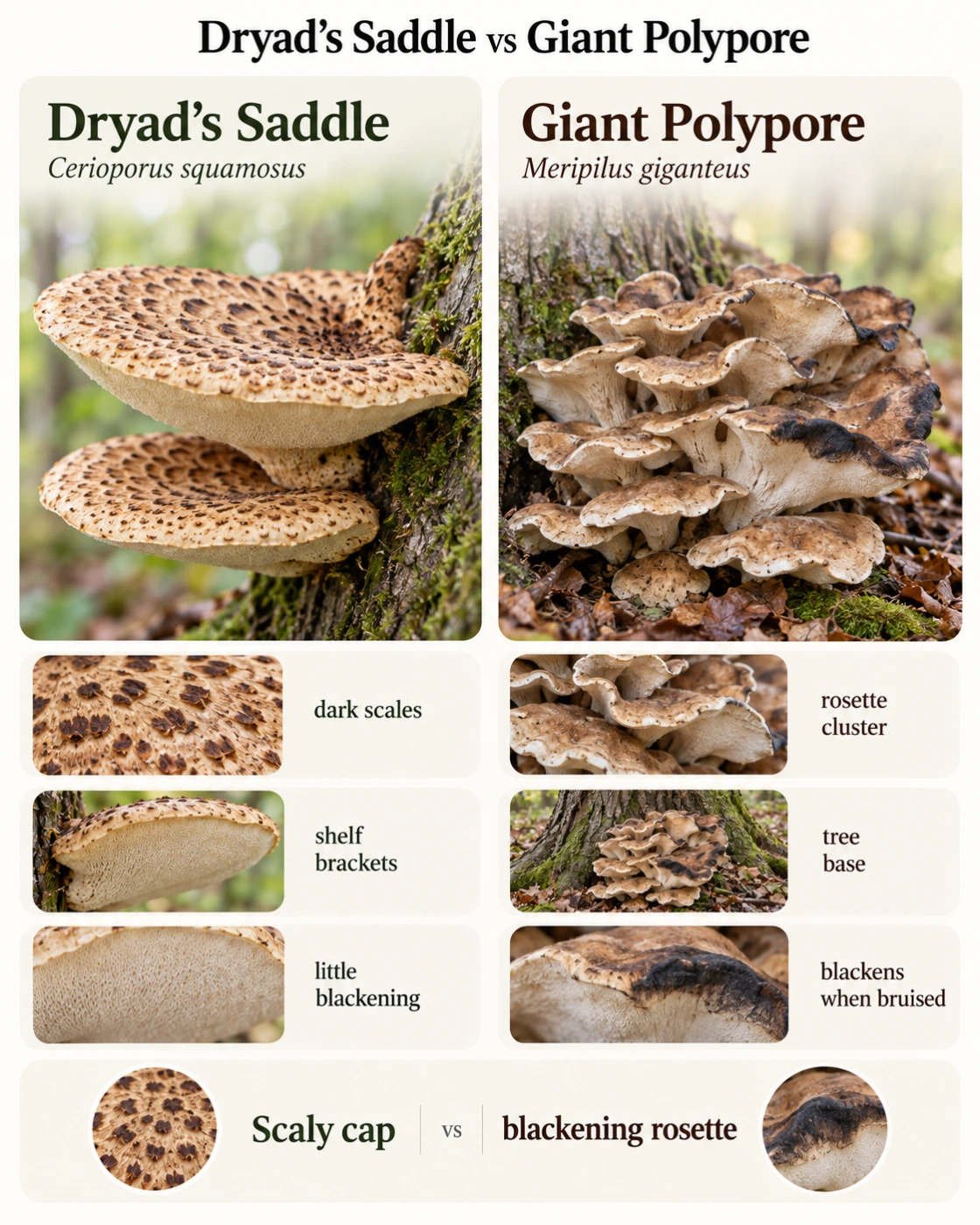
Dryad’s Saddle (Cerioporus squamosus) and Giant Polypore (Meripilus giganteus) are both large bracket fungi that grow on hardwoods and can form impressive clusters around trunks, stumps, and roots. From a distance, both may look like broad brown shelves with pale undersides, especially when the fruit bodies are young.
The easiest way to separate them is to compare cap pattern, growth form, and bruising behavior. Dryad’s Saddle usually has bold dark scales arranged across a tan cap, while Giant Polypore forms larger overlapping rosettes and typically darkens strongly when bruised or cut.
⚠️ Important: Large bracket fungi should not be identified for eating from a single photograph. Age, host tree, texture, bruising, and the pore surface all matter, and older fruit bodies can look very different from young ones.
Quick Comparison
| Feature | Dryad’s Saddle | Giant Polypore |
|---|---|---|
| Scientific name | Cerioporus squamosus | Meripilus giganteus |
| Common name | Dryad’s Saddle / Pheasant Back | Giant Polypore |
| Growth form | Individual shelves, often overlapping | Massive rosettes of many broad fronds |
| Cap color | Cream to tan with dark scales | Pale brown to ochre, usually less boldly patterned |
| Cap pattern | Strong dark radial scales | Broad zoning, streaks, or mottling |
| Underside | White to cream pores | White to cream pores |
| Bruising | Usually weak or limited darkening | Often darkens brown to black |
| Texture | Fleshy when young, tougher with age | Soft-fleshy when young, then tougher |
| Typical host | Hardwood, especially elm, maple, beech, poplar | Hardwood, especially beech, oak and other broadleaf trees |
| Growth position | Trunks, stumps, logs | Base of trees, stumps, buried roots |
| Main clue | Scaly cap pattern | Strong blackening after damage |
The Fastest Way to Tell Them Apart
Look at the upper surface first. Dryad’s Saddle usually has a very obvious pattern of dark brown scales or patches across a pale background, often arranged in broad radial zones.
Then test a fresh area for bruising. Giant Polypore often becomes noticeably dark brown to black where the flesh or pores are pressed or damaged, while Dryad’s Saddle usually does not show the same strong blackening reaction.
Dryad’s Saddle — Cerioporus squamosus
Dryad’s Saddle is a large annual polypore that grows on hardwoods, both living and dead. It often appears in spring and early summer, although fruiting can continue later depending on climate and weather.
The brackets are broad, fan-shaped to kidney-shaped, and usually attach laterally to wood. Several can overlap, but individual caps are often clearly distinguishable.
Cap
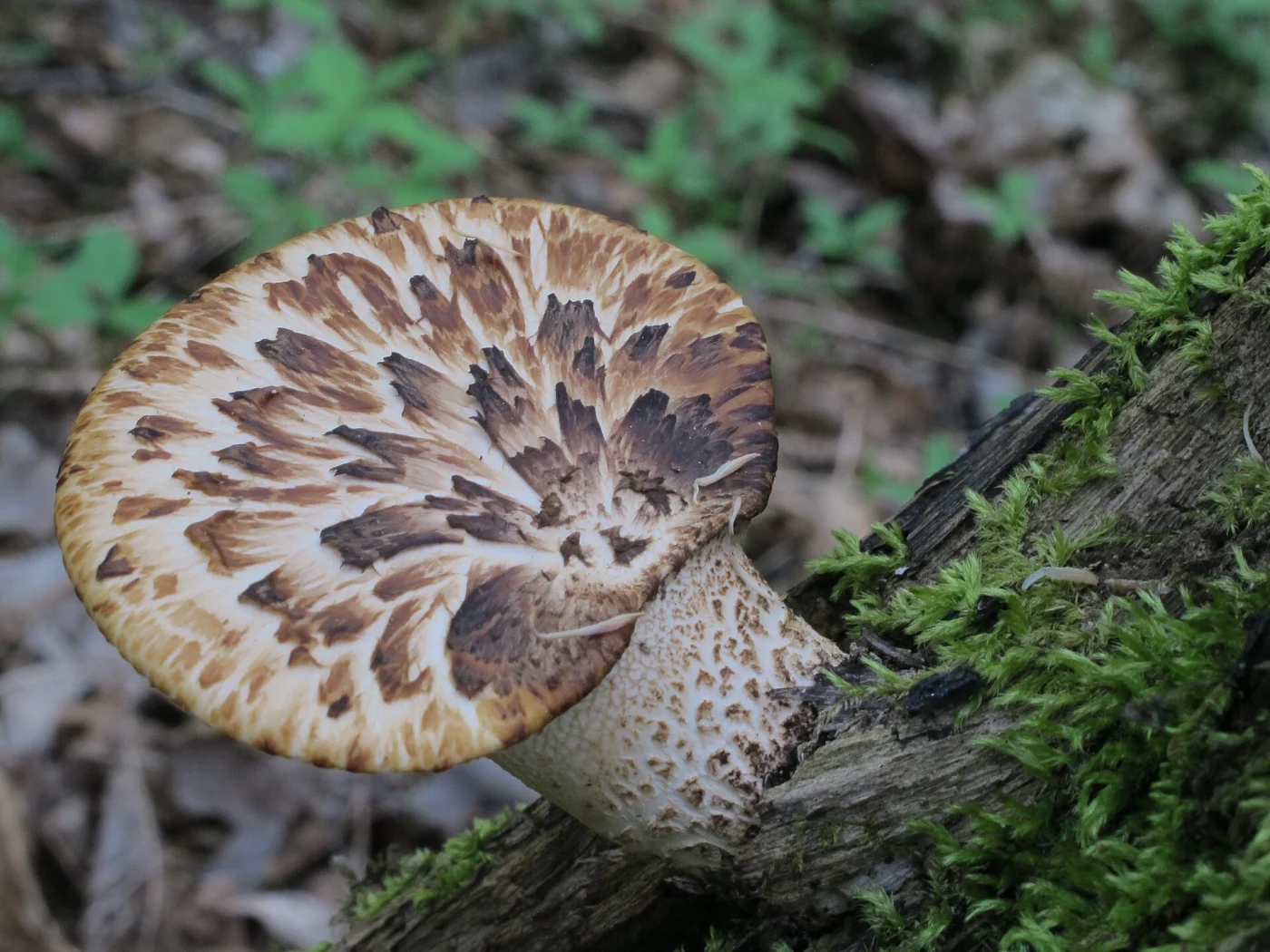
The cap is pale cream, beige, tan, or yellowish brown and covered with darker brown scales. These scales are usually arranged in a striking pattern that can resemble the feathering on a pheasant’s back.
Young caps may be thick and fleshy, while older ones become flatter and tougher. The margin is usually paler and smoother than the center.
Cap Pattern
The dark scales are one of the strongest field marks. They are usually well defined and contrast clearly with the lighter cap surface.
This patterned surface gives rise to the common name Pheasant Back. Giant Polypore can show zoning or mottling, but usually lacks the same bold, regular scaly pattern.
Underside
The underside has a pale pore surface, usually white to cream. The pores are relatively large and can become elongated or angular, especially toward the stem or attachment point.
This is different from many finer-pored polypores. A close-up of the underside can be useful when the cap pattern is weathered or damaged.
Stem and Attachment
Dryad’s Saddle often has a short lateral or off-center stem-like attachment. In some specimens this is obvious, while others appear nearly sessile.
The attachment is usually darkened or blackish at the base. Giant Polypore tends to form many fronds arising from a common basal mass rather than separate saddle-like caps with obvious lateral attachment.
Flesh
The flesh is white to cream and can be quite thick in young specimens. Young caps may feel succulent or firm-fleshy, but they become tough and fibrous with age.
This age-related change is important because mature Dryad’s Saddle can become much harder and less distinctive in texture.
Smell
Fresh Dryad’s Saddle often has a distinctive smell that is frequently described as cucumber-like, watermelon-rind-like, or floury. This can be a useful supporting feature when the mushroom is fresh.
Smell is subjective, so it should not be used as the main distinction. Cap scales and overall growth form are much more reliable.
Giant Polypore — Meripilus giganteus
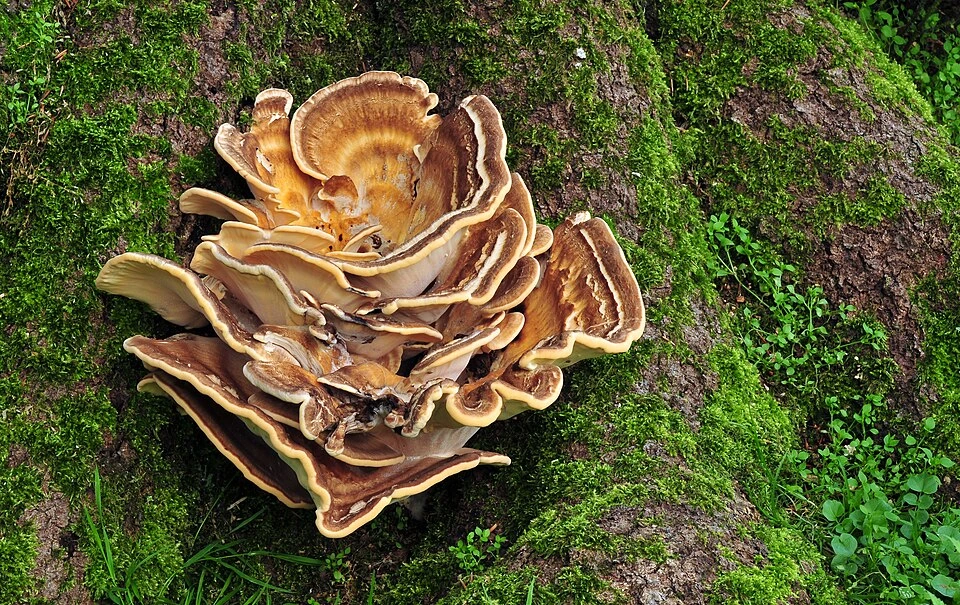
Giant Polypore is a very large annual polypore that can produce enormous rosettes at the base of living or dead broadleaf trees. A single fruiting body can consist of many broad overlapping fronds and reach impressive overall dimensions.
It is especially associated with the lower trunk, root flare, stumps, or buried roots. From a distance, a mature cluster can look like a huge layered fan spreading outward from the tree base.
Cap
Individual fronds are broad and fan-shaped, usually pale brown, ochre, tan, or gray-brown. They may show concentric zoning or uneven streaks, but the pattern is generally less sharply scaly than in Dryad’s Saddle.
Young margins are often paler. With age, the upper surface can darken and become less visually uniform.
Growth Form
The rosette structure is one of the best clues. Many broad fronds arise from a common base and overlap densely.
Dryad’s Saddle can also occur in groups, but the brackets are usually more individually defined and often arranged along trunks or logs rather than forming one massive basal rosette.
Underside
The pore surface is white to cream when fresh. The pores are small to moderately sized and can become darker with age or damage.
The underside is especially useful because Giant Polypore often shows a strong bruising reaction.
Blackening Reaction
Fresh tissue typically darkens where it is pressed, cut, or bruised. The reaction may begin brown and then progress toward very dark brown or black.
This is one of the strongest differences from Dryad’s Saddle. If a large pale polypore at the base of a hardwood turns strongly black after damage, Giant Polypore becomes much more likely.
Flesh
Young flesh is soft to firm and pale. It becomes tougher as the fruit body ages, especially in the thicker central parts of the rosette.
Damage can trigger the characteristic darkening reaction. This can be seen both on the pore surface and in cut flesh.
Where Does Dryad’s Saddle Grow?
Dryad’s Saddle grows on hardwood trunks, stumps, logs, and wounded living trees. It can occur well above ground level as well as near the base.
Elm is a classic host, but the species can also occur on maple, beech, poplar, willow, and other broadleaf trees.
Where Does Giant Polypore Grow?
Giant Polypore is strongly associated with the base of broadleaf trees and their roots. It commonly fruits from soil around the trunk where buried roots or decayed woody tissue are present.
Beech is a particularly well-known host in Europe, but oak and other broadleaf trees can also support it. Its position near the root zone is often an important clue.
Dryad’s Saddle vs Giant Polypore: Cap Pattern
The upper surface is usually the quickest visual difference. Dryad’s Saddle has distinct dark scales on a pale background, creating a patterned appearance.
Giant Polypore tends to be more broadly zoned or mottled. The surface may still have darker markings, but they usually do not form the same clear pheasant-back pattern.
Dryad’s Saddle vs Giant Polypore: Growth Form
Dryad’s Saddle often produces separate fan-shaped brackets, even when several overlap. These may emerge from the side of a trunk, stump, or log.
Giant Polypore more often forms a huge basal rosette. Many broad fronds spread outward from a shared central base near roots or the lower trunk.
Dryad’s Saddle vs Giant Polypore: Bruising
Bruising is one of the most practical tests when the specimen is fresh. Giant Polypore typically darkens strongly after pressure or cutting.
Dryad’s Saddle may discolor somewhat with age or damage, but it usually does not produce the same rapid, pronounced blackening.
Dryad’s Saddle vs Giant Polypore: Pores
Both have pores rather than gills. The pore surface is pale when young, so the underside can initially look similar.
In Dryad’s Saddle, the pores are often relatively large and can become angular or elongated. In Giant Polypore, the stronger bruising response of the pore layer is usually more useful than pore shape alone.
Dryad’s Saddle vs Giant Polypore: Habitat
Both are hardwood-associated decomposers, so host tree alone rarely solves the identification. The position on the tree is often more informative.
A scaly bracket growing from the side of a trunk fits Dryad’s Saddle well. A huge darkening rosette growing around the base of a beech or oak fits Giant Polypore much better.
Is Dryad’s Saddle Edible?
Young Dryad’s Saddle is considered edible when correctly identified and still tender. Older specimens become tough and fibrous and are generally unsuitable for ordinary culinary use.
Edibility should only be considered after confident identification. Large polypores can change appearance significantly with age, and several different species may grow on the same tree.
Is Giant Polypore Edible?
Young Giant Polypore is sometimes described as edible in some sources, but it becomes tough quickly and is not generally treated as a beginner food mushroom. Identification confidence is especially important because large basal polypores can be difficult to separate when weathered.
For MushroomID purposes, it is safer to treat Giant Polypore primarily as an identification species rather than a culinary target.
Other Look-Alikes
Several other large hardwood polypores can resemble one or both species. The most useful comparisons involve growth form, cap texture, pore reaction, and host position.
A large bracket with no obvious scales and no strong blackening reaction should not automatically be forced into either of these two species.
Berkeley’s Polypore — Bondarzewia berkeleyi
Identification
Berkeley’s Polypore forms large pale rosettes at the base of hardwood trees. The caps are often thick, cream to tan, and relatively smooth.
Its overall growth form can resemble Giant Polypore, especially when the fruiting body is young.
Main Difference
Berkeley’s Polypore generally lacks the dramatic blackening reaction of Giant Polypore. Its fronds are often thicker and paler as well.
Black-Staining Polypore — Meripilus sumstinei
Identification
In North America, Meripilus sumstinei is an important black-staining polypore associated with hardwood roots and stumps. It forms large overlapping rosettes and darkens strongly when bruised.
This species occupies the same general identification role that Meripilus giganteus does in Europe.
Main Difference
Geography matters. A black-staining basal polypore in North America should not automatically be called Meripilus giganteus.
Dryad’s Saddle vs Berkeley’s Polypore
Dryad’s Saddle is usually more strongly patterned, with obvious dark scales across a pale cap. Berkeley’s Polypore is generally smoother, thicker, and more rosette-like.
The location also helps. Dryad’s Saddle commonly grows from trunks and logs, while Berkeley’s Polypore is more often found as a large basal rosette.
How to Identify Dryad’s Saddle Step by Step
Start with the cap surface. Look for the characteristic pale background with large dark scales arranged across the cap.
Then examine the underside, attachment, smell, and growth position before deciding on the species.
Step 1: Check the Cap Pattern
Distinct dark scales on a pale tan background strongly support Dryad’s Saddle. A mostly smooth or broadly zoned surface points elsewhere.
Weathered specimens may lose some contrast, so young caps are the easiest to assess.
Step 2: Examine the Pores
Look for pale, relatively large pores. They may appear angular or stretched near the point of attachment.
Very fine pores combined with a massive basal rosette suggest another polypore.
Step 3: Check the Growth Position
Growth from the side of a trunk, stump, or log is common. Several separate brackets may overlap but remain individually recognizable.
A huge basal rosette around roots should make you consider Giant Polypore or another rosette-forming species.
How to Identify Giant Polypore Step by Step
Begin with the overall architecture. A very large cluster of overlapping fronds around the base of a hardwood is a strong first clue.
Then test fresh tissue for the blackening reaction.
Step 1: Look for a Basal Rosette
Many broad fronds should arise from a common base. The fruiting body can become much larger than a typical cluster of Dryad’s Saddle.
This massive layered structure is one of the most characteristic features.
Step 2: Test for Darkening
Press or cut a fresh pore surface and wait. Strong brown-to-black staining strongly supports Meripilus.
The reaction may become clearer after a short delay rather than appearing instantly.
Step 3: Check the Host Position
Look for growth from the root flare, stump base, or buried roots. Fruiting some distance from the trunk can still occur if roots extend through the soil.
This root-zone association is much more typical of Giant Polypore than of many ordinary shelf fungi.
How to Photograph These Polypores for Identification
Take one wide photo showing the entire fruiting body and its relationship to the tree. This is especially important for distinguishing separate shelves from a basal rosette.
Then photograph the upper surface, underside, and any bruised area. For Giant Polypore, a before-and-after bruise photo can be particularly useful.
A close-up of the cap scales is valuable for Dryad’s Saddle. For either species, include the host tree and the exact growth position whenever possible.
Can AI Tell Dryad’s Saddle From Giant Polypore?
AI can often distinguish typical mature specimens because the overall architecture is quite different. Dryad’s Saddle has a stronger scaly cap pattern, while Giant Polypore often forms a massive basal rosette.
The difficult cases are young or damaged fruit bodies. Including bruising behavior, underside photos, and growth position significantly improves the identification.
A top-only image of one isolated frond can be misleading. The full cluster and substrate context are much more informative.
Common Identification Mistakes
One common mistake is identifying every large tan polypore with broad caps as Dryad’s Saddle. The bold scaly pattern should be present before that identification is considered strong.
Another mistake is overlooking bruising. A Giant Polypore that blackens strongly after handling may initially look much paler before it is touched.
A third mistake is ignoring the overall growth form. One close-up photograph can hide whether the fungus is a single shelf or part of an enormous rosette.
Interesting Facts About Dryad’s Saddle and Giant Polypore
Dryad’s Saddle gets its English name from the idea that the broad cap could serve as a saddle for a woodland dryad. The alternative name Pheasant Back refers to the dark patterned scales that resemble feathers.
Giant Polypore can produce some of the largest annual fungal fruiting structures found on hardwoods. A single rosette may contain dozens of overlapping fronds and spread widely around the base of a tree.
Both species are wood decomposers, but their position can reveal something about where decay is occurring. Giant Polypore fruiting around the root zone can indicate extensive fungal activity in roots and lower wood.
The strong blackening reaction in Meripilus is also chemically useful for identification. It provides a dynamic character that is often much more reliable than subtle differences in brown cap color.
Frequently Asked Questions
Can Dryad’s Saddle grow at the base of a tree?
Yes. It is not restricted to high trunks and can fruit from stumps or lower wood. The scaly cap pattern remains more important than height above ground.
Can Giant Polypore grow away from the visible trunk?
Yes. Fruiting can emerge from buried roots some distance from the tree. The apparent soil growth may still be connected to woody roots underneath.
Why does Giant Polypore sometimes look almost white when young?
Young fronds can be very pale before the upper surface darkens. The blackening reaction and rosette structure become more informative in these pale specimens.
Can Dryad’s Saddle lose its scales with age?
The pattern can become less distinct as the cap weathers, cracks, or becomes dirty. Young or middle-aged fruit bodies usually show the markings best.
Do both species return to the same tree each year?
They can fruit repeatedly from the same colonized wood when conditions are suitable. The visible fruiting bodies are annual, but the fungal mycelium persists in the substrate.
Can insects damage the pore surface enough to confuse identification?
Yes. Older brackets can be heavily damaged, especially around the underside. Fresh outer margins are usually the best areas to inspect.
Does black staining always mean Giant Polypore?
No. Other polypores can darken after damage, and in North America Meripilus sumstinei is especially important. Geography and the full set of features still matter.
Can both species occur on the same tree?
It is possible for more than one wood-decay fungus to fruit on the same tree. Each cluster should therefore be examined independently rather than assuming all brackets belong to one species.
Final Identification Notes
Dryad’s Saddle and Giant Polypore are both large hardwood-associated polypores, but they differ strongly in cap pattern, growth form, and bruising behavior.
Dryad’s Saddle usually has bold dark scales on a pale cap, relatively distinct shelf-like brackets, and no dramatic blackening reaction. Giant Polypore forms large basal rosettes of overlapping fronds and typically darkens strongly brown to black when bruised or cut.
Upload a photo and get possible matches in seconds.