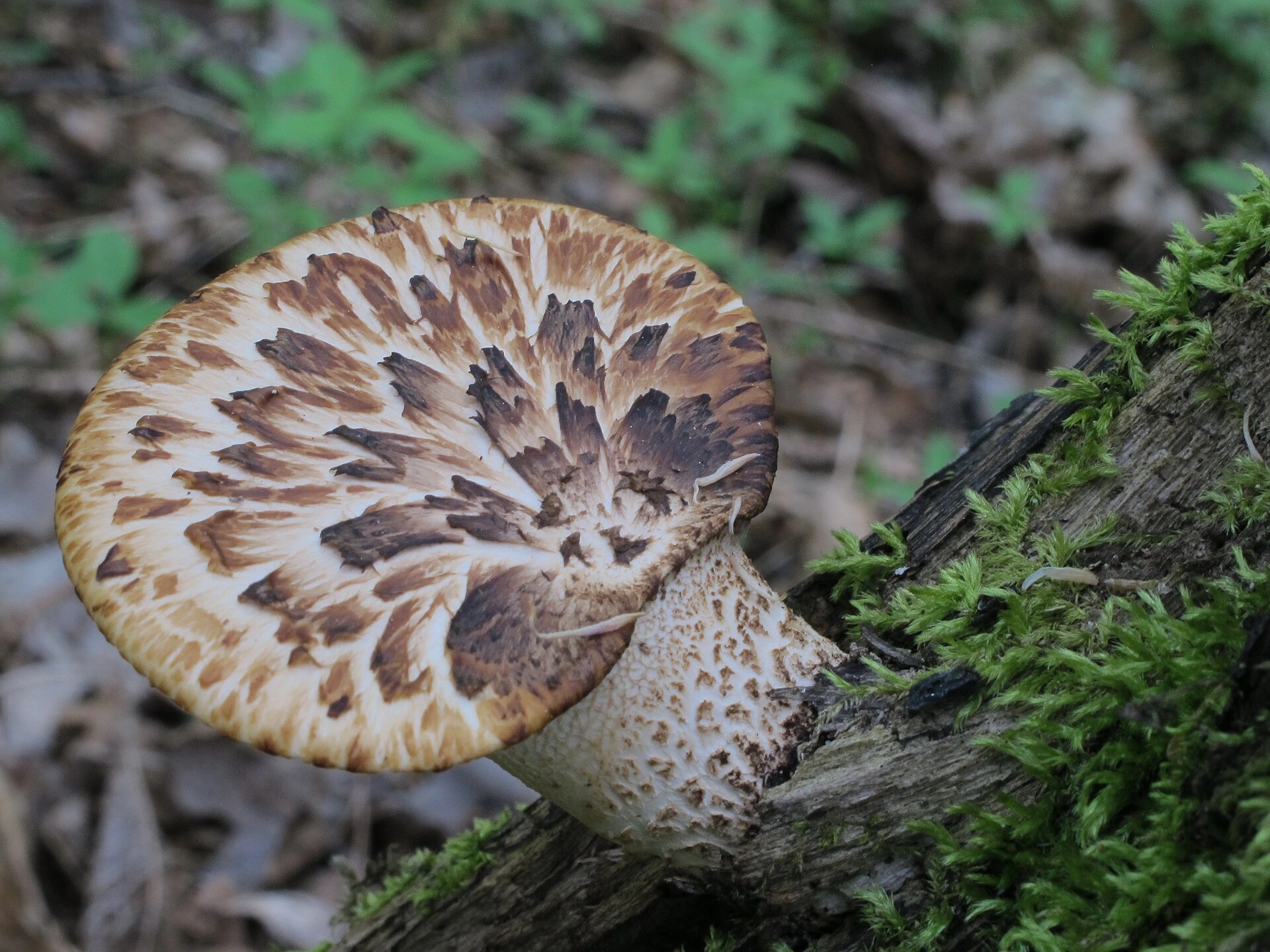
Cerioporus squamosus, commonly known as Dryad’s Saddle or Pheasant Back, is a large bracket fungus that grows on hardwood trees, stumps, and fallen logs. Its broad cream-to-brown cap is covered with dark flattened scales arranged in a distinctive pattern, while the underside has large angular pores instead of gills.
The species is especially common in spring and early summer, although fruiting can continue later depending on climate and rainfall. It is usually easy to recognize once you learn the combination of scaly cap, large pores, lateral stem, and growth directly from hardwood.
⚠️ Important: This guide is for identification and education only. Never eat a wild mushroom based solely on photographs, AI identification, or an online comparison.
Quick Identification
| Feature | Cerioporus squamosus |
|---|---|
| Scientific name | Cerioporus squamosus |
| Common names | Dryad’s Saddle, Pheasant Back |
| Family | Polyporaceae |
| Cap color | Cream, tan, ochre, light brown |
| Cap pattern | Dark brown flattened scales |
| Cap shape | Fan-shaped to kidney-shaped |
| Underside | Large angular pores |
| Gills | Absent |
| Stem | Short, lateral or off-center |
| Flesh | White to cream, firm when young |
| Smell | Often cucumber- or watermelon-rind-like |
| Spore print | White |
| Substrate | Hardwood |
| Ecology | Saprobic and sometimes parasitic |
| Season | Mainly spring to early summer |
| Edibility | Young specimens edible when correctly identified |
| Main look-alikes | Other large polypores and bracket fungi |
What Does Dryad’s Saddle Look Like?
Dryad’s Saddle forms broad fan-shaped or semicircular caps growing directly from wood. The upper surface is usually pale cream, tan, or ochre and covered with darker brown scales that radiate outward from the center.
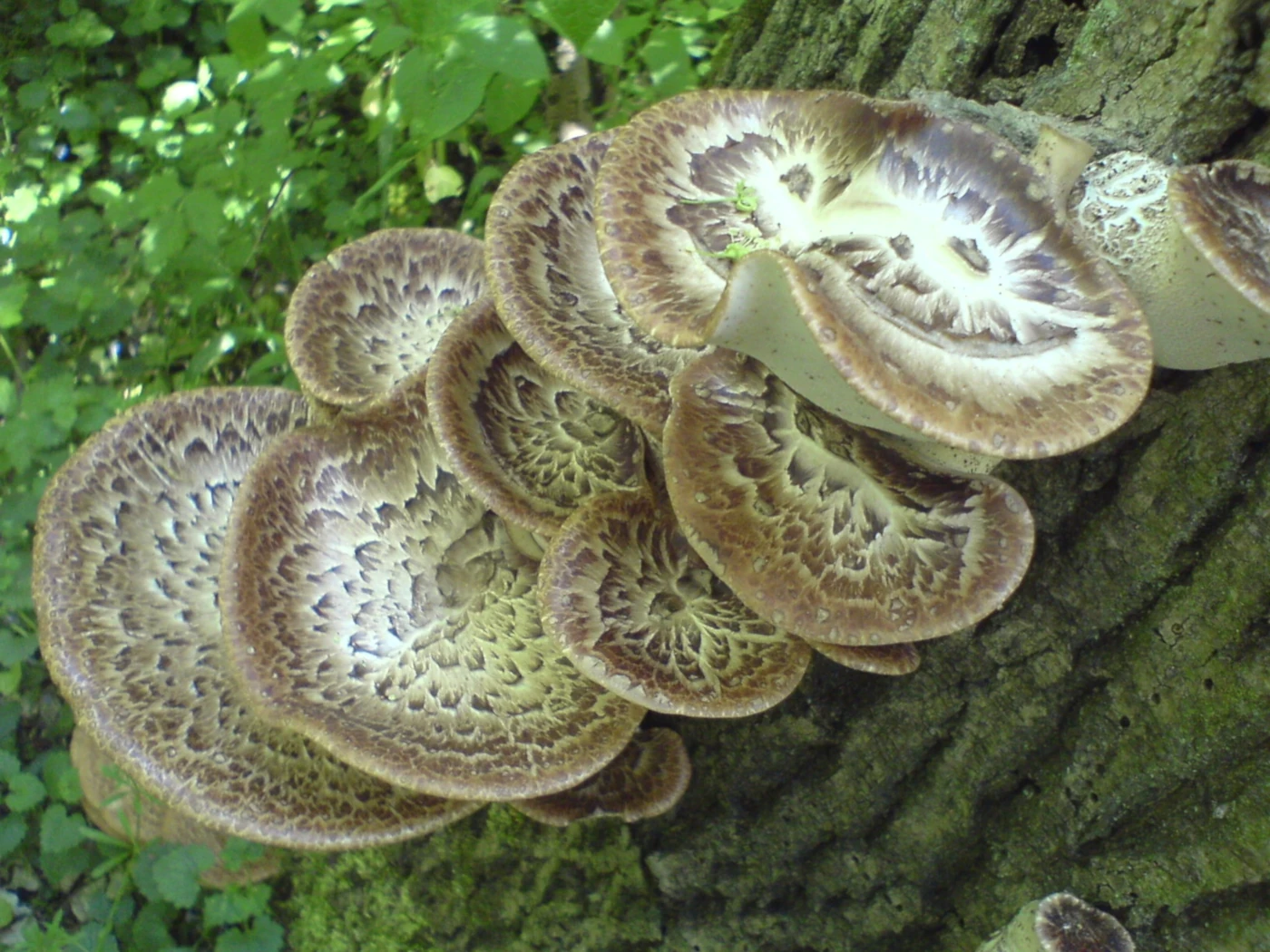
Large specimens can become impressive in size and may grow in overlapping shelves. The fruit bodies are often attached by a short lateral stem, which gives them a shape somewhere between a conventional mushroom and a bracket fungus.
The underside is equally distinctive. Instead of gills, it has large angular or elongated pores that are easy to see without magnification.
Cap
The cap is typically broad and fan-shaped, sometimes resembling a saddle attached to the side of a tree. Young specimens are more rounded and fleshy, while mature caps can become wide, flattened, and slightly wavy along the margin.
The background color is pale cream to yellow-brown. Dark brown scales form repeated patterns across the upper surface and are usually densest toward the center.
Cap Scales
The scales are flat rather than sharply raised. They often form concentric or radiating rows that create the pheasant-feather appearance behind the common name Pheasant Back.
Weathering can make the contrast weaker. Old specimens may lose some of the darker pattern and become more uniformly tan or brown.
Underside
The underside has pores rather than gills. These pores are relatively large, irregular, and often angular or elongated.
This surface can look almost honeycomb-like in mature specimens. The pore openings are usually much coarser than those on many other polypores.
Pore Shape
Young fruit bodies may have smaller, more regular pores. As the mushroom expands, the pores become larger and more stretched.
Near the stem, the pores can become especially elongated. This feature is useful when separating Dryad’s Saddle from polypores with tiny round pores.
Stem
The stem is usually short and attached to the side or lower portion of the cap. It can be pale cream to brown and may darken toward the base.
Some fruit bodies appear almost stemless because the attachment is broad. Others have a more obvious lateral stalk.
Stem Position
The off-center stem is characteristic of many wood-growing polypores. It reflects the way the mushroom projects outward from a vertical trunk or horizontal log.
A perfectly central stem would be less typical. Growth angle usually depends on the orientation of the wood.
Flesh
Young Dryad’s Saddle has white to cream flesh that is relatively soft and firm. As the fruit body matures, the flesh becomes tougher, more fibrous, and eventually leathery.
This age-related change is important because it affects both identification and texture. Very old specimens can become too tough to handle easily.
Flesh Thickness
The cap flesh can be several centimeters thick near the attachment point. It becomes thinner toward the outer margin.
Young margins are usually the softest part of the mushroom. The center and stem toughen first as the fruit body ages.
Smell
Fresh Dryad’s Saddle is famous for a distinctive smell often compared with cucumber, watermelon rind, or fresh flour. Some people notice it immediately, while others find the scent much weaker.
Smell is useful as supporting evidence but should not replace structural identification. The cap scales, pores, and substrate remain more reliable.
Spore Print
The spore print is white. Like many polypores, Dryad’s Saddle releases spores from the pore surface underneath the cap.
Spore color supports identification but is not especially distinctive. Several related bracket fungi also produce white spores.
Where Does Dryad’s Saddle Grow?
Cerioporus squamosus grows on hardwood. It can appear on dead logs and stumps but may also fruit from weakened or damaged living trees.
Elm, maple, willow, poplar, beech, and various other broadleaf trees can serve as hosts. The exact tree association varies by region.
Living Trees
Dryad’s Saddle can act as a parasite on weakened trees. Fruiting bodies may emerge from wounds, old branch scars, cavities, or damaged sections of the trunk.
Its presence on a living tree can indicate internal decay. The fungus contributes to white rot in wood and may weaken structural integrity over time.
Dead Wood
Fallen trunks, large branches, and old stumps are also common substrates. On dead wood, the fungus acts as a decomposer.
Several large fruit bodies may develop along the same log. Repeated fruiting from the same piece of wood can occur over multiple seasons.
When Does Cerioporus squamosus Grow?
Dryad’s Saddle is primarily a spring and early summer mushroom. In many temperate regions, fruiting begins after mild weather and spring rainfall.
A second flush can sometimes occur later in the year. Rainfall and local temperatures influence timing significantly.
Why Spring Fruiting Is Useful
Many large polypores are more noticeable in summer or autumn. Dryad’s Saddle often appears earlier, making it one of the first large bracket fungi of the year.
This timing can help narrow identification when a fresh scaly polypore appears on hardwood in spring. Season should still be used only as supporting evidence.
Distribution
Cerioporus squamosus is widespread across Europe, North America, and parts of Asia. It is especially common in temperate regions with abundant broadleaf trees.
The species has historically been known as Polyporus squamosus, and that older scientific name still appears in many field guides. Modern classifications commonly place it in the genus Cerioporus.
Is Dryad’s Saddle Edible?
Young Dryad’s Saddle is considered edible when correctly identified and still tender. Older specimens quickly become fibrous and tough. The outer margin of a young cap is usually the most tender portion. The thicker central area can become chewy even while the edge remains relatively soft. Proper identification is important because several large bracket fungi can look superficially similar. Texture alone should never be used to decide whether a specimen is suitable for food.
Dryad’s Saddle Look-Alikes
Most look-alikes are other large wood-growing polypores. Some share the fan-shaped form, while others overlap in color or growth pattern.
The combination of large angular pores and dark flattened cap scales is particularly helpful. Few common polypores show both features so strongly.
Meripilus giganteus — Giant Polypore
Identification
Giant Polypore forms large clusters of overlapping fan-shaped caps, often at the base of mature trees. The caps are usually pale brown to darker brown and lack the distinct pheasant-like scale pattern of Dryad’s Saddle.
The pore surface can bruise dark brown or black. Large rosettes may become enormous.
Main Difference
Dryad’s Saddle has conspicuous dark scales on a pale cap and usually more obvious large angular pores. Giant Polypore is more likely to form huge layered rosettes and develop dark bruising.
The two also differ in overall texture and cap pattern. From above, the scale arrangement is usually the easiest distinction.
Laetiporus sulphureus — Chicken of the Woods
Identification
Chicken of the Woods forms bright orange to yellow shelves on trunks and stumps. Young fruit bodies are thick, fleshy, and vividly colored.
The underside has pores rather than gills, but the cap surface lacks the brown scale pattern of Dryad’s Saddle.
Main Difference
Color separates them quickly in most cases. Chicken of the Woods is bright yellow-orange, while Dryad’s Saddle is cream to brown with dark scales.
Older Chicken of the Woods can fade considerably, so underside structure and cap pattern should still be checked.
Trametes versicolor — Turkey Tail
Identification
Turkey Tail forms thin multicolored brackets with concentric zones of gray, brown, cream, and sometimes bluish tones. The fruit bodies are much thinner than Dryad’s Saddle.
Its underside has tiny pores rather than the large angular openings typical of Cerioporus squamosus. Turkey Tail also lacks a substantial lateral stem.
Main Difference
Size and pore structure separate them easily. Dryad’s Saddle is thick, fleshy, and large-pored, while Turkey Tail is thin, leathery, and finely porous.
Fomes fomentarius — Tinder Fungus
Identification
Tinder Fungus produces thick gray to brown hoof-shaped conks. These fruit bodies are perennial and become extremely hard.
The surface is zoned but not covered with the flat dark scales characteristic of Dryad’s Saddle. Its pores are also much finer.
Main Difference
Tinder Fungus is hard, woody, and hoof-shaped. Dryad’s Saddle is flatter, more fan-shaped, and relatively soft when young.
Polyporus tuberaster — Tuberous Polypore
Identification
Tuberous Polypore is related and can resemble a smaller Dryad’s Saddle. It often has a pale cap with brown scales and a central or off-center stem.
The fruit body is generally smaller, and the cap pattern may be less strongly developed. It is often associated with buried wood or woody debris.
Main Difference
Overall size and growth habit are useful clues. Dryad’s Saddle usually becomes much larger and more robust.
Closely related polypores can still be difficult to separate from a photograph alone. Substrate, size, and detailed pore structure may all help.
Dryad’s Saddle vs Giant Polypore
| Feature | Dryad’s Saddle | Giant Polypore |
|---|---|---|
| Cap pattern | Dark flattened scales | Brown zones, little obvious scaling |
| Growth | Individual or overlapping fans | Large rosettes |
| Pores | Large and angular | Finer |
| Bruising | Usually little dramatic darkening | Often dark brown to black |
| Stem | Short and lateral | Usually little obvious stem |
| Season | Mainly spring–early summer | Mainly summer–autumn |
The cap surface is the fastest field clue. Dryad’s Saddle usually looks patterned, while Giant Polypore looks more broadly zoned.
Dryad’s Saddle vs Chicken of the Woods
| Feature | Dryad’s Saddle | Chicken of the Woods |
|---|---|---|
| Cap color | Cream to brown | Bright orange-yellow |
| Cap surface | Dark scales | Smooth to slightly wrinkled |
| Underside | Large pores | Fine pores |
| Flesh | White to cream | Yellowish to white |
| Growth | Fan-shaped caps | Overlapping shelves |
| Main season | Spring | Summer into autumn |
Both are large hardwood polypores, but their color and pore structure differ substantially. Mature faded specimens may require a closer look.
How to Identify Dryad’s Saddle Step by Step
Begin with the substrate and confirm that the fungus is growing from hardwood. Then look for broad fan-shaped caps with dark flattened scales.
Turn the cap over and check for large angular pores. Finally, note the lateral stem and, when possible, smell a fresh specimen.
Step 1: Check the Cap Pattern
Look for repeating brown scales arranged across a pale background. The scales should appear flattened rather than hairy or strongly raised.
This pheasant-feather pattern is one of the most characteristic visual features. It remains useful even when the mushroom has grown quite large.
Step 2: Check the Pores
Turn the mushroom over and inspect the underside. The pores should be clearly visible and relatively large.
If the surface has extremely tiny pores, gills, or teeth, another species should be considered. Pore size is one of the best structural clues.
Step 3: Check the Stem Position
Look for a short off-center or lateral stem. It may be more obvious on fruit bodies growing from vertical trunks.
On horizontal logs, the attachment can appear less stem-like. The important point is that the mushroom emerges directly from wood.
Step 4: Check the Texture
Press the outer cap margin gently. A young specimen should feel firm but still somewhat tender.
An old specimen becomes tough and leathery. Texture helps estimate age but should not be used as a species-level feature by itself.
Why Dryad’s Saddle Can Look So Different With Age
Young fruit bodies are thick, pale, and compact. Their scales are often sharply defined and the pore surface looks clean.
As they expand, the cap becomes wider and flatter. The pores stretch, the margin thins, and the flesh becomes progressively tougher.
Very old specimens may fade, crack, or become damaged by insects. The scale pattern may still be visible even after other features become less clear.
How to Photograph Dryad’s Saddle for Identification
Take a wide photograph showing how the mushroom attaches to the tree or log. This gives useful context about substrate and growth pattern.
Then photograph the cap from above so the scale pattern is clear. A third image should show the pore surface in enough detail to reveal the large angular openings.
A side view can show the lateral stem and cap thickness. If several age stages are present, photograph young and mature fruit bodies together.
Can AI Identify Dryad’s Saddle?
AI can often recognize Cerioporus squamosus from good photographs because the scale pattern and large fan-shaped cap are distinctive. Accuracy improves when the underside and attachment to wood are also visible.
Old weathered specimens can be more difficult because the scales fade and the cap becomes less typical. Closely related polypores may also require additional ecological information.
AI is most useful when several views are available. A single top-down image can miss the large pores and lateral stem that make the identification much stronger.
Common Identification Mistakes
One common mistake is identifying every large bracket fungus as Dryad’s Saddle. Giant Polypore, Chicken of the Woods, and several other species can reach similar sizes.
Another mistake is ignoring the pore surface. Large angular pores provide stronger evidence than general cap color.
A third mistake is assuming old specimens should look exactly like young field-guide examples. Dryad’s Saddle changes dramatically in shape, texture, and color as it matures.
Frequently Asked Questions
Why are some Dryad’s Saddle fruit bodies almost round while others are strongly fan-shaped?
Growth direction depends on how the fungus emerges from the wood. A fruit body growing from the side of a vertical trunk tends to develop a stronger fan shape, while one growing from a horizontal log may appear broader or more rounded.
Can Dryad’s Saddle grow very high on a tree?
Yes. Fruiting bodies can emerge from wounds, branch scars, or decayed sections well above ground level. Their position depends on where suitable colonized wood is present inside the tree.
Why do some specimens have much darker scales than others?
Age, moisture, lighting, and genetics all influence contrast. Young fresh specimens often show the strongest difference between the pale background and dark scales.
Can the same tree produce Dryad’s Saddle for several years?
Yes. The fungus can remain inside colonized wood and produce new fruit bodies in later seasons. Repeated fruiting from the same trunk or stump is therefore possible.
Do insects commonly damage Dryad’s Saddle?
Yes. Older fruit bodies frequently develop tunnels and soft damaged areas. Young firm specimens are usually less affected, but cutting through the cap can reveal hidden insect activity.
Can rain make the pore surface look different?
Yes. Prolonged moisture can darken or stain the pores and make old specimens look less clean than fresh ones. Pore shape is usually more reliable than exact pore color.
Why do some caps split near the margin?
Rapid growth followed by dry weather can cause the surface to crack or split. Large older fruit bodies are particularly likely to show this kind of weather damage.
Can Dryad’s Saddle appear on a tree that still looks healthy?
Yes. The fungus can colonize internal dead or weakened wood before the tree shows obvious external decline. Fruiting bodies may therefore be an early visible sign of internal decay.
Final Identification Notes
Cerioporus squamosus is best recognized by the combination of large fan-shaped caps, dark flattened scales, large angular pores, a short lateral stem, and growth directly from hardwood. The spring fruiting season provides additional support.
The cap pattern is striking, but the underside is just as important. Large stretched pores separate Dryad’s Saddle from many fine-pored brackets and help confirm the identification.
Most confusion involves other large polypores rather than gilled mushrooms. If the cap scales, pore structure, substrate, and growth form all agree, Dryad’s Saddle is usually one of the easier large bracket fungi to recognize.
Upload a photo and get possible matches in seconds.