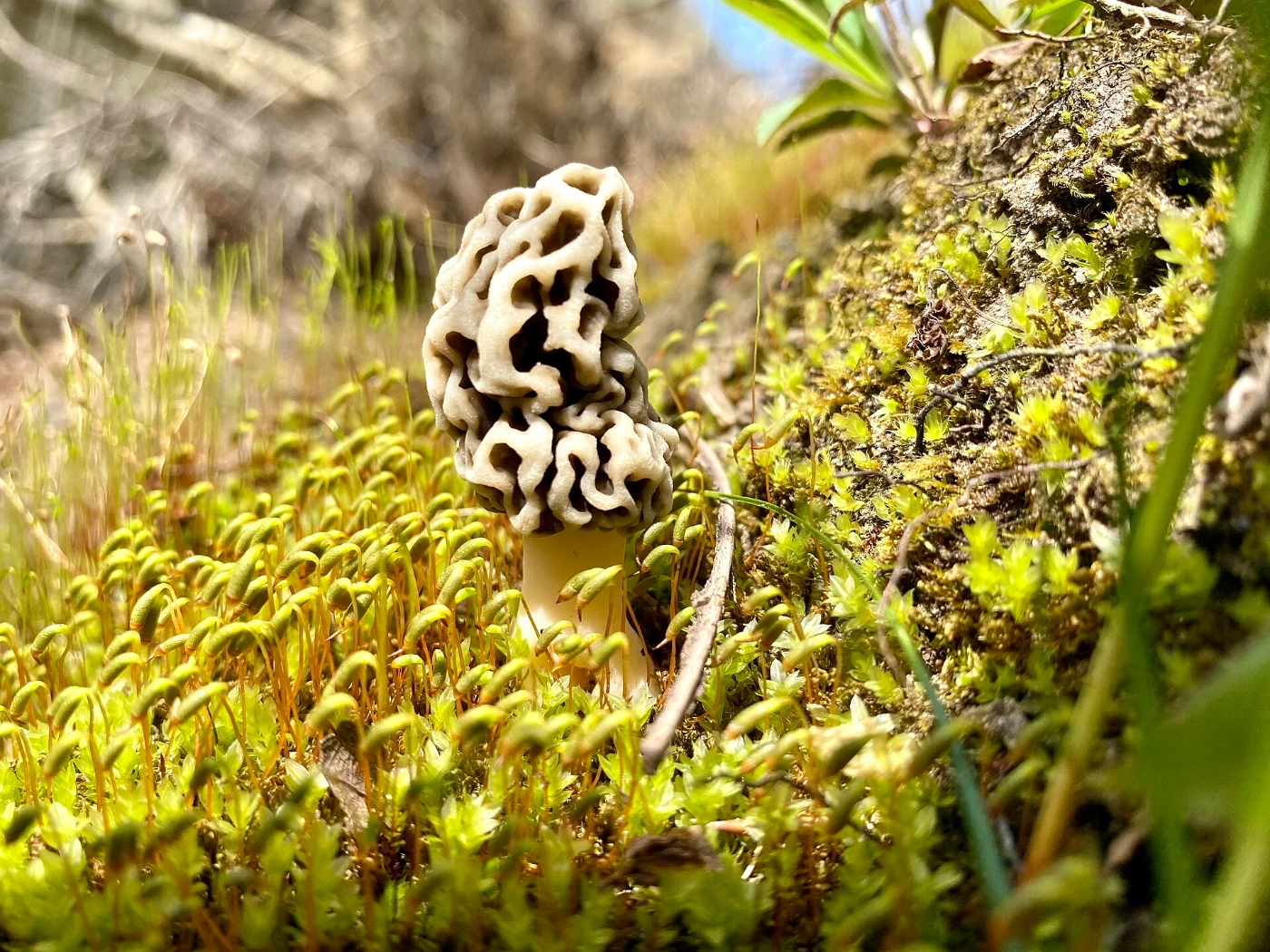
Yellow Morels are among the most sought-after spring mushrooms in North America. They are known for their deeply pitted caps, hollow interior, and pale yellow to tan coloration that usually becomes darker with age.
In eastern and central North America, one of the main species behind the common name Yellow Morel is Morchella americana. Similar yellow morels occur across the continent, so exact identification may depend on geography, habitat, tree association, and mature cap structure.
⚠️ Important: True morels should be completely hollow from cap to stem when cut lengthwise. Never eat a morel-like mushroom unless the interior and cap attachment have been checked carefully, because false morels can look similar from the outside.
Quick Identification
| Feature | Yellow Morel |
|---|---|
| Scientific name | Morchella americana and related yellow morels |
| Common name | Yellow Morel |
| Cap color | Pale yellow, tan, ochre, brownish-yellow |
| Cap surface | Deep pits and ridges |
| Cap shape | Oval to elongated |
| Stem | Pale cream to whitish |
| Interior | Completely hollow |
| Cap attachment | Attached directly to stem |
| Spore print | Cream to pale yellowish |
| Ecology | Complex, often associated with trees and disturbed habitats |
| Main season | Spring |
| Habitat | Hardwood forests, old orchards, river bottoms, disturbed ground |
| Edibility | Edible when correctly identified and cooked |
| Main danger | False morels |
What Does a Yellow Morel Look Like?
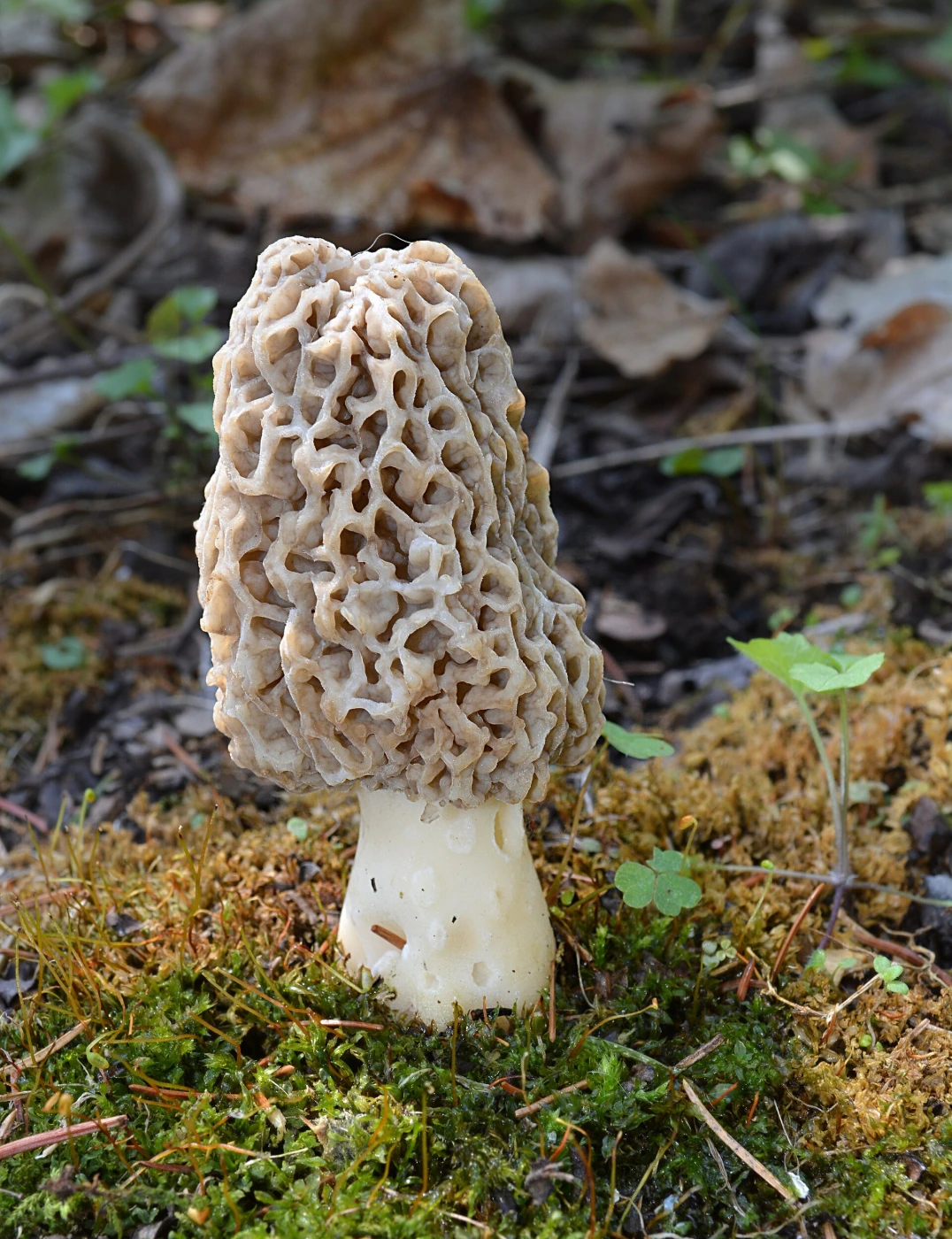
Yellow Morels have a honeycomb-like cap made of deep pits separated by raised ridges. The cap is usually pale when young and becomes more yellow-brown or tan with age.
The stem is pale and generally smooth to slightly textured. When the mushroom is cut from top to bottom, the cap and stem form one continuous hollow chamber.
Cap
The cap is usually oval, rounded, or somewhat elongated. Young specimens can be quite pale, while older mushrooms become more ochre, tan, or brownish-yellow.
The pits vary in shape and size. They are usually irregular rather than arranged in perfect vertical rows.
Cap Color
Fresh young Yellow Morels may be almost cream-colored. As they mature, the ridges and pits often become progressively darker.
Sun exposure, rainfall, soil, and age can all influence color. This is why color alone is not enough to identify a morel species.
Ridges and Pits
The ridges form the most recognizable feature of the cap. They create a deeply pitted, sponge-like surface.
In true morels, the ridges and pits are part of one continuous cap structure. The surface should not look like loose folds or brain-like lobes.
Stem
The stem is usually whitish to cream and can be relatively short or somewhat elongated. It may broaden slightly toward the base.
The surface can be smooth, finely granular, or slightly wrinkled. Older stems often become more fragile.
Interior
The inside is one of the most important identification features. A true Yellow Morel should be hollow from the top of the cap through the stem.
There should not be cottony tissue, multiple chambers, or solid internal folds. A clean longitudinal cut should reveal one continuous hollow cavity.
Cap Attachment
The cap of a Yellow Morel is attached directly to the stem along its lower edge. This differs from half-free morels, where the cap hangs away from the stem for part of its length.
Checking cap attachment can help separate several similar spring mushrooms. It is especially useful when the outside shape is ambiguous.
Where Do Yellow Morels Grow?
Yellow Morels are most strongly associated with spring woodland habitats. They often appear near hardwood trees, in river bottoms, old orchards, forest edges, and disturbed soils.
They can also appear after environmental disturbance. Fire, logging, flooding, and soil disruption can influence morel fruiting in some regions.
Hardwood Forests
In eastern North America, Yellow Morels are often found near hardwoods. Elm, ash, tulip poplar, apple, sycamore, and other trees are commonly mentioned in morel habitats.
Tree association can vary by region. The presence of suitable soil, moisture, and spring temperature is just as important as the tree species itself.
Old Orchards
Abandoned apple orchards are classic morel habitat in some parts of North America. Old trees, disturbed soil, decaying roots, and open spring sunlight can create favorable conditions.
However, orchard history matters. Land with heavy past pesticide use may not be ideal for collecting food mushrooms.
River Bottoms
Floodplain forests and river terraces can produce excellent morel habitat. These areas often combine rich soil, seasonal moisture, and mature hardwood trees.
Morels may appear in patches rather than evenly across the forest floor. A productive area can contain many fruit bodies within a relatively small zone.
Season
Yellow Morels are spring mushrooms. Fruiting often begins when soil temperatures rise and daytime weather becomes mild.
The exact season changes dramatically across North America. Southern populations may appear early in spring, while northern and high-elevation areas fruit much later.
Distribution in North America
Yellow Morels are especially well known in eastern and central North America. Morchella americana is an important species in this region.
Western North America contains other morel species and complexes. A yellow morel found in the West should therefore not automatically be called M. americana.
Morchella americana
Morchella americana is one of the best-known North American yellow morels. It is usually associated with hardwood forests and spring fruiting.
The cap is yellowish to tan when mature, with irregular pits and ridges. The mushroom is completely hollow and has the cap attached directly to the stem.
Is Yellow Morel Edible?
True Yellow Morels are widely considered edible when correctly identified and thoroughly cooked. Raw or undercooked morels should not be eaten.
Even correctly identified morels can cause digestive problems in some people. For first-time consumption, a small portion is more sensible than a large meal.
Look-Alikes
The most important look-alikes are false morels and other true morel species. The interior structure and cap attachment are usually the most useful characters.
Gyromitra Species — False Morels
Identification
False morels often have reddish-brown, chestnut, or dark brown caps with lobed, wrinkled, or brain-like surfaces. Their caps usually do not form the same regular network of deep pits and ridges seen in true morels.
The interior can contain folds, chambers, or cottony tissue rather than one clean hollow cavity. Some species contain gyromitrin or related toxins, although toxicity varies among species.
Main Difference
Cut the mushroom lengthwise. A true Yellow Morel is completely hollow, while many false morels have a more complex internal structure.
Verpa Species — Thimble Morels
Identification
Verpa species have caps attached mainly at the top of the stem. The cap hangs downward like a thimble.
The stem may contain cottony tissue when young. This differs from the direct cap attachment typical of Yellow Morels.
Main Difference
The cap attachment is the fastest clue. Yellow Morels have the cap attached along the lower edge, while Verpa caps are attached mainly at the top.
Half-Free Morels
Identification
Half-free morels belong to true morel groups but have a cap that is attached to the stem only partway down. The lower cap margin hangs free.
They are still true morels, but their structure differs clearly from typical Yellow Morels.
Main Difference
Check the lower edge of the cap. A free lower portion indicates a half-free morel rather than a typical Yellow Morel.
Black Morels
Identification
Black morels usually have darker ridges and a more elongated cap. Young specimens may appear gray or dark olive before turning brown to blackish with age.
They often belong to different species groups and can have different habitat preferences.
Main Difference
Yellow Morels are usually paler and often broader. Black Morels tend to have darker ridges and a more strongly vertical appearance.
Yellow Morel vs False Morel
| Feature | Yellow Morel | False Morel |
|---|---|---|
| Cap surface | Deep pits and ridges | Lobed, folded, brain-like |
| Interior | Completely hollow | Often chambered or cottony |
| Cap attachment | Attached to stem | Variable |
| Shape | Honeycomb-like | Irregular and folded |
| Main risk | Edible only when correctly ID and cooked | Some species toxic |
The internal cut is more important than external color. A mushroom that looks morel-like from above can still belong to a dangerous group.
How to Identify a Yellow Morel Step by Step
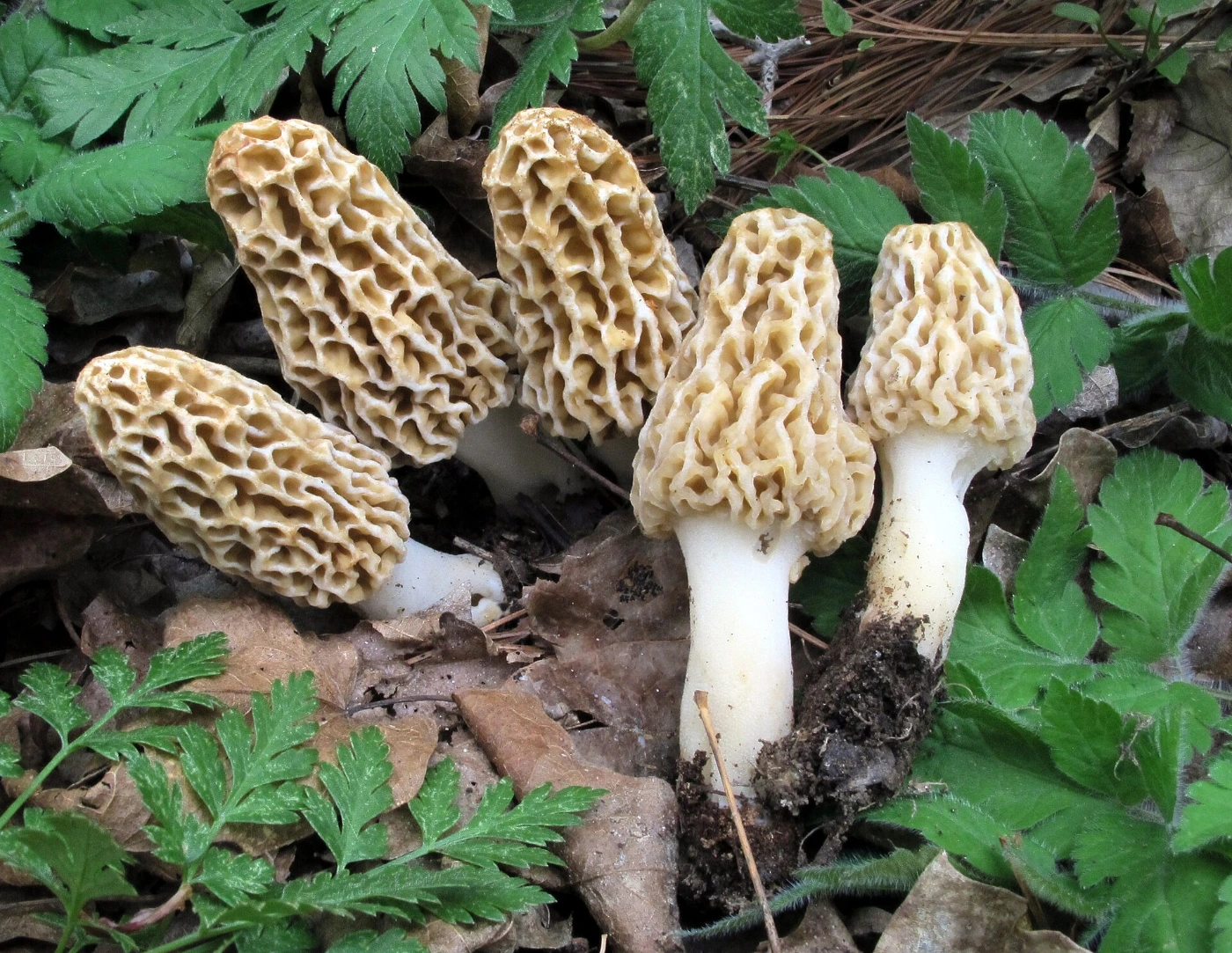
The safest approach is to start with the cap structure and then cut the mushroom lengthwise. These two checks eliminate many common look-alikes.
Step 1: Check the Cap Surface
Look for true pits and ridges rather than loose folds. The surface should resemble a honeycomb.
Brain-like lobes or smooth folded tissue point toward a false morel.
Step 2: Check the Cap Attachment
Look at where the cap meets the stem. A typical Yellow Morel has the cap attached directly along the lower edge.
If the cap hangs free for a significant distance, consider a half-free morel or another group.
Step 3: Cut the Mushroom Lengthwise
A true morel should be hollow from cap to stem. The interior should form one continuous cavity.
Cottony tissue or complicated internal chambers suggest another mushroom.
Step 4: Consider the Habitat
Hardwood forest, old orchard, river bottom, or disturbed spring ground all fit Yellow Morels. Tree species can provide useful supporting evidence.
Habitat should support the identification rather than replace structural checks.
Step 5: Consider the Region
Eastern and central North America fit Morchella americana well. Western morels may belong to different species or complexes.
Regional taxonomy is especially important because the common name Yellow Morel covers more than one taxon.
How to Photograph a Yellow Morel
Take one photo of the mushroom in its habitat before picking it. Include nearby trees, leaf litter, and the surrounding ground.
Then photograph the whole mushroom from the side and take a clear image after cutting it lengthwise. The hollow interior and cap attachment are among the most useful features for confirmation.
Can AI Identify a Yellow Morel?
AI can usually recognize the general morel shape when the cap is clearly visible. However, a cap-only photograph is not enough to rule out false morels reliably.
A photo of the mushroom cut lengthwise is much more informative. Habitat and location also help narrow the likely species.
Common Identification Mistakes
One common mistake is assuming every honeycomb-like spring mushroom is the same Yellow Morel. North America contains multiple morel species and complexes.
Another mistake is relying on cap color. Yellow, tan, gray, and brown tones can overlap depending on age and weather.
The most dangerous mistake is failing to cut the mushroom open. The interior structure can reveal a false morel that looks convincing from the outside.
Interesting Facts
Morels are among the most famous spring mushrooms in North America. Their short fruiting season has created a strong foraging culture around annual morel hunting.
The visible mushroom is only the reproductive structure. The fungal organism itself persists as mycelium in soil, roots, and organic material.
Morel fruiting can be highly unpredictable. A place that produces many mushrooms one year may produce very few the next.
Some morel species also respond strongly to disturbance. Fire-associated morels are especially famous in western North America, where large flushes can appear after forest fires.
Frequently Asked Questions
Are all Yellow Morels Morchella americana?
No. The common name can include several related yellow morels. Morchella americana is especially important in eastern and central North America.
Can Yellow Morels be gray when young?
Yes. Young specimens can be pale gray, cream, or light tan before becoming more yellow or brownish.
Can a true morel have cottony material inside?
A mature true morel should be hollow. Any substantial cottony tissue should make you reconsider the identification.
Do Yellow Morels always grow near dead trees?
No. They can occur near living, dying, or recently dead trees depending on habitat and species. The relationship between morels and trees is more complex than a simple dead-tree rule.
Can morels grow in lawns?
They can occasionally appear in disturbed grassy areas, gardens, or landscaped soil. Woodland and old orchard habitats are more typical.
Do Yellow Morels grow after forest fires?
Some morel species are strongly associated with burns, especially in western North America. Typical eastern Yellow Morels are more commonly associated with hardwood forest and other non-burn habitats.
Can you identify a Yellow Morel without cutting it?
You can often make a strong preliminary identification, but cutting it lengthwise is the best way to confirm the hollow interior. This is especially important when considering it for food.
Why do morels appear for such a short time?
Their fruit bodies respond to a narrow combination of soil temperature, moisture, and seasonal conditions. Once the environment becomes too warm or dry, fruiting usually stops.
Final Identification Notes
Yellow Morels are best recognized by a pitted honeycomb-like cap, pale stem, direct cap attachment, and completely hollow interior. In eastern and central North America, Morchella americana is one of the most important species behind this common name.
The most important safety distinction is from false morels. A true morel should have clear pits and ridges outside and one continuous hollow cavity inside.
The practical field rule is: honeycomb cap + cap attached to stem + completely hollow interior = strong true morel candidate.
Upload a photo and get possible matches in seconds.