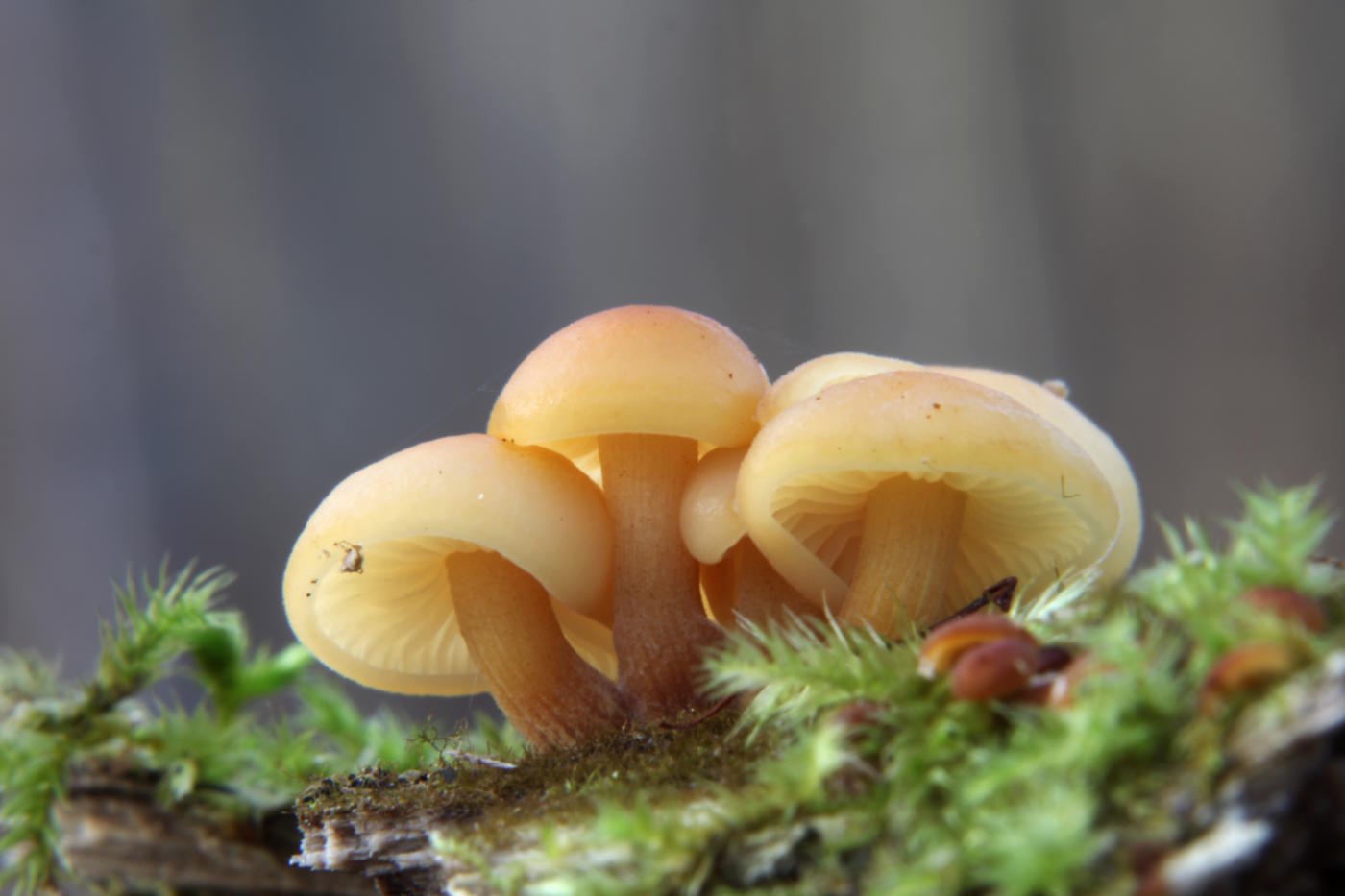
Brown mushrooms are among the most common — and often the most difficult — wild mushrooms to identify. A brown cap can belong to an excellent edible bolete, an ordinary decomposer growing on a stump, or a dangerously poisonous species. This is why “brown mushroom identification” cannot be based on color alone. To identify a brown mushroom, examine the underside of the cap, stem, stem base, spore color, habitat, substrate, bruising reactions, and growth pattern. Small brown mushrooms growing on wood deserve particular caution because deadly Galerina marginata can resemble several edible species.
⚠️ Important: This guide is for identification and education only. Never eat a wild mushroom based only on a photograph, AI result, or comparison with an online guide.
Quick Brown Mushroom Identification Guide
| Species | Typical appearance | Where it grows | Edibility / risk |
|---|---|---|---|
| Boletus edulis | Brown cap, thick pale stem, pores | Soil near trees | Edible |
| Imleria badia | Chestnut-brown cap, yellow pores | Woodland soil | Edible |
| Armillaria spp. | Honey-brown caps, clustered | Wood and tree roots | Some species traditionally eaten; careful ID required |
| Galerina marginata | Small yellow-brown cap | Dead wood | Deadly poisonous |
| Kuehneromyces mutabilis | Two-toned brown cap, clusters | Dead wood | Edible but high-risk identification |
| Flammulina velutipes | Orange-brown cap, dark velvety stem | Dead hardwood | Edible when correctly identified |
| Pluteus cervinus | Gray-brown cap, pink mature gills | Dead wood | Generally regarded as edible but not highly valued |
| Coprinellus micaceus | Honey-brown clustered caps | Buried or exposed wood | Usually considered edible young, but not recommended here |
| Pholiota squarrosa | Brown-yellow cap with scales | Tree trunks and stumps | Not recommended for consumption |
| Paxillus involutus | Brown rolled cap margin | Woodland soil | Poisonous |
| Cortinarius rubellus | Orange-brown to reddish cap | Woodland soil | Deadly poisonous |
| Tylopilus felleus | Brown bolete with pinkish pores | Woodland soil | Not poisonous, but extremely bitter |
First: What Kind of Brown Mushroom Did You Find?
Before trying to identify the species, turn the mushroom over. The underside is often far more useful than the cap color.
If it has pores
A sponge-like surface rather than gills suggests a bolete. Possible brown species include:
- Boletus edulis;
- Imleria badia;
- Tylopilus felleus;
- various Suillus and other boletes.
If it has gills
Look at gill color, attachment, spacing, stem ring, stem base and spore print. Brown mushrooms with gills belong to many unrelated genera, including Galerina, Armillaria, Cortinarius, Pluteus, Pholiota and others.
If it grows directly from wood
Pay special attention. Several edible brown mushrooms grow on logs and stumps, but so does Deadly Galerina (Galerina marginata), an amatoxin-containing species associated with severe and fatal poisonings. Research has confirmed amatoxins in the Galerina marginata species complex.
1. Boletus edulis — Porcini
- Scientific name: Boletus edulis
- Common names: Porcini, Penny Bun, Cep
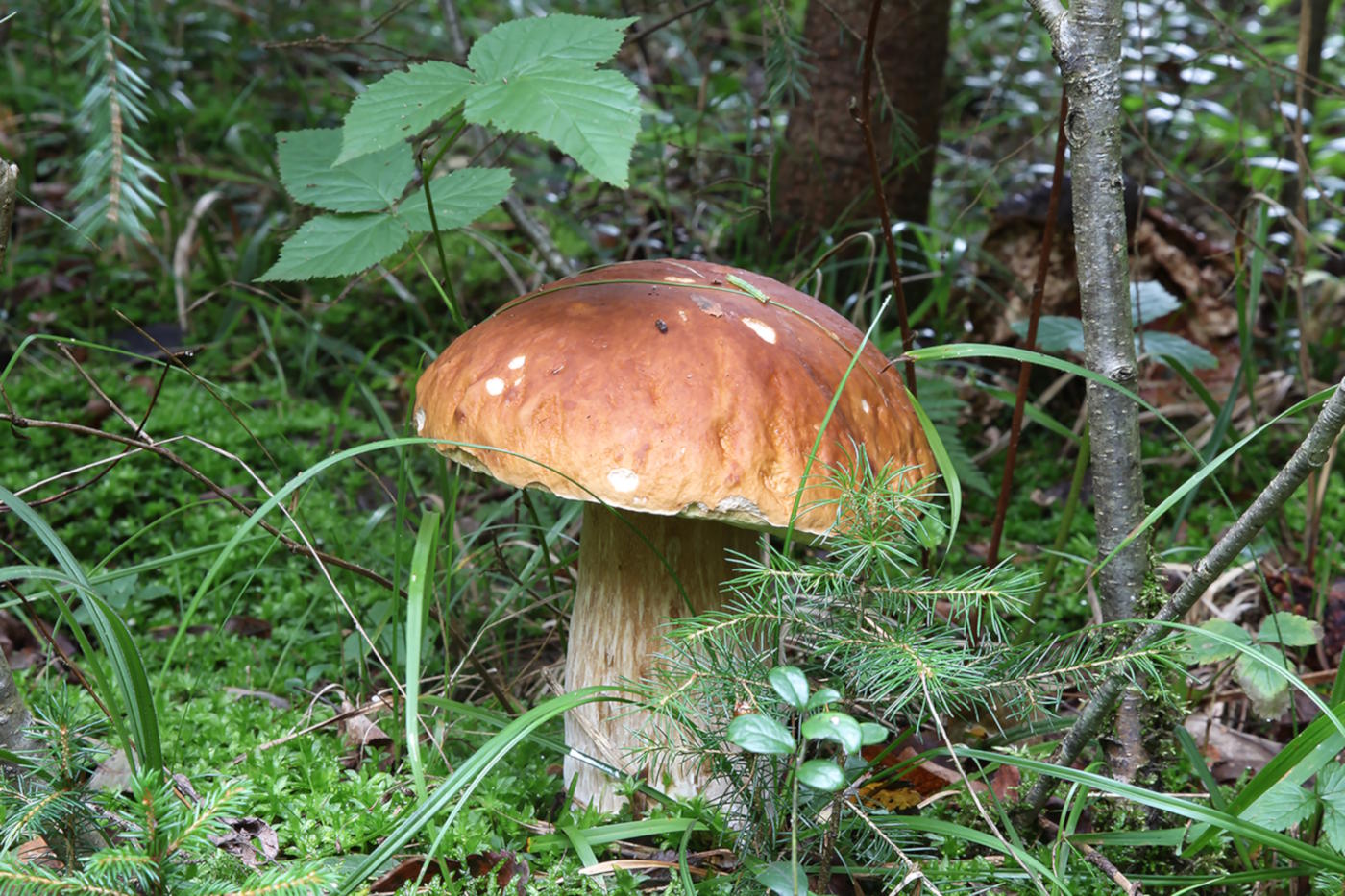
Porcini is one of the best-known edible brown mushrooms. A mature specimen typically has a smooth brown cap above a thick, pale, club-shaped stem. Instead of gills, the underside contains thousands of small pores. Young pores are whitish and gradually become yellowish to olive as the mushroom ages. One particularly useful characteristic is the pale net-like reticulation often visible around the upper portion of the stem.
Where it grows
Porcini grows from soil in association with living trees rather than directly from dead wood. It forms mycorrhizal relationships with trees such as:
- spruce;
- pine;
- beech;
- oak;
- birch.
Main look-alike: Tylopilus felleus
The Bitter Bolete can look remarkably similar to porcini. It usually develops pinkish or flesh-colored pores, while its stem often has a darker, coarser network. It is not considered a deadly mushroom, but its flesh can be intensely bitter and can ruin an entire meal.
Key clue
Porcini: pale-to-olive pores + stout reticulated stem. But never classify an unknown bolete as edible simply because it has a brown cap and pores.
2. Imleria badia — Bay Bolete
- Scientific name: Imleria badia
- Common name: Bay Bolete
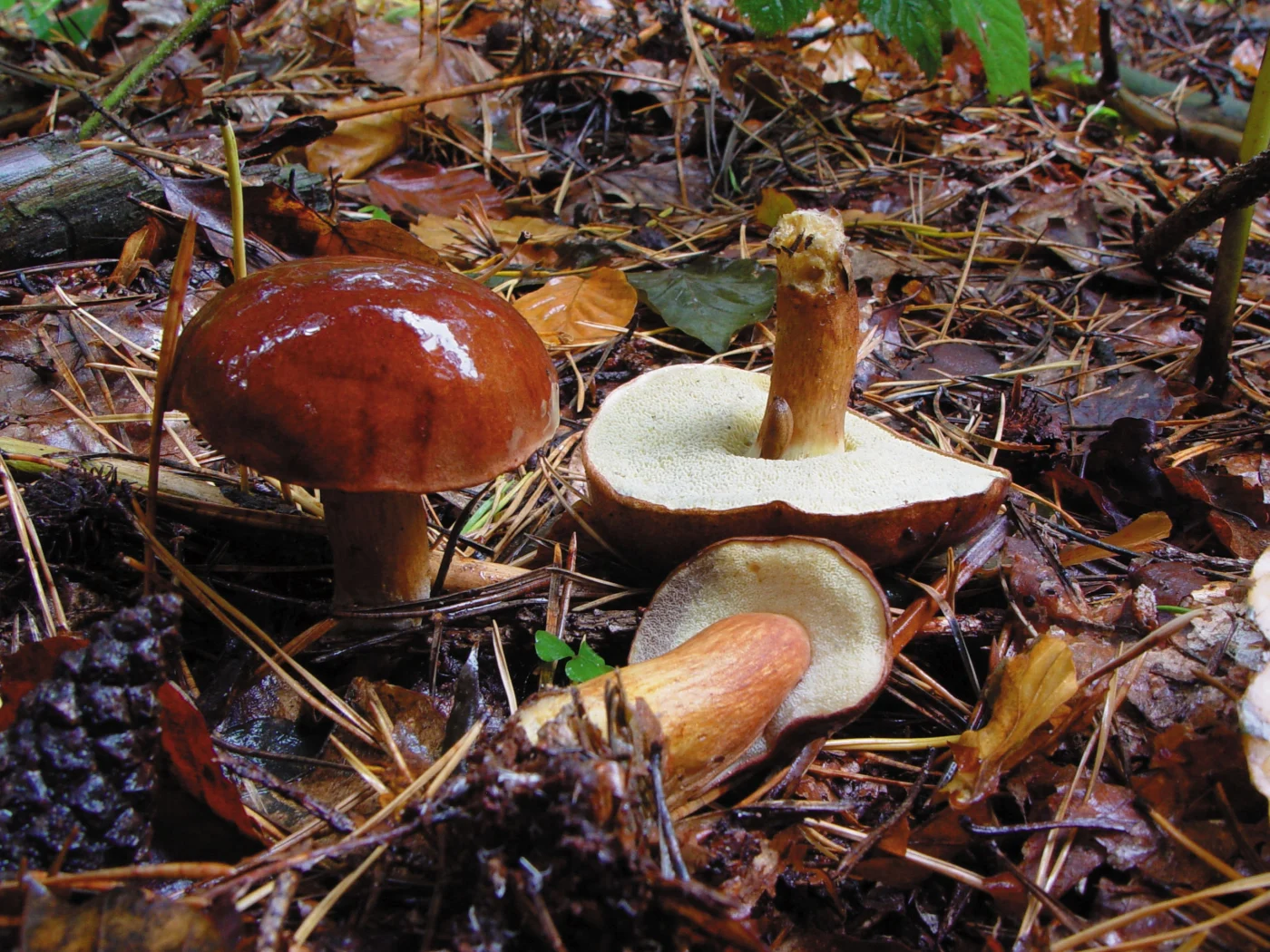
The Bay Bolete is another common brown-capped woodland mushroom. Its cap is usually chestnut, reddish brown, or dark bay brown and may become slightly sticky when wet. The underside has yellowish pores.
A useful characteristic is that the pores may turn blue or blue-green when bruised or pressed. The flesh can also show some blue staining after cutting.
Where it grows
Bay boletes are usually found on woodland soil, especially beneath conifers, although they can also occur with deciduous trees.
Possible confusion
Several other brown boletes can occupy similar habitats. Some poisonous bolete species develop reddish pores or strongly colored stems, but there is no safe rule such as “Blue-staining boletes are poisonous.” That rule is false. Some edible boletes bruise blue, while toxicity depends on species rather than a single color reaction.
Key clue
Look at pore color + bruising + stem structure + associated trees, not simply the brown cap.
3. Armillaria species — Honey Mushrooms
- Common name: Honey Mushroom
- Genus: Armillaria
Honey mushrooms commonly have honey-yellow, tan or brown caps and often grow in large clusters.
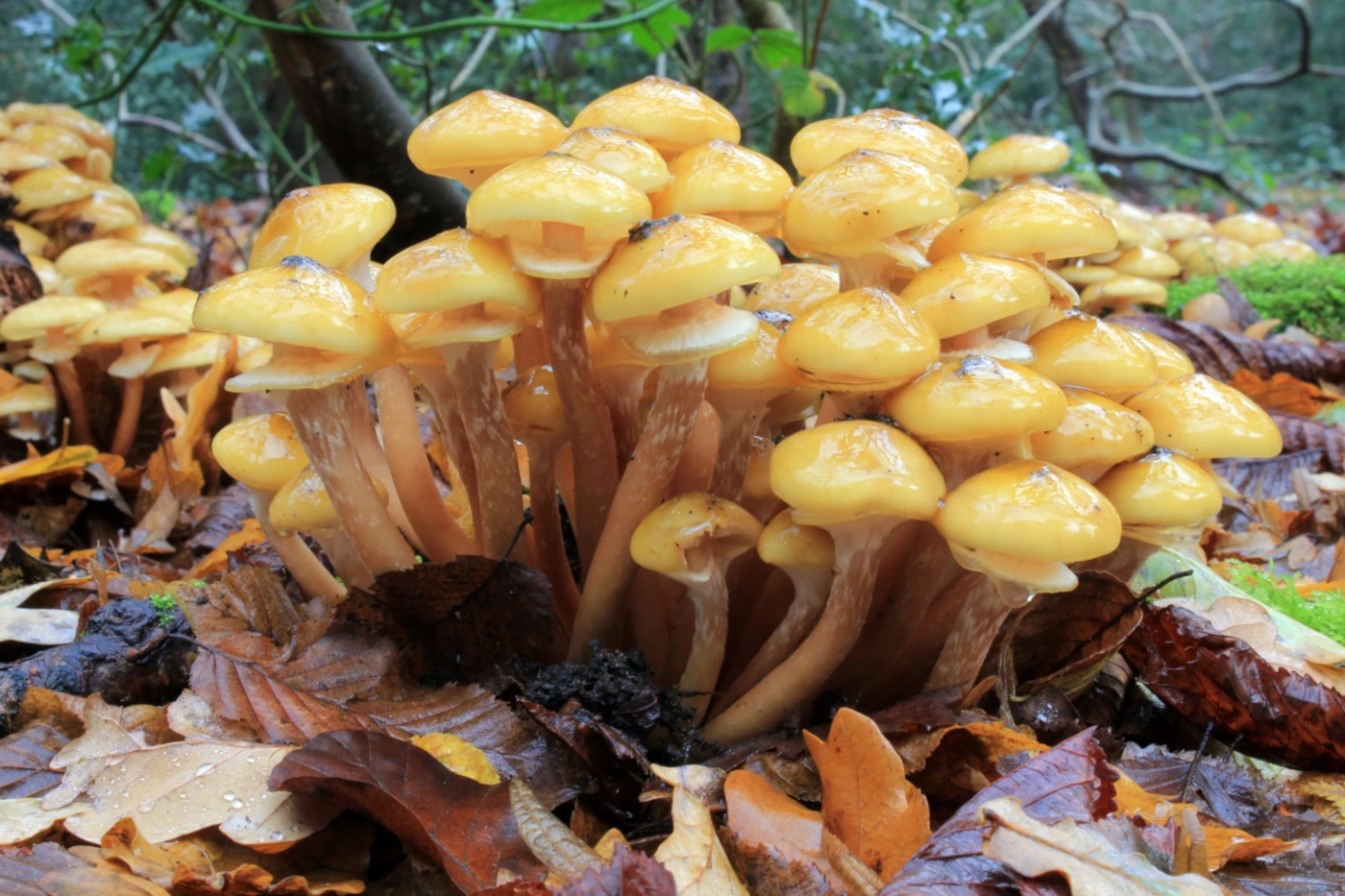
They usually occur around:
- tree trunks;
- stumps;
- roots;
- buried woody material.
Many forms develop small scales on the cap, particularly when young. Some species have a prominent ring around the stem.
Why identification is difficult
Several Armillaria species exist, and their appearances vary. Even more importantly, other brown wood-growing mushrooms can occur in exactly the same habitat.
Dangerous look-alike: Galerina marginata
This is one of the most important mushroom comparisons for anyone collecting honey mushrooms. Both can grow on dead wood and both may have brown caps and stem rings.
The difference in spore color can help:
- Armillaria: generally white spores.
- Galerina marginata: rusty-brown spores.
A mushroom guide describing the group likewise notes the white-versus-brown spore-print distinction between honey mushrooms and the deadly Galerina complex.
Key warning
Never assume every mushroom growing in the same cluster belongs to the same species. Different fungi can fruit from the same stump or log.
4. Galerina marginata — Deadly Galerina
- Scientific name: Galerina marginata
- Common names: Deadly Galerina, Funeral Bell
Among all small brown mushrooms, this is one of the most important species to recognize. The cap is typically yellow-brown, honey-brown, cinnamon or reddish brown. It may become noticeably paler as it dries. The mushroom grows primarily on decaying wood and may appear singly, in small groups, or in clusters.
Gills
Young gills can be relatively pale but become rusty brown as the spores mature. That age-related change is important because pale young gills do not rule out Galerina. Cornell’s mushroom-safety guidance similarly notes that young Galerina gills may appear pale before darkening and recommends using additional characters rather than gill color alone.
Stem
The stem is slender and may have a ring or ring zone. The ring can become damaged or disappear in older specimens.
Why it is dangerous
The Galerina marginata complex contains amatoxins. Scientific analysis has detected amatoxins in specimens belonging to the G. marginata complex, and documented poisoning reports include fatalities.
Common look-alikes
It can be confused with Honey Mushrooms, Kuehneromyces mutabilis, wild enoki and other small wood-growing brown mushrooms.
If an edible mushroom might plausibly be a Galerina, do not eat it without expert confirmation.
5. Kuehneromyces mutabilis — Sheathed Woodtuft
- Scientific name: Kuehneromyces mutabilis
- Common names: Sheathed Woodtuft, Two-Toned Pholiota
This edible wood-growing mushroom can form large clusters on deciduous logs and stumps. Its cap is strongly hygrophanous, which means it changes color as it dries. The result is often a conspicuous two-toned appearance — one part of the cap may be darker brown while another section has already faded.
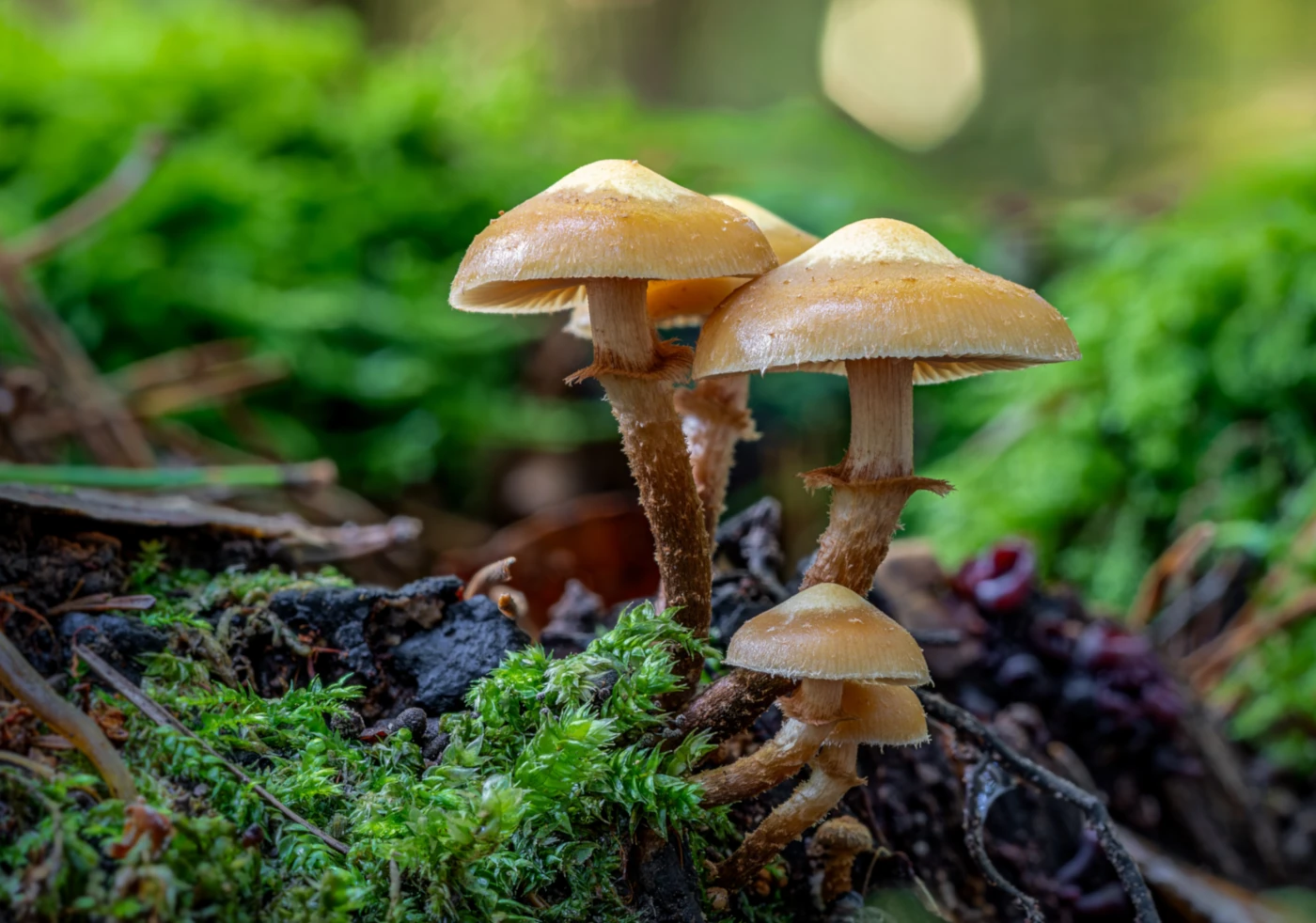
Stem
The lower stem commonly shows small scales beneath the ring. This can be an important identification feature.
Deadly look-alike: Galerina marginata
This is an advanced identification pair.
Both species:
- have brown caps;
- grow on wood;
- can have rings;
- may grow in groups;
- produce rusty-brown spores.
That final point is particularly important: a spore print does not safely separate these two species. Identification resources emphasize the darker scales below the ring on Kuehneromyces as one useful macroscopic difference from Galerina.
Key warning
Because the consequences of confusion are so serious, Kuehneromyces mutabilis is a poor beginner mushroom for food identification.
6. Flammulina velutipes — Velvet Shank
- Scientific name: Flammulina velutipes
- Common names: Velvet Shank, Wild Enoki
Wild enoki looks very different from the long white cultivated enoki mushrooms commonly sold in shops.
Wild specimens develop:
- yellow-brown to orange-brown caps;
- pale gills;
- slender stems.
The lower part of a mature stem becomes dark brown and noticeably velvety, giving the species its common name.
Habitat
It grows in clusters on dead or weakened hardwood trees. It often fruits in cool conditions, including late autumn and winter.
Dangerous look-alike
Again, Galerina marginata must be considered. One major difference is the spore print:
- Flammulina: white.
- Galerina: rusty brown.
But identification should incorporate the complete mushroom rather than relying only on a spore print.
7. Pluteus cervinus — Deer Shield
- Scientific name: Pluteus cervinus
- Common names: Deer Shield, Deer Mushroom
The Deer Shield typically has a smooth gray-brown to dark brown cap. It grows on rotting logs, stumps, buried dead wood.
The gills are initially whitish and become pinkish as the spores mature.
Important identification feature
The gills are free from the stem, meaning they stop just before reaching it. The mushroom has no true ring and no volva.
Look-alikes
Numerous Pluteus species have similar brown caps, and identification may sometimes require microscopic examination.
The pink mature gills can help distinguish Pluteus from several other brown wood-growing mushrooms, but again they are not sufficient on their own.
8. Coprinellus micaceus — Mica Cap
- Scientific name: Coprinellus micaceus
- Common name: Mica Cap
Mica Caps frequently appear in dense clusters around:
- tree stumps;
- buried roots;
- decaying wood.
Their caps range from honey-brown to amber or cinnamon brown. Young specimens frequently show tiny reflective particles on the cap surface that resemble grains of mica — hence the name. Rain can wash these particles away.
As the mushroom ages
The cap becomes strongly grooved and the gills darken. Like many ink-cap relatives, old specimens may begin to break down.
Look-alikes
Related Coprinellus species may be difficult to distinguish. A brown clustered mushroom growing near a stump should also prompt consideration of other wood-growing genera, including Galerina. This is another example of why habitat alone never identifies a species.
9. Pholiota squarrosa — Shaggy Scalycap
- Scientific name: Pholiota squarrosa
- Common name: Shaggy Scalycap
This striking species has a yellowish to brown cap covered in prominent darker scales. The stem can also be conspicuously scaly. It commonly grows in clusters around the bases of trees and on dead or dying wood.
Identification clues
Compared with many “little brown mushrooms,” this species tends to be:
- larger;
- more robust;
- much more heavily scaled.
Look-alikes
Honey mushrooms can sometimes grow in a similar clustered manner around tree bases. Other Pholiota species can be particularly difficult to distinguish from one another. Because edibility reports and reactions within this group are inconsistent, unknown Pholiota-like mushrooms should not be treated as food based on appearance.
10. Paxillus involutus — Brown Roll-Rim
- Scientific name: Paxillus involutus
- Common name: Brown Roll-Rim
The Brown Roll-Rim is a particularly important example of why historical claims about mushroom edibility can be dangerous. Its cap is typically yellow-brown, olive-brown or rusty brown. Young specimens have a strongly inrolled cap margin, which explains the common name. The gills run down the stem and may bruise darker when handled.
Habitat
It occurs on soil in woodland and forms relationships with trees.
Is Brown Roll-Rim edible?
No. It should be regarded as poisonous. The mushroom was historically eaten in parts of Europe, but repeated consumption has been associated with a severe immune-mediated hemolytic syndrome.
This is a good reminder that “People used to eat it” does not mean a mushroom is safe.
Look-alikes
Various brown funnel-shaped mushrooms can look superficially similar, particularly from photographs taken only from above. Always photograph the gills and stem attachment.
11. Cortinarius rubellus — Deadly Webcap
- Scientific name: Cortinarius rubellus
- Common name: Deadly Webcap
Cortinarius is one of the largest and most challenging mushroom genera. Many species have brown, orange-brown or reddish-brown caps. The Deadly Webcap typically has a warm orange-brown to reddish-brown appearance and occurs in woodland.
The cortina
Young Cortinarius mushrooms often have a delicate, cobweb-like partial veil known as a cortina connecting the cap and stem. As the mushroom matures, the veil disappears but may leave rusty-colored fibers around the stem.
Spore color
Cortinarius mushrooms typically produce rusty-brown spores.
Why this mushroom matters
Some Cortinarius species contain orellanine, a toxin capable of causing severe kidney damage. One of the particularly dangerous aspects of orellanine poisoning is that symptoms can be significantly delayed.
Look-alikes
Brown Cortinarius species can resemble many unrelated woodland mushrooms. For beginners, a combination of brown cap + rusty spores + cortina or rusty veil remnants should be a strong reason for caution rather than a final identification.
12. Tylopilus felleus — Bitter Bolete
- Scientific name: Tylopilus felleus
- Common names: Bitter Bolete, Bitter Tylopilus
The Bitter Bolete is important because it can closely resemble porcini.
It has:
- a brown cap;
- thick stem;
- pores rather than gills.
Young pore surfaces can initially appear pale, becoming increasingly pinkish with age.
The stem frequently develops a relatively dark, coarse net-like pattern.
Main look-alike: Boletus edulis
At first glance, a young Bitter Bolete can easily be mistaken for porcini.
Useful differences include:
- Porcini: usually whitish → yellow/olive pores.
- Bitter Bolete: pores often become distinctly pinkish.
The Bitter Bolete is famous for its extremely bitter flavor. Never taste an unidentified wild mushroom as a shortcut to identification.
How to Identify an Unknown Brown Mushroom
When you find an unidentified brown mushroom, work through the specimen systematically.
1. Look Under the Cap
Determine whether the underside has gills, pores, teeth, folds or another structure. This immediately eliminates huge numbers of possibilities.
2. Check Where It Is Growing
Ask whether it is growing directly from soil, from a stump, from a fallen log, from buried wood, from living tree roots or in grass.
For example, a brown mushroom apparently growing “from soil” may actually be attached to buried roots.
3. Photograph the Whole Stem
Do not cut the stem off at ground level before identification. The base can contain important structures.
4. Examine the Gills or Pores
Record:
- color;
- attachment;
- spacing;
- bruising;
- changes with age.
5. Look for a Ring or Cortina
Check for:
- a substantial ring;
- a fragile ring zone;
- cobweb-like veil remnants;
- colored fibers on the stem.
Remember that rings can disappear as mushrooms age.
6. Check the Spore Print
Spore color can dramatically narrow the possibilities. Common colors include white, cream, pink, brown, rusty brown, purple-brown and black.
But a spore print is one piece of evidence, not proof of edibility.
Why Small Brown Mushrooms Are So Difficult to Identify
Mycologists and mushroom enthusiasts often jokingly refer to small brown mushrooms as LBMs — Little Brown Mushrooms. The joke reflects a real identification problem. Species from completely different genera can share similar brown caps, similar sizes, brownish gills, thin stems and woodland habitats.
Some can only be reliably separated by examining microscopic characters such as spores, cystidia or cap structure.
The difference between two superficially similar brown mushrooms can also be enormous from a safety perspective.
Kuehneromyces mutabilis and Galerina marginata, for example, can occupy essentially the same ecological niche and appear remarkably similar. Yet G. marginata belongs to a complex scientifically demonstrated to contain deadly amatoxins.
Brown Mushrooms Growing on Wood
If your brown mushroom is growing on a stump or log, common possibilities include:
- Honey Mushrooms
- Deadly Galerina
- Velvet Shank
- Sheathed Woodtuft
- Mica Caps
- Pholiota species
- Deer Shield
Take extra care with small brown specimens. Do not assume a mushroom is safe because you previously collected edible mushrooms from the same tree. Two or more species can fruit together.
Brown Mushrooms Growing in Gras
Brown mushrooms in lawns and meadows may belong to entirely different groups.
Useful identification features include:
- whether a ring is present;
- gill color;
- spore-print color;
- whether the mushroom grows in fairy rings;
- whether the cap changes color when wet;
- whether the stem base is enlarged.
A lawn mushroom should never be classified simply as a “field mushroom” based on its location.
For example, genuine Agaricus campestris typically develops gills that progress from pink to chocolate brown as the mushroom matures.
Other grassland fungi can look completely different underneath while appearing similar from above.
Brown Mushrooms With Pores
A brown mushroom with a sponge-like underside is most likely some kind of bolete.
Common possibilities include:
- Boletus edulis
- Imleria badia
- Tylopilus felleus
- Suillus species
and numerous other genera.
Do not rely on folklore rules such as:
“All boletes are edible if they don’t have red pores.”
Mushroom identification does not work that way. Use the complete combination of: cap + pores + stem + bruising + habitat + trees + geographic region.
Brown Mushrooms With Gills
A brown cap with gills is far less specific.
Possible genera include Galerina, Cortinarius, Armillaria, Pluteus, Pholiota, Coprinellus, Paxillus and many more.
For gilled brown mushrooms, some of the most useful characteristics are: spore color, gill attachment and veil structure. These features are usually far more informative than brown cap color.
Can You Identify a Brown Mushroom From a Photo?
A good series of photographs can help narrow the possibilities dramatically.
For useful mushroom identification, photograph:
- the cap from above;
- the underside;
- the entire stem;
- the complete stem base;
- a specimen cut lengthwise when appropriate;
- several mushrooms at different ages;
- the substrate;
- nearby trees and habitat.
One top-down image of a brown cap is often insufficient.
An AI mushroom identifier can suggest likely species, but it cannot make an unknown mushroom safe to eat.
Frequently Asked Questions
What is the most common brown mushroom?
There is no single answer. Brown coloration occurs in thousands of mushroom species across many unrelated genera. The most likely species depends on location, habitat, substrate and season.
How do I identify a small brown mushroom?
Start with the underside, spore color, stem, substrate and veil structures. Small brown mushrooms are notoriously difficult to identify and sometimes require microscopy.
Are brown mushrooms poisonous?
Some are edible, some are inedible, and some are dangerously poisonous.
Color does not predict toxicity.
What deadly mushroom is small and brown?
One especially important species is Galerina marginata, which grows on decaying wood and contains amatoxins. Scientific studies have confirmed amatoxins within the G. marginata species complex.
What brown mushroom looks like a porcini?
Tylopilus felleus, the Bitter Bolete, is a common porcini look-alike. Its pores often develop pinkish tones and its flesh is intensely bitter.
What brown mushrooms grow on tree stumps?
Possible species include Honey Mushrooms, Deadly Galerina, Sheathed Woodtuft, Velvet Shank, Mica Caps and various Pholiota species.
Is a brown mushroom with pores edible?
Not necessarily. Having pores rather than gills tells you that the mushroom probably belongs to a bolete or related group, but it does not establish edibility.
Can brown mushrooms be identified by cap color?
No. Brown is one of the least useful mushroom characteristics when considered alone. Moisture, age, sunlight and natural variation can all alter cap color.
Final Identification Rule
When identifying a brown mushroom, stop asking: “Which mushroom has this brown cap?”
Instead ask:
- Does it have gills or pores?
- What color are the spores?
- Does it grow from soil or wood?
- Is there a ring, cortina or volva?
- Does it bruise or change color?
- Which trees are nearby?
Those observations transform a generic “brown mushroom” into a much smaller set of possible species. And if the mushroom is a small brown species growing on wood, always consider Galerina marginata among the possibilities until it has been reliably ruled out. Found a brown mushroom? Use photo identification to narrow down possible species, but confirm the result independently with an experienced local mushroom expert before making any decision about edibility.