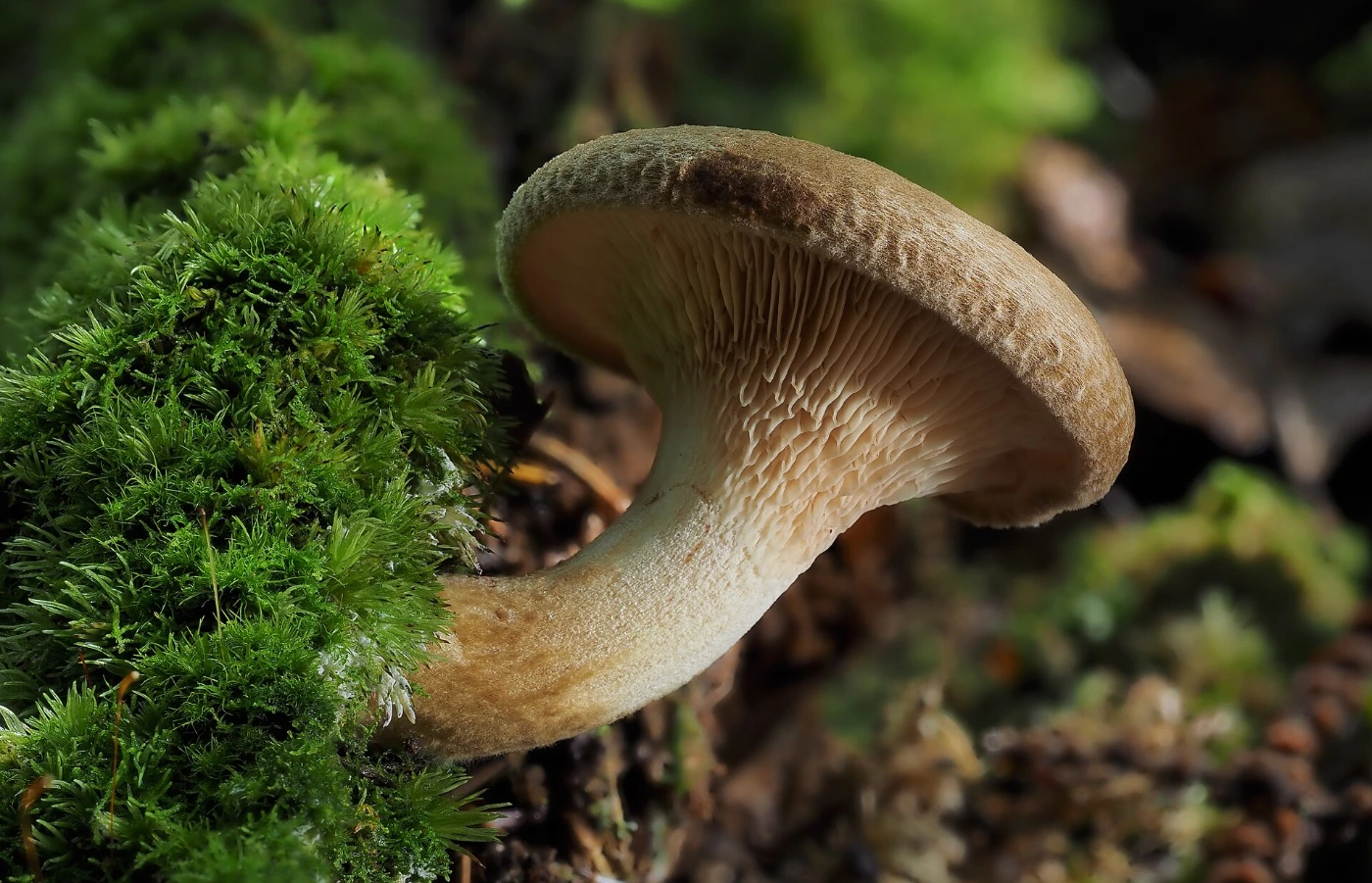
Paxillus involutus, commonly known as the Brown Roll-Rim, is a brown woodland mushroom with a strongly inrolled cap margin, decurrent gills, and flesh that often stains brown when bruised. It is a familiar autumn species across much of the Northern Hemisphere and is especially associated with birch, pine, spruce, and other trees.
The most useful field pattern is brown depressed cap + rolled margin + crowded decurrent gills + brown bruising + woodland habitat. The species can look deceptively ordinary, but it is considered dangerously poisonous and should not be eaten.
⚠️ Important: Brown Roll-Rim was historically eaten in parts of Europe, but serious and fatal poisonings have been documented. Cooking does not make it reliably safe, and repeated consumption may trigger severe immune-mediated haemolysis.
Quick Identification
| Feature | Paxillus involutus |
|---|---|
| Common name | Brown Roll-Rim |
| Cap color | Brown, olive-brown, yellow-brown |
| Cap shape | Convex when young, later depressed or funnel-shaped |
| Cap margin | Strongly inrolled when young |
| Surface | Smooth to finely felted |
| Gills | Crowded, decurrent |
| Gill color | Pale yellow-brown to ochre |
| Bruising | Gills and flesh often stain brown |
| Stem | Short to medium, pale brown |
| Ring | Absent |
| Volva | Absent |
| Spore print | Brown to rusty-brown |
| Ecology | Mycorrhizal |
| Habitat | Woodland, parks, grassy areas near trees |
| Season | Late summer to autumn |
| Toxicity | Poisonous |
| Main look-alikes | Tapinella atrotomentosa, Lactarius species, funnel mushrooms, other Paxillus species |
What Does Paxillus involutus Look Like?
Young Brown Roll-Rims usually have convex caps with margins tightly rolled inward. As the mushroom matures, the center often becomes depressed and can eventually form a shallow funnel.
The cap color varies from yellow-brown and olive-brown to darker reddish-brown. Wet weather may deepen the color, while dry specimens can become paler and duller.
Cap
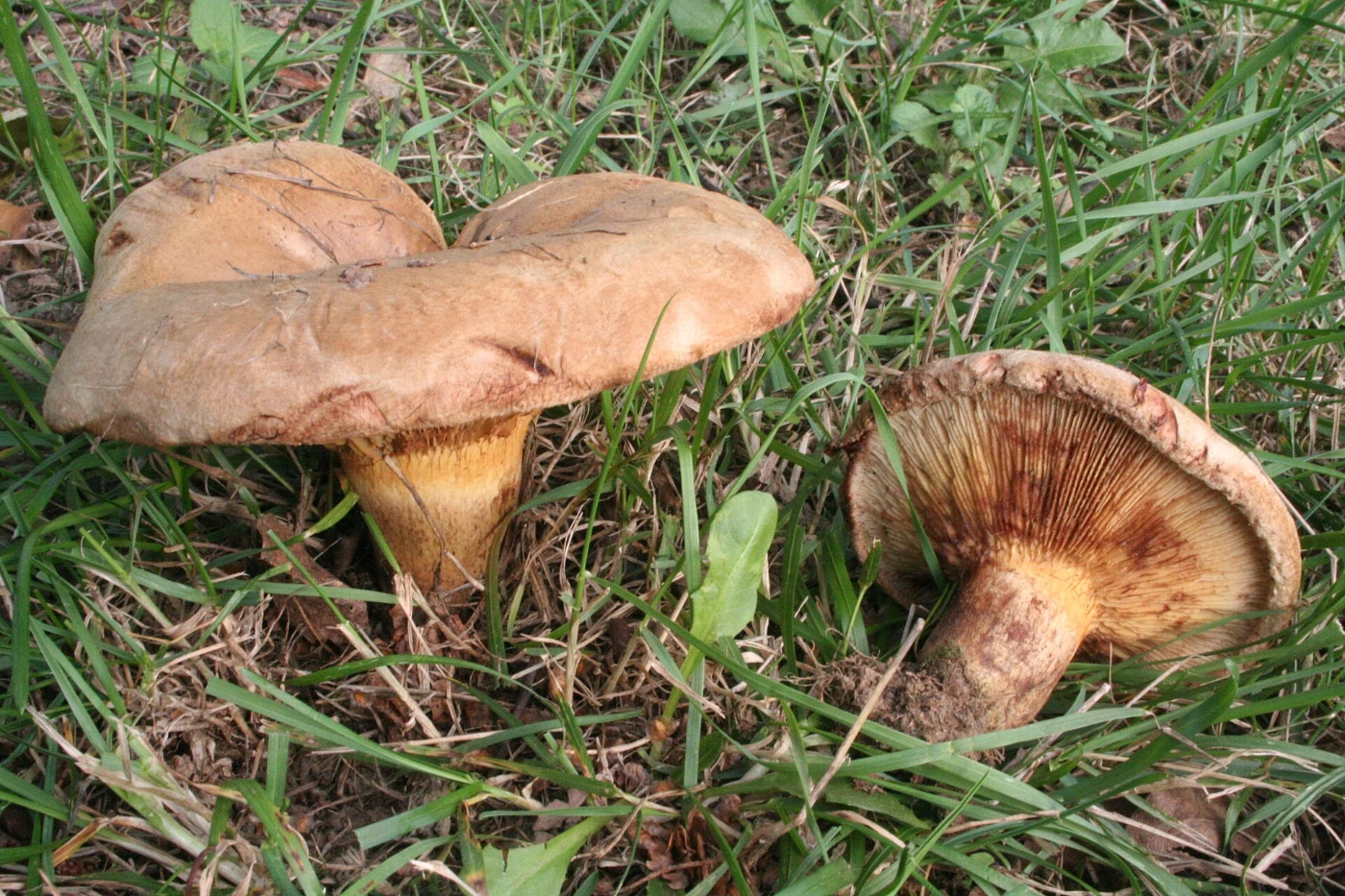
The cap is usually fleshy and broad, often becoming irregular with age. Young caps may have a finely felted or velvety surface.
The inrolled edge is one of the classic features. It is most obvious in young specimens and becomes less pronounced as the cap expands.
Inrolled Margin
The common name “Roll-Rim” refers directly to the strongly rolled cap edge. In young fruit bodies, the margin can curl inward so tightly that it partly hides the gills.
Older mushrooms may flatten enough that the rolled margin is less obvious. This means age must be considered when using this character.
Gills
The gills are crowded and run down the stem, a feature known as decurrent attachment. They begin pale yellowish or ochre and darken with age.
One of the most useful clues is that the gills often bruise brown when pressed. They may also separate relatively easily from the cap flesh.
Brown Bruising
Brown staining is a characteristic feature of Paxillus involutus. Pressing or damaging the gills often produces visible brown discoloration.
The flesh can also darken after cutting or bruising. This reaction is useful when combined with the rolled margin and decurrent gills.
Stem
The stem is usually fairly short, solid, and pale brown to yellow-brown. It can darken where handled or bruised.
There is no ring and no volva. The stem often appears somewhat thick in relation to the cap, but proportions vary considerably.
Flesh
The flesh is pale yellowish to cream when fresh and may turn brown after exposure or damage. It is soft and fleshy rather than brittle.
The texture changes quickly in older specimens. Mature mushrooms can become waterlogged or soft after prolonged rain.
Spore Print
The spore print is brown to rusty-brown. This helps separate Brown Roll-Rim from several pale-spored funnel-shaped mushrooms.
Spore color is useful but not unique to the species. It should be treated as confirmation rather than the sole identifying feature.
Where Does Brown Roll-Rim Grow?
Paxillus involutus is ectomycorrhizal and grows in association with living trees. It can occur in deciduous, mixed, and coniferous woodland.
Birch is a common partner, but the species can also be associated with pine, spruce, and other hosts. It may appear in parks, woodland edges, and grassy areas where tree roots are present.
Birch Woodland
Birch woodland is one of the classic habitats for Brown Roll-Rim. Fruit bodies may appear among moss, leaf litter, grass, or exposed soil.
Several Paxillus species can occur in similar habitats, which is why regional taxonomy matters. The traditional concept of P. involutus includes a complex of related species in Europe.
Coniferous Woodland
The species can also occur with conifers such as pine and spruce. Brown caps blend easily into needles and leaf litter, making the mushrooms easy to overlook.
In mixed forests, host association may be difficult to judge because roots from several tree species overlap. Structural features become more important in these cases.
Season
Brown Roll-Rim typically fruits from late summer through autumn. In mild regions, fruiting may continue quite late into the season.
Rainfall and soil moisture strongly affect abundance. Large groups can appear after sustained wet weather.
Distribution
Paxillus involutus is widely reported across the Northern Hemisphere. It has also been introduced into other regions along with host trees.
Modern studies show that the traditional Paxillus involutus concept contains several genetically distinct species. In Europe, related taxa include Paxillus ammoniavirescens, P. obscurisporus, and P. cuprinus, among others.
Is Paxillus involutus Poisonous?
Yes. Paxillus involutus is considered dangerously poisonous and should not be eaten. Historical reports of edibility are outdated and potentially hazardous.
The species is associated with gastrointestinal poisoning and with a rare but severe immune-mediated condition known as Paxillus syndrome. This syndrome can involve haemolytic anaemia, haemoglobinuria, kidney complications, disseminated intravascular coagulation, and in severe cases death.
Why Was Brown Roll-Rim Once Considered Edible?
The mushroom was eaten for many years in parts of Europe, sometimes after boiling or other preparation. This history led older books to describe it as edible or conditionally edible.
Later poisoning cases showed that repeated consumption could be associated with serious immune reactions. This is an important example of why historical culinary use does not always equal modern safety.
What Is Paxillus Syndrome?
Paxillus syndrome is a rare immune-mediated reaction associated with consumption of Paxillus involutus. It can cause destruction of red blood cells and rapidly become medically serious.
The reaction may occur even after previous meals were tolerated without obvious problems. That unpredictability is one reason the species should not be considered safely edible.
Look-Alikes
Several brown mushrooms have depressed caps and decurrent gills. The most useful distinctions involve cap texture, substrate, bruising, latex production, and whether the mushroom grows from wood or soil.
Tapinella atrotomentosa — Velvet Rollrim
Identification
Tapinella atrotomentosa has a broad brown cap and decurrent gills that can resemble a Brown Roll-Rim. It grows from conifer wood, including stumps, roots, and buried timber.
Its most distinctive feature is the thick dark brown to almost black velvety stem. The stem surface is much more conspicuous than that of Paxillus involutus.
Main Difference
A blackish velvety stem and direct growth from conifer wood point toward Tapinella atrotomentosa. Brown Roll-Rim usually grows terrestrially in association with living tree roots.
Lactarius Species
Identification
Some brown milkcaps also have depressed caps and decurrent gills. Their most important feature is latex released when the gills or flesh are damaged.
Latex can be white, colored, or change color after exposure. Paxillus involutus does not produce milk.
Main Difference
Damage the gills and check for latex. Visible milk strongly favors Lactarius or Lactifluus rather than Paxillus.
Clitocybe and Infundibulicybe Species
Identification
Several funnel-shaped mushrooms have pale to brown caps with decurrent gills. They often grow in woodland litter or grass and may form rings or troops.
Their spores are generally pale rather than rusty-brown. They also lack the characteristic brown bruising seen in Brown Roll-Rim.
Main Difference
Pale spore print and absence of strong brown bruising point away from Paxillus. A strongly rolled young margin is another useful clue.
Paxillus rubicundulus Group
Identification
Members of the Paxillus rubicundulus group can look very similar to P. involutus. They are especially associated with alder.
Cap color, host tree, microscopic characters, and modern molecular data may be needed for confident separation. This is a good example of why the genus can be difficult at species level.
Main Difference
Alder association raises the possibility of Paxillus rubicundulus and related taxa. A birch or mixed woodland specimen may fit P. involutus more readily, but ecology alone is not always decisive.
Other Paxillus Species
Identification
Several European Paxillus species were once grouped under the name P. involutus. They can overlap heavily in cap color, bruising, and general shape.
Some distinctions depend on ecology, spore size, cap behavior with age, and DNA data. Field identification to exact species can therefore be uncertain in atypical cases.
Main Difference
If the mushroom clearly belongs to Paxillus but lacks a typical combination of habitat and morphology, genus-level identification may be safer. Modern taxonomy recognizes multiple distinct species within the former P. involutus complex.
Brown Roll-Rim vs Velvet Rollrim
| Feature | Paxillus involutus | Tapinella atrotomentosa |
|---|---|---|
| Cap | Brown, depressed | Brown, broad |
| Margin | Strongly inrolled when young | Often rolled |
| Gills | Decurrent, bruise brown | Decurrent |
| Stem | Pale brown | Dark, thick, velvety |
| Habitat | Ground near living trees | Conifer wood |
| Ecology | Mycorrhizal | Wood-decaying |
| Best clue | Brown bruising + terrestrial growth | Black velvety stem + wood |
These two are superficially similar but ecologically very different. Checking the stem and substrate usually resolves the comparison quickly.
Brown Roll-Rim vs Brown Milkcaps
| Feature | Paxillus involutus | Brown Lactarius spp. |
|---|---|---|
| Cap | Brown, rolled margin | Brown, often depressed |
| Gills | Decurrent | Often decurrent |
| Latex | None | Present |
| Bruising | Often brown | Variable |
| Spore print | Brownish | Pale cream to yellowish |
| Ecology | Mycorrhizal | Mycorrhizal |
| Best clue | No latex | Latex from damaged gills |
The presence or absence of latex is the easiest field distinction. Color overlap can otherwise be substantial.
How to Identify Paxillus involutus
Start with overall shape. A brown mushroom with a depressed cap and strongly inrolled young margin is a good first clue. Then check the gills. They should run down the stem and often stain brown when rubbed or bruised. Finally, consider ecology and spore color. Terrestrial growth near trees together with a brownish spore print supports the Paxillus group.
Young vs Mature Brown Roll-Rims
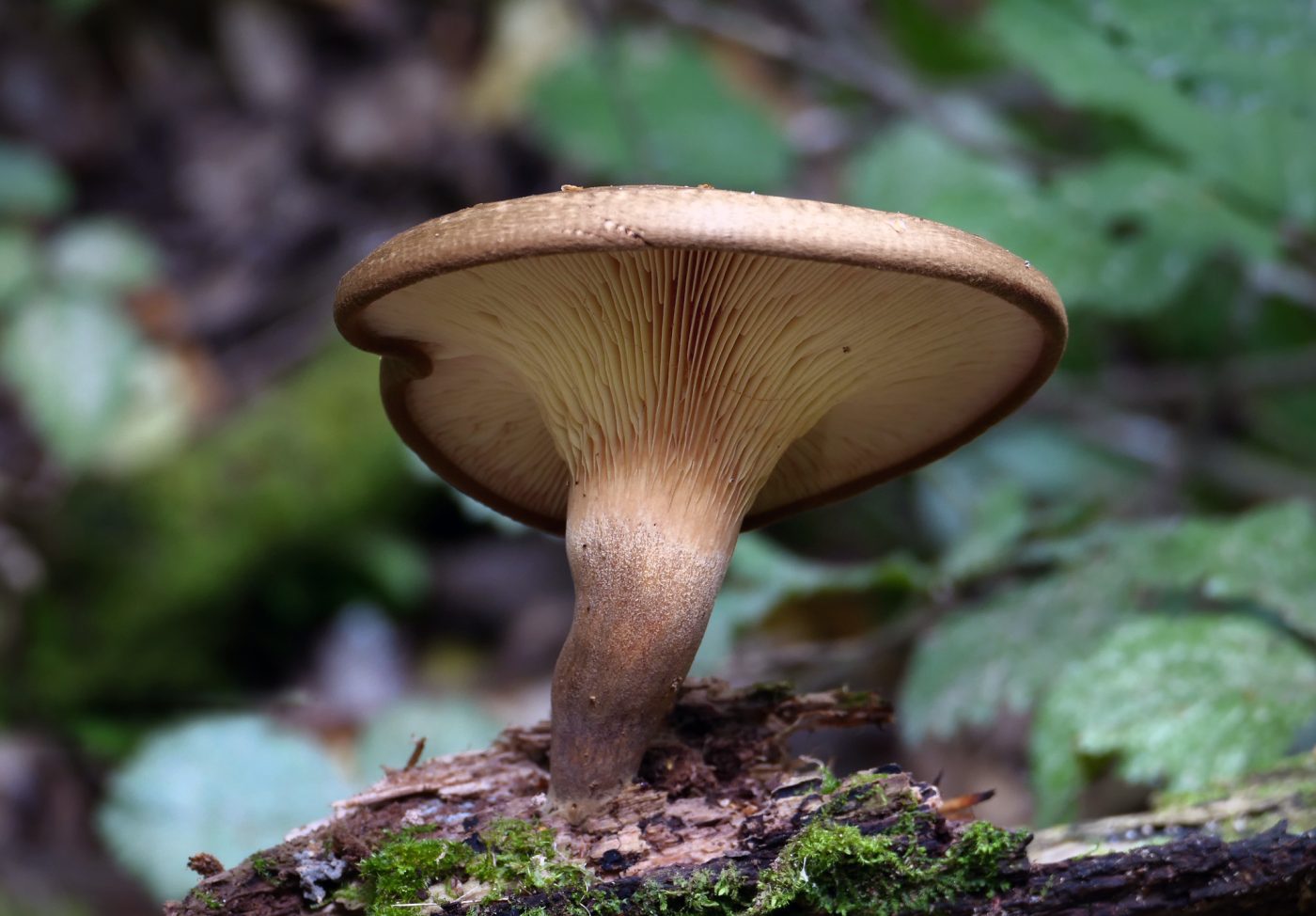
Young fruit bodies are usually easier to recognize because the cap edge is strongly rolled inward. Their gills may be paler and more tightly packed.
Older mushrooms often flatten and become more funnel-shaped. The cap may lose much of the dramatic rolled margin that gave the species its common name.
How Weather Changes the Appearance
Rain can make the cap darker and softer. Prolonged wet weather can also make older mushrooms look smoother and less felted.
Dry conditions may pale the cap and emphasize surface irregularities. Brown bruising usually remains more useful than exact cap shade.
Common Identification Mistakes
One common mistake is assuming that every brown funnel-shaped mushroom is Paxillus involutus. Several genera produce similar depressed caps and decurrent gills.
Another mistake is overlooking the substrate. A similar mushroom growing directly from conifer wood may be Tapinella atrotomentosa instead.
A third mistake is trusting old field guides that describe Brown Roll-Rim as edible. Modern toxicological evidence clearly supports treating it as poisonous.
How to Photograph Paxillus involutus
Photograph the cap from above so the rolled margin and depressed center are visible. A side view should show the decurrent gills and complete stem. It is also useful to photograph the gills before and after gentle pressure. Brown bruising can be an important visual clue for image-based identification.
Can AI Identify Brown Roll-Rim?
AI can often recognize a typical specimen when the rolled margin, decurrent gills, brown staining, and woodland habitat are visible. Older or atypical mushrooms are more difficult because the cap margin may flatten substantially.
The image set should include the underside, full stem, habitat, and bruising reaction. A top-down photograph alone can easily confuse Brown Roll-Rim with unrelated brown funnel-shaped mushrooms.
Interesting Facts
Brown Roll-Rim belongs to the order Boletales even though it has gills rather than pores. This is a useful reminder that visible underside structure does not always reflect deeper evolutionary relationships.
The species was once considered edible in parts of Europe, sometimes even regarded as a common table mushroom. Its later association with severe immune-mediated poisoning completely changed modern safety recommendations.
The traditional name Paxillus involutus also turned out to conceal more diversity than expected. Molecular studies have shown that several distinct European species were historically grouped under the same name.
Its brown-staining gills are especially useful in the field. A gentle press can sometimes reveal the reaction within minutes and make an otherwise plain-looking mushroom much easier to place.
Frequently Asked Questions
Is Paxillus involutus edible if boiled first?
No reliable preparation makes it a safe edible mushroom. Serious immune-mediated poisoning has occurred in people who had eaten the species before without obvious problems.
Why is it called Brown Roll-Rim?
The name refers to the strongly inrolled cap edge of young fruit bodies. As the mushroom ages, the margin becomes flatter and less obvious.
Do the gills always stain brown?
They commonly do, but the reaction can vary with age and moisture. Fresh specimens usually show the feature more clearly than old or dried mushrooms.
Does it grow on wood?
Usually no. Paxillus involutus is mycorrhizal and normally grows from soil near living trees rather than directly from dead wood.
Can it grow under birch?
Yes. Birch is one of the common host trees, although the mushroom can also associate with conifers and other trees.
Is Brown Roll-Rim common in North America and Europe?
The broader Paxillus involutus group is widely distributed across the Northern Hemisphere. Exact species identification can be complicated because the traditional name covers several closely related lineages.
How can I separate it from Velvet Rollrim?
Check the stem and substrate. Velvet Rollrim has a thick dark velvety stem and grows from conifer wood, while Brown Roll-Rim normally grows from soil near living trees.
Can a person eat it safely many times before becoming ill?
Previous tolerance does not prove future safety. Paxillus syndrome is associated with immune sensitization, and severe reactions have occurred after repeated consumption.
Final Identification Notes
Paxillus involutus is best recognized by the combination of a brown depressed cap, strongly inrolled young margin, crowded decurrent gills, brown bruising, terrestrial growth near trees, and brownish spore print.
Its most important look-alikes include Tapinella atrotomentosa, brown milkcaps, pale-spored funnel mushrooms, and other Paxillus species. Substrate, latex production, bruising, and spore color provide the clearest practical distinctions.
The practical field pattern is: brown funnel-shaped cap + rolled margin + decurrent gills that bruise brown + woodland soil = strong Paxillus candidate. Because Brown Roll-Rim is dangerously poisonous, it should never be treated as an edible species.
Upload a photo and get possible matches in seconds.