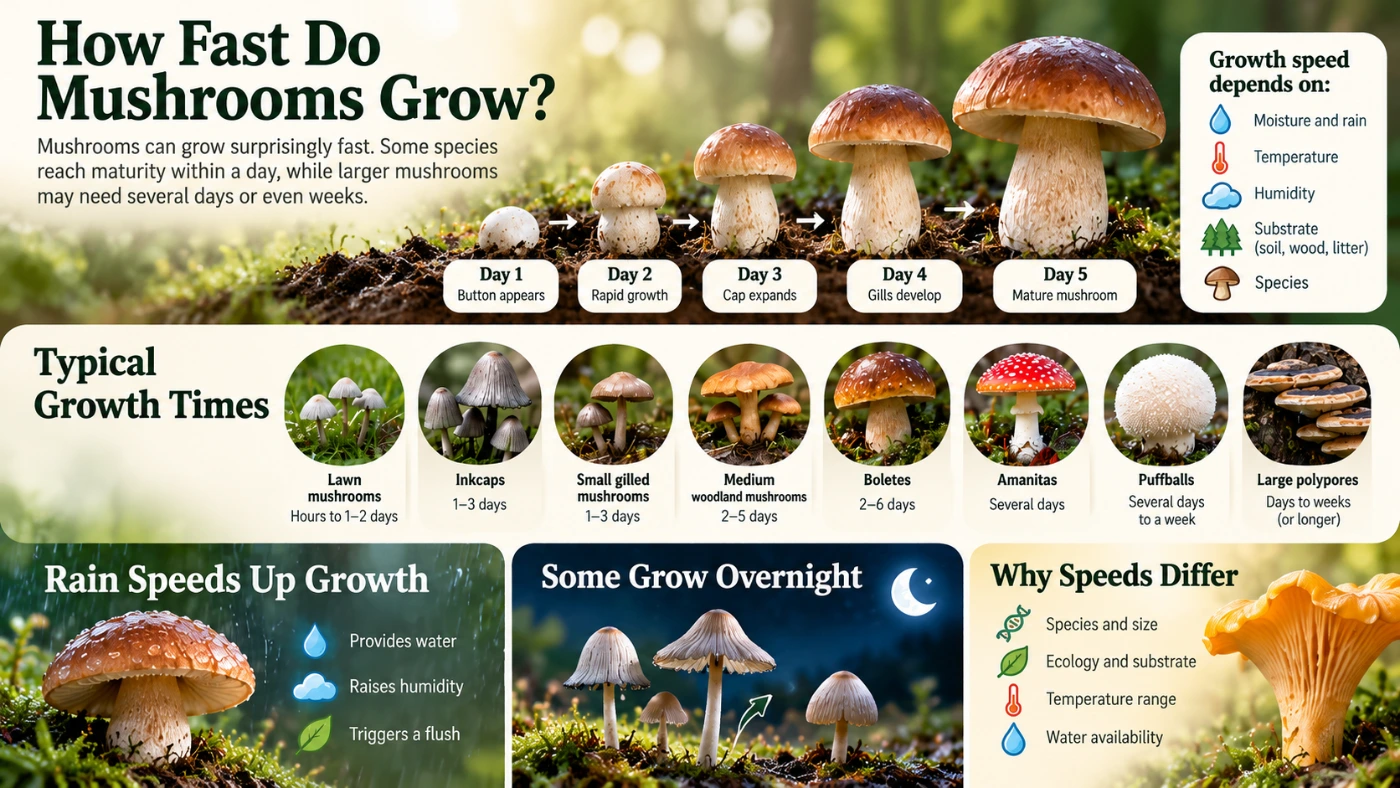
Mushrooms can grow surprisingly fast. Some small species can appear and reach maturity within a day, while larger mushrooms may need several days to develop from a tiny button into a full-sized fruit body.
The exact speed depends on the species, temperature, moisture, humidity, substrate, and how far development had already progressed before the mushroom became visible. What looks like sudden overnight growth is often the rapid expansion of a fruit body that had already started forming below the surface.
How Fast Can a Mushroom Grow?
Many common mushrooms can become noticeably larger within 24 hours under favorable conditions. Some delicate lawn or woodland species may complete most of their visible growth in only one or two days.
Larger mushrooms often take longer. Boletes, Amanitas, puffballs, and large bracket fungi may continue expanding for several days before reaching full size.
Typical Mushroom Growth Times
| Type of mushroom | Approximate visible growth period |
|---|---|
| Tiny lawn mushrooms | Several hours to 1–2 days |
| Inkcaps | 1–3 days |
| Small gilled mushrooms | 1–3 days |
| Medium woodland mushrooms | 2–5 days |
| Boletes | 2–6 days |
| Amanitas | Several days |
| Puffballs | Several days to more than a week |
| Large polypores | Days to weeks |
| Persistent brackets | Weeks, months, or longer |
These are broad patterns rather than fixed schedules. The same species can grow at very different speeds depending on weather and habitat.
Can Mushrooms Really Grow Overnight?
Yes, some mushrooms can expand dramatically overnight. Cool temperatures, high humidity, and reduced evaporation often create excellent conditions during the night.
However, the mushroom usually did not begin from nothing after sunset. A small immature fruit body may already have been present in the soil, wood, or litter and then expanded rapidly once moisture conditions became favorable.
Why Do Mushrooms Grow So Fast?
Mushrooms grow differently from plants. Much of the visible expansion of a fruit body comes from cells taking up water and enlarging rather than from producing large amounts of entirely new tissue.
This allows a mushroom cap or stem to increase in size very quickly. The fungus has already invested energy in the developing structure, and water uptake helps it expand rapidly.
The Fungus Was Already There
The visible mushroom is only the reproductive structure of a larger fungal organism. Most of the fungus exists as mycelium hidden in soil, wood, roots, or organic matter.
The mycelium can live for years without producing obvious fruit bodies. When temperature and moisture become suitable, it can begin producing mushrooms very quickly.
Why Rain Speeds Up Mushroom Growth
Rain provides water that developing mushrooms need for rapid expansion. It also raises humidity and reduces the risk of the fruit body drying out.
A strong flush often follows rain because many fruit bodies begin expanding at roughly the same time. This can make an entire forest floor or lawn appear to change overnight.
How Long After Rain Do Mushrooms Grow?
Some mushrooms can become visible within about a day of good rainfall. Others take two to five days or even longer before appearing.
The timing depends on how dry the substrate was before the rain. If the soil was already moist, mushrooms may respond quickly, while drought-stressed mycelium may need several wet days before fruiting.
Temperature and Growth Speed
Temperature strongly affects fungal metabolism. Warm conditions generally speed growth up to the point where heat or drying becomes stressful.
Different species prefer different temperature ranges. A summer bolete may grow rapidly in warm wet weather, while a winter mushroom such as Velvet Shank performs better under much cooler conditions.
Humidity Matters as Much as Rain
High humidity helps mushrooms retain water. Thin caps and stems can lose moisture rapidly in dry air, even if the soil itself remains damp.
This is one reason mushrooms often grow especially well at night or after several cloudy days. Moist air allows the fruit body to keep expanding without drying at the surface.
How Fast Do Boletes Grow?
Boletes can grow very quickly when conditions are favorable. A small button can become a substantial mushroom within only a few days.
Porcini and other large boletes may continue enlarging for several days before insects, slugs, weather, or age begin to damage the fruit body. Warm wet weather can accelerate both growth and deterioration.
How Fast Do Porcini Grow?
Porcini can increase noticeably in size from one day to the next. A young compact fruit body may become a large mature mushroom in roughly several days under favorable conditions.
Growth is especially rapid after rain when soil moisture is high and temperatures remain mild. This is why experienced mushroom hunters often revisit productive porcini sites repeatedly during a good flush.
How Fast Do Chanterelles Grow?
Chanterelles generally grow more slowly than many soft-fleshed gilled mushrooms. They can remain in good condition for longer and may continue developing over several days.
Their firm flesh also makes them more persistent in the forest. A chanterelle patch can remain productive and recognizable for longer than a patch of delicate inkcaps.
How Fast Do Morels Grow?
Morels can develop quickly once spring conditions become suitable. Individual fruit bodies may noticeably increase in size over only a few days.
Their season is strongly influenced by soil temperature and moisture. Warm spring weather after rain can accelerate development significantly.
How Fast Do Oyster Mushrooms Grow?
Oyster Mushrooms can grow very quickly from small clusters into large overlapping shelves. Under favorable cool and humid conditions, the change can be dramatic within a few days.
Because several fruit bodies often develop from one point on a log, the whole cluster may appear to expand at once. Mature mushrooms can then deteriorate quickly if conditions become warm or dry.
How Fast Do Puffballs Grow?
Small puffballs can reach mature size within several days. Giant Puffballs grow more slowly overall, but their increase in volume can still be remarkable.
A large puffball may expand from a relatively small white ball into a very large fruit body over the course of several days. Once the interior begins changing from white flesh into spores, visible enlargement slows.
How Fast Do Inkcaps Grow?
Inkcaps are among the fastest visible mushrooms. Some can emerge, mature, release spores, and begin dissolving within only a day or two.
This extremely short life cycle explains why they may appear in the morning and look completely different by evening. Their fragile fruit bodies are designed for rapid reproduction rather than long survival.
How Fast Do Bracket Fungi Grow?
Bracket fungi are much more variable. Soft annual polypores may develop over days or weeks, while hard perennial brackets can continue adding new growth for years.
A large bracket on a tree should therefore not be compared with a short-lived lawn mushroom. Their growth strategies are fundamentally different.
Why Some Mushrooms Grow Faster Than Others
Species differ in tissue structure, size, ecology, and reproductive strategy. A tiny mushroom designed to release spores quickly does not need the same development time as a large tough polypore.
Water availability also affects species differently. Soft mushrooms can expand rapidly when hydrated, while dense woody fruit bodies usually grow more gradually.
Young Mushrooms Can Be Hard to See
Many mushrooms spend part of their development hidden under leaves, moss, soil, bark, or wood chips. By the time you notice them, much of their early development may already be complete.
This creates the impression that a mushroom suddenly appeared at full size. In reality, the final visible expansion may only be the last stage of a longer process.
Do Mushrooms Grow Continuously?
Growth is not always steady. A fruit body may expand rapidly during humid periods and slow dramatically when conditions become dry.
Rain, dew, temperature changes, and wind can create alternating periods of faster and slower growth. Some persistent species can even pause during dry weather and continue after moisture returns.
Do Mushrooms Grow Faster at Night?
They can appear to. Nighttime usually brings cooler temperatures, higher humidity, and less direct sunlight, all of which reduce water loss.
The fungus itself does not follow a simple day-versus-night schedule. The important factor is whether the environmental conditions favor continued expansion.
Can You Watch a Mushroom Grow?
Yes. Some mushrooms change enough over a few hours that time-lapse photography can capture obvious movement and expansion.
Inkcaps, oyster mushrooms, and rapidly expanding lawn fungi are especially suitable. Photographing the same mushroom from the same angle every few hours can reveal changes that are difficult to notice in real time.
Why Mushrooms Sometimes Stop Growing
A mushroom may stop developing if the environment becomes too dry, too hot, too cold, or otherwise unfavorable. Insects and physical damage can also interrupt development.
Some immature fruit bodies simply abort. They may remain small, darken, shrivel, or disappear without ever reaching maturity.
Can Mushrooms Grow After Frost?
Some can. Cold-tolerant species such as Oyster Mushrooms and Velvet Shanks can continue fruiting during very cool weather and may survive light freezing.
Other mushrooms are badly damaged by frost. Repeated freezing and thawing can soften tissues and end development even if the mycelium remains healthy.
Does Picking a Mushroom Make Another Grow Faster?
Usually not in any immediate direct sense. The underground mycelium determines whether new fruit bodies will develop based on its condition and the environment.
Removing one mushroom does not cause a replacement to shoot up instantly. However, a productive mycelium may already have several additional fruit bodies developing nearby.
How Long Does a Mushroom Stay Fresh?
Fast-growing mushrooms are often short-lived. Small delicate species may remain in good condition for only hours or a couple of days.
Large fleshy mushrooms can persist for several days, while tough brackets may remain visible for weeks, months, or even years. Growth speed and lifespan are related, but they are not the same thing.
How Fast Does Mycelium Grow?
Mycelium grows much more slowly and continuously than the visible mushroom. It spreads through soil, wood, or another substrate as microscopic hyphae.
The rate depends heavily on species and environmental conditions. The important distinction is that the mycelium may be growing long before any mushrooms appear.
Why Mushrooms in the Same Patch Can Be Different Sizes
A cluster can contain mushrooms at several developmental stages. Some fruit bodies may have started expanding earlier than others.
Microclimate also matters. A mushroom under leaf cover may retain more moisture and grow differently from one exposed to sunlight only a short distance away.
Why Warm Rain Can Produce Explosive Growth
Warm rain can create a particularly favorable combination of high soil moisture and active metabolism. Many fungi respond rapidly when both temperature and water availability are near their preferred range.
The effect can be especially dramatic in summer and early autumn. A previously empty woodland floor may produce numerous visible mushrooms within several days.
Why Too Much Heat Slows Growth
Hot weather increases evaporation and can dry mushroom tissues quickly. Even moist soil may not compensate if the air is hot and dry.
Some fungi also become physiologically less active above their preferred temperature range. More heat does not automatically mean faster growth.
Why Too Much Water Can Also Be a Problem
Saturated soil contains less oxygen, and some fungi do not fruit well under waterlogged conditions. Heavy rain can also physically damage fragile mushrooms.
The best conditions are often moist and humid rather than flooded. Steady rainfall followed by mild weather can be more productive than a violent storm.
Can a Mushroom Double in Size in One Day?
Yes, especially when it is young and actively expanding. Some mushrooms can increase dramatically in diameter or height within 24 hours.
The percentage change is often greatest while the fruit body is still small. Later growth slows as the mushroom reaches maturity and begins focusing on spore production.
When Is a Mushroom Fully Grown?
A mushroom is close to full size when the cap has expanded into its mature form and the spore-producing surface is fully developed. Gilled mushrooms may flatten or open their caps, while puffballs mature internally.
Physical size alone does not define maturity. A mushroom may stop getting larger while its spores continue developing.
How Quickly Do Mushrooms Become Old?
Some species age almost immediately after reaching maturity. Thin gilled mushrooms may collapse, dry, or decay within a day after releasing spores.
Fleshy boletes and Amanitas may remain recognizable for several more days. Tough wood-growing species can persist much longer.
Common Misconceptions
One common misconception is that mushrooms grow from spores immediately after rain. Spores usually develop into mycelium long before the visible fruit body appears.
Another misconception is that all mushrooms grow overnight. Some do develop extremely quickly, but others require days, weeks, or even longer.
A third misconception is that a large mushroom must be old. Some fast-growing species can become surprisingly large within only a few days.
Interesting Facts
Much of a mushroom’s rapid increase in size comes from water entering existing cells. This allows fruit bodies to expand much faster than most plants can build equivalent structures.
Some species have extremely short visible lives. Certain inkcaps can emerge, release spores, and collapse within roughly the same period that a large bracket fungus adds only a small amount of new tissue.
Mushroom hunters sometimes revisit productive sites daily during peak conditions because the forest can change so quickly. A small button overlooked one morning may become an obvious mature mushroom only a day or two later.
The visible fruit body may be short-lived, but the fungus itself can be very old. The underground mycelium can survive through many seasons and produce new mushrooms whenever conditions become favorable.
Frequently Asked Questions
How long does it take a mushroom to grow from a button to full size?
Many fleshy mushrooms need roughly a few days, but the range varies widely between species. Small delicate mushrooms may mature in less than two days, while larger or tougher fungi can take much longer.
Can a mushroom grow overnight?
Yes. Some species can increase dramatically in size overnight when humidity and temperature are favorable. They usually began developing before they became visible, however.
How fast do mushrooms grow after rain?
Some may appear within about 24 hours, while others need several days. A common productive period is roughly two to five days after substantial rainfall.
Do mushrooms grow faster in warm weather?
Often, but only within the preferred temperature range of the species. Excessive heat and dry air can slow or stop fruiting.
Do mushrooms keep growing after the cap opens?
Some continue increasing slightly in size, but growth usually slows as maturity approaches. The mushroom then focuses mainly on developing and releasing spores.
Why do mushrooms seem bigger every morning?
Nighttime humidity and cooler temperatures can support rapid expansion. Reduced evaporation also helps the fruit body retain the water needed for growth.
Can you see mushrooms grow in real time?
With fast species, yes. Time-lapse photography over several hours can capture visible cap expansion and stem elongation.
Does a bigger mushroom always mean an older mushroom?
No. Growth rates differ greatly between species and even between individuals. A large fast-growing mushroom may be younger than a much smaller slow-growing species.
Final Notes
Mushrooms can grow much faster than many people expect. Some small species reach maturity within a day or two, while larger fleshy mushrooms commonly need several days and persistent brackets may develop over weeks or longer.
Their rapid growth is possible because the fungus already exists as mycelium and much of the visible expansion comes from water uptake. Rain, humidity, temperature, substrate, and species all determine how quickly the fruit body develops.
The simplest rule is: small delicate mushrooms may mature in hours or days, most fleshy woodland mushrooms grow over several days, and tough brackets develop much more slowly.
Upload a photo and get possible matches in seconds.