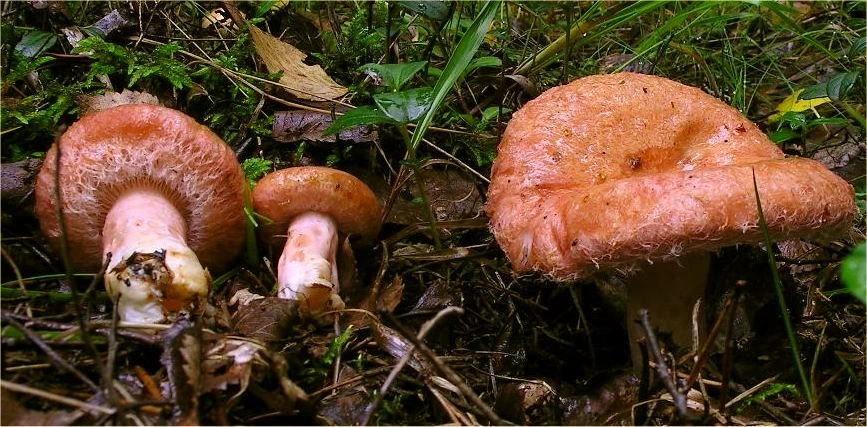
Lactarius torminosus, commonly known as the Woolly Milkcap, is a striking pink to salmon-colored milkcap with a conspicuously hairy cap margin. It is strongly associated with birch and is one of the easiest European milkcaps to recognize when fresh.
The most useful field pattern is pink zoned cap + woolly inrolled margin + white latex + birch habitat. Older specimens can lose some of the hairs and fade in color, so the full combination is more reliable than cap appearance alone.
⚠️ Important: Lactarius torminosus is not a beginner edible mushroom. Raw or insufficiently prepared fruit bodies can cause gastrointestinal symptoms, and edibility traditions vary by region.
Quick Identification
| Feature | Lactarius torminosus |
|---|---|
| Common name | Woolly Milkcap |
| Cap color | Pink, salmon, pink-orange |
| Cap pattern | Concentric zones often visible |
| Cap margin | Strongly woolly, especially when young |
| Gills | Cream to pale pinkish |
| Latex | White |
| Latex color change | Usually remains white |
| Stem | Pale, firm, sometimes with shallow pits |
| Flesh | White to pale pinkish |
| Smell | Mild to slightly fruity or resinous |
| Spore print | Cream |
| Ecology | Mycorrhizal |
| Main host | Birch |
| Season | Summer to autumn |
| Distribution | Europe and other northern temperate regions |
| Edibility | Not recommended without expert knowledge and proper regional preparation |
| Main look-alikes | Lactarius pubescens, other pink milkcaps, orange milkcaps |
What Does Lactarius torminosus Look Like?
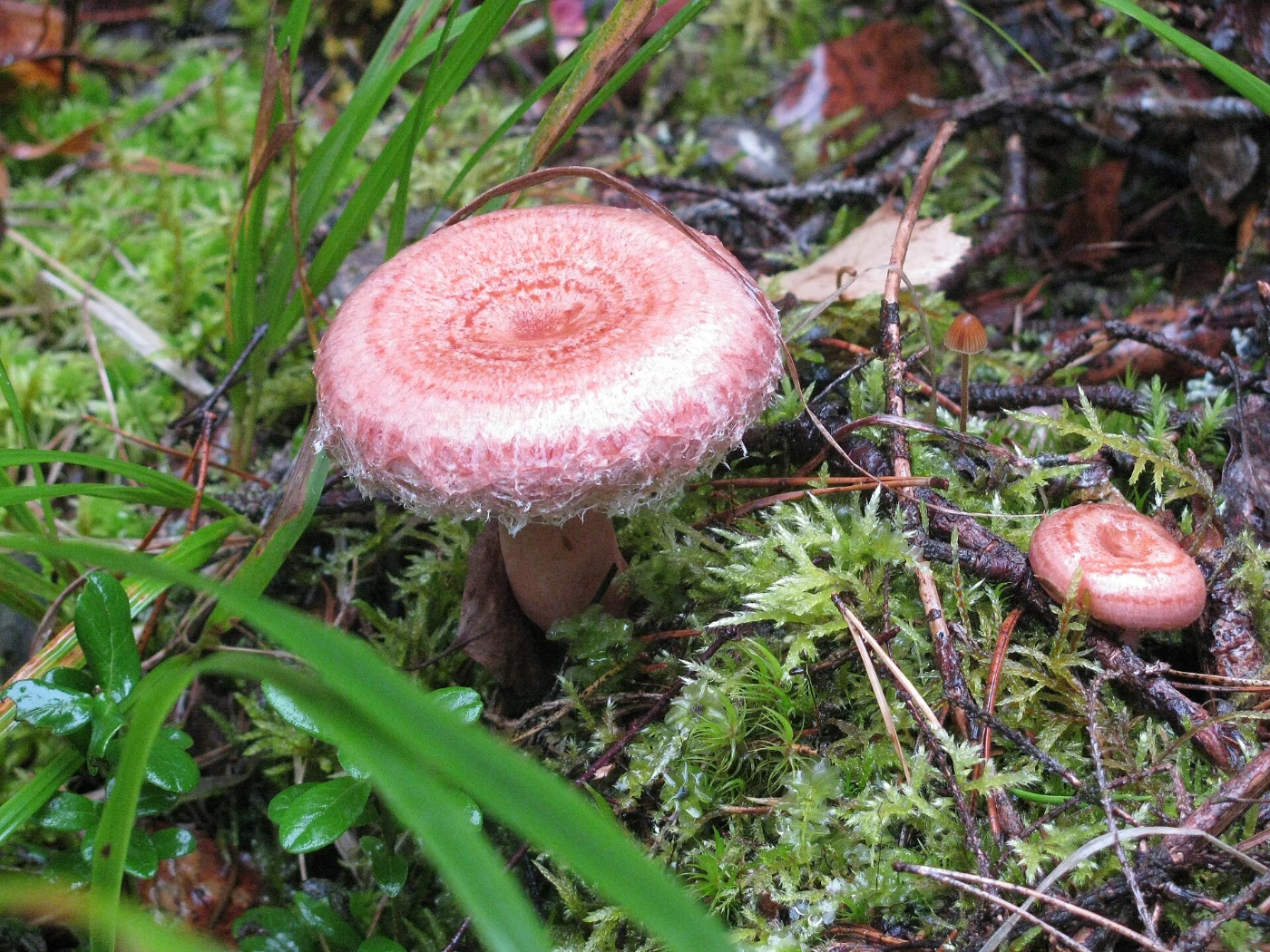
Young Woolly Milkcaps are usually the easiest to recognize. The cap is convex to shallowly depressed and often shows pink or salmon concentric rings.
The edge is rolled inward and covered with conspicuous pale hairs. This woolly fringe can make the cap look almost furry.
Cap
The cap is usually pink, salmon-pink, or pinkish-orange. Darker concentric zones may form rings across the surface.
As the mushroom matures, the cap becomes flatter and often develops a central depression. Rain and age can wash out the color, sometimes making older specimens much paler.
Woolly Margin
The hairy margin is the species’ most famous feature. Young fruit bodies often have long, soft hairs concentrated around the inrolled edge.
These hairs can become much less obvious with age. A mature specimen may retain only a faintly fuzzy margin, especially after heavy rain.
Concentric Zoning
The cap often shows alternating bands of darker and lighter pink. This zoning can be quite strong in fresh specimens.
Not every mushroom shows equally distinct rings. Weathered caps may look almost uniformly pale pink.
Gills
The gills are cream to pale flesh-colored and fairly crowded. They run slightly down the stem or are broadly attached.
When damaged, they release white latex. This immediately places the mushroom among the milkcaps rather than the true Russulas.
Latex
Fresh cuts in the gills or flesh produce white milk-like liquid. The latex usually remains white rather than turning orange, red, or wine-colored.
Its taste is often acrid or peppery. Tasting wild mushrooms is not necessary for routine identification and should not replace safer structural characters.
Stem
The stem is pale, often whitish to pinkish, and usually fairly stout. It can become hollow or softer with age.
Some specimens show shallow pits or slightly darker spots. There is no ring or volva.
Flesh
The flesh is white to pale pinkish and relatively firm when young. Like other members of Russulaceae, it has a brittle texture rather than fibrous flesh.
When cut, the tissue releases white latex. This brittle structure helps separate milkcaps from many superficially similar gilled mushrooms.
Smell
The smell is usually mild and not especially diagnostic. Some specimens may have a faint fruity, resinous, or mushroom-like odor.
Odor should be treated as supporting evidence only. The woolly cap margin and birch association are much more useful.
Spore Print
The spore print is cream to pale yellowish-cream. This fits the general pattern seen in many Lactarius species.
Spore color is useful for confirming the broader group but is not enough to distinguish L. torminosus from close relatives. Cap texture and habitat are more practical field characters.
Where Does Lactarius torminosus Grow?
Woolly Milkcap forms a mycorrhizal relationship with birch. It is therefore strongly associated with birch woodland, mixed forests containing birch, and grassy areas near birch trees.
It does not grow from dead wood or mulch as a decomposer. If no birch is present nearby, the identification deserves extra scrutiny.
Birch Woodland
Classic habitat includes damp birch forest with moss, grass, or leaf litter. Fruiting bodies may appear singly or in scattered groups.
It can also occur along woodland edges where birch roots extend beyond the visible tree canopy. This sometimes makes the host association less obvious at first glance.
Parks and Grassland Near Birch
The species can also appear in parks, lawns, and open grassy places if birch trees are nearby. Urban and suburban sites can therefore produce good examples.
The key is the underground root connection rather than the surface habitat alone. A mushroom in grass may still be mycorrhizal with a birch several meters away.
Season
Lactarius torminosus usually fruits from summer through autumn. In many European regions, late summer and early autumn are especially productive.
Wet weather can trigger substantial flushes. Fruiting may continue later in mild climates before repeated frost.
Distribution
The species is widespread in Europe and northern temperate regions where birch is common. It has also been reported from North America and other areas, although regional taxonomy and introductions should be considered carefully.
For a field identification, the strongest ecological clue is still the presence of birch. Distribution alone is much less useful than host-tree association.
Is Lactarius torminosus Edible?
This species has a complicated culinary history. It is considered inedible or poisonous when raw or improperly prepared, but it has traditionally been consumed in some northern and eastern European regions after special processing.
That processing can involve prolonged soaking, boiling, salting, or fermentation depending on local tradition. Because preparation practices and safety assessments vary, this is not a mushroom to recommend casually as an edible species.
Look-Alikes
The closest look-alikes are other pale pink milkcaps associated with birch. The most important comparison is Lactarius pubescens, which is usually paler and less strongly zoned.
Lactarius pubescens — Downy Milkcap
Identification
Lactarius pubescens is cream, whitish, or pale pink and also has a hairy margin. It grows with birch and produces white latex.
The cap is usually less strongly colored and less clearly zoned than L. torminosus. It often looks softer and paler overall.
Main Difference
Strong pink concentric zoning favors Lactarius torminosus. A much paler cream-pink cap with weaker zoning favors L. pubescens.
Lactarius deliciosus — Saffron Milk Cap
Identification
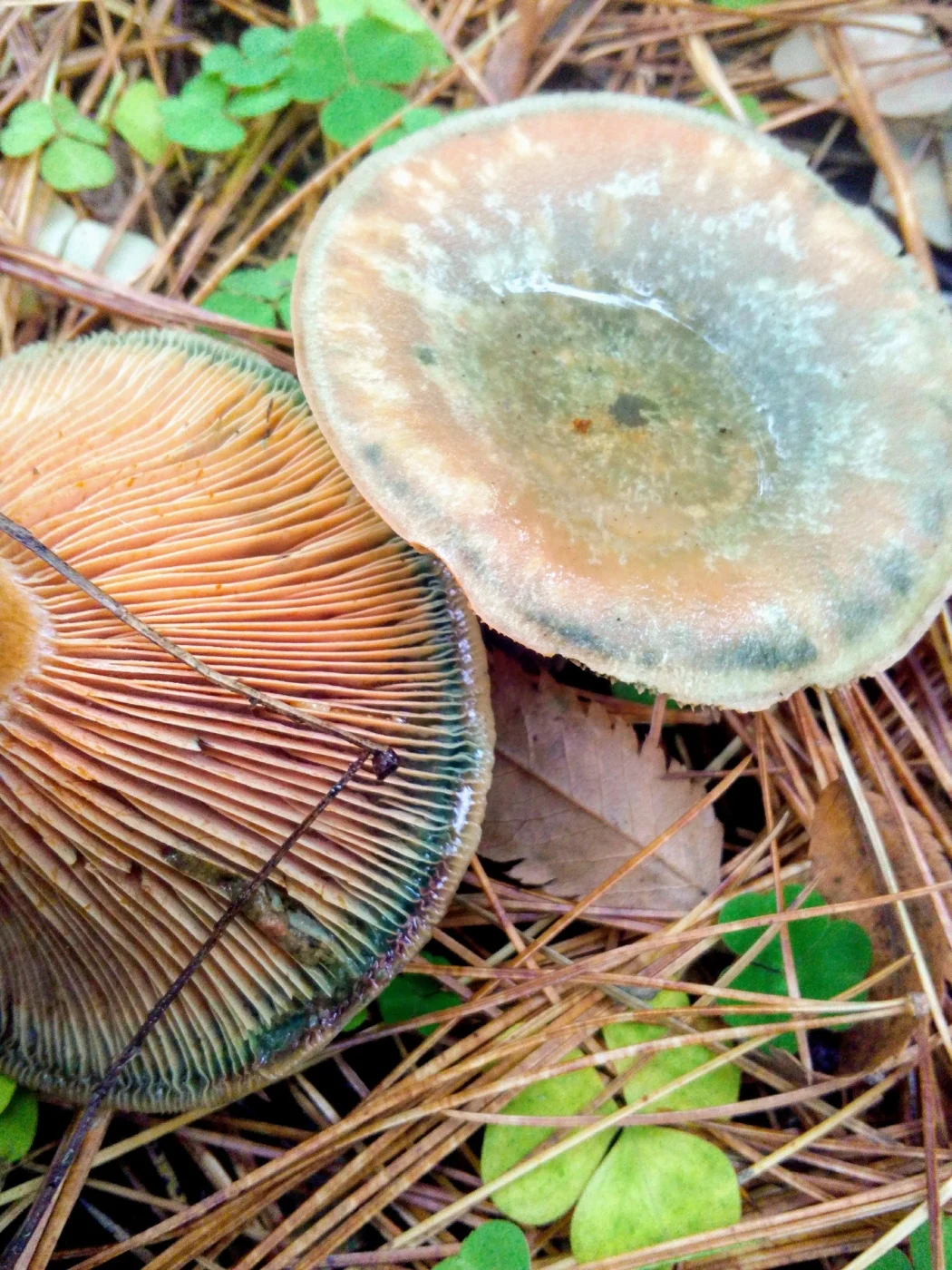
Lactarius deliciosus has an orange cap with concentric zoning and may superficially resemble a colorful L. torminosus. It typically grows with pine rather than birch.
The latex is orange, not white, and the cap margin is not densely woolly. Green staining can also develop with age or damage.
Main Difference
Orange latex and pine habitat point toward L. deliciosus. White latex and a woolly pink margin point toward L. torminosus.
Lactarius deterrimus
Identification
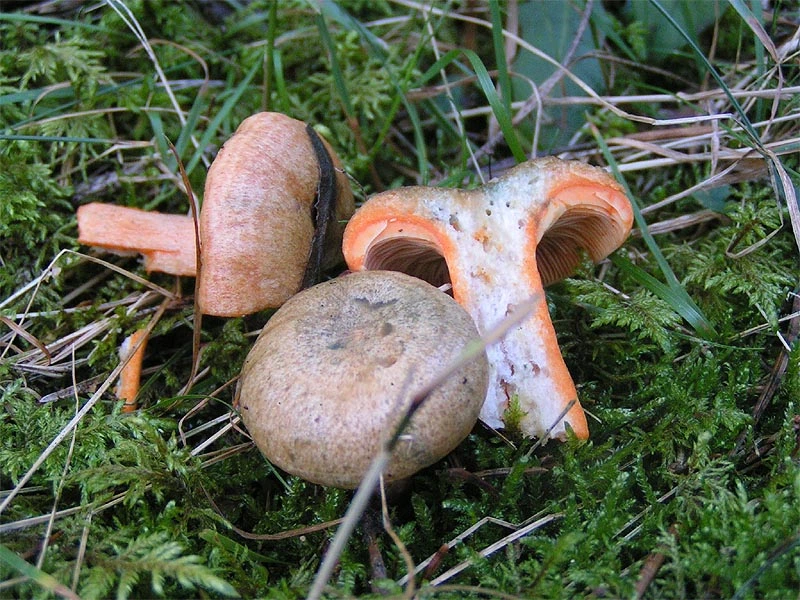
Lactarius deterrimus is another orange milkcap with zoned caps. It is strongly associated with spruce and often develops conspicuous green staining.
Its latex is orange and usually remains orange initially. The cap margin lacks the thick woolly fringe of Woolly Milkcap.
Main Difference
Spruce habitat, orange latex, and strong greening support L. deterrimus. Birch, white latex, and a hairy pink margin support L. torminosus.
Other Pink Lactarius Species
Identification
Several other milkcaps can show pinkish, flesh-colored, or reddish caps. They may differ in host tree, latex behavior, smell, cap surface, or microscopic features.
Color alone is therefore insufficient. Tree association and the exact nature of the cap margin are especially useful.
Main Difference
A strongly woolly margin combined with birch habitat is the central clue for L. torminosus. Other pink milkcaps often lack one or both of these features.
Lactarius torminosus vs Lactarius pubescens
| Feature | Lactarius torminosus | Lactarius pubescens |
|---|---|---|
| Cap color | Pink to salmon | Cream to pale pink |
| Zoning | Often strong | Weak or absent |
| Margin | Strongly woolly | Downy to woolly |
| Latex | White | White |
| Host tree | Birch | Birch |
| Overall appearance | More colorful | Paler |
| Best clue | Pink zones + hairy margin | Pale cap + downy margin |
These two are close and can overlap in appearance. Fresh mature specimens are easier to separate than weathered or unusually pale individuals.
Lactarius torminosus vs Saffron Milk Cap
| Feature | Lactarius torminosus | Lactarius deliciosus |
|---|---|---|
| Cap color | Pink | Orange |
| Margin | Woolly | Smooth to slightly inrolled |
| Latex | White | Orange |
| Host | Birch | Pine |
| Green staining | No strong typical greening | Common with age |
| Best clue | Hairy pink edge | Orange latex |
This comparison is much easier once latex color and host tree are checked. Both can show concentric zoning, which is why cap pattern alone can mislead.
How to Identify Lactarius torminosus
Start with the cap margin. A pink mushroom with a strongly hairy or woolly edge is a good candidate, especially when the cap also shows concentric zones.
Then check the latex and nearby trees. White latex plus birch association makes the identification much stronger.
Finally, compare the overall color with Lactarius pubescens. A deeper pink, more clearly zoned cap fits L. torminosus better.
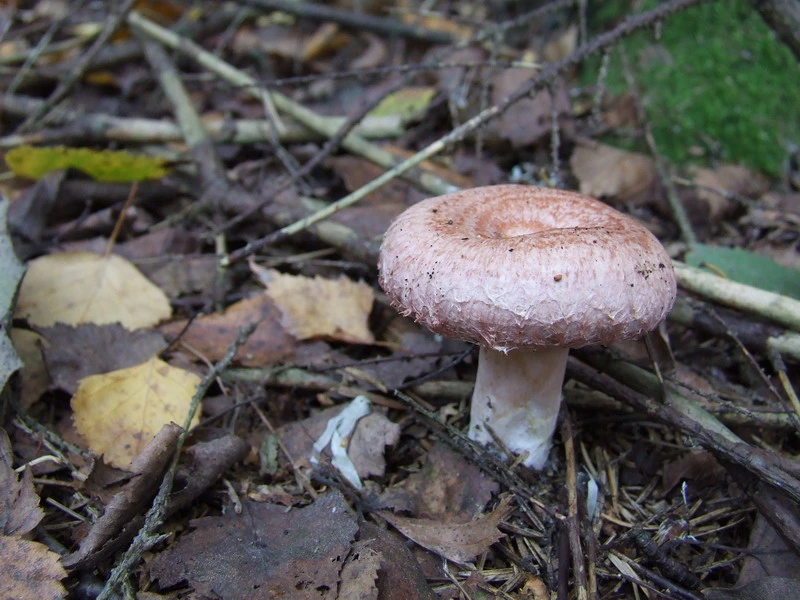
Young vs Mature Woolly Milkcaps
Young specimens usually have the strongest woolly fringe and most clearly inrolled cap margin. Their colors can also be brighter and more saturated.
Older mushrooms often flatten, fade, and lose much of the visible hair. This can make a mature specimen surprisingly difficult to match with textbook photographs.
How Weather Changes the Appearance
Heavy rain can wash out the cap color and flatten or remove surface hairs. Dry weather may make the cap paler and emphasize cracks or surface texture.
This is why a weathered Woolly Milkcap may not look especially “woolly.” Host tree and latex remain useful when the classic appearance has deteriorated.
Common Identification Mistakes
One common mistake is calling every pink milkcap Lactarius torminosus. Several species can share pinkish colors and white latex.
Another mistake is ignoring tree association. A similar mushroom under pine or spruce belongs in a very different comparison.
A third mistake is relying on the hairy margin in old specimens. Mature mushrooms may lose much of the fringe, so ecology and latex become more important.
How to Photograph Lactarius torminosus
Take a close-up of the cap edge so the woolly hairs are visible. Side lighting often reveals them much better than flat overhead light.
Also photograph the gills after gently damaging a small area so the white latex is visible. Include nearby birch leaves, bark, or trees when possible because host association is an important clue.
Can AI Identify Lactarius torminosus?
AI can often recognize a typical fresh specimen when the pink zoned cap and woolly margin are clearly visible. Accuracy decreases with faded, rain-washed, or older mushrooms.
A useful photo set should show the cap, margin, gills, latex, full stem, and nearby trees. A top-down cap photograph alone misses several of the strongest diagnostic features.
Interesting Facts
The common name Woolly Milkcap refers directly to the cap margin. Few European milkcaps have such a conspicuously furry edge when young.
The species is tightly linked to birch through mycorrhiza. The fungus exchanges mineral nutrients and water with the tree in return for sugars produced by photosynthesis.
Its culinary history also differs strongly between regions. A mushroom rejected as inedible in one country may have a long tradition of salted or fermented use in another.
The cap hairs can disappear surprisingly quickly with age and weather. This means the same species can look dramatically different within a few days.
Frequently Asked Questions
Does Lactarius torminosus always have a hairy margin?
Young specimens usually do, but the hairs can become much less obvious with age. Rain and expansion of the cap can remove or flatten the fringe.
Does the latex change color?
The latex is typically white and usually remains white. This is an important difference from orange milkcaps such as Lactarius deliciosus.
Can Woolly Milkcap grow without birch?
It is strongly associated with birch. A similar mushroom without nearby birch should be identified cautiously and compared with other species.
Why are some specimens almost white?
Age, rain, and individual variation can reduce the pink coloration. Very pale specimens can approach the appearance of Lactarius pubescens.
Is the cap always strongly zoned?
No. Some fruit bodies show very clear concentric bands, while others are only weakly zoned. The woolly margin and host association remain useful.
Can the stem have pits?
Shallow pits or spots can occur, but they are not as diagnostic as the cap margin and latex. Stem details are mainly supporting characters.
Is Lactarius torminosus edible after cooking?
Simple cooking is not a reliable general recommendation for this species. Traditional use in some regions involves additional processing such as soaking, boiling, salting, or fermentation.
Can it be confused with poisonous Amanita species?
Amanitas do not produce latex and generally have very different cap and stem structures. Checking for white milk from damaged gills quickly separates Woolly Milkcap from Amanita.
Final Identification Notes
Lactarius torminosus is best recognized by the combination of a pink to salmon cap, conspicuously woolly inrolled margin, white latex, brittle flesh, and strong association with birch. Concentric pink zoning provides additional support when clearly visible.
The closest common look-alike is Lactarius pubescens, which is usually paler and less strongly zoned. Orange milkcaps such as L. deliciosus and L. deterrimus differ most clearly in latex color and host tree.
The practical field pattern is: pink zoned cap + woolly margin + white latex + birch = strong Lactarius torminosus candidate.
Upload a photo and get possible matches in seconds.