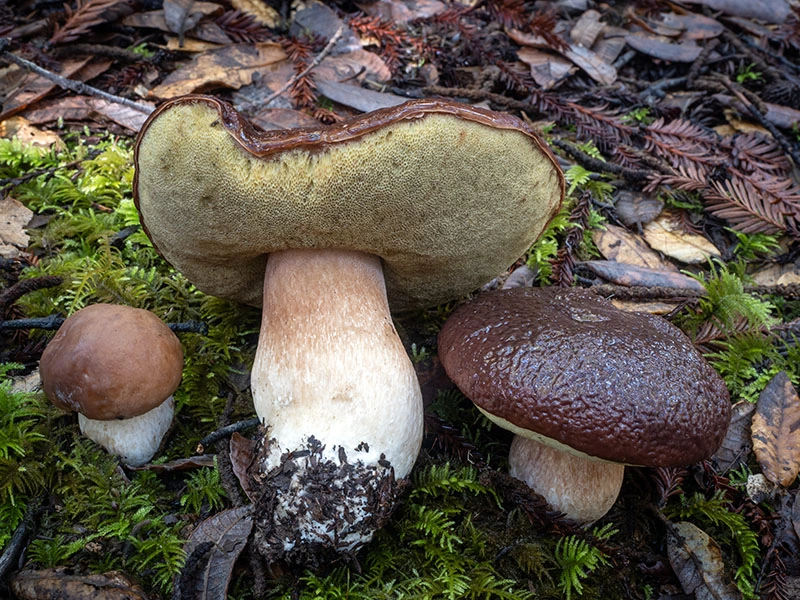
Boletus regineus, commonly known as the Queen Bolete, is a large western North American porcini-type mushroom with a brown cap, thick pale stem, white young pores, and firm white flesh that usually does not stain blue when cut. It is especially associated with hardwoods in California and can be an impressive mushroom, with mature caps sometimes becoming very large.
The most useful identification pattern is brown cap + white pores when young + thick pale reticulated stem + white non-staining flesh + western North American woodland. It belongs to the king bolete group and can resemble California porcini and several other robust edible boletes.
⚠️ Important: Do not identify a bolete as edible from a brown cap and white pores alone. Check pore color, bruising, stem ornamentation, flesh color, habitat, and relevant regional look-alikes before considering edibility.
Quick Identification
| Feature | Boletus regineus |
|---|---|
| Common name | Queen Bolete |
| Cap | Brown to chestnut, sometimes with pale bloom when young |
| Cap size | Large, sometimes very large |
| Young pores | White |
| Mature pores | Yellow to yellow-green |
| Bruising | Usually little or no blue staining |
| Stem | Thick, pale, often club-shaped |
| Reticulation | Present, especially on upper stem |
| Flesh | White, thick, firm |
| Flesh staining | Usually unchanged |
| Spore print | Olive-brown |
| Ecology | Mycorrhizal |
| Main habitat | Hardwood and mixed woodland |
| Common associates | Tanoak, madrone, oak, chinquapin, manzanita |
| Season | Mainly autumn |
| Distribution | Western North America |
| Edibility | Edible when correctly identified and cooked |
| Main look-alikes | California Porcini, Spring King, Bitter Bolete, other king boletes |
What Does Boletus regineus Look Like?
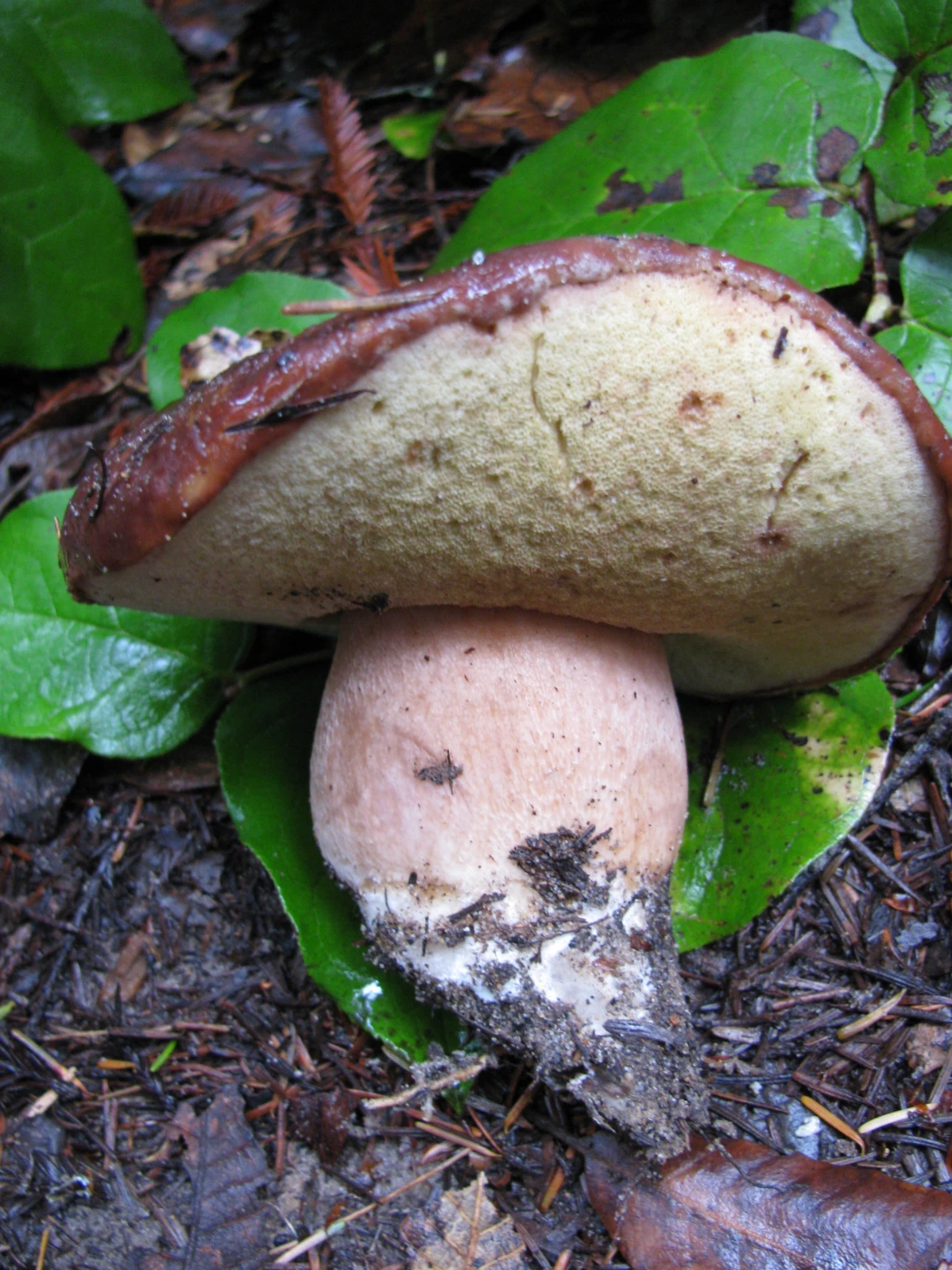
Queen Bolete is a robust mushroom with the classic proportions associated with porcini. Young specimens often have thick swollen stems and rounded caps, while mature fruit bodies become broader and more evenly proportioned.
The cap can range from pale brown to dark chestnut or cinnamon-brown. Young specimens may carry a whitish bloom over the cap surface, which can make them look strikingly pale compared with older mushrooms.
Cap
The cap is convex to bun-shaped when young and becomes broadly convex with age. Large mature specimens can develop an almost flat upper surface, although many retain a rounded profile.
Fresh caps can be somewhat sticky or viscid in wet weather. Dry specimens may look smoother and more matte.
Cap Color
Typical colors include medium brown, chestnut, reddish-brown, and cinnamon-brown. Young caps may appear much paler because of a thin white bloom covering the darker surface beneath.
This bloom tends to disappear as the mushroom matures. Older fruit bodies therefore often look considerably darker than young specimens from the same area.
Pores
The underside has pores rather than gills. These begin white in young mushrooms and gradually become yellow, yellow-green, and eventually more olive as the spores mature.
The pore surface generally does not show strong blue staining when touched. A slight reaction can occasionally occur, but dramatic blue bruising would suggest looking carefully at other bolete groups.
Tubes
The pore layer consists of vertical tubes beneath the cap. These are white when young and change color along with the pore surface as the mushroom ages.
In older specimens the tube layer can become thick and soft. This is common among large king boletes and does not by itself indicate a different species.
Stem
The stem is thick and usually white to pale cream when young. It may become slightly brownish with age but often remains relatively pale compared with the cap.
Young stems can be club-shaped or somewhat bulbous. Mature mushrooms often become more cylindrical as the stem elongates.
Reticulation
A fine raised network, or reticulation, is usually visible on at least the upper portion of the stem. It is often white when young and can become slightly darker with age.
Reticulation is an important feature within the king bolete group. Its color, strength, and position can help separate similar species.
Flesh
The flesh is thick, white, and firm when fresh. It normally shows little or no color change when cut.
This stable white flesh is one of the useful features separating Queen Bolete from many strongly blue-staining boletes. Very slight blue coloration near the tubes can occasionally occur, but strong widespread staining would be atypical.
Smell and Taste
The smell is generally mild and pleasant rather than strongly distinctive. Fresh specimens have the familiar mushroom aroma associated with large boletes.
Taste is also described as mild. Structural characters and habitat are much more useful for identification than smell or taste.
Spore Print
The spore print is olive-brown, typical of many boletes. Mature pores may also develop an olive cast as large numbers of spores accumulate.
Spore color confirms the broader group but is not especially useful for distinguishing Queen Bolete from its closest relatives. Habitat, stem ornamentation, and cap features provide stronger field clues.
Where Does Boletus regineus Grow?
Queen Bolete is a mycorrhizal mushroom, meaning it forms an underground relationship with living trees and shrubs. It does not grow from dead logs, stumps, or wood chips.
In California it is particularly associated with hardwoods and broadleaf evergreen trees. Tanoak is one of its most characteristic partners, with madrone, oak, golden chinquapin, and manzanita also reported as associates.
Tanoak Woodland
Tanoak woodland is one of the best habitats to associate with Boletus regineus. Fruiting bodies may appear among leaf litter in coastal and mixed forests.
The mushrooms can occur singly or in groups. A productive site may produce several large specimens after autumn rainfall.
Madrone and Oak Habitat
Madrone and oak can also support Queen Bolete. Mixed hardwood-conifer forests are especially worth checking because several potential host trees may occur close together.
The actual mycorrhizal partner can be difficult to determine visually when roots from different trees overlap. Habitat should therefore support an identification rather than determine it by itself.
Season
Queen Bolete is primarily a fall mushroom. In coastal California and the western mountains, fruiting typically follows autumn rains.
The main season can extend from roughly October into December in suitable areas. Occasional spring fruiting has also been reported, but autumn is much more characteristic.
Distribution
Boletus regineus is a western North American species. It is particularly well known from California and Oregon and also occurs farther north in parts of the Pacific Northwest.
In California it occurs in coastal ranges from central parts of the state northward and also in foothill regions of the Sierra Nevada. Its ecology shifts somewhat farther north, where conifer associations may become more important.
Is Boletus regineus Edible?
Queen Bolete is considered edible when correctly identified and properly cooked. Like other king boletes, it has firm flesh and a mild flavor that makes it desirable for cooking and drying.
Only fresh specimens should be used. Large mature mushrooms can become soft, insect-damaged, or spongy even when they still look impressive from above.
Look-Alikes
The closest look-alikes are other members of the king bolete group. The most useful differences involve host tree, season, cap color, stem ornamentation, bruising, and geographic range.
Boletus edulis var. grandedulis — California Porcini
Identification
California Porcini is another large brown bolete with white young pores, thick white flesh, and a reticulated stem. It can look extremely similar to Queen Bolete.
Its ecology is one of the most useful differences. California Porcini is especially associated with Bishop pine and Monterey pine, while Queen Bolete is more strongly associated with tanoak and other hardwoods.
Main Difference
Pine habitat strongly favors California Porcini, while tanoak or mixed hardwood habitat supports Queen Bolete. Cap appearance can overlap considerably, so tree association is often more useful than color.
Boletus rex-veris — Spring King
Identification
Spring King is another western North American king bolete with a brown cap, thick pale stem, and white young pores. It is particularly associated with montane conifer forests.
Its major difference is timing. Boletus rex-veris is mainly a spring to early-summer mushroom rather than a classic autumn species.
Main Difference
Season and elevation provide useful separation. A large king bolete fruiting in spring in mountain conifer habitat fits Spring King better, while an autumn mushroom with tanoak or madrone supports Queen Bolete.
Tylopilus felleus — Bitter Bolete
Identification
Bitter Bolete also has a brown cap and reticulated stem, making it superficially similar to king boletes. The mature pore surface, however, becomes distinctly pinkish rather than yellow-green.
The stem reticulation is usually darker and more prominent. The flesh is intensely bitter even though the mushroom is not typically regarded as dangerously poisonous.
Main Difference
Pink mature pores and dark reticulation favor Tylopilus felleus. Queen Bolete has pale pores that mature toward yellow and olive and usually has paler stem reticulation.
Boletus barrowsii — White King Bolete
Identification
White King Bolete is a pale southwestern member of the king bolete group. Its cap can remain cream, whitish, or pale tan instead of becoming the richer brown typical of Queen Bolete.
It is particularly associated with southwestern North America and often grows with ponderosa pine and other conifers. Geographic range is therefore an important part of the comparison.
Main Difference
A very pale cap and southwestern conifer habitat favor Boletus barrowsii. A brown mushroom in California tanoak or madrone habitat fits Queen Bolete better.
Blue-Staining Boletes
Identification
Several western boletes can have brown or reddish caps and yellow pores. Many show rapid blue staining when the pores or flesh are damaged.
This reaction is much stronger than expected in Boletus regineus. Stem colors can also include yellow, red, or other tones absent from the classic Queen Bolete appearance.
Main Difference
Strong blue staining points away from Queen Bolete. B. regineus should have white flesh that remains essentially unchanged after cutting.
Queen Bolete vs California Porcini
| Feature | Boletus regineus | California Porcini |
|---|---|---|
| Cap | Brown to chestnut | Brown to dark brown |
| Young pores | White | White |
| Mature pores | Yellow to olive | Yellow to olive |
| Flesh | White | White |
| Blue staining | Usually absent | Usually absent |
| Stem | Thick, pale, reticulated | Thick, pale, reticulated |
| Main hosts | Tanoak, madrone, oak | Bishop pine, Monterey pine |
| Main season | Fall | Fall |
| Best clue | Hardwood association | Pine association |
These two can be very difficult to separate from a single mushroom photograph. Tree association and the entire collection often provide more useful information than subtle cap differences.
Queen Bolete vs Spring King
| Feature | Boletus regineus | Boletus rex-veris |
|---|---|---|
| Main season | Autumn | Spring to early summer |
| Habitat | Hardwood and mixed forest | Montane conifer forest |
| Cap | Brown, sometimes whitish bloom | Brown to reddish-brown |
| Pores | White → yellow/olive | White → yellow/olive |
| Flesh | White, non-staining | White, usually non-staining |
| Stem | Reticulated | Reticulated |
| Best clue | Fall + hardwoods | Spring + mountain conifers |
Season makes this one of the easier king bolete comparisons. Habitat provides further confirmation when the fruiting period is unusual.
How to Identify Boletus regineus
Start by confirming that the mushroom belongs to the king bolete group. Look for a large robust fruit body with white young pores, thick white flesh, and a pale reticulated stem.
Next, cut the mushroom and observe the flesh. Queen Bolete should remain essentially white rather than developing strong blue staining.
Finally, examine the surrounding trees. Autumn fruiting with tanoak, madrone, oak, or related western hardwoods provides strong ecological support for Boletus regineus.
Young vs Mature Queen Boletes
Young mushrooms can look strikingly pale because of the whitish bloom covering the darker cap. Their stems are often thick and swollen and the pore surface is bright white.
As the mushroom expands, the cap becomes more obviously brown and the pores change toward yellow-green or olive. The stem may also become more cylindrical.
How Weather Changes the Appearance
Wet weather can make the cap noticeably sticky and deepen its brown coloration. Dry conditions make it more matte and may emphasize cracks or irregularities in older fruit bodies.
Rain can also remove much of the whitish bloom from young caps. This means two specimens from the same patch can appear quite different depending on age and weather.
Common Identification Mistakes
One common mistake is identifying every western brown king bolete as Boletus edulis. Western North America contains several distinct porcini-like species with different ecological preferences.
Another mistake is confusing Queen Bolete with the European Royal Bolete. Boletus regineus is a western North American king bolete, whereas the European species historically called Boletus regius is now generally placed in Butyriboletus.
A third mistake is ignoring tree association. Host trees are especially valuable when comparing several otherwise very similar western king boletes.
How to Photograph Boletus regineus
Take photographs of the cap, pore surface, complete stem, and stem reticulation. A vertical section through the cap and stem is also useful because it documents flesh color and staining.
Include the surrounding trees in at least one photograph. Tanoak, madrone, oak, and pine habitat can significantly change the likely identification.
Can AI Identify Boletus regineus?
AI can usually recognize a typical king bolete from its thick stem, brown cap, and pale pores. Separating Boletus regineus from California Porcini and other western king boletes is much harder from appearance alone.
Host trees, season, exact location, bruising reaction, and photographs of the stem network considerably improve the result. A cap-only photograph is unlikely to support confident species-level identification.
Interesting Facts
Boletus regineus was formally described as a distinct species relatively recently compared with many classic European boletes. The type collection came from Mendocino County, California.
The name regineus refers to a queenly or regal quality, which explains the common name Queen Bolete. The mushroom can certainly look impressive when mature, with exceptionally large caps reported in good conditions.
Its recognition as a separate species also illustrates how North American porcini taxonomy has changed. Mushrooms that once tended to be placed broadly under European names are increasingly recognized as distinct regional species.
Queen Bolete is particularly interesting ecologically because it is often associated with western hardwoods rather than only with conifers. Tanoak is especially characteristic in coastal California.
Frequently Asked Questions
Is Boletus regineus the same as Boletus regius?
No. Boletus regineus is the western North American Queen Bolete, while European Boletus regius is a different mushroom now generally called Butyriboletus regius.
Does Queen Bolete turn blue when cut?
Usually not. The flesh typically remains white, although very slight blue staining near the tube layer can occasionally occur.
Where is Boletus regineus most common?
It is especially associated with western North America, including California and Oregon. California coastal ranges and some Sierra foothill habitats are particularly important.
Does it grow with pine?
It can occur in mixed habitats and northern populations may associate with conifers, but tanoak and other hardwood associations are especially characteristic in California.
What color are the pores?
Young pores are white. They become yellow and eventually yellow-green to olive as the mushroom matures.
Is the stem reticulated?
Yes. Fine net-like reticulation is normally visible on at least the upper part of the stem.
Can Queen Bolete grow in November?
Yes. Autumn is its main season in California, and November can be particularly productive after suitable rainfall.
How do I separate it from California Porcini?
Host tree is one of the most practical clues. California Porcini is strongly associated with pines, while Queen Bolete is especially characteristic around tanoak, madrone, oak, and related hardwoods.
Final Identification Notes
Boletus regineus is best recognized as a large western king bolete with a brown cap, white young pores that mature yellow-green, thick pale reticulated stem, and white flesh that normally does not stain blue. Autumn fruiting around tanoak and other western hardwoods provides especially useful ecological support.
Its closest practical comparison in California is California Porcini, which is strongly associated with Bishop and Monterey pines. Spring King differs most clearly in its spring fruiting and montane conifer habitat.
The practical field pattern is: large brown king bolete + white non-staining flesh + pale reticulated stem + autumn + tanoak/madrone/oak = strong Boletus regineus candidate.
Upload a photo and get possible matches in seconds.