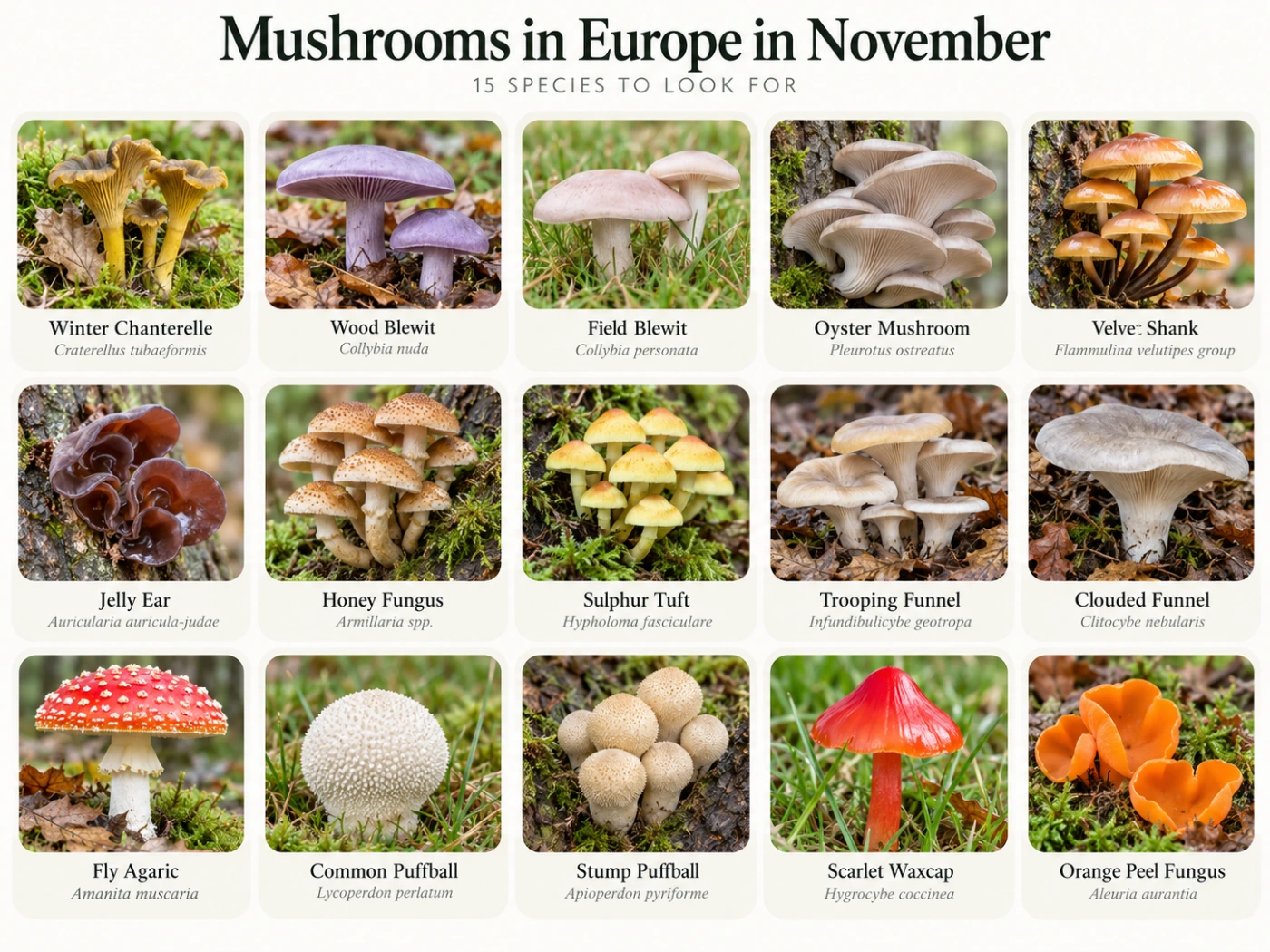
November is a transition month for mushroom hunting in Europe. Many classic autumn species are disappearing after the first frosts, while cold-tolerant mushrooms such as Winter Chanterelles, Velvet Shanks, Oyster Mushrooms, and Wood Blewits can still be abundant.
What you find depends strongly on latitude, altitude, rainfall, and temperature. Northern and mountain regions may already have frequent frost or snow, while forests in western and southern Europe can remain productive well into November and sometimes beyond.
⚠️ Important: Seasonal timing is only a clue and should never be used to identify a mushroom by itself. Always confirm structural features, habitat, substrate, and important look-alikes before considering edibility.
Quick Guide to November Mushrooms
| Mushroom | Scientific name | Typical habitat | November likelihood |
|---|---|---|---|
| Winter Chanterelle | Craterellus tubaeformis | Damp conifer woodland | Very common late-season target |
| Wood Blewit | Collybia nuda | Woodland litter | Common |
| Field Blewit | Collybia personata | Grassland | Common |
| Oyster Mushroom | Pleurotus ostreatus | Dead hardwood | Common |
| Velvet Shank | Flammulina velutipes group | Dead deciduous wood | Increasing |
| Jelly Ear | Auricularia auricula-judae | Elder and other hardwood | Common |
| Honey Fungus | Armillaria spp. | Trees, roots, stumps | Late season |
| Sulphur Tuft | Hypholoma fasciculare | Dead wood | Common |
| Trooping Funnel | Infundibulicybe geotropa | Woodland, parkland | Common |
| Clouded Funnel | Clitocybe nebularis | Woodland litter | Common |
| Fly Agaric | Amanita muscaria | Birch, pine, spruce | Late season |
| Common Puffball | Lycoperdon perlatum | Woodland | Late season |
| Stump Puffball | Apioperdon pyriforme | Decaying wood | Late season |
| Scarlet Waxcap | Hygrocybe coccinea | Old grassland | Often late |
| Orange Peel Fungus | Aleuria aurantia | Bare disturbed soil | Early November especially |
Why November Is Different
October is often dominated by large flushes of boletes, Russulas, Amanitas, milkcaps, and other classic woodland mushrooms. By November, colder nights and repeated frosts begin reducing many of these species.
At the same time, several fungi are particularly well adapted to cool weather. Wood-decaying species also become increasingly noticeable because they are less dependent on warm soil conditions than many mycorrhizal mushrooms.
1. Craterellus tubaeformis — Winter Chanterelle
Winter Chanterelle is one of the most characteristic late-autumn mushrooms in northern and central Europe. It often appears in large groups in damp coniferous woodland, particularly among moss.
The cap is brownish to yellow-brown and develops a deep funnel with a hole leading into the hollow stem. The underside has blunt grayish or yellowish folds rather than thin true gills, while the stem is usually yellow to yellow-orange.
Where to Look
Damp mossy spruce and pine woodland is especially productive. Large colonies can hide surprisingly well because the brown caps blend into fallen needles and wet vegetation.
November is often an excellent month for this species. In mild conditions it may continue into December.
2. Collybia nuda — Wood Blewit
Wood Blewit is a classic cold-season mushroom that often becomes more noticeable as other woodland species disappear. It grows among leaf litter, compost-rich soil, and humus in deciduous, mixed, and sometimes coniferous woodland.
Young mushrooms can have striking lilac-purple caps, gills, and stems. The colors fade with age, and mature specimens may become much browner than beginners expect.
Key Identification Feature
The combination of violet tones and a pale pinkish-buff spore print is useful. Purple Cortinarius species are important look-alikes because they produce rusty-brown spores instead.
Wood Blewits should only be eaten when correctly identified and thoroughly cooked. Some people experience gastrointestinal upset even from properly prepared specimens.
3. Collybia personata — Field Blewit
Field Blewit is closely related to Wood Blewit but usually grows in grassland rather than woodland. It often occurs in rings or arcs in old pasture, lawns, parkland, and grassy roadside areas.
The cap is generally beige, gray-brown, or buff rather than purple. The most distinctive color is often concentrated in the thick lilac or violet stem.
November Habitat
Look in unfertilized grassland and older lawns after periods of cool wet weather. Field Blewits can persist after many other grassland mushrooms have disappeared.
The species may continue into winter in milder parts of Europe. Frost can damage exposed fruit bodies, but fresh mushrooms can appear again during warmer spells.
4. Pleurotus ostreatus — Oyster Mushroom
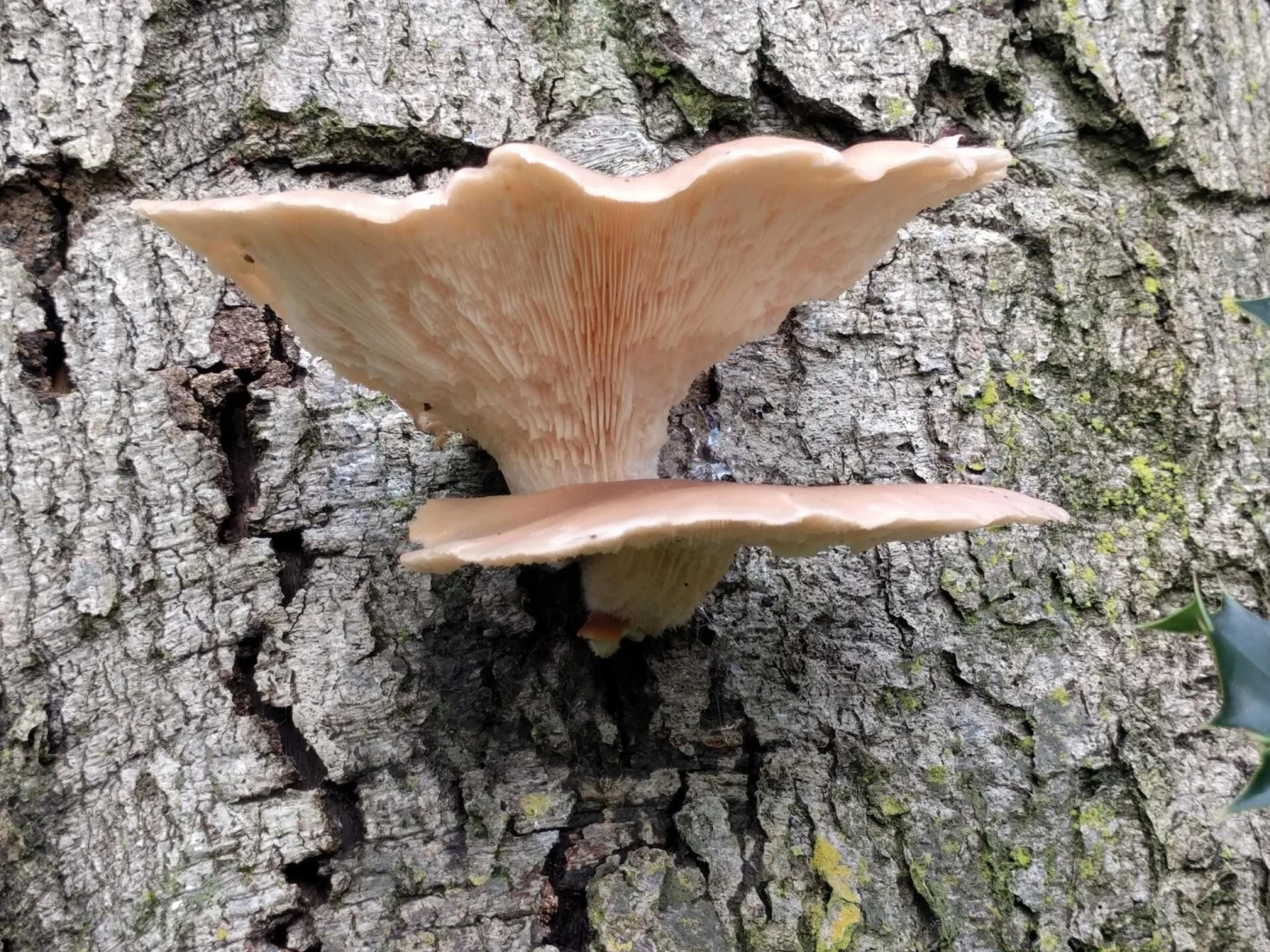
Oyster Mushrooms are strongly associated with cool weather and can appear throughout late autumn and winter. They usually form overlapping shelves on dead or weakened deciduous trees.
Caps range from pale gray to brown, blue-gray, or almost cream. White gills run down the short lateral stem, and several fruit bodies commonly emerge together from the same section of wood.
Where to Look
Beech is a particularly common substrate, although other hardwoods are also used. Fallen trunks, standing dead trees, and large branches are all worth inspecting.
November can mark the start of a productive Oyster Mushroom period. In southern and western Europe, fruiting may continue well into winter.
5. Flammulina velutipes Group — Velvet Shank
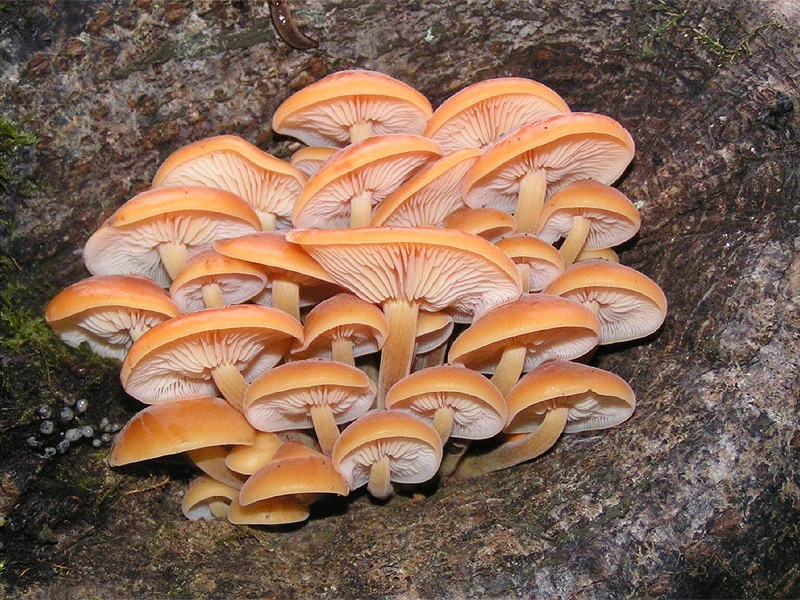
Velvet Shank is one of the true winter mushrooms of Europe. It can survive freezing conditions and may fruit during mild periods from late autumn through winter.
The caps are yellow-orange to honey-brown and often shiny or sticky when wet. Mature stems are dark brown to almost black toward the base and have a distinctive velvety surface.
Important Look-Alike
Small brown mushrooms growing on wood require particular care because the deadly Galerina marginata can occur in similar habitats. Velvet Shank has a white spore print, whereas Galerina produces rusty-brown spores.
Modern taxonomy also suggests that the traditional name Flammulina velutipes can include closely related species. For ordinary field identification, it is often safer to think in terms of the Velvet Shank group.
6. Auricularia auricula-judae — Jelly Ear
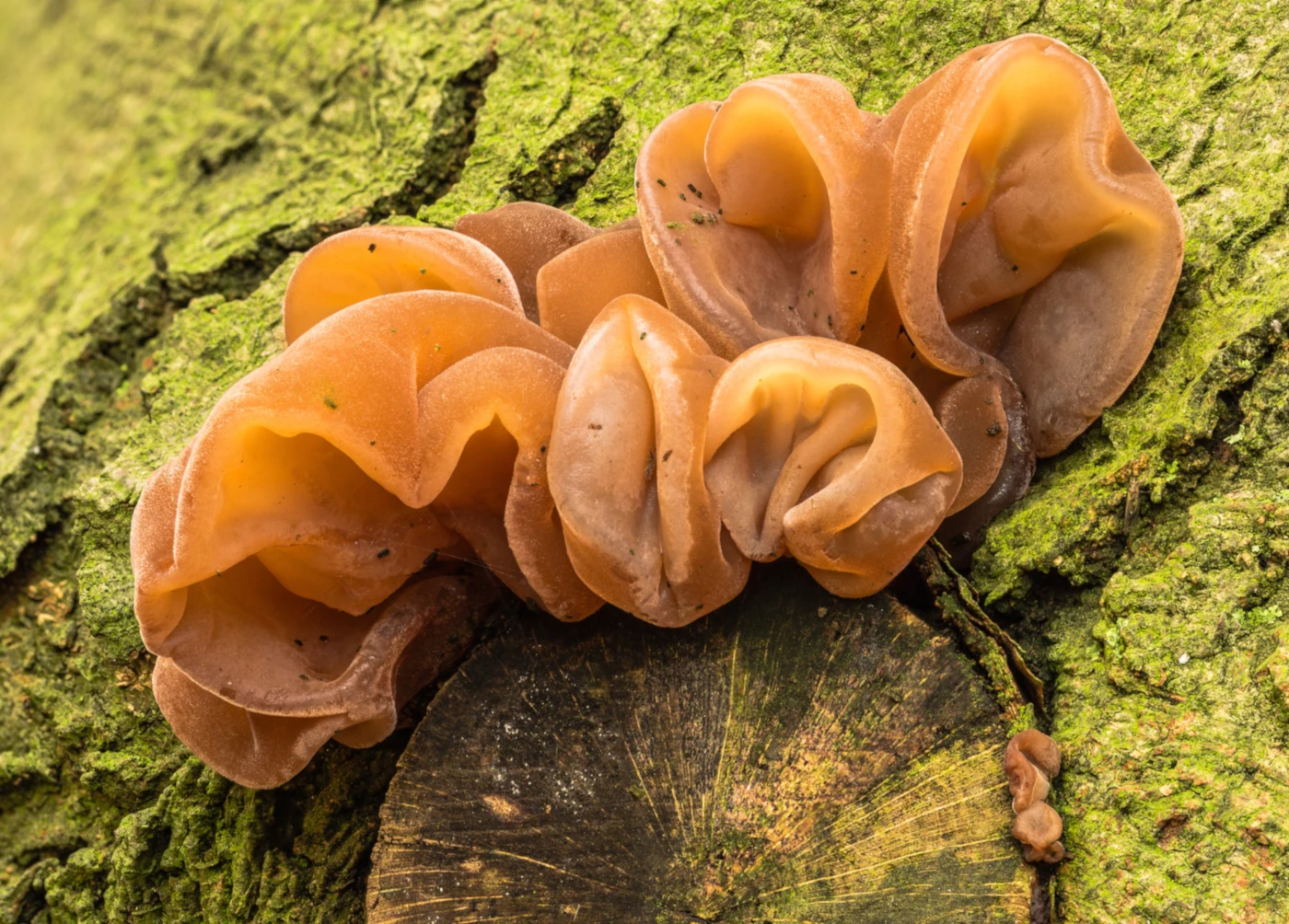
Jelly Ear can be found throughout much of the year, but damp late-autumn weather makes the fruit bodies particularly noticeable. It forms gelatinous ear-shaped structures that are brown to reddish-brown.
The species is strongly associated with elder in Europe, although it can grow on other deciduous wood. During dry weather the mushrooms shrink dramatically and become tough, then expand again after rain.
November Conditions
Wet, mild periods are ideal for finding fresh fruit bodies. Hedgerows, woodland edges, parks, and old elder branches can all produce good colonies.
The rubbery texture is very different from most conventional cap-and-stem mushrooms. This makes the group relatively easy to recognize once its typical appearance is familiar.
7. Armillaria Species — Honey Fungus
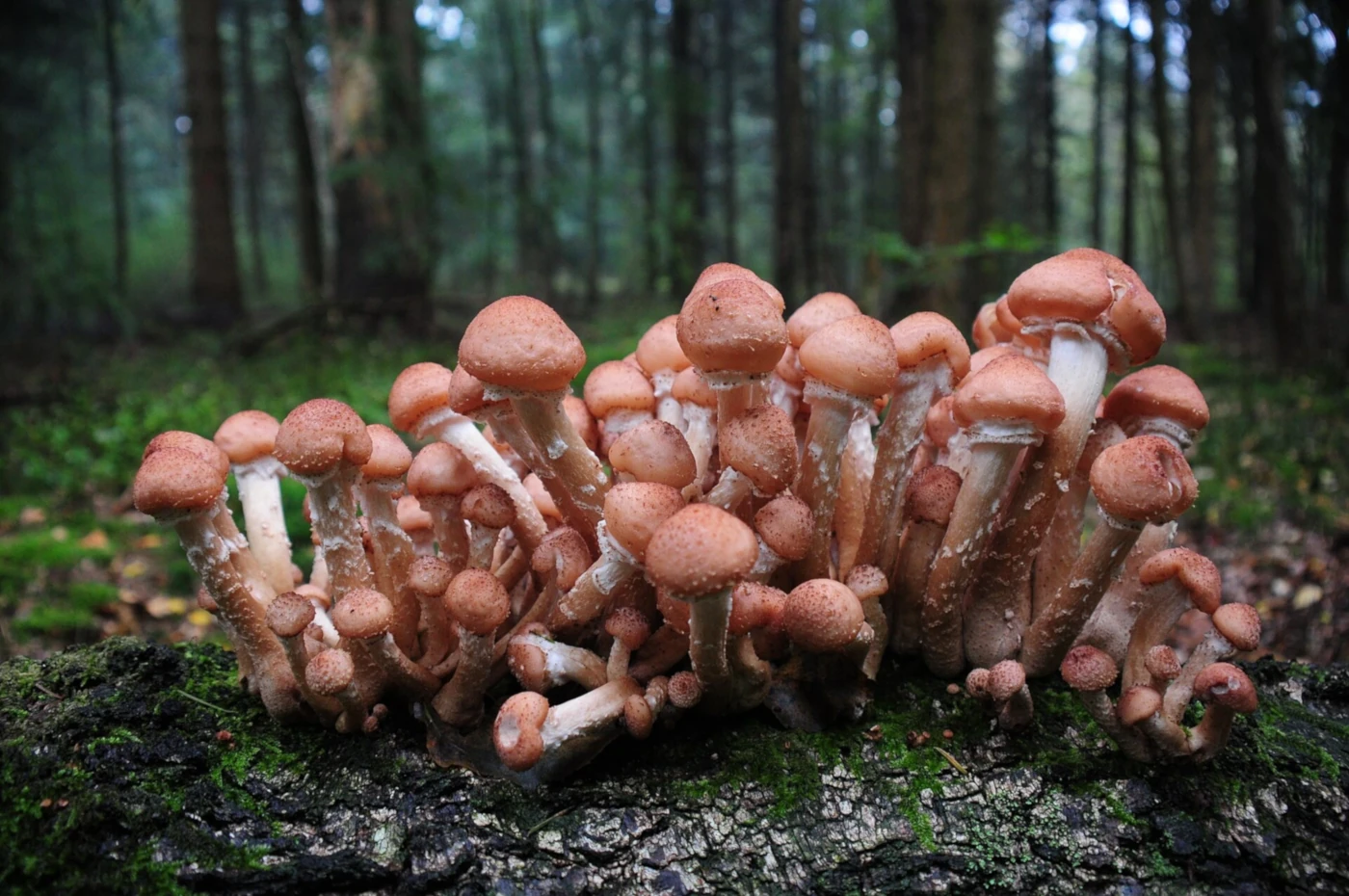
Honey Fungus often fruits in large clusters around tree bases, stumps, buried roots, and dead wood. Several Armillaria species occur in Europe, so not every Honey Fungus should automatically be called Armillaria mellea.
Caps are usually honey-yellow to brown and may carry darker scales. Many species have a stem ring, pale gills, and white spores.
Late Autumn Fruiting
Large clusters can persist into November, particularly during mild wet weather. Old gardens, woodland, parks, and orchards are common places to find them.
Honey Fungus is also an important tree pathogen. Its underground rhizomorphs can spread through soil and colonize living woody plants as well as dead material.
8. Hypholoma fasciculare — Sulphur Tuft
Sulphur Tuft is one of the most common mushrooms on dead wood in European forests. Bright yellow clusters may appear on stumps, logs, and buried roots well into late autumn.
Young gills have a distinctive yellow-green or olive tone and later become much darker as the spores mature. The clustered growth and sulphur-yellow color are usually conspicuous.
Toxicity
Sulphur Tuft is poisonous and can cause significant gastrointestinal symptoms. It should not be confused with edible clustered mushrooms simply because it grows abundantly.
Late autumn is an excellent time to learn this species because it remains common when many woodland mushrooms have finished fruiting. Large colonies can contain dozens of mushrooms at different stages.
9. Infundibulicybe geotropa — Trooping Funnel
Trooping Funnel is a large pale mushroom that often forms long lines, arcs, or huge fairy rings. Mature caps become funnel-shaped but usually retain a noticeable central bump.
The pale gills run down the stem, and the whole mushroom can become quite large. It occurs in woodland clearings, parkland, grassy edges, and beneath broadleaf trees.
Why It Is Typical of November
This species often continues fruiting after the main autumn peak. Large groups can remain visible into December in mild climates.
Its tendency to grow in rings or troops can make a colony easy to notice from a distance. Individual mushrooms should still be examined carefully because several pale funnel-shaped fungi can look similar.
10. Clitocybe nebularis — Clouded Funnel
Clouded Funnel is one of the classic late-autumn woodland mushrooms. Large gray caps can appear in substantial rings or groups among fallen leaves in both deciduous and coniferous forests.
The cap often has a cloudy marbled appearance, while the crowded pale gills run slightly down the stem. Mature mushrooms can become large and produce a strong distinctive odor.
Edibility
This species has a history of culinary use but is now generally treated cautiously because it can cause gastrointestinal reactions in some people. It is better regarded as an identification species rather than an easy edible target.
November is one of the best months to encounter it. Large colonies can dominate woodland floors after many earlier autumn species have disappeared.
11. Amanita muscaria — Fly Agaric
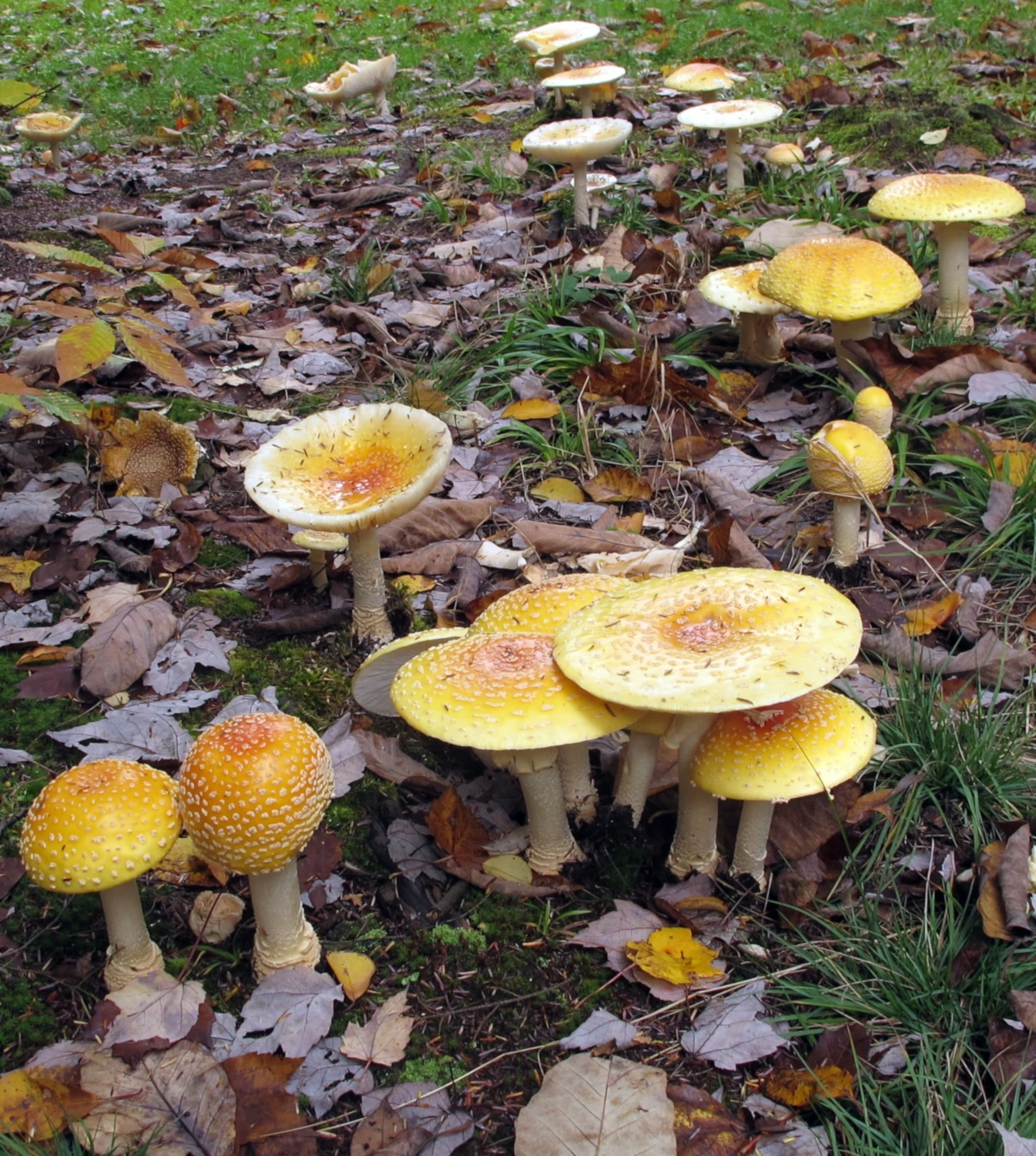
Fly Agaric is strongly associated with autumn, but fruiting can continue into November and occasionally later during mild weather. Its red or orange-red cap with pale veil patches makes it one of Europe’s most recognizable mushrooms.
It forms mycorrhizal relationships with trees, particularly birch, pine, and spruce. Older mushrooms can lose many of their white cap patches after heavy rain.
Late-Season Appearance
November specimens are often faded, rain-washed, or frost-damaged. A Fly Agaric found late in the season may therefore look less like the classic bright red mushroom shown in illustrations.
The species contains ibotenic acid and muscimol and is poisonous. Its toxicity is neurological rather than the amatoxin liver-damage syndrome associated with Death Cap.
12. Lycoperdon perlatum — Common Puffball
Common Puffball is a widespread woodland species that can still be encountered in November. Young fruit bodies are white to cream and covered with small pointed warts that leave a net-like pattern when rubbed away.
As the mushroom matures, the interior changes from firm white flesh into a mass of brown spores. A small opening eventually develops at the top through which spores escape.
Identification
Young puffballs should always be cut vertically before any consideration of edibility. The interior must be homogeneous rather than showing the developing structures of a young Amanita or another cap-and-stem mushroom.
By November, many Common Puffballs are already mature and brown. These old fruit bodies can remain visible even after active growth has ended.
13. Apioperdon pyriforme — Stump Puffball
Stump Puffball differs from many puffballs because it grows on decaying wood rather than directly from ordinary soil. Colonies can contain dozens or hundreds of pear-shaped fruit bodies packed around stumps and buried timber.
Young mushrooms are pale and have white interiors, while older specimens become brown and powdery. The clustered growth on wood is one of the most useful field characters.
November Colonies
This is primarily an autumn species, but colonies can still be found late in the season. Mature brown fruit bodies may remain long after the youngest mushrooms have disappeared.
Buried wood can sometimes make a colony appear to grow directly from soil. Digging visually around the base often reveals the hidden woody substrate.
14. Hygrocybe coccinea — Scarlet Waxcap
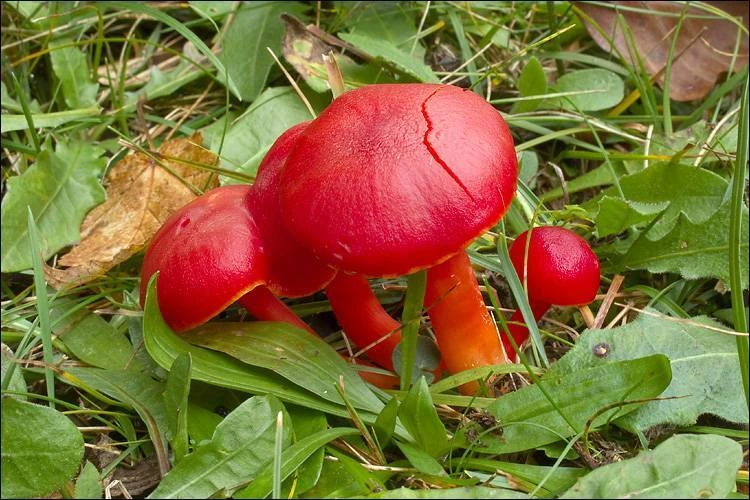
Scarlet Waxcap is a small, brightly colored grassland mushroom. Its cap is vivid scarlet to red-orange, while the stem is similarly colorful and lacks a ring.
Waxcaps are strongly associated with old, relatively nutrient-poor grasslands. Cemeteries, old lawns, meadows, and unimproved pasture can be particularly productive habitats.
Late Grassland Season
Waxcap season often continues well into November when temperatures remain above prolonged freezing. Different species can occur together, turning an otherwise dull late-autumn lawn into a surprisingly colorful habitat.
Scarlet Waxcap should not be identified by red color alone. Cap texture, gills, blackening reactions, size, and habitat are all useful when separating similar Hygrocybe species.
15. Aleuria aurantia — Orange Peel Fungus
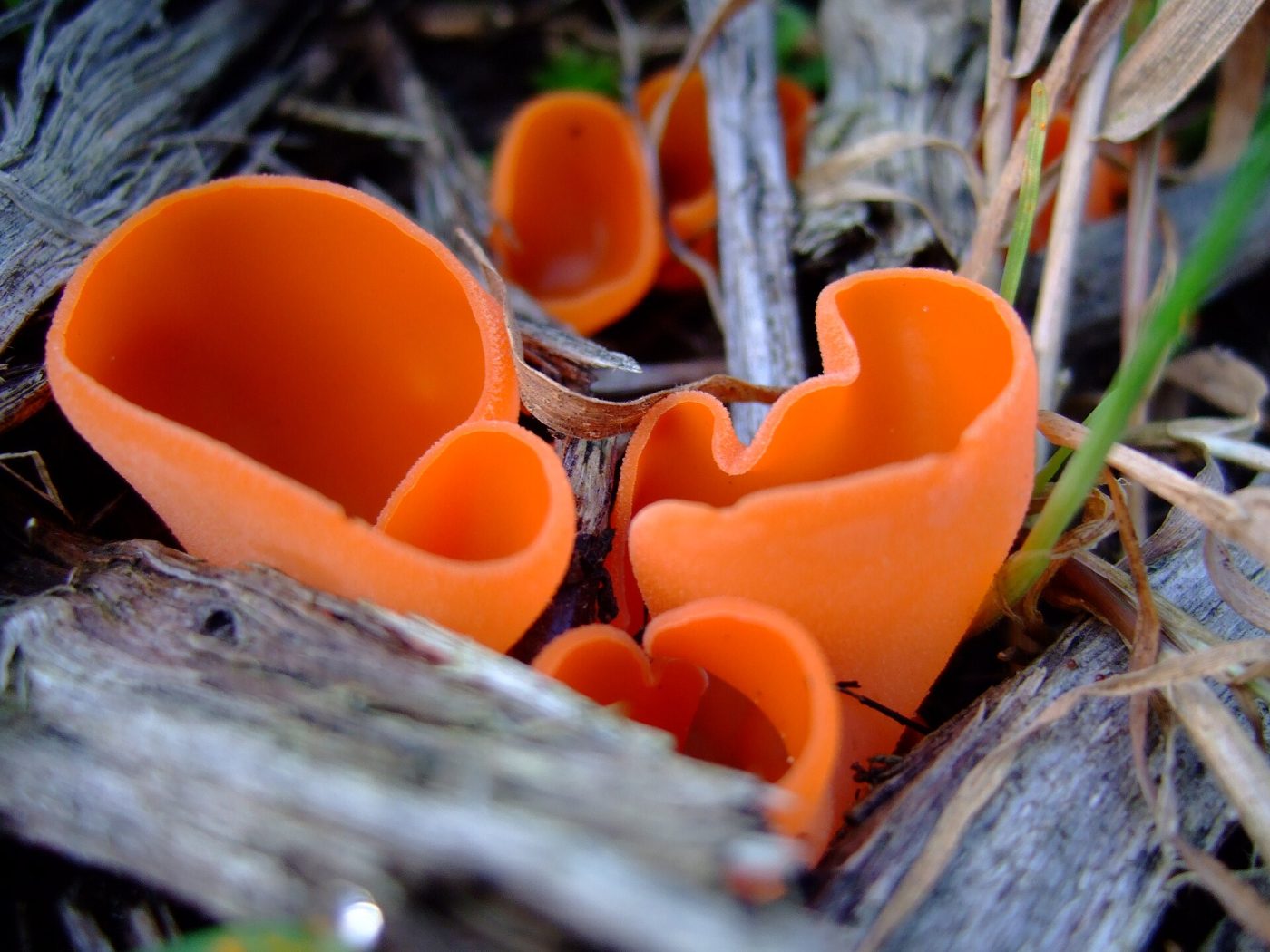
Orange Peel Fungus looks like pieces of bright orange peel scattered across bare soil. The fruit bodies are cup-shaped or irregularly flattened and usually lack a conventional stem.
It prefers disturbed ground, compacted soil, gravel tracks, path edges, and recently exposed earth. Groups can create vivid orange patches that are visible from several meters away.
November Timing
In northern Europe the main season is usually drawing to a close by early November. Farther south, fruiting can continue later because autumn conditions arrive more slowly.
This makes it a good example of why a single European mushroom calendar cannot apply equally from Scandinavia to the Mediterranean. Latitude and local weather can shift fruiting by several weeks.
What Happens to Porcini in November?
Porcini and related king boletes are primarily summer and autumn mushrooms. In much of northern and central Europe, the main season has usually declined sharply by November.
That does not mean a November porcini is impossible. Mild coastal climates and southern Europe can still produce late fruit bodies, especially after rain followed by relatively warm temperatures.
Can You Still Find Chanterelles in November?
Golden Chanterelles can persist into November in some European regions, particularly where hard frost has not arrived. Their season is much less reliable at this point than it was earlier in autumn.
Winter Chanterelle becomes the more characteristic late-season species. Despite the common name, it is not simply a winter form of the Golden Chanterelle but a distinct species with a hollow stem and different underside.
Northern Europe in November
In Scandinavia, the Baltic region, high mountains, and colder parts of northeastern Europe, repeated frost can dramatically reduce mushroom diversity. Wood-growing and cold-tolerant fungi become increasingly important as the month progresses.
Winter Chanterelles may still occur in suitable forests, while Velvet Shanks, Oyster Mushrooms, Jelly Ears, and persistent bracket fungi become more prominent. Snow cover can end conventional ground-mushroom searching altogether in some years.
Central Europe in November
Germany, Poland, Czechia, Slovakia, Austria, and surrounding regions can still have a substantial late-autumn season. Elevation makes a large difference, with lowland forests often remaining productive after mountain areas have frozen.
Wood Blewits, Winter Chanterelles, late Honey Fungus, Oyster Mushrooms, funnels, and wood-decaying species are all reasonable targets. Warm years can also extend the season of several mushrooms normally associated with October.
Western Europe in November
Oceanic climates in Britain, Ireland, western France, Belgium, and the Netherlands often remain comparatively mild. Regular rainfall combined with limited severe frost can support a diverse November fungal season.
Wood Blewits, waxcaps, Winter Chanterelles, Oyster Mushrooms, Trooping Funnels, and many wood-growing fungi can continue strongly. Some autumn species may persist surprisingly late during warm years.
Southern Europe in November
November can still feel like the main autumn mushroom season in parts of Spain, Portugal, Italy, southern France, and the Balkans. The arrival of seasonal rain may be more important than falling temperature.
Species that have already disappeared from northern Europe can still be fruiting actively. Local altitude is crucial, because Mediterranean lowlands and nearby mountain forests can have completely different seasonal patterns.
Best Habitats to Search in November
Damp conifer woodland is particularly useful for Winter Chanterelles, while deciduous woodland provides Wood Blewits, funnels, Oyster Mushrooms, and many wood-decaying species. Dead trees and stumps become increasingly productive places to inspect as ground-fruiting diversity decreases.
Old grasslands are also worth checking because waxcaps and Field Blewits can continue late into the year. After prolonged rain, paths and disturbed ground may produce Orange Peel Fungus and other small autumn species.
How Frost Changes November Mushrooms
A light frost does not automatically end the mushroom season. Some fruit bodies survive freezing remarkably well, while others collapse or decay rapidly after being frozen.
Repeated freeze-thaw cycles can also make identification more difficult. Colors fade, cap surfaces change, and stems may become waterlogged or distorted, so damaged mushrooms should be treated cautiously.
Common November Identification Mistakes
One common mistake is assuming that a mushroom cannot be a particular species because a guide gives an earlier season. Mushroom calendars describe typical periods rather than absolute limits, and unusual weather can shift fruiting significantly.
Another error is identifying late mushrooms from color alone after frost or heavy rain. Weathered Wood Blewits, Fly Agarics, and other species can look very different from fresh textbook specimens.
A third mistake is assuming that anything appearing after the first frost must be a winter mushroom. Many ordinary autumn species can continue fruiting during temporary warm periods.
Interesting Facts
November often marks a shift from mycorrhizal mushrooms toward species associated with dead wood and litter. This does not mean mycorrhizal fungi disappear underground, but their visible fruiting bodies become less frequent as temperatures fall.
Cold-season mushrooms also use different strategies for coping with difficult conditions. Velvet Shank tolerates freezing particularly well, while persistent fungi such as Jelly Ear can shrink during dry or cold periods and expand again when moisture returns.
The European mushroom season also moves geographically through autumn. At the same calendar date, northern forests may already be frozen while Mediterranean regions are entering some of their most productive weeks.
Frequently Asked Questions
Is November too late for mushroom hunting in Europe?
No. In many regions November is still an excellent month, although the species mix changes significantly. Cold-tolerant and wood-growing mushrooms become increasingly important.
What is the best November mushroom to look for?
Winter Chanterelle is one of the most characteristic late-autumn woodland species. Oyster Mushroom, Wood Blewit, and Velvet Shank are also particularly useful November targets.
Can porcini still appear in November?
Yes, especially in mild or southern regions, but they become much less predictable farther north. By November, porcini should usually be considered a possible late bonus rather than the main target.
Do mushrooms stop growing after the first frost?
Not all of them. Some species tolerate light or even substantial freezing, and new fruit bodies may appear during later mild periods.
Are mushrooms found after frost safe to eat?
Frost itself does not identify whether a mushroom is edible, and damaged fruit bodies can deteriorate quickly. Any mushroom considered for food needs correct identification and should also be fresh and in good condition.
Why are there more mushrooms on wood in late autumn?
Many wood-decaying fungi fruit well in cool, damp weather and are less dependent on warm soil conditions. Their fruit bodies can also be more persistent than those of soft, short-lived ground mushrooms.
Is November better in southern Europe than northern Europe?
Often yes for overall diversity, because southern regions usually remain warmer later into the year. Rainfall patterns can reverse this in individual seasons, so local conditions remain important.
Can I find mushrooms in European cities in November?
Yes. Parks, cemeteries, old lawns, mulched beds, stumps, and mature street trees can support considerable fungal diversity. Urban environments can even stay slightly warmer than surrounding countryside.
Final Notes
November is not the end of the European mushroom season but the beginning of a different phase. Winter Chanterelles, Wood Blewits, Oyster Mushrooms, Velvet Shanks, Jelly Ears, late Honey Fungus, funnels, waxcaps, and wood-growing species become some of the most characteristic finds.
Location matters more in November than during the peak of autumn. Northern Europe may already be entering winter, while mild Atlantic and Mediterranean regions can still support an impressive variety of mushrooms.
For identification, treat the month only as supporting evidence. A mushroom found in November still needs to match its structure, habitat, substrate, spore characters, and relevant look-alikes before a species name can be assigned.
Upload a photo and get possible matches in seconds.