Waxcaps are some of the most colorful mushrooms found in old grasslands. Species in and around the genus Hygrocybe can be scarlet, orange, yellow, green, pink, or even blackening, and many have smooth or slightly greasy caps with thick, waxy-looking gills.
The challenge is that several species can look very similar, especially when photographed only from above. Reliable identification depends on a combination of cap texture, gill attachment, stem color, bruising reactions, smell, size, habitat, and season.
⚠️ Important: Waxcaps are difficult to identify to species level from photographs alone, and several names have changed as the group has been revised taxonomically. For food use, do not rely on color or AI identification alone.
Quick Identification
| Feature | Typical Waxcap |
|---|---|
| Main genera | Hygrocybe and related genera |
| Cap | Brightly colored, often smooth or greasy |
| Gills | Thick, waxy, relatively widely spaced |
| Stem | Usually smooth, often brightly colored |
| Ring | Usually absent |
| Volva | Absent |
| Spore print | White |
| Flesh | Thin to moderately firm |
| Ecology | Strongly associated with grassland |
| Typical habitat | Old lawns, meadows, pastures, churchyards |
| Season | Mainly autumn |
| Important clues | Gill attachment, cap texture, smell, bruising |
| Edibility | Varies; generally not a beginner group |
What Are Waxcap Mushrooms?
Waxcaps are a group of small to medium-sized grassland mushrooms famous for their vivid colors and waxy gills. Many classic species have historically been placed in Hygrocybe, although modern taxonomy has moved some into related genera.
For field identification, the overall waxcap look remains useful. A brightly colored mushroom with thick, widely spaced gills and a smooth stem in old unfertilized grassland is a strong candidate for this group.
Why Are They Called Waxcaps?
The name comes mainly from the texture of the gills and cap. The gills often appear thick, soft, and wax-like rather than thin and papery.
Some species also have caps that feel greasy, slippery, or almost polished when wet. Others are dry, so the name describes the group as a whole rather than every individual species.
Habitat Is One of the Strongest Clues
Waxcaps are strongly associated with old, low-nutrient grasslands. They often appear in meadows, lawns, pastures, cemeteries, churchyards, and other areas that have not been heavily fertilized or disturbed.
This habitat relationship is so strong that waxcap diversity can be used as an indicator of valuable grassland. A colorful mushroom in wood chips or directly on wood is therefore much less likely to be a true grassland waxcap.
Old Lawns and Meadows
Long-established lawns can support surprisingly rich waxcap communities when they have received little fertilizer. Regular mowing does not automatically prevent fruiting.
Some of the best sites have short turf but very old soils. This is why waxcaps are often found in places that look ordinary from above but have a long history of low-intensity management.
Churchyards and Cemeteries
Churchyards and old cemeteries are classic waxcap habitats in parts of Europe. Their soils may have remained relatively undisturbed for decades or centuries.
Several brightly colored species can fruit together in the same area. This means habitat narrows the group but does not identify one species by itself.
Cap Color
Waxcaps come in an unusually wide range of colors. Red, orange, yellow, green, olive, pink, white, gray, and blackening species all occur.
Color is useful for sorting species into rough groups, but it is not enough for a final identification. Age, rain, sunlight, and drying can shift colors significantly.
Cap Texture
Cap texture is often more useful than exact color. Some waxcaps are smooth and greasy, while others are dry, finely scaly, or almost velvety.
A close-up of the cap surface can therefore be more useful than another distant image. The difference between smooth and finely scaly is especially important in some red species.
Gill Structure
Waxcap gills are usually relatively thick and widely spaced. They often look blunt and substantial compared with the thin crowded gills of many small lawn mushrooms.
The gills may be white, yellow, orange, red, or similarly colored to the cap. Their exact attachment to the stem is one of the most useful identification features.
Gill Attachment
Some species have gills attached directly to the stem, while others are notched, broadly attached, or clearly decurrent. Decurrent gills run down the stem to some degree.
This feature can be difficult to judge from one photograph. A side view showing the entire underside is much more informative.
Stem
Waxcap stems are usually smooth and lack a ring. They may be straight, curved, compressed, or slightly grooved.
Color can match the cap or become paler toward the base. In some species, the lower stem is distinctly yellow even when the cap is red.
Flesh
The flesh is usually thin and does not have the brittle chalk-like texture of Russulas. Some species are relatively firm, while others are delicate.
Cutting the fruit body can reveal important color changes. A few waxcaps blacken strongly after damage or age.
Bruising and Blackening
Color change after handling is a major identification feature in some waxcaps. Certain species quickly become gray or black when bruised, cut, or simply old.
This reaction is much more useful than a static cap photograph. A before-and-after image can document it clearly.
Smell
Most waxcaps have mild odors, but a few species are distinctive. Hygrocybe reidii, for example, is known for a sweet smell often compared with honey.
Odor should be treated as supporting evidence because perception varies. When the smell is strong and characteristic, however, it can be very useful.
Spore Print
Waxcaps generally produce white spores. A white spore print supports the broader group but usually does not separate the common species.
Spore shape and microscopic features can become important for difficult identifications. For field use, habitat and morphology usually come first.
Scarlet Waxcap — Hygrocybe coccinea
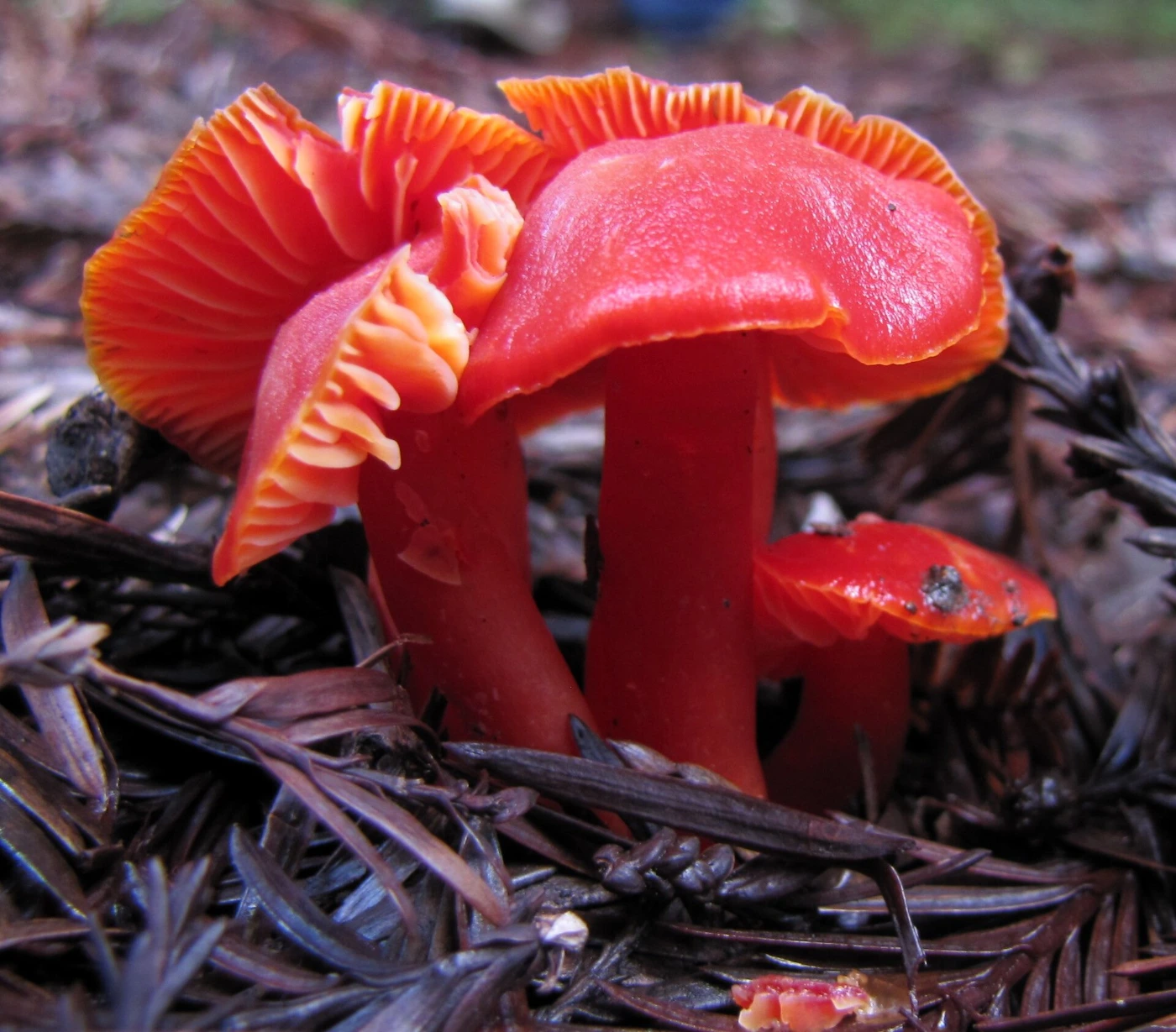
Hygrocybe coccinea is a classic red waxcap with a scarlet to orange-red cap and waxy gills. The stem is usually similarly colored and becomes paler toward the base.
It is generally smaller and more delicate than Crimson Waxcap. The smooth moist cap also helps separate it from some more finely scaly red species.
Main Identification Clue
Look for a relatively small scarlet waxcap with a smooth cap, waxy gills, and old grassland habitat. Exact identification still requires comparison with other red species.
Crimson Waxcap — Hygrocybe punicea
Crimson Waxcap is usually larger and more robust than Scarlet Waxcap. The cap is deep red to crimson, and the stem can be thick and strongly colored.
Its overall build is one of the best clues. A large substantial red waxcap is more likely to be Hygrocybe punicea than H. coccinea.
Main Identification Clue
Size and robustness matter more than shade alone. Deep crimson color plus a thick stem strongly supports this species.
Vermilion Waxcap — Hygrocybe miniata
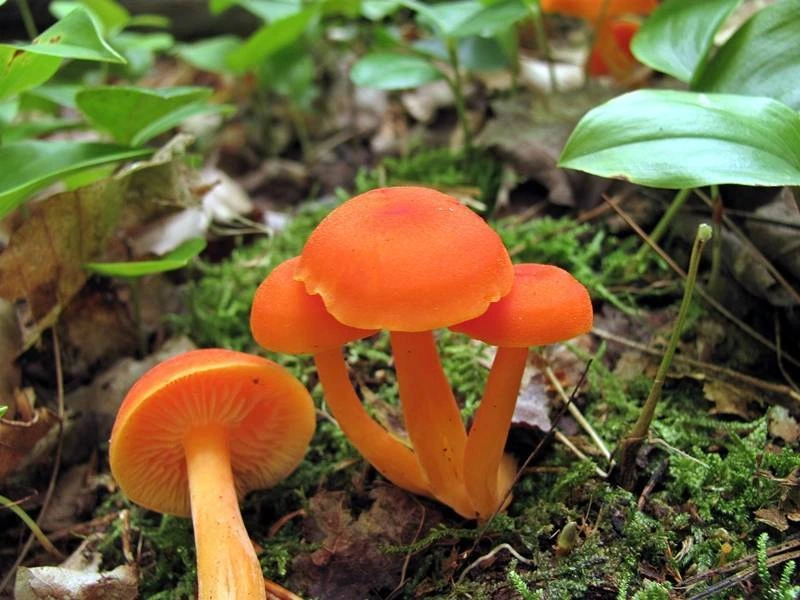
Hygrocybe miniata is usually small and red to orange-red. The cap surface is often dry and finely scaly rather than smooth and greasy.
This texture separates it from Scarlet Waxcap in many typical specimens. Weathered caps can still make the comparison difficult.
Main Identification Clue
A small vermilion mushroom with a finely textured or scaly cap is a strong Hygrocybe miniata candidate.
Honey Waxcap — Hygrocybe reidii
Honey Waxcap is usually orange to reddish-orange and can overlap visually with several other waxcaps. Its most distinctive feature is the sweet honey-like smell.
The odor can be especially noticeable in fresh fruit bodies. If the smell is absent, the identification becomes less secure.
Main Identification Clue
The best combination is orange-red coloration plus a clear honey odor in old grassland.
Butter Waxcap — Hygrocybe ceracea
Butter Waxcap is small and usually yellow to yellow-orange. It has a smooth moist cap and pale to yellowish waxy gills.
Its brighter yellow overall appearance separates it from the strongly red waxcaps. Older specimens can become more orange.
Main Identification Clue
Small size plus a buttery yellow cap and waxy gills is the typical field pattern.
Parrot Waxcap — Gliophorus psittacinus
Parrot Waxcap is one of the most striking species in the broader waxcap group. Fresh specimens often show green or olive tones on the cap and upper stem, sometimes mixed with yellow or orange.
The surface can be strongly slimy. As the mushroom ages, the green color may fade dramatically.
Main Identification Clue
Fresh green coloration combined with a very slippery cap is highly characteristic.
Blackening Waxcap — Hygrocybe conica Group
Members of the Blackening Waxcap group often begin yellow, orange, or red and gradually turn gray to black after damage or aging. The cap is typically conical or sharply pointed when young.
This blackening reaction is one of the most dramatic features in the group. Even old fruit bodies may become almost entirely black.
Main Identification Clue
A conical waxcap that strongly blackens after handling or age fits the Hygrocybe conica group well.
Splendid Waxcap — Hygrocybe splendidissima
Splendid Waxcap is a large, bright red species with a striking appearance. It can resemble Crimson Waxcap and other large red taxa.
Features such as cap shape, smell, and detailed gill characters become important. Exact separation is not always easy from photographs.
Main Identification Clue
Large size and vivid red color place it among the larger red waxcaps, but comparison with H. punicea is necessary.
Meadow Waxcap — Cuphophyllus pratensis
Meadow Waxcap is less brightly colored than many Hygrocybe. It is usually buff, apricot, or pale orange with thick, strongly decurrent gills.
The more substantial fleshy build and downward-running gills help distinguish it from smaller colorful waxcaps. Modern taxonomy usually places it in Cuphophyllus rather than Hygrocybe.
Main Identification Clue
Look for a pale apricot grassland mushroom with thick decurrent gills and a sturdy build.
Waxcap Color Groups
| Color Group | Examples | Useful Next Check |
|---|---|---|
| Red / scarlet | H. coccinea, H. punicea, H. miniata | Size and cap texture |
| Orange | H. reidii, faded red species | Smell and gill attachment |
| Yellow | H. ceracea and relatives | Cap texture and size |
| Green | Gliophorus psittacinus | Slime and fading |
| Blackening | H. conica group | Bruising reaction |
| Pale apricot | Cuphophyllus pratensis | Decurrent gills |
Color is useful for narrowing the options, but the second feature is usually what makes the identification meaningful.
Scarlet Waxcap vs Crimson Waxcap
| Feature | Scarlet Waxcap | Crimson Waxcap |
|---|---|---|
| Scientific name | H. coccinea | H. punicea |
| Size | Small to medium | Larger |
| Build | Slender | Robust |
| Cap | Scarlet to orange-red | Deep red to crimson |
| Stem | Slender | Thick |
| Best clue | Smaller overall | Large substantial form |
This is one of the most common red waxcap comparisons.
Scarlet Waxcap vs Vermilion Waxcap
| Feature | Scarlet Waxcap | Vermilion Waxcap |
|---|---|---|
| Cap surface | Smooth | Often finely scaly |
| Color | Scarlet-red | Vermilion to orange-red |
| Texture | Moist to slightly greasy | Often drier |
| Size | Small to medium | Usually small |
| Best clue | Smooth cap | Textured cap |
A detailed cap photograph is particularly helpful here.
Waxcaps vs Small Red Lawn Mushrooms
Not every colorful lawn mushroom is a waxcap. Several unrelated genera can produce small red, orange, or yellow fruit bodies in grass.
The waxy thick gills and low-nutrient grassland habitat are therefore important. Thin crowded gills or growth in recently fertilized disturbed soil may point elsewhere.
Waxcaps vs Mycena
Some Mycena species can be small and colorful, but they are generally more delicate and have thin gills. They also often occur on leaf litter, wood, or forest debris rather than classic waxcap grassland.
Stem and gill texture are usually enough to separate typical specimens. Habitat provides additional support.
Waxcaps vs Laccaria
Laccaria can also have widely spaced gills and bright colors. However, the gills are not typically waxy in the same way, and many species grow in woodland as mycorrhizal fungi.
Spore print and ecology can help when morphology overlaps. Purple or brownish Laccaria species usually look quite different from classic waxcaps.
Are Waxcaps Edible?
Some waxcaps have historically been described as edible, but the group is generally not a good target for beginner foraging. Many are small, difficult to identify precisely, and ecologically important.
For MushroomID purposes, they are better treated primarily as identification and conservation species. Colorful appearance does not provide any general rule about edibility.
How to Identify a Waxcap Step by Step
Start with habitat and gill structure rather than color alone. Once the mushroom fits the waxcap group, use texture, size, smell, and bruising to narrow the species.
This approach is more reliable than trying to memorize a separate color for every name.
Step 1: Check the Habitat
Ask whether the mushroom is growing in old grassland, meadow, pasture, lawn, or churchyard. Low-nutrient turf strongly supports the group.
Growth from wood, bark mulch, or deep forest litter should make you reconsider the identification.
Step 2: Examine the Gills
Look for thick, waxy, relatively widely spaced gills. Then note whether they are attached, notched, or decurrent.
Take a side photograph because top-down images rarely show this feature well.
Step 3: Check the Cap Surface
Determine whether the cap is smooth, greasy, slimy, dry, or finely scaly. This can quickly separate several similar red and orange species.
Touch is useful when appropriate, but a close macro photograph can also reveal surface texture.
Step 4: Observe Bruising
Gently handle or cut an already collected specimen and watch for darkening. Strong gray-to-black staining immediately narrows the possibilities.
Take another photograph after several minutes if the reaction is developing slowly.
Step 5: Check Smell and Size
A honey smell may suggest Hygrocybe reidii, while very large red fruit bodies suggest species such as H. punicea. These features work best after the basic waxcap identification is secure.
Several fruit bodies at different ages are useful because size and color change considerably over time.
How to Photograph Waxcaps for Identification
Take one photograph showing the mushroom in its grassland habitat. A wider image can reveal turf condition and whether several waxcap species are growing together.
Then photograph the cap surface, gills, full stem, and side profile. If the mushroom changes color after handling, add a second image showing the reaction.
For red waxcaps, a close-up of the cap texture is especially valuable. For blackening species, before-and-after photographs are much more useful than one static image.
Can AI Identify Waxcaps?
AI can usually recognize a typical specimen as a waxcap when habitat, cap, gills, and stem are all visible. Exact species identification is much harder because many taxa differ in subtle structural features.
A top-down photograph of a red mushroom is particularly weak evidence. The same image could fit several Hygrocybe species.
A cautious result such as “red waxcap” or “Hygrocybe group” can therefore be more accurate than forcing an exact species when gill attachment, texture, or habitat are missing.
Common Identification Mistakes
One common mistake is treating cap color as the main feature. Scarlet, crimson, vermilion, and orange shades overlap strongly and change with weather.
Another mistake is ignoring texture. Smooth and finely scaly caps can separate species that otherwise look almost identical.
Habitat is also frequently underused. Waxcaps are strongly linked to old grassland, so a colorful mushroom growing in wood chips should follow a different identification path.
Interesting Facts About Waxcaps
Waxcap-rich grasslands can be ecologically important even when they look like ordinary lawns or meadows. A high diversity of waxcaps often indicates a long history of low nutrient input and relatively undisturbed soil.
Some sites can produce many colors at once. Red, yellow, orange, green, and blackening species may fruit within the same small grassland during favorable autumn weather.
The taxonomy of waxcaps has changed significantly with DNA research. Species once grouped together in Hygrocybe are now distributed among genera such as Hygrocybe, Gliophorus, Cuphophyllus, and others.
Their bright pigments are also useful reminders that vivid color is not a toxicity test. In fungi, bright red or yellow coloration can occur in edible, inedible, toxic, or simply unstudied species.
Frequently Asked Questions
Why do some waxcaps fade almost completely with age?
Pigments can change with drying, sunlight, and weathering. A mushroom that began scarlet may become orange or yellowish before it deteriorates.
Can several waxcap species grow within a few meters of each other?
Yes. High-quality grassland can support many species simultaneously. Each fruit body should therefore be examined independently.
Can fertilizer make waxcaps disappear?
Heavy nutrient enrichment is strongly associated with loss of waxcap diversity. Long-established low-nutrient grasslands are generally much better habitats.
Do waxcaps return to the same lawn every year?
They can, although fruiting varies with rainfall and temperature. The fungal organism can persist even in years when few fruit bodies appear.
Why do blackening waxcaps become dark without obvious bruising?
Aging itself can trigger discoloration. Some fruit bodies darken gradually even without being handled.
Can waxcaps grow in short mown grass?
Yes. Short turf is common in many classic waxcap sites, provided the soil has not been heavily fertilized or disturbed.
Are all green waxcaps Parrot Waxcaps?
No. Green coloration is highly suggestive of the parrot waxcap group, but faded specimens and related taxa can complicate exact identification.
Why are some waxcaps difficult to identify even for experts?
Several species overlap strongly in color and size and may require microscopic or molecular features for confident separation. Field identification can sometimes only reach genus or species-group level.
Final Identification Notes
Waxcap identification works best by combining grassland habitat, thick waxy gills, cap texture, stem features, smell, size, and bruising reactions. Color is useful for narrowing the possibilities but should never be the final deciding feature.
Red species such as Hygrocybe coccinea, H. punicea, and H. miniata are best separated by size and cap texture, while Honey Waxcap adds a distinctive smell and Blackening Waxcaps add a dramatic color reaction. Green, yellow, and pale apricot species follow their own combinations of texture and gill attachment.
The simplest field rule is: confirm old grassland first, then check the gills, cap texture, and any color change before trying to name the species.
Upload a photo and get possible matches in seconds.