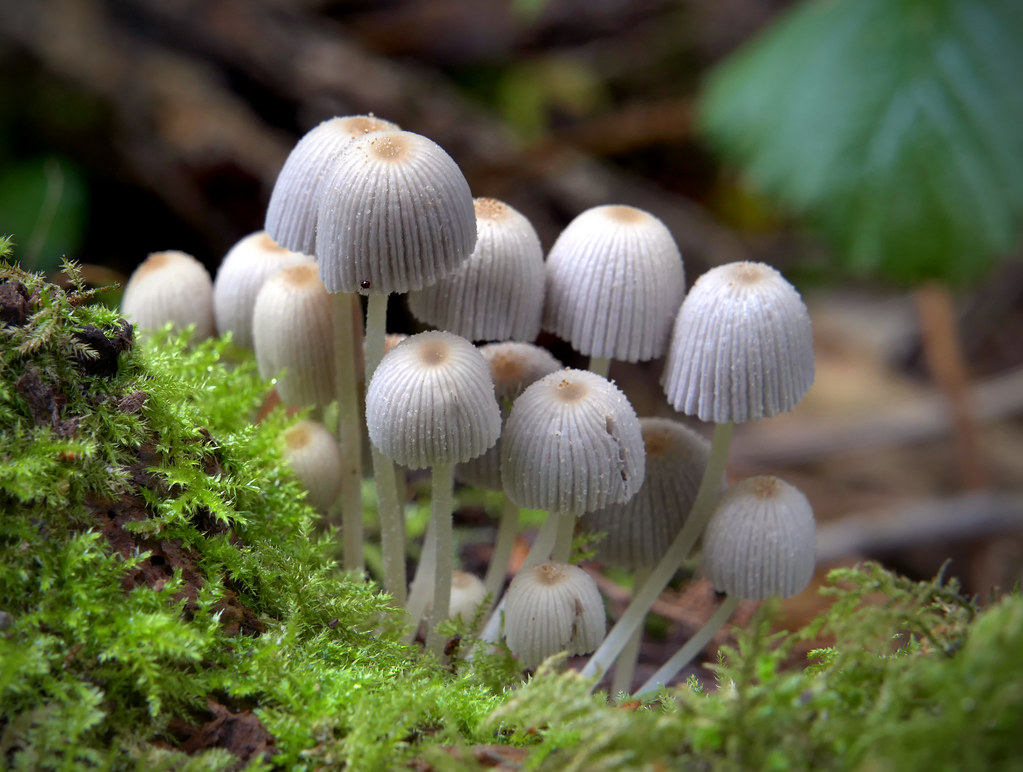
Mushrooms appearing in lawns are extremely common, especially after periods of rain. Some grow from decaying organic matter in the soil, others live in association with grass roots, and some are actually fruiting from buried wood or old tree roots that are no longer visible at the surface.
For identification, the location alone is never enough. A mushroom growing in grass may be edible, inedible, psychoactive, toxic, or simply difficult to identify with confidence. The most useful features are the underside of the cap, spore color, stem structure, bruising reactions, growth pattern, and whether the mushroom is truly growing from soil or from hidden woody material.
⚠️ Important: This article is for identification and education only. Never eat a wild mushroom based only on a photograph, AI result, or comparison with an online guide.
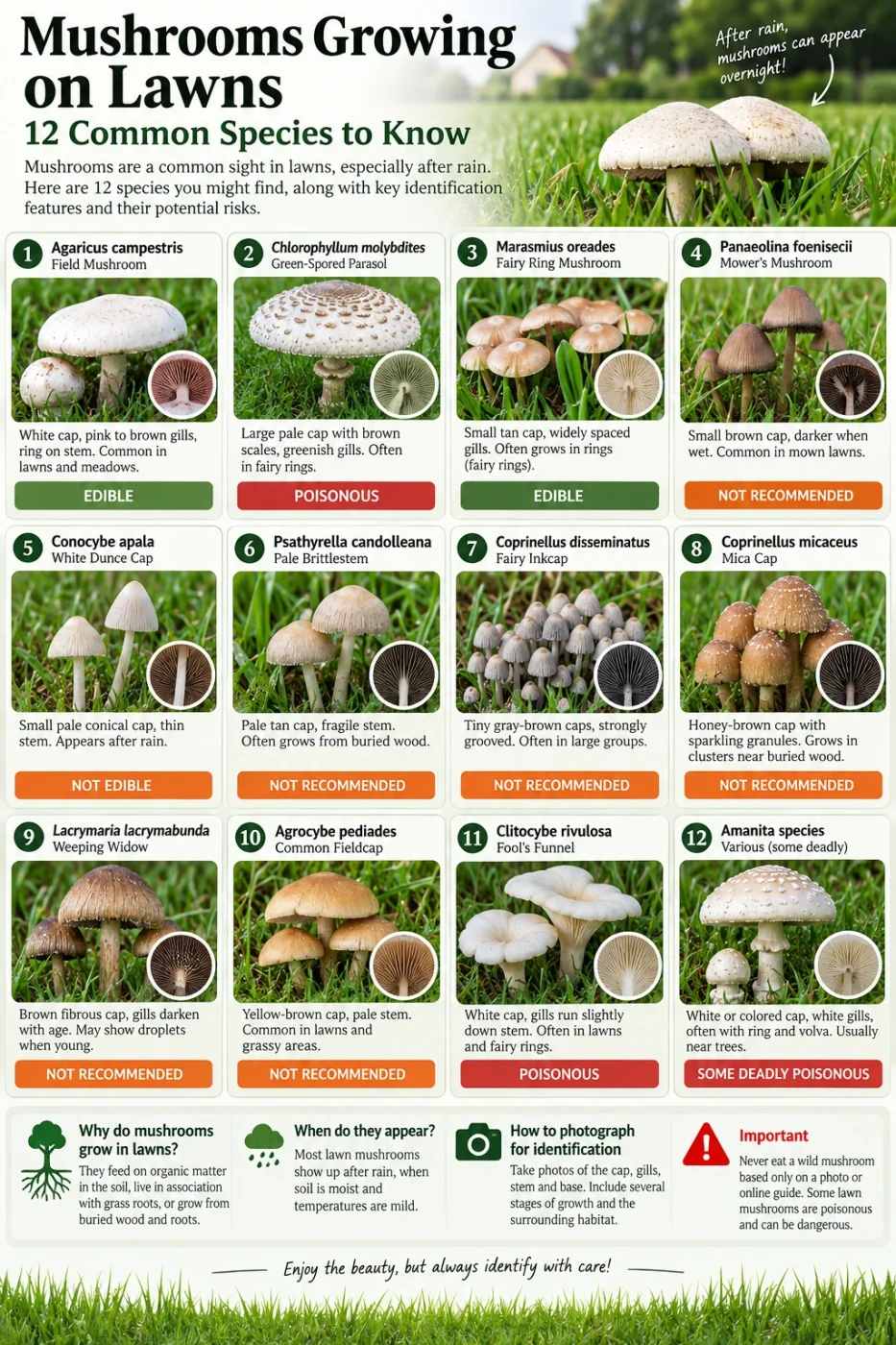
Quick Lawn Mushroom Identification Guide
| Species | Typical appearance | Common lawn habitat | Risk |
|---|---|---|---|
| Agaricus campestris | White cap, pink to brown gills | Meadows and lawns | Edible when correctly identified |
| Chlorophyllum molybdites | Large pale scaly cap | Lawns, parks, gardens | Poisonous |
| Marasmius oreades | Small tan cap | Lawns, fairy rings | Edible when correctly identified |
| Panaeolina foenisecii | Small brown cap | Mown lawns | Not recommended |
| Conocybe apala | Small pale conical cap | Damp lawns | Not edible |
| Psathyrella candolleana | Pale tan fragile cap | Lawns with buried wood | Not recommended |
| Coprinellus disseminatus | Tiny gray-brown clustered caps | Buried roots and stumps | Not recommended |
| Coprinellus micaceus | Honey-brown clustered caps | Near buried wood | Not recommended |
| Lacrymaria lacrymabunda | Brown fibrous cap | Grass, gardens, paths | Not recommended |
| Agrocybe pediades | Yellow-brown cap | Lawns and grassy areas | Not recommended |
| Clitocybe rivulosa | Small white cap | Lawns and grassy areas | Poisonous |
| Amanita species | White or colored cap, white gills | Near trees in lawns | Some deadly poisonous |
Why Do Mushrooms Grow in Lawns?
A lawn may look like a simple layer of grass, but the soil beneath it can contain roots, dead plant material, buried timber, old tree stumps and extensive fungal networks. Mushrooms are only the visible fruiting bodies of fungi living below the surface.
Heavy rain, irrigation, cool temperatures and high humidity can trigger sudden fruiting. This is why a lawn can appear completely clear one day and be covered with mushrooms the next morning.
Some species decompose dead organic matter in the soil, while others form mycorrhizal relationships with nearby trees. If mushrooms repeatedly appear in the same place, there may be a persistent underground food source such as buried roots.
1. Agaricus campestris — Field Mushroom
- Scientific name: Agaricus campestris
- Common name: Field Mushroom
The Field Mushroom is one of the best-known grassland mushrooms. It usually develops a white to cream cap and grows in lawns, meadows and pastures, sometimes forming rings.
The gills are one of its most useful characteristics. Young mushrooms have pink gills, which gradually become dark chocolate brown as the spores mature. The stem is pale and usually has a relatively delicate ring.
A Field Mushroom should never be identified from the white cap alone because several dangerous white mushrooms can look similar from above.
Main look-alike: White Amanitas
Some young Amanitas also have white caps and pale stems, but their gills remain white rather than turning pink and brown. Amanitas may also have a volva or bulbous structure around the base of the stem, which can be hidden below the soil.
For this reason, the entire stem base should always be removed carefully and examined before identification.
2. Chlorophyllum molybdites — Green-Spored Parasol
- Scientific name: Chlorophyllum molybdites
- Common names: Green-Spored Parasol, False Parasol
This is one of the most important poisonous lawn mushrooms to recognize. It frequently appears in lawns, parks and gardens, often in large fairy rings after warm wet weather.
The mushroom is relatively large, with a pale cap covered in brownish scales and a substantial stem with a ring. Young gills are pale, but mature specimens develop gray-green to greenish gills as the spores accumulate.
The spore print is green, which is one of the best-known identification features of the species.
Why it matters
Chlorophyllum molybdites is a common cause of gastrointestinal mushroom poisoning. It can cause severe vomiting, abdominal pain and diarrhea.
Its large size and parasol-like appearance make it especially risky because it can be confused with edible parasol mushrooms.
3. Marasmius oreades — Fairy Ring Mushroom
- Scientific name: Marasmius oreades
- Common names: Fairy Ring Mushroom, Fairy Ring Champignon
This small tan mushroom is famous for producing circular or curved rings in lawns. The cap is usually pale tan to buff and often has a slightly darker center.
The stem is thin but surprisingly tough and flexible. The gills are relatively widely spaced and pale.
The species grows directly from grassland soil rather than from visible wood.
Fairy rings
The characteristic ring shape forms because the underground fungal network expands outward over time. Grass around the edge of the colony may become greener because fungal decomposition releases nutrients into the soil.
Several unrelated fungi can also produce fairy rings, so the circular growth pattern does not identify the species by itself.
4. Panaeolina foenisecii — Mower’s Mushroom
- Scientific name: Panaeolina foenisecii
- Common names: Mower’s Mushroom, Haymaker’s Mushroom
This is one of the most common small brown mushrooms found in frequently cut lawns. It often appears shortly after rain and may disappear quickly once the grass dries.
The cap is usually brown when wet and becomes noticeably paler as it dries. This moisture-related color change can produce a two-toned appearance.
The gills become dark brown to mottled as the spores mature.
Identification difficulty
Mower’s Mushrooms belong to the broad category often called “little brown mushrooms.” Small brown lawn species can be difficult to distinguish from one another, especially from photographs.
They should not be collected for food based on casual identification.
5. Conocybe apala — White Dunce Cap
- Scientific name: Conocybe apala
- Common name: White Dunce Cap
This delicate mushroom frequently appears in well-watered lawns after rain. It has a small pale cream to whitish cap that begins distinctly conical and becomes broader with age.
The stem is extremely thin and fragile, while mature gills become cinnamon to rusty brown as the spores develop.
The mushroom often survives only briefly in sunny weather and may collapse within hours as the lawn dries.
Why it can be confusing
Small pale Conocybe species can look superficially similar to many other lawn mushrooms. Some related species contain biologically active or toxic compounds, so identification to genus alone should never be treated as evidence of edibility.
6. Psathyrella candolleana — Pale Brittlestem
- Scientific name: Psathyrella candolleana
- Common name: Pale Brittlestem
The Pale Brittlestem usually has a pale cream to tan cap and a fragile white stem. Young caps may show veil fragments around the margin, although these can disappear quickly.
Its gills darken as the spores mature.
Although it may seem to be growing directly from lawn soil, the fungus often develops from buried wood, old roots or other woody material below the surface.
Identification clue
If mushrooms repeatedly appear in a tight cluster in exactly the same part of a lawn, buried roots or an old stump may be present even when no wood is visible.
7. Coprinellus disseminatus — Fairy Inkcap
- Scientific name: Coprinellus disseminatus
- Common names: Fairy Inkcap, Trooping Crumble Cap
Fairy Inkcaps usually appear in very large groups containing dozens or even hundreds of tiny mushrooms. Their caps are grayish, beige or pale brown and strongly grooved.
They often occur around old trees, buried stumps and decaying roots.
Unlike some larger inkcaps, this species does not usually dissolve into black liquid as dramatically when mature.
Lawn clue
A huge cluster appearing around one point in a lawn often indicates buried woody material. The fungus may be fruiting from roots long after the original tree has been removed.
8. Coprinellus micaceus — Mica Cap
- Scientific name: Coprinellus micaceus
- Common name: Mica Cap
Mica Caps have honey-brown to amber caps and commonly grow in clusters near stumps, tree bases and buried roots. On lawns they may appear to grow directly from soil even when the mycelium is actually feeding on buried wood.
Young mushrooms often have tiny sparkling particles on the cap surface that resemble mica crystals. Rain can wash these particles away, so older specimens may lack this feature.
As the mushrooms mature, the caps become strongly lined and the gills darken.
Look-alikes
Several related inkcaps can appear almost identical in photographs. Growth pattern, cap surface and microscopic features may be needed for precise identification.
9. Lacrymaria lacrymabunda — Weeping Widow
- Scientific name: Lacrymaria lacrymabunda
- Common name: Weeping Widow
The Weeping Widow is a medium-sized brown mushroom that can appear in lawns, gardens, woodland edges and disturbed grassy areas.
Its cap is often covered with fine fibers or scales, giving it a slightly woolly appearance. Young specimens may have remnants of a partial veil connecting the cap edge to the stem.
The gills darken strongly with age and can produce small droplets when young, which inspired the “weeping” part of the common name.
Identification note
Its brown cap and darkening gills can resemble several other grassland mushrooms. The fibrous cap surface and veil remnants can help narrow the possibilities, but they are not unique to this species.
10. Agrocybe pediades — Common Fieldcap
- Scientific name: Agrocybe pediades
- Common names: Common Fieldcap, Common Agrocybe
This relatively small mushroom appears in lawns, grassy paths, parks and other open areas. The cap is usually yellow-brown, tan or ochre and often becomes paler as it dries.
The gills mature from pale tones to brown as the spores develop, and the stem is generally slender and pale.
It is a common but easily overlooked lawn mushroom because its appearance is not particularly distinctive.
Look-alikes
Other Agrocybe species and several small brown grassland mushrooms can look similar. A casual photograph from above is rarely enough for confident identification.
11. Clitocybe rivulosa — Fool’s Funnel
- Scientific name: Clitocybe rivulosa
- Common names: Fool’s Funnel, False Champignon
This is one of the important poisonous white lawn mushrooms. It often appears in lawns, parks, grassy verges and other open habitats.
The cap is white to pale cream and may develop subtle concentric zones or cracking as it dries. The gills are pale and run slightly down the stem.
Because it grows in grass and can appear in rings, it may be confused with edible grassland mushrooms by inexperienced collectors.
Toxicity
The species contains muscarine and can cause serious cholinergic poisoning. Symptoms can include sweating, salivation, abdominal cramps, vomiting, diarrhea and slowed heart rate.
Any small white funnel-shaped mushroom growing in grass deserves careful identification.
12. Amanita Species in Lawns
- Genus: Amanita
Amanitas are usually associated with woodland, but they can also appear in lawns when suitable host trees are nearby. A lawn containing birch, oak, pine or other mycorrhizal trees may produce Amanita fruit bodies several meters away from the trunk.
Depending on the species, caps may be white, yellow, brown, orange or red. Most have pale or white gills, and many show a ring, volva or other veil remnants.
Why lawn Amanitas matter
Some Amanitas are among the most dangerous mushrooms in the world. A white mushroom appearing in grass should therefore not automatically be assumed to be an Agaricus or another harmless lawn species.
Examining the complete stem base is particularly important because a volva can remain buried underground.
White Mushrooms Growing in Lawns
White lawn mushrooms deserve extra caution because several unrelated species share this appearance.
Possible examples include Field Mushrooms, Green-Spored Parasols, Fool’s Funnel and various Amanitas. From above, a young specimen may show little more than a white rounded cap.
The underside immediately provides more information. Pink or brown gills suggest Agaricus, greenish mature gills suggest Chlorophyllum molybdites, while persistently white gills combined with Amanita structures around the stem base require particular caution.
Brown Mushrooms Growing in Lawns
Small brown lawn mushrooms are extremely common and often difficult to identify. Mower’s Mushrooms, Common Fieldcaps, various Conocybe species and many other fungi can all fit the general description.
Instead of trying to identify them by shade of brown, examine the gills, spore print, stem and cap texture. Also observe whether the cap changes dramatically as it dries, since hygrophanous color change is common among lawn fungi.
Mushrooms Growing in Fairy Rings
A fairy ring is a circular or curved pattern of mushrooms caused by the underground fungal colony expanding outward. Sometimes the grass along the ring becomes greener because the fungus releases nutrients as it decomposes organic material.
Fairy Ring Mushrooms are famous for this behavior, but they are not the only species that form rings. Green-Spored Parasols, Agaricus species and several other lawn fungi can also grow in arcs or circles.
The ring pattern should therefore be treated as ecological information rather than a species-level identification feature.
Mushrooms Growing Around Old Tree Stumps
If a tree was removed years ago, its roots may still remain beneath the lawn. Fungi continue breaking this wood down long after the visible trunk has disappeared.
Mica Caps, Fairy Inkcaps and various brittle-stemmed mushrooms may repeatedly appear over the same buried root system. This explains why some lawn mushrooms occur in dense localized clusters rather than being scattered evenly across the grass.
Are Lawn Mushrooms Dangerous to Dogs?
Some lawn mushrooms can be poisonous to dogs, and pets may eat mushrooms that humans would normally ignore. The risk is difficult to judge from appearance alone because many small lawn species are hard to identify.
If a dog has eaten an unknown mushroom, remove any remaining specimens from the area and keep a sample if possible. Photographs of the whole mushroom, including its underside and stem base, can be useful for identification. Contact a veterinarian or animal poison service if ingestion is suspected, particularly if the animal develops vomiting, weakness, unusual behavior, tremors or other symptoms.
Should You Remove Mushrooms From Your Lawn?
Most lawn mushrooms are simply evidence that fungi are decomposing organic material underground. Their presence does not usually mean the lawn is unhealthy.
Removing the visible mushrooms will reduce the chance of children or pets eating them, but it normally does not eliminate the fungus because the mycelium remains in the soil. Reducing excessive watering, improving drainage and removing buried woody debris can sometimes reduce fruiting.
Fungicides are rarely a practical solution for ordinary lawn mushrooms.
How to Photograph a Lawn Mushroom for Identification
A useful set of photographs should show the cap from above, the gills or pores underneath, the complete stem and its base, and several specimens at different stages of development. A photograph of the surrounding grass and nearby trees can also provide important ecological clues.
If the mushroom appears to grow directly from soil, carefully check for buried wood or roots. Do not cut the stem off before photographing the base, because important structures can remain below ground level.
Can You Identify a Lawn Mushroom From a Photo?
Some distinctive lawn mushrooms can be recognized reasonably well from good photographs, but many cannot. Small brown mushrooms and young white mushrooms are particularly difficult because important features may be hidden or undeveloped.
Photo-identification tools are useful for narrowing down possibilities, but the result should be treated as a starting point. Decisions about edibility require independent confirmation based on the complete mushroom and local species knowledge.
Frequently Asked Questions
Why are mushrooms suddenly growing in my lawn?
Rain, irrigation, humidity and suitable temperatures can stimulate fungi already living in the soil to produce fruiting bodies. The underground fungus may have been present for months or years before mushrooms appeared.
Are mushrooms in the lawn poisonous?
Some are harmless or edible, while others are poisonous. Habitat and cap color alone cannot determine toxicity.
What is the large white mushroom growing in my lawn?
One common possibility is Chlorophyllum molybdites, the Green-Spored Parasol, especially in warm climates. However, large white lawn mushrooms belong to several species, so the underside, spore print and stem base need to be examined.
What are the tiny brown mushrooms in my grass?
Mower’s Mushroom is one common possibility, but many unrelated small brown fungi grow in lawns. Accurate identification may require more than photographs.
Why do mushrooms form a circle in grass?
The fungal mycelium expands outward through the soil, producing mushrooms around its active outer edge. Over time this can create a circular or arc-shaped fairy ring.
Do mushrooms mean my lawn has a disease?
Usually no. Many lawn mushrooms are decomposers feeding on dead organic material rather than attacking healthy grass.
Can I mow over lawn mushrooms?
Yes, although mowing only removes the fruiting bodies. The underground fungal network will remain and may produce more mushrooms when conditions become suitable again.
Final Identification Notes
A lawn is not a single mushroom habitat. It can support grassland fungi, wood-decaying species growing from buried roots and mycorrhizal mushrooms associated with nearby trees, which is why mushrooms appearing only a few meters apart may belong to completely different ecological groups.
Start identification by looking under the cap and examining the whole stem. Then consider gill or pore color, spore print, growth pattern, nearby trees and hidden wood beneath the soil. Large white parasol-like mushrooms and small white funnel-shaped species deserve particular caution, while any mushroom suspected to be an Amanita should be collected with the complete stem base intact for identification.
Found mushrooms growing in your lawn? A photo identifier can help narrow down likely species, but never use a photo or AI result alone to decide whether a wild mushroom is safe to eat.