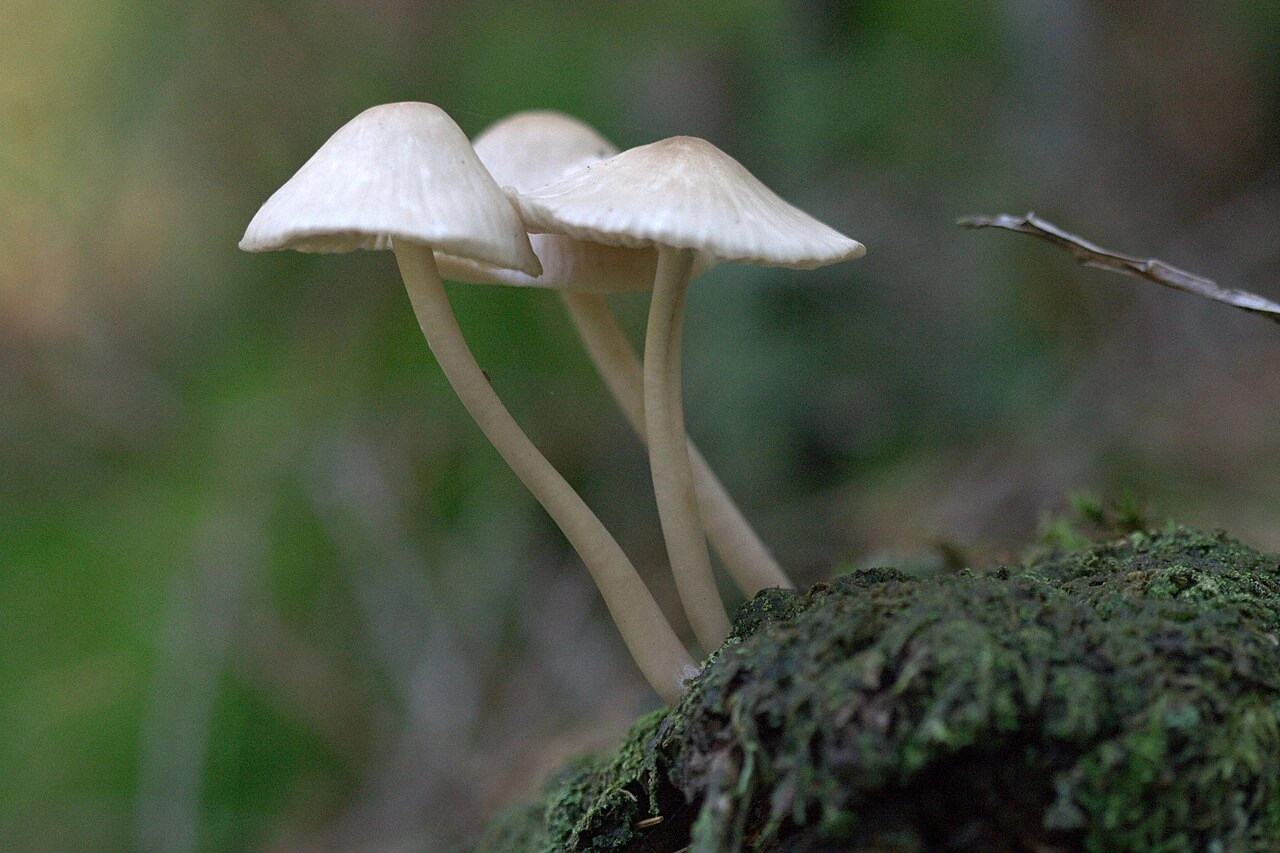
White mushrooms are among the most difficult wild mushrooms to identify safely. A smooth white cap can belong to a common edible species, an inedible lawn mushroom, or one of the most dangerous fungi in the world.
Color alone is almost useless for reliable identification. The most important features are the gills or pores, stem base, presence of a ring or volva, spore print, habitat, bruising reactions and changes that occur as the mushroom matures.
This is especially important with white Amanitas. Some deadly species can look remarkably ordinary, particularly when they are young.
⚠️ Important: This guide is for education and identification only. Never eat a wild mushroom based only on a photograph, AI result, cap color, or comparison with an online guide.
Quick White Mushroom Identification Guide
| Species | Key appearance | Typical habitat | Risk |
|---|---|---|---|
| Agaricus campestris | White cap, pink to dark brown gills | Meadows and lawns | Edible when correctly identified |
| Agaricus arvensis | Large white cap, gills darken with age | Grassland and pastures | Edible when correctly identified |
| Amanita virosa | White cap, white gills, ring and volva | Woodland | Deadly poisonous |
| Amanita verna | White cap, white gills and volva | Woodland | Deadly poisonous |
| Amanita phalloides pale forms | Pale to white cap, white gills, volva | Woodland | Deadly poisonous |
| Chlorophyllum molybdites | Large white scaly cap, greenish mature gills | Lawns and parks | Poisonous |
| Leucoagaricus leucothites | Smooth white cap and white gills | Lawns and grassy areas | Not recommended |
| Clitocybe rivulosa | Small white funnel-shaped cap | Lawns and grassland | Poisonous |
| Lepista personata pale forms | Pale cap, lilac tones on stem | Grassland | Edibility requires confident ID |
| Coprinus comatus | Tall white shaggy cap | Lawns, paths and disturbed soil | Edible when young and correctly identified |
| Calocybe gambosa | Cream-white thick cap | Grassland and woodland edges | Edible when correctly identified |
| White puffballs | Round, white and solid inside | Lawns and woodland | Some edible when young, but Amanita confusion is dangerous |
First: Look Under the Cap
The underside of the mushroom usually tells you more than the white cap itself. If the mushroom has gills, note their color when young and old, whether they touch the stem, and whether they change color as spores mature.
Pink gills that turn chocolate brown strongly suggest an Agaricus species. Gills that remain white throughout maturity deserve more caution because this pattern occurs in several Amanitas, as well as in many unrelated white mushrooms.
If the underside has pores rather than gills, you are dealing with a different group altogether. White-capped boletes exist, but they are less commonly mistaken for the classic white lawn and woodland mushrooms discussed here.
1. Agaricus campestris — Field Mushroom
- Scientific name: Agaricus campestris
- Common name: Field Mushroom
The Field Mushroom is one of the best-known edible white mushrooms of lawns, meadows and pastures. Its cap is usually white to cream and may remain fairly smooth or develop small scales with age.
The gills are the most useful feature. They begin pink, become deeper reddish brown and eventually mature to dark chocolate brown. The spore print is also dark brown.
The stem is pale and usually carries a relatively delicate ring, while the base lacks the sack-like volva found in many dangerous Amanitas.
Dangerous look-alike: White Amanita
A young white Amanita can superficially resemble a Field Mushroom from above. The main difference is that Amanita gills remain white, while Agaricus gills progressively darken.
The complete stem base is also crucial. Amanitas may have a volva surrounding the base, sometimes hidden below soil or leaf litter. A mushroom cut off at ground level may therefore lose one of its most important identification features.
2. Agaricus arvensis — Horse Mushroom
- Scientific name: Agaricus arvensis
- Common name: Horse Mushroom
The Horse Mushroom is a large pale species often found in fields, pastures and grassy areas. The cap is white to cream when young and may become yellowish with age or handling.
As with other Agaricus, the gills begin pale and gradually turn through pinkish tones to dark brown. The mushroom often has a substantial ring and can develop yellow staining, particularly near the stem base.
This species can be confused with other white Agaricus species, including some that cause gastrointestinal illness. Smell, staining reactions and habitat can all be useful, but they should be considered together rather than separately.
3. Amanita virosa — Destroying Angel
- Scientific name: Amanita virosa
- Common name: Destroying Angel
The Destroying Angel is one of the most important deadly white mushrooms to recognize. It has a white cap, white gills, a white stem and typically a ring around the upper stem.
The base usually sits inside a distinct white volva. This structure may be partly buried, which is why removing the whole mushroom rather than cutting the stem is essential during identification.
Amanita virosa contains amatoxins capable of causing severe liver failure. Early symptoms may be delayed for many hours, and a temporary period of apparent recovery can occur even while internal damage continues.
Main identification warning
A pure white mushroom with white gills and a volva at the base should be treated with extreme caution. Even experienced foragers are careful around white Amanitas because several deadly species share this general appearance.
4. Amanita verna — Fool’s Mushroom
- Scientific name: Amanita verna
- Common names: Fool’s Mushroom, Spring Destroying Angel
Amanita verna is another deadly white Amanita. It typically has a smooth white cap, white gills, a white stem, a ring and a sack-like volva at the base.
It is particularly associated with warmer regions and may appear earlier in the year than some other deadly Amanitas. Its clean white appearance can make it look deceptively harmless.
The species contains amatoxins and should never be confused with edible white grassland mushrooms. The combination of persistently white gills and a volva should always trigger caution.
5. Pale Amanita phalloides — Death Cap
- Scientific name: Amanita phalloides
- Common name: Death Cap
The Death Cap is usually associated with olive, greenish or yellowish caps, but some specimens can be unusually pale and may approach cream or nearly white.
The gills remain white, the stem is pale, and a ring is generally present. At the base is a prominent sack-like volva, although this may be hidden in the soil.
Because cap color varies, a mushroom should never be ruled out as a Death Cap merely because it lacks the familiar greenish appearance. Stem-base structures and gill color are far more important than cap shade.
6. Chlorophyllum molybdites — Green-Spored Parasol
- Scientific name: Chlorophyllum molybdites
- Common names: Green-Spored Parasol, False Parasol
This large white mushroom is especially common in lawns, parks and gardens in warm climates. It often forms fairy rings and can appear in large numbers after rain.
The cap is pale and typically covered with brownish scales. Young gills may look white or cream, but mature specimens develop a gray-green or greenish cast as the spores mature.
Its spore print is distinctly green, one of the most useful characteristics of the species. The mushroom can cause severe gastrointestinal poisoning and is a common source of accidental ingestion.
Look-alike: Parasol Mushroom
The edible Parasol Mushroom can look similar, especially when viewed from above. The true Parasol typically has a more obvious snakeskin pattern on the stem and a pale spore print rather than green spores.
Large parasol-like lawn mushrooms should therefore never be identified from cap pattern alone.
7. Leucoagaricus leucothites — White Dapperling
- Scientific name: Leucoagaricus leucothites
- Common names: White Dapperling, Smooth Parasol
This mushroom has a smooth white to cream cap and white gills. It often grows in lawns, parks, roadside grass and disturbed ground.
The stem usually has a ring, and the overall appearance can resemble a small pale parasol. Unlike Agaricus, its gills remain light rather than becoming chocolate brown.
The species is particularly important because it can resemble young white Amanitas. For that reason, casual identification for food is not advisable.
8. Clitocybe rivulosa — Fool’s Funnel
- Scientific name: Clitocybe rivulosa
- Common names: Fool’s Funnel, False Champignon
This small white mushroom commonly grows in lawns, parks and other grassy habitats. The cap is usually white to pale cream and becomes flatter or shallowly funnel-shaped as it matures.
The gills are pale and run slightly down the stem. The cap surface may develop faint concentric markings, particularly as it dries.
The species contains muscarine and can cause serious poisoning. Symptoms may include sweating, salivation, nausea, vomiting, abdominal cramps and cardiovascular effects.
Why it is easy to overlook
Fool’s Funnel does not look dramatic or obviously dangerous. Its small size and plain white appearance make it a good example of why mushroom toxicity cannot be judged by how threatening a species looks.
9. Lepista personata — Field Blewit
- Scientific name: Lepista personata
- Common name: Field Blewit
Field Blewits are usually associated with lilac or violet coloration on the stem, but pale specimens can appear cream-white from above. They occur in grassland, pasture and open habitats, sometimes forming rings.
The cap is relatively fleshy and pale, while the gills are crowded and light in color. The lower stem often retains violet or lilac tones, which can be an important clue.
Several pale grassland mushrooms can appear similar, so complete identification is necessary before considering edibility.
10. Coprinus comatus — Shaggy Mane
- Scientific name: Coprinus comatus
- Common names: Shaggy Mane, Lawyer’s Wig
The Shaggy Mane is one of the more distinctive white mushrooms commonly found in lawns, roadside grass and disturbed soil. Young specimens have tall cylindrical caps covered with shaggy white scales.
As the mushroom matures, the cap opens and the gills progress from white to pink and then black. Eventually, the cap begins to dissolve into a dark ink-like liquid.
Young Shaggy Manes are traditionally considered edible when correctly identified and consumed before the gills darken. However, the unusual aging process makes mature specimens unsuitable.
11. Calocybe gambosa — St. George’s Mushroom
- Scientific name: Calocybe gambosa
- Common name: St. George’s Mushroom
This pale cream to white mushroom is typically associated with spring. It grows in grassland, woodland edges, hedgerows and sometimes fairy rings.
The cap is thick and fleshy, while the gills are crowded, pale and relatively narrow. The mushroom is also known for a strong mealy or flour-like smell.
Several toxic pale mushrooms can occur in similar habitats, so season and smell are supporting clues rather than definitive proof.
12. White Puffballs
Several true puffballs produce round white fruit bodies in lawns, meadows and woodland. Young edible species are typically uniformly white inside and contain no visible gills, stem or developing cap.
The most important danger is confusion with a young Amanita still enclosed inside its universal veil.
Puffball vs Young Amanita
A suspected puffball should always be cut vertically through the center. A genuine young puffball should be solid and uniformly white inside.
A young Amanita may reveal the outline of a cap, gills and stem hidden within the outer tissue. This difference is critical because some white Amanitas are deadly.
White Mushrooms Growing on Lawns
Lawns can support several white species, including Field Mushrooms, Horse Mushrooms, Green-Spored Parasols, White Dapperlings and Fool’s Funnel.
The first useful question is what happens to the gills as the mushroom ages. Pink-to-brown gills suggest Agaricus, greenish mature gills point toward Chlorophyllum molybdites, while persistently pale gills require consideration of several other genera.
Nearby trees also matter. An Amanita may appear in an apparently open lawn if suitable tree roots extend below the grass.
White Mushrooms Growing in Forests
White woodland mushrooms deserve particular caution because this habitat includes several deadly Amanitas.
If the mushroom has white gills, a ring and a volva at the base, identification should focus immediately on Amanita species. The entire stem base is essential and should never be discarded before identification.
Other white woodland fungi exist, but no white-gilled mushroom should be treated as edible simply because its cap resembles a familiar supermarket mushroom.
White Mushrooms With Pink Gills
Pink gills are commonly associated with young Agaricus mushrooms. As the mushroom matures, those gills usually become reddish brown and eventually dark chocolate brown.
This progression can help distinguish Agaricus from deadly white Amanitas, whose gills remain pale. However, gill color alone is not enough for a safe identification because age, lighting and immature development can make colors difficult to interpret.
White Mushrooms With White Gills
White cap plus white gills is a broad and potentially dangerous combination.
It occurs in Amanitas, white dapperlings, some funnel mushrooms and numerous other groups. The next features to inspect are the ring, stem base, volva, gill attachment, spore print and habitat.
A white mushroom with white gills and a volva should be treated as potentially dangerous until confidently identified.
White Mushrooms With Brown Gills
A mature white mushroom with dark brown gills is often an Agaricus species, but not every Agaricus is edible.
Some species produce strong yellow staining and unpleasant chemical odors and can cause gastrointestinal symptoms. Correct identification therefore requires more than simply confirming brown gills.
How to Check the Stem Base
The stem base can be the difference between recognizing an edible Agaricus and overlooking a deadly Amanita.
Carefully loosen the surrounding soil and remove the entire mushroom intact. Look for a bulbous base, a sack-like volva or rings of veil material around the lower stem.
Never identify an unknown white mushroom after cutting the stem at ground level because essential structures may remain buried.
How to Photograph a White Mushroom for Identification
White mushrooms are difficult to photograph because bright surfaces can lose detail in direct sunlight. Use soft natural light when possible and avoid overexposure.
Photograph the cap, underside, full stem, stem base and surrounding habitat. Include younger and older specimens if several are present, since gill color and cap shape can change dramatically with age.
A single top-down image of a white cap provides very little reliable information.
Can AI Identify a White Mushroom?
AI can help narrow the possibilities, especially when several clear photographs are available. It may recognize general groups such as Agaricus, Amanita or Chlorophyllum and suggest likely species.
However, white mushrooms are precisely the kind of identification problem where missing details can be critical. A hidden volva, immature gill color or damaged ring can completely change the interpretation.
AI identification should therefore be treated as a hypothesis rather than proof, especially when a potentially deadly Amanita is among the possible matches.
Are White Mushrooms Poisonous?
Some are edible and some are extremely poisonous. White coloration has no reliable relationship with toxicity.
Field Mushrooms and Shaggy Manes are examples of edible white species when correctly identified. Destroying Angels and pale Death Caps demonstrate the opposite extreme, since they contain toxins capable of causing fatal liver failure.
This wide range is why folklore rules based on color should never be used.
Frequently Asked Questions
What is the white mushroom growing in my lawn?
Common possibilities include Field Mushroom, Horse Mushroom, Green-Spored Parasol, White Dapperling and Fool’s Funnel. The underside, gill color, stem base and spore print are more useful than cap color.
What white mushrooms are deadly?
Several white Amanitas are deadly, including Destroying Angels such as Amanita virosa and Amanita verna. Pale forms of Amanita phalloides can also appear almost white.
How can I tell a white Amanita from a Field Mushroom?
A mature Field Mushroom normally develops pink and then dark brown gills, while Amanita gills remain white. Amanitas may also have a volva at the stem base.
Are all white mushrooms with brown gills edible?
No. Brown mature gills may suggest Agaricus, but some Agaricus species are inedible or can cause gastrointestinal illness.
Is a large white mushroom in the lawn poisonous?
It may be. Chlorophyllum molybdites, the Green-Spored Parasol, is a common large lawn mushroom that can cause severe gastrointestinal poisoning.
What is a small white funnel-shaped mushroom in grass?
One possibility is Clitocybe rivulosa, the poisonous Fool’s Funnel. Several other pale grassland species can look similar, so complete identification is necessary.
How do I identify a white puffball?
Cut it completely through the center. A young true puffball should be uniformly white inside without any developing cap, gills or stem.
Final Identification Notes
White mushroom identification should begin with structures rather than color. Check whether the gills remain white or darken, whether a ring is present, and most importantly whether the stem base has a volva or other veil remnants.
A particularly important warning combination is white cap + white gills + ring + volva. This pattern is characteristic of several dangerous Amanitas and should always be treated seriously.
By contrast, pink gills that mature to chocolate brown suggest Agaricus, while greenish mature gills point toward Chlorophyllum molybdites. These clues narrow the possibilities, but none should be used alone to decide whether a mushroom is edible.
Found a white mushroom? Photo identification can help generate possible matches, but any decision involving consumption should be independently confirmed by an experienced local mushroom expert.