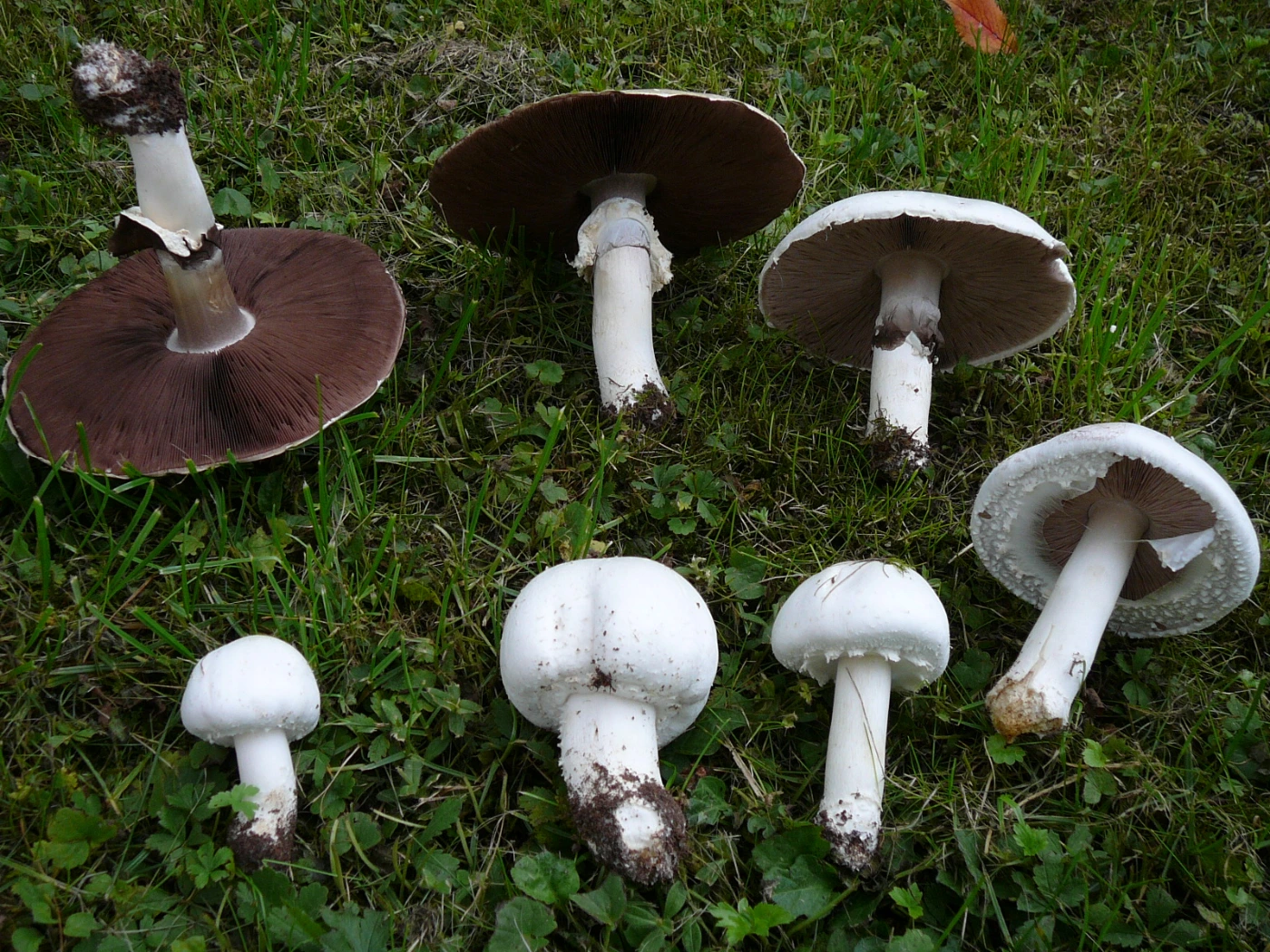
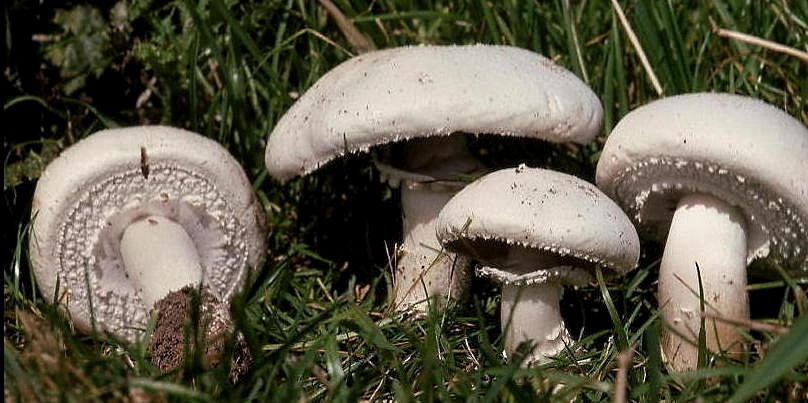
Agaricus arvensis, commonly known as the Horse Mushroom, is a large pale Agaricus found in grassland, pastures, parks, roadside verges, and other open habitats. It is usually recognized by its broad white to cream cap, pink young gills that darken to chocolate-brown, substantial ring, and pleasant anise or almond-like odor.
The most useful field pattern is large pale Agaricus + pink-to-brown gills + strong ring + sweet anise-like smell + no volva. The species can resemble several edible and toxic Agaricus, so bruising reaction and odor are especially important.
⚠️ Important: Horse Mushroom can be confused with toxic yellow-staining Agaricus and with white Amanita species. Always inspect the complete stem base, mature gill color, bruising reaction, and odor before assigning an identification.
Quick Identification
| Feature | Agaricus arvensis |
|---|---|
| Common name | Horse Mushroom |
| Cap color | White to cream, sometimes yellowish with age |
| Cap surface | Smooth to slightly fibrillose |
| Cap shape | Convex, later broad and flat |
| Gills | Free |
| Young gills | Pale pink to gray-pink |
| Mature gills | Chocolate-brown |
| Stem | White, thick, central |
| Ring | Large, persistent, often double |
| Volva | Absent |
| Flesh | White, sometimes slowly yellowing |
| Smell | Sweet, anise-like or almond-like |
| Spore print | Dark brown |
| Habitat | Grassland, pastures, parks, verges |
| Ecology | Saprotrophic |
| Season | Summer to autumn |
| Edibility | Edible when correctly identified |
| Main look-alikes | Agaricus xanthodermus, Agaricus campestris, Agaricus sylvicola, white Amanita |
What Does Agaricus arvensis Look Like?
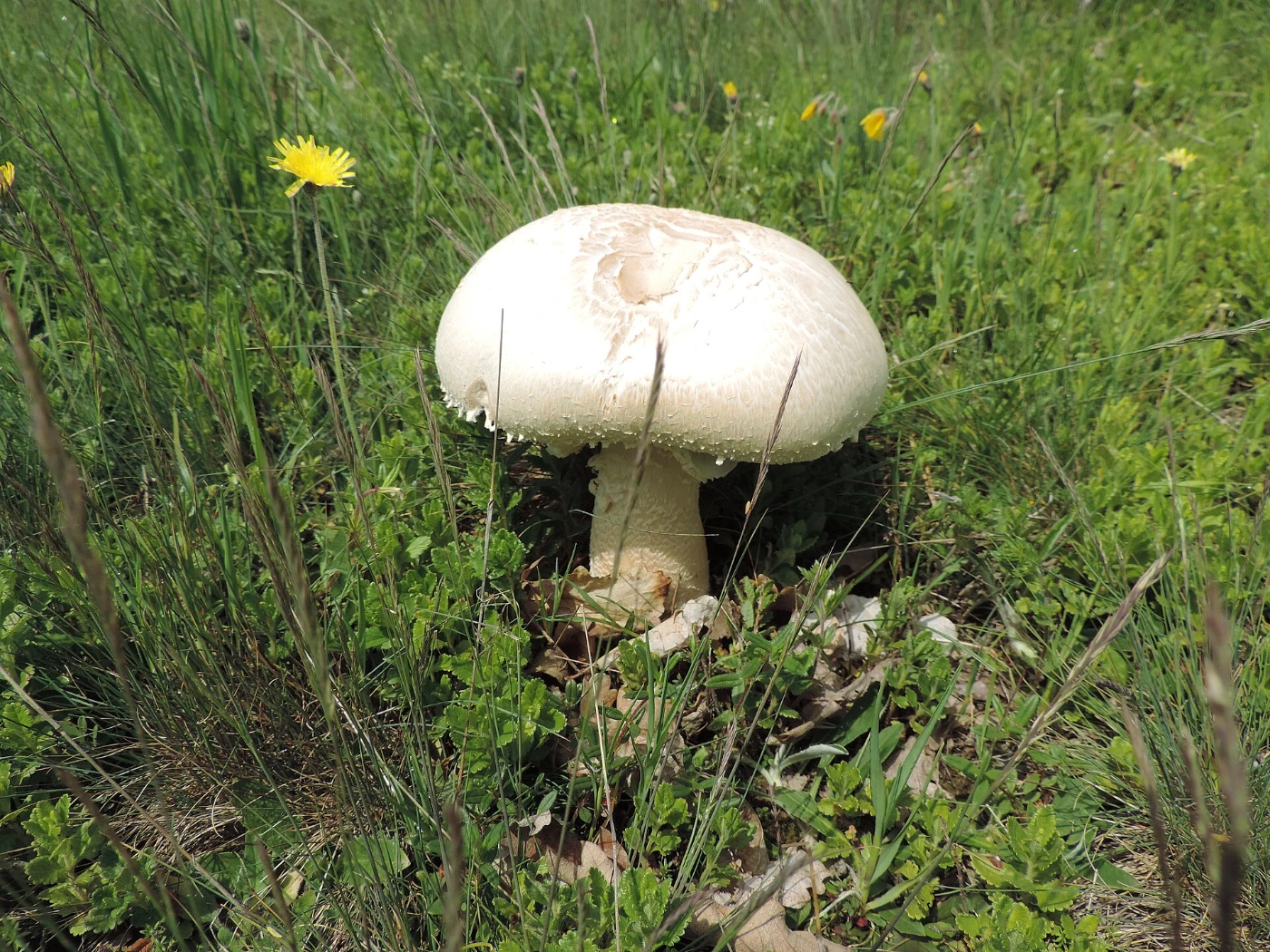
Horse Mushroom is a robust species that can become considerably larger than the average Field Mushroom. The cap is initially rounded and white, then expands into a broad convex or nearly flat shape.
Older specimens often develop cream, yellowish, or slightly ochre tones. The gills undergo the classic Agaricus color progression from pale pink to dark brown as the spores mature.
Cap
Young caps are white to ivory and usually smooth. With age, the surface may become cream-colored, yellowish, or slightly cracked in dry weather.
The cap is often thick and fleshy. Mature fruit bodies can become very broad and heavy compared with many smaller grassland Agaricus.
Cap Color
Fresh specimens are usually white or pale cream. Slight yellowing can occur naturally with age or handling.
This color change should not be confused with the rapid bright chrome-yellow reaction of the toxic Yellow Stainer group. Speed and intensity of staining are important.
Gills
The gills are free from the stem. Young gills are pale pink, gray-pink, or flesh-colored and become progressively darker as the mushroom matures.
Mature gills are chocolate-brown to very dark brown. This change is one of the strongest characters separating Agaricus from white Amanita species, whose gills remain white.
Stem
The stem is white, solid when young, and usually thick in proportion to the cap. It may become somewhat hollow or softer with age.
The base is usually not enclosed in any sac-like structure. The absence of a volva is an important safety feature when distinguishing Horse Mushroom from Amanita.
Ring
The ring is one of the best field characters. It is usually large, persistent, and well developed.
The underside can show a distinctive cogwheel or gear-like pattern. This complex double-ring structure helps separate Agaricus arvensis from some simpler grassland Agaricus.
Flesh
The flesh is white and thick. It may slowly develop pale yellowish tones after cutting or bruising, especially near the surface.
The staining is usually much less dramatic than in Agaricus xanthodermus. A rapid vivid yellow reaction at the stem base should raise suspicion for a different species.
Smell
A fresh Horse Mushroom often smells sweet and pleasant, with an odor compared to anise, almonds, or marzipan. This is one of its most useful distinguishing features.
The odor is often easiest to detect by smelling the cap or freshly cut stem. Old or dry mushrooms may have a much weaker aroma.
Spore Print
The spore print is dark brown, usually chocolate-brown. This matches the darkening of the mature gills.
A brown spore print supports Agaricus and helps separate the mushroom from white-spored Amanita and Leucoagaricus.
Where Does Agaricus arvensis Grow?
Horse Mushroom is primarily a grassland species. It often appears in nutrient-rich open areas such as meadows, pastures, parks, lawns, roadside verges, and field margins.
The species is saprotrophic and feeds on organic matter in the soil. It does not require a living tree partner.
Pastures and Meadows
Pastures are classic habitat for Horse Mushroom. Large fruit bodies may appear singly, in loose groups, or in arcs after periods of rain.
Rich soil and old grazing land can support repeated fruiting. The species may return to the same areas over several seasons.
Parks and Lawns
Horse Mushrooms can also occur in large managed lawns and parks. Their size makes them especially noticeable once the caps expand.
Urban habitat does not make a mushroom safe to eat. Pollution, pesticides, and species confusion still need to be considered.
Roadside Verges
Roadside grass can support Horse Mushroom because of compacted, nutrient-rich soil. However, roadside specimens may accumulate contaminants from traffic and should not automatically be considered suitable for consumption.
For identification purposes, the habitat is still useful. Open grassland rather than woodland strongly supports A. arvensis over some similar species.
Season
Horse Mushroom usually fruits from summer into autumn. Warm wet periods often trigger the largest flushes.
In mild climates it may continue later in the season. Timing varies with rainfall, temperature, and latitude.
Distribution
Agaricus arvensis is widely reported across Europe and other temperate regions. It is also known from North America, although regional Agaricus taxonomy can be complex.
As with many widespread mushroom names, some collections may require microscopic confirmation. Field identification is strongest when several classic features occur together.
Is Agaricus arvensis Edible?
Horse Mushroom is generally considered edible when correctly identified and properly cooked. It has a long history of culinary use in several regions.
However, edible status should never be inferred from cap color or habitat alone. Confusion with toxic yellow-staining Agaricus is the main practical concern.
Why Odor Matters So Much
The sweet anise or almond-like smell is one of the best clues. Toxic yellow-staining Agaricus often have a harsher phenolic or chemical odor instead.
Smell should be checked together with bruising reaction. A pleasant odor plus mild or slow yellowing fits Horse Mushroom much better than rapid yellow staining plus disinfectant-like smell.
Look-Alikes
Several pale Agaricus can resemble Horse Mushroom. Exact separation depends heavily on odor, staining, ring structure, and habitat.
Agaricus xanthodermus — Yellow Stainer
Identification
Yellow Stainer is a toxic Agaricus that can look almost identical from above. It often has a white cap and grows in lawns, parks, gardens, and disturbed ground.
When the stem base is cut or bruised, it usually turns bright chrome-yellow very quickly. The mushroom often has a phenolic, ink-like, medicinal, or disinfectant odor.
Main Difference
Pleasant anise smell + slow mild yellowing favor Horse Mushroom. Rapid bright yellow staining + chemical smell favor Yellow Stainer.
Agaricus campestris — Field Mushroom
Identification
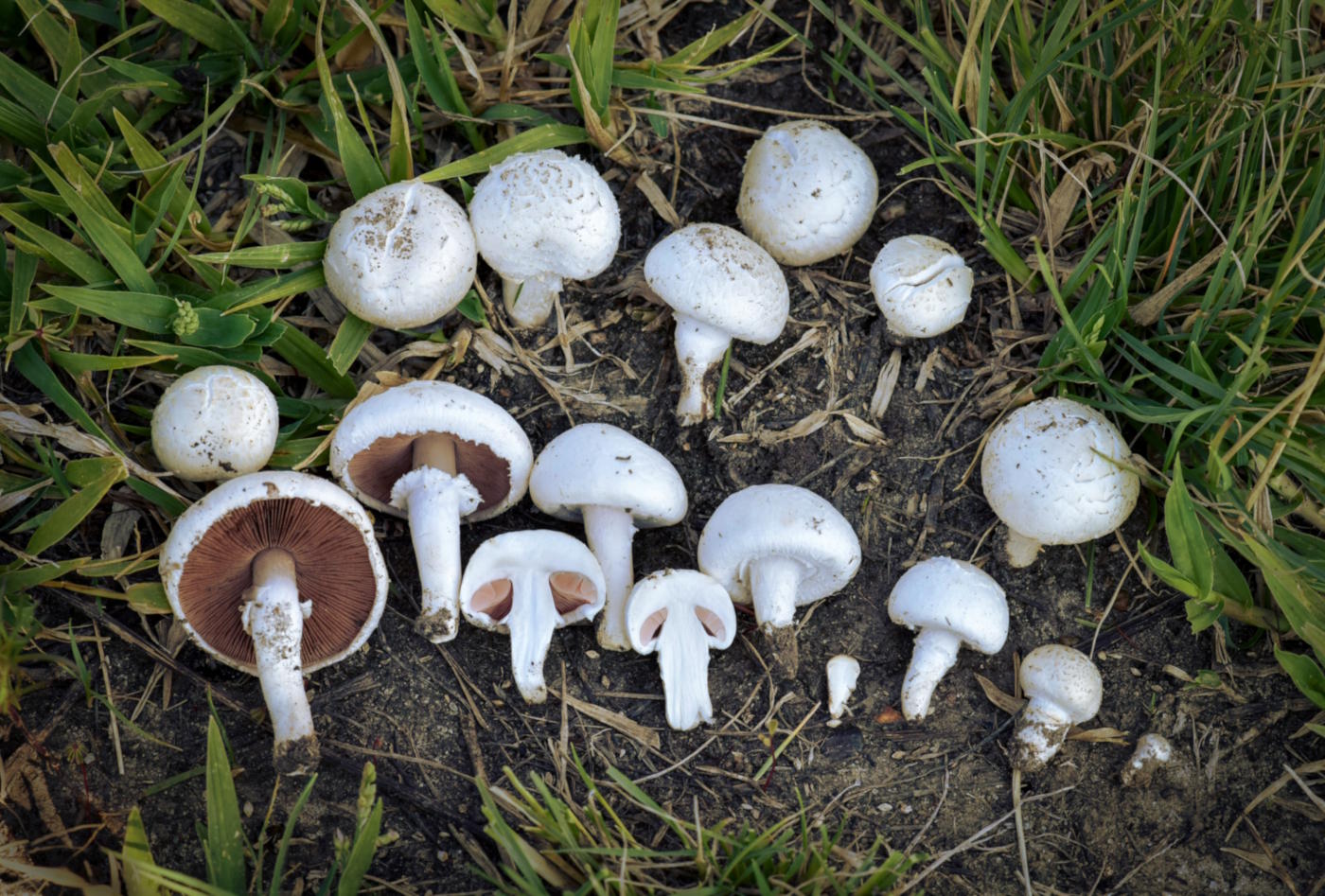
Field Mushroom is usually smaller and less robust than Horse Mushroom. Its ring is generally thinner and simpler.
The odor is mild rather than strongly anise-like. It also usually shows less yellow staining.
Main Difference
A large size, strong sweet odor, and substantial double ring favor Agaricus arvensis. A smaller mushroom with simpler ring and mild odor fits Agaricus campestris better.
Agaricus sylvicola — Wood Mushroom
Identification
Wood Mushroom can be extremely similar in color, smell, and bruising reaction. It is also pale, often smells of anise, and may show yellowing.
The main practical difference is habitat. Agaricus sylvicola is primarily a woodland species, while Agaricus arvensis is typically found in open grassland.
Main Difference
Grassland favors Horse Mushroom; woodland favors Wood Mushroom.
Agaricus augustus — The Prince
Identification
The Prince is another large Agaricus with a strong almond-like odor. It differs by having a cap covered with conspicuous brown scales.
It is commonly associated with woodland edges, parks, and areas near trees. The patterned cap makes mature specimens relatively distinctive.
Main Difference
A strongly brown-scaled cap points toward Agaricus augustus. Horse Mushroom usually has a much smoother pale cap.
White Amanita Species
Identification
White Amanita species can have white caps, free gills, and a stem ring. Deadly destroying angels are the most important safety comparison.
Their gills remain white at maturity, their spores are white, and many have a sac-like volva around the stem base.
Main Difference
Pink-to-brown mature gills + brown spores + no volva favor Agaricus. White mature gills + white spores + volva strongly favor Amanita.
Horse Mushroom vs Yellow Stainer
| Feature | Agaricus arvensis | Agaricus xanthodermus |
|---|---|---|
| Cap | White to cream | White to pale |
| Young gills | Pinkish | Pinkish |
| Mature gills | Chocolate-brown | Chocolate-brown |
| Yellowing | Mild or slower | Rapid, vivid yellow |
| Strongest yellowing | Surface, mild | Stem base |
| Odor | Anise / almond | Phenolic / chemical |
| Ring | Large, complex | Present |
| Edibility | Edible when correctly identified | Toxic |
| Best clue | Sweet smell | Yellow base + chemical smell |
This is the most important Agaricus comparison for Horse Mushroom. The odor and reaction at the stem base should always be checked.
Horse Mushroom vs Field Mushroom
| Feature | Agaricus arvensis | Agaricus campestris |
|---|---|---|
| Typical size | Large | Small to medium |
| Cap | White to cream | White to cream |
| Odor | Sweet, anise-like | Mild |
| Ring | Large, often double | Thin, simpler |
| Yellowing | Sometimes | Usually little |
| Habitat | Grassland | Grassland |
| Best clue | Strong ring + sweet odor | Smaller + simple ring |
The two can occur in similar habitats. Ring structure and odor are usually more useful than cap color.
Horse Mushroom vs Wood Mushroom
| Feature | Agaricus arvensis | Agaricus sylvicola |
|---|---|---|
| Cap | White to cream | White to cream |
| Odor | Anise / almond | Anise / almond |
| Yellowing | Mild | Often clearer |
| Habitat | Meadows, lawns, pastures | Woodland |
| Ring | Large | Large |
| Best clue | Open grassland | Forest habitat |
These species can be difficult to separate from appearance alone. Ecology is often one of the strongest practical clues.
How to Identify Agaricus arvensis
Start with the habitat. A large pale Agaricus growing in open grassland, pasture, or park is a good candidate.
Then check the gills. They should mature from pale pink to chocolate-brown and remain free from the stem.
Next inspect the ring and smell the mushroom. A large persistent ring with a cogwheel-like underside and a sweet anise odor strongly supports Agaricus arvensis.
Finally, cut or bruise the stem base. Mild yellowing is acceptable, but rapid bright yellow staining combined with a chemical odor points away from Horse Mushroom.
Young vs Mature Horse Mushrooms
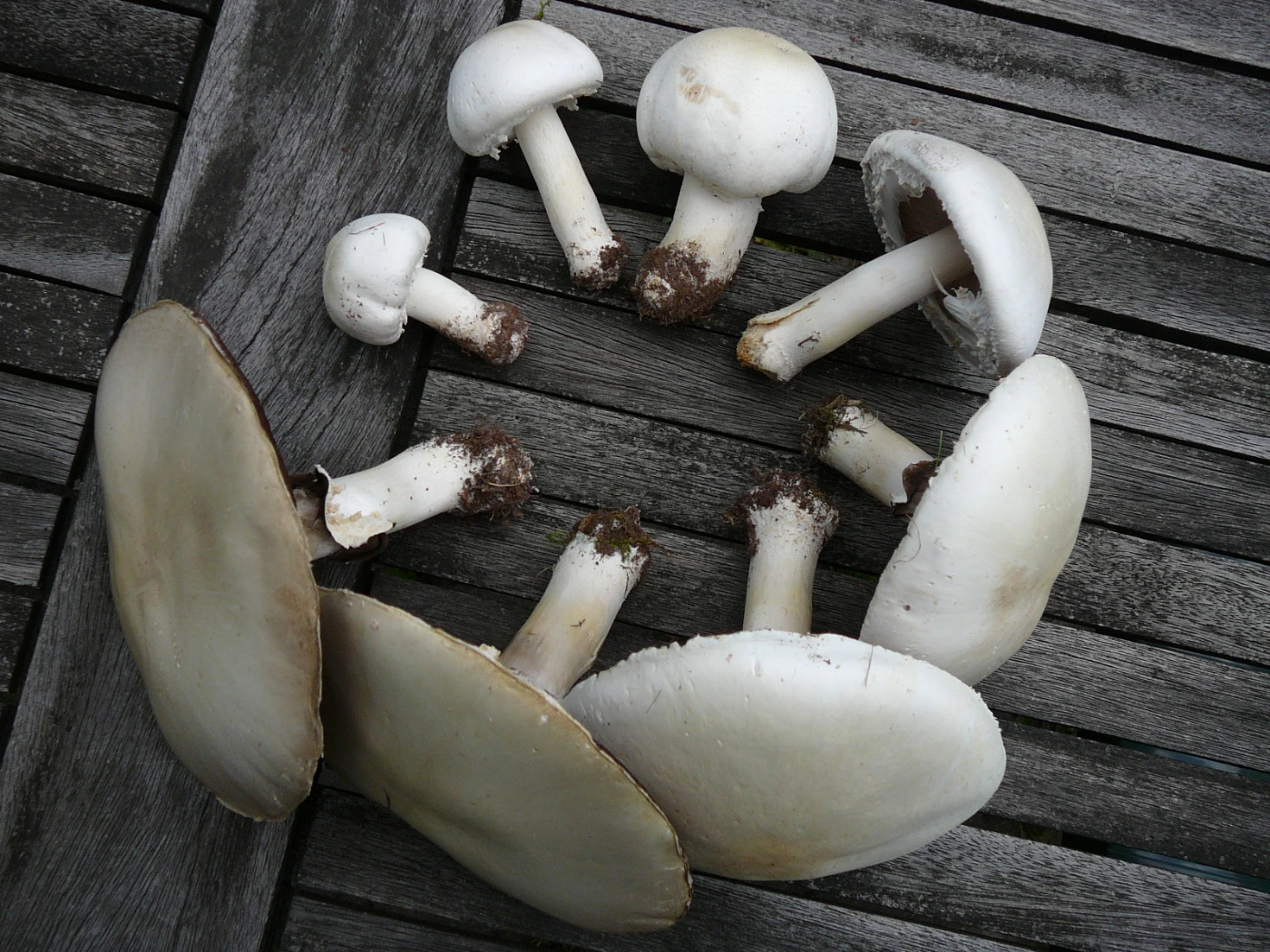
Young specimens have rounded white caps and concealed or only partly visible gills. At this stage, they can be harder to distinguish from other white mushrooms.
Mature specimens provide much more information. Pink-to-brown gill development, ring structure, odor, and bruising reactions become easier to assess.
How Weather Changes the Appearance
Rain can make the cap look smoother and slightly glossy. Dry weather can produce cracking, discoloration, or a more cream-toned surface.
Yellowing reactions may also be weaker in old or dry mushrooms. Fresh fruit bodies provide the clearest identification features.
Common Identification Mistakes
One common mistake is treating any large white grassland Agaricus as Horse Mushroom. Yellow Stainer can occur in exactly the same kinds of habitats.
Another mistake is ignoring smell. In this group, a pleasant anise odor versus a phenolic chemical odor is genuinely useful.
A third mistake is looking only at the cap. The stem base, ring, and gills contain much stronger identification information.
How to Photograph Agaricus arvensis
Take a wide photograph showing the grassland habitat and the complete fruit body. Then carefully remove the mushroom with the stem base intact.
Photograph the gills, ring, and stem base separately. If testing bruising, take another image several minutes after cutting to document any color change.
Can AI Identify Horse Mushroom?
AI can often recognize a large pale Agaricus from its pink-to-brown gills, ring, and open grassland habitat. Exact species identification is less reliable because smell cannot be judged from a photograph.
Providing the odor description and showing any yellowing at the stem base can improve the result substantially. A single cap photo is not enough to separate Horse Mushroom from Yellow Stainer safely.
Interesting Facts
The common name Horse Mushroom is associated with the species’ frequent occurrence in pastures and nutrient-rich grassland. Historically, such habitats were often enriched by grazing animals.
The underside of the ring can have a distinctive cogwheel appearance. This small structural detail is one of the more useful field characters for the species.
The sweet anise or almond-like odor is produced by volatile aromatic compounds. Similar scents occur in several Agaricus species and form an important identification group.
Horse Mushroom also shows why yellow staining cannot be interpreted in isolation. Some edible Agaricus yellow mildly, while toxic species may produce a much faster and brighter reaction.
Frequently Asked Questions
What does Agaricus arvensis smell like?
Fresh specimens often have a sweet anise, almond, or marzipan-like odor. The smell can become weaker in old or dry mushrooms.
Does Horse Mushroom turn yellow?
It can show mild or gradual yellowing. Rapid bright yellow staining at the stem base is more suggestive of Yellow Stainer.
What color are the gills?
Young gills are pale pink or gray-pink and mature to chocolate-brown. They should not remain white in a mature specimen.
Does it have a volva?
No. A sac-like volva at the stem base strongly suggests another genus, especially Amanita.
Where does Horse Mushroom grow?
It typically grows in meadows, pastures, parks, lawns, and roadside grass. Open nutrient-rich grassland is classic habitat.
Is Agaricus arvensis edible?
Yes, it is generally considered edible when correctly identified and properly cooked. Confusion with toxic Agaricus is the main safety concern.
How do you separate it from Yellow Stainer?
Check the smell and the stem base. Horse Mushroom smells sweet and may yellow mildly, while Yellow Stainer usually turns vivid yellow quickly and smells phenolic or chemical.
How do you separate it from Amanita?
Mature Horse Mushroom has chocolate-brown gills and brown spores, with no volva. Amanita retains pale or white gills and often has a volva.
Final Identification Notes
Agaricus arvensis is best recognized by the combination of a large white to cream cap, free gills that mature from pink to chocolate-brown, a substantial persistent ring, sweet anise or almond odor, and open grassland habitat.
The most important look-alike is Agaricus xanthodermus. Rapid bright yellow staining at the stem base together with a harsh phenolic smell strongly points away from Horse Mushroom.
The practical field pattern is: large pale Agaricus + grassland + pink-to-brown gills + big double ring + sweet anise smell = strong Agaricus arvensis candidate.
Upload a photo and get possible matches in seconds.