Wild mushroom foraging can be rewarding, but appearance alone is not enough to determine whether a mushroom is safe to eat. Some prized edible species have poisonous — and occasionally deadly — look-alikes growing in the same forests and during the same seasons.
Color is especially unreliable. Accurate mushroom identification may require examining the underside of the cap, stem base, gills or pores, flesh, spore print, habitat, host trees, bruising reactions, and other features. Poison Control warns that wild mushrooms should not be eaten unless they have been reliably identified by an expert. Some serious mushroom poisonings also have delayed symptoms, which can make them particularly dangerous.
This guide compares ten well-known edible mushrooms with species that can be confused with them.
Important: This article is for educational purposes only. Never use a photograph, mobile app, AI identification, or a single visual feature as the sole basis for deciding whether a wild mushroom is edible.
Quick Mushroom Look-Alike Comparison
| Edible mushroom | Dangerous or poisonous look-alike | One important difference |
|---|---|---|
| Chanterelle | Jack-o’-lantern | Chanterelles have blunt folds; jack-o’-lanterns have true gills |
| True morel | False morel | True morels are hollow inside |
| Honey mushroom | Galerina marginata | Galerina can contain deadly amatoxins |
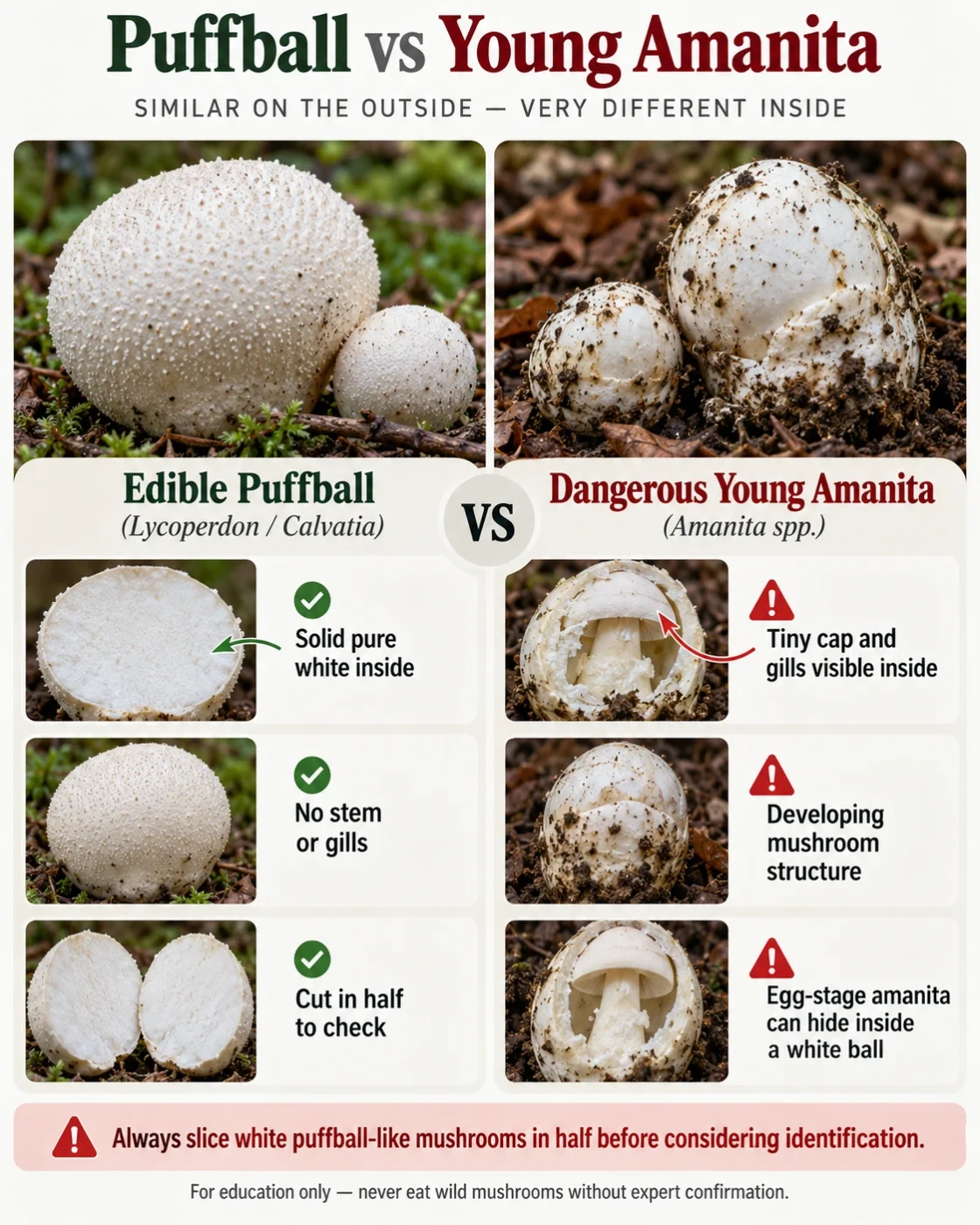
| Puffball | Young Amanita | Puffballs should be uniformly solid white inside |
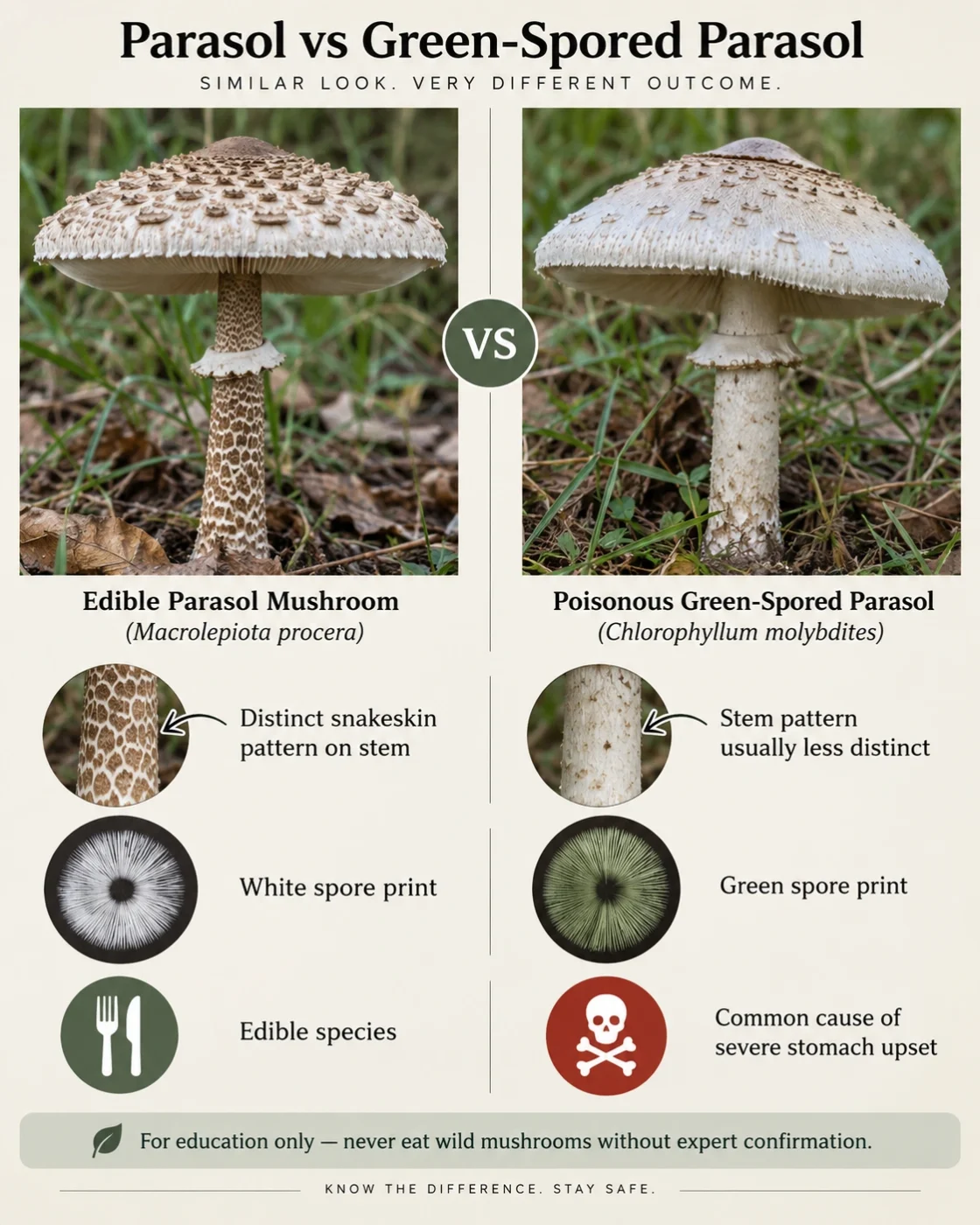
| Parasol mushroom | Green-spored parasol | Look-alike develops a greenish spore print |
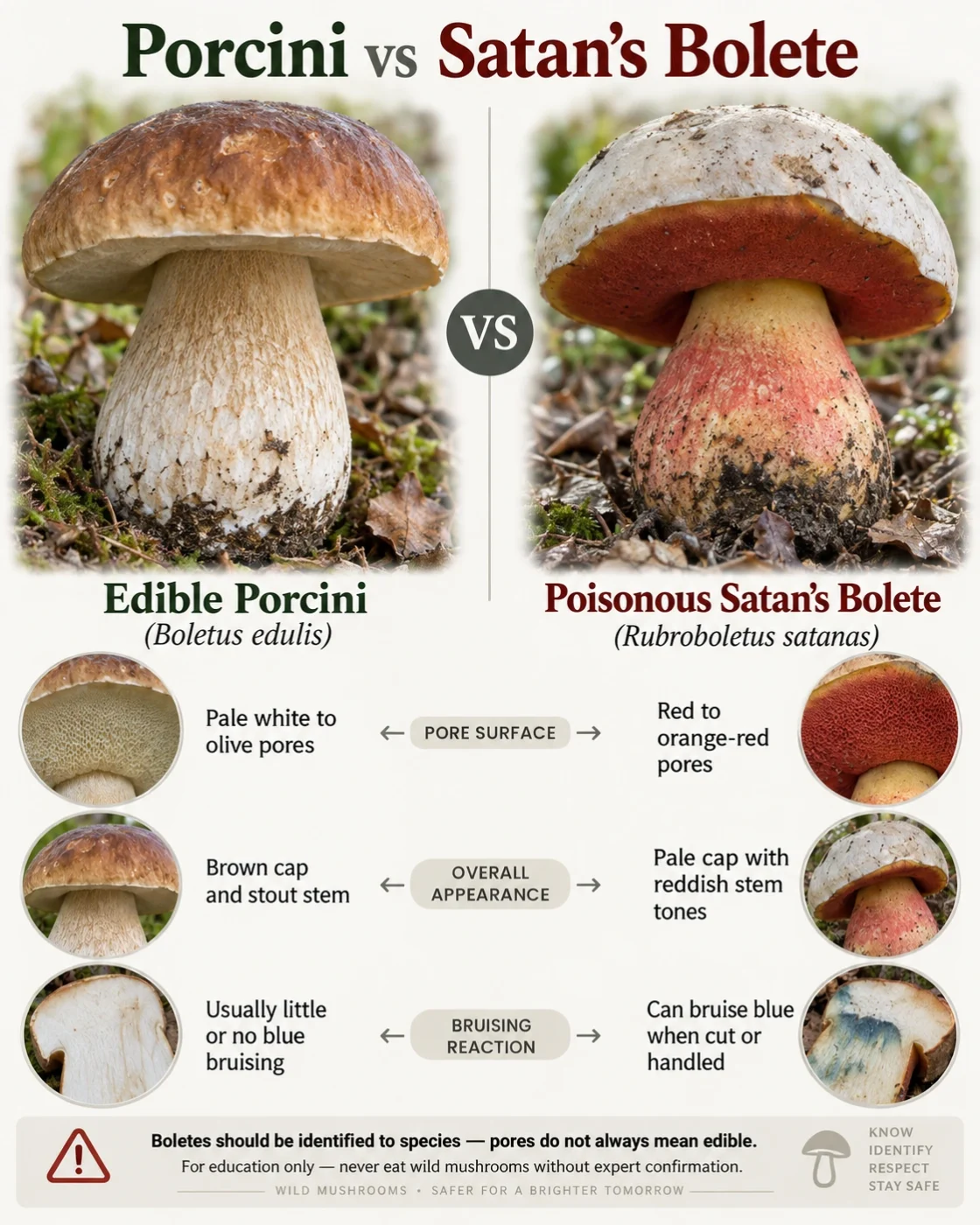
| Porcini | Satan’s bolete and related toxic boletes | Toxic boletes often show combinations of red pores and strong color changes |
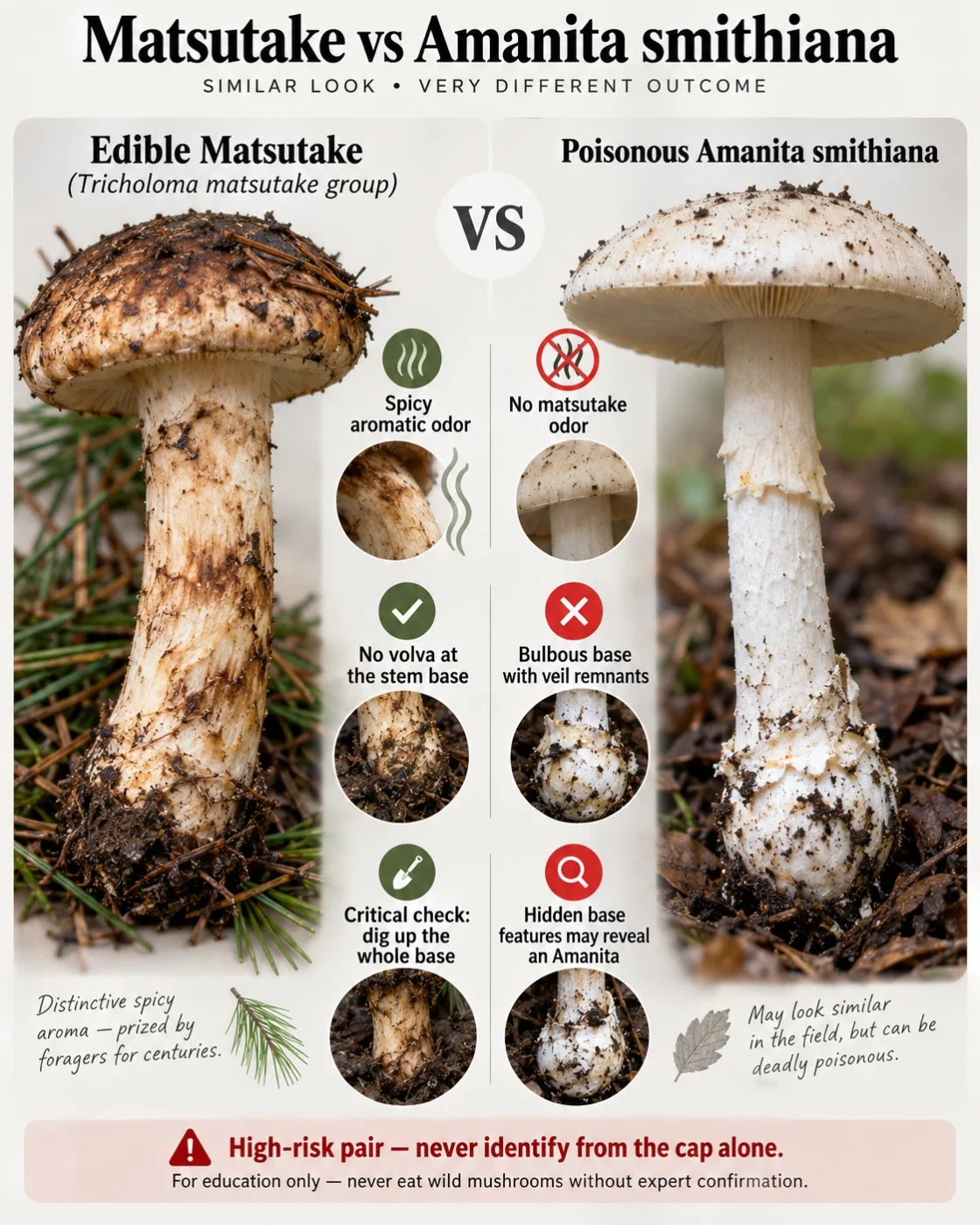
| Matsutake | Amanita smithiana | Amanita may have structures around the stem base hidden in soil |
| Field mushroom | Death cap / destroying angel | Amanitas may have a volva at the stem base |
| Caesar’s mushroom | Fly agaric and other Amanitas | Young Amanitas can look surprisingly similar |
| Saffron milk cap | Woolly milkcap | Cap texture and latex characteristics differ |
1. Chanterelle vs Jack-o’-Lantern
Edible mushroom: Cantharellus species
Poisonous look-alike: Omphalotus species
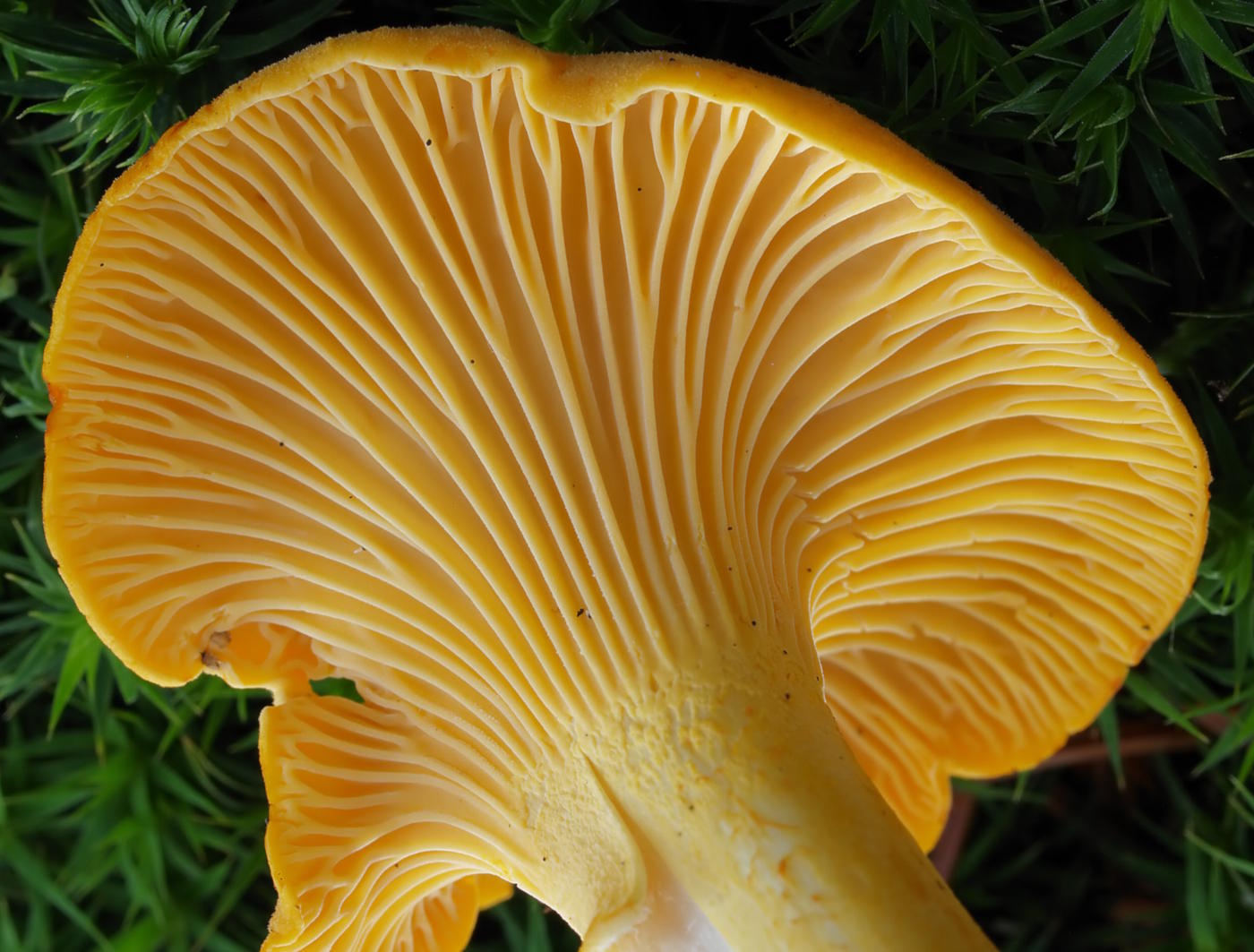
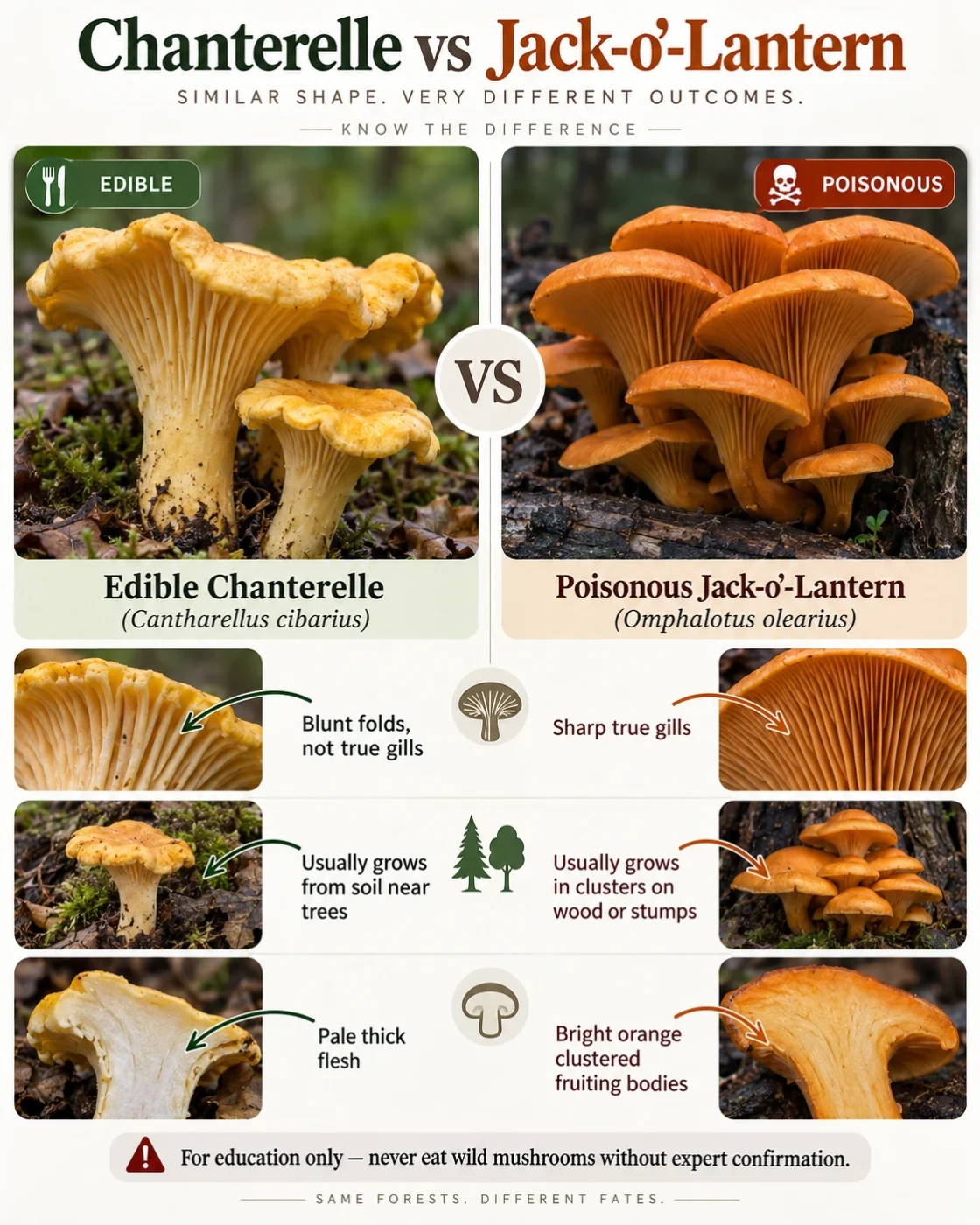
Chanterelles are among the most popular wild mushrooms. Their yellow to orange coloration and funnel-shaped caps are distinctive, but inexperienced foragers can confuse them with jack-o’-lantern mushrooms.
The underside is one of the most useful clues. Chanterelles have blunt, forked folds or ridges that run down the stem rather than thin, blade-like true gills. Jack-o’-lanterns have numerous sharp-edged true gills.
Habitat also provides an important clue. Chanterelles usually emerge from soil in association with trees, while jack-o’-lanterns grow from wood, including buried roots, stumps, and decaying trees. Jack-o’-lanterns also frequently occur in dense clusters.
The Missouri Department of Conservation specifically identifies jack-o’-lantern mushrooms as poisonous chanterelle look-alikes and notes their true gills and tendency to grow in clusters from wood.
Eating jack-o’-lantern mushrooms can cause significant gastrointestinal poisoning, including nausea, vomiting, abdominal pain, and diarrhea.
Key distinction
Chanterelle: blunt ridges, usually growing from soil.
Jack-o’-lantern: sharp true gills, commonly growing in clusters from wood.
2. True Morel vs False Morel
Edible mushroom: Morchella species
Dangerous look-alike: Gyromitra species
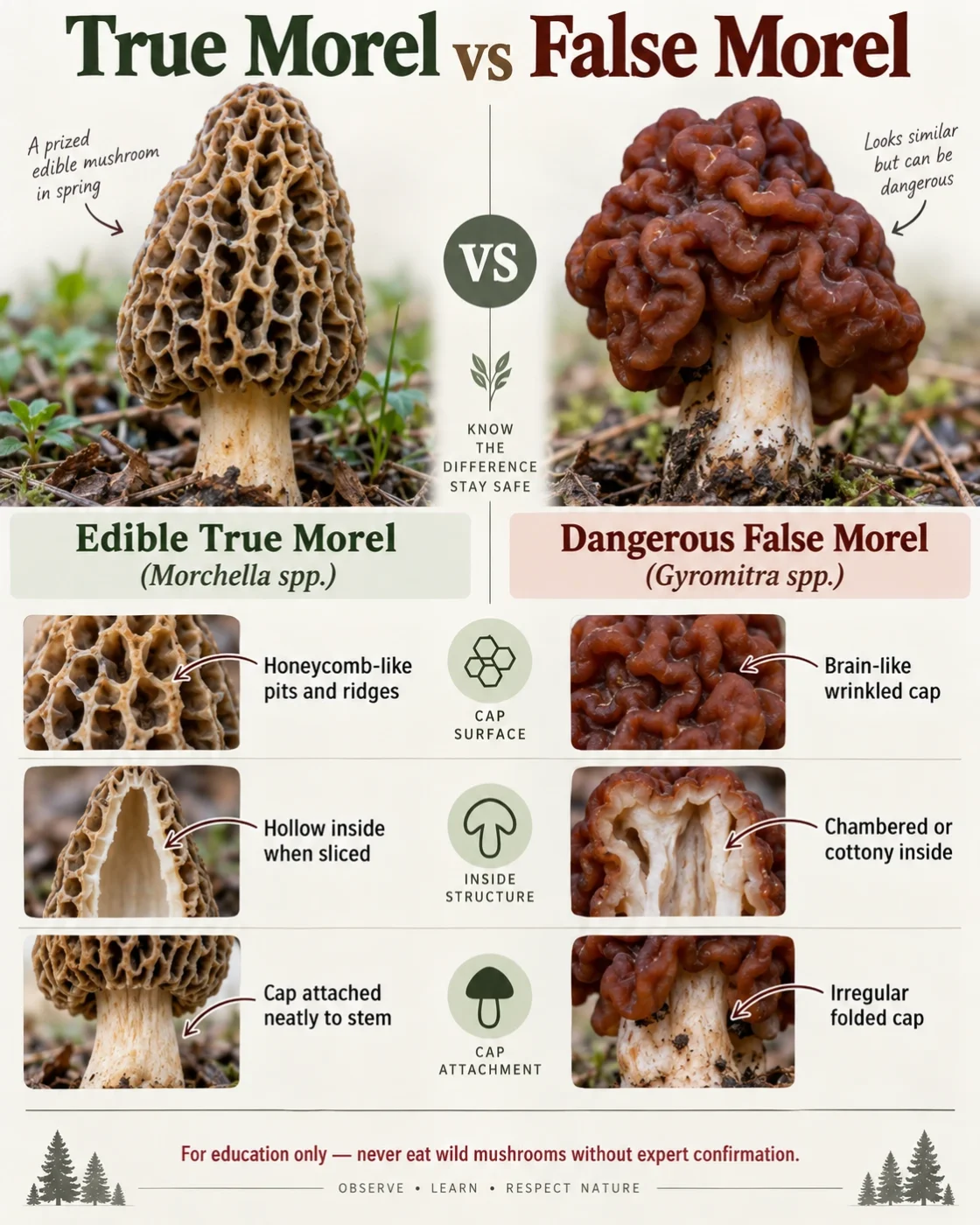
Morels are famous spring mushrooms with deeply pitted caps that resemble a honeycomb. Several so-called false morels, particularly species of Gyromitra, appear during similar seasons and can cause serious poisoning.
A true morel has a cap covered with clearly defined pits and ridges. When the mushroom is cut lengthwise from top to bottom, the interior is essentially hollow.
False morels tend to have irregular, folded, lobed, or brain-like caps rather than a regular network of pits. Their interior is often chambered rather than completely hollow.
Some Gyromitra species contain gyromitrin, which can cause severe gastrointestinal symptoms as well as liver, kidney, neurological, and blood-cell damage. Serious and fatal poisonings have occurred.
Even true morels should not be eaten raw or inadequately cooked.
Key distinction
True morel: clearly pitted cap and hollow interior.
False morel: wrinkled or brain-like cap and often chambered interior.
3. Honey Mushroom vs Galerina marginata
Edible mushroom: Armillaria species
Deadly look-alike: Galerina marginata
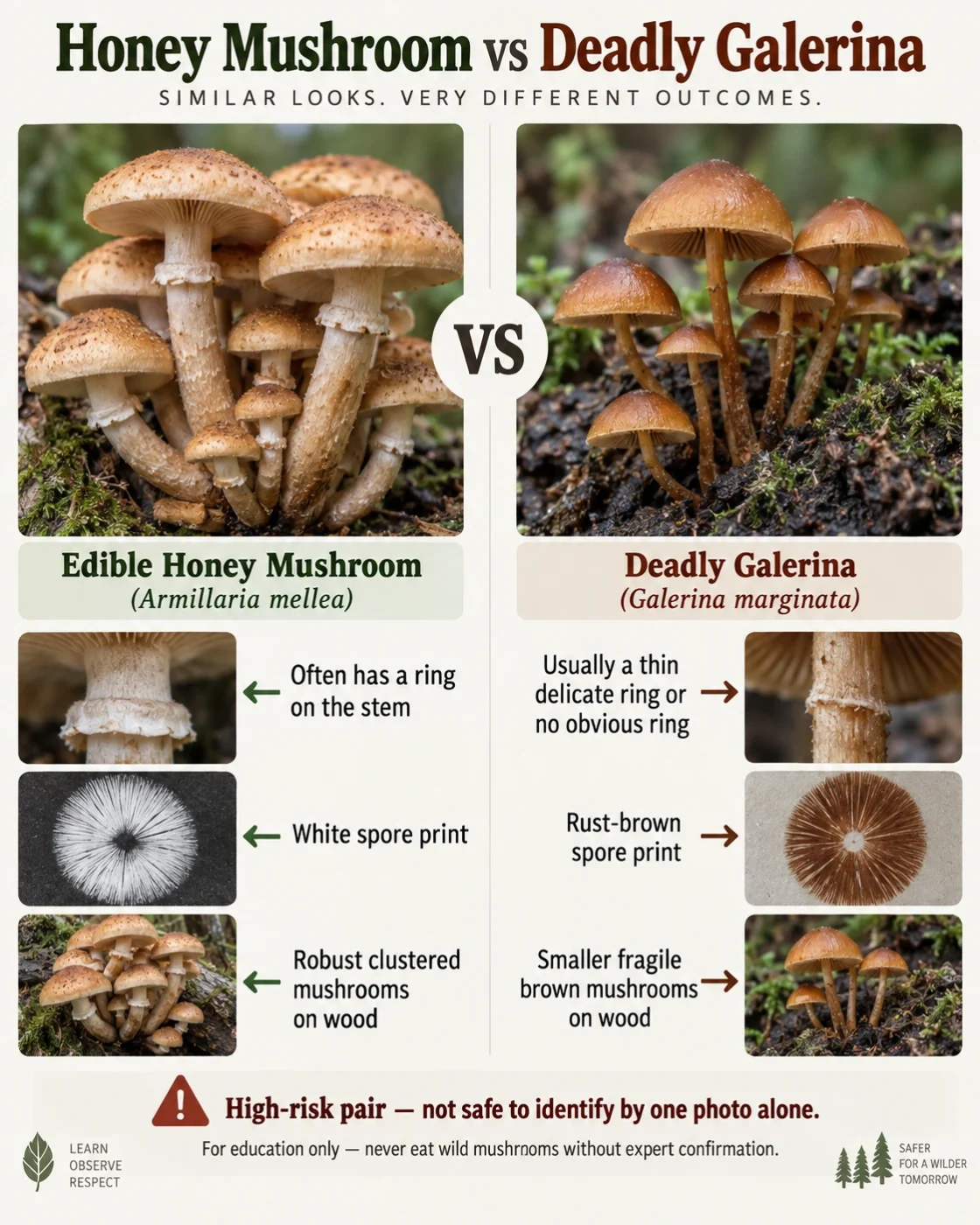
Honey mushrooms often fruit in large groups around trees, stumps, roots, and buried wood. Unfortunately, deadly Galerina marginata can occupy similar habitats.
This is one of the mushroom comparisons where relying on general cap color is particularly dangerous. Both can appear brownish or honey-colored and may occur on dead wood.
Galerina marginata is especially important because it contains amatoxins — the same class of toxins associated with deadly Amanita poisoning. NAMA includes Galerina marginata among mushrooms responsible for extremely serious amatoxin poisoning.
Identification should incorporate several characteristics, including spore-print color, cap and stem structure, growth pattern, and microscopic characters when necessary.
This is not a pair that beginners should attempt to separate using photographs alone.
Key distinction
There is no single beginner-friendly visual feature that makes this comparison safe. Any honey-colored mushroom growing on wood deserves careful identification before consumption.
4. Puffball vs Young Amanita
Edible mushroom: selected true puffballs
Dangerous look-alike: immature Amanita species
Young puffballs can appear as round white balls on the forest floor. Unfortunately, very young Amanitas can initially be enclosed in a universal veil and may also resemble a white ball.
For that reason, edible puffballs should always be cut vertically through the center before identification is considered complete.
A genuine edible puffball in suitable condition should have a uniform, solid white interior without the outline of a developing cap, gills, or stem.
A young Amanita cut open may reveal a recognizable immature mushroom structure inside — including the beginnings of the cap, gills, and stem.
This distinction is extremely important because some Amanitas contain amatoxins capable of causing fatal liver failure. NAMA identifies Amanita phalloides and several destroying-angel species among the mushrooms responsible for extremely serious amatoxin poisoning.
Key distinction
Puffball: uniformly white and homogeneous inside when young and edible.
Young Amanita: internal mushroom structures may be visible when cut open.
Never eat an unidentified white “egg-shaped” mushroom without cutting it completely through the center.
5. Parasol Mushroom vs Green-Spored Parasol
Edible mushroom: Macrolepiota procera
Poisonous look-alike: Chlorophyllum molybdites
The parasol mushroom is a large, elegant mushroom with a tall stem and broad, scaly cap. Several other large lawn mushrooms can look surprisingly similar.
One important poisonous look-alike is Chlorophyllum molybdites, commonly known as the green-spored parasol or false parasol.
Young specimens can have pale gills, making quick visual identification unreliable. As the spores mature, however, the gills of C. molybdites can develop a gray-green to greenish appearance, and its spore print is characteristically green.
The species is a well-known cause of mushroom poisoning and can produce severe vomiting, diarrhea, and abdominal distress. NAMA poisoning reports repeatedly include Chlorophyllum molybdites.
Key distinction
True parasol: pale spore print.
Green-spored parasol: greenish mature gills and green spore print.
Large size and a scaly cap alone are not enough for identification.
6. Porcini vs Toxic Boletes
Edible mushroom: Boletus edulis and close edible relatives
Dangerous look-alikes: toxic red-pored boletes, including species traditionally associated with the “Satan’s bolete” group
Porcini are among the world’s most sought-after edible mushrooms. Instead of gills, the underside of the cap consists of a sponge-like layer of pores.
That feature makes boletes relatively easy to recognize as a broad group — but it does not mean that every bolete is edible.
Some poisonous boletes can produce intense gastrointestinal symptoms. Potential warning characters among certain toxic species include bright red or orange pores, red coloration on the stem, and strong blue staining after the flesh is cut or bruised.
However, none of these characters should be treated as a universal rule. Some edible boletes stain blue, while coloration varies considerably with species, age, and condition.
Key distinction
Porcini: typically pale pores when young, becoming yellowish to olive with age, with a characteristic reticulated network often visible on the upper stem.
Some toxic boletes: may combine red pores, strong red stem coloration, and rapid staining.
Boletes should be identified to species rather than classified as edible simply because they have pores instead of gills.
7. Matsutake vs Amanita smithiana
Edible mushroom: matsutake group, including Tricholoma species harvested under this common name
Dangerous look-alike: Amanita smithiana
Matsutake mushrooms are highly prized, particularly in Japanese cuisine. In western North America, however, mushroom hunters have confused matsutake-like mushrooms with Amanita smithiana.
NAMA reports that Amanita smithiana has caused numerous poisonings in the Pacific Northwest and notes that it may be mistaken for the locally harvested pine mushroom or matsutake. Poisoning can involve gastrointestinal symptoms and serious kidney damage.
The problem is made more difficult because important Amanita structures can remain underground. Pulling or digging out the entire stem base rather than cutting the mushroom above ground can therefore be essential for identification.
Key distinction
Never identify a matsutake-like mushroom without examining the entire stem base and considering habitat, odor, gill attachment, veil structures, and other diagnostic characteristics.
This is a particularly poor group for identification from cap photographs alone.
8. Field Mushroom vs Death Cap or Destroying Angel
Edible mushroom: Agaricus campestris and related edible Agaricus
Deadly look-alikes: dangerous white or pale Amanita species
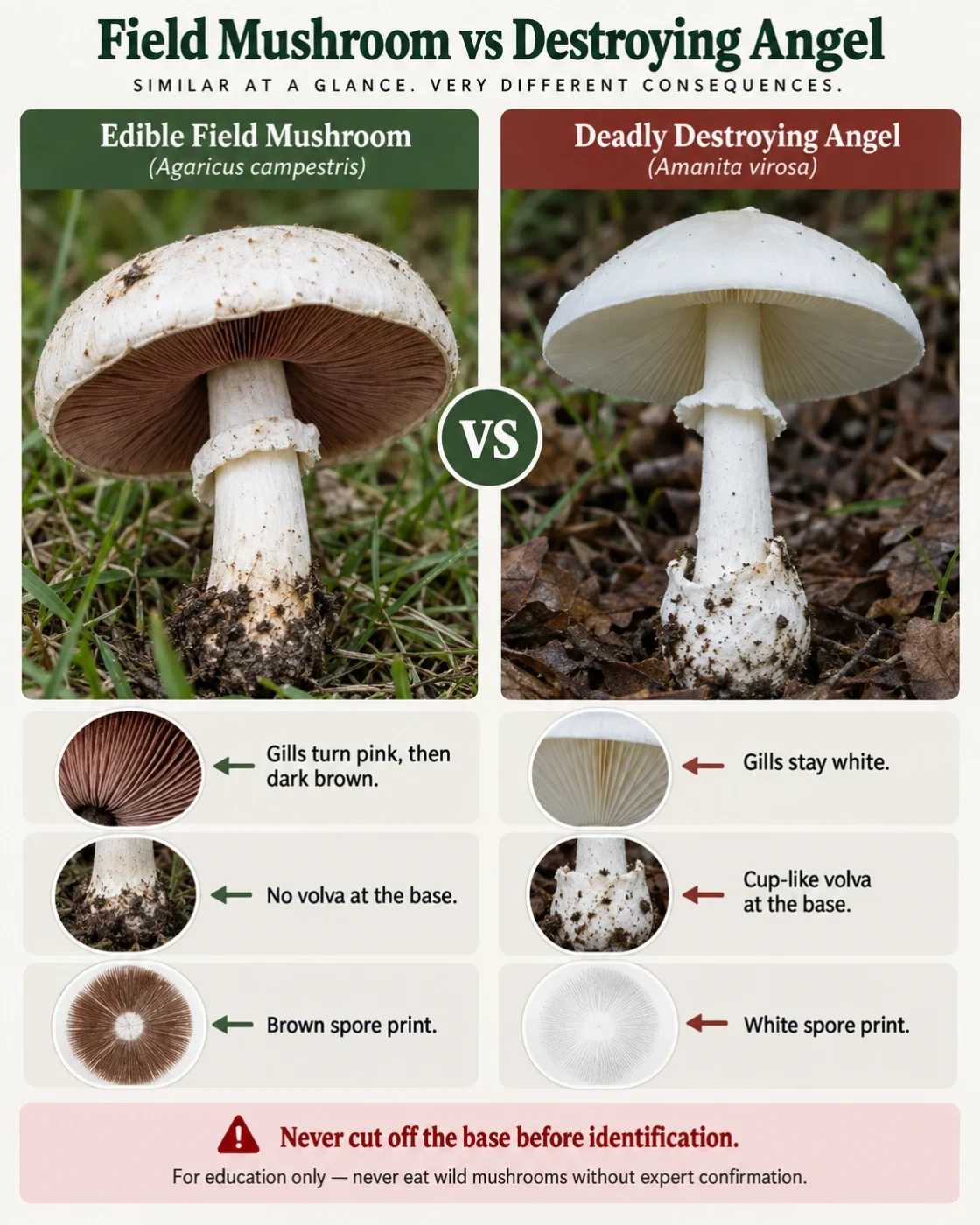
Field mushrooms are familiar white mushrooms often found in grasslands and lawns. Young specimens can superficially resemble dangerous Amanitas.
One useful distinction is gill development. Agaricus mushrooms typically have pinkish gills when young that become chocolate brown as the spores mature. Amanitas normally retain pale or white gills.
The base of the stem is even more important. Deadly Amanitas can possess a cup-like volva around the stem base, which may be hidden below the soil or leaf litter.
This is why mushroom hunters should never identify a potentially edible white mushroom after cutting the stem off at ground level.
Death caps and destroying angels can contain amatoxins capable of causing catastrophic liver damage, and symptoms may not appear until many hours after the mushroom has been eaten.
Key distinction
Agaricus: gills generally progress from pink toward dark brown.
Dangerous Amanita: typically pale gills and may have a volva at the stem base.
A white cap alone tells you almost nothing about edibility.
9. Caesar’s Mushroom vs Fly Agaric and Other Amanitas
Edible mushroom: Amanita caesarea group
Dangerous look-alikes: Amanita muscaria and other toxic Amanitas
Caesar’s mushroom has been prized as an edible species since antiquity, particularly around the Mediterranean region. But it belongs to Amanita — the same genus that contains some of the world’s most dangerous mushrooms.
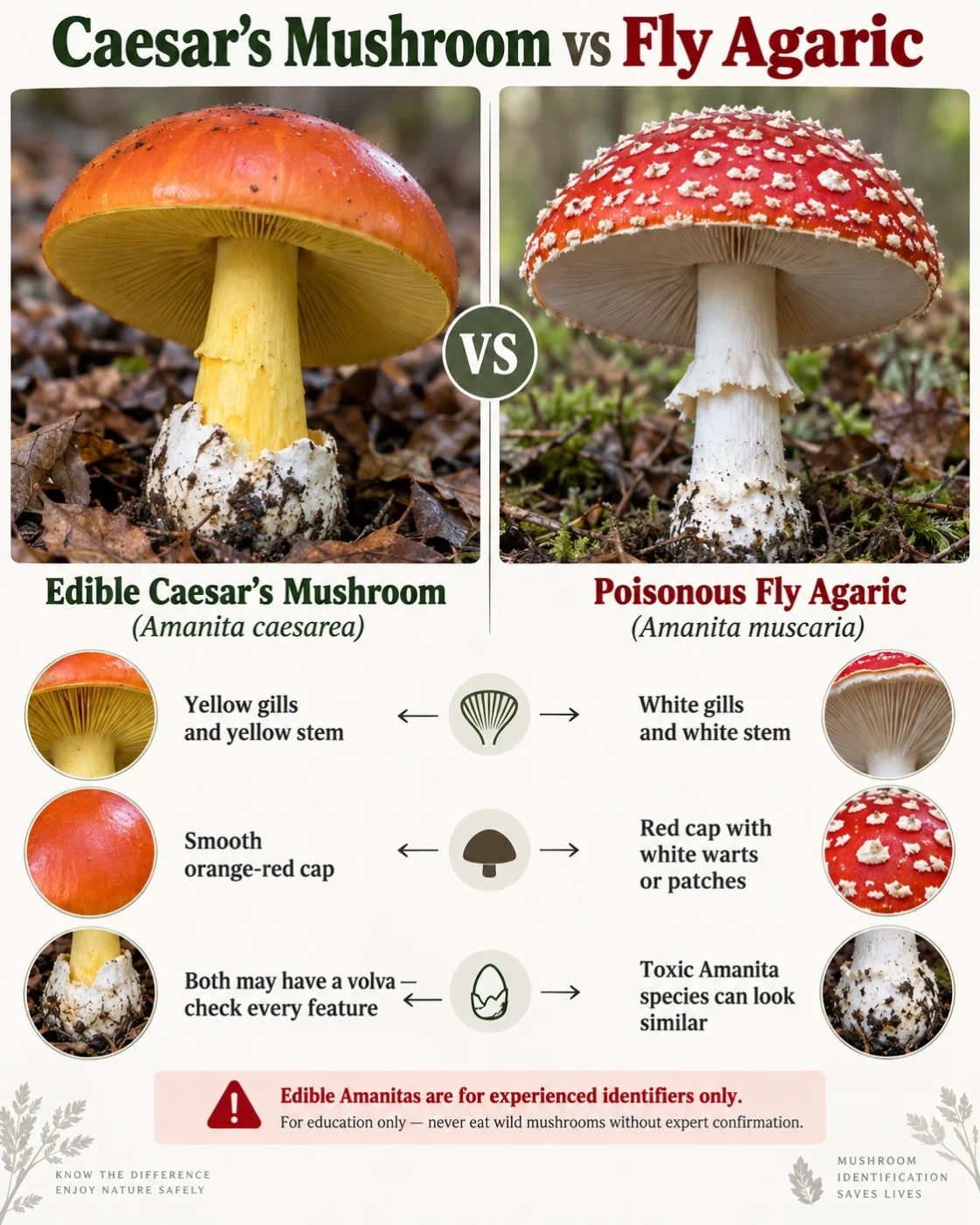
Mature Caesar’s mushrooms typically show an orange to red-orange cap, yellow gills, a yellow stem and ring, and a prominent white sac-like volva around the stem base.
Fly agarics may also have orange-red caps, particularly after rain has washed away some of their characteristic white patches. Young specimens enclosed in their veils can be especially challenging.
Amanita muscaria contains neuroactive toxins and can produce serious poisoning. More importantly, a person unfamiliar with Amanita morphology risks confusing edible species with still more dangerous members of the genus.
Key distinction
Identification requires examination of cap, gills, stem, ring, volva, and the complete stem base together.
For beginners, edible Amanitas are among the groups where a conservative approach is especially appropriate.
10. Saffron Milk Cap vs Woolly Milkcap
Edible mushroom: Lactarius deliciosus group
Toxic or inedible look-alike: Lactarius torminosus
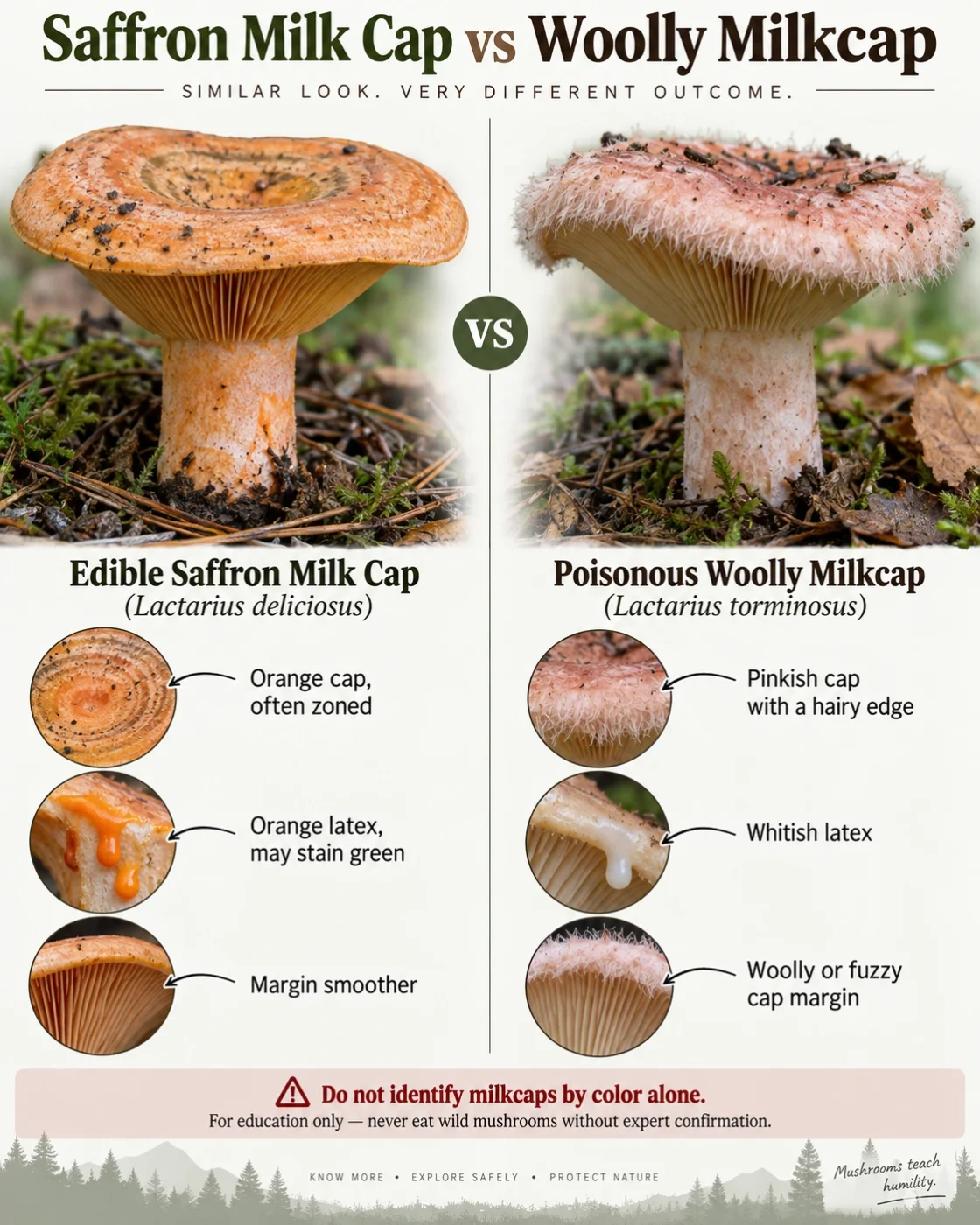
Saffron milk caps are popular edible mushrooms in many parts of Europe. They commonly occur with pine trees and release colored latex when the gills or flesh are damaged.
The woolly milkcap, Lactarius torminosus, can occur in similar northern habitats and has a superficially similar zoned cap.
The surface of L. torminosus, however, tends to have a conspicuously woolly or hairy margin when young, while the cap is typically pinkish rather than the stronger orange coloration associated with saffron milk caps. Its latex and staining behavior also differ.
Consumption of improperly identified toxic milkcaps can cause gastrointestinal illness.
Key distinction
Do not identify milkcaps by cap color alone. Examine the latex color, changes after exposure, cap margin, gills, bruising behavior, and associated tree species.
Why Mushroom Look-Alikes Are So Difficult
Mushroom identification is rarely based on a single feature.
A photograph of the cap may exclude dozens of species while still leaving several possibilities that differ dramatically in edibility. Reliable identification can require seeing the underside, intact stem base, substrate, surrounding trees, flesh after cutting, spore color, odor, and sometimes microscopic structures.
Geography matters as well. A mushroom familiar to a forager in Europe may have a different but similar-looking counterpart in North America. Poison Control specifically warns that knowledge learned in one region should not automatically be applied elsewhere.
This is also why sayings such as “poisonous mushrooms turn silver black,” “insects only eat edible mushrooms,” or “cooking removes the poison” should never be used as identification rules. Cooking does not make many poisonous species safe.
What to Photograph for Mushroom Identification
If you find an unknown mushroom, photograph it before disturbing its surroundings. A useful identification set should show the cap from above, the underside with gills, pores, teeth, or folds, the entire stem including its base, a mushroom cut lengthwise, and the surrounding habitat.
Whenever possible, record nearby trees and whether the mushroom is growing directly from soil, living wood, dead wood, buried roots, grass, or another substrate.
A single attractive top-down photograph is often not enough to distinguish an edible mushroom from a poisonous look-alike.
Can AI Identify Whether a Mushroom Is Safe to Eat?
AI and photo-based mushroom identification tools can be useful for suggesting possible species and narrowing down a large number of candidates. They are best treated as an identification aid, not as proof of edibility.
An image may fail to show critical characteristics such as a hidden volva, latex color, spore print, smell, microscopic structures, or the mushroom’s association with a particular tree.
If an identification has consequences for eating a wild mushroom, verify it independently with an experienced local mushroom expert or mycological organization.
Final Safety Rule
The most important lesson from mushroom look-alikes is simple: similar appearance does not mean similar toxicity.
A chanterelle can resemble a poisonous jack-o’-lantern. A morel can be confused with a toxic false morel. A honey mushroom can grow alongside an amatoxin-containing Galerina. A harmless-looking white mushroom can belong to the same general visual category as a deadly Amanita.
When there is uncertainty, leave the mushroom uneaten.
Use mushroom identification guides and photo-identification tools to learn which species might be present, then confirm the identification using multiple characteristics and appropriate local expertise.
References
Safety and toxicology information in this guide is based in part on resources from the North American Mycological Association, Poison Control, the Missouri Department of Conservation, and university or government mushroom-identification resources.