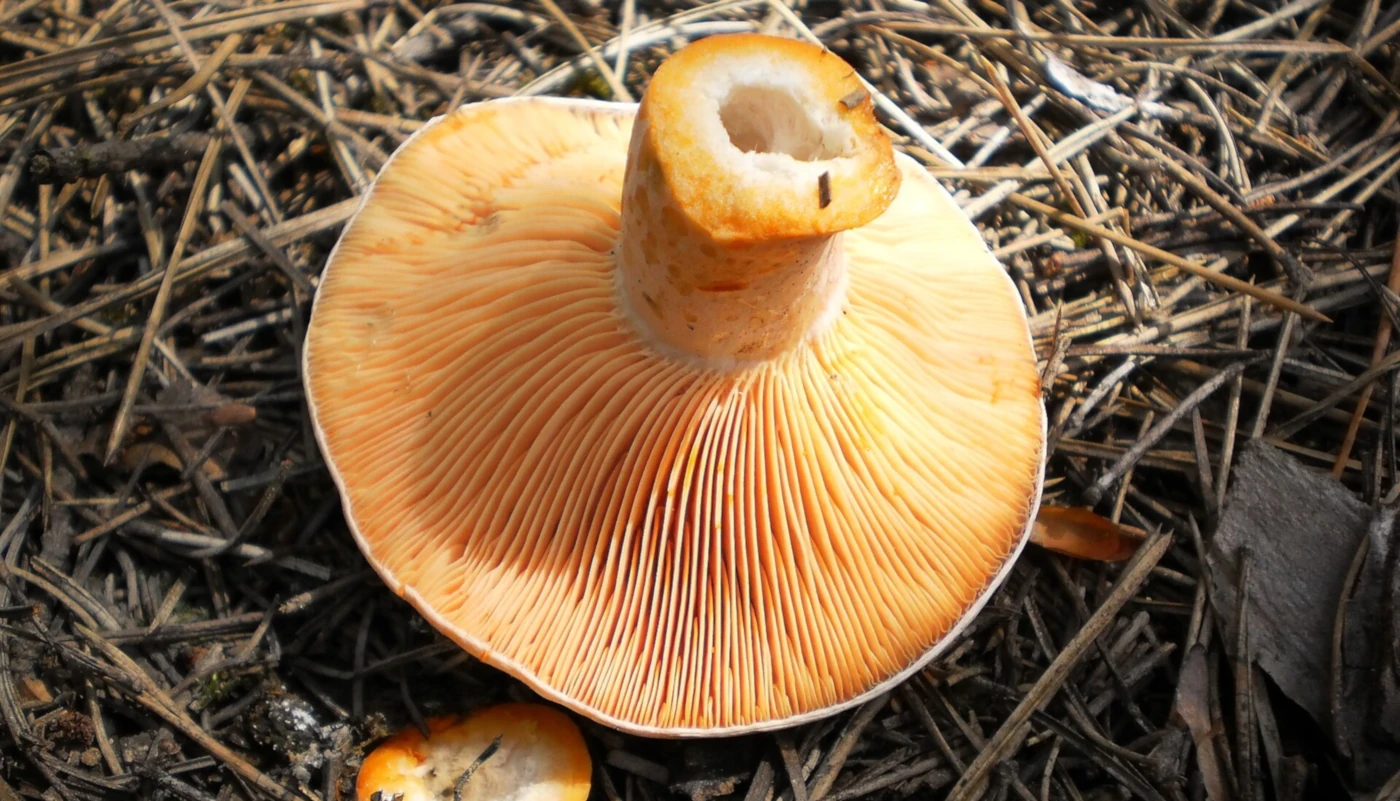
Lactarius deliciosus, commonly known as the Saffron Milk Cap, is one of the most recognizable orange woodland mushrooms. It is known for its carrot-orange cap, orange latex, concentric zones, and the greenish staining that often appears after bruising or with age.
Despite its distinctive appearance, several related milkcaps can look very similar, and exact species identification may depend on geography and host tree. The safest approach is to focus on latex color, staining, gill structure, cap pattern, and habitat rather than relying on orange coloration alone.
⚠️ Important: This guide is for identification and education only. Never eat a wild mushroom based solely on photographs, AI identification, or an online comparison.
Quick Identification
| Feature | Lactarius deliciosus |
|---|---|
| Scientific name | Lactarius deliciosus |
| Common name | Saffron Milk Cap |
| Family | Russulaceae |
| Cap color | Orange to carrot-orange |
| Cap pattern | Often concentric darker zones |
| Gills | Orange to pale orange, decurrent |
| Latex | Orange |
| Bruising | Green to blue-green staining |
| Stem | Orange, often with darker pits |
| Flesh | Firm, brittle, pale orange |
| Spore print | Cream to pale ochre |
| Ecology | Mycorrhizal |
| Main host | Pine |
| Habitat | Pine forests and plantations |
| Season | Late summer through autumn |
| Edibility | Edible when correctly identified |
| Main look-alikes | Other orange milkcaps, Woolly Milkcap, False Saffron Milk Cap |
What Does Lactarius deliciosus Look Like?
The Saffron Milk Cap is usually orange from cap to stem, with darker concentric rings visible across the cap surface. Mature mushrooms often develop a depressed or funnel-shaped center while the margin becomes increasingly irregular.
Fresh specimens can look extremely bright, while older fruit bodies often develop green patches. This green staining is one of the most characteristic features of the species group and commonly appears where the mushroom has been handled, damaged, or aged.
The whole mushroom has a firm but brittle texture typical of the Russulaceae. If the gills or flesh are damaged, orange latex appears and provides one of the most valuable identification clues.
Cap
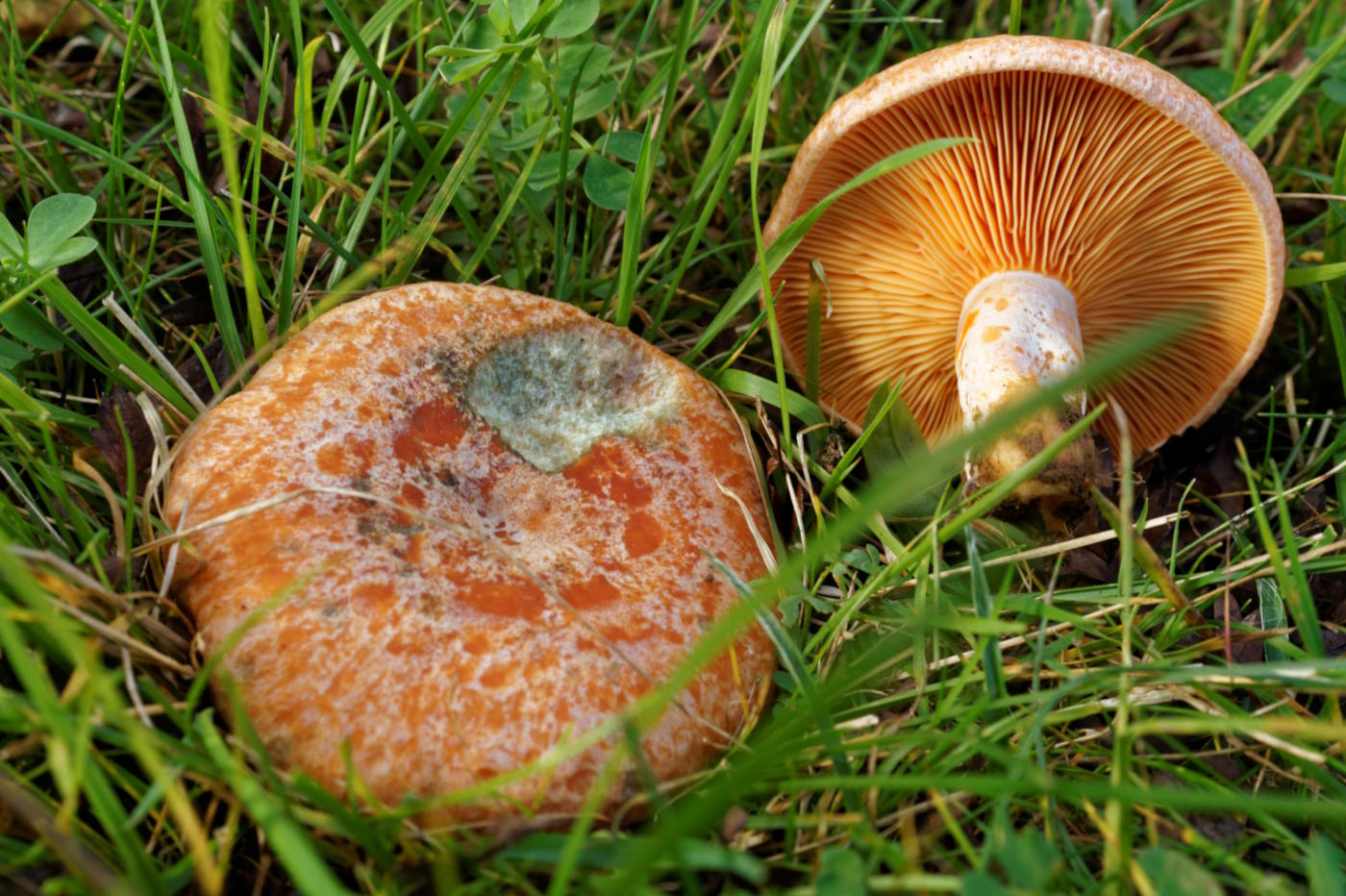
Young caps are convex with the margin rolled inward. As the mushroom matures, the center becomes depressed and may eventually form a broad shallow funnel.
Color ranges from pale orange to intense carrot-orange. Darker circular bands often create a zoned pattern radiating outward from the center.
Cap Surface
The cap is generally smooth and may become slightly sticky in wet weather. It lacks the shaggy or strongly woolly surface found in some related milkcaps.
Green staining may appear spontaneously with age or after handling. In older mushrooms, the green coloration can become extensive enough to obscure the original orange tones.
Gills
The gills are crowded and run down the stem, a pattern described as decurrent. Their color is orange to pale orange and generally matches the rest of the mushroom.
Damage to the gills releases orange latex. Green staining can then develop along the bruised areas, especially as the latex oxidizes.
Gill Structure
The gills are true blade-like structures rather than the false ridges found on chanterelles. This makes the mushroom easy to separate from golden chanterelles once the underside is examined carefully.
The gills are also relatively brittle. Pressing or scratching them can easily expose the latex response.
Latex
Latex is one of the defining characteristics of milkcaps. In Lactarius deliciosus, the liquid is orange when freshly released.
The latex may darken or contribute to greenish discoloration as the mushroom is exposed to air. This reaction, combined with the orange body and pine habitat, creates a strong identification pattern.
Why Latex Color Matters
Different milkcap species produce latex in different colors. White, watery, yellowing, orange, and other latex reactions can help separate closely related species.
For orange milkcaps, latex behavior is often more useful than cap color. Several species can share a nearly identical orange appearance but differ in how their latex changes after exposure.
Green Staining
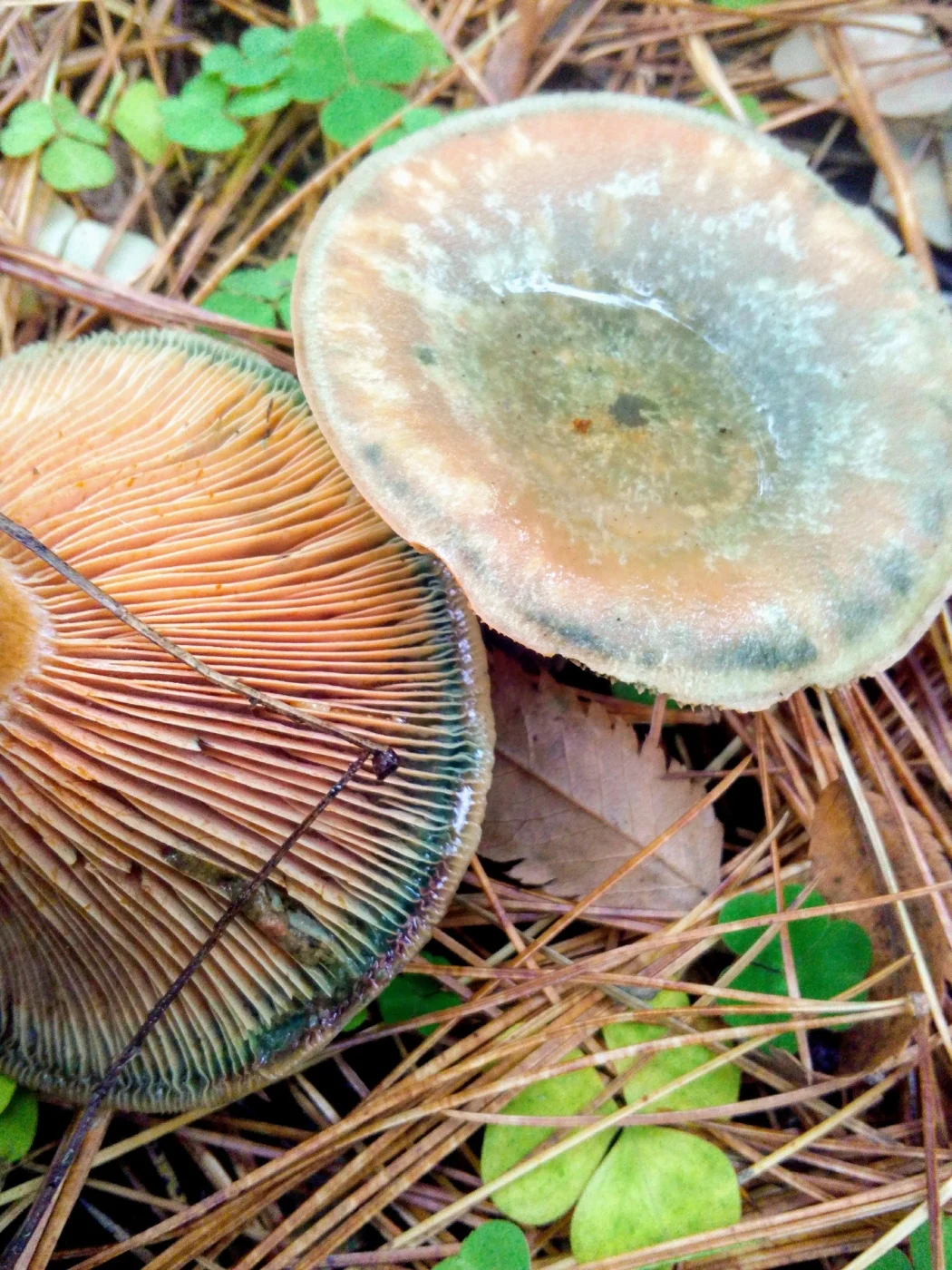
Green staining is one of the most memorable features of the Saffron Milk Cap group. It can develop on the cap, gills, stem, and damaged flesh.
The reaction may appear as small blue-green marks at first and become darker with age. Old mushrooms sometimes look heavily mottled with green despite having started out almost entirely orange.
Is Green Staining a Sign of Spoilage?
Not necessarily. Green staining is a normal chemical reaction in this mushroom group and does not automatically indicate decay.
Rotten areas usually have a different texture, smell, or discoloration. Normal green bruising remains one of the expected characteristics of correctly identified specimens.
Stem
The stem is orange to pale orange and usually fairly short and sturdy. Small darker depressions or pits may appear on the surface.
It is generally solid when young but may become more hollow or internally irregular with age. The stem lacks both a ring and a volva.
Stem Pits
Small darker orange spots or shallow pits on the stem are a useful supporting feature. They can be obvious in fresh specimens but may be less visible on weathered mushrooms.
These markings should not be confused with scales. They look more like darker dots or shallow depressions within the orange surface.
Flesh
The flesh is pale orange to cream-orange and has the brittle texture typical of milkcaps and Russulas. It breaks rather than bending when enough pressure is applied.
Freshly cut flesh may release orange latex and later develop green discoloration. The interior should not show the fibrous texture typical of many unrelated gilled mushrooms.
Smell
The smell is usually mild and mushroom-like. Some specimens may have a slightly fruity or resinous note, but aroma is not one of the strongest identification features.
Smell varies between specimens and regions. It is better used as supporting information after latex, staining, gills, and habitat have already been examined.
Spore Print
The spore print is generally cream to pale ochre. This is typical of many milkcaps and Russulas.
Spore color is useful for confirming the broader group but does not usually separate Lactarius deliciosus from close relatives. Latex and ecological association are much more practical in the field.
Where Does Saffron Milk Cap Grow?
Lactarius deliciosus forms mycorrhizal relationships with living pine roots. It therefore grows from soil rather than directly from dead wood.
Pine forests, plantations, woodland edges, and grassy areas beneath mature pines can all provide suitable habitat. The mushroom may appear surprisingly far from a visible trunk because pine roots extend well beyond the tree base.
Pine Association
Pine association is one of the most important ecological clues. True Lactarius deliciosus is closely linked with Pinus species.
Different orange milkcaps may prefer spruce, fir, or other conifers instead. Knowing the nearby host tree can therefore help distinguish species that look almost identical.
When Does Lactarius deliciosus Grow?
Late summer through autumn is the main fruiting period in temperate climates. Rainfall after warm weather often triggers large flushes.
In milder regions, fruiting can continue late into autumn or early winter. Timing varies substantially with latitude, elevation, and annual rainfall.
Distribution
Lactarius deliciosus is native to Europe and parts of Eurasia and is strongly associated with pine forests. It has also become established in other parts of the world where compatible pines have been planted.
Outside its native range, closely related orange milkcaps may also occur. Because several species are visually similar, exact species-level identification should take geography into account.
Is Lactarius deliciosus Edible?
Saffron Milk Cap is widely regarded as edible when correctly identified and properly cooked. It is collected traditionally in many European countries and is especially well known in Mediterranean cuisine.
Its texture is firmer than many soft gilled mushrooms, and the orange color often deepens during cooking. Correct identification is still essential because several similar milkcaps differ in taste and edibility.
Saffron Milk Cap Look-Alikes
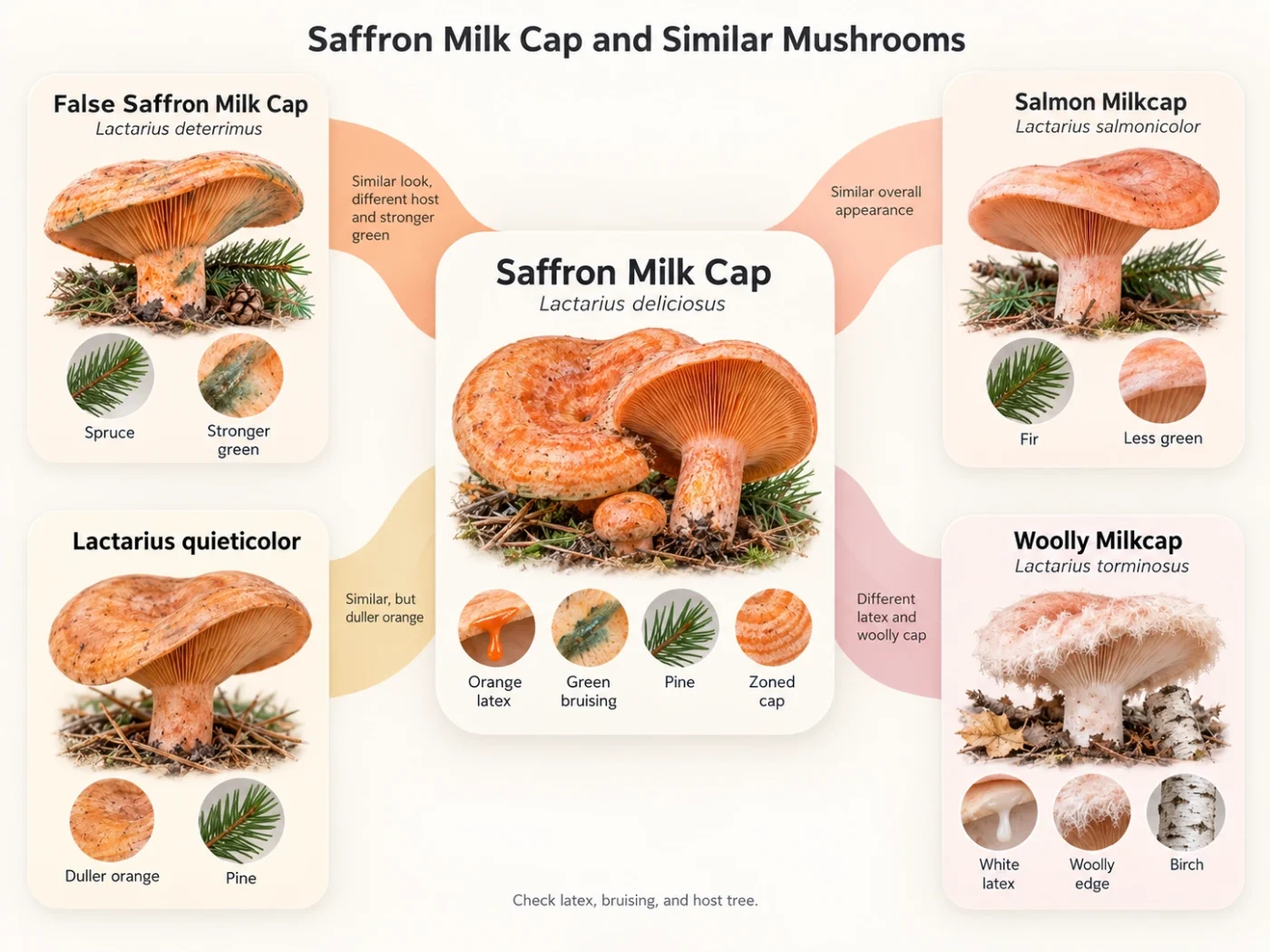
Orange milkcaps are one of the clearest examples of a mushroom group where closely related species can look nearly identical. The most useful differences involve host tree, latex color, staining reaction, cap texture, and taste.
Not every similar orange milkcap is dangerous, but exact identification matters when mushrooms are being collected for food.
Lactarius deterrimus — False Saffron Milk Cap
Identification
Lactarius deterrimus is extremely similar in color and overall structure. It has orange gills, orange latex, and often develops strong green staining.
The cap can be less strongly zoned, and green discoloration may develop rapidly. The species is especially associated with spruce rather than pine.
Main Difference
Host tree is one of the strongest practical clues. A similar orange milkcap fruiting beneath spruce is more consistent with Lactarius deterrimus than classic L. deliciosus.
Green staining can also be more extensive. Because both species overlap in appearance, ecology becomes especially important.
Lactarius salmonicolor — Salmon Milkcap
Identification
Lactarius salmonicolor is another orange milkcap with salmon-colored fruit bodies. It often appears brighter and more uniformly colored than L. deliciosus.
Green staining is usually absent or much weaker. The species is mainly associated with fir trees.
Main Difference
A fir association combined with weak or absent green staining points toward Lactarius salmonicolor. Classic L. deliciosus is more strongly linked with pine and commonly develops green bruising.
Lactarius quieticolor
Identification
Lactarius quieticolor can resemble a darker, duller version of Saffron Milk Cap. Caps may be gray-orange, brownish orange, or muted carrot-colored rather than vividly orange.
The mushroom also produces orange latex and can develop green staining. Pine association creates considerable ecological overlap with L. deliciosus.
Main Difference
Overall color tends to be duller and more gray-brown. Close relatives in this group can be difficult to separate confidently without detailed regional knowledge.
Lactarius torminosus — Woolly Milkcap
Identification
Woolly Milkcap has a pink to salmon cap with conspicuous woolly or hairy margins. It often displays concentric zones similar to those of Saffron Milk Cap.
The latex is white rather than orange. The species is commonly associated with birch.
Main Difference
The hairy cap margin and white latex immediately separate it from Lactarius deliciosus. Habitat also differs because Woolly Milkcap is strongly linked with birch rather than pine.
Lactarius deliciosus vs Lactarius deterrimus
| Feature | Lactarius deliciosus | Lactarius deterrimus |
|---|---|---|
| Cap | Orange, often clearly zoned | Orange, often less strongly zoned |
| Latex | Orange | Orange |
| Green staining | Common | Often strong |
| Main host | Pine | Spruce |
| Stem | Often orange with pits | Often more uniformly orange |
| Edibility | Edible when correctly identified | Generally considered edible but lower quality |
The host tree is often the simplest useful distinction in the field. Appearance alone may not be sufficient because individual mushrooms can overlap greatly.
Lactarius deliciosus vs Woolly Milkcap
| Feature | Saffron Milk Cap | Woolly Milkcap |
|---|---|---|
| Cap color | Orange | Pink to salmon |
| Margin | Smooth to slightly rolled | Strongly woolly |
| Latex | Orange | White |
| Bruising | Greenish | Not characteristic green bruising |
| Main host | Pine | Birch |
| Safety | Edible when correctly identified | Not generally treated as a choice edible |
This comparison is easier than separating closely related orange milkcaps. Latex color and cap texture usually provide an immediate distinction.
Saffron Milk Cap vs Chanterelle
These mushrooms can both appear orange or golden and share similar woodland habitats, but their undersides are completely different. Saffron Milk Cap has true blade-like gills, while chanterelles have blunt false gills or ridges.
Damaging the gills provides another obvious difference because Saffron Milk Cap releases orange latex. Chanterelles do not produce milk.
| Feature | Saffron Milk Cap | Chanterelle |
|---|---|---|
| Underside | True gills | False gills |
| Latex | Orange | None |
| Green staining | Common | Not typical |
| Flesh | Brittle | Firm and fibrous |
| Main ecology | Mycorrhizal, especially pine | Mycorrhizal with various trees |
| Cap | Orange, often zoned | Yellow to orange, usually not concentrically zoned |
From above, a distant specimen may create confusion. Once the underside is visible, the distinction becomes straightforward.
How to Identify Saffron Milk Cap Step by Step
Begin by confirming that the mushroom has true orange gills. Scratch or cut the gills and look for orange latex.
Next, check for green bruising and examine the cap for darker concentric zones. Then look at the stem for orange coloration and small darker pits.
Finally, identify the nearby trees. A convincing orange milkcap beneath pine strongly supports the Lactarius deliciosus group.
Step 1: Check for Milk
Damage one gill gently and observe whether liquid appears. Fresh Saffron Milk Caps should release orange latex.
Very dry or old mushrooms may produce less visible liquid. A fresh specimen is therefore preferable when using latex as an identification feature.
Step 2: Watch for Green Staining
Check places where the mushroom has been handled or damaged. Green or blue-green patches may become visible on the cap, gills, or stem.
Staining can take time to intensify. It may already be present naturally on older fruit bodies.
Step 3: Identify the Host Tree
Look above and around the mushroom rather than only at the immediate ground. Pine needles, cones, bark, and nearby mature trees can help confirm the host.
Tree association becomes especially important when separating several orange milkcaps. A visually identical mushroom beneath spruce or fir may belong to another species.
Why Orange Milkcaps Can Be Difficult to Identify
Several species share orange caps, orange gills, orange latex, and green staining. This means that even a very good photograph may be sufficient only for identification to a species group.
Modern taxonomy has also separated some mushrooms that older field guides treated more broadly. Regional information and host trees are therefore increasingly important.
For practical field use, it is better to recognize uncertainty than to force an exact species name. This is especially true when the specimen occurs outside the classic European pine habitat.
How to Photograph Saffron Milk Cap for Identification
Start with a clear top view showing the concentric cap zones. Then photograph the underside so the orange decurrent gills are visible.
A useful third image should show freshly damaged gills with latex. Photographing the same area again after green staining develops can provide valuable additional evidence.
The final photo should show the surrounding habitat and nearby trees. A pine cone or visible pine needles in the frame can provide useful ecological context without needing a written description.
Can AI Identify Saffron Milk Cap?
AI can often recognize an orange milkcap group when multiple clear images are available. Cap zoning, orange gills, green bruising, and the overall shape are all visually useful features.
Species-level accuracy is more difficult because several Lactarius species look very similar. Latex color and host tree may not be visible in a photograph unless the user deliberately documents them.
The best AI identification set therefore includes the cap, gills, stem, fresh latex, bruising, and surrounding trees. A single cap photograph is much less informative.
Common Identification Mistakes
One common mistake is identifying every orange milkcap as Lactarius deliciosus. Similar species associated with spruce, fir, or pine can look almost identical.
Another mistake is ignoring latex. Milk color is one of the strongest features in the genus and can immediately eliminate many possibilities.
A third mistake is treating green staining as evidence that a mushroom has gone bad. In the Saffron Milk Cap group, green bruising is often a normal identification feature rather than decay.
Frequently Asked Questions
Can insects damage Saffron Milk Caps quickly?
Yes. Older specimens are often attacked by insect larvae, especially in warm wet weather. Cutting the mushroom lengthwise can reveal internal tunnels or soft damaged areas that are not visible from the cap.
Why do some Saffron Milk Caps look much greener than others?
Age, handling, weather, and physical damage all affect the amount of green discoloration. A mushroom that has been bruised repeatedly or exposed for several days can become dramatically greener than a fresh specimen from the same patch.
Can you find Saffron Milk Caps in pine plantations rather than natural forest?
Yes. They can fruit abundantly in planted pine stands because the fungus depends on compatible pine roots rather than on an untouched natural forest. This is also one reason the species group has become established in some regions outside its original range.
Do Saffron Milk Caps come back in the same place every year?
They often can because the underground mycelium remains associated with the host tree roots. Fruiting intensity changes from year to year depending on rainfall, temperature, and the condition of the host trees.
Can frost damage Saffron Milk Caps?
Light frost may not immediately destroy a firm fresh mushroom, but repeated freezing and thawing can make fruit bodies soft and deteriorated. Late-season specimens should therefore be checked carefully for texture and freshness.
Why does the latex sometimes seem weak or almost absent?
Dry weather, old age, and damaged tissue can reduce the amount of visible latex. Fresh younger specimens usually provide a clearer reaction than dry or weathered mushrooms.
Can Saffron Milk Caps stain a basket or hands?
Yes. Orange latex and green oxidation marks can transfer to fingers, paper, or other mushrooms in a basket. This staining is normal and can become more noticeable after the mushrooms have been handled.
Should very old green Saffron Milk Caps still be used for food?
Identification and freshness are separate questions. Heavy green staining may be normal, but mushrooms that are soft, waterlogged, moldy, heavily insect-damaged, or decomposing should not be treated as good food specimens.
Final Identification Notes
Lactarius deliciosus is best recognized by the combination of orange zoned cap, orange decurrent gills, orange latex, green bruising, orange pitted stem, and association with pine trees. Any one of these features alone is less useful than the complete pattern.
The hardest identifications usually involve other orange milkcaps rather than completely unrelated mushrooms. Host tree becomes particularly valuable when distinguishing pine-associated Saffron Milk Caps from similar species linked with spruce or fir.
For a strong identification, document both morphology and ecology. A clear photograph of the gills and latex together with the nearby host tree is far more informative than a beautiful cap-only image.
Upload a photo and get possible matches in seconds.