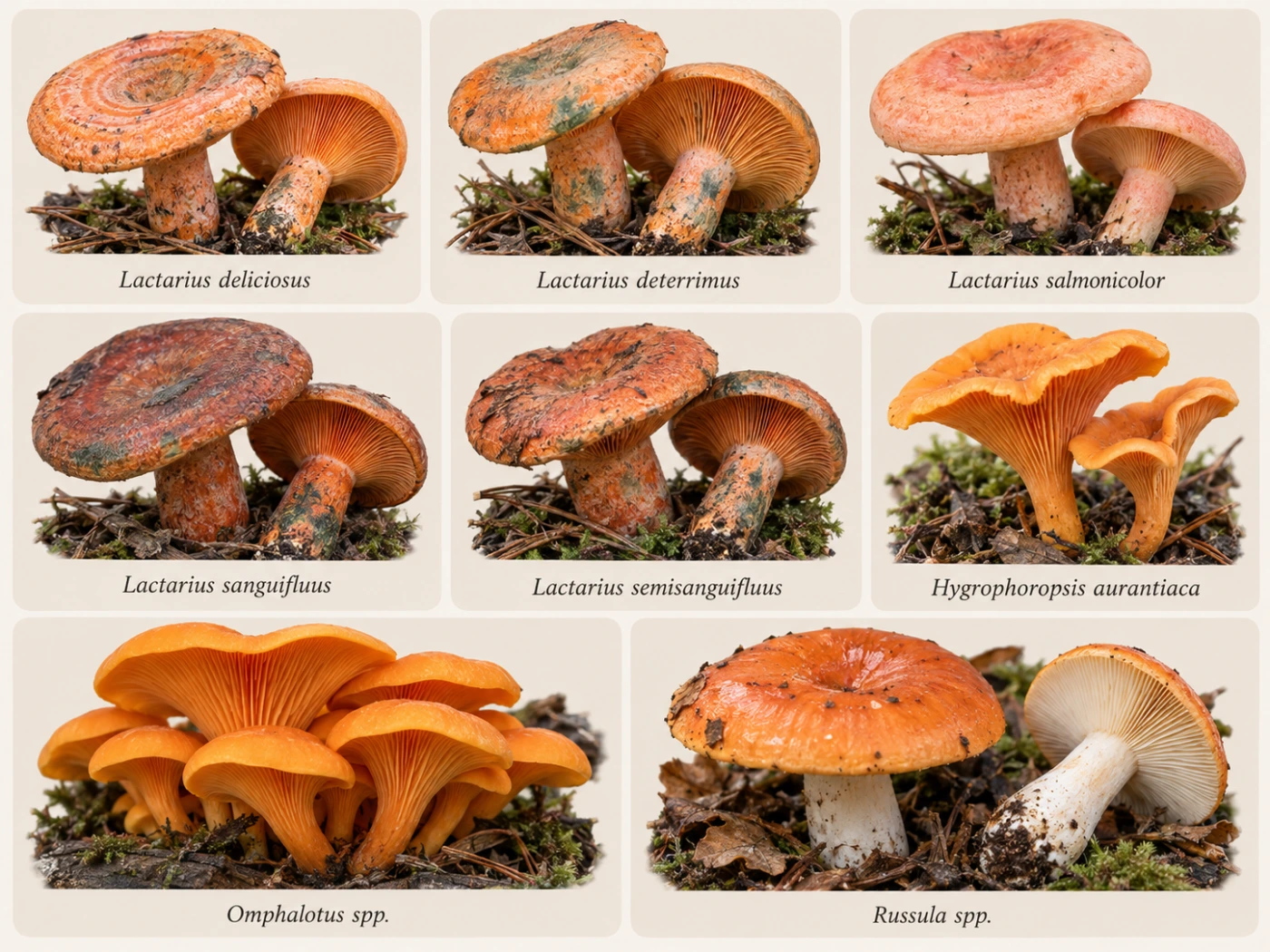
Mushrooms that release orange, carrot-colored, reddish-orange, or wine-red latex when their gills are damaged belong to one of the most recognizable milkcap groups. Many are commonly called saffron milk caps, but several closely related species can look very similar while associating with different trees and occurring in different regions.
The most useful identification method is to combine latex color, how the latex changes after exposure, green staining, cap zoning, stem markings, host tree, and geography. Calling every orange milkcap Lactarius deliciosus is one of the most common mistakes in this group.
⚠️ Important: Several saffron milk caps are considered edible when correctly identified and properly prepared, but exact species identification can be difficult. Never use orange latex alone as proof that a wild mushroom is safe to eat.
Quick Identification
| Feature | Typical Saffron Milk Cap |
|---|---|
| Main genus | Lactarius |
| Key feature | Orange to reddish latex |
| Cap color | Orange, carrot-orange, salmon, reddish-orange |
| Cap pattern | Often concentrically zoned |
| Gills | Orange to salmon, usually decurrent |
| Damage reaction | Often green or blue-green staining |
| Stem | Orange to pale orange, sometimes spotted or pitted |
| Ring | Absent |
| Volva | Absent |
| Flesh | Pale orange to carrot-colored |
| Spore print | Cream to pale ochre |
| Ecology | Mycorrhizal |
| Important hosts | Pine, spruce, fir and other conifers |
| Season | Summer to autumn |
| Main clue | Orange latex + conifer host + staining pattern |
| Edibility | Varies by species; several are edible when correctly identified |
What Are Saffron Milk Caps?
Saffron milk caps are a group of closely related Lactarius mushrooms known for colored latex and orange-toned fruit bodies. They typically grow in association with conifers and often develop green stains after bruising, aging, or weather damage.
The group includes several species rather than one universal “saffron milk cap.” In Europe, familiar names include Lactarius deliciosus, L. deterrimus, L. salmonicolor, L. sanguifluus, and related taxa.
Why Orange Latex Is So Useful
Latex is one of the strongest clues available for milkcap identification. When fresh gills are scratched or cut, droplets may appear almost immediately.
In saffron milk caps, the latex can begin carrot-orange, deep orange, reddish, or wine-colored. What happens during the next few minutes can be just as important as the initial color.
How to Test the Latex
Use a fresh mushroom and gently cut several gills near the edge of the cap. Watch both the exposed latex and the damaged gill tissue.
Take note of the color immediately and then check again after several minutes. Some reactions intensify or shift only after exposure to air.
Use Fresh Specimens
Old or dry milkcaps may release very little liquid. A mushroom that normally produces abundant latex can seem almost dry after prolonged hot weather.
If the first scratch gives no result, try fresher tissue closer to the cap center. Do not assume the mushroom is not a milkcap until healthy tissue has been checked.
Orange Latex
Carrot-orange latex is typical of several members of the Lactarius deliciosus group. It often matches the orange or salmon tones of the gills and flesh.
The latex may remain orange for a while or gradually change. The timing and direction of the change can help separate similar species.
Red or Wine-Colored Latex
Some related milkcaps produce darker latex that appears reddish, blood-red, or wine-colored rather than bright carrot-orange.
This feature is particularly important in species such as Lactarius sanguifluus. Dark red latex should not automatically be treated as normal variation within L. deliciosus.
Green Staining
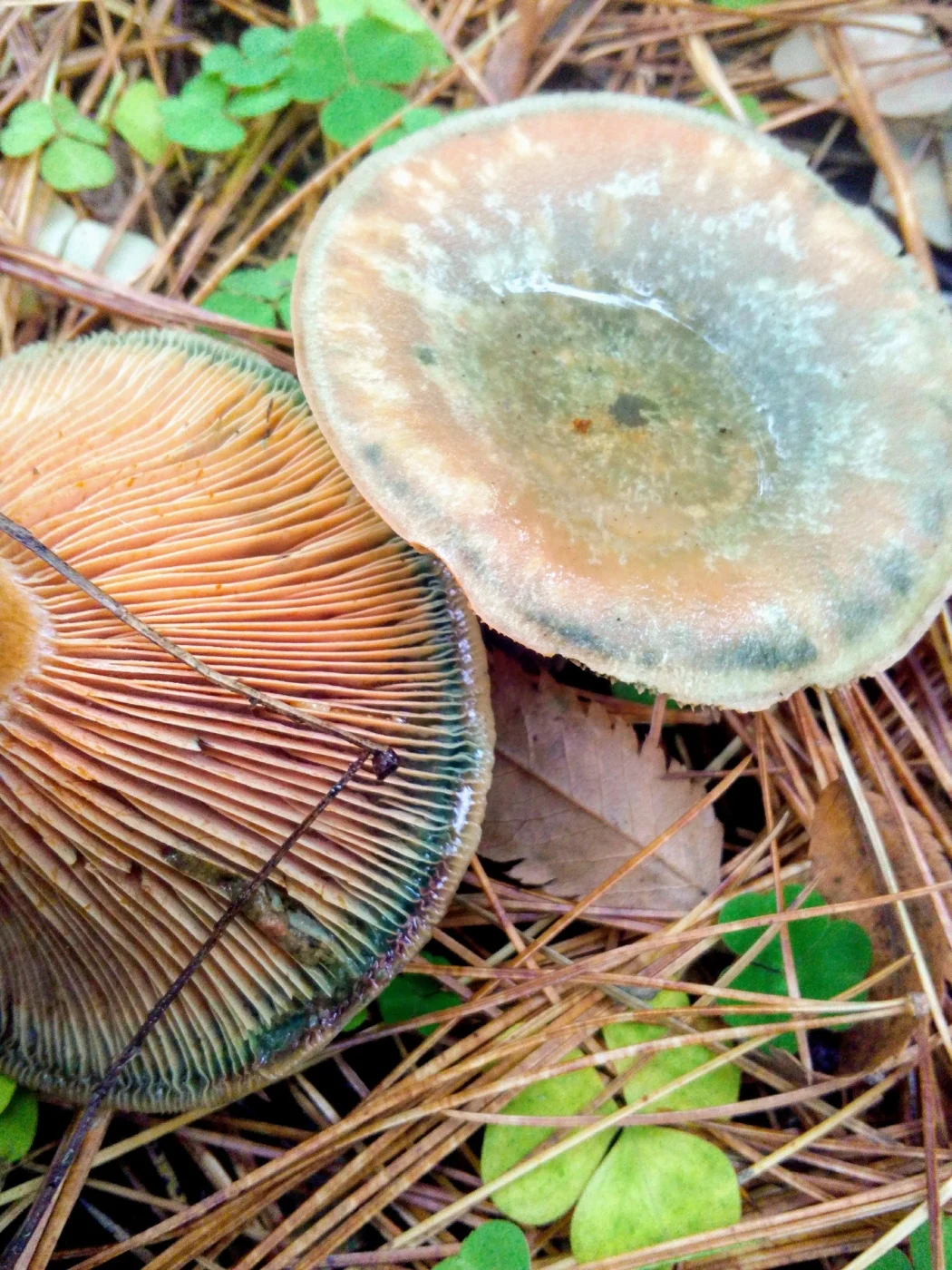
Many saffron milk caps develop green or blue-green stains after damage. These can appear on the gills, cap, stem, or cut flesh.
Green staining is useful, but it is not unique to one species. The amount and speed of the reaction need to be interpreted together with host tree and latex color.
Why Do Orange Milkcaps Turn Green?
The green color is caused by chemical changes in pigments after the tissue is damaged or ages. It is not mold and does not automatically mean the mushroom is rotten.
Older fruit bodies may develop extensive green patches naturally. Fresh bruising can also turn green in a much more localized pattern.
Cap
Saffron milk caps usually have orange to salmon-colored caps, often with darker concentric bands. The center frequently becomes depressed as the mushroom matures.
Young caps can be convex with rolled margins. Older specimens often become broadly funnel-shaped and much more irregular.
Concentric Zones
Dark and pale orange rings across the cap are common in many species. These zones can be sharply defined or almost absent depending on species, age, and moisture.
Strong zoning supports a saffron milk cap identification but does not establish one exact species. Some close relatives are much less obviously zoned.
Gills
The gills are usually orange, salmon, or pale carrot-colored and run down the stem to some degree. When damaged, they often release colored latex and later stain green.
Mature gills may also develop green patches naturally. A photograph of the underside is therefore far more informative than a top-only image.
Stem
The stem is usually orange to pale salmon and lacks a ring. Depending on species, it may show darker pits, spots, or shallow depressions called scrobicules.
These stem markings can be extremely useful. Their presence, absence, size, and color help separate otherwise similar orange milkcaps.
Flesh
The flesh is usually pale cream to orange and relatively brittle. Cutting through the cap and stem may expose both latex and staining reactions.
Fresh internal tissue gives better information than old surface damage. A cross-section can also reveal whether green discoloration develops inside the mushroom.
Smell
Most saffron milk caps have a mild or somewhat fruity mushroom odor. Smell is usually less important than latex color and tree association.
Strongly unusual odors should encourage comparison with other milkcaps. As always, odor remains subjective and should not be a primary identification feature.
Spore Print
The spore print is usually pale cream to ochre. This is consistent with many Lactarius species and confirms the broader milkcap group.
Spore print color is not especially useful for separating the closely related orange-latex species. Host tree and latex behavior are usually much more valuable.
Host Tree Is One of the Most Important Clues
Most saffron milk caps form mycorrhizal relationships with conifers. This means the nearby tree can be one of the strongest identification characters.
A mushroom under pine may belong to a different species from a nearly identical mushroom under spruce or fir. This ecological distinction is crucial.
Saffron Milk Caps Under Pine
Pine-associated orange milkcaps include Lactarius deliciosus sensu stricto and several related taxa depending on region. Typical specimens may have zoned orange caps, orange latex, and green staining.
The exact species depends on geography. A North American orange milkcap under pine should not automatically receive a European name.
Saffron Milk Caps Under Spruce
Spruce is strongly associated with species such as Lactarius deterrimus in Europe. These mushrooms can look extremely similar to pine-associated saffron milk caps.
Host identification often solves a problem that cap color cannot. If spruce is clearly the mycorrhizal partner, L. deterrimus becomes much more plausible.
Saffron Milk Caps Under Fir
Fir-associated species include Lactarius salmonicolor in Europe. These can have smoother salmon-orange coloration and may show less dramatic green staining than some relatives.
The association with fir is particularly important. Without the host tree, the species can be difficult to distinguish visually.
Lactarius deliciosus — Saffron Milk Cap
Identification
Lactarius deliciosus typically has an orange to carrot-colored cap with visible concentric zoning. The gills and latex are orange, and damaged areas may develop green staining.
The stem may show darker orange pits or spots. In the European sense, the species is strongly associated with pine.
Main Identification Clue
The best combination is pine host + orange latex + zoned orange cap + green staining. Even this combination should be interpreted geographically because related taxa occur outside Europe.
Lactarius deterrimus — False Saffron Milk Cap
Identification
Lactarius deterrimus is very similar to L. deliciosus but is associated especially with spruce. The cap is orange and often develops extensive green discoloration.
The latex begins orange and can change after exposure. Mature specimens may become heavily green-stained, sometimes much more than classic L. deliciosus.
Main Identification Clue
The strongest practical clue is the host tree. An orange saffron milk cap growing with spruce in Europe fits Lactarius deterrimus much better than L. deliciosus sensu stricto.
Lactarius salmonicolor — Salmon Milk Cap
Identification
Lactarius salmonicolor usually has a smooth salmon-orange to peach-orange appearance. It is associated particularly with fir.
The cap can be less strongly zoned than in classic L. deliciosus. Green staining may also be less pronounced or slower.
Main Identification Clue
Fir association is one of the most useful clues. A salmon-orange milkcap under fir deserves comparison with L. salmonicolor before other saffron milk cap names are applied.
Lactarius sanguifluus — Bloody Milk Cap
Identification
Lactarius sanguifluus produces latex that becomes reddish to wine-red rather than remaining simply carrot-orange. The cap can be orange-brown, reddish, or dull salmon.
Green staining may still occur with age or damage. The deeper latex color is the most memorable feature.
Main Identification Clue
Wine-red or blood-red latex separates this species from many classic orange-latex relatives. Host and regional distribution should still be checked.
Lactarius semisanguifluus
Identification
This species can begin with orange latex that gradually turns wine-red after exposure. The transition may be especially useful when observed on fresh damaged gills.
The cap is usually orange to gray-orange and can develop green staining. It can be difficult to separate from other members of the group from photographs alone.
Main Identification Clue
The key is not merely the initial latex color but the change from orange toward reddish or wine tones. Watching the reaction over time is therefore essential.
Orange Milkcap Comparison
| Species | Latex | Typical Host | Green Staining | Useful Clue |
|---|---|---|---|---|
| Lactarius deliciosus | Orange | Pine | Common | Zoned cap + pine |
| L. deterrimus | Orange, changing | Spruce | Often strong | Spruce association |
| L. salmonicolor | Orange | Fir | Usually less dramatic | Salmon color + fir |
| L. sanguifluus | Red to wine-red | Conifers | Possible | Dark reddish latex |
| L. semisanguifluus | Orange → wine-red | Conifers | Common | Latex changes color |
This table is most useful in Europe. Similar North American mushrooms may belong to different regional taxa.
North American Saffron Milk Caps
North America has several orange and reddish milkcaps that resemble European Lactarius deliciosus. Older field guides and websites sometimes apply European names too broadly.
Modern identification should account for regional species concepts. If geography is uncertain, “Lactarius deliciosus group” or “orange saffron milk cap” can be more accurate than forcing a European species name.
Orange Latex vs White Latex
White-latex milkcaps belong to many different ecological and taxonomic groups. A mushroom with white latex should not be placed in the saffron milk cap group simply because its cap is orange.
Conversely, some saffron milk caps may release less visible latex when old or dry. Fresh tissue should always be tested.
Orange Latex vs Orange Gill Color
Orange gills do not automatically mean orange latex. Several unrelated mushrooms have orange gills but release no milk at all.
The liquid itself must be observed from freshly damaged tissue. This is one reason a close-up sequence can be more useful than a single photograph.
Saffron Milk Cap vs False Chanterelle
False Chanterelle (Hygrophoropsis aurantiaca) can have a vivid orange cap and strongly forked orange gills. From above, it can superficially resemble some saffron milk caps.
The decisive difference is latex. False Chanterelle has no orange milk and usually has thinner, softer gills.
Saffron Milk Cap vs Jack-o’-Lantern
Omphalotus species can be bright orange and have true decurrent gills. They often grow in clusters from wood, buried roots, or tree bases.
They do not produce orange latex and are toxic. Wood-associated clustered growth strongly points away from a saffron milk cap.
Saffron Milk Cap vs Orange Russula
Some Russula species can have orange or reddish caps and brittle flesh. Their structure may look very similar to milkcaps because both groups belong to Russulaceae.
The major distinction is latex. Russula species do not produce true milk when the gills are damaged.
Are Saffron Milk Caps Edible?
Several saffron milk caps are widely regarded as edible when correctly identified and properly prepared. They are traditional food mushrooms in parts of Europe and elsewhere.
However, edibility should never be inferred from orange latex alone. Exact species, condition, regional identity, and possible look-alikes should all be considered first.
Why Species Identification Still Matters
Closely related milkcaps can differ in taste, texture, ecological preference, and culinary reputation. Even when several members of the group are edible, confidently separating them remains useful.
Regional taxonomy adds another reason for caution. A European species name may not accurately describe a similar-looking North American mushroom.
How to Identify a Saffron Milk Cap Step by Step
Start with fresh gills and latex rather than cap color. After that, identify nearby conifers and watch for staining.
This sequence usually provides much stronger evidence than appearance from above.
Step 1: Cut Fresh Gills
Look for orange, carrot-colored, reddish, or wine-colored latex. Record the exact initial color.
Wait several minutes and check whether the liquid or damaged tissue changes.
Step 2: Watch for Green Staining
Observe gills, cap, stem, and cut flesh. Green or blue-green staining supports several members of the saffron milk cap group.
Note how quickly the reaction develops and how extensive it becomes.
Step 3: Identify the Host Tree
Determine whether the mushroom is growing with pine, spruce, fir, or another conifer. This may be the decisive clue between very similar species.
If several conifers grow together, avoid assuming the nearest trunk is automatically the host.
Step 4: Check the Cap
Look for concentric zones, orange intensity, green patches, and overall shape. Strong zoning is common in some species but weak in others.
Cap color should support the identification rather than control it.
Step 5: Examine the Stem
Look for pits, spots, green stains, and overall coloration. Some species have conspicuous scrobicules while others are relatively plain.
Photographing the stem close-up can therefore be surprisingly useful.
How to Photograph Orange-Latex Milkcaps
Take one photograph of the entire mushroom in habitat, including nearby conifer needles or trees. Then photograph the underside before damaging it.
Scratch or cut several fresh gills and immediately photograph the latex. Take another image several minutes later to record any shift toward red, wine, or green staining.
A final close-up of the stem can show pits and discoloration. Together, this sequence provides far more information than a single attractive cap photograph.
Can AI Identify Saffron Milk Caps?
AI can often recognize the orange milkcap group from cap shape, gills, latex, and green staining. Exact species identification is much more difficult.
Host tree and geography are often the missing pieces. A responsible system should sometimes return “saffron milk cap group” rather than forcing Lactarius deliciosus from appearance alone.
For a broader approach to milkcap identification, see Milkcap Mushroom Identification: How to Use Latex, Color and Habitat.
Common Identification Mistakes
The most common mistake is calling every orange-latex milkcap Lactarius deliciosus. Spruce, fir, and regional species can look extremely similar.
Another mistake is observing the latex only once. A mushroom whose milk begins orange and later becomes wine-red may provide a crucial identification clue only after several minutes.
Ignoring the host tree is equally problematic. In this group, ecology can be more diagnostic than minor differences in cap color.
Interesting Facts About Saffron Milk Caps
The colored latex is produced by specialized cells within the mushroom. When those cells are broken, their contents are exposed to air and can undergo visible chemical changes.
The famous green staining is also a chemical reaction rather than evidence of spoilage. This is why even fresh, healthy saffron milk caps can develop vivid green patches where they have been bruised.
Saffron milk caps also demonstrate how tightly fungi and trees can be linked. Two nearly identical orange mushrooms can represent different species largely because one lives with pine and another with spruce or fir.
These mushrooms have a long culinary history in parts of Europe, where local names and traditions often distinguish species or ecological forms that casual field guides may group together. Modern DNA-based taxonomy has shown that the group is even more diverse than its outward similarity suggests.
Frequently Asked Questions
Can orange latex become darker without turning green?
Yes. In some species the latex can shift toward red or wine-colored tones before other staining becomes obvious. Recording the change over several minutes is important.
Can an old saffron milk cap stop producing visible latex?
Yes. Dry or old fruit bodies can release very little milk. Fresh internal tissue may still show the characteristic coloration.
Why do some specimens have huge green patches?
Repeated bruising, age, rainfall, and insect damage can expose large areas of tissue to oxidation. Extensive green coloration is therefore common in older fruit bodies of some species.
Can two different saffron milk cap species grow in one forest?
Yes. Mixed forests with several conifer species may support more than one orange milkcap. Each fruit body should be evaluated together with its probable host.
Do orange-latex milkcaps always have zoned caps?
No. Some species show strong concentric rings, while others are only faintly zoned or nearly uniform in color.
Can green staining appear without obvious orange latex?
Yes, particularly in older or dry specimens where little liquid remains. Existing green damage may persist even when the latex is difficult to observe.
Why can photographs make the latex look yellow instead of orange?
Camera white balance, forest shade, and reflected green light can distort warm colors. Recording the observed color in notes is useful alongside photographs.
Can a saffron milk cap grow under a tree other than a conifer?
Classic orange-latex saffron milk caps are strongly associated with conifers, though exact ecological relationships vary by species and region. A similar mushroom in a very different habitat deserves careful reconsideration.
Final Identification Notes
Mushrooms with orange latex are best identified by combining latex color, latex changes, green staining, host tree, cap zoning, stem markings, and geography. The orange milk itself is a powerful clue, but it does not identify one exact species.
In Europe, pine suggests Lactarius deliciosus, spruce strongly supports L. deterrimus, and fir can point toward L. salmonicolor, while reddish or changing latex brings species such as L. sanguifluus and L. semisanguifluus into consideration. Outside Europe, similar mushrooms may belong to different regional taxa.
The simplest field rule is: cut the gills, watch the latex change, identify the conifer, and then compare the cap and stem. That sequence is much more reliable than calling every orange milkcap a Saffron Milk Cap.
Upload a photo and get possible matches in seconds.