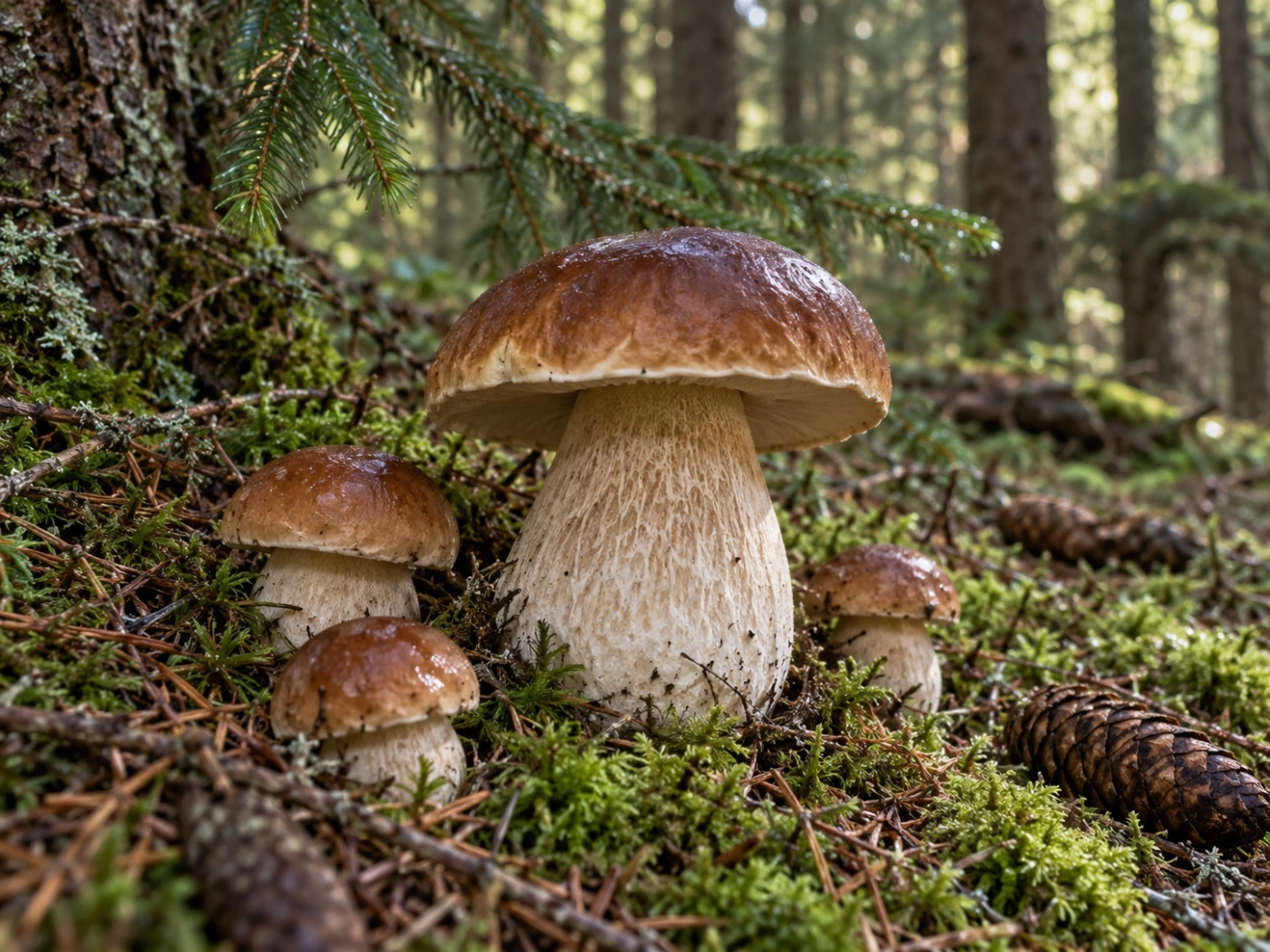
Boletus edulis, commonly known as Porcini, Cep, or Penny Bun, is one of the best-known edible boletes in Europe and other temperate regions. Under spruce, it can be especially common and may appear in mossy forest, needle litter, old plantations, and mature conifer woodland.
Finding a bolete under spruce is a useful clue, but the tree alone is not enough for identification. The most reliable combination is brown cap, white to olive pores, thick pale stem with fine reticulation, white flesh, and little or no blue staining.
⚠️ Important: Never identify a bolete for food from cap color alone. Check the pore surface, stem pattern, flesh color, bruising reaction, taste-related look-alikes, and regional species before considering edibility.
Quick Identification
| Feature | Boletus edulis |
|---|---|
| Scientific name | Boletus edulis |
| Common names | Porcini, Cep, Penny Bun |
| Cap color | Light brown to chestnut-brown |
| Cap surface | Smooth, sometimes slightly sticky when wet |
| Underside | Pores, not gills |
| Young pores | White |
| Mature pores | Yellow to olive |
| Stem | Thick, pale, often club-shaped |
| Stem pattern | Fine pale reticulation |
| Flesh | White |
| Bruising | Usually little or no blue staining |
| Main host under conifers | Spruce, pine and related trees |
| Ecology | Mycorrhizal |
| Season | Summer to autumn |
| Edibility | Edible when correctly identified |
| Main look-alikes | Tylopilus felleus, Boletus reticulatus, Boletus pinophilus, Imleria badia, some toxic red-pored boletes |
Why Boletus edulis Is Common Under Spruce
Boletus edulis forms a mycorrhizal partnership with living tree roots. Spruce is one of its most important hosts in many parts of Europe, although the species can also occur with other conifers and broadleaf trees.
The fungus exchanges water and mineral nutrients with the tree in return for sugars. This underground relationship is why productive porcini spots can continue fruiting around the same spruce trees for many years.
What Does Boletus edulis Look Like Under Spruce?
Porcini under spruce often has a classic compact shape, especially when young. The cap can be rounded and chestnut-brown, while the thick stem may look almost bulbous.
Mature specimens usually become broader and flatter. The pore surface changes from white to yellow and then olive as the spores develop.
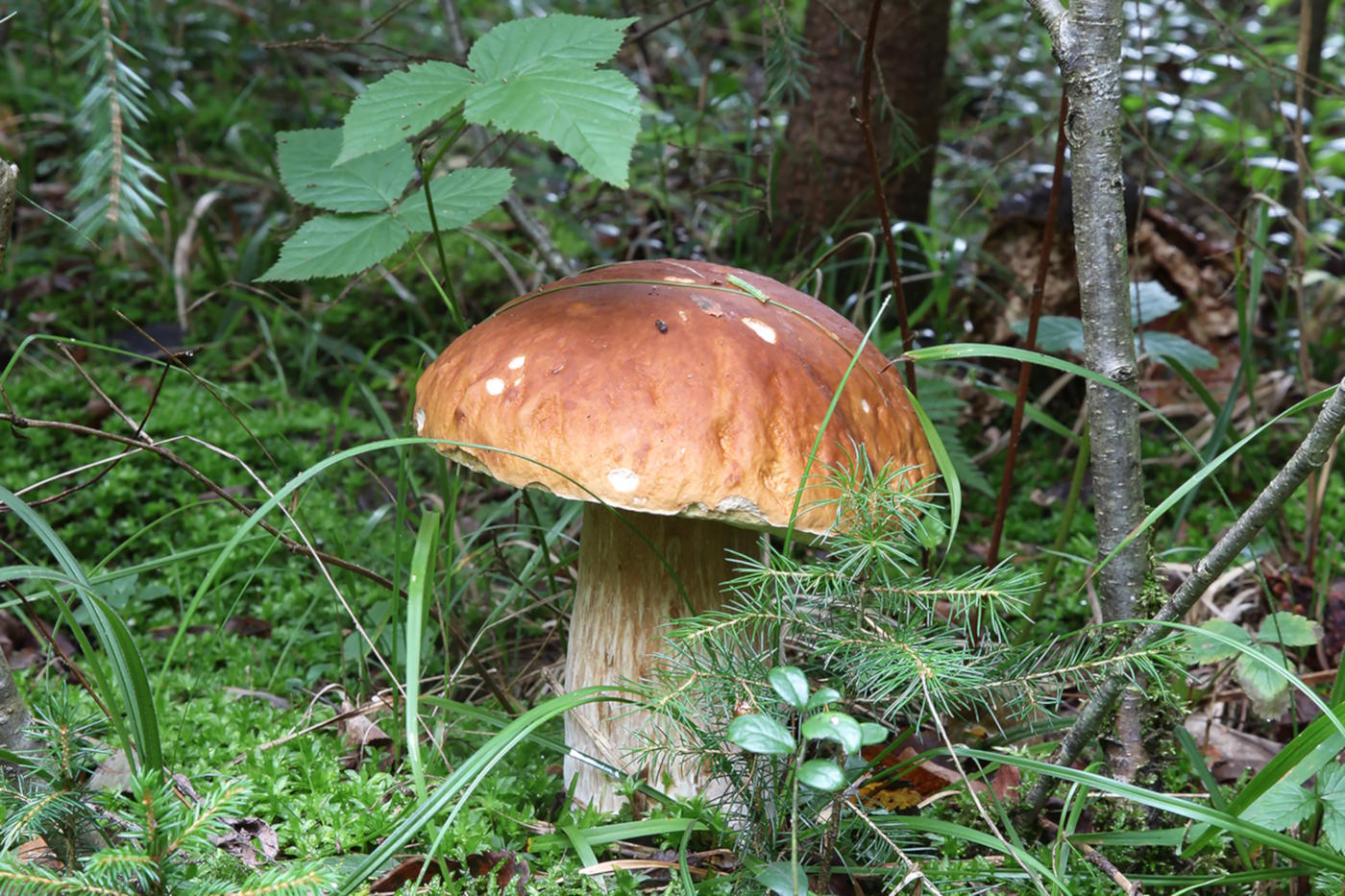
Cap
The cap is usually brown, chestnut, tan, or occasionally quite dark. Young mushrooms often have a smooth rounded cap with a pale margin.
The surface may feel slightly sticky after rain, while dry weather makes it look more matte. Color can vary significantly even among mushrooms growing within the same spruce forest.
Cap Margin
Young Boletus edulis often has a pale or whitish band along the cap edge. This feature can be useful, although it becomes less obvious as the mushroom matures.
The margin is usually smooth rather than strongly cracked or wavy. Weathering can still alter the appearance in older fruit bodies.
Pores
The underside has a layer of tubes ending in tiny pores rather than gills. This is one of the first features to check when identifying any porcini-like mushroom.
Young pores are white, which is a very useful clue. With age, they become pale yellow and eventually olive or greenish-olive.
Bruising Reaction
The pore surface of Boletus edulis usually does not show strong blue bruising. Slight discoloration can occur in old or damaged specimens, but dramatic blue staining points more strongly toward other boletes.
This difference is useful because many yellow-pored boletes can bruise blue quickly. Bruising should always be checked on fresh tissue.
Stem
The stem is thick, firm, and often club-shaped, especially in young mushrooms. It is usually pale cream to light brown and becomes more cylindrical with age.
One of the key features is the fine net-like pattern called reticulation. This pattern is usually pale and most obvious on the upper stem.
Stem Reticulation
The reticulation of Boletus edulis is typically light-colored against the stem. It can be delicate and easy to miss in poor light.
This feature helps separate porcini from several look-alikes. Dark or strongly contrasting netting may suggest another species.
Flesh
The flesh is white, thick, and firm when fresh. It should remain largely white after cutting rather than rapidly turning blue.
Older mushrooms may become soft or spongy, especially in the cap. Insect damage is common and can make internal tissue less useful for identification.
Smell
Fresh porcini usually has a mild, pleasant mushroom smell. The odor is not strong enough to identify the species on its own.
A strange chemical, sharply unpleasant, or otherwise distinctive smell should make you reconsider the identification. Smell is best used as supporting evidence rather than as a main diagnostic feature.
Where Under Spruce Does Boletus edulis Grow?
Porcini can grow in moss, needle litter, grass, and relatively open areas beneath spruce. It often appears where the forest floor is not too densely covered by tall vegetation.
Mature spruce forests can be especially productive. Edges, paths, small clearings, and gently sloping ground may all produce fruit bodies after suitable weather.
Mossy Spruce Forest
Moss helps retain moisture near the soil surface, which can create favorable fruiting conditions. Brown caps often appear partly hidden among green moss.
This habitat can make fresh porcini easy to spot once one mushroom is found. Several additional fruit bodies may occur nearby because the same mycelial network can fruit across a wider area.
Spruce Plantations
Planted spruce stands can also support Boletus edulis once suitable mycorrhizal relationships become established. Older plantations are generally more likely to produce a rich bolete community than very young ones.
Soil, moisture, forest management, and local fungal history all influence productivity. Two visually similar plantations can therefore have very different mushroom communities.
Season
Porcini usually fruits from summer through autumn, although exact timing depends on region and climate. In some areas, an early summer flush may be followed by a stronger autumn season.
Rainfall is one of the major triggers. Warm soil followed by several days of moisture can lead to sudden and abundant fruiting.
Distribution
Boletus edulis is widely distributed in Europe and across parts of the Northern Hemisphere. It is closely associated with temperate forests and suitable mycorrhizal host trees.
The name is sometimes used too broadly outside its core range. North American king boletes include several related regional species, so not every porcini-like mushroom under spruce in North America should automatically be called B. edulis.
Is Boletus edulis Under Spruce Edible?
Yes, Boletus edulis is a highly valued edible mushroom when correctly identified. Its firm texture and mild flavor make it one of the most widely collected wild mushrooms.
Correct identification still matters because several brown boletes can look similar. The safest approach is to confirm the white-to-olive pores, pale stem reticulation, white non-blueing flesh, and suitable habitat.
Look-Alikes
Several boletes can resemble Boletus edulis under spruce or nearby conifers. The most useful differences involve pore color, stem reticulation, bruising, bitterness, and host tree.
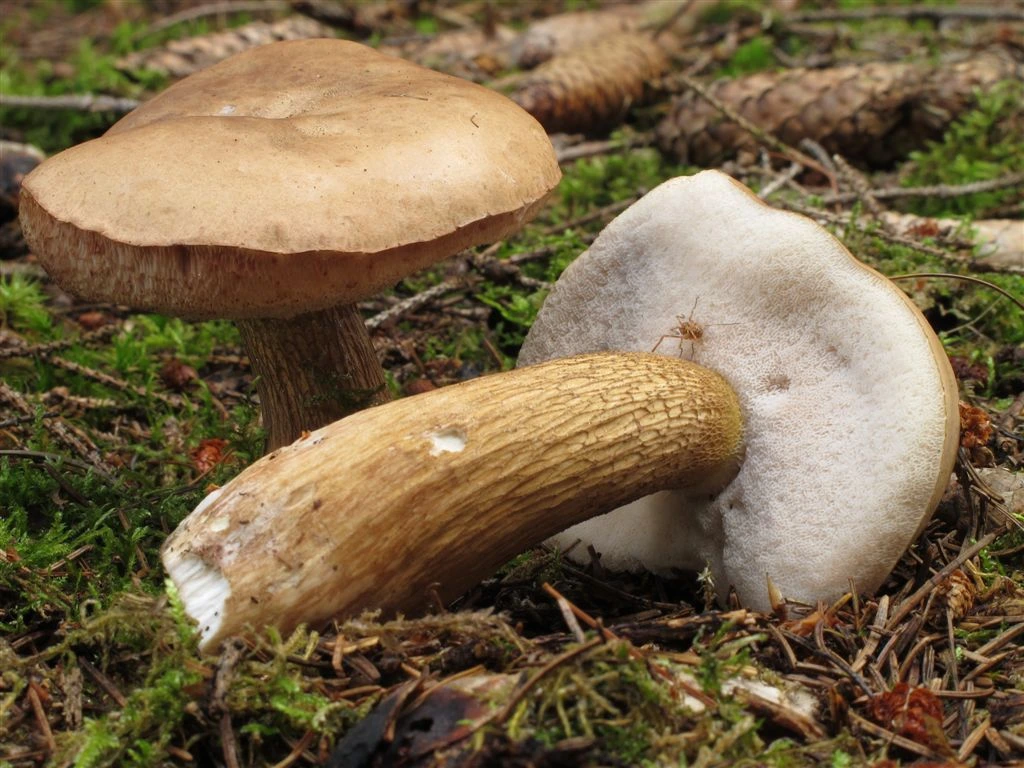
Tylopilus felleus — Bitter Bolete
Identification
Tylopilus felleus can look remarkably similar to porcini from above. It usually has a brown cap, a pale to brownish stem, and a strong net-like pattern.
The pore surface starts pale but becomes pinkish with maturity. The stem reticulation is often darker and more contrasting than in Boletus edulis.
Main Difference
Mature pink pores are one of the strongest clues. Porcini develops yellow to olive pores instead of pink ones.
Bitter Bolete is also famous for its extreme bitterness. It is not considered deadly, but even a small amount can ruin an entire dish.
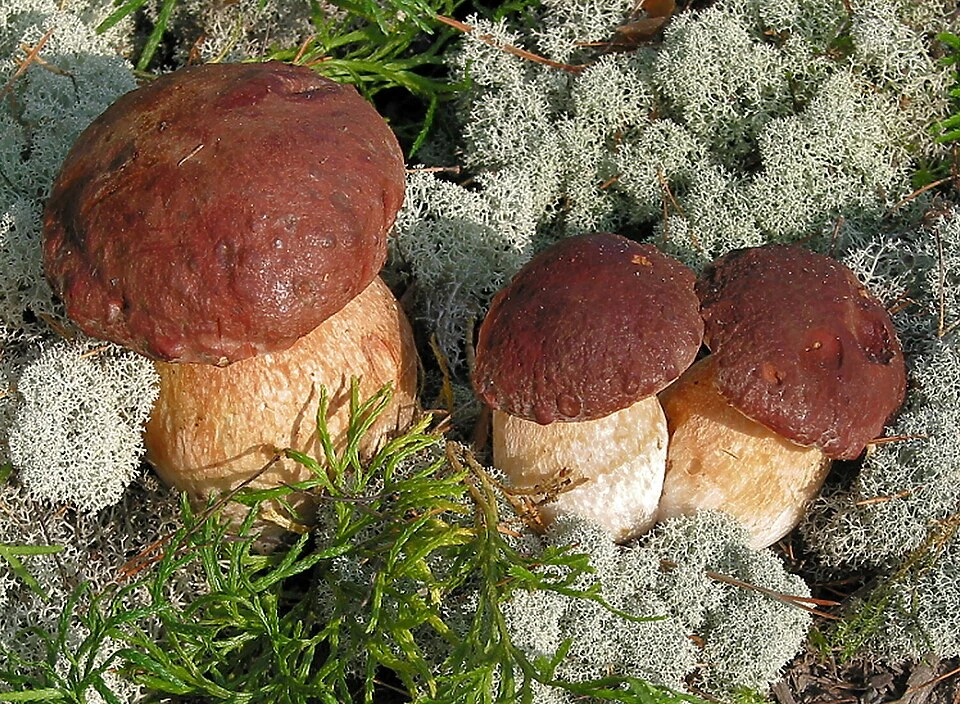
Boletus pinophilus — Pine Bolete
Identification
Boletus pinophilus is another large king bolete with a thick stem and reticulation. It often has a darker reddish-brown or mahogany cap than typical B. edulis.
It is especially associated with pine and other conifers. The flesh remains white and the pores follow a similar white-to-yellow progression.
Main Difference
Host tree and cap color are useful together. A very dark reddish-brown king bolete under pine fits B. pinophilus better than a typical spruce-associated B. edulis.
Boletus reticulatus — Summer Bolete
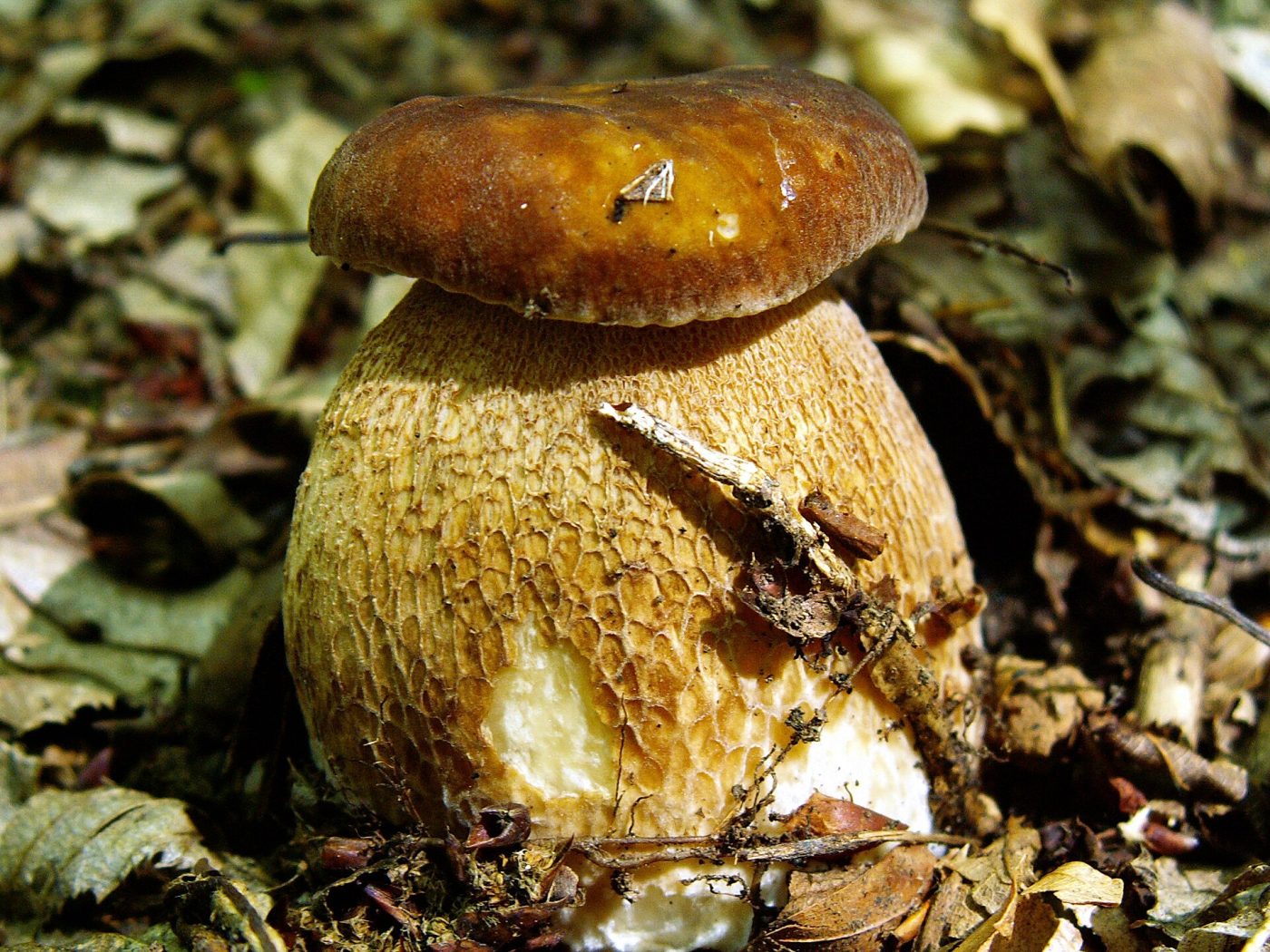
Identification
Boletus reticulatus is a close relative with a brown cap and strong stem reticulation. It is often found in warmer broadleaf forests with oak and beech.
The cap surface is usually dry and can crack in hot weather. Fruiting often starts earlier in the season than typical autumn porcini.
Main Difference
Broadleaf habitat is the strongest practical clue. Under spruce, B. edulis is generally the more likely candidate.
Imleria badia — Bay Bolete
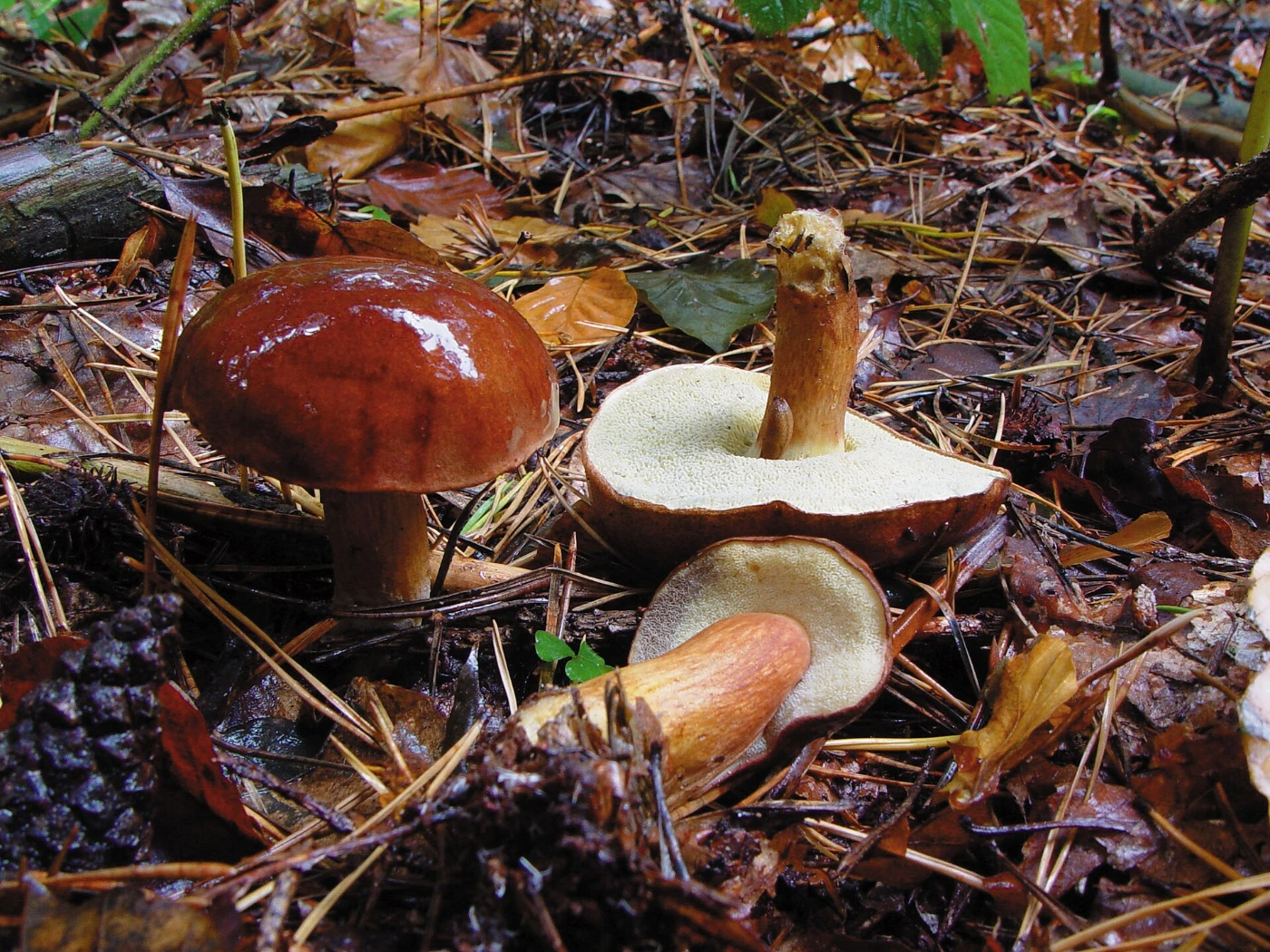
Identification
Bay Bolete has a brown cap and yellow pores, which can make mature specimens look somewhat porcini-like. The stem is usually more slender and lacks the classic pale reticulation of B. edulis.
The pores often bruise blue when pressed. This reaction can be quite noticeable on fresh mushrooms.
Main Difference
Blue bruising and lack of reticulation point toward Bay Bolete. Porcini usually has a thick reticulated stem and little or no blue staining.
Red-Pored Boletes
Identification
Some red-pored boletes can have brownish caps and thick stems. Their pore surfaces, however, become orange-red to red rather than white, yellow, or olive.
Many of these species also show strong blue bruising. Some are poisonous or cause gastrointestinal illness, so they deserve careful attention.
Main Difference
Red pores immediately point away from Boletus edulis. Strong blue staining provides another useful warning that the mushroom belongs to a different group.
Boletus edulis vs Bitter Bolete
| Feature | Boletus edulis | Tylopilus felleus |
|---|---|---|
| Young pores | White | White to pale |
| Mature pores | Yellow to olive | Pink |
| Stem net | Pale | Often darker |
| Taste | Mild | Extremely bitter |
| Flesh | White | White |
| Blue bruising | Usually absent | Usually absent |
| Main clue | Olive mature pores | Pink mature pores |
This is one of the most important porcini comparisons because the two mushrooms can look very similar from above. The pore color on mature specimens is often more useful than cap color.
Boletus edulis vs Bay Bolete
| Feature | Boletus edulis | Imleria badia |
|---|---|---|
| Stem | Thick, reticulated | More slender, not reticulated |
| Young pores | White | Yellowish |
| Mature pores | Yellow to olive | Yellow to olive |
| Bruising | Little or none | Often blue |
| Cap | Brown | Chestnut-brown |
| Main clue | Pale stem net | Blue-bruising pores |
Both can occur in conifer forest, so tree habitat alone does not separate them. Stem texture and bruising are more useful.
How to Identify Boletus edulis Under Spruce Step by Step
The best approach is to start with the underside and stem rather than the cap. Brown caps are common across many bolete species and are not diagnostic by themselves.
Step 1: Confirm Spruce Habitat
Make sure spruce is actually present and likely to be the host. In mixed forest, pine, birch, beech, or other trees may also be nearby.
Spruce association strongly supports B. edulis, but it does not prove the identification. The mushroom itself still needs to match the expected features.
Step 2: Check the Pores
Young pores should be white and mature pores yellow to olive. Pink, red, or strongly orange pores suggest another species.
Press the pore surface gently and watch for discoloration. Strong blue bruising makes typical B. edulis less likely.
Step 3: Examine the Stem
Look for a thick pale stem with fine whitish reticulation. The netting is usually easiest to see near the top.
Dark reticulation or a completely smooth stem should make you compare other boletes. Stem pattern is one of the most useful features in this group.
Step 4: Cut the Flesh
The flesh should remain white or nearly white after cutting. Rapid blue staining points toward another bolete.
Check both the cap and stem because some bruising reactions are stronger in one part than another. Fresh tissue gives the clearest result.
Step 5: Consider the Whole Mushroom
A typical specimen combines a brown cap, white-to-olive pores, thick reticulated stem, white flesh, and spruce habitat. When all of these features agree, the identification becomes much stronger.
Do not rely on one clue alone. Several look-alikes can match two or three of these features but differ in another critical character.
How to Photograph Porcini Under Spruce
Take one wide photograph showing the mushroom with spruce needles, cones, moss, or nearby trunks. Habitat information is especially useful when comparing closely related king boletes.
Then photograph the cap, pore surface, full stem, and reticulation. A cut section showing whether the flesh stains blue can provide another important identification image.
Can AI Identify Boletus edulis Under Spruce?
AI can often recognize a porcini-like bolete from a good set of photographs. Exact identification becomes much stronger when the pore surface, stem netting, and host tree are visible.
A single cap-only image is much less reliable. Brown king boletes, Bitter Bolete, and Bay Bolete can all look similar from above.
Common Identification Mistakes
One common mistake is identifying every large brown bolete as porcini. Several genera contain mushrooms with similar cap shape and color.
Another mistake is ignoring mature pore color. Pink pores strongly suggest Bitter Bolete, while red pores point toward a completely different group.
The third mistake is overlooking stem reticulation. A fine pale net on a thick stem is one of the most useful features of Boletus edulis.
Interesting Facts
Porcini is one of the most important wild edible mushrooms in European cuisine. It is collected fresh, dried, frozen, and preserved in many regions.
The name “porcini” comes from Italian usage and is widely applied to king boletes. “Cep” is common in English and French-influenced contexts, while “Penny Bun” refers to the rounded brown shape of young caps.
The underground fungus can remain associated with the same spruce roots for many years. This is why experienced foragers often return to the same productive trees season after season.
Weather can dramatically change fruiting from one year to the next. A forest that seems empty during a dry season may produce large numbers of porcini after the right combination of rain and temperature.
Frequently Asked Questions
Can Boletus edulis grow directly beside a spruce trunk?
Yes, but it can also appear several meters away because spruce roots spread widely through the soil. The mushroom does not need to touch the trunk to be connected to the tree.
Can young porcini have completely white pores?
Yes. Pure white pores are typical in young fruit bodies and gradually become yellow and then olive with age.
Can the cap become very dark under spruce?
Yes. Cap color can range from pale brown to deep chestnut and can vary with moisture, genetics, and age.
Can Boletus edulis bruise slightly blue?
Typical B. edulis should not show strong blue staining, although minor discoloration can occur in damaged or aging tissue. A rapid intense blue reaction should make you investigate other bolete species.
Can porcini grow under planted spruce?
Yes. Mature spruce plantations can support Boletus edulis if suitable mycorrhizal relationships and soil conditions are present.
Why are some porcini stems much thicker than others?
Young mushrooms often have very swollen stems, while older specimens become more elongated and cylindrical. Growing conditions can also affect proportions.
Do porcini return to the same spruce trees every year?
They can return to the same general area because the mycelium remains associated with the root system. Fruiting still depends strongly on rainfall, temperature, and other seasonal conditions.
Can Bitter Bolete grow in the same spruce forest?
Yes. That is why checking the mature pore color and stem reticulation is important even in a classic porcini habitat.
Final Identification Notes
Boletus edulis under spruce is best recognized by a brown cap, white pores that mature to yellow and olive, a thick pale reticulated stem, white flesh, and little or no blue staining. Spruce habitat strengthens the identification but should always be combined with the mushroom’s physical features.
The most important look-alike is Tylopilus felleus, which develops pink pores and often darker stem reticulation. Bay Bolete is another common comparison, but it usually lacks reticulation and often bruises blue.
The practical field pattern is: spruce + brown cap + white-to-olive pores + pale stem net + white non-blueing flesh = strong Boletus edulis candidate.
Upload a photo and get possible matches in seconds.