Yellow pores are one of the most useful clues when identifying boletes. Instead of gills, these mushrooms have a sponge-like layer of tubes beneath the cap, and in many species the pore surface becomes yellow as the fruit body develops.
But yellow pores do not identify a mushroom by themselves. Some yellow-pored boletes are excellent edible species, others are bitter or unsuitable for food, and several turn dramatically blue when bruised. The stem pattern, cap surface, bruising reaction, host trees, and geography all matter.
⚠️ Important: Yellow pores are not a sign of edibility. Never eat a wild bolete based solely on pore color, photographs, AI identification, or an online comparison.
Quick Guide to 12 Yellow-Pored Boletes
| Species | Common name | Pores | Bruising | Safety |
|---|---|---|---|---|
| Boletus edulis | Porcini | White → yellow → olive | Little or none | Edible when correctly identified |
| Boletus pinophilus | Pine Bolete | White → yellow → olive | Little or none | Edible when correctly identified |
| Boletus reticulatus | Summer Cep | White → yellow → olive | Little or none | Edible when correctly identified |
| Imleria badia | Bay Bolete | Yellow to olive | Often blue | Edible when correctly identified |
| Suillus luteus | Slippery Jack | Yellow | Little or none | Edible when correctly identified |
| Suillus granulatus | Weeping Bolete | Yellow | Little or none | Edible when correctly identified |
| Suillus bovinus | Bovine Bolete | Yellow to olive | Usually weak | Edibility varies in quality |
| Suillus variegatus | Velvet Bolete | Yellow to olive | Sometimes blue | Edible when correctly identified |
| Xerocomellus chrysenteron | Red Cracking Bolete | Yellow | Often blue | Edibility varies |
| Butyriboletus appendiculatus group | Butter Bolete | Yellow | Mild to moderate blueing | Edible when correctly identified |
| Caloboletus calopus | Bitter Beech Bolete | Yellow | Blue | Inedible due to bitterness |
| Cyanoboletus pulverulentus | Ink-Stain Bolete | Yellow | Very rapid dark blue | Not recommended for beginners |
Why Do Bolete Pores Turn Yellow?
The pore surface of many boletes changes color as the mushroom matures. In king boletes such as Boletus edulis, the pores usually begin white, become yellow, and eventually turn olive-green as spores mature. Other species are already yellow when relatively young. In these mushrooms, the exact shade may range from lemon-yellow to golden, mustard, or olive-yellow.
Pore Color Changes With Age
Young mushrooms may look completely different from mature ones underneath. A Porcini with almost white pores can later develop a strongly yellow or olive pore surface. This is why age should always be considered during identification. Several specimens at different stages are often more informative than one isolated fruit body.
Yellow Pores vs Yellow Gills
Boletes do not have conventional gills. Their underside consists of thousands of tiny tubes that open as pores. From a distance, the surface can look smooth or sponge-like. A close view reveals many small round or angular openings rather than thin blade-like gills. This distinction immediately separates boletes from most ordinary gilled mushrooms. It is one of the first features worth checking in the field.
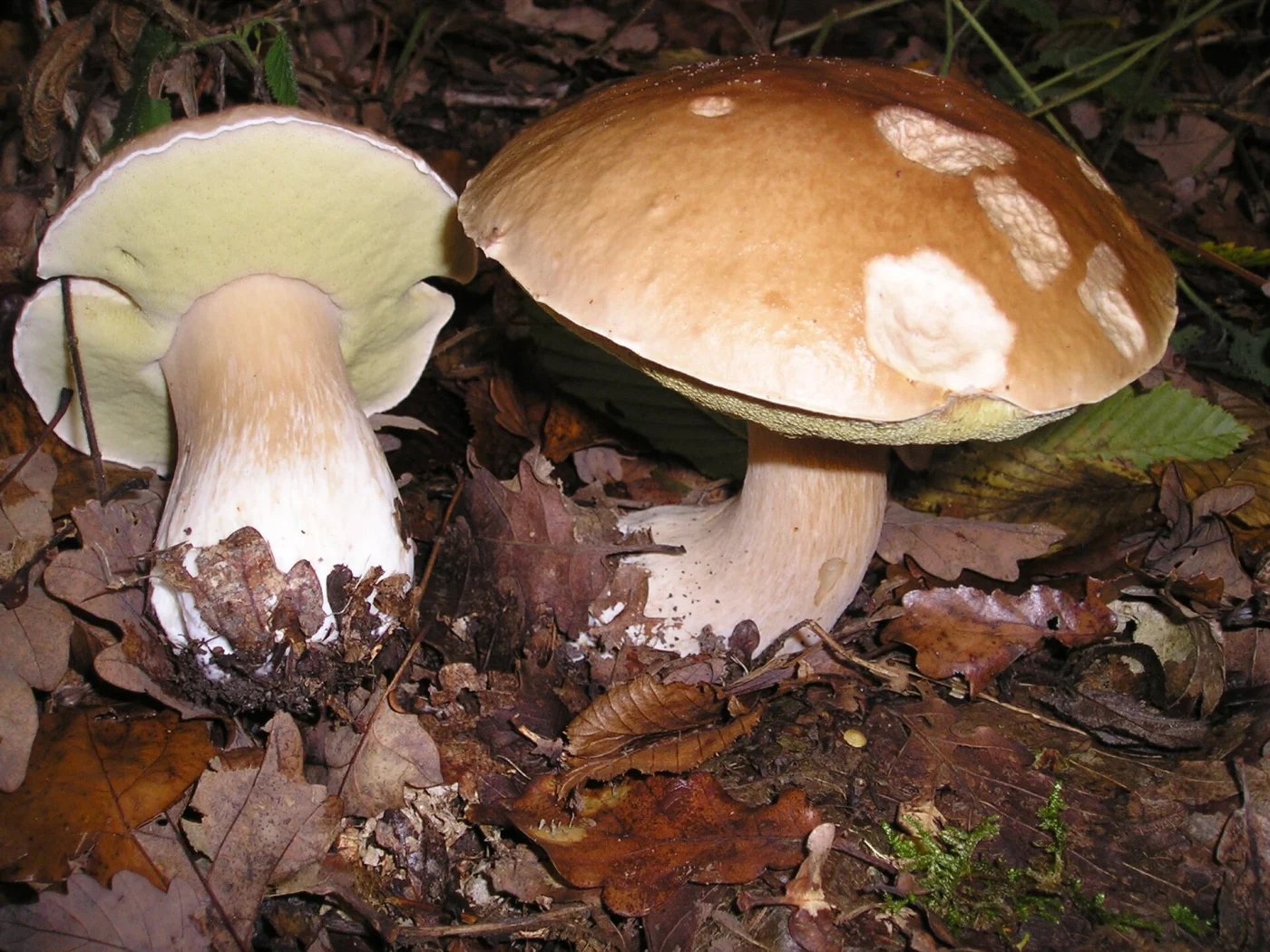
1. Boletus edulis — Porcini
Identification
Porcini has a brown to chestnut cap, a thick pale stem, and a fine pore surface. Young pores are white before turning yellow and eventually olive-green.
The stem often has pale reticulation, particularly near the upper portion. The flesh is white and normally does not turn blue when cut.
Habitat
Boletus edulis forms mycorrhizal relationships with both coniferous and broadleaf trees. Spruce, pine, birch, beech, and oak can all be important hosts.
It grows from soil rather than directly from wood. Summer through autumn is the main season in temperate regions.
Main Clue
Yellow-to-olive mature pores combined with pale reticulation and non-blueing white flesh strongly support the king bolete group.
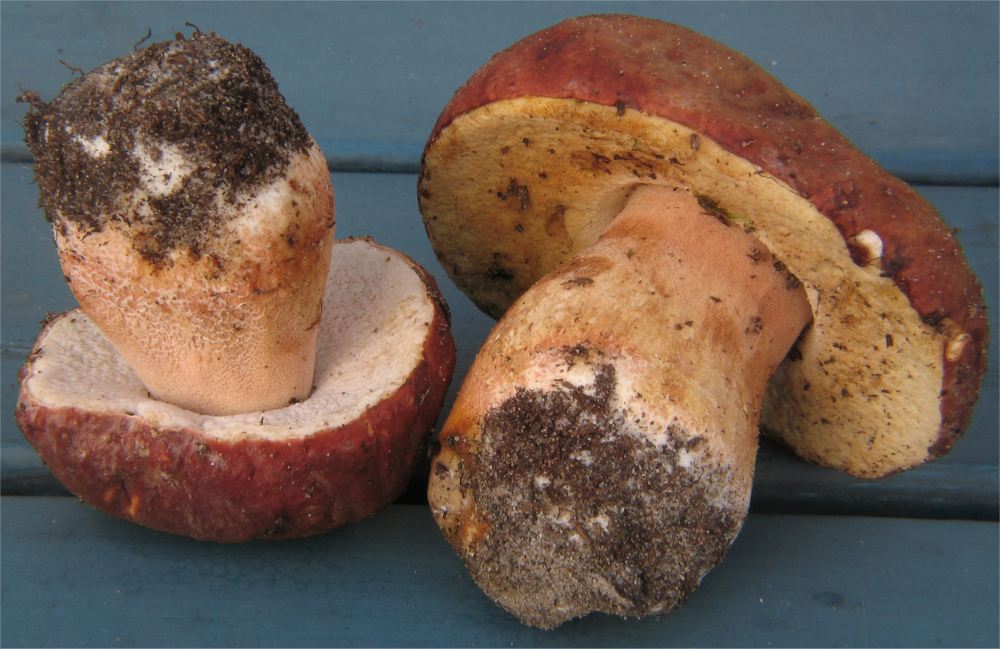
2. Boletus pinophilus — Pine Bolete
Identification
Pine Bolete resembles Porcini but usually has a darker reddish-brown or wine-brown cap. The stem is thick and commonly shows pale reticulation.
Its pores follow the familiar king bolete progression from white to yellow and finally olive. The flesh generally remains white when cut.
Habitat
It is strongly associated with pine and other conifers. Mossy conifer forests are classic habitat.
Compared with Boletus edulis, the cap often looks darker and redder. Host trees provide useful supporting evidence.
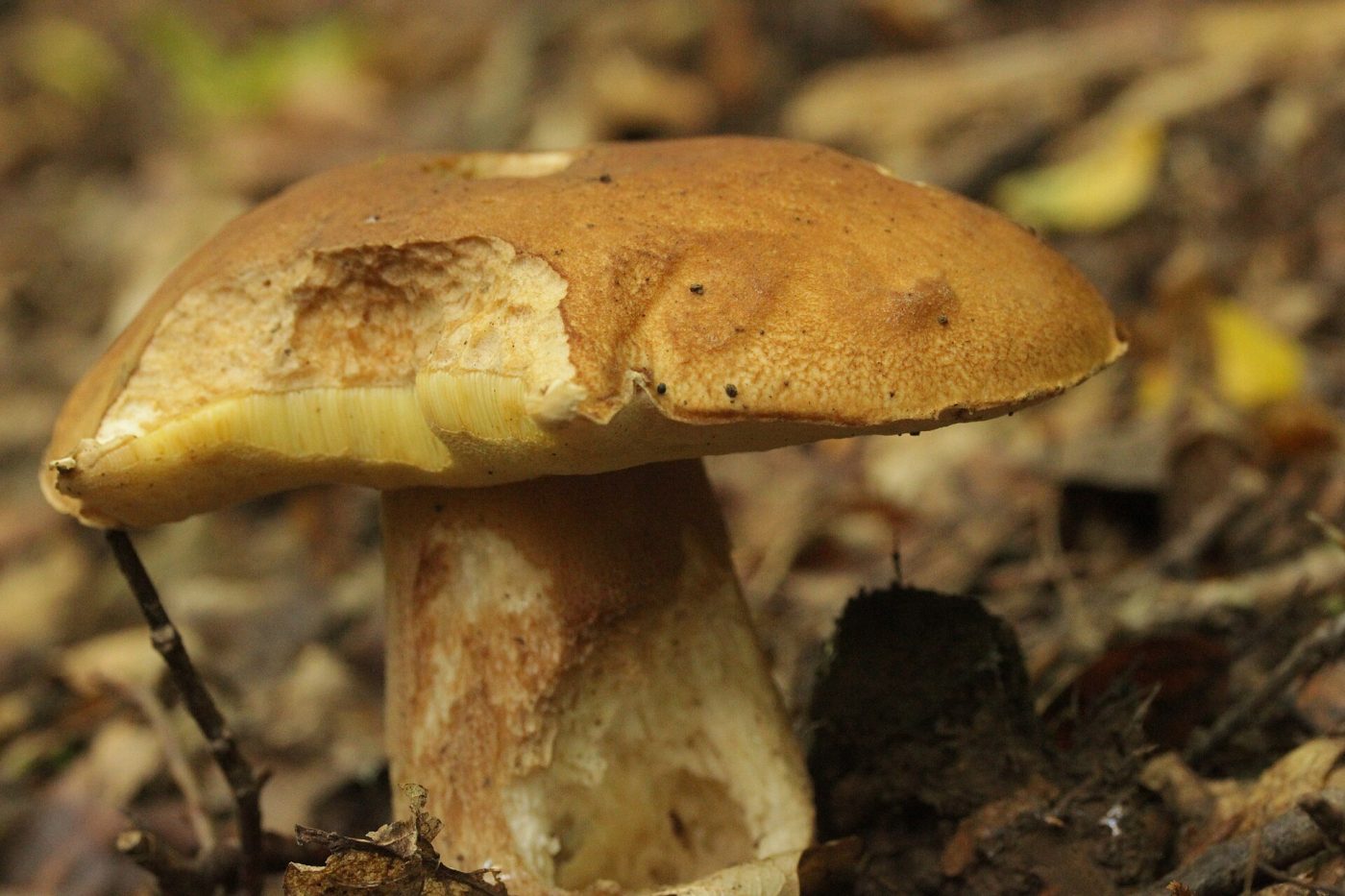
3. Boletus reticulatus — Summer Cep
Identification
Summer Cep typically has a warm tan to brown cap and a strongly reticulated pale stem. The cap is often dry or slightly velvety.
The pores begin pale and become yellow to olive with age. The flesh normally remains white without strong blue staining.
Habitat
Oak and beech are especially important hosts. The species often appears earlier in the year than classic autumn Porcini.
Warm broadleaf woodland is particularly suitable. Dry summer weather may cause the cap surface to crack.
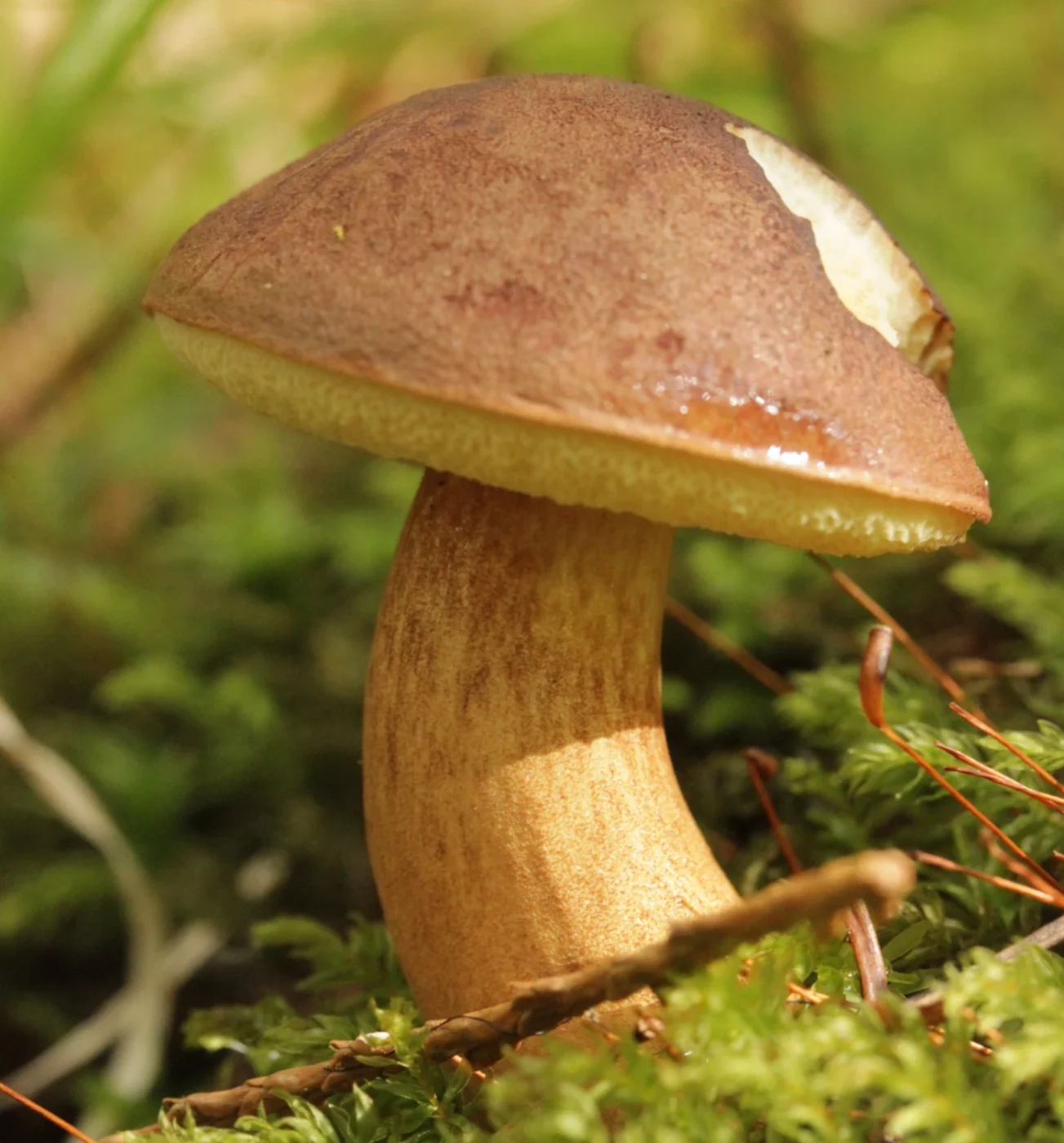
4. Imleria badia — Bay Bolete
Identification
Bay Bolete has a smooth chestnut-brown cap and yellow pores. The pore surface commonly turns blue when pressed.
The stem is usually brownish and lacks the strong pale reticulation of Porcini. The flesh may also show some blueing after cutting.
Habitat
Conifer and mixed forests are typical. Pine and spruce can both be associated with the species.
It often grows among moss, needles, and forest litter. Autumn can produce large numbers.
Main Clue
A brown cap plus yellow pores that bruise blue is a classic Bay Bolete combination.
5. Suillus luteus — Slippery Jack
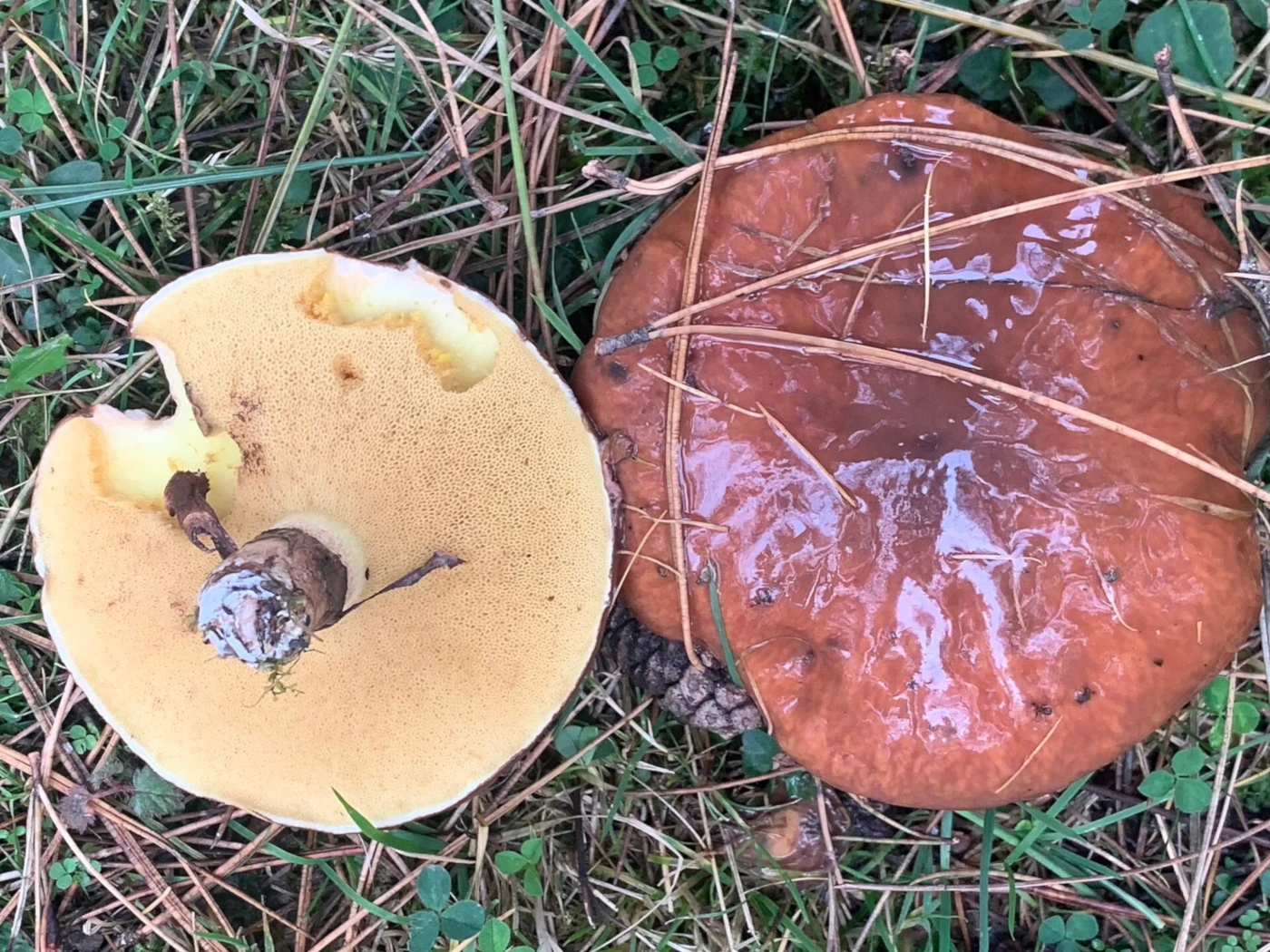
Identification
Slippery Jack has a brown cap that becomes extremely slimy in wet weather. Beneath it is a yellow pore surface.
The stem carries a distinct ring, which is one of its most useful features. Strong blue bruising is usually absent.
Habitat
The species is strongly associated with pine. It can appear in natural forests, plantations, parks, and grassy areas around planted pines.
Large groups are common after rain. The same site can fruit repeatedly.
Main Clue
The combination of yellow pores + slimy brown cap + ring + pine is highly characteristic.
6. Suillus granulatus — Weeping Bolete
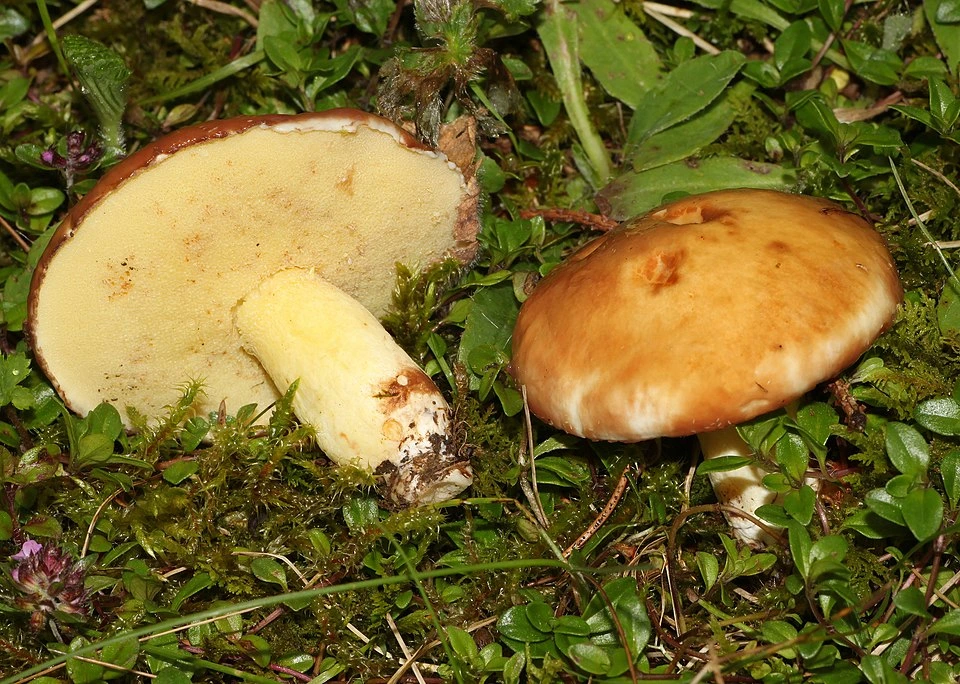
Identification
Weeping Bolete has a yellow-brown to orange-brown cap and yellow pores. Young specimens may produce tiny milky droplets from the pore surface.
The stem has small glandular dots but no ring. This immediately helps separate it from Suillus luteus.
Habitat
It is closely associated with pine and is common in plantations and grassy pine habitats. Young stands can be especially productive.
The pores usually do not show dramatic blue bruising.
Main Clue
Look for a ringless stem with glandular dots beneath a sticky brown cap.
7. Suillus bovinus — Bovine Bolete
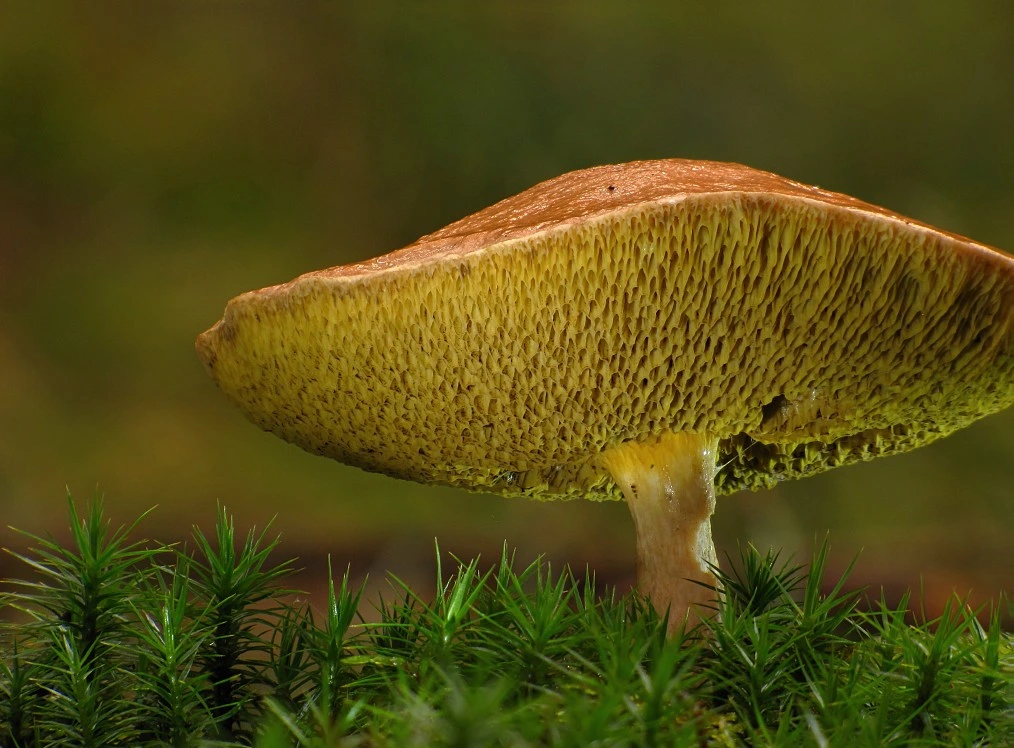
Identification
Bovine Bolete has a yellow-brown to orange-brown cap and relatively large, irregular pores. The pore surface becomes yellow to olive.
The stem is usually slender compared with many other boletes. A ring is absent.
Habitat
It grows with pine, often in acidic soil. Mossy pine forests can produce large groups.
The species frequently appears together with other Suillus species, so each fruit body should be checked separately.
Main Clue
The large irregular pores are particularly useful. They are much coarser than those of Slippery Jack.
8. Suillus variegatus — Velvet Bolete
Identification
Velvet Bolete has a yellow-brown to ochre cap with a dry, finely textured surface. Unlike many Suillus species, the cap is not strongly slimy.
The pores are yellow to olive and may show some blue staining. The stem lacks a ring.
Habitat
It is associated mainly with pine and is particularly characteristic of acidic conifer habitats. Sandy soils and heath-like forests can be suitable.
Its dry cap makes it stand out within a genus famous for sticky mushrooms.
Main Clue
A dry textured cap plus yellow pores and pine habitat points toward this species.
9. Xerocomellus chrysenteron — Red Cracking Bolete
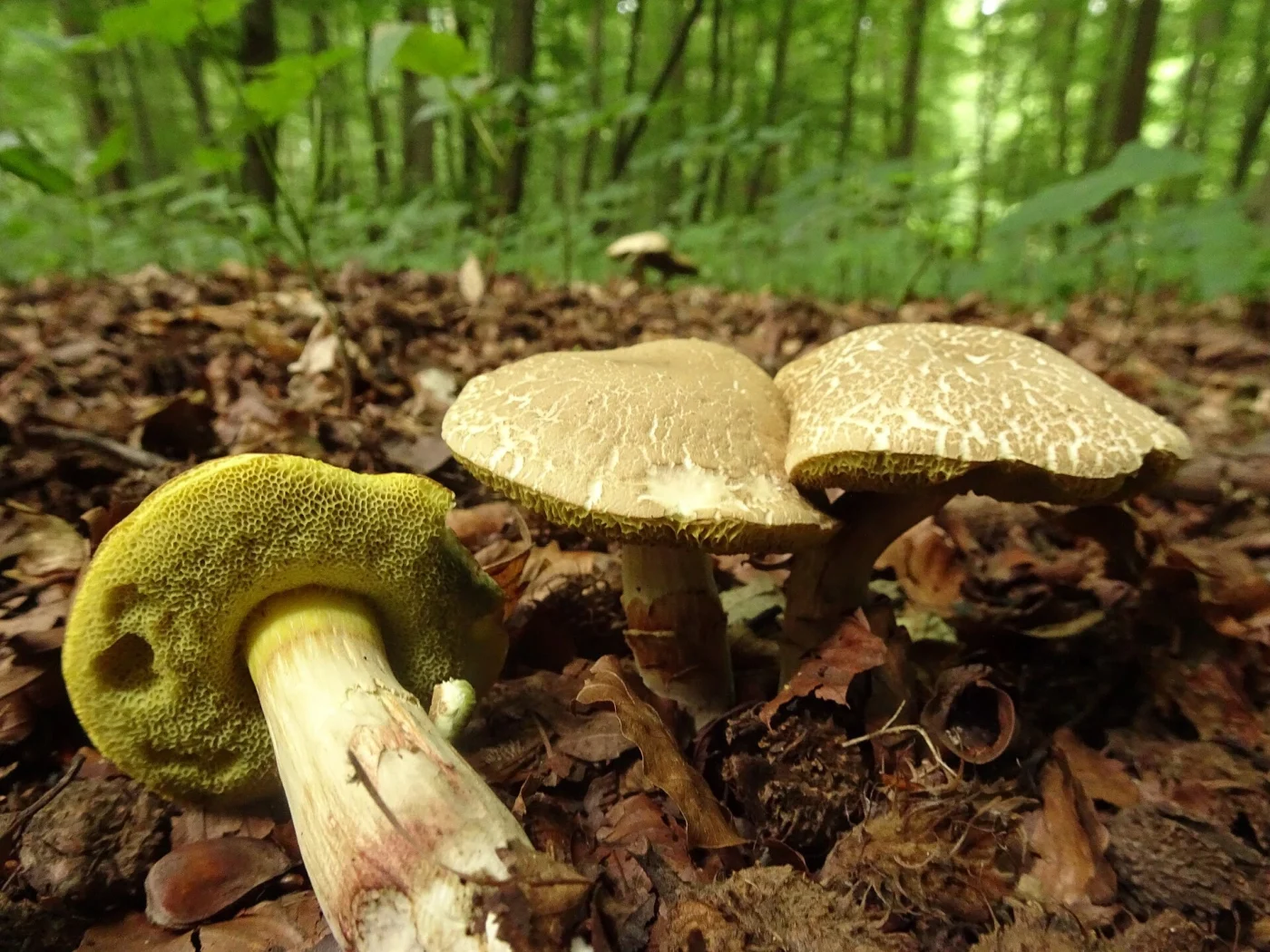
Identification
Red Cracking Bolete usually has a brown to olive-brown cap that develops cracks with age. Reddish tissue can become visible beneath those cracks.
The pores are yellow and often turn blue when bruised. The stem commonly shows yellow and reddish tones.
Habitat
It occurs in both broadleaf and coniferous woodland. Oaks, beeches, and other trees can be associated with it.
It is widespread and often appears in parks as well as forests.
Main Clue
Cracked brown cap exposing reddish tissue beneath, together with yellow blue-bruising pores, is a useful combination.
10. Butyriboletus appendiculatus Group — Butter Boletes
Identification
Butter Boletes are typically robust mushrooms with brown caps, bright yellow pores, and thick yellowish stems. Fine reticulation may be visible toward the upper stem.
The pale yellow flesh can show mild to moderate blueing, particularly near the cap or pore layer.
Habitat
Broadleaf woodland is typical, especially with oak and beech. Warm regions tend to be more favorable.
Several related species can look similar, so species-level identification may require careful geographic and ecological context.
Main Clue
The combination of a robust king-bolete-like shape with strongly yellow pores and yellow stem separates this group from classic Porcini.
11. Caloboletus calopus — Bitter Beech Bolete
Identification
Bitter Beech Bolete has a pale gray-brown cap and vivid yellow pores. The thick stem is often yellow near the top and red lower down.
The flesh can turn blue when cut. The mushroom is also famously bitter.
Habitat
Beech and other broadleaf trees are common hosts. It can also occur in mixed woodland depending on region.
The combination of yellow pores, red-yellow stem, and blue bruising can be dramatic.
Safety
The species is considered inedible because of its extreme bitterness. Yellow pores therefore clearly do not indicate edibility.
12. Cyanoboletus pulverulentus — Ink-Stain Bolete
Identification
Ink-Stain Bolete has a brown cap, yellow pores, and a yellowish stem that may show reddish tones. Almost every damaged surface can turn blue very rapidly.
The blue reaction may become so dark that bruised tissue appears nearly black. Few boletes show such an intense color change.
Habitat
It occurs in broadleaf and mixed woodland. Oak and beech can be associated with it in Europe.
The species can be smaller and more slender than massive king boletes.
Main Clue
Very rapid dark blue staining across the pore surface, stem, and flesh is the defining visual feature.
Yellow Pores That Turn Blue
Blue bruising is common among several yellow-pored boletes. Bay Bolete, Red Cracking Bolete, Butter Boletes, Bitter Beech Bolete, and Ink-Stain Bolete can all show some degree of blue staining.
The speed and intensity vary dramatically. Some species develop only a faint blue tone, while others change within seconds.
Blue Does Not Mean Poisonous
Blue bruising is a chemical oxidation reaction. It does not provide a direct test for toxicity.
Edible, inedible, and poisonous boletes can all turn blue. The reaction should therefore be treated as an identification feature rather than a safety test.
Yellow Pores That Do Not Turn Blue
Classic king boletes such as Boletus edulis, B. pinophilus, and B. reticulatus usually retain white flesh and show little or no strong blue staining.
Several Suillus species also show weak or absent blue bruising. This makes them easier to separate from strongly reactive boletes when other features agree.
The lack of blueing is still not proof of edibility. Bitter and otherwise unsuitable species may also show little reaction.
Yellow Pores and Stem Patterns
The stem often provides the next major clue after pore color. Reticulation, glandular dots, red dots, a ring, or a smooth surface can all point toward different groups.
A pale network suggests one identification path, while a red-yellow stem without reticulation suggests another.
Reticulation
King boletes often have a net-like pattern on the stem. In edible Porcini-type species, the network is usually pale.
Dark or strongly contrasting reticulation may suggest a look-alike such as Bitter Bolete, although that species often develops pink rather than yellow mature pores.
Glandular Dots
Tiny dots are particularly useful in Suillus. Suillus granulatus is a classic example.
Combined with pine habitat and a lack of ring, these dots can be more informative than the cap color.
Yellow Pores Under Pine Trees
Pine forests are especially rich in yellow-pored boletes. Suillus luteus, Suillus granulatus, Suillus bovinus, Suillus variegatus, Pine Bolete, and Bay Bolete can all occur in pine habitats.
This makes host-tree identification extremely useful. Several similar brown boletes may grow within only a few meters of one another.
A mushroom under pine should still be identified structurally first. Habitat narrows the possibilities but does not determine the species.
Yellow Pores Under Oak and Beech
Broadleaf woodland supports another major set of yellow-pored boletes. Summer Cep, Butter Boletes, Bitter Beech Bolete, and Ink-Stain Bolete can all occur around oak or beech.
Warm broadleaf forests can contain several bolete species fruiting simultaneously. Pore color must therefore be combined with bruising and stem characters.
The same oak may even support more than one mycorrhizal bolete species during the same season.
How to Identify a Yellow-Pored Bolete Step by Step
Start by confirming that the underside really consists of pores rather than gills. Then note whether the pores are lemon-yellow, golden, olive-yellow, or changing from white with age.
Next, test a small area for bruising and examine the stem closely. Finally, identify nearby trees and consider geography and season.
Step 1: Check the Pores
Look at pore size as well as color. Fine round pores and large angular pores can point toward different genera.
Also compare younger and older specimens. Mature pore color is often much more informative.
Step 2: Test Bruising
Press a small area of the pore surface and watch for several minutes. Record whether it remains yellow, turns pale blue, or rapidly becomes dark navy.
A cut through the cap and stem can reveal a different reaction inside. Some boletes blue only in selected areas.
Step 3: Examine the Stem
Look for a ring, reticulation, glandular dots, red coloration, or a completely smooth surface. Stem ornamentation is often essential.
Photograph the upper and lower stem separately if necessary. Small details may be difficult to see in a full-body image.
Step 4: Identify the Host Trees
Pine, spruce, oak, beech, and birch support different bolete communities. A correct host identification can significantly narrow the possibilities.
In mixed forest, check all nearby trees. Mycorrhizal roots can extend several meters from the trunk.
How to Photograph Yellow-Pored Boletes
Take one photograph showing the entire mushroom before handling it. Include the surrounding habitat and nearby trees if possible.
Then photograph the pore surface in natural light. Artificial warm lighting can make yellow pores look orange or brown.
A close-up of the stem should record reticulation, dots, rings, or color zones. Finally, photograph bruising before and several minutes after damage.
Can AI Identify Yellow-Pored Boletes?
AI can often narrow a mushroom to the correct bolete group when the pore surface and stem are visible. Yellow pores are a useful visual clue, but they are shared by many species.
The hardest distinctions involve similar brown-capped boletes with nearly identical pore colors. Bruising speed, stem ornamentation, host tree, and geography can significantly improve accuracy.
A cautious AI system should sometimes return several possible species rather than force one exact identification. This is especially important in taxonomically difficult bolete groups.
Common Identification Mistakes
One common mistake is calling every yellow-pored brown mushroom Porcini. Many Suillus, Xerocomellus, Imleria, Caloboletus, and related boletes share similar colors.
Another mistake is treating blue bruising as a toxicity test. The reaction occurs across edible and inedible species.
A third mistake is ignoring age. White young pores, bright yellow mature pores, and olive old pores can all belong to the same species.
Interesting Facts About Yellow-Pored Boletes
Boletes are unusually useful for visual identification because their chemistry can produce dramatic color reactions. In some species, damaged yellow tissue becomes blue almost instantly as compounds oxidize after exposure to air.
The king bolete group shows a completely different strategy. Their flesh generally stays white, while the pore layer slowly changes from white through yellow to olive as spores mature.
Many Suillus species are exceptionally closely tied to pine roots. Humans have unintentionally helped spread some of these fungi around the world by planting compatible pine species far outside their native ranges.
Pore shape itself can also change as a mushroom grows. Small round openings may become stretched and irregular as the cap expands, meaning one species can look noticeably different at different ages.
Frequently Asked Questions
Why are the pores brighter yellow on some mushrooms after rain?
Hydrated tissue often appears more saturated and vivid. As the mushroom dries, the same pores may look duller, paler, or more olive.
Can yellow pores become brown without passing through olive?
Yes. Aging, drying, handling, and spore deposits can alter the appearance of old pore surfaces. Fresh undamaged sections are best for judging the original color.
Why do some boletes have yellow pores but white flesh?
Pore tissue and cap flesh can contain different concentrations of pigments and reactive compounds. Their colors therefore do not need to match.
Can insects change the color of the pore layer?
Yes. Larvae and slugs damage tissue and can cause brown, blue, or darkened patches. Intact areas provide more reliable identification clues.
Why can the same species bruise strongly one day and weakly another?
Moisture, temperature, age, and tissue condition all affect oxidation reactions. Fresh hydrated mushrooms usually show the clearest response.
Can the pore layer be removed from a bolete?
In many mature boletes, the tubular layer separates fairly easily from the cap flesh. This is a structural feature of boletes but is not enough to identify the species.
Why do very young boletes sometimes seem to have no visible pores?
The openings can be extremely small when the mushroom is young. From a distance, the underside may look almost like a smooth pale surface.
Are yellow pores useful if the mushroom is already very old?
Less so. Old pores can become olive, brown, stained, or damaged, so stem features, habitat, and younger nearby specimens become more important.
Final Identification Notes
Yellow pores are an excellent starting point for bolete identification, but they are not a final answer. Porcini, Bay Bolete, Slippery Jack, Weeping Bolete, Butter Boletes, Bitter Beech Bolete, and Ink-Stain Bolete can all show yellow pore surfaces while differing greatly in bruising, ecology, and edibility.
After checking pore color, examine the stem and watch for bruising. Reticulation, glandular dots, rings, red coloration, and host trees are often what separate one species from another.
The most useful rule is simple: yellow pores tell you where to start; the stem, bruising reaction, and habitat tell you where to finish.
Upload a photo and get possible matches in seconds.