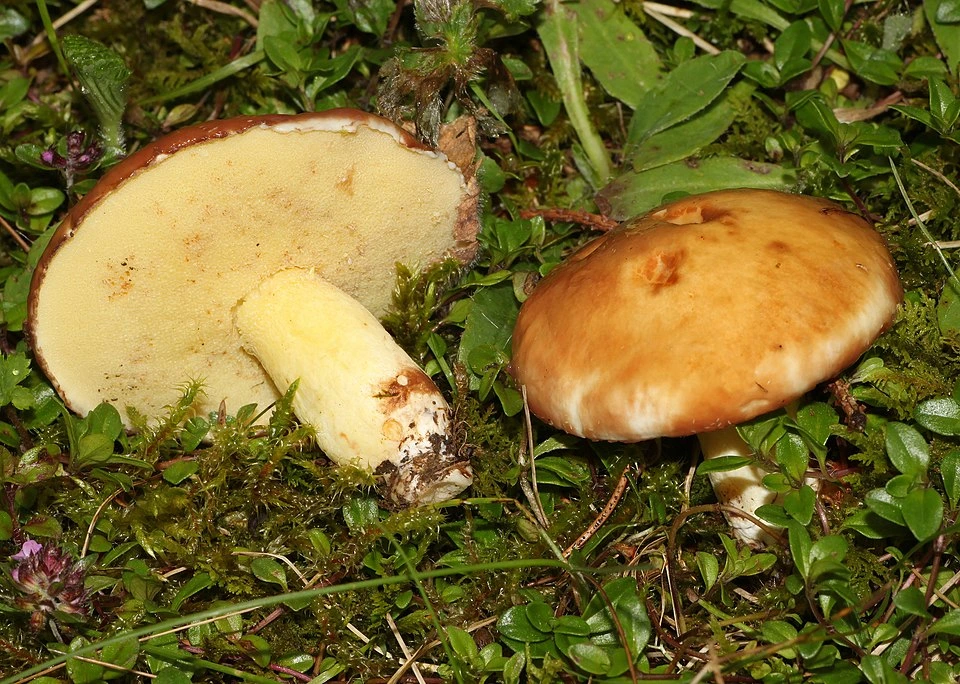
Suillus granulatus, commonly known as the Weeping Bolete or Granulated Bolete, is a pine-associated mushroom with a smooth yellow-brown cap, yellow pores, and a pale stem covered with small glandular dots. Young specimens may produce tiny milky droplets from the pore surface, which is one of the features behind the common name “Weeping Bolete.”
It is especially common in pine forests, plantations, grassy areas beneath pines, and other places where compatible pine roots are present. Identification is usually straightforward when you combine the lack of a ring, glandular dots on the stem, yellow pores, sticky cap, and strong association with pine.
Important: This guide is for identification and education only. Never eat a wild mushroom based solely on photographs, AI identification, or an online comparison.
Quick Identification
| Feature | Suillus granulatus |
|---|---|
| Scientific name | Suillus granulatus |
| Common names | Weeping Bolete, Granulated Bolete |
| Family | Suillaceae |
| Cap color | Yellow-brown, ochre, orange-brown |
| Cap surface | Smooth, often sticky when wet |
| Underside | Yellow pores |
| Young pore reaction | May exude milky droplets |
| Stem | Pale yellow to cream |
| Stem pattern | Small glandular dots |
| Ring | Absent |
| Flesh | Pale yellow, soft with age |
| Bruising | Usually little dramatic blueing |
| Spore print | Brown to olive-brown |
| Ecology | Mycorrhizal |
| Main host | Pine |
| Season | Summer through autumn |
| Edibility | Edible when correctly identified |
| Main look-alikes | Suillus luteus, Suillus collinitus, other ringless Suillus species |
What Does Suillus granulatus Look Like?
The Weeping Bolete has the classic Suillus appearance: a smooth brownish cap, yellow sponge-like pores underneath, and a pale stem. Young mushrooms are usually compact, while mature specimens become broader and softer.
The cap is often glossy or sticky after rain. The stem lacks a ring and develops many tiny brownish or reddish glandular dots, particularly toward the upper half.
Young pore surfaces may produce small pale droplets. These droplets can leave darker spots as they dry, making mature specimens look more speckled underneath.
Cap
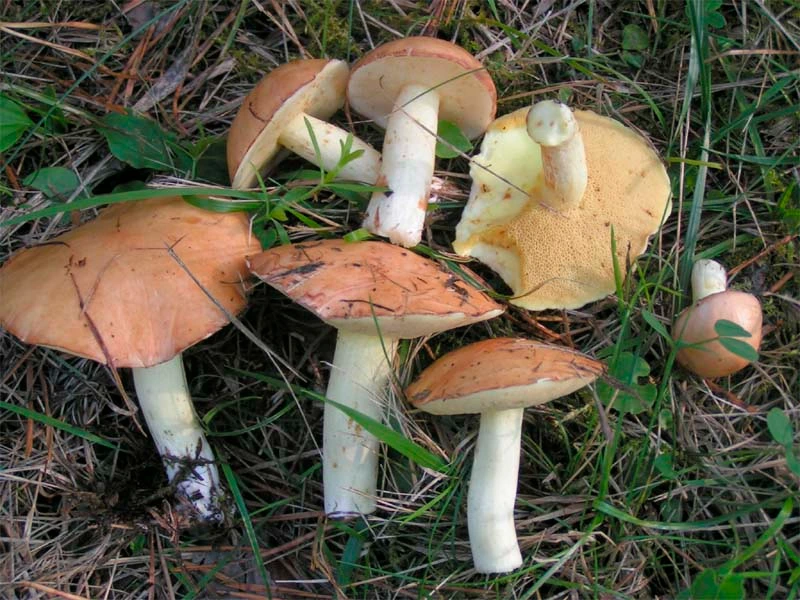
The cap usually begins rounded and convex, then gradually flattens with age. Color ranges from pale ochre and yellow-brown to orange-brown or chestnut.
The surface is smooth and can become noticeably sticky when wet. In dry weather, it may appear much more matte and slightly paler.
Cap Margin
Young caps often have a smooth, slightly curved margin. Unlike Suillus luteus, there is no partial veil creating a ring on the stem.
The margin can become somewhat irregular in older specimens. Weathering and insect damage may also change the appearance considerably.
Pores
The underside has pores rather than gills. Young pores are pale yellow and gradually become deeper yellow or olive-yellow as the mushroom matures.
The pores are relatively small but become more visible with age. Pressing them usually does not produce the strong blue staining seen in some other boletes.
The “Weeping” Droplets
Young specimens may exude tiny milky or clear droplets from the pore surface. These are especially noticeable in humid weather.
The droplets can dry into small brownish marks. This feature is useful but not always present, so it should be treated as supporting evidence rather than a requirement.
Stem
The stem is pale cream to yellowish and usually fairly cylindrical. It lacks a ring, which is one of the easiest ways to separate it from Suillus luteus.
Small glandular dots often cover the upper stem. These can be yellowish at first and become brownish or reddish with age.
Glandular Dots
The dots are tiny and can look like pinpricks or speckles. They are produced by glandular structures and are a classic feature in several Suillus species.
In Suillus granulatus, these dots are usually especially noticeable near the pore surface. They help distinguish the species from boletes with smooth or strongly reticulated stems.
Flesh
The flesh is pale yellow to cream and relatively soft. Young mushrooms are firmer, while older fruit bodies become increasingly spongy.
Strong blue bruising is not a typical feature. A bolete that turns deep blue rapidly after cutting should lead you toward another group.
Texture
The cap flesh can become watery or soft in wet weather. The pore layer also becomes increasingly spongy as the mushroom matures.
Older specimens are often heavily attacked by insects. Young firm fruit bodies provide the clearest identification features.
Smell
The smell is mild and mushroom-like. It is not usually strong enough to function as a primary identification feature.
Odor can vary with age and freshness. Cap texture, stem dots, pore color, and pine association are much more useful.
Spore Print
The spore print is brown to olive-brown. This is typical of many boletes and helps confirm the broader group.
Spore color is not especially useful for separating Suillus granulatus from close relatives. Ecology and stem structure are more practical in the field.
Where Does Suillus granulatus Grow?
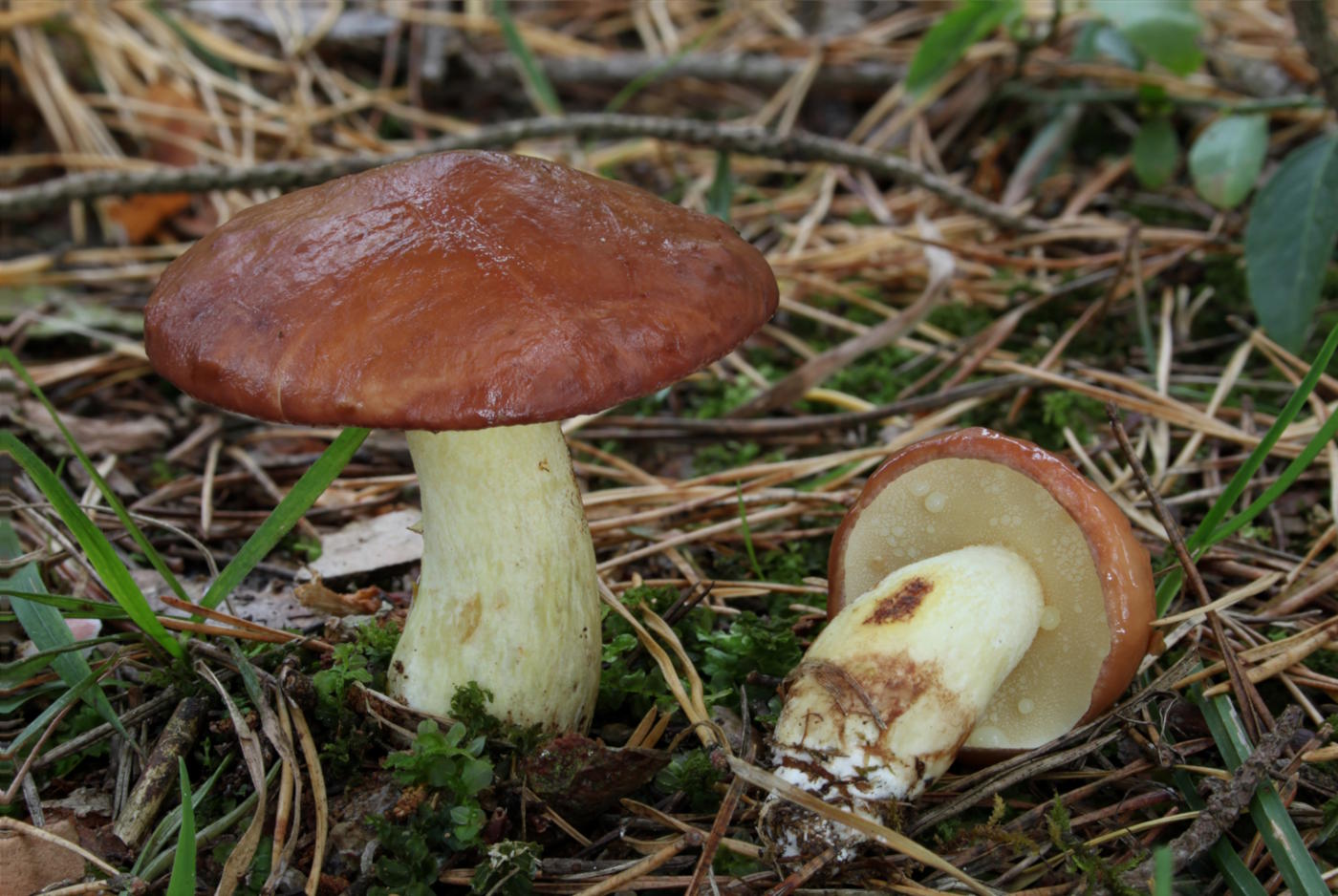
Suillus granulatus forms mycorrhizal relationships with pine roots. It therefore grows from soil rather than directly from wood.
Pine forests, young plantations, woodland edges, grassy parks beneath pines, and roadside pine plantings can all support the species. The mushroom may appear several meters from the nearest trunk because pine roots extend far through the soil.
Pine Association
Pine is one of the strongest identification clues. Suillus granulatus is especially associated with two-needled pines and other compatible Pinus species. This relationship can make the species very common in planted pine forests outside its original range. Where pines have been introduced, their fungal partners may follow.
Pine Plantations
Young pine plantations can produce large numbers of Suillus mushrooms. The fungi often colonize relatively disturbed or grassy soil around the trees. This makes Weeping Bolete easier to encounter than many old-forest fungi. It can appear in places that do not look like traditional woodland at all.
When Does Suillus granulatus Grow?
The main season is summer through autumn in temperate regions. Fruiting often increases after sustained rainfall. Warm conditions combined with moist soil are particularly favorable. In mild climates, the season can continue well into late autumn.
Weather and Fruiting
A dry summer can suppress fruiting even when healthy mycelium remains underground. Once rainfall returns, large groups may appear quickly. Several fruit bodies often develop in the same patch. Productive sites can return in later years when weather conditions are suitable.
Distribution
Suillus granulatus is widespread across Europe and parts of Asia and has also been introduced to other regions together with planted pines. It can now be found in many temperate areas where compatible pine species grow.
The exact distribution is strongly influenced by forestry and tree planting. This makes it a good example of how fungi can expand their range alongside their host trees.
Is Suillus granulatus Edible?
The Weeping Bolete is generally considered edible when correctly identified and properly prepared. It is not usually rated as highly as Porcini because the texture can become soft and the cap surface may be slimy.
Some people remove the cap skin before cooking. Older specimens are usually less desirable because they become spongy and frequently contain insect damage.
Like other Suillus species, it can cause gastrointestinal discomfort in some people. Proper identification and sensible preparation remain important.
Suillus granulatus Look-Alikes
Most look-alikes are other Suillus species associated with pine. These mushrooms can share sticky caps, yellow pores, and glandular dots, so the ring, cap pattern, and stem structure become especially useful. Exact species identification can also depend on pine species and geography. In some regions, several similar ringless Suillus species occur together.
Suillus luteus — Slippery Jack
Identification
Suillus luteus has a brown sticky cap and yellow pores, making it one of the most obvious look-alikes. The key difference is that Slippery Jack has a distinct ring on the stem.
Young specimens may also show a partial veil covering the pores. As the mushroom expands, the veil tears and leaves the ring behind.
Main Difference
Weeping Bolete lacks a ring. Slippery Jack usually has a clear persistent ring or ring zone.
This is one of the easiest comparisons within the genus. If a brown sticky pine bolete has a substantial ring, S. luteus becomes much more likely.
Suillus granulatus vs Suillus luteus
| Feature | Suillus granulatus | Suillus luteus |
|---|---|---|
| Cap | Yellow-brown to orange-brown | Darker brown |
| Surface | Sticky when wet | Very slimy when wet |
| Ring | Absent | Present |
| Pores | Yellow | Yellow |
| Young pore droplets | Often present | Usually not characteristic |
| Stem | Glandular dots | Ring plus pale lower stem |
| Host | Pine | Pine |
The ring is the fastest field feature. Pore droplets and stem dots provide additional support for S. granulatus.
Suillus collinitus
Identification
Suillus collinitus is another ringless pine-associated species with a sticky brown cap and yellow pores. It can look extremely similar to S. granulatus.
The stem base may show pinkish mycelium, and the cap often has more obvious radial fibers or streaks. These details can be subtle.
Main Difference
Pinkish basal mycelium is one of the most useful clues for S. collinitus. The cap can also look more radially streaked than the smoother cap of S. granulatus.
This comparison can be difficult from photographs alone. Examining the stem base and habitat carefully helps.
Suillus bovinus — Bovine Bolete
Identification
Bovine Bolete has an orange-brown to yellow-brown cap and large irregular pores. The pore openings are usually more elongated and less compact than those of S. granulatus.
The stem is relatively slender and lacks the obvious glandular dots seen in Weeping Bolete. The overall mushroom often looks less robust.
Main Difference
The large irregular pore openings are the easiest clue. Suillus granulatus generally has smaller, more regular yellow pores.
Both may occur under pine, so habitat alone cannot separate them.
Suillus variegatus — Velvet Bolete
Identification
Velvet Bolete usually has a dry or finely textured yellow-brown cap rather than a strongly sticky one. The surface can look velvety or granular.
The pores are yellow to olive, and the flesh may show some blueing. Pine forests are a common habitat.
Main Difference
A dry textured cap points away from Suillus granulatus. Weeping Bolete is normally smoother and more slippery when wet.
The stem also lacks the same obvious pattern of glandular dots.
Weeping Bolete vs Bay Bolete
Bay Bolete, Imleria badia, has a brown cap and yellow pores but usually lacks the glandular-dot pattern of Suillus granulatus. It also commonly bruises blue on the pore surface.
The cap of Bay Bolete can be smooth and slightly sticky, which creates some overlap. Blue bruising and stem appearance are therefore especially useful.
Quick Comparison
| Feature | Weeping Bolete | Bay Bolete |
|---|---|---|
| Host | Strongly pine-associated | Conifer and mixed forests |
| Stem | Glandular dots | Smooth to fibrous |
| Blue bruising | Usually weak or absent | Common on pores |
| Ring | None | None |
| Cap | Sticky yellow-brown | Chestnut-brown |
| Pores | Yellow | Yellow |
The glandular dots are one of the best clues. Bay Bolete also tends to have a darker, more chestnut-colored cap.
How to Identify Suillus granulatus Step by Step
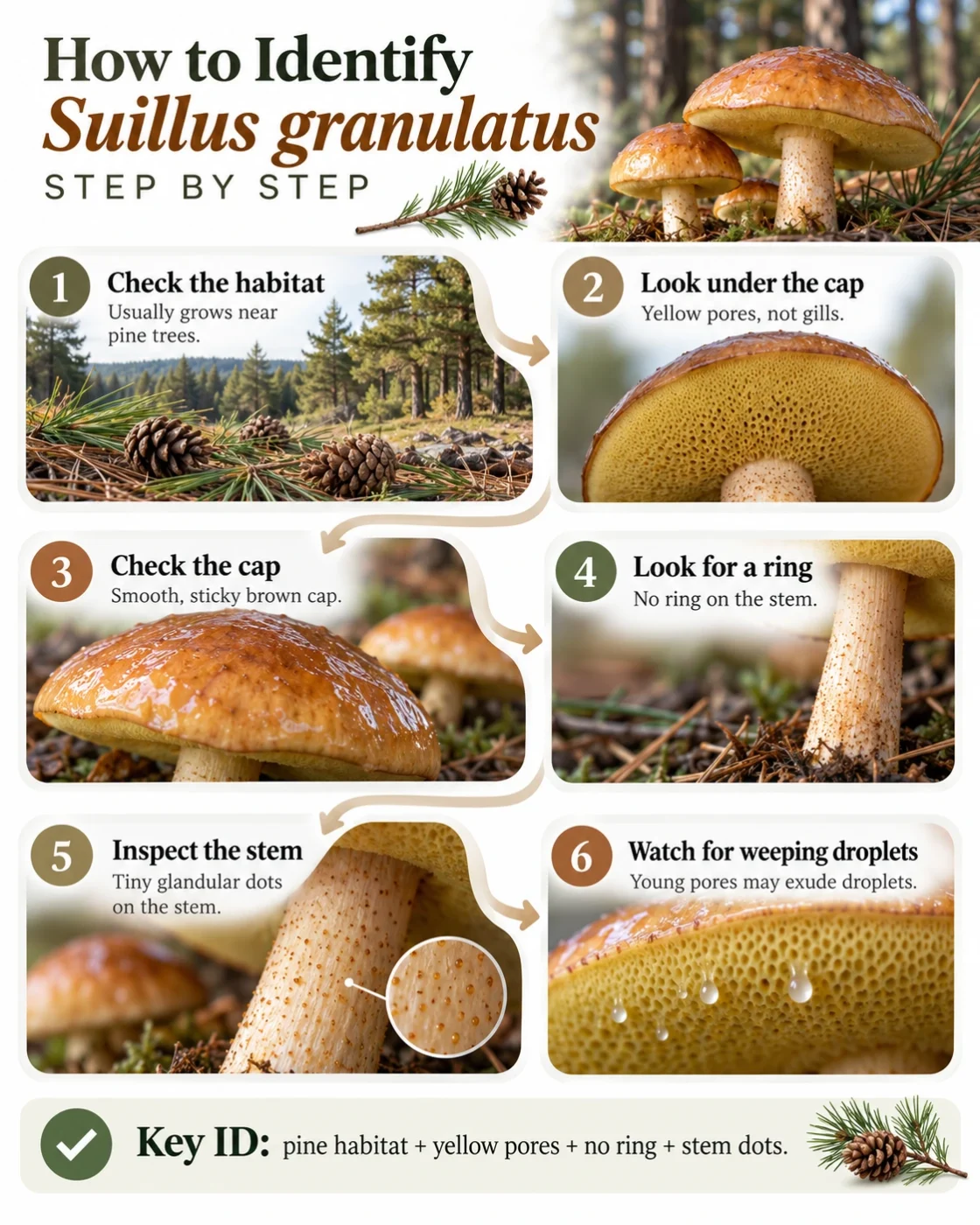
Start by confirming that the mushroom has pores rather than gills. Then check for a smooth sticky cap and yellow pore surface. Next, examine the stem carefully for glandular dots and make sure there is no ring. Finally, confirm that the mushroom is growing near pine.
Step 1: Check for a Ring
This is the fastest first test among common pine Suillus. A true Suillus granulatus should not have a persistent ring.
If a clear ring is present, compare the mushroom with Suillus luteus. Damaged old specimens can be less obvious, so check multiple fruit bodies if possible.
Step 2: Look at the Stem Dots
Inspect the upper stem in good light. Small dark or reddish glandular dots strongly support the Suillus granulatus group.
These dots can become more obvious with age. Young stems may initially look cleaner and paler.
Step 3: Check the Pore Surface
Young pores should be yellow and may produce small droplets. Mature pores become darker yellow or olive.
Strong blue bruising is not expected. A rapid blue reaction should lead toward another bolete.
Step 4: Confirm the Host Tree
Look for pine needles, cones, and bark. In mixed woodland, make sure the nearby conifer is actually pine rather than spruce or fir.
Host identification is particularly useful with Suillus. Many species have strong preferences for specific conifers.
Why Suillus Species Can Be Difficult to Separate
Several Suillus species share brown sticky caps, yellow pores, and pine habitat. This makes quick cap-only identification unreliable.
Ring presence, glandular dots, cap texture, pore shape, basal mycelium, and host species all become important. Some difficult specimens may remain best identified to genus or species group.
Modern taxonomy has also clarified relationships that older field guides treated more broadly. Regional identification therefore matters.
How to Photograph Suillus granulatus for Identification
Take a photo of the whole mushroom in its pine habitat. Include needles or cones when possible so the host tree is clear.
Then photograph the pore surface and the upper stem in close-up. The glandular dots should be sharp enough to distinguish them from ordinary dirt or discoloration.
A final image of the stem base can help separate close relatives. If young pore droplets are visible, photograph them before handling the mushroom too much.
Can AI Identify Suillus granulatus?
AI can often recognize a Suillus-type mushroom from its sticky brown cap, yellow pores, and pine habitat. Species-level identification becomes much stronger when the stem dots and lack of a ring are clearly visible.
Close relatives remain difficult because many share the same basic shape and color. A cap-only photograph may be enough for genus-level recognition but not for a confident species name.
Host-tree information can substantially improve the result. Photos showing pine needles, cones, and the complete stem are especially useful.
Common Identification Mistakes
One common mistake is calling every sticky brown pine bolete Slippery Jack. Several ringless Suillus species look similar but differ in stem structure and pore features.
Another mistake is ignoring the ring. The presence or absence of a ring immediately separates some of the most common species.
A third mistake is treating young pore droplets as mandatory. They can be absent in dry weather or older specimens, so the rest of the identification should still be checked.
Frequently Asked Questions
Why do some Weeping Boletes have no visible droplets at all?
Humidity, age, and freshness strongly affect the droplets. Dry or mature specimens may show none even when all other features fit Suillus granulatus.
Can the glandular dots rub off when the mushroom is handled?
They can become less obvious after repeated handling, rain, or surface damage. Fresh specimens usually show the pattern more clearly than old weathered ones.
Why are some caps much darker than others in the same patch?
Moisture, age, and exposure to sunlight can all affect cap color. Wet caps often look darker and glossier than dry specimens growing only a short distance away.
Can Suillus granulatus grow in lawns?
Yes, if pine roots are present beneath the grass. It can appear in parks, gardens, and roadside lawns even when the nearest pine trunk is several meters away.
Do young pine trees support this mushroom?
Yes. Suillus species are often especially successful with young pines and can appear in plantations relatively early after planting.
Why do older specimens become so soft underneath?
The pore layer expands and absorbs moisture as the mushroom matures. This creates the increasingly spongy texture typical of old boletes.
Can several Suillus species grow under the same pine trees?
Yes. A single pine stand can support multiple Suillus species, sometimes fruiting at the same time. Each mushroom should therefore be checked individually.
Can insect damage hide important identification features?
Yes. Larvae and slugs can damage pores, stems, and cap surfaces enough to obscure useful details. Fresher intact specimens are much better for identification.
Final Identification Notes
Suillus granulatus is best recognized by the combination of a smooth sticky yellow-brown cap, yellow pores, no ring, small glandular dots on the stem, occasional young pore droplets, and strong association with pine.
The most important look-alike is Suillus luteus, which normally has a distinct ring. Other ringless Suillus species require closer attention to pore shape, cap texture, basal mycelium, and stem markings.
For a strong identification, do not rely only on the “weeping” droplets. The complete combination of stem, pores, cap, and host tree is far more reliable.
Upload a photo and get possible matches in seconds.