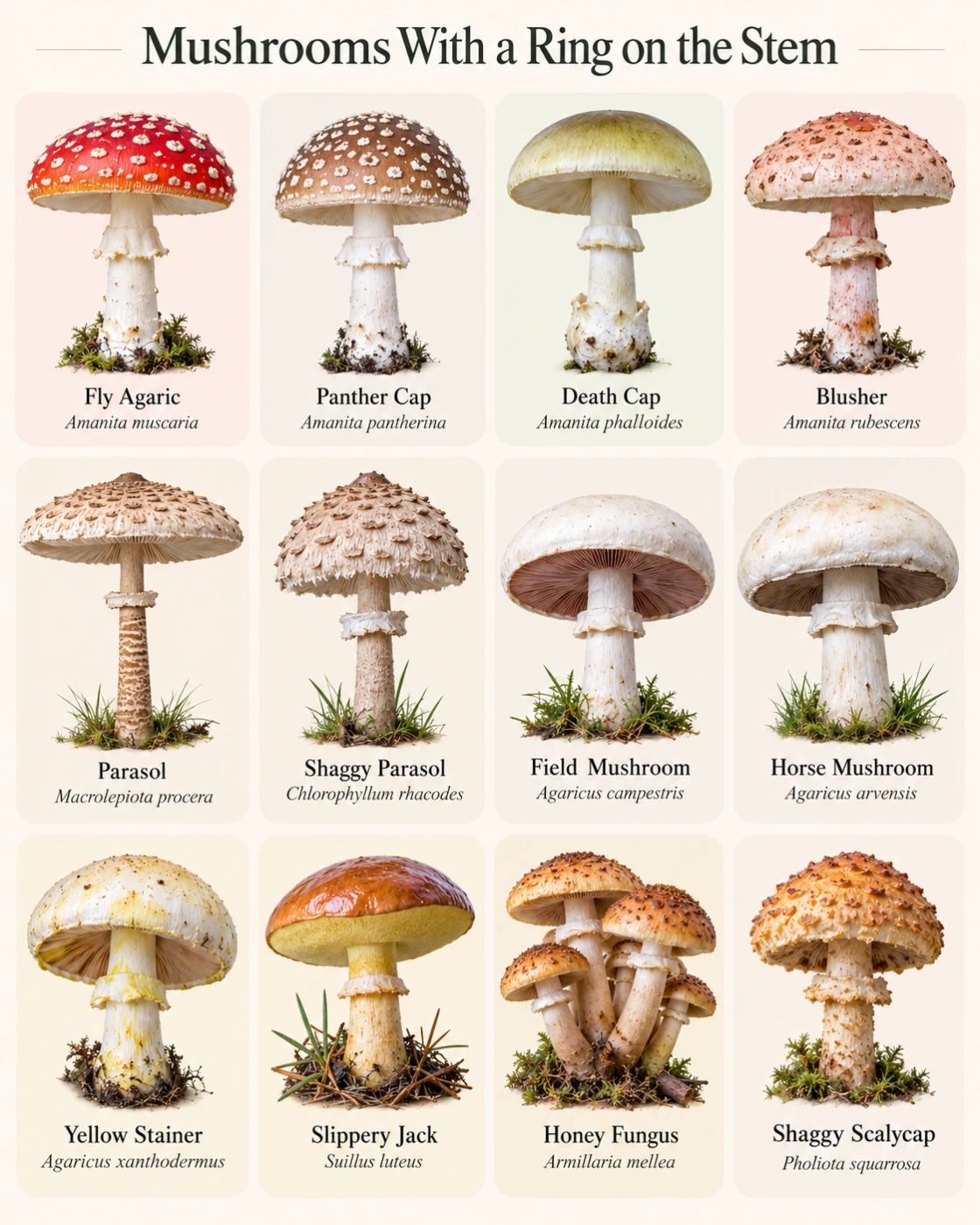
A ring on a mushroom stem can be one of the most useful identification clues in the field. It may indicate that the mushroom once had a partial veil covering the gills or pores while it was young, and the remains of that veil stayed behind as a ring when the cap expanded.
But a ring is not a species by itself, and it is not a sign that a mushroom is edible. Ringed stems occur in edible mushrooms, poisonous mushrooms, and some deadly species, so the ring should always be treated as one structural clue among several.
⚠️ Important: Never eat a wild mushroom simply because it has a familiar-looking ring. Always identify the whole mushroom, including the cap, underside, stem base, habitat, and other key features.
What Is a Ring on a Mushroom Stem?
The ring is also called an annulus. It forms when a partial veil that protected the young gills or pores tears as the mushroom expands.
The remaining veil tissue may stay attached to the stem as a skirt, collar, band, or fragile zone. In some species the ring is thick and persistent, while in others it disappears quickly.
Why the Ring Matters
A ring can immediately narrow down the possible groups. For example, many Amanita, Agaricus, Macrolepiota, and some Suillus species have obvious rings.
At the same time, related species may differ mainly in whether a ring is present or absent. This makes the ring especially useful in comparisons.
Different Types of Mushroom Rings
Not all rings look alike. Their shape and texture can be just as important as their presence.
Some rings hang downward like a skirt, some sit upright like a collar, and others are reduced to a thin band.
Hanging Skirt-Like Ring
This type is common in several Amanita species and in Parasol Mushroom. It often looks broad, membranous, and easy to see.
A large hanging ring can be very distinctive, but its exact structure should be combined with the stem base and cap features.
Movable Ring
Parasol Mushroom, Macrolepiota procera, is famous for having a ring that can often slide up and down the stem.
This feature helps distinguish it from many smaller lepiotoid mushrooms. However, it should not be used alone because ring mobility can vary with age and damage.
Fragile Ring
Some species have rings that tear or disappear quickly. Old specimens may retain only a faint ring zone or scattered veil fragments.
This is why a mushroom that appears ringless is not always truly ringless.
Ring Zone
In some mushrooms, the ring is not a distinct membrane but a colored band or roughened zone on the stem.
These subtle remnants can still be useful if other features support the identification.
12 Common Mushrooms With a Ring on the Stem
| Species | Common name | Ring type | Key clue |
|---|---|---|---|
| Amanita muscaria | Fly Agaric | Broad hanging ring | Red cap, white warts |
| Amanita pantherina | Panther Cap | Membranous ring | Brown cap, white warts |
| Amanita phalloides | Death Cap | Hanging ring | Volva at base, white gills |
| Amanita rubescens | Blusher | Hanging ring | Flesh reddens when damaged |
| Macrolepiota procera | Parasol | Large movable ring | Tall patterned stem |
| Chlorophyllum rhacodes group | Shaggy Parasol | Thick ring | Shaggy cap, reddening flesh |
| Agaricus campestris | Field Mushroom | Thin ring | Pink to brown gills |
| Agaricus arvensis | Horse Mushroom | Large ring | Yellowing, anise-like smell |
| Agaricus xanthodermus | Yellow Stainer | Ring present | Bright yellow bruising, unpleasant odor |
| Suillus luteus | Slippery Jack | Membranous ring | Slimy brown cap, yellow pores |
| Armillaria mellea group | Honey Fungus | Ring on many species | Clusters on roots or wood |
| Pholiota squarrosa | Shaggy Scalycap | Ring zone | Dense scales, wood habitat |
Amanita muscaria — Fly Agaric
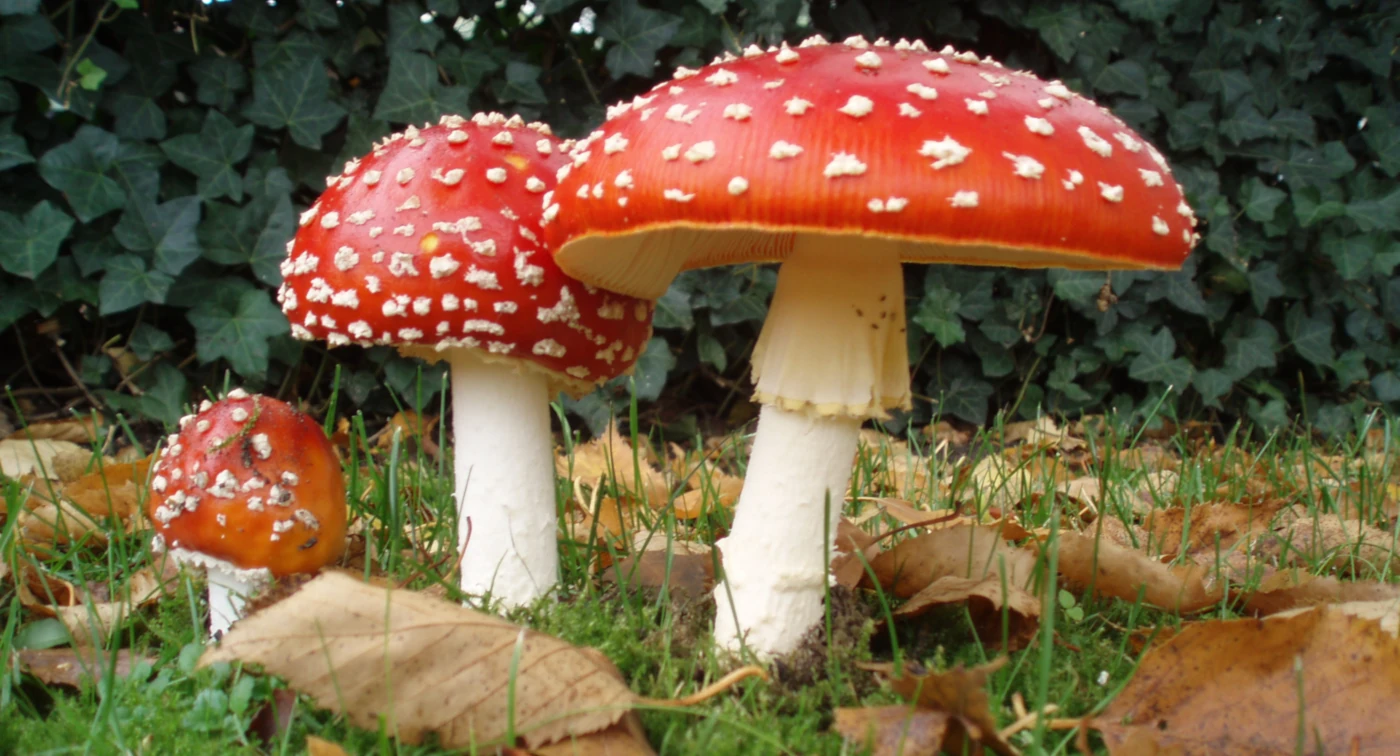
Fly Agaric has a white ring on the stem, usually broad and skirt-like. The cap is red to orange-red and often covered with pale veil remnants.
The stem base is bulbous and may carry additional veil remnants. This combination of ring plus bulb plus white gills points strongly toward Amanita.
Why the Ring Matters
The ring helps confirm that this is not simply a red-capped mushroom. It is part of a larger Amanita structure.
The base should always be examined because Amanita identification depends heavily on both ring and basal features.
Amanita pantherina — Panther Cap
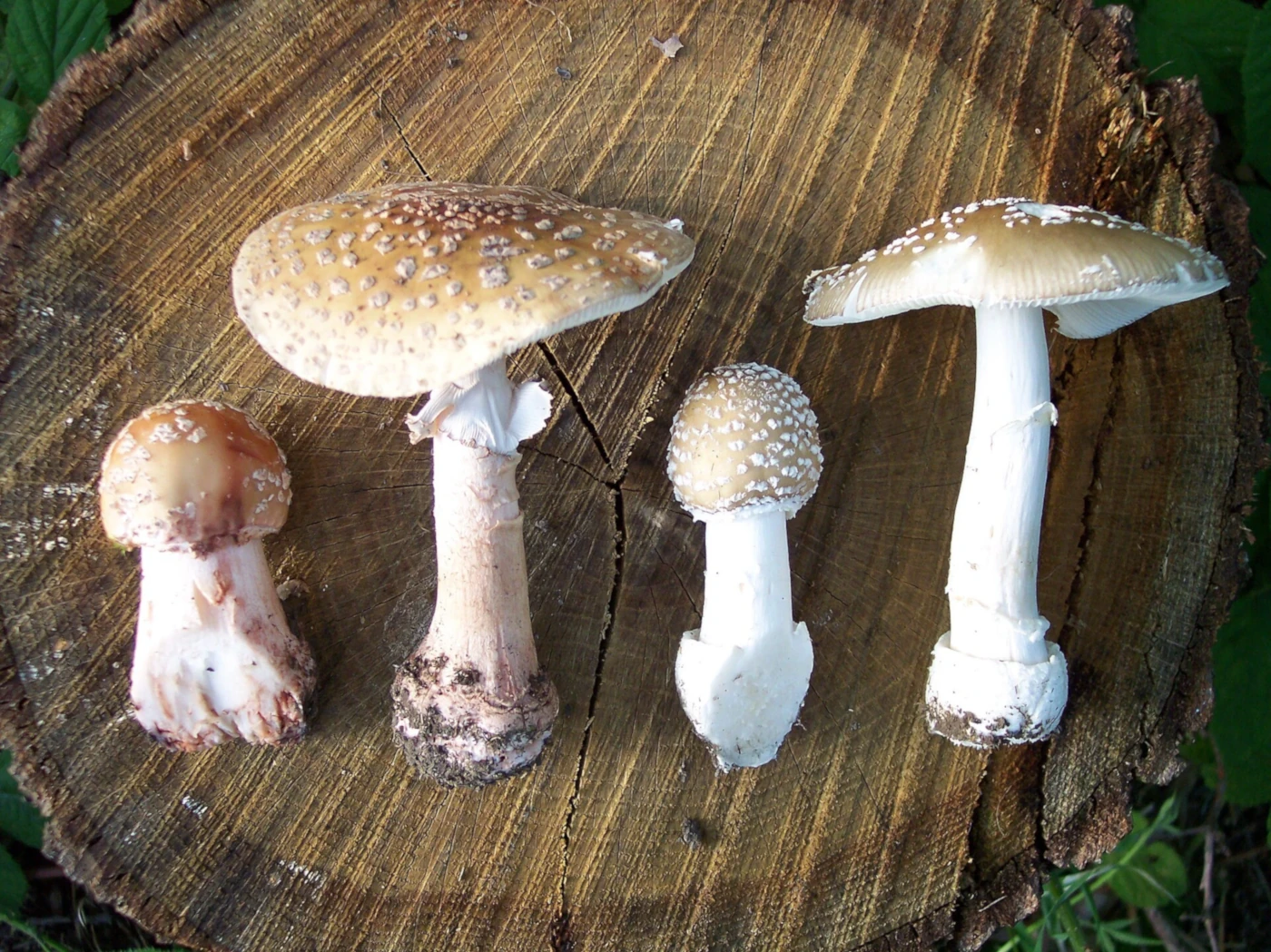
Panther Cap also has a ring, but the cap is brown to gray-brown with white veil patches. The margin is often clearly striate.
Its stem base usually has more defined veil remnants than Fly Agaric.
Why the Ring Matters
The ring helps separate the mushroom from ringless grisettes. However, the cap and bulb are more important for distinguishing exact Amanita species.
Amanita phalloides — Death Cap
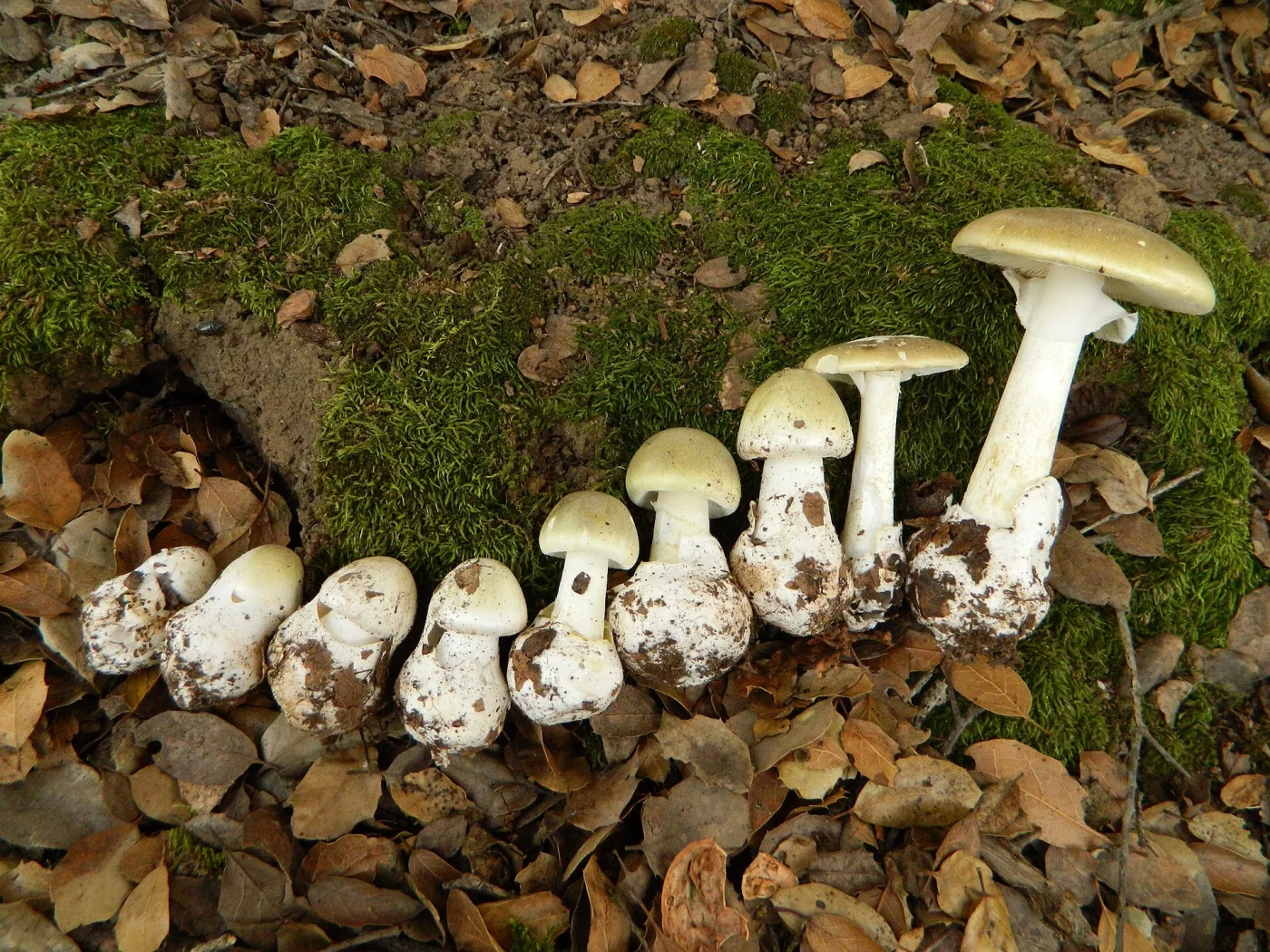
Death Cap has a pale to olive, yellowish, or greenish cap, white gills, a pale hanging ring, and a large sack-like volva at the base.
The volva is one of the most important features because the ring alone is shared with many harmless and edible mushrooms.
Safety Significance
This is one of the clearest examples of why a ring does not imply edibility. Death Cap is deadly poisonous.
Any pale ringed mushroom with white gills and a volva deserves extreme caution.
Amanita rubescens — Blusher
The Blusher has a ring and often a brownish or reddish-brown cap with pale veil patches. Damaged flesh develops reddish or wine-colored staining.
This bruising is one of its most useful identifying features.
Why the Ring Matters
The ring places it within the ringed Amanita group, but the reddening reaction separates it from several similar species.
Stem base structure should still be checked carefully.
Macrolepiota procera — Parasol
Parasol Mushroom has a large cap with brown scales, a tall stem with a snakeskin-like pattern, and a thick ring that can often move up and down.
It is one of the most recognizable ringed mushrooms when mature.
Movable Ring
The movable ring is a famous field feature. It is especially useful when combined with the patterned stem and very large size.
Small ringed lepiotoid mushrooms should not be assumed to be young Parasols.
Chlorophyllum rhacodes Group — Shaggy Parasol
Shaggy Parasols have large scaly caps and a prominent ring. The flesh often reddens or becomes orange after cutting.
The stem lacks the classic snakeskin pattern of Macrolepiota procera.
Main Difference From Parasol
A plain stem and stronger reddish bruising point toward Chlorophyllum. The cap scales are also often more coarse and shaggy.
Ring structure can help, but stem pattern and bruising are stronger clues.
Agaricus campestris — Field Mushroom
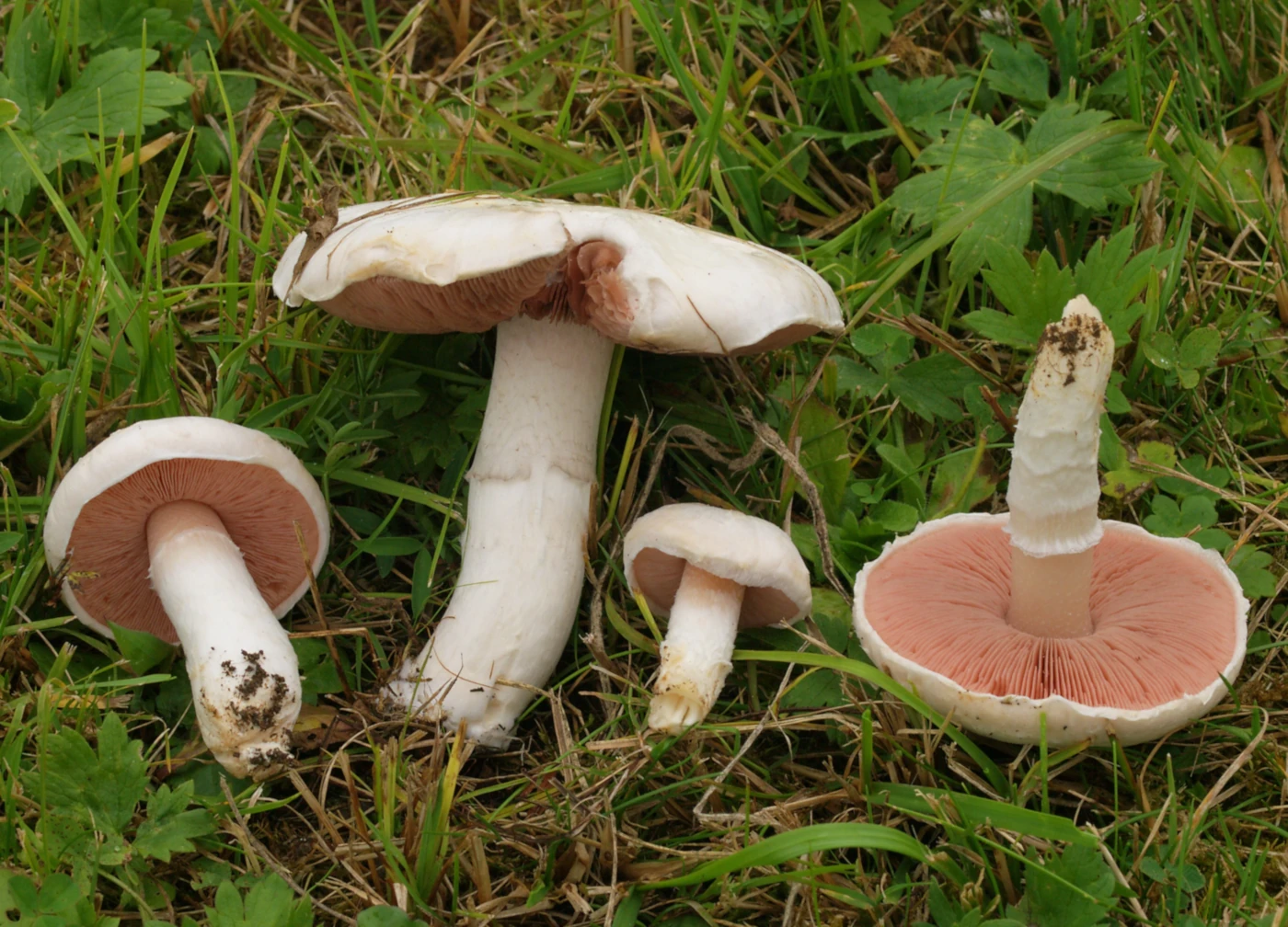
Field Mushroom has a white cap, pink young gills that become chocolate-brown, and a relatively modest ring.
It usually grows in grassy areas rather than deep woodland.
Why the Ring Matters
The ring supports identification as an Agaricus, but the gill color is more important. Amanitas usually keep white gills, while Agaricus gills darken with age.
This difference is critical in pale ringed mushrooms.
Agaricus arvensis — Horse Mushroom
Horse Mushroom is a large pale Agaricus with a substantial ring. It often develops some yellow staining and may have a sweet anise-like smell.
The gills begin pale pinkish and darken as spores mature.
Main Identification Clue
The combination of a large ring, darkening gills, yellowing tendency, and characteristic smell helps narrow the identification.
Agaricus xanthodermus — Yellow Stainer
Yellow Stainer has a white cap and a ring but bruises bright yellow, especially near the stem base. It often has an unpleasant chemical or phenolic odor.
It can cause gastrointestinal illness.
Why the Ring Can Mislead
At first glance, it can resemble edible Agaricus species. The ring does nothing to prove edibility.
Bruising and smell are much more important in this comparison.
Suillus luteus — Slippery Jack
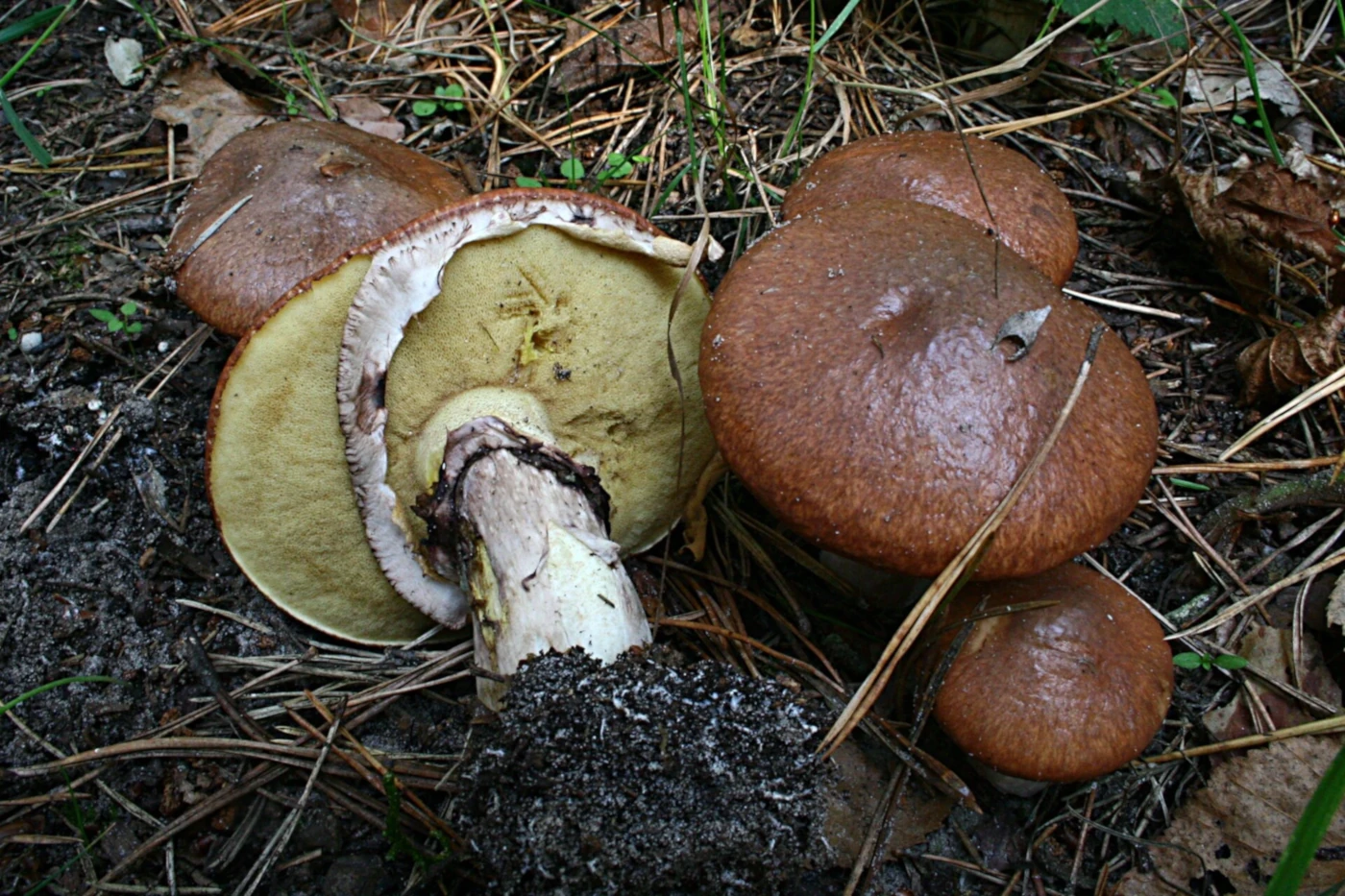
Slippery Jack is unusual among boletes because it has a ring. The cap is brown and very slimy when wet, while the underside has yellow pores instead of gills.
The ring forms from a partial veil covering the young pore surface.
Why the Ring Matters
This is one of the best examples of a ring being useful within a bolete group. Suillus luteus is easily separated from several similar ringless Suillus species by this feature.
Armillaria mellea Group — Honey Fungus
Many Honey Fungus species have a ring on the stem and grow in clusters around roots, stumps, or buried wood.
The cap is often honey-brown and may have darker scales.
Ring Variability
Not every honey mushroom relative is ringed. Some formerly grouped species are now placed in Desarmillaria and lack a ring.
This makes ring presence useful for narrowing the group, but not for identifying all honey mushrooms.
Pholiota squarrosa — Shaggy Scalycap
Shaggy Scalycap grows in dense clusters on or near wood and has prominent scales on the cap and stem.
A ring or ring zone may be visible on the upper stem.
Main Identification Clue
The combination of dense coarse scales, wood habitat, and clustered growth is more useful than the ring alone.
Ringed Mushrooms With White Gills
White gills plus a ring immediately bring several Amanita species to mind. This combination becomes especially important when the stem also has a swollen base or volva.
However, other mushrooms can also have pale gills and a ring. The base and gill attachment must still be checked.
Ring Plus Volva
A ring together with a sack-like volva is a major warning combination. It is especially important in species such as Death Cap.
The base should never be cut off and discarded during identification.
Ringed Mushrooms With Brown Gills
Many Agaricus species have a ring and gills that change from pink to dark brown as the mushroom matures.
This is very different from Amanitas, which usually retain white gills.
Why Gill Color Matters
A pale cap plus ring can look similar across genera. Mature gill color can quickly separate major groups.
This is one of the most practical examples of using multiple features together.
Ringed Mushrooms With Pores
Most ringed mushrooms people notice have gills, but some boletes also have rings. Suillus luteus is the classic example.
The underside immediately changes the identification pathway. Yellow pores plus a ring under pine suggest something very different from white gills plus a ring.
Ringed Mushrooms Growing on Wood
Honey mushrooms and some Pholiota species can have rings and grow in clusters from wood or buried roots.
This habitat can quickly narrow the possibilities. A ringed mushroom fruiting from a stump should not be approached the same way as a ringed mushroom growing alone from soil.
Why Rings Disappear
Rings can be fragile. Rain, insects, age, abrasion, and handling can all destroy them.
A mushroom that “has no ring” may actually have had one earlier in development.
Check Younger Specimens
If several mushrooms are growing together, compare different ages. Young fruit bodies often retain veil structures more clearly.
This can be especially helpful with Slippery Jack and some Amanitas.
How to Identify a Ringed Mushroom Step by Step
Start by confirming whether the mushroom has gills, pores, or another underside. This immediately narrows the major groups.
Then inspect the ring itself, the stem base, gill or pore color, habitat, and any bruising reactions.
Step 1: Check the Underside
White gills suggest one path, darkening gills another, and pores another entirely.
This should be the first major split in the identification.
Step 2: Examine the Ring
Ask whether it is broad, thin, hanging, movable, fragile, or only visible as a zone.
Ring structure can separate closely related groups.
Step 3: Check the Stem Base
Look for a volva, bulb, rooting base, or normal cylindrical stem.
This step is especially important in Amanitas.
Step 4: Look for Bruising
Yellowing, reddening, or other color changes can narrow identification dramatically.
This is useful in Agaricus, Chlorophyllum, and several Amanitas.
Step 5: Check Habitat
Soil, grass, pine roots, stumps, and buried wood all point toward different groups.
Habitat should confirm the structural identification rather than replace it.
How to Photograph a Ringed Mushroom
Take one side photograph showing the full stem and ring. Make sure the ring is not hidden behind the cap.
Then photograph the underside and the complete stem base. For Amanitas, gently expose the bulb and volva without cutting them off.
A close-up of the ring can also help show its thickness and texture. Habitat photos are useful for separating woodland, grassland, and wood-growing species.
Can AI Identify Mushrooms by the Ring?
AI can use ring presence as a strong structural clue, but it should never treat it as decisive. Many unrelated groups share this feature.
Accuracy improves significantly when the ring is shown together with gills or pores, stem base, bruising, and habitat.
A cap-only photo often misses the ring entirely. Side views are therefore especially important.
Common Identification Mistakes
One common mistake is assuming a ring means the mushroom is edible. Some of the most dangerous mushrooms in the world have rings.
Another mistake is failing to check whether the ring is actually part of the mushroom or just torn cap tissue or debris. A true ring should be structurally connected to the stem.
A third mistake is overlooking an old damaged ring and wrongly concluding the mushroom belongs to a ringless species.
Interesting Facts About Mushroom Rings
The ring is a remnant of a temporary protective structure. In young mushrooms, the partial veil shields developing gills or pores before the cap opens.
Some species retain a dramatic ring for most of their life, while others lose it within hours or days. This makes ring persistence itself an identification feature.
The ring can also reveal developmental history. A mushroom with a movable ring, for example, shows that the veil separated in a very different way from one with a fragile ring zone.
In evolutionary terms, rings have appeared in many unrelated mushroom groups. This is why the same feature can occur in boletes, Amanitas, Agaricus, parasols, and wood-growing species.
Frequently Asked Questions
Can a mushroom have two rings?
Some species can appear to have multiple ring zones or stacked veil remnants. This is usually caused by complex veil structures rather than two completely separate rings.
Can rain remove a ring completely?
Yes. Thin rings can tear, collapse, or wash away, especially in older specimens.
Why are rings sometimes darker than the stem?
Spores, dirt, and moisture can collect on the upper surface of the ring. In dark-spored species this can make the ring look brown or rusty.
Can a ring change color with age?
Yes. White rings can become cream, brown, stained, or translucent as they age.
Are young mushrooms easier to identify by the ring?
Often yes, because veil structures are fresher and less damaged. However, very young mushrooms may still have the veil closed and not yet show a mature ring.
Can a ring be hidden under the cap?
Yes. In small or young specimens, the ring may sit very close to the gills and be difficult to see from above.
Do all Amanitas have rings?
No. Several Amanita groups, such as many grisettes, lack a ring entirely.
Do all Suillus species have rings?
No. Some, such as Suillus luteus, are ringed, while others such as Suillus granulatus are ringless.
Final Identification Notes
A ring on the stem is an important clue, but it only tells part of the story. Ringed mushrooms include edible species, poisonous species, and deadly species, so the ring should always be interpreted together with the underside, stem base, bruising, habitat, and spore characteristics.
The most useful question is not simply “does it have a ring?” but “what kind of ring, on what kind of mushroom?”
White gills plus a ring and volva suggest Amanita, darkening gills plus a ring suggest Agaricus, and yellow pores plus a ring may suggest Suillus. Structure first, ring second, species last.
Upload a photo and get possible matches in seconds.