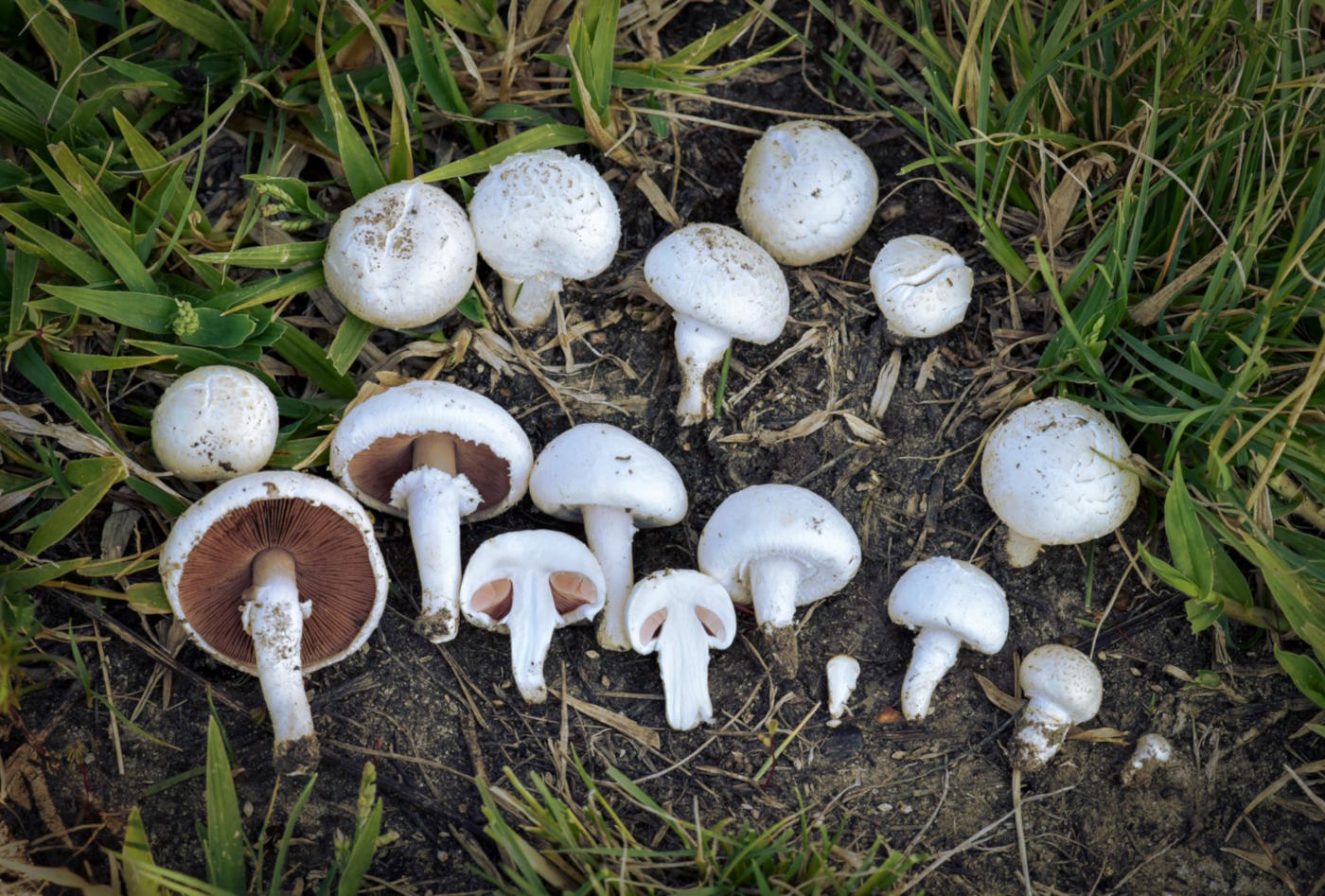
Agaricus campestris, commonly known as the Field Mushroom, is one of the classic edible mushrooms of meadows, pastures and lawns. It is closely related to the cultivated button mushroom, but unlike supermarket mushrooms, it grows naturally in open grassy habitats.
The species is usually recognized by its pale cap, pink young gills that mature to chocolate brown, and its preference for grassland rather than woodland. However, white wild mushrooms can be difficult to identify safely, and some poisonous species may look similar when viewed only from above.
⚠️ Important: This guide is for identification and education only. Never eat a wild mushroom based solely on a photograph, AI result, or comparison with an online guide.
Agaricus Campestris Quick Identification
| Feature | Agaricus campestris |
|---|---|
| Scientific name | Agaricus campestris |
| Common names | Field Mushroom, Meadow Mushroom |
| Family | Agaricaceae |
| Cap | White to cream, sometimes slightly scaly |
| Gills | Pink when young, becoming dark brown |
| Stem | White, fairly short, with a delicate ring |
| Stem base | No volva |
| Spore print | Dark brown |
| Habitat | Lawns, meadows, pastures and grassy fields |
| Growth pattern | Solitary, scattered, grouped, or in fairy rings |
| Main season | Usually late summer through autumn |
| Edibility | Edible when correctly identified |
| Main look-alikes | White Amanitas, Yellow Stainer, Horse Mushroom and other Agaricus species |
What Does Agaricus Campestris Look Like?
The Field Mushroom has the familiar shape people associate with a typical mushroom: a rounded pale cap, a central stem and closely packed gills underneath. Young specimens often resemble small cultivated button mushrooms.
The cap starts hemispherical and gradually expands to become convex or almost flat. Its surface is usually white to cream, although older specimens can develop grayish, tan or light brown tones.
The cap may remain smooth or show small scales, especially toward the center. Weather and age can alter the appearance considerably, so cap color and texture alone are not enough for identification.
Cap
The cap commonly grows to around 3–10 cm across, though larger specimens can occur under favorable conditions. Young mushrooms often have a clean white appearance, while mature caps may show slight discoloration or cracking.
The margin begins curved inward and opens gradually as the mushroom matures. Remnants of the partial veil may briefly remain attached to the edge in very young specimens, but these usually disappear quickly.
One useful clue is that Agaricus campestris generally lacks the large, coarse brown scales seen in some parasol-like lawn mushrooms.
Gills
The gills are among the most important characteristics of the Field Mushroom.
In very young specimens they are pale pink or flesh-colored. As the mushroom matures, the gills become deeper pink, then reddish brown, and finally dark chocolate brown as the spores develop.
They are free from the stem, meaning the gills stop just before reaching it rather than attaching directly.
This progression from pink to brown is particularly useful when distinguishing Agaricus campestris from dangerous white Amanitas, whose gills remain white.
Stem
The stem is usually white, solid when young and relatively short compared with the width of the cap. It is often slightly thicker toward the base but should not have a large bulb or sack-like structure.
A thin, delicate ring may be present around the upper part of the stem. This ring is a remnant of the partial veil that originally covered the developing gills.
The ring can disappear with age, so its absence does not automatically rule out the species.
Stem Base
The base of the stem is a critical identification feature.
Agaricus campestris does not have a volva. A volva is a cup-like or sack-like structure surrounding the stem base and is characteristic of many Amanita species.
When identifying any wild white mushroom, remove the entire specimen carefully from the soil rather than cutting the stem at ground level. A hidden volva can remain buried below the surface and may be one of the most important warnings that the mushroom is not an Agaricus.
Spore Print
The spore print of Agaricus campestris is dark brown to chocolate brown.
This matches the color of the mature gills and helps confirm placement in the genus Agaricus. However, many related species produce similarly colored spores, so the spore print cannot identify A. campestris on its own.
It is most useful when combined with habitat, gill development, staining reactions and stem-base structure.
Flesh
The flesh is white and relatively firm in fresh mushrooms. Cutting or bruising may produce little color change or sometimes a slight pinkish reaction.
Strong bright yellow staining, particularly around the stem base, suggests that another Agaricus species may be present. This is important because several yellow-staining species can cause gastrointestinal illness.
Odor also matters. The Field Mushroom usually has a mild, pleasant mushroom smell rather than a strong chemical or phenolic odor.
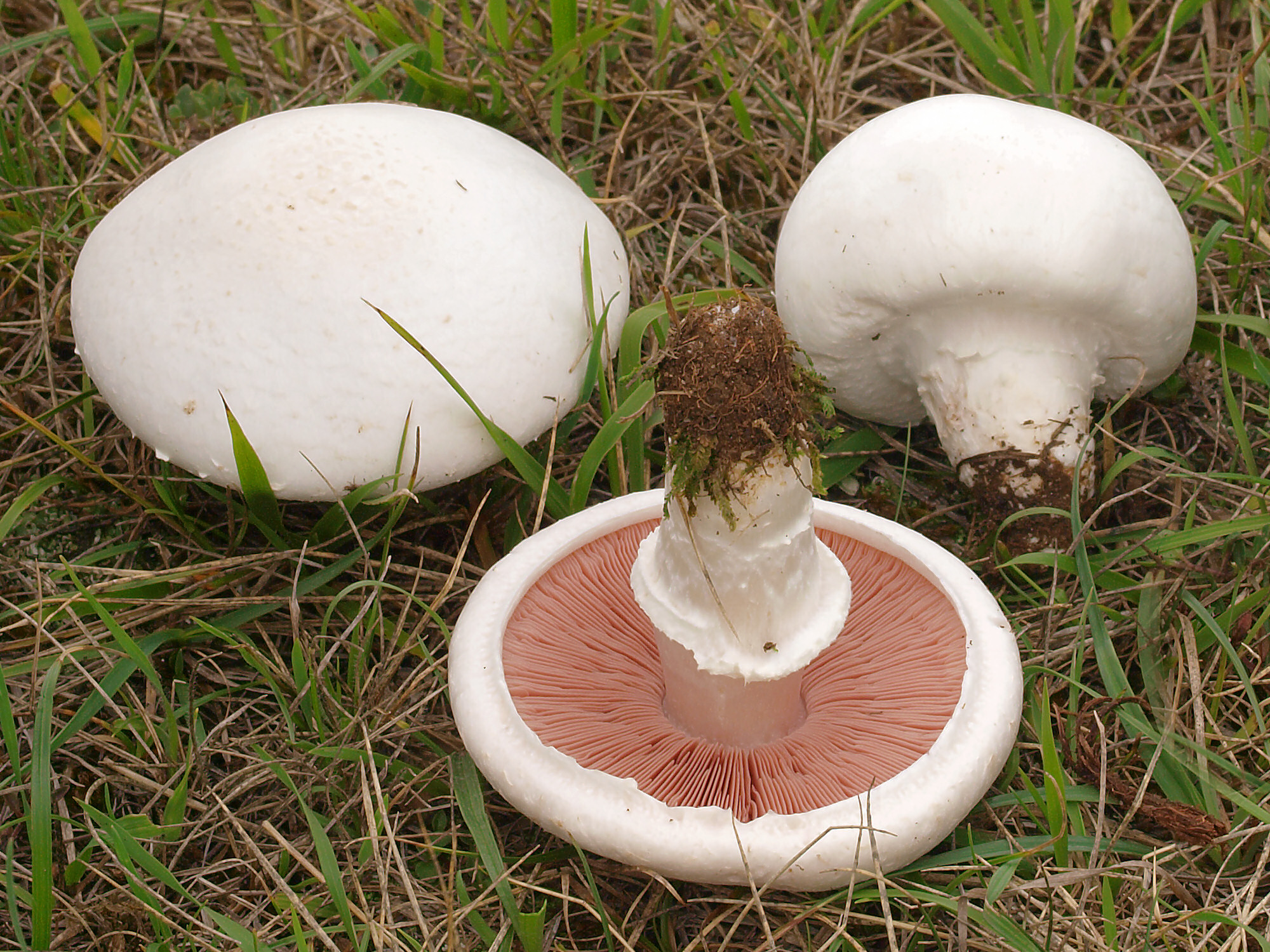
Where Does Agaricus Campestris Grow?
Field Mushrooms are grassland fungi.
They commonly appear in meadows, pastures, lawns, parks and other open grassy places. They are especially associated with nutrient-rich soils and may appear where livestock have grazed.
Unlike many woodland mushrooms, Agaricus campestris is not dependent on forming mycorrhizal relationships with trees. It feeds on organic material in the soil.
This explains why it can occur in open fields far away from woodland.
Does Agaricus Campestris Grow in Fairy Rings?
Yes. Field Mushrooms can grow in arcs or full fairy rings.
The underground fungal colony expands outward through the soil, and fruit bodies may appear around the active edge. Over time this can produce a circular pattern in the grass.
Fairy rings are not unique to this species, however. Many unrelated fungi can create the same pattern, so the growth shape should be treated as supporting ecological information rather than proof of identity.
Distribution
Agaricus campestris is widespread across temperate regions and is reported from Europe, North America and many other parts of the world.
It has long been associated with agricultural landscapes and traditional grasslands. The species may be particularly noticeable in old meadows and pastures that have not been heavily treated with fungicides or disturbed.
Closely related Agaricus species occur in similar habitats, which can make identification more difficult in regions with high species diversity.
When Does the Field Mushroom Grow?
Field Mushrooms usually appear from late summer through autumn, especially after rain.
The exact season varies by climate. In mild regions, fruiting can continue later into the year if soil remains moist and temperatures stay suitable.
A period of warm weather followed by substantial rain often triggers a sudden flush of mushrooms in grassland.
Is Agaricus campestris Edible?
Yes. The Field Mushroom is a well-known edible species when correctly identified and collected in good condition.
Its flavor is mild and similar to cultivated Agaricus mushrooms. Young, firm specimens are generally preferred because older mushrooms can become soft and insect-damaged.
The main challenge is not edibility but accurate identification. Several white mushrooms growing in grass can look similar, and some are poisonous.
Agaricus campestris Look-Alikes
The most important look-alikes include both related Agaricus species and unrelated white mushrooms.
The safest approach is to compare several characteristics at once, especially gill color, staining, smell and the complete stem base.
1. Amanita Species — Dangerous White Look-Alikes
Some white Amanitas can superficially resemble young Field Mushrooms.
The most important difference is the gills. Agaricus campestris develops pink and then brown gills, while Amanita gills typically remain white.
The stem base is equally important. Dangerous Amanitas may have a volva, which can be hidden underground.
Main difference
Field Mushroom: pink to chocolate-brown gills and no volva.
White Amanita: white gills and may have a volva at the base.
Never identify a white mushroom from the cap alone.
2. Agaricus xanthodermus — Yellow Stainer
- Scientific name: Agaricus xanthodermus
- Common name: Yellow Stainer
The Yellow Stainer is one of the most important poisonous Agaricus species to recognize.
It can look very similar to edible Field Mushrooms, especially when young. The key clue is the strong yellow staining that appears when the flesh or stem base is bruised or cut.
The yellow coloration is often most intense at the base of the stem. The mushroom may also produce a strong chemical, phenolic or ink-like odor, especially when heated.
The Yellow Stainer can cause significant gastrointestinal symptoms.
Main difference
Field Mushroom: little or no yellow staining, mild mushroom odor.
Yellow Stainer: strong yellow staining and often an unpleasant chemical smell.
3. Agaricus arvensis — Horse Mushroom
- Scientific name: Agaricus arvensis
- Common name: Horse Mushroom
Horse Mushrooms are larger than typical Field Mushrooms and also grow in grassland.
Their caps are usually white to cream, and the gills follow the same basic Agaricus progression from pale to pink and eventually brown.
Horse Mushrooms often develop yellow tones when handled and typically have a more substantial ring than Agaricus campestris. They may also smell slightly of anise or almonds.
The two edible species can look similar, especially in younger stages.
4. Agaricus bisporus — Cultivated Mushroom
- Scientific name: Agaricus bisporus
- Common names: Button Mushroom, Portobello, Common Mushroom
This is the familiar cultivated mushroom sold in supermarkets.
Wild or escaped populations can sometimes occur outdoors and resemble Field Mushrooms. The two are closely related and share the characteristic pink-to-brown gill development.
Habitat and microscopic features may be needed for confident separation in unusual cases.
5. Leucoagaricus leucothites — White Dapperling
- Scientific name: Leucoagaricus leucothites
- Common names: White Dapperling, Smooth Parasol
White Dapperlings often grow in lawns and grassy places, making habitat alone unhelpful.
They have white caps and pale gills, but unlike Agaricus, the gills remain light rather than becoming dark chocolate brown.
Because the species can resemble young Amanitas as well as pale Agaricus, it is not a mushroom that should be identified casually for food.
Field Mushroom vs Destroying Angel
| Feature | Agaricus campestris | Destroying Angel |
|---|---|---|
| Cap | White to cream | White |
| Young gills | Pink | White |
| Mature gills | Chocolate brown | White |
| Spore print | Dark brown | White |
| Ring | Small or delicate | Usually present |
| Volva | Absent | Present |
| Habitat | Grassland | Usually woodland or near trees |
| Risk | Edible when correctly identified | Deadly poisonous |
The gill color difference is highly useful, but the entire stem base should still be checked because young mushrooms can be difficult to interpret.
Field Mushroom vs Yellow Stainer
| Feature | Agaricus campestris | Agaricus xanthodermus |
|---|---|---|
| Cap | White to cream | White to cream |
| Gills | Pink to brown | Pink to brown |
| Yellow staining | Weak or absent | Strong, especially at stem base |
| Odor | Mild mushroom smell | Often chemical or phenolic |
| Habitat | Lawns and pastures | Lawns, parks, gardens |
| Edibility | Edible when correctly identified | Poisonous |
This comparison shows why gill color alone cannot distinguish edible and poisonous Agaricus species.
How to Identify Agaricus campestris Step by Step
Begin with habitat. A Field Mushroom should normally be growing in grassland rather than directly from wood or deep woodland litter.
Then examine the gills. Pink gills on a young specimen that gradually turn chocolate brown strongly support Agaricus.
Next, remove the mushroom intact and inspect the stem base. There should be no volva. Finally, check for staining and odor. Strong yellow staining and a chemical smell suggest a different species.
How to Photograph a Field Mushroom for Identification
Photograph the cap from above, but do not stop there. The underside should be clearly visible so that gill color can be judged.
Also photograph the whole stem, the complete stem base and several mushrooms at different ages if possible. A group containing young and mature specimens can show the progression from pink to brown gills.
Include enough of the surrounding area to show whether the mushroom is growing in grass, near trees, or from hidden woody material.
Can Agaricus campestris Be Identified From a Photo?
Good photographs can often strongly suggest the species, especially when the habitat and gill colors are visible.
However, safe identification may require additional features that a photograph cannot capture well, such as smell, staining reactions and subtle stem characteristics.
AI or photo-identification tools can help narrow down possible species, but they should not be used as the sole basis for deciding whether a white wild mushroom is edible.
Why Do the Gills Change Color?
The color change reflects spore development.
Young Field Mushrooms have pale pink gills because the spores are not yet fully mature. As they develop, the gills become deeper brown and eventually almost chocolate-colored.
This transition is one of the defining visual characteristics of many Agaricus species.
Can Field Mushrooms Grow in Lawns?
Yes. Lawns are one of the classic habitats for Agaricus campestris, especially when the soil contains plenty of organic material.
They may appear suddenly after rain and can grow alone, in small groups, or in broad rings.
Because other white lawn mushrooms can be poisonous, location should never be used as the only identification feature.
Interesting Facts About Agaricus campestris
The Field Mushroom is closely related to the cultivated species used for button mushrooms, cremini and portobellos. This relationship explains why its overall form and flavor feel familiar to many people.
The species has a long history as a wild food in Europe and elsewhere, particularly in agricultural landscapes where open pastures provide suitable habitat.
Its Latin name reflects this association. The word campestris refers to fields or open countryside.
Frequently Asked Questions
Is Agaricus campestris edible?
Yes, it is considered an edible species when correctly identified. Confusion with poisonous Agaricus species and dangerous white mushrooms is the main risk.
Where does Agaricus campestris grow?
It grows mainly in lawns, meadows, pastures and other grassy habitats.
What color are Field Mushroom gills?
They are pink when young, become reddish brown and finally mature to dark chocolate brown.
Does Agaricus campestris have a volva?
No. A sack-like volva at the stem base strongly suggests that the mushroom belongs to another group, potentially Amanita.
What color is the spore print?
The spore print is dark brown.
Does Agaricus campestris turn yellow?
It may show little or mild discoloration, but strong immediate yellow staining, especially at the stem base, suggests another Agaricus species such as the Yellow Stainer.
What mushrooms look like Field Mushrooms?
Important look-alikes include white Amanitas, Yellow Stainers, Horse Mushrooms and White Dapperlings.
When do Field Mushrooms appear?
They most commonly fruit from late summer through autumn, often following periods of rain.
Can Field Mushrooms grow in fairy rings?
Yes. They may grow in arcs or complete rings in lawns and pastures.
How can I tell a Field Mushroom from a white Amanita?
Check the gills and stem base. Field Mushrooms develop pink to brown gills and lack a volva, while white Amanitas usually retain white gills and may have a volva around the stem base.
Final Identification Notes
A typical Agaricus campestris combines a white to cream cap, pink young gills that mature to dark brown, a dark brown spore print, a relatively delicate ring and no volva at the stem base.
Its grassland habitat is helpful, but no single characteristic is enough on its own. White Amanitas can be dangerous, while poisonous Agaricus species such as the Yellow Stainer may share the same pink-to-brown gill development.
The most reliable approach is to combine gill color, complete stem base, staining reaction, odor and habitat before reaching an identification.
Found a white mushroom in grass? Photo identification can help narrow down possible species, but any decision involving consumption should be independently confirmed by an experienced local mushroom expert.