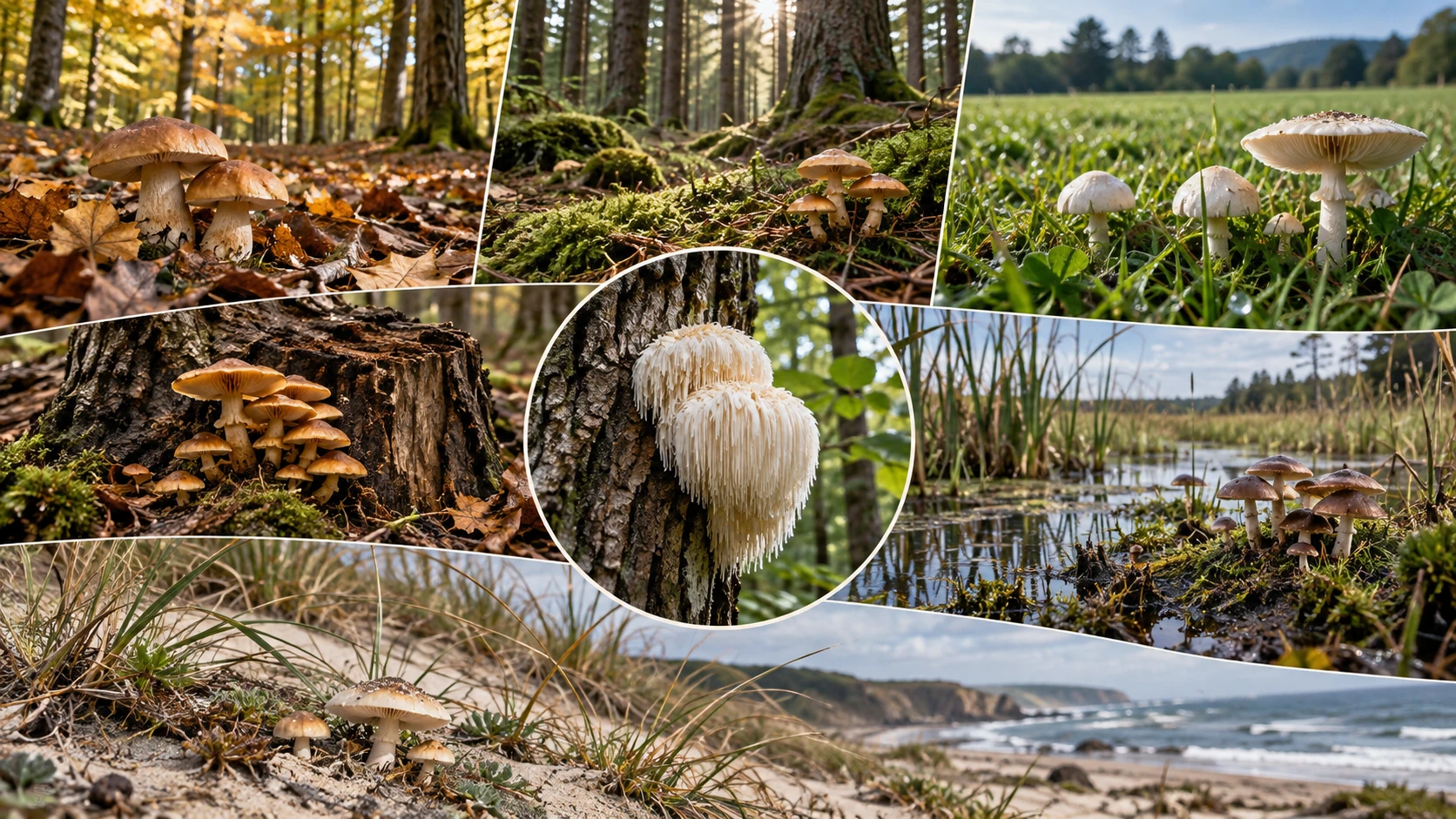
Where a mushroom grows is one of the most useful clues for identification. A brown cap or white gills may occur in hundreds of species, but the same mushroom growing on a pine stump, in short grass, under birch trees, or from buried wood belongs to a much smaller set of possibilities.
Habitat does not identify a mushroom by itself, but it can eliminate many wrong matches. The most useful questions are whether the mushroom is growing from soil or wood, which trees are nearby, whether the ground is wet or dry, and whether the fruit bodies appear alone, in clusters, or in rings.
⚠️ Important: Habitat is an identification clue, not proof of edibility. Never eat a wild mushroom based only on where it grows, a photograph, or an AI result.
Quick Habitat Guide
| Habitat | Common mushroom groups |
|---|---|
| Deciduous woodland | Amanita, Boletus, Russula, Lactarius, Cantharellus |
| Conifer forest | Suillus, Cortinarius, Lactarius, Amanita, Imleria |
| Lawns and meadows | Agaricus, Marasmius, Chlorophyllum, Panaeolina |
| Dead logs and stumps | Pleurotus, Armillaria, Galerina, Trametes |
| Living trees | Hericium, Laetiporus, polypores |
| Buried wood and roots | Coprinellus, Psathyrella, Armillaria |
| Wetlands and damp ground | Mycena, Galerina, waxcaps and other small species |
| Mossy forest floor | Cortinarius, Russula, Lactarius |
| Dung and rich soil | Panaeolus, Coprinopsis and other decomposers |
| Sandy and coastal habitats | Specialized Agaricus, earthstars and dune fungi |
1. Deciduous Woodland
Deciduous forests support some of the richest mushroom communities because trees such as oak, beech, birch, hornbeam and hazel form partnerships with many mycorrhizal fungi. Common genera in these habitats include Boletus, Russula, Lactarius, Amanita and Cantharellus.
Tree identification is extremely useful in these environments because many fungi have strong host preferences. A mushroom under birch may belong to a completely different species from a similar-looking mushroom beneath oak, even when the caps appear almost identical.
For example, some Leccinum species are strongly associated with birch, while certain boletes favor oak or beech. When photographing a woodland mushroom, it is therefore worth including nearby trunks, leaves, bark or fallen needles.
2. Conifer Forests
Pine, spruce, fir and other conifers support a different community of fungi. Species from genera such as Suillus, Cortinarius, Lactarius, Amanita and Imleria are common in these habitats.
Many conifer-associated mushrooms have evolved close relationships with particular tree species. This means that the same cap color and general shape can point to different species depending on whether the mushroom is growing beneath pine, spruce or fir.
Needles, cones and bark can help identify the host tree even when the canopy is difficult to see. This ecological information is particularly useful when identifying boletes, milkcaps and some Amanitas.
3. Lawns and Meadows
Grassland mushrooms often appear suddenly after rain and may grow alone, in groups, or in fairy rings. Common lawn genera include Agaricus, Marasmius, Chlorophyllum, Panaeolina, Conocybe and Clitocybe.
Some of these species are edible when correctly identified, while others are poisonous. One important example is Chlorophyllum molybdites, the Green-Spored Parasol, which can form large rings on lawns and cause severe gastrointestinal poisoning.
Grassland habitat is helpful, but nearby trees still matter. Some mycorrhizal mushrooms can fruit several meters away from a trunk because tree roots extend beneath the lawn.
4. Dead Logs and Stumps
Dead wood supports a huge number of mushroom species. Oyster mushrooms, honey mushrooms, Deadly Galerina, turkey tails, inkcaps and many other fungi can all grow from logs and stumps.
The exact type of wood matters because some species prefer hardwoods such as beech or oak, while others are more common on conifers. The condition of the wood also matters, since freshly fallen timber and heavily decomposed logs can host very different fungi.
Wood decay creates an important identification trap because two completely different species can grow from the same stump at the same time. Small brown mushrooms on wood deserve particular caution because poisonous Galerina marginata can resemble several edible species.
5. Living Trees
Some fungi fruit directly from living trunks and branches. Examples include Hericium erinaceus, Lion’s Mane, and Laetiporus sulphureus, Chicken of the Woods, along with many bracket fungi.
A mushroom on a living tree may be feeding on dead internal wood or causing active decay. The fruit body can emerge from a wound, cavity, broken branch or a section of trunk that still looks healthy from the outside.
Host tree species is often an important clue. When photographing a tree-growing mushroom, show both the fruit body and enough of the bark, trunk and leaves to make the host easier to identify.
6. Buried Wood and Old Roots
A mushroom may appear to grow from soil even when it is actually attached to buried wood. This is common in parks, gardens and lawns where trees have been removed but their roots remain underground.
Species of Coprinellus, Psathyrella, Armillaria and other genera may repeatedly fruit in the same place because the hidden woody substrate remains available for years. This explains why tight clusters of mushrooms often appear in the middle of otherwise open grass.
If mushrooms return to one small patch season after season, buried roots or old stump material may be present. Checking the attachment point can therefore completely change the identification.
7. Wetlands, Marshes and Damp Ground
Some fungi prefer persistently moist soils, stream edges, bogs and wet woodland. These environments support many small species, including members of Galerina, Mycena and several other genera that can be difficult to identify from photographs.
Moisture strongly influences appearance. Hygrophanous mushrooms can become much darker when wet and fade dramatically as they dry, sometimes making the same species look very different within a few hours.
Habitat moisture should therefore be recorded together with color. A dark brown cap photographed immediately after rain may become pale tan later the same day.
8. Mossy Forest Floor
Moss creates a cool, humid microhabitat that supports many woodland fungi. Small mushrooms growing through moss may appear to emerge directly from the green surface, but their mycelium is usually associated with soil, buried wood or nearby tree roots.
Species of Cortinarius, Russula, Lactarius and numerous smaller genera may appear in moss-rich forests. This habitat can make stem bases difficult to see, so careful examination may be necessary when the lower stem contains important identification features.
When photographing these mushrooms, include the surrounding moss and nearby trees rather than isolating only the cap. The context may be more informative than the close-up.
9. Dung, Compost and Nutrient-Rich Soil
Dung and heavily enriched soil support specialized decomposer fungi. Species of Panaeolus, Coprinopsis and other genera may grow directly from manure or from soil enriched by animals.
Compost piles, mulched gardens and heavily fertilized areas can create similar nutrient-rich conditions. Substrate is especially important here because several small brown mushrooms can look nearly identical while having very different ecological preferences.
A photograph that excludes the material the mushroom is growing from can remove one of the strongest identification clues. Whenever possible, include both the mushroom and its exact substrate.
10. Sandy Soil, Dunes and Coastal Grassland
Dry sandy habitats support their own specialized fungal communities. Mushrooms growing in dunes or coastal grassland must tolerate low nutrients, wind and rapidly changing moisture conditions.
Some Agaricus, earthstars and other fungi are adapted to these environments. Their fruit bodies may partly develop below the surface or become coated with sand, which can make identification from cap color more difficult.
Habitat can be particularly useful here because many ordinary woodland species would be unlikely to occur in exposed dunes. The combination of sand, coastal vegetation and growth form can sharply narrow the possibilities.
Why Tree Species Matter So Much
Many mushrooms form mycorrhizal relationships with trees. The fungal mycelium connects with roots and exchanges minerals and water for sugars produced by the tree.
Because some fungi associate with only one or a small group of tree species, identifying nearby trees can dramatically narrow the possibilities. Birch, oak, beech, pine, spruce and fir are especially useful trees to recognize when identifying European and North American mushrooms.
If you are unsure of the tree, photograph its leaves, needles, bark and cones along with the mushroom. This can be more useful than taking several nearly identical close-ups of the cap.
Soil or Wood?
One of the most important first questions is whether the mushroom is truly growing from soil. A mushroom emerging in grass can be attached to buried wood, while a species next to a tree may be decomposing dead roots rather than forming a mycorrhizal relationship.
Carefully inspect the base and substrate before assuming the ecological type. This distinction helps separate wood decomposers such as Galerina and Pleurotus from many soil-growing woodland mushrooms.
Why Growth Pattern Helps
Mushrooms can grow singly, scattered, in dense clusters, in shelves, or in rings. Honey mushrooms frequently form large clusters around wood and roots, Fairy Ring Mushrooms often appear in arcs or circles, and oyster mushrooms usually grow in overlapping groups from wood.
Growth pattern should not be used alone, but it can reinforce other characteristics. A species that normally grows in dense clusters would be less likely to match a solitary mushroom with otherwise similar colors and dimensions.
Why Season Matters
Habitat becomes even more useful when combined with season. Some mushrooms are strongly associated with spring, while many woodland species peak in late summer and autumn, and a few wood-growing fungi regularly appear during colder winter weather.
Season varies with climate, rainfall and altitude, so it should never be treated as an exact rule. However, a mushroom appearing months outside the usual fruiting period for a candidate species is a good reason to reconsider the identification.
How Habitat Helps With Different Mushroom Groups
Boletes
Boletes are a good example of why habitat matters. A brown bolete under pine may suggest a different group from a similar mushroom under birch or oak, because host trees are often essential for distinguishing related species.
Pore color, stem pattern and bruising still matter, but ecological association can reduce a long list of possible boletes to a much smaller set. This is why photographs of boletes should include nearby trees whenever possible.
Wood-Growing Mushrooms
Wood-growing mushrooms should be evaluated according to both the tree species and the condition of the wood. Ask whether the wood is living, dead, standing or fallen, and whether it is hardwood or conifer.
A Lion’s Mane on mature hardwood, an Oyster Mushroom on a fallen deciduous log and a Galerina on decaying wood may all occupy very different ecological niches despite sharing the broad category of “mushrooms on wood.”
Lawn Mushrooms
Lawns can support decomposers, grassland specialists and tree-associated fungi at the same time. Check whether the mushroom is near a tree, whether buried roots may be present, and whether it grows in a ring.
A large white mushroom in grass could be an Agaricus, a Green-Spored Parasol or another species entirely. Habitat narrows the possibilities, but gill color and stem structure remain essential.
Common Habitat Mistakes
One common mistake is assuming that mushrooms growing close together are the same species. Different fungi can share the same log, stump or patch of soil, so each group should still be examined carefully.
Another frequent error is ignoring buried wood or distant tree roots. A mushroom that appears terrestrial may actually be a wood decomposer, while a mycorrhizal species may fruit several meters away from its host tree.
The best identification combines habitat with morphology rather than treating either one as sufficient.
How to Photograph Mushroom Habitat
Do not take only a close-up of the cap. A useful identification set should include the whole mushroom, underside, complete stem base and a wider photograph showing exactly where it grows.
For woodland species, include nearby trees and forest litter. For wood-growing mushrooms, photograph the log, stump or trunk, and for lawn fungi, show the surrounding grass and nearby trees.
These contextual images often provide information that a perfect macro photograph cannot. In many cases, habitat can eliminate more wrong candidates than an additional close-up of the cap.
Can AI Use Habitat for Mushroom Identification?
Yes, especially when habitat information is visible or provided explicitly. A photo-identification system can often narrow the possibilities more effectively when it knows whether a mushroom is growing on oak, pine, dead wood, grass, dung or another substrate.
However, images frequently hide the substrate or surrounding vegetation, which can lead to incorrect matches. The best results come from combining several photographs with information about location, season, substrate and nearby trees.
Frequently Asked Questions
Where do most mushrooms grow?
Mushrooms can grow in forests, lawns, meadows, wetlands, gardens, dunes, compost, dung and on living or dead wood. Different species have very different ecological requirements, so there is no single “typical” mushroom habitat.
Why do mushrooms grow under trees?
Many species form mycorrhizal relationships with tree roots, while others decompose dead roots, branches or internal wood. This is why identifying the tree can be highly useful during mushroom identification.
Why do mushrooms grow on dead trees?
Wood-decaying fungi break down cellulose, lignin and other components of wood. In doing so, they recycle nutrients and play an important role in forest ecosystems.
Why are mushrooms growing in my lawn?
They may be decomposing organic material in the soil, feeding on buried roots, or living in association with nearby trees. Rain and irrigation often trigger the visible fruiting bodies.
Can the same mushroom grow on both wood and soil?
Some mushrooms can appear to grow from soil when they are actually attached to buried wood. True habitat preference depends on the species, so checking the attachment point is important.
Do poisonous mushrooms grow in different habitats from edible ones?
No. Edible and poisonous mushrooms can occupy the same forests, lawns and logs, which is why habitat alone cannot determine safety.
Why do mushrooms grow in circles?
An underground fungal colony can expand outward from a central point. Fruit bodies then appear around the active outer edge, creating the familiar pattern known as a fairy ring.
Does finding a mushroom under a particular tree identify it?
Not by itself, but host tree association can be one of the strongest identification clues when combined with cap, gills, pores, stem and other physical features.
Final Identification Notes
Habitat is one of the best ways to turn a vague mushroom description into a manageable set of possibilities. A “brown mushroom” provides little information, but a brown mushroom with pores growing under birch in autumn is already much more specific.
Start by asking whether the mushroom grows from soil, living wood, dead wood, buried roots, grass, moss, dung or another substrate. Then identify nearby trees and note the growth pattern, moisture and season.
These ecological clues should always be combined with physical characteristics such as gills, pores, stem base, spore color and bruising reactions.
Found an unknown mushroom? Photograph both the mushroom and its habitat, because the surrounding trees, substrate and growth pattern can be just as important for identification as the cap itself.