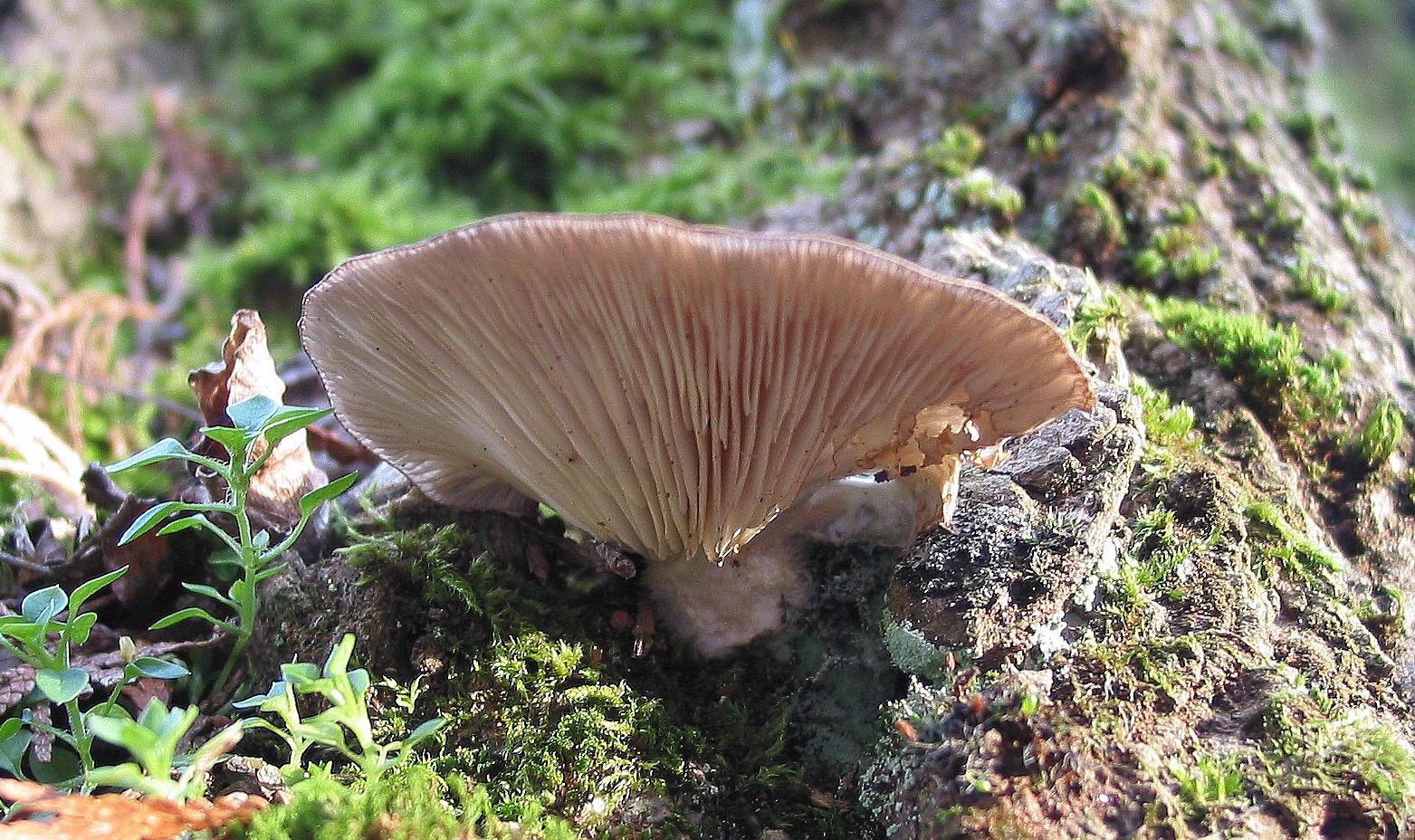
Pleurotus ostreatus, commonly known as the Oyster Mushroom, is one of the most recognizable edible mushrooms growing on wood. Its broad fan-shaped cap, pale gills running down the attachment point, and tendency to form overlapping clusters on dead or weakened trees give it a characteristic appearance.
Oyster Mushrooms are also widely cultivated and sold commercially, but wild specimens require careful identification. Several unrelated fungi grow in a similar shelf-like form, and some can look surprisingly similar when young or photographed from only one angle. One particularly important look-alike is Pleurocybella porrigens, known as Angel Wings, which has been associated with serious and fatal poisonings.
⚠️ Important: This guide is intended for identification and education. Never eat a wild mushroom solely because it resembles a photograph, matches an AI result, or appears similar to cultivated Oyster Mushrooms.
Quick Identification
| Feature | Pleurotus ostreatus |
|---|---|
| Scientific name | Pleurotus ostreatus |
| Common names | Oyster Mushroom, Tree Oyster, Grey Oyster |
| Family | Pleurotaceae |
| Cap | Fan-shaped, shell-shaped or semicircular |
| Cap color | Gray, gray-brown, brown, sometimes pale |
| Gills | White to cream, running down the stem or attachment point |
| Stem | Short, lateral, eccentric, or almost absent |
| Flesh | Thick, white and soft-fleshy |
| Spore print | White to pale grayish or lilac-gray |
| Substrate | Dead or weakened wood |
| Common hosts | Mainly decididuous hardwoods |
| Growth | Usually overlapping clusters |
| Main season | Often autumn through cool weather |
| Edibility | Edible when correctly identified |
| Important look-alikes | Angel Wings, other Pleurotus, Crepidotus, Hohenbuehelia, late oyster-like fungi |
What Does Pleurotus ostreatus Look Like?
The Oyster Mushroom typically grows sideways from wood rather than standing upright on a central stem. Its cap resembles a fan, shell or oyster, which is the origin of both the scientific name ostreatus and the common name Oyster Mushroom.
Several fruit bodies frequently grow together in overlapping tiers. A cluster may contain small young mushrooms beside large mature caps, producing the layered appearance often seen on logs and tree trunks.
Cap shape varies with the position of the mushroom on the wood. Specimens growing from the side of a vertical trunk may be strongly fan-shaped, while those developing on the upper surface of a fallen log can form more rounded caps with a better-developed stem.
Cap
The cap is usually smooth and can range from gray and bluish gray to gray-brown, tan or darker brown. Young mushrooms often have a curved margin that gradually becomes flatter or slightly wavy as the cap expands.
Size is highly variable. Small specimens may measure only a few centimeters across, while well-developed fruit bodies can exceed 15 cm under favorable conditions.
Color is influenced by genetics, temperature, age and environmental conditions. Because cultivated Oyster Mushrooms are often pale, people sometimes expect wild Pleurotus ostreatus to be white, but wild forms can be considerably darker.
Gills
The gills are one of the most useful identification features. They are usually white to cream and run noticeably down toward the attachment point, a pattern known as decurrent gills.
When a short stem is present, the gills continue down its surface rather than ending sharply where the cap meets the stem. On nearly stemless mushrooms, the gills converge toward the point where the fruit body attaches to the wood.
The gills are relatively crowded and may occasionally fork or connect near the base. Their pale color contrasts with the dark brown or rusty gills found in many other wood-growing mushroom groups.
Stem
The stem of Pleurotus ostreatus is usually short and positioned to one side rather than in the center. Some fruit bodies appear almost completely stemless and attach directly to the wood.
When a stem is present, it is typically white, firm and continuous with the flesh of the cap. Fine white hairs or mycelial material may be visible close to the attachment point.
Stem length alone is not a reliable identification feature. Oyster Mushrooms can develop different shapes depending on available space, orientation and growing conditions.
Flesh
Fresh Oyster Mushroom flesh is white, relatively thick and fleshy. Mature caps remain much more substantial than the very thin fruit bodies of some important look-alikes.
When cut, the flesh does not usually display dramatic blue, red or yellow staining reactions. Older mushrooms can become tougher around the attachment point while remaining softer near the cap margin.
Flesh thickness is particularly helpful when comparing Oyster Mushrooms with Angel Wings, which generally produce thinner and more delicate fruit bodies.
Spore Print
The spore print of Pleurotus ostreatus is pale, typically appearing white to slightly grayish or faintly lilac-gray. Because several oyster-shaped fungi also have pale spores, spore color alone cannot confirm the species.
It is more useful when eliminating mushrooms that produce distinctly brown, rusty, pink or dark spore prints. Identification should still include the cap structure, gills, substrate, flesh and growth pattern.
Where Do Oyster Mushrooms Grow?
Wild Oyster Mushrooms grow from wood or woody material rather than ordinary soil. They are decomposers that break down wood and contribute to nutrient recycling in forests.
They are most commonly associated with deciduous trees and can occur on fallen trunks, logs, stumps and standing dead trees. They may also fruit from weakened or damaged living trees where suitable dead wood is available internally.
If an Oyster-like mushroom appears to grow directly from the ground, inspect the area carefully. Buried roots, logs or other woody debris may be hidden beneath the soil.
Which Trees Do Oyster Mushrooms Grow On?
Oyster Mushrooms are primarily associated with hardwoods. Depending on region, they may be found on beech, poplar, willow, maple and numerous other broadleaf trees.
Host tree can help with identification but should not be treated as absolute proof. Closely related Pleurotus species overlap in appearance and ecology, while several unrelated oyster-shaped fungi also grow on wood.
When photographing a suspected Oyster Mushroom, include part of the log or trunk and, when possible, leaves, bark or other features that help identify the tree.
Do Oyster Mushrooms Grow on Living Trees?
Yes. Oyster Mushrooms can fruit from living trees when suitable weakened or dead wood is present. A tree can still carry green leaves while internal sections of its trunk or branches are being decomposed by fungi.
The appearance of large fungal fruit bodies on a living tree can indicate decay within the wood. From a tree-health perspective, this can be important because internal structural damage may be much greater than the external appearance suggests.
From a mushroom-identification perspective, the essential point is that growth on a living trunk does not rule out Pleurotus ostreatus.
When Do Oyster Mushrooms Grow?
Pleurotus ostreatus is strongly associated with cooler conditions and is commonly found in autumn and into colder weather. In many temperate regions, fruiting becomes particularly noticeable after cool rainy periods.
This distinguishes it somewhat from certain closely related Oyster Mushroom species that favor warmer seasons. However, climate varies greatly, and seasonal timing overlaps between species.
Mild winters can allow Oyster Mushrooms to continue fruiting unusually late. The same log may also produce several flushes when moisture and temperature become favorable again.
Are Oyster Mushrooms Edible?
Yes. Pleurotus ostreatus is a widely eaten edible mushroom and one of the major cultivated mushrooms worldwide. Young caps have tender flesh and a mild flavor, while older fruit bodies can become progressively tougher.
Wild specimens should still be identified carefully because “oyster-shaped mushroom growing on wood” is not sufficient for species-level identification. The condition of the mushroom also matters, and old, decaying or heavily insect-damaged fruit bodies should not be treated like fresh cultivated mushrooms.
Another consideration is the substrate. Fungi can accumulate substances from their environment, so mushrooms growing on chemically treated timber or heavily contaminated sites are poor choices for food even when the species itself is edible.
Oyster Mushroom Look-Alikes
Most confusion involves other shelf-like mushrooms growing from wood. Some are closely related edible Pleurotus species, while others belong to completely different genera.
The most useful combination for recognizing a typical Oyster Mushroom is a soft fleshy fruit body, pale decurrent gills, lateral attachment and growth directly from wood. Even this combination should be checked carefully because Angel Wings can share several of these characteristics.
Pleurocybella porrigens — Angel Wings
- Scientific name: Pleurocybella porrigens
- Common name: Angel Wings
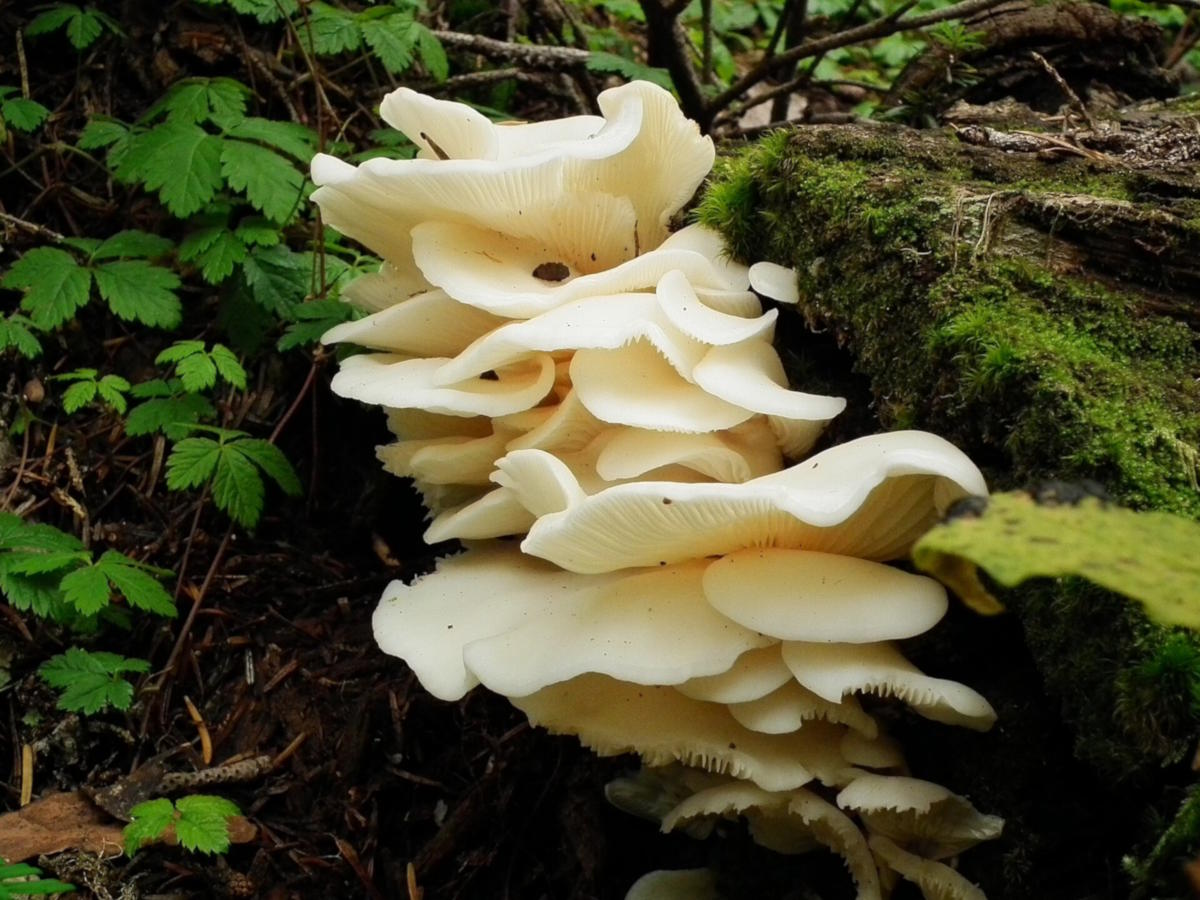
Angel Wings is one of the most important Oyster Mushroom look-alikes. It forms white to ivory shelf-like mushrooms with pale gills and may grow in overlapping groups on decaying wood.
The fruit bodies are generally thinner and more delicate than those of Pleurotus ostreatus. They are often nearly pure white and can form spoon-shaped, tongue-shaped or irregularly lobed caps with almost no stem.
Substrate is particularly useful. Angel Wings is strongly associated with well-decayed conifer wood, while classic Pleurotus ostreatus is much more commonly encountered on deciduous hardwoods.
Angel Wings has historically been listed as edible in some older literature, but it has been associated with serious and fatal poisoning episodes. It should therefore not be treated as an edible Oyster Mushroom substitute.
Oyster Mushroom vs Angel Wings
| Feature | Pleurotus ostreatus | Pleurocybella porrigens |
|---|---|---|
| Common name | Oyster Mushroom | Angel Wings |
| Cap | Gray to brown or pale | Usually white to ivory |
| Flesh | Relatively thick and fleshy | Thin and delicate |
| Stem | Short, lateral or absent | Usually essentially absent |
| Gills | Pale and decurrent | Pale and decurrent |
| Typical wood | Mainly hardwood | Strongly associated with conifers |
| Growth | Overlapping clusters | Overlapping thin shelves |
| Edibility | Edible when correctly identified | Should not be eaten |
Color alone should not be used for this comparison because pale Oyster Mushrooms exist. Flesh thickness, substrate, overall structure and other characteristics need to be considered together.
Pleurotus pulmonarius — Phoenix Oyster
- Scientific name: Pleurotus pulmonarius
- Common names: Phoenix Oyster, Indian Oyster
This is a close relative of Pleurotus ostreatus and can be difficult to distinguish from it. It is often paler, with white, cream or light tan caps, and tends to fruit during warmer weather.
Both species grow from wood, possess decurrent pale gills and have an oyster-like cap. The distinction can become difficult enough that photographs alone may not provide confident species-level identification.
For ordinary identification, recognizing that a mushroom belongs to the Pleurotus group may be easier than determining exactly which closely related Oyster Mushroom species is present.
Pleurotus eryngii — King Oyster
- Scientific name: Pleurotus eryngii
- Common name: King Oyster Mushroom
King Oyster is familiar as a cultivated mushroom with a very thick central stem and relatively small cap. Wild forms also differ ecologically from the classic Oyster Mushroom and are associated with the roots of certain herbaceous plants rather than typical dead hardwood logs.
Its substantial stem makes mature specimens quite different from the laterally attached form of Pleurotus ostreatus. However, younger or unusual specimens illustrate how variable the genus can be.
This is another reason why one simplified rule such as “all Oyster Mushrooms have no stem” is inaccurate.
Sarcomyxa serotina — Late Oyster
- Scientific name: Sarcomyxa serotina
- Common names: Late Oyster, Olive Oysterling
The Late Oyster forms shelf-like caps on wood and can superficially resemble Oyster Mushrooms. It tends to have yellowish, olive, greenish or brownish tones and usually possesses yellowish rather than clean white flesh around the attachment area.
Like Pleurotus ostreatus, it can appear during cool seasons. Its combination of coloration, texture and structural differences helps separate the two when specimens are well developed.
Cap color should still be treated carefully because lighting, moisture and age can substantially alter the appearance of wood-growing fungi.
Crepidotus Species
Species of Crepidotus are small, laterally attached mushrooms that frequently grow from dead wood. Their fan-shaped caps can resemble miniature Oyster Mushrooms, particularly in photographs that provide no sense of scale.
Many Crepidotus species are considerably smaller and thinner than typical mature Pleurotus ostreatus. An especially useful difference is their spore color, which tends toward brown rather than the pale spores characteristic of Oyster Mushrooms.
Species-level identification within Crepidotus can be difficult. Small oyster-shaped mushrooms should therefore not automatically be assumed to be young Pleurotus.
Hohenbuehelia Species
Hohenbuehelia species can have oyster-shaped caps, lateral attachment and pale gills, making some members of the genus genuinely similar to Pleurotus.
Several have a distinctive gelatinous layer beneath the cap skin, although this feature may not be obvious without examining a section of the fruit body. Microscopic characters can also become important when separating difficult specimens.
This group demonstrates why even a mushroom with the correct general shape and pale gills is not automatically Pleurotus ostreatus.
Omphalotus Species — Jack-o’-Lantern Mushrooms
Jack-o’-Lantern mushrooms are not especially convincing Oyster Mushroom look-alikes once the underside and coloration are examined, but beginners sometimes confuse them because both can form large clusters from wood.
Omphalotus species are usually orange to orange-brown and possess strongly colored true gills. Oyster Mushrooms are typically gray, brown or pale with white to cream gills.
Jack-o’-Lantern mushrooms are poisonous and can cause significant gastrointestinal symptoms. Their presence emphasizes the importance of examining gills rather than judging a cluster only from its general shape.
Oyster Mushroom vs Other Pleurotus Species
Species-level identification within Pleurotus is more difficult than many beginner guides suggest. Cap color, stem position and fruiting season overlap, while environmental conditions can substantially alter appearance.
A pale summer Oyster Mushroom might belong to Pleurotus pulmonarius, while a gray cool-season specimen may fit P. ostreatus better. In some regions, additional closely related species complicate the picture further.
For this reason, distinguishing a genuine Pleurotus from a potentially dangerous unrelated look-alike is often more important for practical identification than forcing every specimen into a precise species based only on photographs.
How to Identify an Oyster Mushroom
Begin with the substrate. A typical Oyster Mushroom should be growing directly from wood or from buried woody material, not simply from ordinary lawn soil.
Next, examine the entire fruit body. Look for a fan-shaped or shell-like cap, lateral attachment, soft fleshy texture and pale gills that run downward toward the attachment point.
Finally, consider cap thickness, host wood, season and spore color. If the fruit body is extremely thin, nearly pure white and growing on decaying conifer wood, Angel Wings should be considered carefully rather than assuming the mushroom is Pleurotus ostreatus.
Why Wood Type Matters
Knowing whether a mushroom is growing on hardwood or conifer wood can dramatically improve identification. Classic Oyster Mushrooms are especially associated with broadleaf trees, while Angel Wings characteristically occur on decaying conifer wood.
Wood identification is not always easy once a log has lost its bark and leaves. In those cases, examine nearby trees, remaining bark patterns, branching structure and any visible needles or leaves.
The substrate should be treated as one diagnostic feature among several. No mushroom should be identified solely because it grows from the “correct” kind of tree.
How to Photograph Oyster Mushrooms for Identification
A top-down photograph of a cluster is useful for showing cap color and growth pattern, but it is not enough. At least one image should clearly show the pale gills and how they run toward the point of attachment.
Photograph the side of the cluster as well so that cap thickness and stem development are visible. A wider image showing the log, stump or trunk can provide essential information about the substrate and growth pattern.
If several fruit bodies are available, photograph both young and mature specimens. The combination often reveals characteristics that are difficult to see in a single mushroom.
Can Oyster Mushrooms Be Identified From a Photo?
Typical mature Oyster Mushrooms can often be recognized reasonably well from a good series of photographs. Their growth on wood, overlapping caps, lateral attachment and decurrent pale gills form a useful combination of features.
Problems arise when only the upper surface is photographed or when the mushrooms are unusually pale, small or thin. Several look-alikes share the same general profile, and distinctions between closely related Pleurotus species may be impossible from photographs alone.
AI identification can help narrow the possibilities, but the result should always be checked against substrate, gill structure, flesh thickness and other physical characteristics.
Why Are Some Oyster Mushrooms Gray and Others White?
Oyster Mushroom color is naturally variable. Genetics, age, temperature, exposure and growing conditions can all influence the cap.
Wild Pleurotus ostreatus is frequently gray or gray-brown, while cultivated strains may be considerably paler. Closely related Oyster Mushroom species can also produce cream, beige or almost white fruit bodies.
Color is therefore useful only when combined with other features. A white mushroom is not automatically Angel Wings, just as a gray fan-shaped mushroom is not automatically Pleurotus ostreatus.
Do Oyster Mushrooms Always Grow in Clusters?
They commonly form dense overlapping clusters, but not every fruiting produces a spectacular group. A few caps may grow together, and occasional fruit bodies can appear relatively isolated.
Available space influences growth form. A fungus fruiting from a narrow crack may produce a different shape from one growing freely from the side of a broad log.
Clustered growth is therefore characteristic but not mandatory for identification.
Interesting Facts About Pleurotus ostreatus
The name Pleurotus refers to the characteristic sideways or lateral position of the stem, while ostreatus refers to the oyster-like shape of the cap. This makes the scientific name unusually descriptive of the mushroom’s appearance.
Oyster Mushrooms are efficient wood decomposers and produce enzymes capable of breaking down lignin, one of the major structural components of wood. This ability has also made species of Pleurotus interesting in research involving decomposition and environmental applications.
The mushroom is now cultivated around the world on many plant-based substrates. Commercial production demonstrates the fungus’s ability to use cellulose-rich materials far beyond the logs on which wild fruit bodies are normally encountered.
Frequently Asked Questions
What does an Oyster Mushroom look like?
A typical Oyster Mushroom has a gray, gray-brown or pale fan-shaped cap with white to cream gills running down toward a short lateral stem or direct attachment point. The flesh should be relatively thick and soft rather than thin and papery.
Where do Oyster Mushrooms grow?
They grow directly from woody material, particularly dead or weakened hardwood trees. Fallen logs, stumps and standing dead trunks are common habitats.
Do Oyster Mushrooms grow from the ground?
They normally require wood. A cluster apparently growing from soil may actually be attached to buried roots, a buried stump or another hidden woody substrate.
What color are Oyster Mushroom gills?
The gills are usually white to cream and run down toward the attachment point. They remain considerably paler than the brown or rusty gills of many other wood-growing mushrooms.
What color is an Oyster Mushroom spore print?
The spore print is pale and can appear white, grayish or faintly lilac-gray. Spore color alone is not sufficient for species identification.
Are Oyster Mushrooms edible?
Pleurotus ostreatus is an edible species and is widely cultivated commercially. Wild specimens should still be confidently identified and collected from an appropriate uncontaminated substrate.
What is the most important Oyster Mushroom look-alike?
Angel Wings, Pleurocybella porrigens, is one of the most important species to know. It usually has thinner white fruit bodies and is particularly associated with decaying conifer wood.
How can you tell Oyster Mushrooms from Angel Wings?
Typical Oyster Mushrooms are thicker and fleshier and commonly grow on hardwood. Angel Wings tend to be thinner, almost stemless, predominantly white, and strongly associated with decaying conifer wood.
Do Oyster Mushrooms grow on conifers?
The classic habitat of Pleurotus ostreatus is primarily hardwood, although fungi do not always follow simplified field-guide rules perfectly. An extremely thin white oyster-like mushroom growing on decaying conifer wood should prompt careful consideration of Angel Wings.
When do Oyster Mushrooms grow?
They commonly fruit during cooler periods, particularly autumn and early winter in temperate regions. Timing varies according to climate, rainfall and local conditions.
Final Identification Notes
A typical Pleurotus ostreatus combines a fan-shaped or oyster-shaped cap, pale decurrent gills, thick white flesh, lateral attachment and growth directly from wood. Gray to brown cap coloration and overlapping clusters are common, but both features can vary.
The most important mistake to avoid is identifying every pale shelf-like mushroom as an Oyster Mushroom. Angel Wings can share pale gills, lateral growth and overlapping clusters, while other genera produce smaller oyster-shaped fungi on the same kinds of substrates.
For a stronger identification, combine cap shape, gills, flesh thickness, stem position, spore color, host wood, growth pattern and season. A clear photograph of the underside and the substrate is usually much more useful than another photograph of the cap from above.
Found an oyster-shaped mushroom on a tree? Photo identification can help narrow the possibilities, but inspect the gills, flesh, attachment point and type of wood before reaching a final identification.