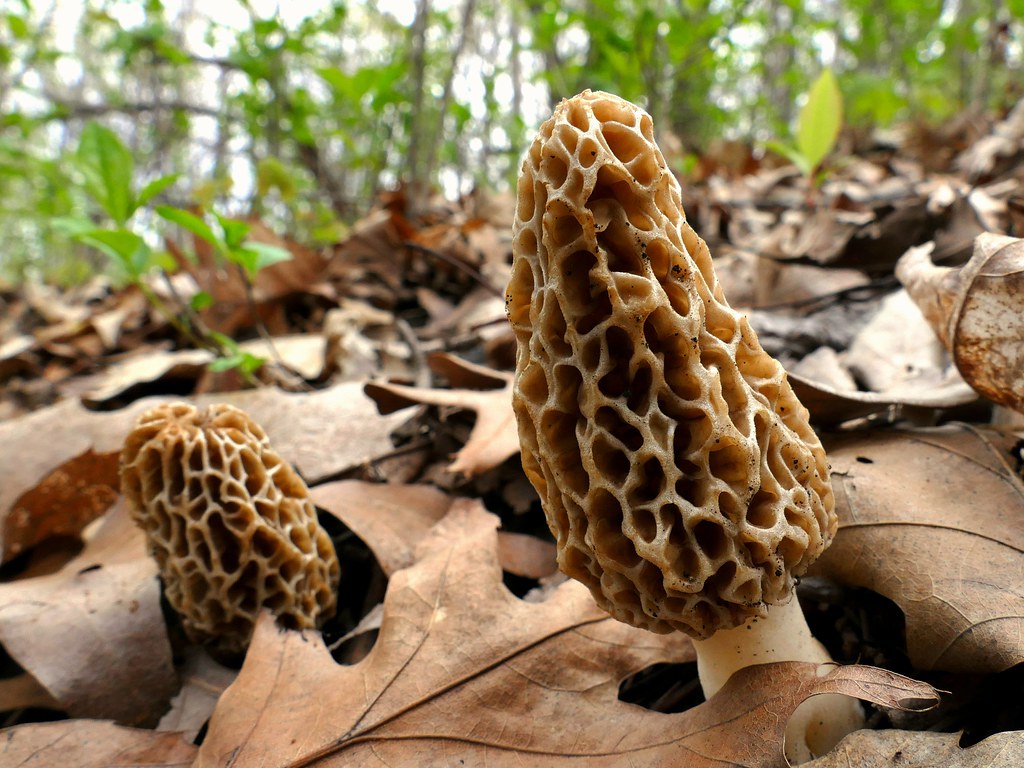
True morels are among the most sought-after spring mushrooms, but their unusual wrinkled appearance can lead to confusion with several so-called false morels. The most important distinction is that true morels belong to the genus Morchella, while false morels usually belong to genera such as Gyromitra and can contain dangerous toxins.
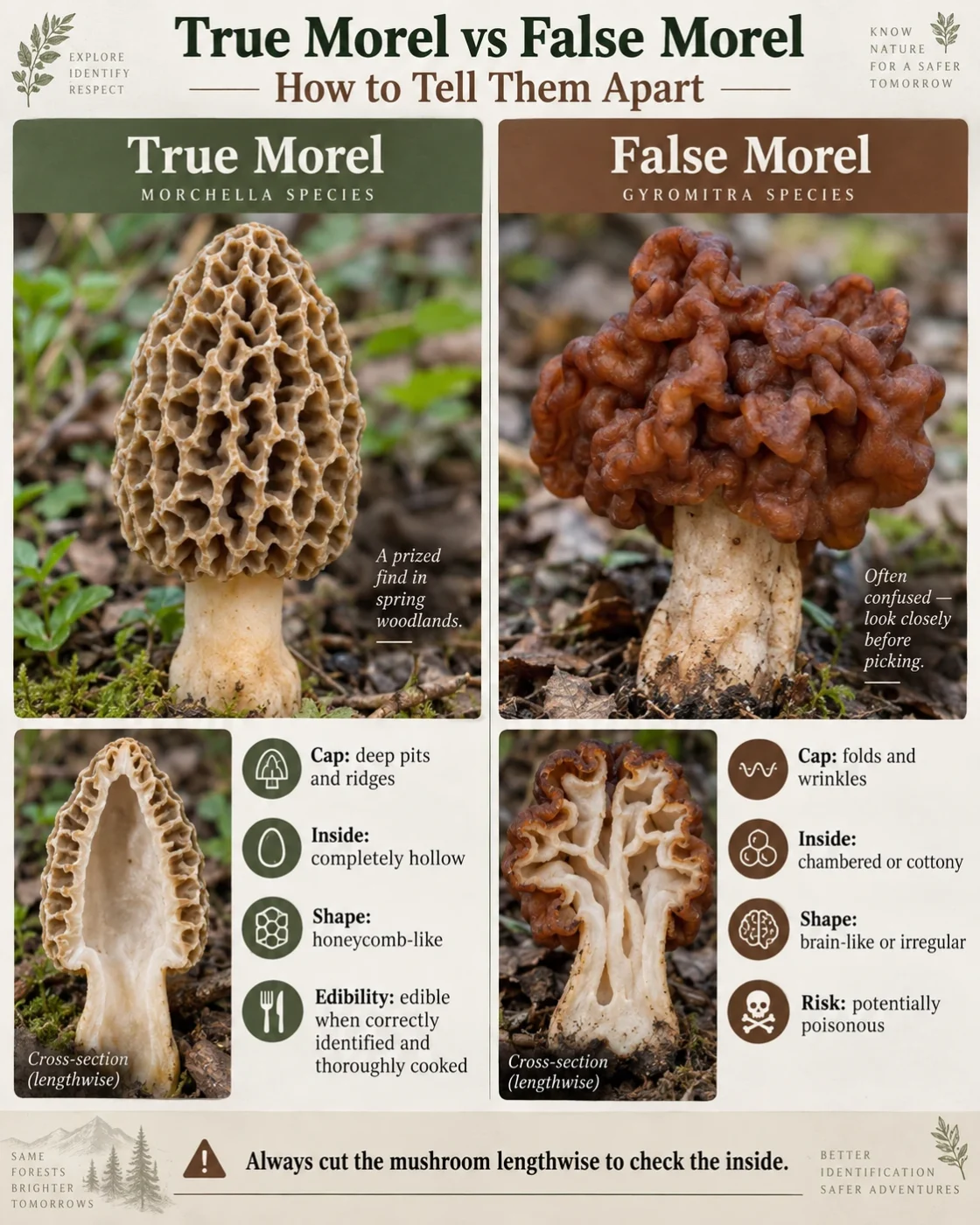
The differences are often visible once the mushroom is examined carefully. True morels have a clearly pitted, honeycomb-like cap and are hollow inside from top to bottom, while false morels usually have lobed, wrinkled or brain-like caps and a chambered interior.
⚠️ Important: This guide is for identification and education only. Never eat a wild mushroom based solely on a photograph, AI result, or comparison with an online guide.
Quick Comparison
| Feature | True Morel | False Morel |
|---|---|---|
| Main genus | Morchella | Usually Gyromitra |
| Cap surface | Deep pits and ridges | Lobes, folds and wrinkles |
| Overall cap shape | Honeycomb-like | Brain-like, saddle-shaped or irregular |
| Interior | Completely hollow | Chambered or cottony |
| Cap attachment | Usually attached directly to stem | Often irregular or partly free |
| Typical season | Mainly spring | Often spring, sometimes other periods |
| Edibility | Edible when correctly identified and thoroughly cooked | Potentially poisonous; should be avoided |
| Main risk | Confusion with false morels | Some species contain gyromitrin |
What Does a True Morel Look Like?
True morels belong to the genus Morchella. Their most characteristic feature is the cap surface, which is covered with a network of deep pits separated by raised ridges.
This pattern gives the mushroom a honeycomb, sponge or pinecone-like appearance. The pits are true depressions in the cap rather than simple wrinkles lying on the surface.
Cap color varies considerably among morel species and with age. Depending on species, the mushroom may be gray, yellow-brown, tan, dark brown or nearly black.
Because color is so variable, structure is far more useful than shade when trying to identify a true morel.
The Hollow Interior of a True Morel
One of the most useful features of true morels is their hollow interior. If a mature morel is cut lengthwise from the top of the cap through the bottom of the stem, the inside should form a continuous hollow cavity.
The stem is not filled with dense tissue, and the cap should not contain a maze of internal chambers. This characteristic is consistent across the true morels commonly collected for food.
The hollow test is extremely useful, but it should not be used by itself. A correct identification should also include the characteristic pitted cap and the way the cap connects to the stem.
What Does a False Morel Look Like?
The name “false morel” is applied to several mushrooms that resemble true morels superficially. The species most often discussed belong to the genus Gyromitra.
Instead of a regular honeycomb pattern, false morel caps usually have broad folds, lobes, wrinkles or saddle-like structures. Some species develop a deeply convoluted cap that resembles the surface of a brain.
The colors often range from tan and brown to reddish brown or dark chestnut. Some false morels can become large and heavy, making them look impressive even though their structure is very different from that of a true morel.
The Chambered Interior of False Morels
Cutting the mushroom lengthwise is one of the easiest ways to see the structural difference. False morels are usually not completely hollow from cap to stem.
Instead, the interior may contain chambers, folds, partitions or cottony tissue. The stem can appear irregular and divided internally rather than forming one clean empty cavity.
This difference is particularly obvious in well-developed specimens. A cross-section is often more informative than several photographs of the cap surface.
Cap Surface: Pits vs Wrinkles
The cap is usually the first feature people notice, but the important distinction is not simply whether the mushroom looks wrinkled.
A true morel has deep pits surrounded by raised ridges. The surface resembles a structured honeycomb, with many clearly defined depressions extending inward.
A false morel usually has folds that bulge outward. The cap may resemble a folded cloth, brain, saddle or irregular mass rather than a network of individual pits.
This is one of the best visual differences once you know what to look for.
Cap Attachment
In many common true morels, the lower edge of the cap is attached directly to the stem. The cap and stem form a fairly continuous structure.
There are exceptions, particularly half-free morels, in which the lower portion of the cap hangs away from the stem. Even these mushrooms still retain the characteristic pitted cap and completely hollow interior of true morels.
False morels often have a more irregular relationship between cap and stem. Their lobed caps may hang loosely, attach in several places or fold around the stem in unpredictable ways.
For this reason, cap attachment is useful as supporting evidence but should not be used alone.
True Morel vs Gyromitra esculenta
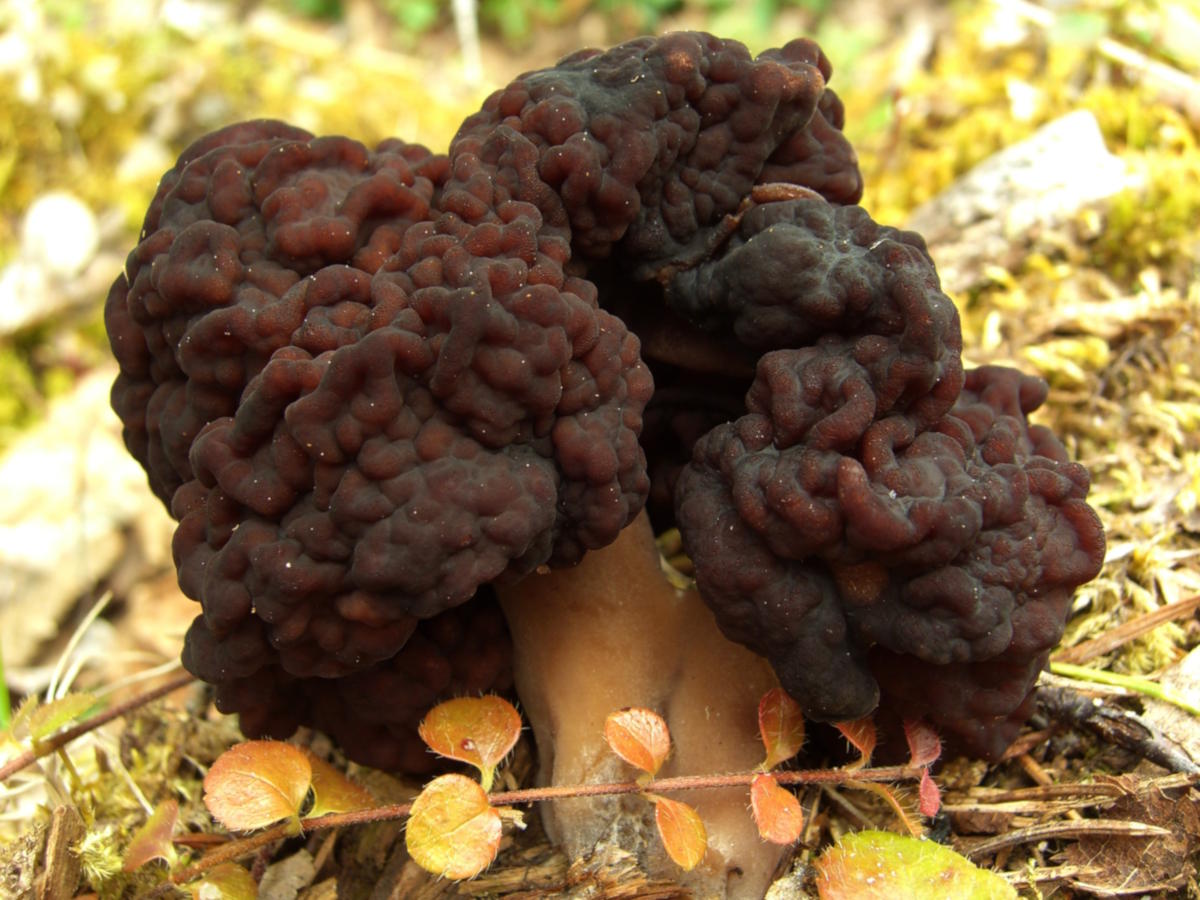
Gyromitra esculenta is one of the best-known false morels and one of the most important species to distinguish from true Morchella.
Its cap is usually reddish brown to dark brown and strongly folded or brain-like. The surface lacks the deep regular pits typical of true morels.
Inside, the mushroom is chambered rather than forming one continuous hollow cavity. This combination of a convoluted cap and irregular interior separates it from true morels even when both are found during the same season.
Main Difference
A true morel looks like a structured honeycomb and is completely hollow inside. Gyromitra esculenta looks more like a folded brain and contains internal chambers.
True Morel vs Gyromitra caroliniana
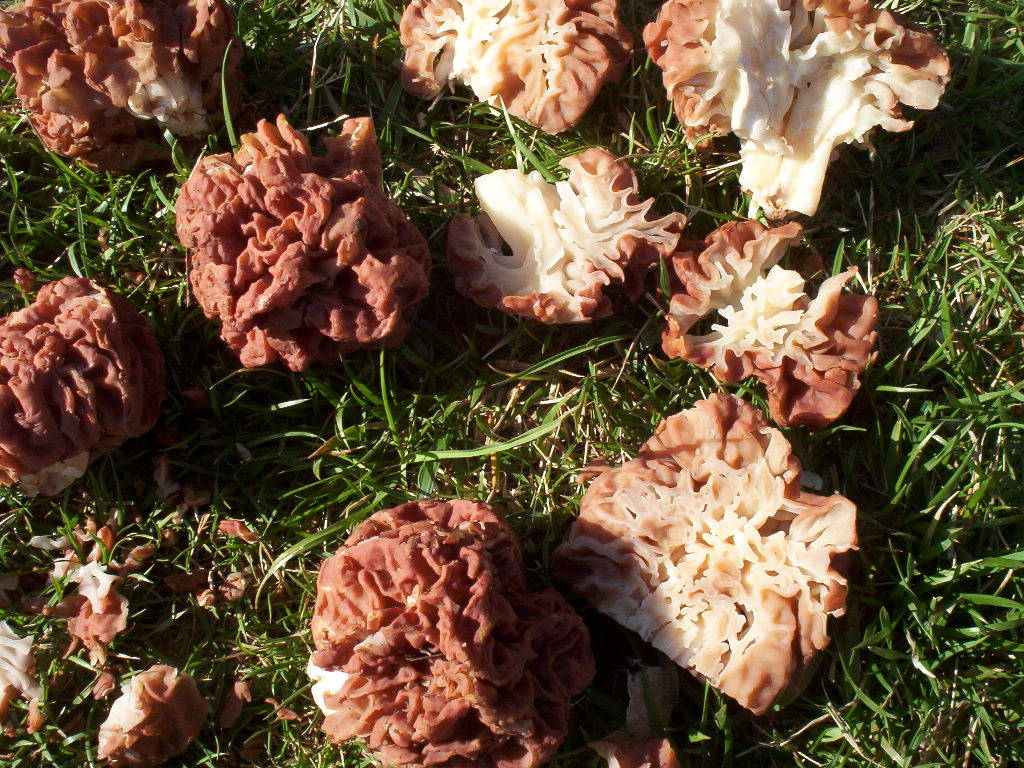
Gyromitra caroliniana, sometimes called the Big Red False Morel, can grow considerably larger than many true morels. It has a thick reddish-brown cap covered with deep convolutions.
The stem is pale and can become very robust, but the interior is chambered rather than hollow. Its large size can make it particularly striking on the forest floor.
This species may fruit during the same general spring period as true morels. Season alone therefore cannot separate the two.
True Morel vs Gyromitra brunnea
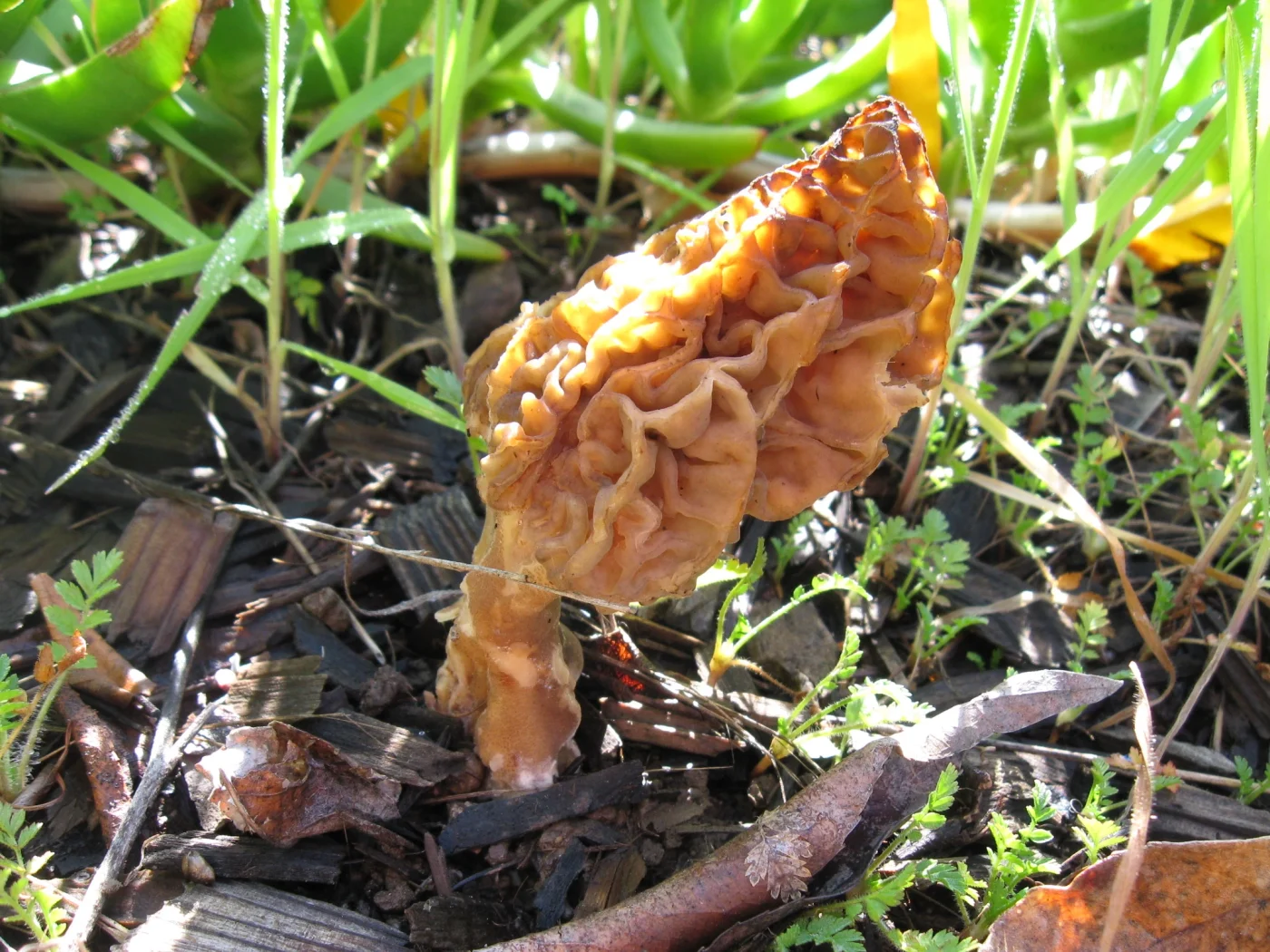
Gyromitra brunnea, sometimes called the Gabled False Morel, often has a cap divided into broad saddle-shaped or irregular lobes. It may be reddish brown to chestnut brown.
The cap surface is wrinkled rather than pitted, and the stem and cap contain internal chambers. In some specimens the lobes can look less obviously brain-like than those of other Gyromitra, making careful examination important.
The basic distinction remains the same: true morels have real pits and a hollow interior, while Gyromitra brunnea has folds and chambers.
Half-Free Morels
Half-free morels can confuse beginners because their caps are not fully attached along the lower edge. In these species, only the upper portion of the cap is attached to the stem, leaving the lower edge hanging free.
Despite this difference, they are still true morels. The cap has genuine pits and ridges, and the inside of the mushroom remains hollow.
This is a good example of why a single identification rule such as “the cap must be attached all the way around” is too simple.
Elfin Saddles and Other Morel-Like Mushrooms
Species of Helvella can also be mistaken for morels, especially by people unfamiliar with spring fungi. Their caps may be folded, saddle-shaped, lobed or irregular.
Many Helvella species also have unusual stems that may be deeply grooved, ribbed or hollow in complicated ways. They do not display the typical honeycomb pattern of true morels.
Other wrinkled cup fungi can create similar confusion. The more unusual the cap structure appears, the more important it becomes to cut the mushroom open and inspect the whole fruit body.
Where Do True Morels Grow?
True morels grow from soil rather than directly from logs or standing wood. They are most often found in woodland, forest edges, old orchards, disturbed areas and other habitats where suitable soil conditions occur.
Tree associations vary by region and species. Morel hunters often search near elm, ash, apple, cottonwood, oak and other trees, but there is no universal host tree that guarantees morels.
Recently disturbed ground can also be productive. In some regions, large flushes appear after forest fires or other ecological disturbances.
Habitat is helpful, but it should be treated as one clue among several.
Where Do False Morels Grow?
False morels also frequently occur on the ground in woodland, which is one reason habitat alone cannot separate them from true morels.
They may grow near stumps, fallen wood, conifers or mixed forest depending on species. Some appear very early in spring and can overlap with the true morel season.
Finding a mushroom in a classic morel habitat therefore does not make it a true morel. The physical structure still has to be examined.
When Do Morels Appear?
True morels are strongly associated with spring in temperate climates. Fruiting usually begins as soil temperatures rise and moisture becomes suitable.
The exact season varies by latitude, altitude and weather. In some regions they appear in March, while farther north or at higher elevations they may not fruit until April or May.
False morels can appear during the same period, and some species fruit slightly earlier. Because their seasons overlap, timing is useful for finding mushrooms but not for proving identity.
Are False Morels Poisonous?
False morels should be regarded as potentially poisonous. Several Gyromitra species contain gyromitrin, a compound that can be converted in the body to monomethylhydrazine.
Poisoning can cause gastrointestinal and neurological symptoms and, in severe cases, liver damage, seizures or death. Toxin concentration can vary between species, populations and individual mushrooms.
Some false morels have historically been eaten in certain regions after special preparation, but this does not make them reliably safe. The toxin level cannot be judged from appearance, and incomplete preparation can leave dangerous amounts behind.
For a general identification guide, the safest approach is to treat false morels as mushrooms that should not be eaten.
Are True Morels Safe to Eat Raw?
No. Even correctly identified true morels should be thoroughly cooked before eating.
Raw or undercooked morels can cause gastrointestinal symptoms and other adverse reactions. Cooking is part of normal preparation for true morels, but cooking cannot transform an incorrectly identified false morel into a safe true morel.
Correct species identification always comes first.
True Morel vs False Morel at a Glance
| Feature | True Morel | False Morel |
|---|---|---|
| Cap texture | Honeycomb pits and ridges | Wrinkles, folds or lobes |
| Cap appearance | Structured and regular | Brain-like or irregular |
| Interior | Continuously hollow | Chambered or partly filled |
| Stem | Hollow | Often chambered |
| Color | Gray, tan, yellow-brown, dark brown | Tan, brown, reddish brown |
| Season | Spring | Often spring, overlapping |
| Safety | Edible when correctly identified and cooked | Potentially poisonous |
The hollow interior and pitted cap are the most useful combination of features. Neither should be considered in isolation.
How to Identify a Morel Step by Step
Begin with the cap surface. A true morel should have clearly defined pits surrounded by raised ridges rather than broad folds or brain-like lobes.
Next, cut the mushroom lengthwise. The inside should be hollow from the top of the cap through the stem.
Then examine the cap attachment and habitat. These additional features help confirm that the mushroom fits a true Morchella rather than one of several spring look-alikes.
If the interior is chambered or the cap lacks true pits, the mushroom should not be treated as a true morel.
How to Photograph Morels for Identification
A useful identification set should include the cap from several angles, the whole stem and the exact place where the mushroom is growing. Cap structure is easier to judge when side lighting reveals the depth of the pits and ridges.
The most useful additional image is a lengthwise cross-section. This immediately shows whether the mushroom is completely hollow or contains chambers.
A photograph of nearby trees and the surrounding habitat can also provide useful context, but habitat should not replace structural examination.
Can Morels Be Identified From a Photo?
Typical true morels can often be recognized with good photographs, especially when the cap pattern and complete fruit body are clearly visible.
However, a single photograph from above may hide the features that matter most. Brain-like false morels can look deceptively similar when the image is small, blurred or taken from an unusual angle.
AI identification becomes much more useful when photographs include the underside, stem and interior. A cross-section can provide information that no cap-only image can reproduce.
Common Morel Identification Mistakes
One common mistake is focusing too heavily on color. True and false morels both occur in various shades of brown, tan and gray, so color is much less useful than cap structure.
Another mistake is assuming that all mushrooms found in spring are true morels. False morels can fruit at the same time and in similar habitats.
A third mistake is checking only whether the stem seems hollow. The correct pattern is a mushroom that is completely hollow through both cap and stem, combined with a genuinely pitted cap.
Frequently Asked Questions
What is the easiest way to tell a true morel from a false morel?
Look at the cap and then cut the mushroom lengthwise. True morels have deep honeycomb-like pits and are completely hollow inside, while false morels usually have wrinkled or brain-like caps and chambered interiors.
Are all false morels poisonous?
Several species contain potentially dangerous toxins, and toxin concentration is variable. For practical safety, false morels should be treated as potentially poisonous and not collected for food.
Are true morels hollow?
Yes. A true morel should be hollow through the cap and stem when sliced vertically.
Do false morels have hollow stems?
They are usually chambered rather than completely hollow. Internal partitions, folds or cottony tissue may be visible.
What does a false morel cap look like?
The cap is often lobed, wrinkled, saddle-shaped or brain-like. It does not have the regular network of deep pits and raised ridges seen in true morels.
Can true and false morels grow in the same habitat?
Yes. Their habitats and fruiting seasons can overlap, so location alone cannot determine which one you found.
What color are true morels?
Depending on species and age, they can be gray, tan, yellow-brown, brown or very dark. Color is not a reliable standalone identification feature.
Can you eat true morels raw?
No. Correctly identified true morels should be thoroughly cooked before consumption.
What is the most dangerous false morel?
Several Gyromitra species are associated with poisoning, including Gyromitra esculenta. It is safer not to attempt to rank unknown false morels by apparent risk.
Does a brain-like cap mean it is a false morel?
A strongly brain-like or lobed cap is characteristic of several false morels. A true morel should instead have clear pits and ridges forming a honeycomb-like surface.
Final Identification Notes
The safest visual distinction between true and false morels comes from combining two features. A true morel has a genuinely pitted honeycomb cap and is completely hollow from top to bottom.
False morels usually replace those pits with broad wrinkles, folds or brain-like lobes, and their interiors are typically chambered rather than forming one continuous hollow cavity. Habitat and season can support an identification, but they overlap too much to be used as deciding factors.
When uncertainty remains, do not eat the mushroom. Found a morel-like mushroom? Photograph the entire specimen and cut one lengthwise for identification, because the inside can be just as important as the cap.