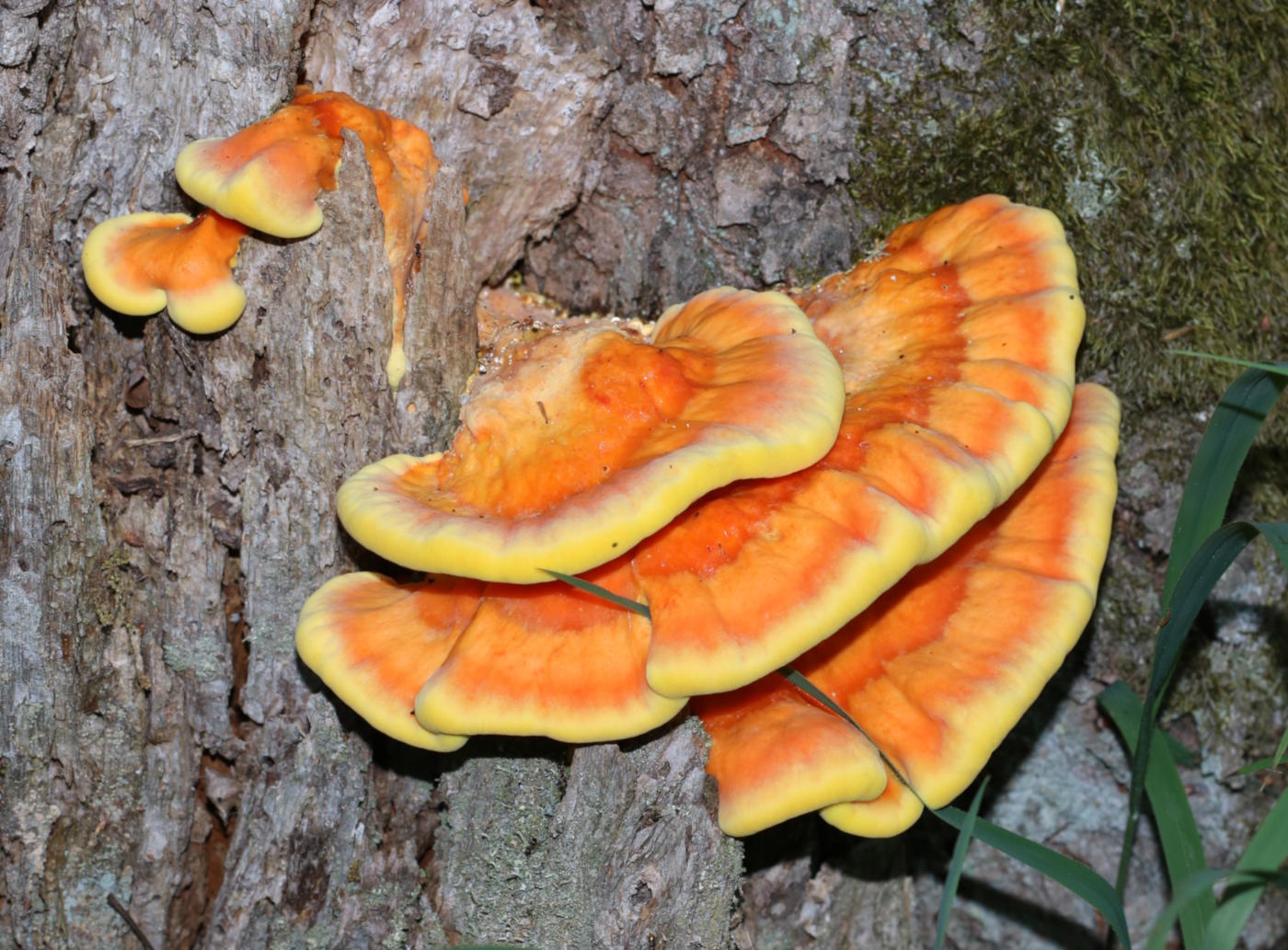
Laetiporus sulphureus, commonly known as Chicken of the Woods, is one of the most striking bracket fungi found on trees. Its bright yellow to orange shelves often form large overlapping clusters, making mature specimens easy to notice from a distance.
The species is widely known as an edible mushroom when young and correctly identified, but several similar shelf fungi can cause confusion. Accurate identification should consider color, pore structure, texture, host tree, age and the exact way the fruit body grows from wood.
⚠️ Important: This guide is for identification and education only. Never eat a wild mushroom based solely on a photograph, AI result, or comparison with an online guide.
Quick Identification
| Feature | Laetiporus sulphureus |
|---|---|
| Scientific name | Laetiporus sulphureus |
| Common names | Chicken of the Woods, Sulphur Polypore |
| Family | Fomitopsidaceae |
| Shape | Overlapping shelf-like brackets |
| Cap color | Bright orange to yellow-orange |
| Underside | Yellow pores, no gills |
| Stem | Usually absent |
| Flesh | Soft and moist when young, tougher with age |
| Spore print | White |
| Substrate | Living or dead wood |
| Common hosts | Mainly deciduous trees |
| Growth pattern | Dense overlapping clusters |
| Main season | Usually summer through autumn |
| Edibility | Edible when young and correctly identified |
| Main look-alikes | Other Laetiporus, Meripilus, Bondarzewia, some orange polypores |
What Does Laetiporus sulphureus Look Like?
Chicken of the Woods typically forms large shelves that grow directly from trunks, stumps or large branches. The caps are usually fan-shaped or semicircular and overlap in tiers, creating a layered mass that can become very large.
Fresh young specimens are vivid yellow and orange, often with a brighter yellow margin. As they age, the colors fade toward pale orange, cream or dirty yellow, and the flesh becomes much tougher.
This color transition is useful because the best identification features are usually strongest in young, healthy fruit bodies.
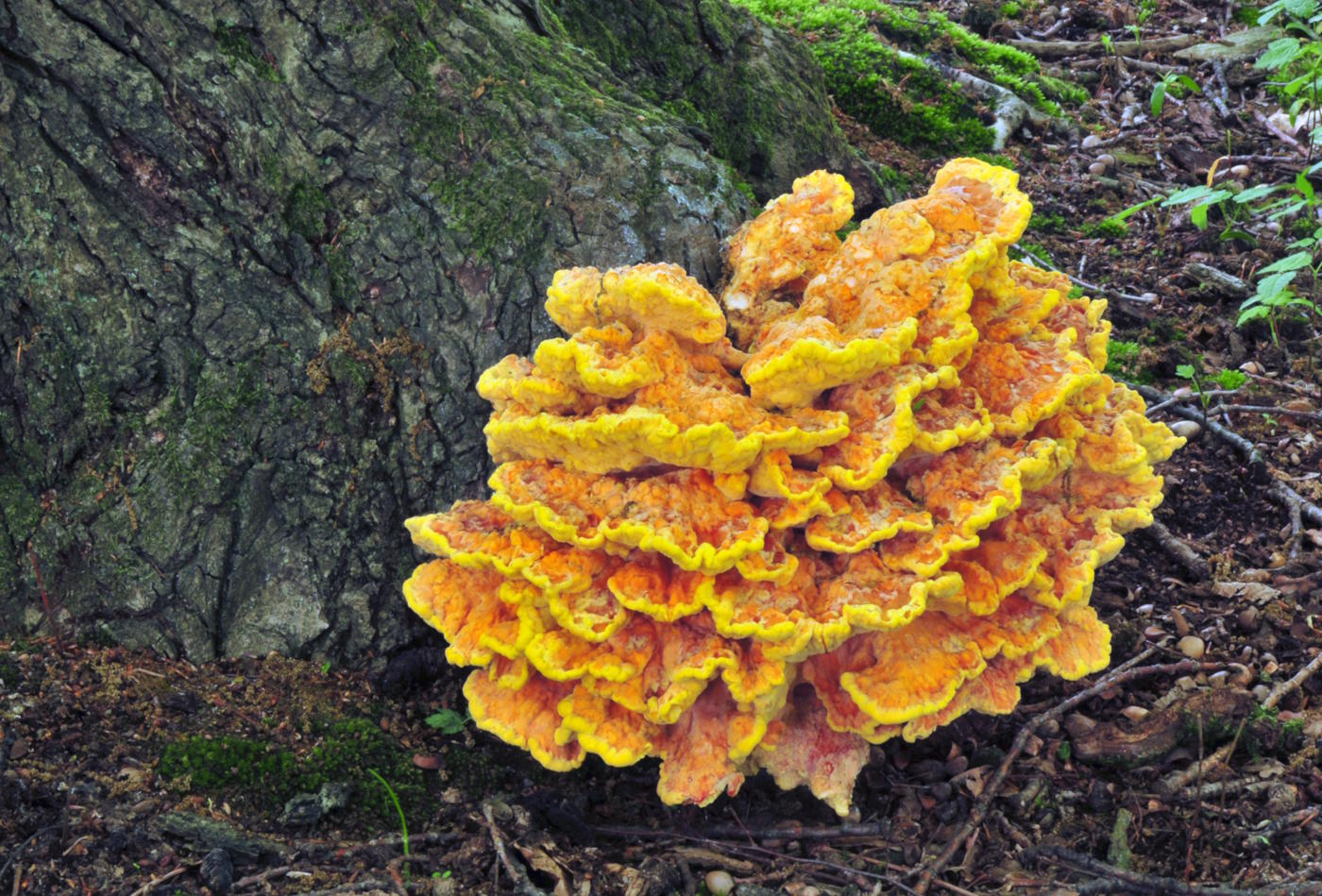
Cap
The upper surface is usually smooth to slightly wrinkled and lacks the scales seen in many other bracket fungi. Color is most intense when the mushroom is young, ranging from sulphur yellow at the edges to orange or reddish orange toward the center.
Individual shelves can become broad and thick, and several may fuse together into a large cluster. The margin is usually rounded when young and becomes thinner, wavier and less regular with age.
Cap color alone is not enough for identification, but the combination of bright orange-yellow shelves and a yellow pore surface is highly characteristic.
Underside and Pores
The underside of Laetiporus sulphureus has pores rather than gills. These pores are small, closely packed and usually yellow in fresh specimens.
This is one of the most important features to check. A mushroom with true gills is not Chicken of the Woods, even if the cap is orange and shelf-like.
As the fruit body ages, the pore surface may become paler. Older specimens can lose much of the vivid yellow coloration that makes younger clusters so distinctive.
Stem and Attachment
Chicken of the Woods usually has no obvious stem. The brackets attach directly to the wood along a broad base.
Some fruit bodies develop a narrowed attachment area, but they do not normally form the classic cap-and-central-stem structure seen in many ground-growing mushrooms.
The attachment point can help distinguish Laetiporus from other orange mushrooms that merely grow near wood rather than directly from it.
Flesh and Texture
Young flesh is soft, moist and tender, often with a texture that has inspired the common name “Chicken of the Woods.” The inside is usually pale yellow to cream.
As the mushroom matures, the flesh becomes fibrous, dry and eventually corky. Older brackets can remain attached to the tree long after they are no longer suitable as food.
Texture is therefore useful both for identification and for judging age.
Spore Print
The spore print is white. This can support identification, although spore color is less distinctive here than in many gilled mushrooms.
Because several bracket fungi also produce pale spores, the spore print should be considered together with color, pores, host tree and growth form.
Where Does Chicken of the Woods Grow?
Laetiporus sulphureus grows directly from wood. It may occur on living trees, dead standing trunks, stumps and large fallen logs.
It is mainly associated with deciduous trees and can be found on oak, willow, poplar, beech, cherry and other broadleaf hosts. Exact preferences vary by region.
The fungus causes brown rot in wood, breaking down structural components and weakening the host. On living trees, fruiting can indicate significant internal decay.
Does It Grow on Living Trees?
Yes. Chicken of the Woods can fruit on trees that are still alive because the fungus may be decomposing heartwood inside the trunk.
A tree can therefore produce a large cluster of fruit bodies while still carrying green leaves. The visible brackets may be the first obvious sign that internal decay is present.
From an identification perspective, growth on a living tree is entirely consistent with Laetiporus sulphureus.
When Does Chicken of the Woods Grow?
The main fruiting period is usually summer through autumn, although timing varies with climate, rainfall and latitude.
Fresh clusters often appear after warm, wet periods. Once established on a suitable host, the fungus may fruit again from the same tree in later years.
Season is a useful supporting clue, but it should never override structural features.
Is Chicken of the Woods Edible?
Yes. Young Laetiporus sulphureus is widely regarded as edible when correctly identified and properly cooked.
The best fruit bodies are usually young, soft and brightly colored. Older shelves become tougher and less pleasant in texture.
Some people experience gastrointestinal discomfort after eating Laetiporus, so even correctly identified specimens may not suit everyone. Thorough cooking and trying only a small amount initially are commonly recommended practices.
Chicken of the Woods Look-Alikes
The main look-alikes are other large bracket fungi growing on wood. Most are easier to separate once the underside, texture and color are examined carefully.
The most useful combination for Chicken of the Woods is bright orange-yellow shelves + yellow pore surface + no gills + growth directly from wood.
Other Laetiporus Species
Several closely related Laetiporus species can resemble L. sulphureus very closely. In North America especially, different species may prefer different host trees or produce slightly different color patterns.
Some have pale or whitish pore surfaces rather than the bright yellow underside typical of classic L. sulphureus. Because the genus is regionally complex, species-level identification may require more than appearance alone.
For practical field identification, recognizing the Laetiporus group correctly is often easier than determining the exact species from photographs.
Meripilus giganteus — Giant Polypore
- Scientific name: Meripilus giganteus
- Common name: Giant Polypore
Giant Polypore can form large overlapping clusters at the base of trees and may initially resemble Chicken of the Woods from a distance. However, its colors are generally brown, cream and gray rather than vivid orange-yellow.
A particularly useful clue is that Meripilus flesh and pore surfaces often darken strongly when bruised or damaged. The fruit bodies are also usually more subdued in color and can become enormous.
Main Difference
Chicken of the Woods is bright orange-yellow and usually does not show the same dramatic blackening reaction. Giant Polypore is duller and commonly darkens after handling.
Bondarzewia berkeleyi — Berkeley’s Polypore
- Scientific name: Bondarzewia berkeleyi
- Common name: Berkeley’s Polypore
This large bracket fungus grows at the base of hardwood trees and can form massive overlapping clusters. Its caps are typically cream, tan or pale brown rather than orange.
The fruit bodies are thicker and more muted in color, while the underside has pores. From above, a pale old Chicken of the Woods could superficially resemble it, but fresh specimens are usually easy to separate by color.
Orange Polypores and Other Bracket Fungi
Several unrelated bracket fungi can show orange, rust or reddish tones. Most differ in pore color, flesh texture, cap surface or host preference.
Some are woody and hard from the beginning, unlike the soft fleshy texture of young Laetiporus. Others form thinner crusts or small shelves rather than large fleshy brackets.
This is why checking texture and underside structure is as important as looking at cap color.
Chicken of the Woods vs Giant Polypore
| Feature | Laetiporus sulphureus | Meripilus giganteus |
|---|---|---|
| Cap color | Bright orange to yellow | Cream to brown-gray |
| Underside | Yellow pores | Pale pores |
| Bruising | Usually little dramatic darkening | Often darkens strongly |
| Flesh | Soft and tender when young | Firmer and more fibrous |
| Growth | Overlapping shelves | Massive rosette-like clusters |
| Host | Mainly hardwood | Usually broadleaf trees |
| Edibility | Edible when young and correctly identified | Not usually collected as a choice edible |
The color difference is usually obvious in fresh specimens, but older Chicken of the Woods can fade considerably.
How to Identify Chicken of the Woods Step by Step
Start with the growth form. A likely specimen should be growing directly from wood and forming several overlapping shelves rather than a single cap with a central stem.
Next, inspect the underside. It should have tiny yellow pores rather than gills, teeth or a smooth surface.
Then check the texture and color. Young fruit bodies should be soft, fleshy and brightly orange-yellow. Finally, consider the host tree and season as supporting evidence.
How to Photograph Chicken of the Woods for Identification
Photograph the entire cluster from the side so the layered growth pattern is visible. A second image should show the pore surface underneath.
Include a close-up of the flesh and attachment point if possible. A wider photo of the tree or log can help determine whether the fungus is growing on hardwood or another substrate.
Multiple angles are more useful than one close-up because the overall architecture is a major identification feature.
Can Chicken of the Woods Be Identified From a Photo?
Typical young specimens are among the easier bracket fungi to recognize from good photographs. Their bright colors, overlapping shelves and yellow pore surface form a distinctive combination.
Problems arise with old faded fruit bodies or unusual regional Laetiporus species. A photo of the upper surface alone can also hide the pore structure and make confusion more likely.
AI identification can help narrow the possibilities, but the underside, texture and host wood should still be checked manually.
Why Does Chicken of the Woods Change Color?
Fresh growth is usually the brightest. As the mushroom ages, sunlight, drying and weathering gradually reduce the orange and yellow tones.
Older shelves may become pale cream, chalky yellow or almost white at the edges. Once the colors fade, the fruit body can look much less distinctive.
This is why very old specimens are more difficult to identify from color alone.
Can Chicken of the Woods Grow on Conifers?
The classic Laetiporus sulphureus is mainly associated with deciduous trees, but other Laetiporus species can occur on different hosts, including conifers in some regions.
Host tree is therefore useful but not absolute. A bright orange bracket on conifer wood may still belong to Laetiporus, but species-level identification becomes more important.
Regional field guides can be especially helpful in areas where several Laetiporus species overlap.
Is Chicken of the Woods Always Bright Orange?
No. Young specimens are usually vivid, but mature fruit bodies can fade considerably.
Some related Laetiporus species are naturally paler, and environmental conditions also influence color. The safest identification uses color together with pore structure, texture, substrate and growth form.
A pale bracket should never be identified as Chicken of the Woods based on shape alone.
Interesting Facts About Laetiporus sulphureus
The common name comes from the texture of young fruit bodies, which many people compare with cooked chicken. The species has been collected as a wild food for generations in many regions.
Its scientific name is also descriptive. The word sulphureus refers to the vivid sulphur-yellow coloration found on fresh fruit bodies.
Ecologically, the fungus is an important wood decomposer. By breaking down the internal structure of trees, it plays a role in nutrient cycling while also contributing to structural decay in infected hosts.
Frequently Asked Questions
What does Chicken of the Woods look like?
It forms bright orange and yellow shelves growing in overlapping clusters from wood. The underside has tiny yellow pores rather than gills.
Where does Chicken of the Woods grow?
It grows directly from living or dead wood, mainly on broadleaf trees such as oak, willow, poplar and beech.
Does Chicken of the Woods have gills?
No. The underside has a pore surface.
What color is the underside?
Fresh specimens usually have a yellow pore surface. Older fruit bodies may become paler.
Is Chicken of the Woods edible?
Young specimens are considered edible when correctly identified and thoroughly cooked. Older brackets become tough and fibrous.
What mushrooms look like Chicken of the Woods?
Important comparisons include other Laetiporus species, Giant Polypore, Berkeley’s Polypore and several orange or pale bracket fungi.
Does Chicken of the Woods grow from the ground?
It grows from wood. If it appears terrestrial, buried roots or woody material may be present underneath.
When does Chicken of the Woods appear?
It most commonly fruits from summer through autumn, although exact timing varies by region and weather.
Can it grow on living trees?
Yes. Fruiting on a living tree often indicates internal wood decay.
How can I tell Chicken of the Woods from Giant Polypore?
Chicken of the Woods is usually bright orange-yellow, while Giant Polypore is more brown or gray and often darkens strongly when bruised.
Final Identification Notes
A typical Laetiporus sulphureus combines bright orange-yellow overlapping shelves, a yellow pore surface, soft fleshy texture when young, and growth directly from wood.
The most important checks are the underside and substrate. A mushroom with true gills is not Chicken of the Woods, and a cluster not attached to wood should be reconsidered carefully.
Older specimens can fade and become difficult to recognize, while regional Laetiporus species may differ subtly in color and host preference. For the strongest identification, combine cap color, pores, texture, host tree, growth pattern and season.
Found a bright orange bracket fungus? Photo identification can help narrow the possibilities, but inspect the pore surface, texture and host wood before reaching a final identification.