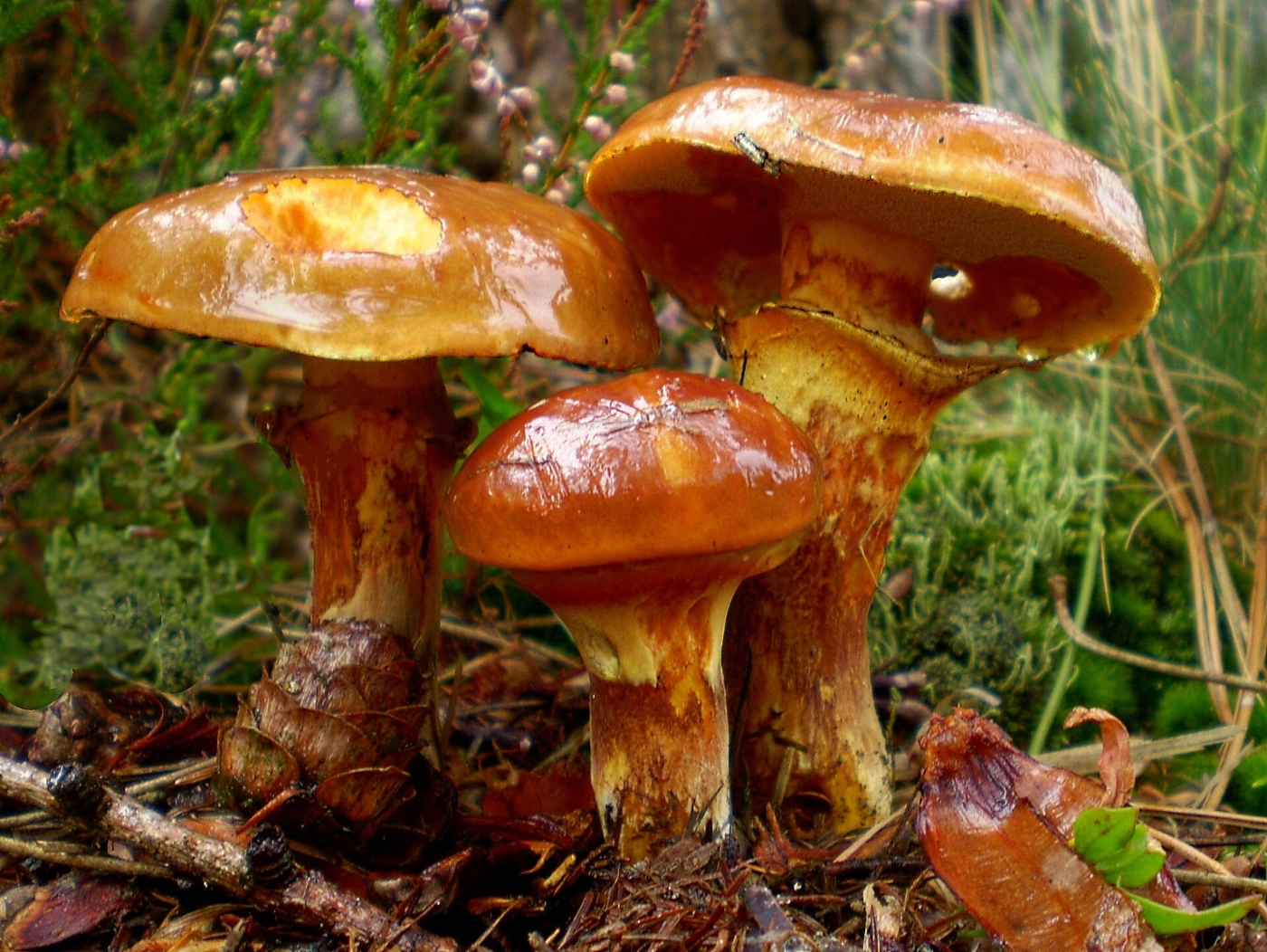
Suillus grevillei, commonly known as the Larch Bolete, is a bright yellow to orange bolete with a strongly sticky cap that grows in close association with larch trees. It is one of the easiest Suillus species to narrow down when the host tree is known.
The most useful field pattern is yellow-orange slimy cap + yellow pores + ring zone on the stem + larch nearby. Because several Suillus species can look similar, the tree association is one of the strongest identification clues.
⚠️ Important: Suillus grevillei is generally considered edible when correctly identified and thoroughly cooked, but Suillus mushrooms can cause gastrointestinal upset in some people. The slimy cap skin and soft pore layer are often removed before cooking.
Quick Identification
| Feature | Suillus grevillei |
|---|---|
| Common name | Larch Bolete |
| Cap color | Yellow, golden-yellow, orange-yellow, rusty orange |
| Cap surface | Strongly viscid or slimy |
| Underside | Pores, not gills |
| Young pores | Lemon-yellow |
| Mature pores | Yellow to cinnamon-toned |
| Bruising | Pores may stain rusty-brown |
| Stem | Yellow to pale, often with brownish dots or scales |
| Ring | Thin ring or ring zone from veil |
| Flesh | Pale yellow to yellowish |
| Spore print | Ochre to sienna-brown |
| Ecology | Mycorrhizal |
| Main host | Larch |
| Season | Summer to autumn |
| Edibility | Edible when correctly identified and cooked |
| Main look-alikes | Other Suillus species |
What Does Suillus grevillei Look Like?
The Larch Bolete has a vivid appearance, especially when fresh. Young mushrooms often have bright chrome-yellow or golden caps that gradually deepen toward orange or rusty yellow with age.
The cap becomes extremely slippery in wet weather. Even when conditions are dry, it can retain a glossy appearance that makes it stand out among duller woodland boletes.
Cap
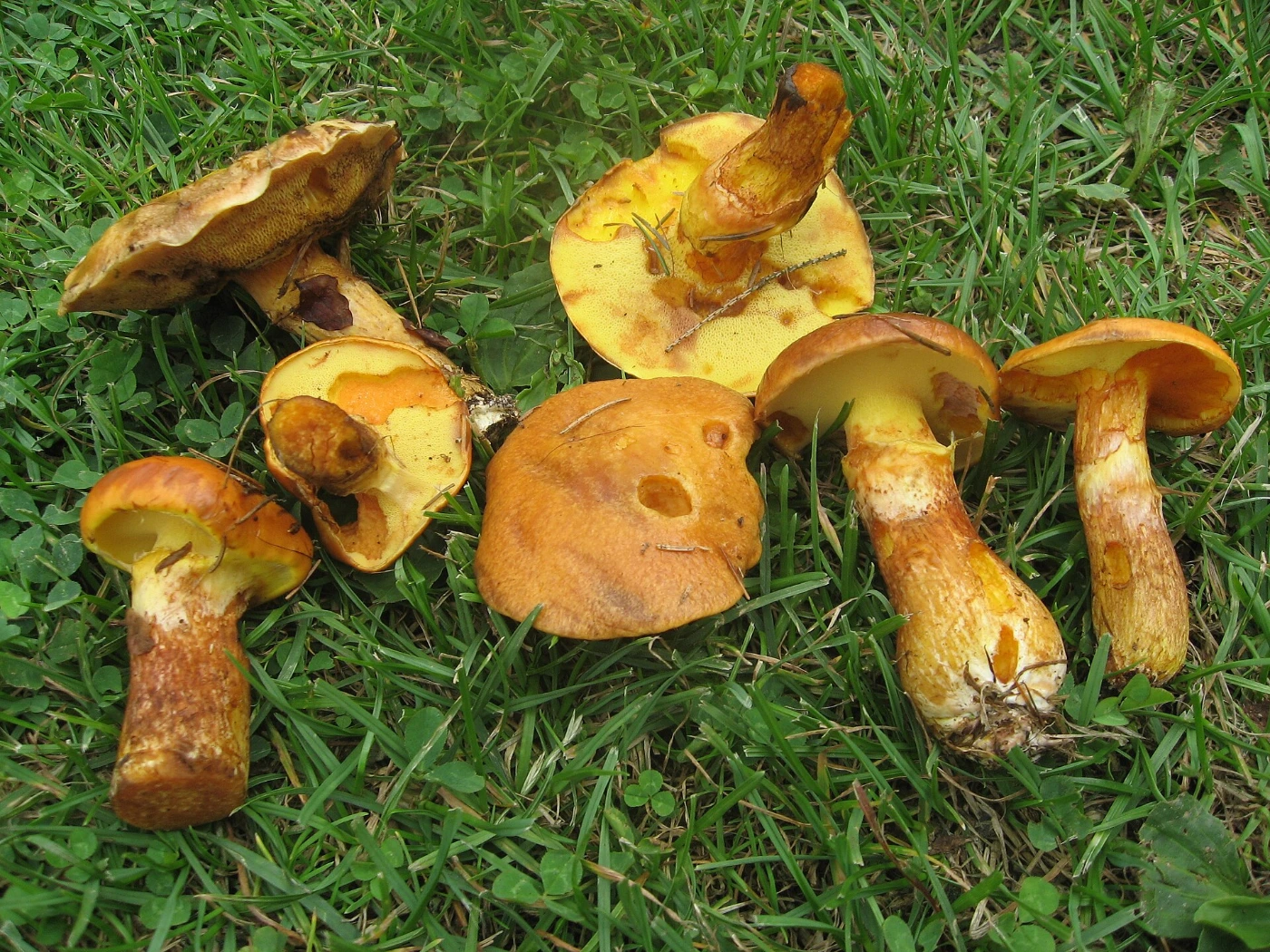
The cap is usually convex when young and broadens with age. Mature caps can become nearly flat and may develop a slightly wavy margin.
Typical colors range from pale yellow through daffodil yellow to deep orange-yellow. Some darker forms can become chestnut or rusty brown.
Sticky Cap
The strongly viscid surface is one of the defining characteristics. In wet weather, the mushroom can feel almost coated in mucus.
This slimy layer is typical of many Suillus species. It often collects needles, leaves, and soil particles, so older mushrooms may look much dirtier than fresh specimens.
Pores
The underside has a sponge-like pore surface rather than gills. Young pores are bright lemon-yellow.
As the mushroom matures, the pores darken and may develop cinnamon or ochre tones. Bruising can cause rusty-brown discoloration.
Tubes
The tubes are yellow and generally remain pale when the mushroom is cut. They form the spongy layer beneath the cap.
In old specimens, this layer can become soft and waterlogged. It is often removed before cooking.
Stem
The stem is usually yellowish and relatively slender compared with the broad cap. Brown dots or fine scales may occur on the lower portion.
The upper part of the stem is often paler. A veil in young mushrooms creates a ring or ring zone as the cap expands.
Ring and Veil
Young fruit bodies have a pale veil covering the pore surface. As the cap opens, this veil tears and leaves a thin ring or obvious ring zone on the stem.
The ring may become less distinct with age. Therefore, older mushrooms can appear almost ringless even though young specimens clearly show the veil structure.
Flesh
The flesh is pale yellow to yellow-orange and contains a substantial amount of moisture. It does not normally show dramatic blue staining.
This watery texture is one reason fresh Larch Boletes are sometimes considered less desirable than porcini or firmer boletes.
Smell
The smell is mild and not particularly distinctive. It may simply smell mushroom-like or slightly earthy.
Odor is therefore not a major identification character. Cap texture, pores, ring zone, and larch habitat are far more useful.
Spore Print
The spore print is ochre to sienna-brown. The spores themselves are smooth and elongated.
A spore print can help confirm the broader bolete identification but is rarely necessary when the host tree and morphology are clear.
Where Does Suillus grevillei Grow?
The Larch Bolete is ectomycorrhizal with larch. This means the fungus lives in a mutualistic relationship with the roots of living Larix trees.
It is therefore usually found directly beneath or near larch trees. Parks, woodland edges, planted larch stands, and mixed forests containing larch are all typical habitats.
Why Larch Is So Important
Many mushroom features can vary, but host association is much more stable. If there is no larch nearby, another Suillus species is usually more likely.
This makes Suillus grevillei a good example of why tree identification matters in mushroom hunting. A photograph of the surrounding habitat can sometimes be as useful as a close-up of the cap.
Season
The main fruiting season is summer through autumn. In Britain and Ireland, it is commonly recorded from July into October or November.
Timing varies by climate and altitude. Wet weather can trigger large flushes, especially in areas with mature larches.
Distribution
The species is widespread across much of Europe wherever larch occurs. It has also been reported outside its native range in areas where larch trees have been planted.
Because its ecology is tied so closely to larch, distribution often mirrors the presence of suitable host trees.
Does Suillus grevillei Grow in Groups?
Yes. Larch Boletes can be very gregarious and may appear in lines, arcs, or loose groups under their host trees.
Several generations of fruit bodies may appear in the same area over a period of weeks. Productive larch stands can therefore yield many mushrooms during favorable weather.
Is Suillus grevillei Edible?
Larch Bolete is generally regarded as edible when correctly identified and properly cooked. However, it is not usually considered one of the finest edible boletes.
The flesh can be watery and soft, especially in mature specimens. Some people also experience gastrointestinal discomfort after eating Suillus mushrooms.
Should You Peel the Cap?
The sticky cap skin is often removed before cooking. This improves texture and removes much of the slime and attached forest debris.
Older pore layers may also be removed because they become soft and can contribute to an unpleasant texture. These steps are culinary preferences rather than identification requirements.
Is Drying Better Than Eating It Fresh?
Drying can improve both flavor and texture. The high water content makes the mushroom shrink considerably, but the resulting dried pieces can be useful in soups and sauces.
This is particularly practical when a large flush produces more mushrooms than can be used fresh.
Look-Alikes
The closest look-alikes are other Suillus species. Most can be separated by host tree, ring presence, cap color, and pore features.
Suillus luteus — Slippery Jack
Identification
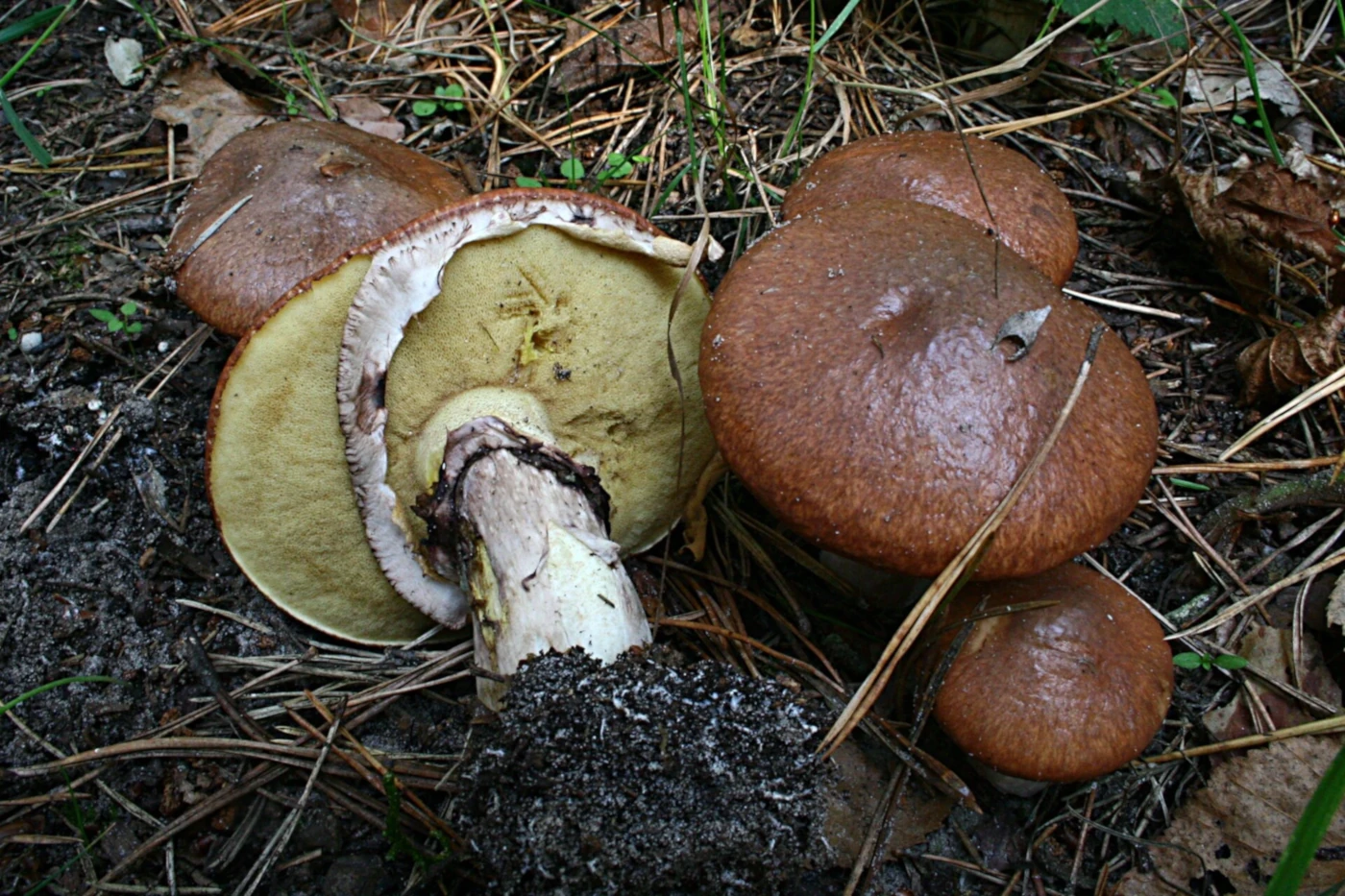
Suillus luteus also has a strongly slimy cap and a stem ring. Its cap is usually much darker, ranging from brown to dark chestnut.
It is associated mainly with pine rather than larch. The combination of dark brown cap and pine habitat separates it from the brighter Larch Bolete.
Main Difference
Yellow-orange cap + larch = Suillus grevillei. Dark brown cap + pine = Suillus luteus.
Suillus granulatus — Weeping Bolete
Identification
Suillus granulatus has a sticky yellow-brown to orange-brown cap and yellow pores. Young pores may release small droplets.
Unlike S. grevillei, it lacks a true ring or ring zone and grows mainly with pine.
Main Difference
No ring and pine association favor S. granulatus. A ring zone and larch strongly favor S. grevillei.
Suillus bovinus — Bovine Bolete
Identification
Bovine Bolete is usually duller, with a yellow-brown or orange-brown cap. It also lacks the distinct veil-derived ring zone of Larch Bolete.
It is associated with pine rather than larch. Its pores are often more irregular and larger.
Main Difference
Host tree and ring structure provide the clearest distinction. S. bovinus grows with pine and lacks the ring zone typical of S. grevillei.
Other Larch-Associated Suillus
Identification
Several Suillus species can grow with larch, depending on region. Some may be paler, darker, or lack a ring.
Exact separation may require closer examination of pore size, cap color, stem markings, and regional distribution.
Main Difference
Suillus grevillei is characterized by the combination of a bright yellow-orange slimy cap and a veil-derived ring zone. Unusual specimens should be compared with other regional larch-associated species.
Suillus grevillei vs Suillus luteus
| Feature | Suillus grevillei | Suillus luteus |
|---|---|---|
| Cap color | Yellow to orange-yellow | Brown to dark chestnut |
| Cap texture | Very slimy | Very slimy |
| Pores | Yellow | Yellow |
| Ring | Present / ring zone | Present |
| Main host | Larch | Pine |
| Best clue | Bright cap + larch | Dark cap + pine |
These two are structurally similar. Host tree is one of the fastest ways to separate them.
Suillus grevillei vs Suillus granulatus
| Feature | Suillus grevillei | Suillus granulatus |
|---|---|---|
| Cap | Yellow-orange | Yellow-brown / orange-brown |
| Pores | Yellow | Yellow, may exude droplets |
| Ring | Present or ring zone | Absent |
| Main host | Larch | Pine |
| Stem | Often brown-dotted below ring | Glandular dots |
| Best clue | Ring + larch | No ring + pine |
Ring structure and host tree together provide a strong field distinction.
How to Identify Suillus grevillei
Start with the tree. If the mushroom is growing beneath larch, the identification becomes much easier.
Next examine the cap and underside. A vivid yellow-orange slimy cap with yellow pores strongly supports the species.
Finally, look for veil remnants or a ring zone on the stem. When all three characters occur together, Suillus grevillei becomes a strong candidate.
Young vs Mature Larch Boletes
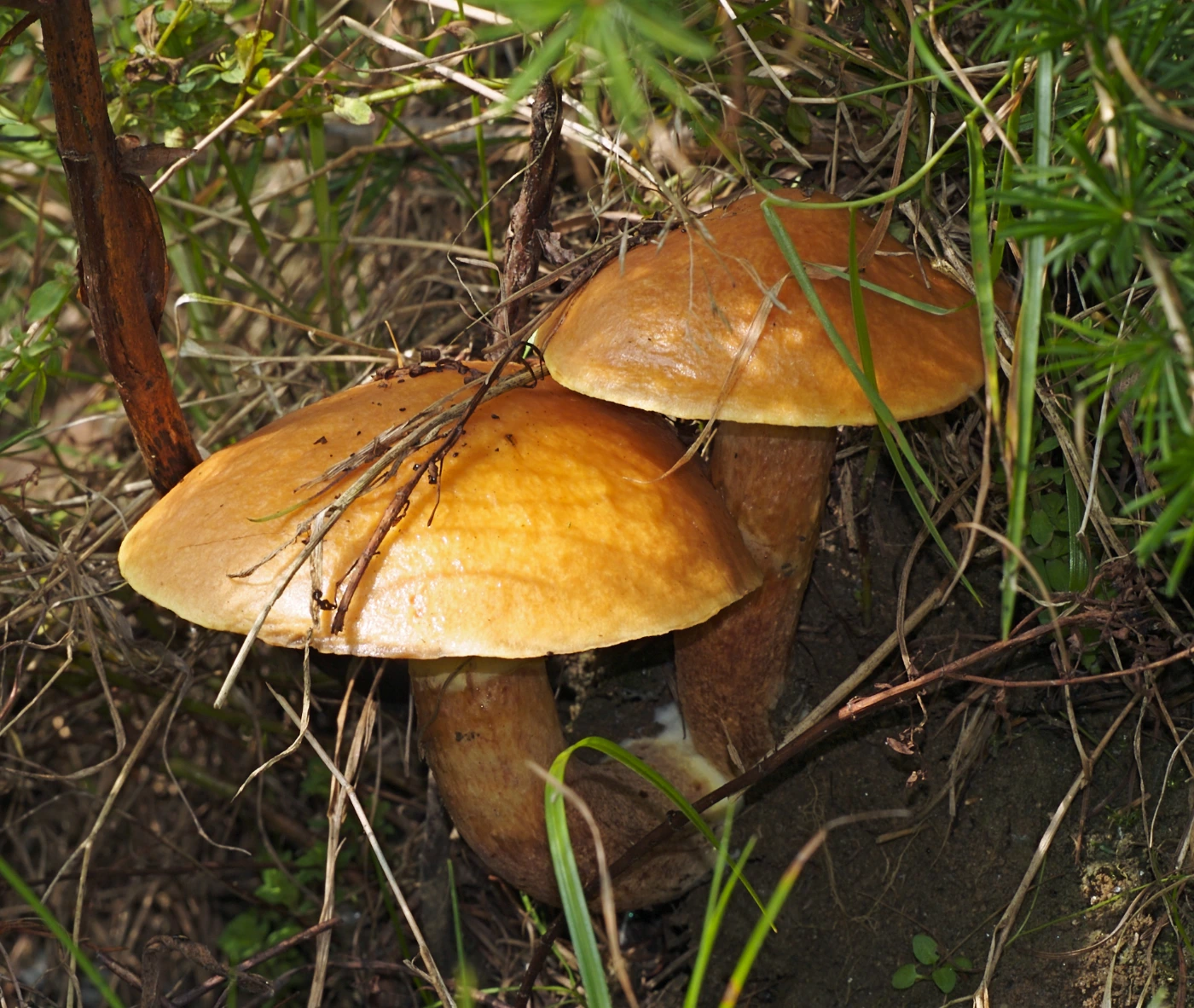
Young specimens usually have the brightest yellow colors and a clear veil covering the pores. Their caps are strongly convex and often very glossy.
Mature mushrooms become more orange or rusty in color, and the ring can become less obvious. The pores darken and the flesh becomes softer and more watery.
How Rain Changes the Appearance
Rain makes the cap dramatically more slippery and reflective. It also causes needles and debris to stick to the surface.
During dry weather, the mushroom can still appear glossy but may feel much less slimy. This variability can make the same species look surprisingly different from one day to the next.
Common Identification Mistakes
One common mistake is identifying every slimy bolete as Slippery Jack. Several Suillus species have equally slippery caps.
Another mistake is ignoring the host tree. Larch association is one of the strongest clues for this species.
A third mistake is assuming the ring must always be obvious. In older specimens, the veil can leave only a weak ring zone.
How to Photograph Suillus grevillei
Photograph the mushroom before removing it and include the larch tree or fallen larch needles if possible. This records the most important ecological clue.
Then photograph the pore surface, full stem, and ring zone. A side view showing both cap color and stem structure is especially useful.
Can AI Identify Larch Bolete?
AI can often recognize typical specimens when the yellow-orange slimy cap, pores, and ring zone are visible. Confidence improves substantially when larch habitat is also provided.
A single top-down cap photograph is much less useful. Many Suillus species can look similar from above.
Interesting Facts
The genus name Suillus refers to pigs or swine and is linked to the greasy character of many species in the genus. Larch Bolete is one of the clearest examples because its cap can become extremely slimy.
The specific epithet grevillei honors Scottish botanist and mycologist Robert Kaye Greville. The species was originally described in the nineteenth century and later transferred into Suillus.
Its dependence on larch is especially useful for identification. Even when cap color varies, the ecological relationship remains a strong clue.
Large fruitings can also form arcs beneath trees. These patterns reflect the spread of the underground mycorrhizal mycelium rather than mushrooms appearing randomly.
Frequently Asked Questions
Why is Suillus grevillei called Larch Bolete?
It forms a mycorrhizal relationship with larch trees. Finding the mushroom without a nearby larch would be unusual.
Is the cap always yellow?
No. It can range from pale yellow through bright orange-yellow to rusty orange or darker forms.
Does Larch Bolete have a ring?
Young mushrooms have a veil that later leaves a thin ring or ring zone on the stem. This can become less obvious as the mushroom ages.
Does it have gills?
No. It is a bolete and has a sponge-like pore surface beneath the cap.
Does Suillus grevillei turn blue?
Strong blue staining is not typical. The pores may bruise rusty-brown instead.
Is Suillus grevillei edible?
It is generally considered edible when correctly identified and cooked. Some people experience gastrointestinal upset from Suillus, so caution is appropriate.
Should the slimy cap skin be removed?
It is commonly peeled before cooking because the texture can be unpleasant. Removing the soft pore layer from older specimens is also common.
What is the easiest way to separate it from Slippery Jack?
Check the tree and cap color. Larch Bolete is bright yellow-orange and grows with larch, while Slippery Jack usually has a darker brown cap and grows with pine.
Final Identification Notes
Suillus grevillei is best recognized by the combination of a bright yellow to orange strongly viscid cap, yellow pores, a veil-derived ring or ring zone, and close association with larch trees.
The most similar species are other Suillus, particularly Slippery Jack and Weeping Bolete. Host tree, ring presence, and cap color usually separate them quickly.
The practical field pattern is: slimy yellow-orange bolete + yellow pores + ring zone + larch = strong Suillus grevillei candidate.
Upload a photo and get possible matches in seconds.