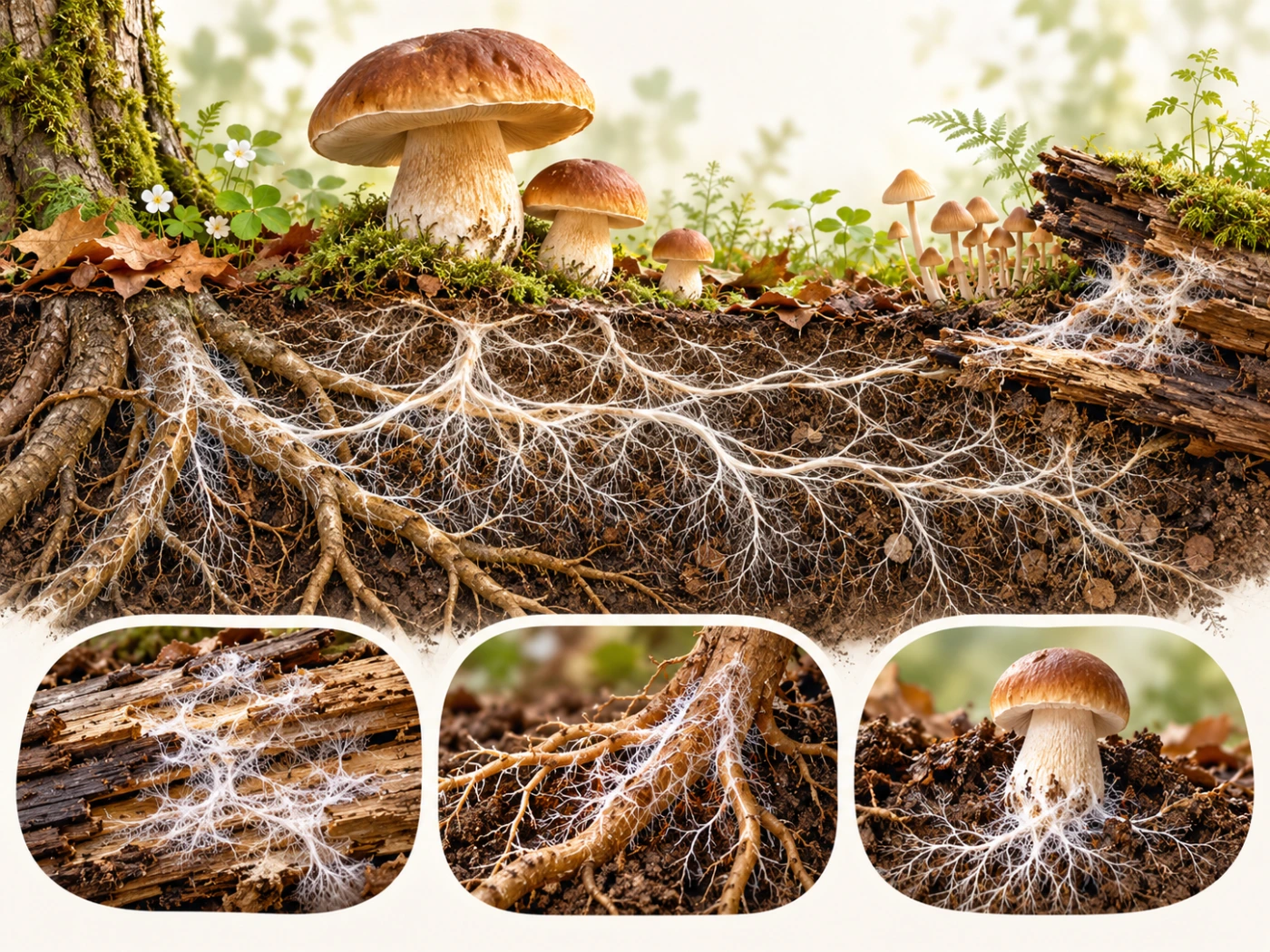
When you see a mushroom growing from the ground or a fallen log, you are usually seeing only a small part of the fungus. Most of the organism may be hidden underground, inside wood, or among dead leaves as a network of extremely thin threads called mycelium.
Mycelium is the main growing body of many fungi. It absorbs nutrients, spreads through its surroundings, interacts with plants and other organisms, and produces mushrooms when conditions are right.
Quick Answer
| Question | Simple Answer |
|---|---|
| What is mycelium? | A network of microscopic fungal threads |
| What are the threads called? | Hyphae |
| Where does it grow? | Soil, wood, roots, leaf litter and other organic material |
| Is mycelium the mushroom? | It is the main body of the fungus; the mushroom is usually a fruit body |
| What does it do? | Absorbs nutrients and expands through its substrate |
| Does it produce mushrooms? | Yes, when conditions allow |
| How long can it live? | Often years, sometimes much longer |
| Can it connect with trees? | Yes, many fungi form mycorrhiza with roots |
| Can you see it? | Sometimes, as white or pale thread-like growth |
What Is Mycelium?
Mycelium is a network made from tiny fungal filaments called hyphae. Each hypha is much thinner than the roots of a plant and can grow through soil, wood, leaves, or other material.
Thousands or millions of these threads together form the mycelium. Instead of having roots, stems, and leaves like a plant, a fungus uses this spreading network to explore its environment and obtain food.
What Are Hyphae?
Hyphae are the individual threads that make up mycelium. They grow mainly at their tips, allowing the fungus to move gradually into new areas.
As the hyphae branch, the network becomes larger and more complex. Some parts explore new material, while others transport nutrients through the colony.
Is Mycelium the Same as a Mushroom?
Not exactly. The visible mushroom is usually a fruit body, a temporary structure produced mainly for reproduction.
The mycelium is the longer-lived part of the fungus. A mushroom may survive for only days or weeks, while the mycelium that produced it can remain in the same soil or wood for years.
For more on this difference, see How Long Do Mushrooms Live?.
Where Does Mycelium Grow?
Mycelium grows wherever a fungus can find a suitable combination of food, moisture, temperature, and other environmental conditions. Different fungal species specialize in very different habitats.
Some live in forest soil, some spread through dead wood, and others grow closely around or inside plant roots.
Mycelium in Soil
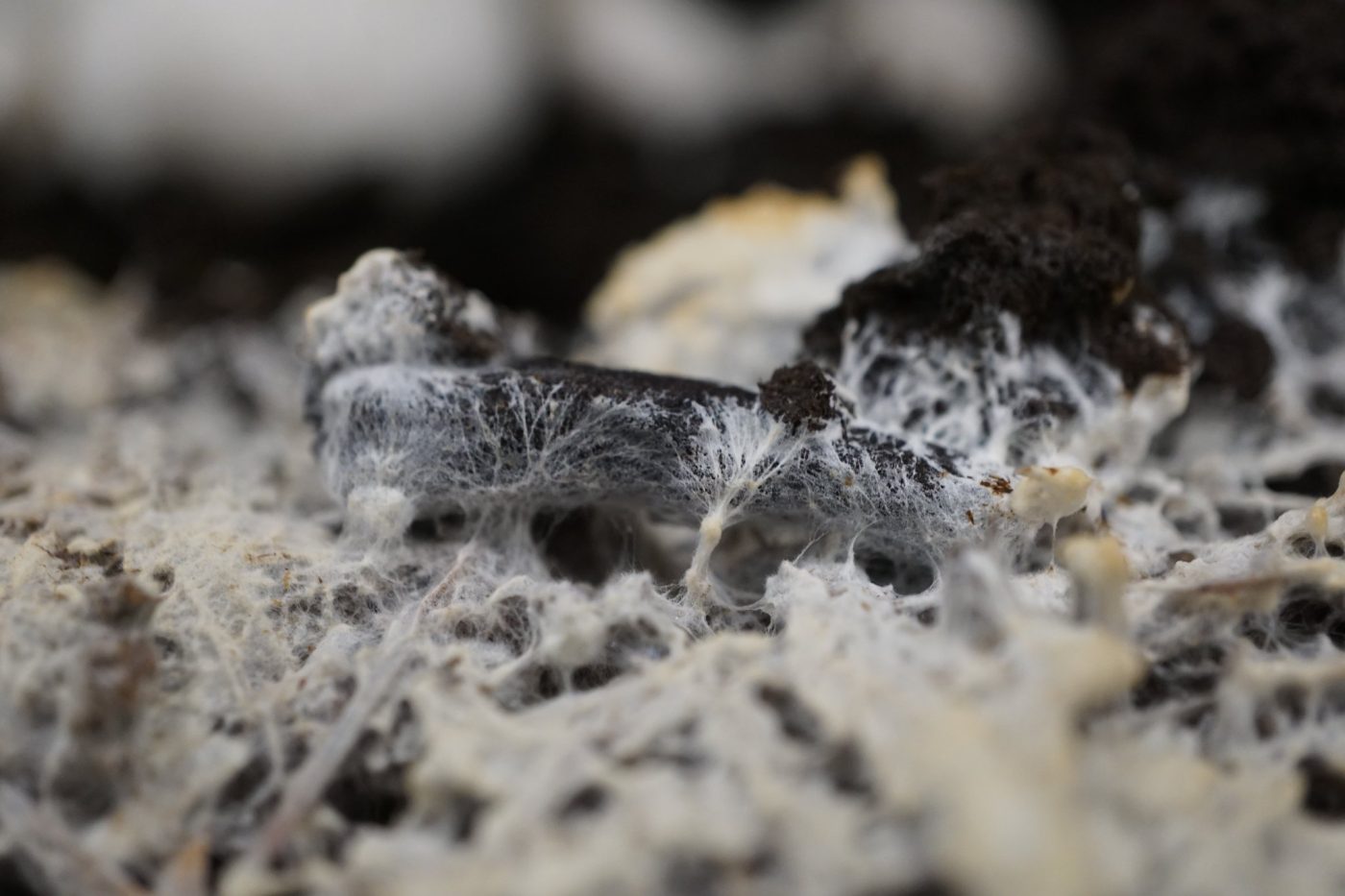
Forest and grassland soils can contain huge networks of fungal hyphae. Much of this growth is invisible because the threads are mixed among soil particles, roots, and decomposing organic matter.
Soil fungi may decompose dead material or form relationships with living plants. The type of fungus determines how the mycelium obtains its nutrients.
Mycelium in Wood
Wood-decaying fungi grow through dead or weakened trunks, branches, roots, and stumps. Their hyphae release enzymes that break down complex materials such as cellulose and lignin.
The mushroom you see on a log may therefore represent a fungus that has already been growing inside the wood for a long time. Removing the visible bracket usually does not remove the hidden mycelium.
Mycelium in Leaf Litter
Some fungi specialize in decomposing fallen leaves, needles, twigs, and other forest debris. Their mycelium spreads through this material and helps recycle nutrients.
Small mushrooms emerging from leaf litter may be connected to extensive networks that are almost impossible to see without disturbing the substrate.
How Does Mycelium Eat?
Fungi do not eat food the way animals do. Instead, the mycelium releases enzymes into its surroundings.
These enzymes break large molecules into smaller substances that the hyphae can absorb. In simple terms, fungi digest much of their food outside their bodies and then take the nutrients in.
How Does Mycelium Grow?
A mycelial network grows as hyphal tips extend into new material. When a tip encounters suitable food and conditions, it continues branching and exploring.
Growth does not necessarily happen evenly in every direction. The fungus may grow faster toward moisture, nutrients, suitable roots, or fresh wood.
Why Does Mycelium Form a Network?
A branching network allows a fungus to explore a large area while remaining connected. Nutrients collected in one part of the mycelium can sometimes support growth elsewhere.
This structure is especially effective in soil and wood, where useful resources are spread unevenly. Instead of staying in one compact body, the fungus can reach through tiny spaces.
How Does Mycelium Produce Mushrooms?
A fungus does not produce mushrooms all the time. Fruiting usually begins when environmental conditions and the internal state of the mycelium are suitable.
Changes in moisture, temperature, season, food availability, and other factors can trigger development. The mycelium then builds a fruit body that grows toward the surface or out of wood.
Why Do Mushrooms Appear After Rain?
The mycelium was usually already present before the rain. Moisture can create conditions that allow fruit bodies to begin or rapidly continue development.
This is why mushrooms can seem to appear suddenly. The hidden fungus may have been living there for months or years before a visible mushroom emerged.
What Is Mycorrhizal Mycelium?
Many familiar woodland mushrooms form a partnership called mycorrhiza with living trees and plants. Their mycelium grows around or into fine roots and exchanges resources with the plant.
The fungus receives sugars produced by photosynthesis. In return, the fungal network can help the plant obtain water and mineral nutrients from the soil.
Which Mushrooms Form Mycorrhiza?
Many boletes, Amanitas, Russulas, milkcaps, chanterelles, and other woodland fungi are mycorrhizal. This is why certain mushrooms repeatedly appear near particular trees.
A Pine Bolete is not merely growing near a pine by coincidence. Its underground mycelium is part of a biological relationship with tree roots.
Can One Mycelium Connect to More Than One Tree?
Yes. A fungal network may interact with roots from more than one plant, depending on the species and local conditions.
This does not mean that all trees in a forest are connected by one fungus. Forest soils contain many overlapping fungal networks belonging to many different species and individuals.
Do All Fungi Help Trees?
No. Fungi use several different lifestyles.
Some form beneficial mycorrhizal partnerships, while others decompose dead material. Still others are parasites or pathogens that obtain nutrients from living organisms.
Saprotrophic Mycelium
Saprotrophic fungi feed on dead organic material. Oyster Mushrooms, many polypores, and numerous small woodland fungi use this strategy.
Their mycelium is essential for decomposition. Without fungi and other decomposers, dead wood and plant material would accumulate much more slowly.
Parasitic Mycelium
Parasitic fungi obtain nutrients from living organisms. Some attack plants, trees, insects, or even other fungi.
Hypomyces lactifluorum, the Lobster Mushroom fungus, is a good example of a fungus parasitizing another mushroom. Its mycelium changes the host fruit body dramatically.
How Big Can Mycelium Become?
A mycelial network can be much larger than the visible mushrooms suggest. Some fungal individuals spread across large areas of soil or through extensive root systems.
Most networks are difficult to measure because they are hidden and mixed with other fungi. A group of mushrooms spread over a wide area may represent one fungal individual, several individuals, or several different species.
How Long Does Mycelium Live?
Many fungal colonies can persist for years, especially when their food source or plant partner remains available. Some long-lived fungal individuals can survive for decades or much longer.
The visible fruit bodies may appear only during certain seasons. The absence of mushrooms does not necessarily mean the mycelium has died.
Does Mycelium Die in Winter?
Many fungi survive winter as mycelium in soil, wood, roots, or other protected substrates. Cold temperatures may slow growth without killing the organism.
When favorable conditions return, activity can increase again. Some species even produce fruit bodies during cold periods.
Can Mycelium Survive Drought?
Many fungi can survive temporary dry conditions, although active growth may slow dramatically. The ability to tolerate drought varies between species and habitats.
A dry summer can therefore prevent mushrooms from appearing even while the underground fungus remains alive.
Is White Growth in Soil Always Mycelium?
White thread-like growth can be fungal mycelium, especially when found through damp wood chips, soil, or decomposing leaves. However, color alone does not identify the fungus.
Different fungi can produce white, cream, yellowish, or differently colored mycelium. A visible network usually cannot be identified to species simply from its appearance.
What Does Mycelium Look Like?
Visible mycelium often resembles very fine white threads, cotton, spiderwebs, or branching roots. In wood it may form pale sheets or fibrous zones beneath bark.
Much of it is too fine to notice without magnification. The dramatic white networks sometimes photographed beneath mushrooms represent only especially visible examples.
Is Mycelium a Root System?
It can look similar, but mycelium is not made of roots. Fungi and plants are completely different groups of organisms.
Roots are multicellular plant organs with specialized tissues. Mycelium is made from networks of fungal hyphae.
Does Picking Mushrooms Damage Mycelium?
Picking a fruit body usually does not remove the entire fungus. The main mycelial network remains in its substrate.
Careless disturbance of soil, digging, or repeatedly damaging the substrate can be more disruptive than removing one mushroom. The effects also depend on the species and habitat.
Can Mycelium Produce More Mushrooms After Picking?
Yes. If the mycelium remains healthy and conditions are suitable, it can produce additional fruit bodies.
Those new mushrooms are not the previous mushroom growing back. They are new reproductive structures produced by the same or nearby fungal mycelium.
Why Do Mushrooms Return to the Same Place?
The underground fungal colony may remain established in the same location year after year. When moisture and temperature again become favorable, it can fruit in approximately the same area.
This is why mushroom hunters often remember productive locations. The habitat and fungal network can persist even when no mushrooms are visible for much of the year.
What Is a Fairy Ring?
A fairy ring can form when mycelium expands outward through soil from an original starting point. Mushrooms then appear mainly around the actively growing outer edge.
As the network expands, the visible ring can become wider each year. Not every circular mushroom pattern has exactly the same cause, but outward mycelial growth is the classic explanation.
Can Mycelium Move?
Mycelium does not move from place to place like an animal. Instead, it spreads by growing new hyphae into neighboring material.
Fungi can also colonize new locations through spores or transported fragments. Once established, the new mycelium begins expanding locally.
What Happens When Two Mycelial Networks Meet?
When fungal hyphae meet, several outcomes are possible. Compatible individuals may interact or fuse in some species, while incompatible fungi may compete and form boundaries.
Forest soil is therefore not occupied by one continuous fungal web. It is a complex mosaic of competing and interacting fungal organisms.
Mycelium and Mushroom Identification
Mycelium is usually much harder to identify than fruit bodies. Most species-level identification depends on visible mushroom structures such as cap, gills, pores, stem, spores, bruising reactions, and habitat.
However, ecology can reveal what the hidden mycelium is doing. A bolete under birch suggests mycorrhizal growth, while Oyster Mushrooms on a dead log indicate wood-decaying mycelium.
Can AI Identify Mycelium From a Photo?
Usually not reliably to species level. White fungal threads in soil or wood often lack enough visible diagnostic features.
A fruit body provides much more information. If mushrooms are present, photographs of the cap, underside, stem, substrate, and surrounding habitat usually offer a better route to identification.
Common Misunderstandings About Mycelium
A common misconception is that the visible mushroom is the entire organism. For many fungi, the fruit body is only a temporary reproductive structure connected to a much larger hidden network.
Another misconception is that every white thread in soil belongs to one giant fungus. Soil can contain many fungal species growing through the same small area.
It is also misleading to describe all mycorrhizal networks as a single forest-wide communication system. Fungal relationships with plants are real and important, but natural forests contain many interacting species and networks rather than one universal underground web.
Interesting Facts About Mycelium
A tiny piece of soil can contain many meters of fungal hyphae. Because individual threads are microscopic, an enormous amount of fungal material can exist in a space that looks almost empty to us.
Mycelium is also constantly changing. Some hyphae grow into new areas while others die back, so the network is better thought of as a living dynamic system than a fixed underground structure.
Wood-decaying mycelium can change the physical structure of trees long before mushrooms become visible. By the time a large bracket appears, the fungus may already have been active inside the wood for years.
Mycorrhizal fungi also demonstrate that the visible boundaries between organisms are not always simple. A tree and fungus remain separate organisms, yet their roots and hyphae can become closely connected and exchange resources for long periods.
Frequently Asked Questions
Can mycelium grow without ever producing mushrooms?
Yes. A fungal colony may remain vegetative for long periods without producing visible fruit bodies. Conditions may simply never become suitable for fruiting.
Can you find mycelium under every mushroom?
Usually some fungal tissue connects the fruit body to its substrate, but it may be too fine or deeply buried to see. Digging extensively just to find it is rarely useful for identification.
Why does mycelium sometimes smell strongly?
Some fungi produce distinctive volatile compounds as they grow. Odor varies widely between species and can also be affected by bacteria and the material being decomposed.
Can mycelium grow through concrete or stone?
Fungi generally grow through cracks, soil, wood, or organic material rather than digesting solid stone or concrete as food. Moisture and small deposits of organic matter can allow growth along surfaces and into gaps.
Can mycelium live after a tree dies?
Sometimes. A mycorrhizal fungus may lose an important partner when a tree dies, while wood-decaying fungi can continue growing as the dead tree becomes a food source.
Why is mycelium sometimes yellow or orange instead of white?
Different fungi produce different pigments, and age or environmental conditions can also affect color. White is common but is not a universal mycelium color.
Does every mushroom in one cluster come from the same mycelium?
Often clustered mushrooms are connected to the same local fungal network, but this cannot always be assumed. Multiple individuals or even species can fruit very close together.
Can mycelium be older than the trees around it?
It is possible in some situations, especially when a fungal colony persists through changing vegetation. Determining the exact age of a hidden fungal individual is usually difficult.
Final Notes
Mycelium is the hidden growing body of a fungus, made from branching microscopic threads called hyphae. It spreads through soil, wood, roots, and other material, absorbs nutrients, interacts with its environment, and can eventually produce visible mushrooms.
The mushroom is therefore only one stage in a much larger life cycle. A fruit body may appear for a few days, while the mycelium beneath it can remain alive and active for years.
The simplest way to remember it is: the mushroom is what you see; mycelium is the network that keeps the fungus growing.
Upload a photo and get possible matches in seconds.