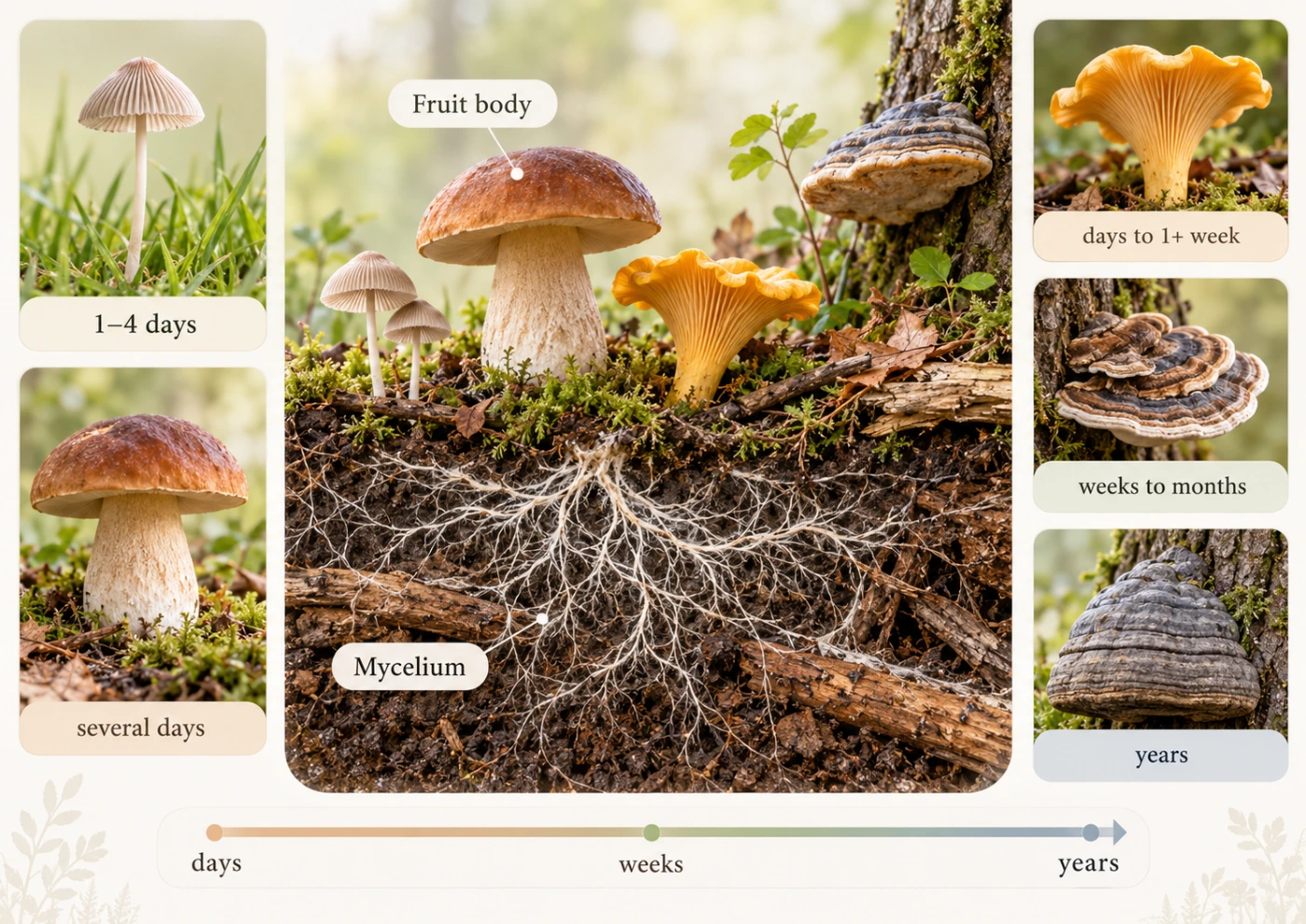
A mushroom may seem to appear overnight and disappear just a few days later. In many cases, that is exactly what happens to the visible fruit body. But the mushroom you see above ground is only one part of the organism. The main body of the fungus, called mycelium, can live hidden in soil, wood, or other material for years, decades, and sometimes much longer.
⚠️ Important: The visible mushroom and the fungus itself are not the same thing. A fruit body may last only a few days, while the underground or internal mycelium can survive for many years.
Quick Answer
| Part of the fungus | Typical lifespan |
|---|---|
| Small delicate mushroom | A few days |
| Larger fleshy mushroom | Several days to a few weeks |
| Tough bracket fungus | Weeks, months, or longer |
| Annual polypore fruit body | Usually one season |
| Perennial conk | Several years |
| Underground mycelium | Years to decades or more |
There is no single answer because different fungi live in very different ways.
How Long Does a Mushroom Fruit Body Live?
The visible mushroom is usually temporary. Its main job is to produce and release spores.
Once that job is done, the fruit body often begins to dry, rot, collapse, or get eaten by insects and animals.
Small Mushrooms May Last Only a Few Days
Tiny lawn and woodland mushrooms can appear very quickly after rain. Some remain fresh for only one or two days before they begin to shrivel.
Warm weather, dry wind, and direct sun can shorten their life even more. In cool, damp conditions, the same type of mushroom may stay visible for longer.
Larger Mushrooms Usually Last Longer
Large mushrooms such as boletes, Amanitas, and many Russulas can remain recognizable for several days or sometimes more than a week.
Their lifespan depends heavily on weather and condition. Insects can also damage them very quickly, especially during warm periods.
How Long Do Chanterelles Live?
Chanterelles are relatively firm mushrooms and can often remain in good condition for several days. In cool, damp forest conditions they may persist longer than many softer species.
Older chanterelles gradually become tougher, darker, or damaged by insects and weather. Their visible life is still short compared with the mycelium that produced them.
How Long Do Boletes Live?
Boletes often grow quickly and age quickly. A young firm bolete can become soft, insect-damaged, or overmature within only a few days.
The pore layer changes noticeably as the mushroom ages. White or pale pores may become yellow, olive, brownish, or otherwise darker depending on the species.
How Long Do Morels Live?
Morels usually remain fresh for a relatively short period. They can dry out rapidly, especially during warm spring weather.
A fruit body may still stand after it has dried, but that does not mean it is still actively growing. Drying simply preserves the shape for a while.
How Long Do Oyster Mushrooms Live?
Oyster Mushrooms can remain on wood for several days and sometimes longer in cool weather. Their clusters gradually dry, yellow, or become soft around the edges.
Because they grow in groups, new fruit bodies can appear while older ones are already declining. This can make a colony seem continuously active.
How Long Do Puffballs Live?
Puffballs change dramatically with age. Young fruit bodies are firm and white inside, while mature ones turn into spore-filled structures.
Once mature, they may remain visible for quite a long time. At that stage, however, they are no longer fresh young mushrooms.
How Long Do Bracket Fungi Live?
Bracket fungi often live longer than ordinary fleshy mushrooms. Some fruit bodies remain attached to wood for months.
Others are perennial and add a new growth layer each year. These hard conks can stay on the same tree for many years.
Annual vs Perennial Polypores
Annual polypores produce a fruit body that develops during one season. It may persist after it dies, but it does not continue growing as the same living structure year after year.
Perennial polypores are different. Their fruit bodies remain in place and continue growing over multiple years, often forming new pore layers beneath older tissue.
How Long Does Mycelium Live?
The mycelium usually lives much longer than the mushroom itself. It is made of microscopic threads called hyphae that spread through soil, wood, roots, leaf litter, or other material.
As long as suitable food, moisture, and environmental conditions remain available, the mycelium can continue living and expanding.
Mycelium in Soil
Mycorrhizal fungi live in partnership with trees and other plants. Their mycelium can remain associated with the same root system for many years.
This is why mushrooms may appear in the same area repeatedly. The visible fruit bodies come and go, but the fungus remains underground.
Mycelium in Wood
Wood-decaying fungi can live inside a trunk or stump for years. The visible brackets or clusters appear only when conditions are suitable for reproduction.
Even after the fruit bodies disappear, the fungus can continue decomposing the wood from inside.
Why Do Mushrooms Appear So Suddenly?
The mycelium is already present before the mushroom appears. When moisture, temperature, and other conditions become suitable, it can rapidly build a fruit body.
This is why mushrooms seem to appear overnight. The fungus did not suddenly arrive overnight; only the visible reproductive structure did.
How Fast Can Mushrooms Grow?
Some mushrooms can expand very quickly once fruiting begins. Small species may reach full size in a day or two, while larger mushrooms can grow substantially over several days.
Growth speed depends on species, water availability, temperature, and the amount of stored energy available to the mycelium.
Do Mushrooms Keep Growing After They Open?
Many mushrooms continue expanding for some time after the cap opens. The cap may flatten, the stem may lengthen, and the spore-bearing surface continues maturing.
Eventually growth slows and the fruit body focuses mainly on spore production and release.
What Happens When a Mushroom Dies?
A dead fruit body usually begins to dry or decompose. Bacteria, insects, slugs, molds, and other fungi may break it down.
Its nutrients return to the ecosystem. In this way, even a short-lived mushroom becomes part of a much larger cycle.
Does Picking a Mushroom Kill the Fungus?
Usually no. Picking a fruit body is more like picking an apple from a tree than cutting down the entire organism.
The main mycelium remains in the soil or wood. If conditions remain suitable, it may produce more mushrooms later.
Do Mushrooms Grow Back After Picking?
They can, but not because the same mushroom regenerates. New fruit bodies develop from the mycelium.
They may appear in the same spot days, weeks, months, or even a year later. Timing depends on species and environmental conditions.
Can the Same Fungus Produce Mushrooms Every Year?
Yes. Many fungal colonies fruit repeatedly in the same general area.
A good mushroom spot can remain productive for years because the same mycelial network stays alive underground or inside wood.
Why Do Some Mushroom Spots Stop Producing?
Changes in moisture, temperature, host trees, soil, or available food can reduce fruiting. The mycelium may still be alive even if no mushrooms appear for a season.
In other cases, the fungus may decline because its food source has been exhausted or its tree partner has died.
Do Mushrooms Live Longer in Cold Weather?
Often they do. Cool temperatures can slow drying, insect activity, and decay.
This is one reason some autumn and winter mushrooms remain fresh longer than similar soft mushrooms during warm summer weather.
Does Rain Make Mushrooms Live Longer?
Rain can help keep fruit bodies hydrated, but too much moisture can also speed decomposition. Constant wet conditions may encourage bacteria, molds, and slugs.
The best conditions for longevity are often cool, humid, and not excessively wet.
Does Sunlight Shorten Mushroom Life?
Direct sun and dry wind can quickly dehydrate mushrooms. Thin caps may shrivel in hours under harsh conditions.
Forest shade helps many species stay moist longer. This partly explains why fruit bodies can remain fresh longer under dense woodland cover.
Why Do Some Mushrooms Last for Years?
Hard perennial polypores are built very differently from soft gilled mushrooms. Their tissue is woody, corky, or extremely tough.
Instead of collapsing after a few days, they can survive weather and continue adding new growth. This makes them among the longest-lasting visible fungal structures.
How Old Can a Fungus Become?
Some fungal colonies can become extremely old because the mycelium keeps growing through its substrate. In suitable conditions, a single genetic individual may persist for decades, centuries, or even longer.
Age is difficult to measure because the organism is hidden and constantly growing. The visible mushrooms do not reveal how old the underlying fungus really is.
Mushroom Lifespan by Type
| Mushroom type | Visible lifespan |
|---|---|
| Small lawn mushroom | 1–4 days |
| Delicate woodland mushroom | A few days |
| Bolete | Several days |
| Chanterelle | Several days to more than a week |
| Oyster Mushroom | Several days to around a week or more |
| Puffball | Days to weeks depending on maturity |
| Annual bracket | Weeks to months |
| Perennial conk | Multiple years |
These are rough ranges rather than fixed rules. Weather and species can change them substantially.
How to Tell if a Mushroom Is Old
Old mushrooms often become soft, dry, cracked, darkened, or heavily insect-damaged. Gills and pores may also change color as spores mature.
The smell can become unpleasant, and the flesh may lose its original firm texture. Age should always be considered during identification because old specimens can look very different from young ones.
Why Age Matters for Identification
Many mushroom features change over time. Cap shape, color, gill color, pore color, rings, veil remnants, and texture can all look different in mature specimens.
A young and old mushroom of the same species can sometimes look like two different species. Comparing several ages from one location can make identification much easier.
Can AI Tell How Old a Mushroom Is?
AI can sometimes estimate whether a fruit body is young, mature, or old from visible features. It cannot usually determine an exact age in days.
Photos of the underside, cap, stem, and habitat help. A single top-down photo gives much less information about maturity.
Common Misunderstandings
One common mistake is thinking that the visible mushroom is the whole fungus. In reality, it is usually only a temporary reproductive structure.
Another mistake is assuming that a mushroom must be newly grown because it appeared suddenly. The hidden mycelium may have been present for years before conditions triggered fruiting.
People also sometimes think picking mushrooms removes the fungus from the area. In most cases, the mycelium remains alive and can produce new fruit bodies later.
Interesting Facts About Mushroom Lifespans
A mushroom can be one of the shortest-lived visible parts of a very long-lived organism. The fruit body may last only days while the mycelium survives for decades.
Some fungi repeatedly produce mushrooms from the same underground colony over many seasons. This means a “new” mushroom may actually come from an organism that has been living in the area for a very long time.
Perennial bracket fungi use a completely different strategy from soft mushrooms. Instead of producing a new short-lived fruit body every time, they can keep the same tough structure and add new growth layers year after year.
The speed of mushroom development is also remarkable. Much of the fruit body is built largely by expanding cells and absorbing water, which helps explain how some mushrooms can grow so quickly after rain.
Frequently Asked Questions
Can a mushroom live for only one day?
Yes. Some very small or delicate mushrooms can appear, mature, release spores, and collapse in a remarkably short time.
Can a mushroom remain standing after it is dead?
Yes. Dried mushrooms and tough brackets may stay attached or upright long after active growth has stopped.
Why do mushrooms sometimes disappear overnight?
They may dry out, collapse, be eaten by animals, or be destroyed by weather. Short-lived fruit bodies can change extremely quickly.
Can the same mycelium produce different-sized mushrooms each year?
Yes. Moisture, temperature, food reserves, and weather can affect both the number and size of fruit bodies.
Does a large mushroom always live longer than a small one?
No. Size can influence durability, but tissue type and weather matter more. A large soft mushroom can decay faster than a small tough bracket.
Can mycelium survive freezing weather?
Many species can survive seasonal cold while hidden in soil, wood, or roots. Fruiting may stop even though the fungus itself remains alive.
Can mushrooms keep growing after being picked?
They may continue small internal changes for a short time, but they no longer have access to the mycelial network that supplies water and nutrients. Normal development soon stops.
Why do old mushrooms often look darker?
Pigments change, tissues dry, spores mature, and damaged areas oxidize. These processes can make older fruit bodies much darker than young ones.
Final Identification Notes
The visible mushroom usually has a short life. Many fleshy fruit bodies last only a few days to a few weeks, while tough brackets can persist for months and perennial conks for years.
The fungus itself can live far longer. Its hidden mycelium may survive in soil, roots, or wood for years, decades, or more and produce new mushrooms whenever conditions become favorable.
The simplest way to remember it is: the mushroom is temporary, but the fungus can be long-lived.
Upload a photo and get possible matches in seconds.