Polypores are some of the most distinctive fungi in forests, parks, and old woodlands. Instead of conventional gills, most have a surface covered with tiny pores, and many grow as shelves, brackets, rosettes, or hard hoof-shaped conks directly from wood.
They can be soft and fleshy, thin and leathery, or so hard that they persist for years. Learning to identify polypores means paying attention to pore shape, cap texture, growth form, host tree, bruising, thickness, and whether the fruit body is annual or perennial.
⚠️ Important: This guide is for identification and education only. Never eat or use a wild fungus medicinally based solely on photographs, AI identification, or an online comparison.
Quick Guide to Common Polypore Features
| Feature | What to Check |
|---|---|
| Growth form | Shelf, bracket, rosette, hoof, crust |
| Underside | Round pores, angular pores, maze-like pores |
| Cap texture | Soft, leathery, corky, woody |
| Cap surface | Smooth, zoned, scaly, varnished, hairy |
| Stem | Usually absent, sometimes lateral or central |
| Substrate | Living tree, stump, log, buried wood |
| Host tree | Hardwood, conifer, specific tree species |
| Bruising | No change, brown, black, red |
| Age | Annual or perennial |
| Flesh | White, cream, brown, corky |
| Spore print | Usually pale, but varies |
| Main season | Depends strongly on species |
What Is a Polypore?
Polypores are fungi that usually produce spores from tubes opening as pores on the underside of the fruit body. The word “polypore” literally refers to this many-pored structure.
Many polypores grow directly from wood and play important roles as decomposers or parasites. Some break down dead logs, while others colonize weakened living trees and continue fruiting after the tree dies.
Are All Polypores Bracket Fungi?
No. Many polypores form brackets, but not every polypore has a shelf-like shape, and not every bracket fungus has typical round pores.
Some form large rosettes at tree bases, while others grow as crusts or irregular masses. A few bracket fungi even have elongated, maze-like, or gill-like fertile surfaces.
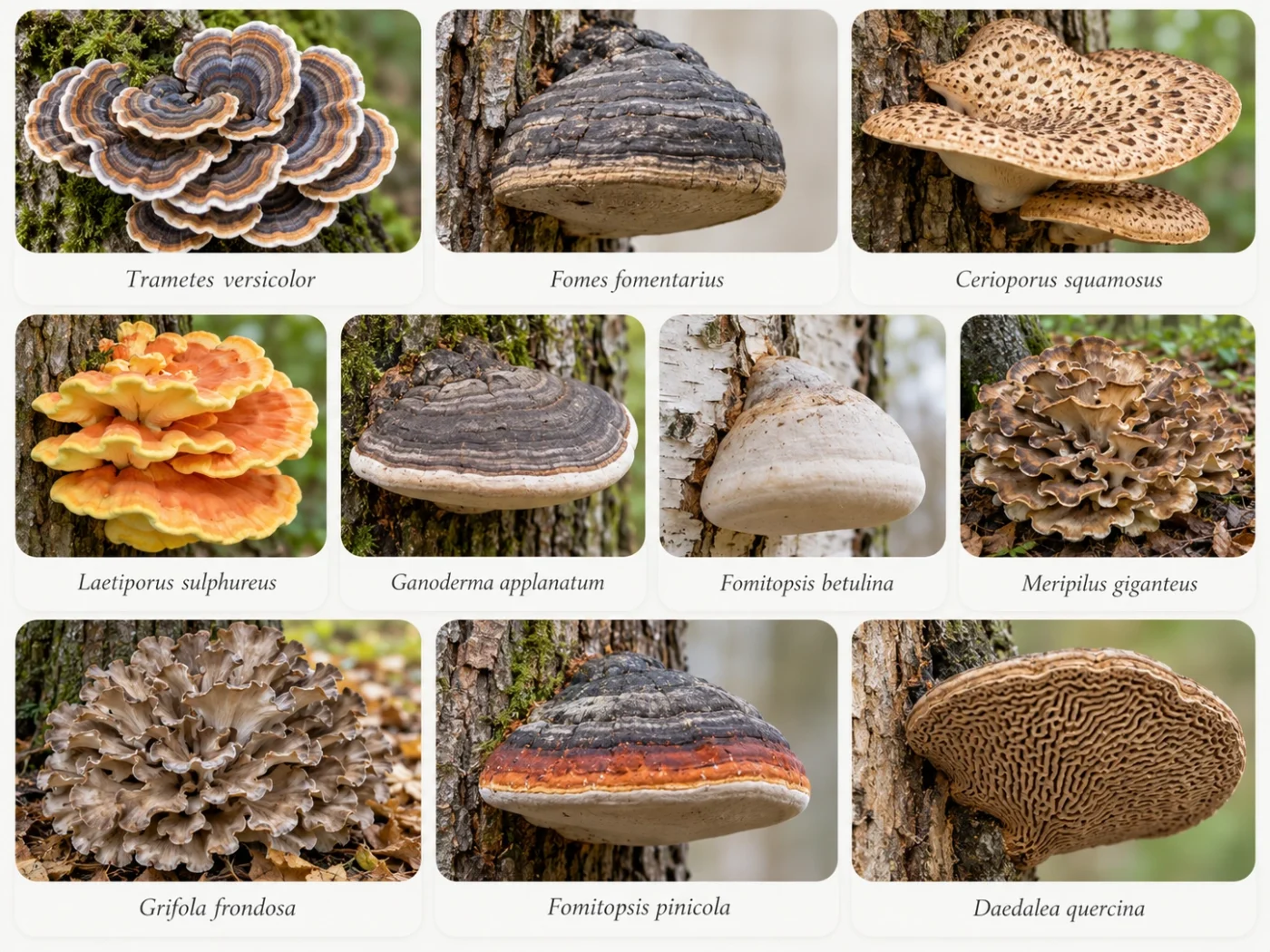
The Underside Is the Best Place to Start
The pore surface is often the fastest way to narrow a polypore identification. Pores can be tiny and almost invisible, large and angular, stretched into slots, or arranged in maze-like patterns.
Looking only at the top of a bracket is risky because several unrelated fungi share the same brown, gray, or zoned cap colors. The underside often reveals far more.
Tiny Round Pores
Turkey Tail, Tinder Fungus, Artist’s Conk, and many other classic polypores have very fine pores. From a distance, the underside may look nearly smooth.
A hand lens can help when the pores are extremely small. Fine pore size is especially useful for separating these species from coarser annual polypores.
Large Angular Pores
Dryad’s Saddle has relatively large, angular pores that can be seen easily without magnification. The openings become even more stretched as the fruit body expands.
This makes the underside look almost honeycomb-like. Large pores are one of the strongest clues for this species.
Maze-Like Pores
Some polypores develop elongated or labyrinth-like pores. These can look surprisingly similar to gills at first glance.
Birch Mazegill is a classic example. The fertile surface forms long slot-like structures rather than ordinary round pores.
Teeth or Gills Instead of Pores
Not every shelf fungus is a true polypore in the narrow sense. Some wood-growing fungi have teeth, smooth fertile surfaces, or gill-like folds.
This is why “bracket fungus” is a broader visual description than “polypore.” Always check what is actually happening underneath.
Cap Shape
Growth form can immediately narrow the possibilities. Some polypores form thin overlapping fans, while others produce massive hoof-shaped conks or multi-layered rosettes.
The shape also reflects how long the fungus lives. Annual fruit bodies are often softer and thinner, while perennial conks become thick and woody over time.
Thin Fan-Shaped Brackets
Turkey Tail forms numerous thin flexible fans, often layered over one another. The fruit bodies are only a few millimeters thick.
Other thin brackets can look similar from above, so pore structure remains essential. False Turkey Tail, for example, lacks true pores.
Thick Hoof-Shaped Conks
Tinder Fungus and several Phellinus species form hard hoof-shaped structures. These conks may remain on a tree for many years.
Growth zones often build up season after season. Their toughness immediately separates them from soft annual species.
Large Rosettes
Giant Polypore and Hen of the Woods can form large rosettes composed of many overlapping caps. These usually appear around the base of trees or from buried roots.
Rosette form is useful, but individual cap texture and bruising reactions help distinguish species. Large size alone is never enough.
Cap Surface
The upper surface can be smooth, scaly, zoned, hairy, varnished, or cracked. These textures are often more useful than exact color.
A brown bracket with clear flat scales belongs in a different identification path from a glossy lacquered bracket or a gray hoof-shaped conk.
Concentric Zoning
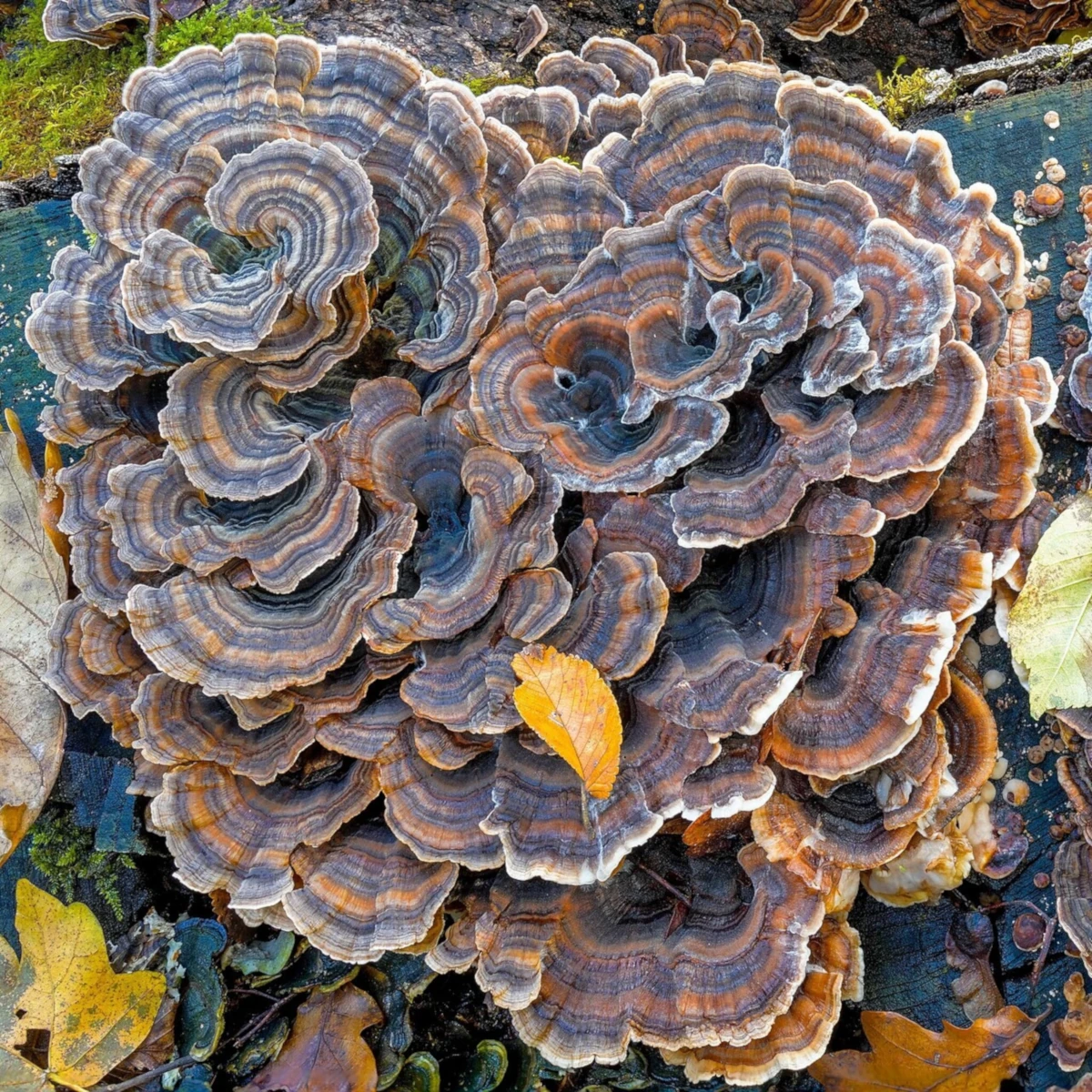
Turkey Tail is famous for narrow concentric bands in multiple colors. Gray, cream, brown, orange, and blue-gray zones can all occur.
Other species are also zoned, so banding by itself is not conclusive. The underside must still match.
Scaly Caps
Dryad’s Saddle has obvious brown flattened scales over a pale background. The pattern often resembles pheasant feathers.
Scaly texture is much less common than plain zoning, making it a useful clue. Large pores underneath reinforce the identification.
Varnished Caps
Some Ganoderma species have shiny reddish-brown lacquered surfaces. The appearance can be almost polished.
This “varnished” look is distinctive but not universal across the genus. Other Ganoderma species are duller and flatter.
Annual vs Perennial Polypores
One of the most useful questions is whether the fruit body lasts one season or several years. Annual species usually grow, release spores, and decay within months.
Perennial fungi keep the same conk and add new growth layers over time. These fruit bodies become increasingly hard and thick.
Annual Species
Turkey Tail, Dryad’s Saddle, Chicken of the Woods, and many other polypores produce annual fruit bodies. Their exact durability varies, but they do not build massive multi-year conks.
Fresh annual brackets often have softer margins and cleaner pore surfaces. Old ones may dry, fade, or fall apart.
Perennial Species
Tinder Fungus and several Phellinus and Ganoderma species can produce long-lived conks. Each growing season may add a new tube layer underneath.
Cutting through an old fruit body can reveal multiple internal zones. This layered structure is a strong clue for perennial growth.
Host Tree Is a Major Identification Clue
Polypores often show strong preferences for certain trees or tree groups. Birch, beech, oak, willow, poplar, conifers, and fruit trees can each support different species.
The host tree should never override morphology, but it can quickly eliminate unlikely options. A fungus known almost exclusively from birch is less likely on oak.
Polypores on Birch
Birch supports several famous bracket fungi, including Birch Polypore and Tinder Fungus. Their shapes and textures are very different despite sharing the same host.
This is a good example of why host alone is not enough. The same trunk can even support multiple bracket species.
Polypores on Oak
Oak can support Artist’s Conk, Beefsteak Fungus, Chicken of the Woods, and several perennial decay fungi. Tree age and condition matter greatly.
Fungi may appear on the trunk, at the base, or from buried roots. Large basal rosettes often indicate root or lower-trunk decay.
Polypores on Conifers
Some species specialize in conifer wood. Red-belted conks and related fungi are particularly associated with spruce, pine, and other conifers.
Host identification becomes especially important in mixed forests. Bark, cones, and fallen needles can help when foliage is high above the ground.
Living Trees vs Dead Wood
A polypore on living wood may act as a parasite, a decomposer of already-dead tissue, or both. Fruiting from a living trunk can therefore indicate internal decay without proving that the fungus originally killed the tree.
On dead wood, the ecological role is clearer: the fungus is decomposing the remaining material. Many species continue growing long after a host tree has fallen.
Why This Matters
Substrate condition helps narrow species and gives ecological context. Chicken of the Woods on a living oak tells a different story from Turkey Tail on a fallen branch.
For tree health, repeated large conks on a living trunk can be more important than the mushroom’s exact common name. Internal decay may already be advanced.
1. Trametes versicolor — Turkey Tail
Identification
Turkey Tail forms thin flexible brackets with sharply contrasting concentric color zones. The underside is white to cream and covered with very fine pores.
The fruit bodies usually grow in overlapping rows on dead hardwood. A velvety upper surface is another useful clue.
Main Look-Alike
False Turkey Tail in the genus Stereum can look almost identical from above. The key difference is underneath, because Stereum has a smooth fertile surface without pores.
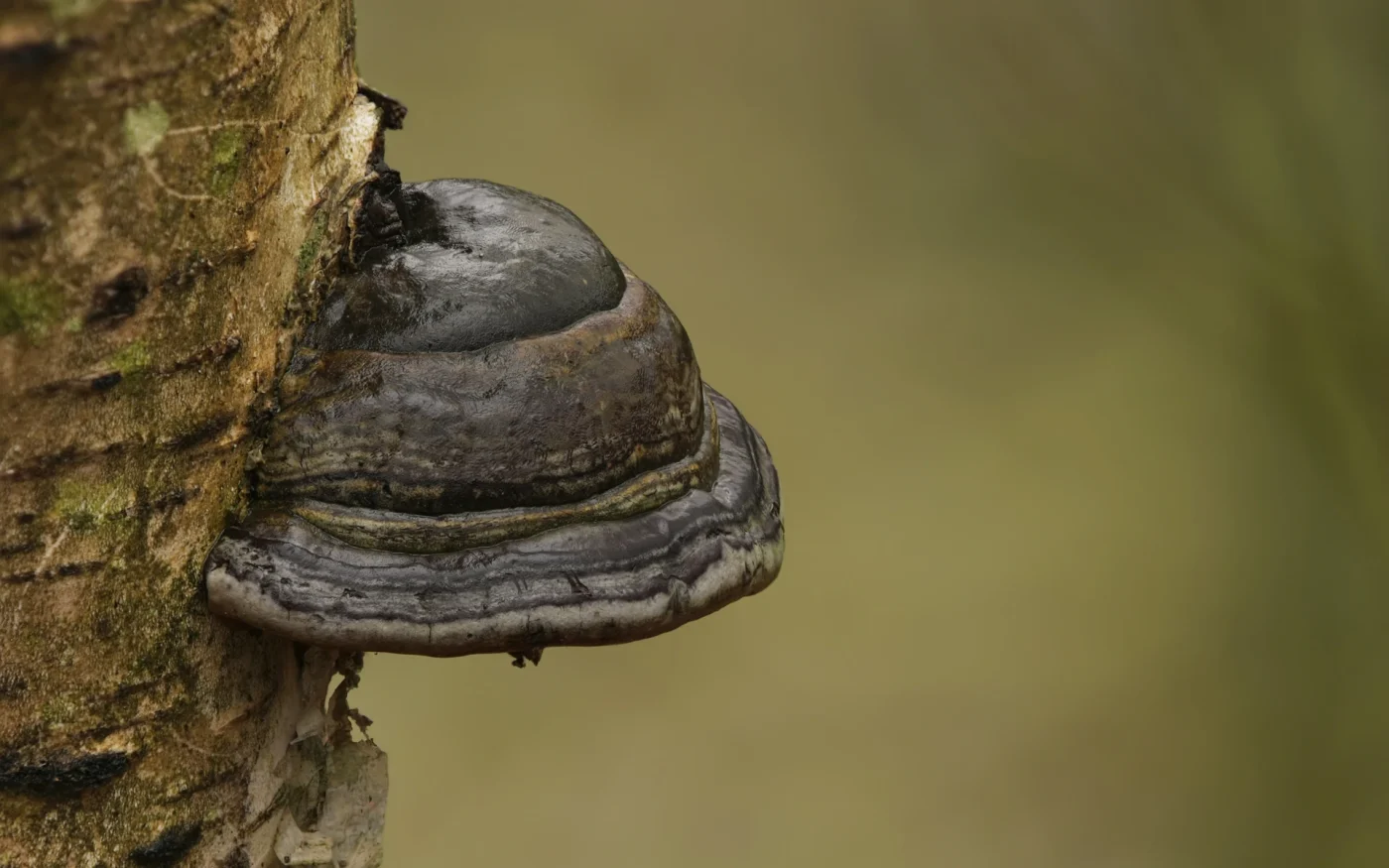
2. Fomes fomentarius — Tinder Fungus
Identification
Tinder Fungus forms a hard gray to brown hoof-shaped conk on broadleaf trees. Birch and beech are especially common hosts.
The underside has tiny pale pores, and the fruit body is perennial. Its corky internal tissue was historically used to make tinder material.
Main Look-Alikes
Hard Phellinus species can resemble it. Darker pore surfaces, host tree, and internal color help separate difficult specimens.
3. Cerioporus squamosus — Dryad’s Saddle
Identification
Dryad’s Saddle has a large cream-to-brown fan-shaped cap covered with dark flat scales. The underside has large angular pores.
A short lateral stem is often visible. Fresh specimens can have a cucumber-like or watermelon-rind odor.
Main Look-Alikes
Giant Polypore may form similarly large fans, but it lacks the strong pheasant-like scale pattern. Dryad’s Saddle also has much larger obvious pores.
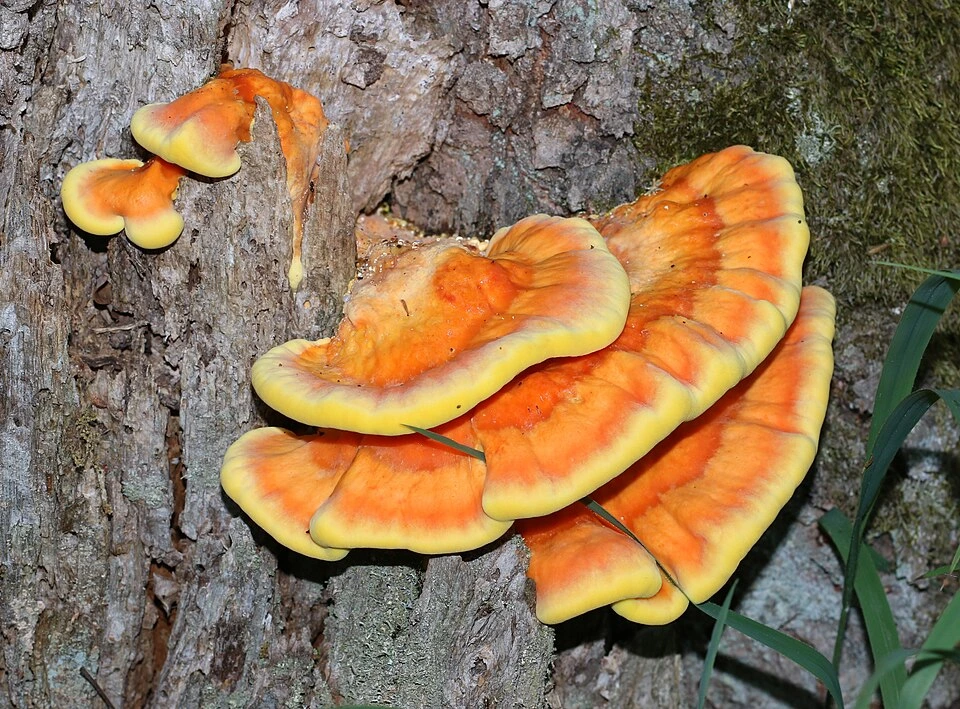
4. Laetiporus sulphureus — Chicken of the Woods
Identification
Chicken of the Woods forms bright yellow and orange shelves on trees and stumps. Young fruit bodies are thick, soft, and fleshy.
The underside has fine yellowish pores. Older specimens fade and become tougher.
Main Look-Alikes
Other Laetiporus species can look very similar and differ by geography and host tree. Species-level identification is therefore partly regional.
5. Ganoderma applanatum — Artist’s Conk
Identification
Artist’s Conk forms broad flat perennial brackets with brown upper surfaces. The pale underside bruises brown when scratched.
This scratch-sensitive surface is so distinctive that drawings can remain visible. The fruit body is hard and long-lived.
Main Look-Alikes
Other Ganoderma species can share the same general shape. Surface texture, varnishing, host tree, and pore reaction help narrow them.
6. Fomitopsis betulina — Birch Polypore
Identification
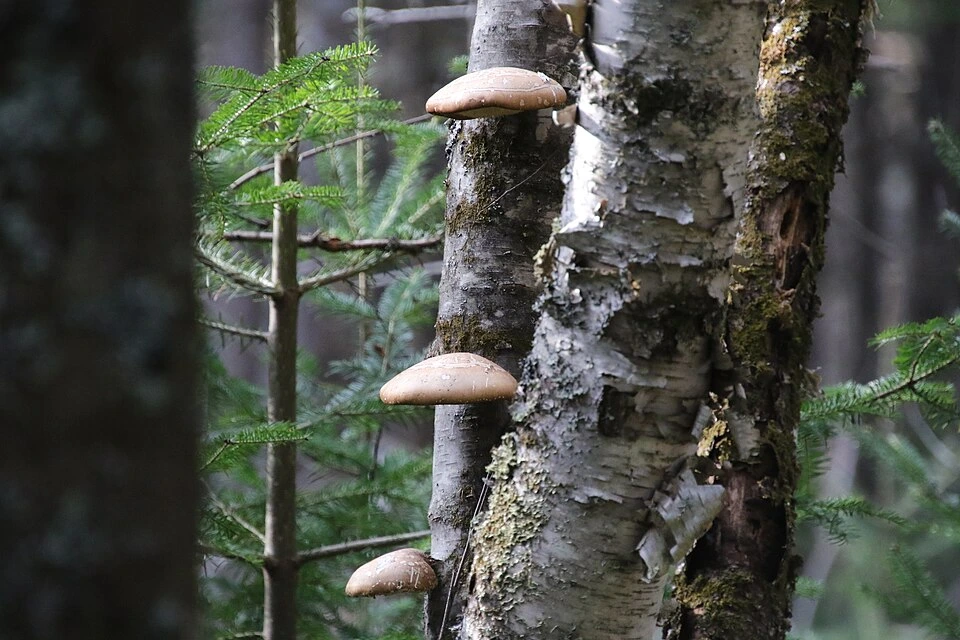
Birch Polypore forms pale rounded shelves almost exclusively on birch. Young specimens are relatively soft, while old ones become corkier.
The underside has fine white pores. The cap is much smoother and paler than that of Tinder Fungus.
Main Look-Alikes
Tinder Fungus also grows on birch but is harder, darker, and strongly hoof-shaped. Growth habit separates them well.
7. Meripilus giganteus — Giant Polypore
Identification
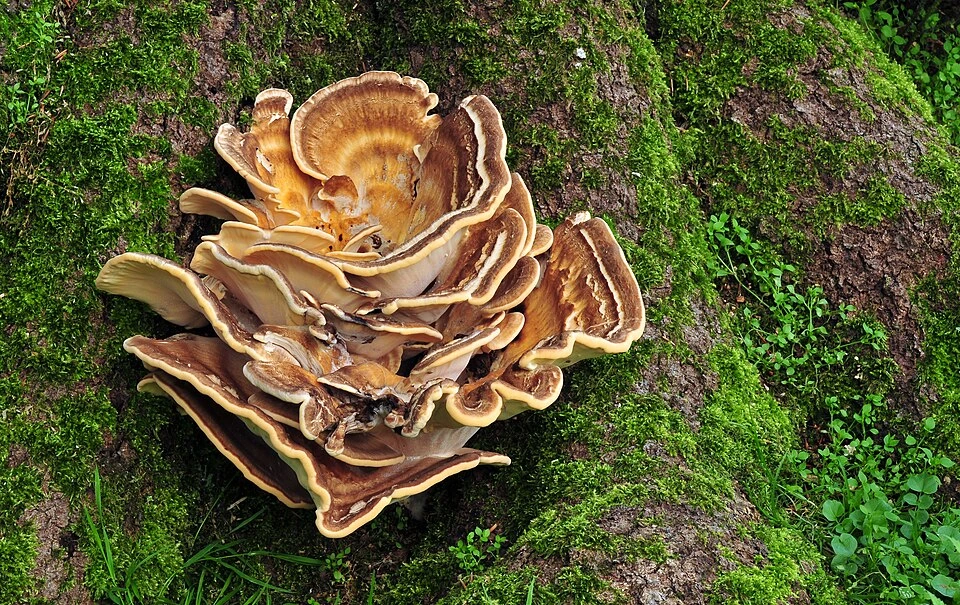
Giant Polypore forms enormous rosettes of overlapping brownish fans, usually near the base of broadleaf trees. Damaged tissue often darkens strongly.
A single rosette can become very large. Basal growth is one of the strongest ecological clues.
Main Look-Alikes
Hen of the Woods can also form large rosettes. Cap size, pore structure, texture, and bruising help separate them.
8. Grifola frondosa — Hen of the Woods
Identification
Hen of the Woods produces branching clusters of many gray-brown fan-shaped caps. The entire fruit body grows as a dense rosette from a shared base.
It is especially associated with old oak roots and tree bases. The underside has fine white pores.
Main Look-Alikes
Giant Polypore is usually broader, heavier, and more prone to dark bruising. Hen of the Woods tends to have many smaller individual caps.
9. Fomitopsis pinicola Group — Red-Belted Conks
Identification
Red-belted conks are hard perennial brackets often showing dark older zones, a reddish band, and a pale growing margin. They frequently occur on conifers.
The underside has small pores. The contrast between the red-brown band and pale edge can be distinctive in fresh growth.
Main Look-Alikes
Other perennial conks can share dark surfaces. Host tree and the characteristic banding are particularly useful.
10. Daedalea quercina — Oak Mazegill
Identification
Oak Mazegill produces thick corky brackets, usually on oak. The underside has large maze-like pores rather than ordinary round openings.
This labyrinth pattern is immediately distinctive. Old fruit bodies become hard and persistent.
Main Look-Alikes
Other maze-pored fungi can look similar, but oak association is especially useful. Pore pattern should still be examined closely.
Pore Size as an Identification Tool
Pore size can range from almost microscopic to several millimeters wide. This simple characteristic is surprisingly useful for separating common bracket fungi.
Tiny pores suggest groups such as Turkey Tail, Ganoderma, or Tinder Fungus. Large angular openings point toward fungi such as Dryad’s Saddle.
Count Pores in a Small Area
A hand lens and ruler can help estimate pore density. You do not need exact laboratory precision for this to be useful.
The general difference between “many tiny pores” and “a few obvious pores” is often enough. Detailed counts become more important only for very similar species.
Bruising and Color Changes
Some polypores change color rapidly when touched. Giant Polypore often darkens strongly, while Artist’s Conk develops brown marks on its pale pore surface.
These reactions can be highly diagnostic. Test a small area rather than damaging the entire fruit body.
Photograph the Reaction
Take a photograph before touching the surface and another a few minutes later. This helps document both color and speed of change.
Older dried specimens may react less clearly. Fresh active pore surfaces usually provide better evidence.
Flesh Texture and Color
Cutting a bracket can reveal important internal features. Flesh may be white, cream, brown, corky, fibrous, or layered.
Soft young flesh points toward very different species from a dense woody conk. Internal color can also separate look-alikes that seem similar outside.
Hard vs Soft Polypores
Chicken of the Woods and young Dryad’s Saddle are relatively soft. Tinder Fungus and Artist’s Conk are extremely hard and woody.
Texture often reflects life strategy. Annual fungi tend to be softer, while perennial species invest in durable tissue.
How to Identify a Polypore Step by Step
Start by confirming that the fungus is growing from wood or buried woody material. Then examine the underside and decide whether you are seeing round pores, angular pores, maze-like pores, teeth, or a smooth surface.
Next, study growth form, cap texture, bruising, and the host tree. Finally, decide whether the fruit body appears annual and soft or perennial and woody.
Step 1: Check the Underside
Do not identify a bracket from the top alone. The fertile surface often provides the most diagnostic feature.
Photograph the pores closely. Pore size and shape can separate species that look almost identical from above.
Step 2: Check the Growth Form
Ask whether the fungus forms a single hoof, thin overlapping shelves, a basal rosette, or a broad flat conk. Overall architecture narrows the field quickly.
Look at the entire colony rather than one isolated cap. Growth pattern is often visible only from a wider view.
Step 3: Identify the Host
Determine whether the fungus grows on birch, oak, beech, willow, conifer, or another tree. Bark and fallen leaves can help if the tree is dead.
Do not assume the nearest tree is always the substrate. Buried roots and partially decomposed wood can complicate the picture.
Step 4: Check Texture and Bruising
Feel whether the fruit body is soft, leathery, corky, or woody. Then test a small area for color change if the species group is known to bruise.
These features are especially helpful with large rosette-forming and perennial species.
How to Photograph Bracket Fungi for Identification
Take a side view that shows thickness, attachment, and overall shape. A top-down image alone often hides critical structure.
Then photograph the underside closely enough to show pore size and shape. Include a ruler or coin if scale is unclear.
A wider image should show the host tree or log. For basal fungi, include the tree base and surrounding roots.
Can AI Identify Polypores?
AI can often recognize distinctive species such as Turkey Tail, Dryad’s Saddle, Chicken of the Woods, and Tinder Fungus when multiple clear photos are available. Growth form and cap pattern are visually useful.
The difficult cases are old gray or brown perennial conks. Several genera converge on very similar hoof-shaped forms, and host tree or microscopic features may be needed.
For better results, include the underside, side profile, host tree, and any bruising reaction. A single photograph of the top surface is often insufficient.
Common Polypore Identification Mistakes
One common mistake is calling every shelf fungus Turkey Tail. Many thin brackets have colorful zones, but only true Turkey Tail has the correct fine porous underside.
Another mistake is ignoring host tree. Birch, oak, and conifers support very different common species, even when the brackets look similar.
A third mistake is assuming every hard conk is perennial. Some annual fungi become surprisingly tough after drying, so growth layers and internal structure should also be checked.
Frequently Asked Questions
Why do some bracket fungi grow upside down after a tree falls?
New growth can reorient itself after the trunk changes position. The fungus tends to produce the active pore surface facing downward, so old and new growth may point in different directions.
Can one log have several polypore species at once?
Yes. Different fungi can occupy separate zones of the same log or colonize wood at different stages of decay. Each bracket should therefore be identified independently.
Why are some old polypores covered with green algae?
Long-lived fruit bodies remain exposed for months or years, giving algae and moss time to colonize them. Green surface growth can hide original cap colors without changing the underlying fungus.
Do woodpecker holes or insect tunnels affect identification?
They can. Old conks may be heavily damaged by insects or birds, making pore surfaces and edges harder to interpret. Fresher fruit bodies usually provide better diagnostic features.
Can a polypore continue growing after its tree falls?
Yes, especially if enough moisture remains in the wood. Some fungi continue producing new layers or fresh annual brackets on fallen trunks.
Why do some brackets appear high above the ground?
The fungus fruits where suitable colonized wood exists. Wounds, dead branches, and internal decay can occur several meters up the trunk.
Can frost change the appearance of polypores?
Yes. Repeated freezing and thawing can darken soft annual brackets, crack surfaces, and alter texture. Hard perennial conks are generally much less affected.
Should a bracket on a living tree be removed?
Removing the visible fruit body does not remove the fungus inside the wood. If tree stability is a concern, the condition of the tree should be assessed rather than simply removing the conk.
Final Identification Notes
Polypore identification becomes much easier once you stop focusing only on cap color. The most useful sequence is underside structure → growth form → texture → host tree → bruising → annual or perennial habit.
Tiny pores, large angular pores, maze-like openings, flat scales, varnished surfaces, and hard hoof-shaped growth each point toward different groups. The host tree then provides another powerful layer of evidence.
Bracket fungi can remain visible far longer than ordinary mushrooms, making them excellent species to study throughout the year. With a few structural clues, even an anonymous brown shelf on a log can become a much more manageable identification problem.
Upload a photo and get possible matches in seconds.