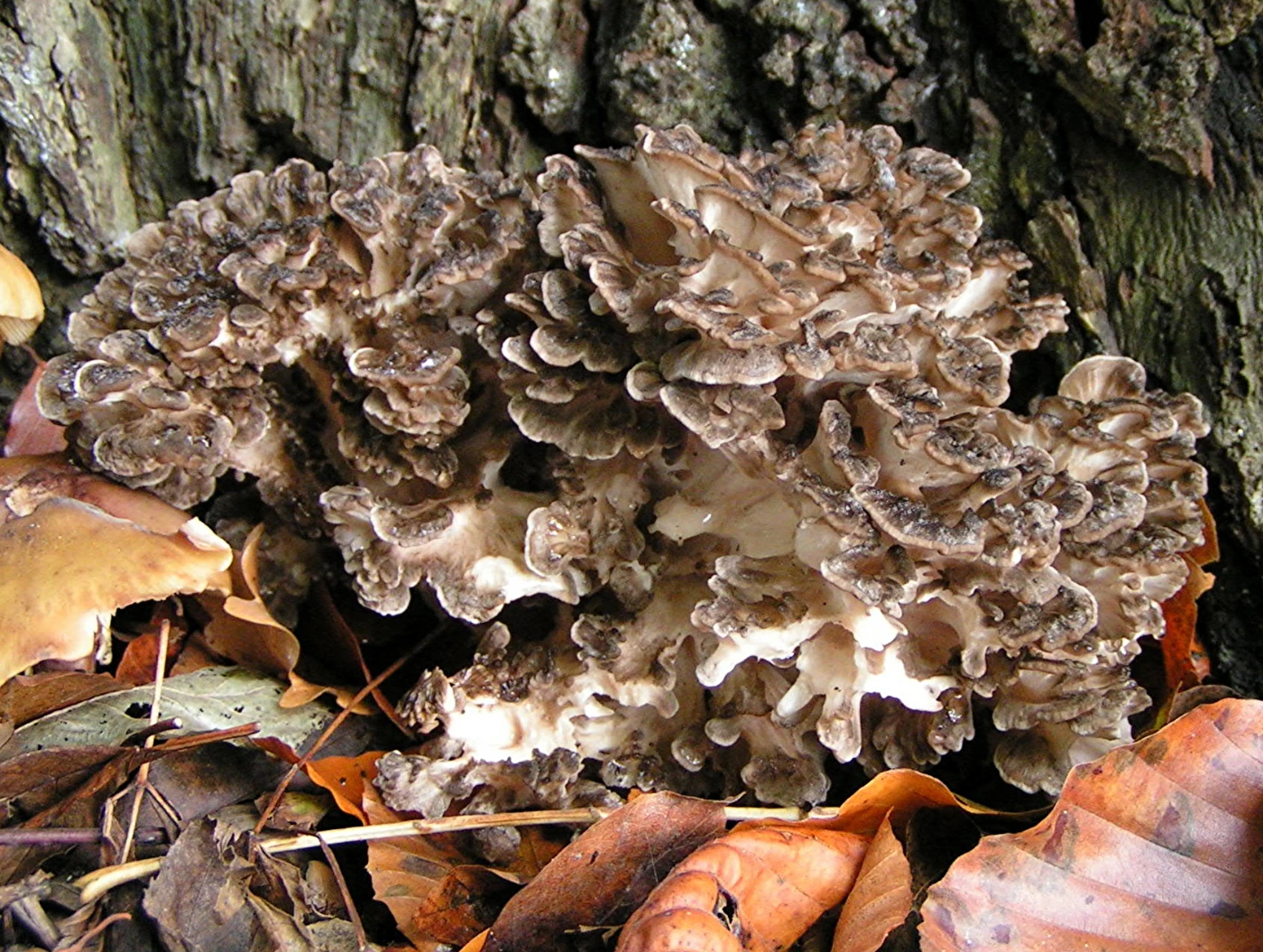
Grifola frondosa, commonly known as Maitake or Hen of the Woods, is a large clustered polypore that grows at the base of mature hardwood trees, especially oaks. Its many overlapping gray-brown fronds can form massive rosettes that resemble a ruffled bird or a bouquet of leaves.
Maitake is one of the most recognizable edible polypores when mature, but several other large bracket fungi can look similar from a distance. The most reliable identification comes from combining growth form, pore surface, host tree, bruising behavior, and texture.
⚠️ Important: Never eat a wild mushroom based solely on photographs, AI identification, or one visible feature. Large clustered polypores can be difficult to separate when old or damaged.
Quick Identification
| Feature | Grifola frondosa |
|---|---|
| Scientific name | Grifola frondosa |
| Common names | Maitake, Hen of the Woods |
| Family | Meripilaceae |
| Growth form | Large rosette of many overlapping fronds |
| Cap color | Gray-brown to brown |
| Underside | White pores |
| Stem | Branched central base |
| Flesh | White, firm when young |
| Bruising | Usually little dramatic staining |
| Spore print | White |
| Substrate | Roots/base of hardwood trees |
| Main host | Especially oak |
| Season | Late summer through autumn |
| Ecology | Wood-decaying / root-associated |
| Edibility | Edible when correctly identified and properly cooked |
| Main look-alikes | Meripilus giganteus, Bondarzewia berkeleyi, Polyporus umbellatus |
What Does Maitake Look Like?
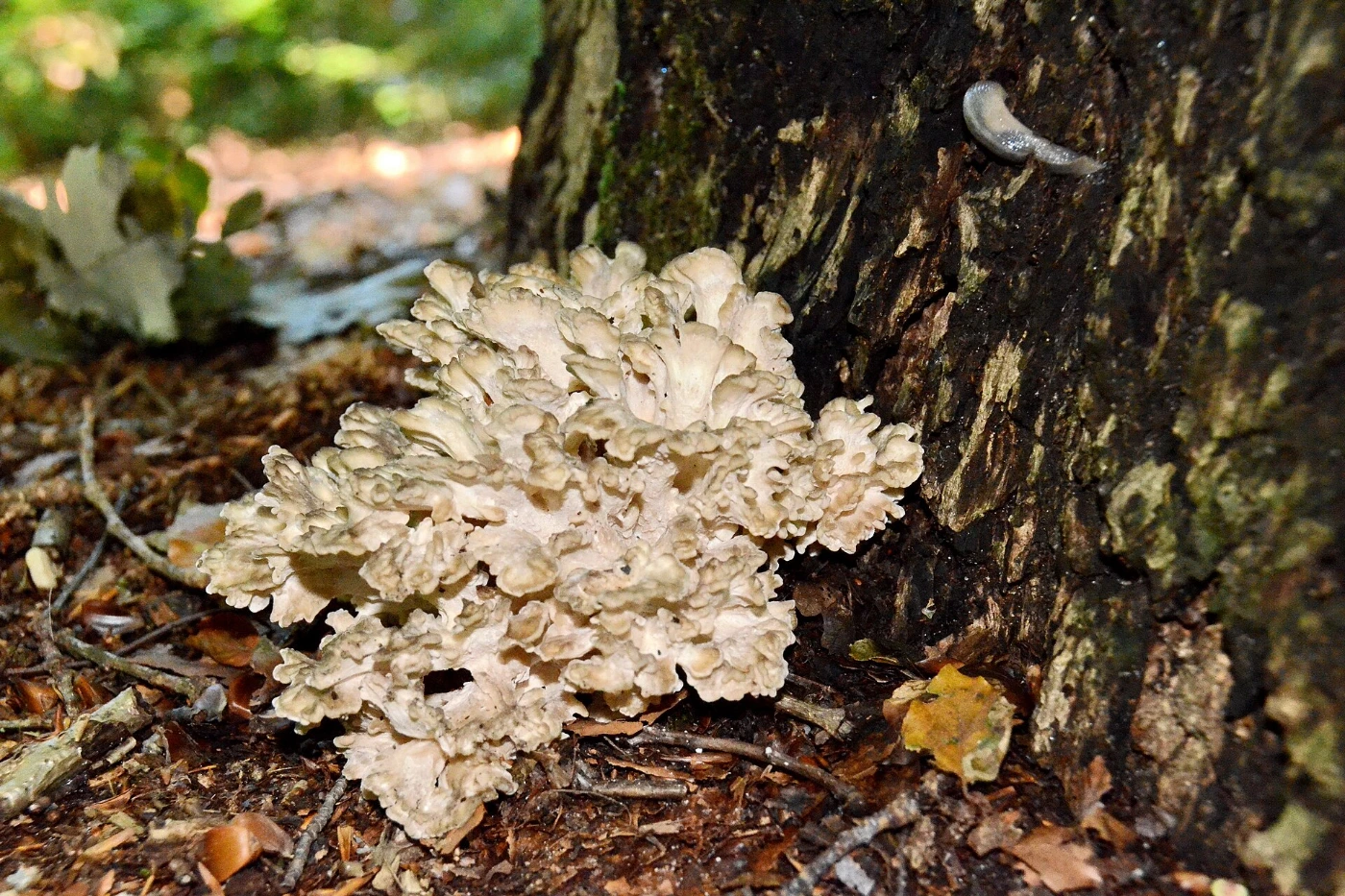
Maitake forms a large branching mass made of dozens or even hundreds of individual spoon-shaped or fan-shaped caps. These arise from a common thick base and create a layered rosette.
A mature cluster can become very large, sometimes weighing several kilograms. The overall appearance is much more complex than a single bracket fungus.
Caps
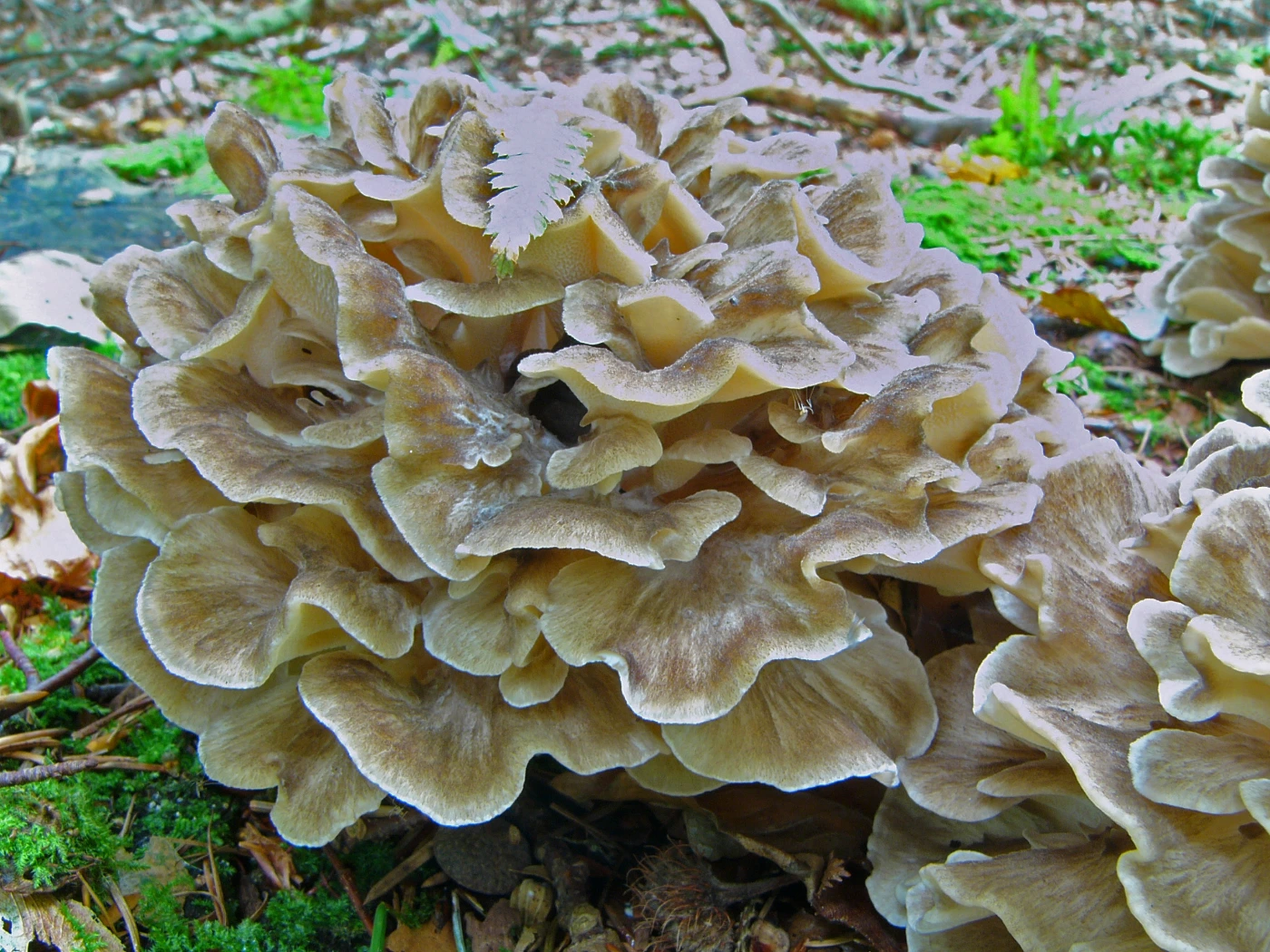
Individual caps are usually gray-brown, brown, or smoky gray. They are thin compared with the thick central base and often have wavy margins.
The upper surface may show faint zoning or subtle darker streaks.
Cap Shape
The caps are usually fan-shaped or spoon-shaped rather than round. They overlap tightly and point outward from the center.
This layered rosette is one of the strongest identification features.
Pore Surface
The underside is white to cream and covered with tiny pores. There are no gills.
The pore surface extends across the underside of each frond and may continue slightly onto the branching structure.
Pore Size
The pores are small and can look almost smooth from a distance. Close inspection reveals the fine openings.
They remain pale in fresh specimens.
Stem and Branching Base
Maitake does not have one ordinary stem. Instead, many branches arise from a thick central base.
Each branch supports several caps, creating the characteristic clustered architecture.
Why the Base Matters
The branching structure helps separate Maitake from several layered bracket fungi that grow as separate shelves directly from the trunk.
A single common base is a useful clue.
Flesh
The flesh is white and firm when young. Older clusters become tougher and more fibrous.
The outer margins are usually more tender than the thick central base.
Texture
Fresh Maitake has a dense but not woody texture. Very old specimens become leathery and less suitable for culinary use.
The texture is much softer than many perennial conks.
Smell
The smell is usually mild, earthy, and mushroom-like. Some people describe it as pleasantly savory.
Odor is not one of the strongest diagnostic features, but it can support an otherwise convincing identification.
Spore Print
The spore print is white.
This helps confirm the broader polypore group but is rarely necessary if the mushroom’s structure and host are clear.
Where Does Maitake Grow?
Maitake usually grows at the base of mature hardwood trees or from buried roots. It is especially famous for its association with oak.
The fruit body may appear to grow directly from the soil even though it is connected to underground wood.
Oak Association
Oak is the classic host in both Europe and North America. Large old trees are especially typical sites.
The same tree may produce Maitake repeatedly over multiple years.
Other Hardwood Hosts
Depending on region, Maitake can also occur with other hardwoods. However, oak remains the most characteristic association.
A similar rosette beneath conifers should be examined carefully before calling it Maitake.
When Does Maitake Grow?
The main season is late summer through autumn. Fruiting often begins after warm wet weather.
In many regions, September and October are particularly productive.
Repeat Fruiting
Maitake can return to the same tree year after year because the fungus remains established in the root or lower trunk system.
Finding one productive site can therefore be useful in future seasons.
Distribution
Grifola frondosa occurs across temperate parts of Europe, Asia, and North America.
Its abundance varies regionally and depends strongly on suitable mature hardwood habitat.
Is Maitake Edible?
Maitake is considered edible when correctly identified and properly cooked. Young fresh clusters are highly valued for their texture and flavor.
The tender outer fronds are usually preferred, while the thick central base can become tough.
Culinary Use
Maitake can be sautéed, roasted, grilled, or added to soups and other dishes. Its layered structure creates many crisp edges during cooking.
Old specimens should be avoided if they are tough, insect-damaged, or beginning to decay.
Medicinal Reputation and Caution
Maitake has a long reputation in food and traditional use, and extracts from Grifola frondosa have been studied for compounds such as beta-glucans.
However, research on isolated extracts or laboratory models should not be interpreted as proof that eating wild Maitake treats or prevents disease.
For MushroomID purposes, it is best treated first as a mushroom identification topic, not as a medical product.
Maitake Look-Alikes
Several large polypores form rosettes at the bases of hardwood trees. Their size and growth habit can make them confusing from a distance.
The most important comparisons are with Giant Polypore and Berkeley’s Polypore.
Meripilus giganteus — Giant Polypore
Identification
Giant Polypore forms huge clusters of broad overlapping fronds at the base of hardwood trees.
Its caps are generally larger and broader than typical Maitake fronds.
Bruising
One of its most useful features is dark bruising. Damaged pore surfaces and flesh often turn brown to black.
Main Difference
Maitake usually has smaller, more numerous gray-brown fronds and does not characteristically blacken as strongly.
Grifola frondosa vs Meripilus giganteus
| Feature | Maitake | Giant Polypore |
|---|---|---|
| Fronds | Numerous, relatively small | Larger, broader |
| Color | Gray-brown | Tan to brown |
| Bruising | Usually mild | Strong dark/black staining |
| Growth | Dense branching rosette | Broad layered rosette |
| Host | Especially oak | Many hardwoods |
| Edibility | Edible when correctly identified | Young parts sometimes considered edible, but often tough |
Bruising is one of the fastest field differences.
Bondarzewia berkeleyi — Berkeley’s Polypore
Identification
Berkeley’s Polypore forms large pale rosettes with thick cream to tan caps.
The caps are usually much larger and thicker than Maitake’s delicate fronds.
Main Difference
Maitake tends to be darker, more finely divided, and made of many smaller fronds.
Berkeley’s Polypore looks heavier and more massive.
Polyporus umbellatus — Umbrella Polypore
Identification
This species forms a branching cluster, but instead of broad irregular fronds it has many distinct round caps on individual branch tips.
The structure can resemble a bouquet of small umbrellas.
Main Difference
Maitake caps are more fan-shaped and merge into a dense layered rosette.
Polyporus umbellatus has more clearly separated cap-and-stem units.
Laetiporus Species — Chicken of the Woods
Identification
Chicken of the Woods forms layered brackets with bright yellow, orange, or salmon coloration.
Its appearance can also be large and clustered around tree bases.
Main Difference
The vivid orange-yellow color immediately separates it from gray-brown Maitake in fresh condition.
Its brackets are also thicker and less finely divided.
Maitake vs Chicken of the Woods
| Feature | Maitake | Chicken of the Woods |
|---|---|---|
| Color | Gray-brown | Bright yellow-orange |
| Fronds | Thin and numerous | Thick shelf-like brackets |
| Pores | White | Yellow to cream |
| Main host | Especially oak | Several hardwoods and some conifers |
| Growth form | Dense leafy rosette | Layered shelves |
These two are usually easy to separate by color and structure.
How to Identify Maitake Step by Step
Start by looking at the overall architecture. Maitake should form a large multi-branched rosette with many overlapping gray-brown fronds.
Then inspect the underside for white pores and check the host tree.
Step 1: Look for a Rosette
The mushroom should consist of many caps emerging from one central branching base.
A few separate shelf brackets are less typical.
Step 2: Check the Cap Color
Look for gray, smoky brown, or muted brown tones.
Bright yellow, orange, or very pale cream suggests another polypore.
Step 3: Check the Underside
The underside should be porous and pale.
True gills would rule out Maitake.
Step 4: Test Bruising
Press a small area of the pore surface. Strong blackening points more toward Meripilus.
Maitake generally shows less dramatic staining.
Step 5: Identify the Host
An old oak strongly supports Maitake.
If the host is unclear, inspect bark, leaves, acorns, and nearby roots.
How to Photograph Maitake for Identification
Take one wide photograph showing the entire cluster and the base of the tree.
Then photograph individual fronds from above and below.
A close-up of the pore surface and a side image showing the branching base are especially useful.
Can AI Identify Maitake?
AI can often recognize a classic mature Maitake because the dense gray-brown rosette is visually distinctive.
Problems arise with very young clusters or old damaged fruit bodies that lose the typical layered form.
Including the host tree, underside, and full cluster greatly improves identification.
Common Identification Mistakes
One common mistake is calling every large polypore at the base of an oak Maitake. Giant Polypore and Berkeley’s Polypore can occupy similar habitats.
Another is ignoring bruising. Strong black staining is an important clue toward Meripilus.
A third mistake is using size alone. Several large polypores can produce enormous fruit bodies.
Interesting Facts About Maitake
The Japanese name maitake is often translated as “dancing mushroom.” One traditional explanation is that people were so pleased to find this valuable fungus that they danced with joy.
The English name Hen of the Woods comes from the layered, feather-like appearance of the cluster, which can resemble a sitting hen.
Maitake can form exceptionally large fruit bodies. A single mature cluster may weigh several kilograms while still arising from one connected fungal organism.
The fungus can also return to the same tree repeatedly for years. The visible rosette is temporary, while the mycelium remains inside or around the root system.
Frequently Asked Questions
Can Maitake grow away from the tree trunk?
Yes. It can fruit from buried roots and appear a short distance from the visible trunk.
Why are some clusters much darker than others?
Color varies with age, moisture, sunlight, and genetics. Fresh shaded clusters can look significantly darker than dry exposed ones.
Can Maitake grow on fallen logs?
It is more characteristically found at the base of living, declining, or dead hardwoods, especially around roots. Direct growth from fallen wood is less typical.
Why do older clusters become tough?
The tissues become more fibrous as the fruit body matures and dries.
Can one oak produce multiple clusters?
Yes. Several rosettes can emerge from different roots or points around the base of the same tree.
Does Maitake always have gray caps?
No. Color can range from pale gray-brown to darker brown, but the overall tone is usually muted rather than bright.
Can insects damage Maitake quickly?
Yes. Large fleshy polypores often attract insects, especially as they mature.
Can Maitake return to exactly the same spot next year?
Yes. This is common when the fungal mycelium remains established in the same host root system.
Final Identification Notes
Grifola frondosa is best recognized by the combination of a large branching rosette, many overlapping gray-brown fronds, white pores, a shared central base, and growth around the roots of mature hardwoods, especially oak.
The most important look-alike is Giant Polypore, Meripilus giganteus. Strong dark or black bruising, broader fronds, and a heavier layered structure favor Meripilus.
The simplest rule is: many small gray-brown fronds + white pores + oak + little black bruising = strong Maitake candidate.
Upload a photo and get possible matches in seconds.