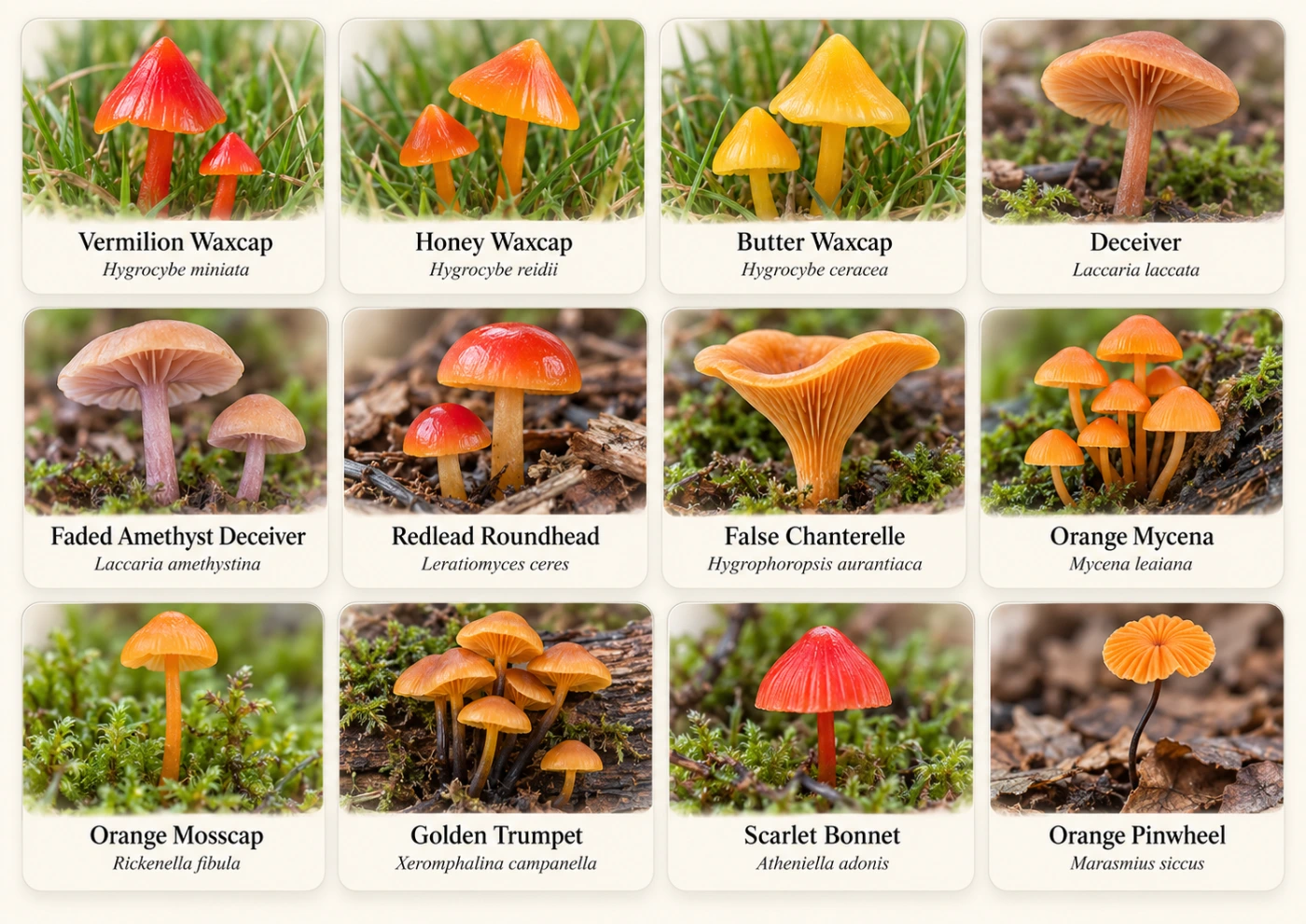
Small orange mushrooms can appear in lawns, forests, wood-chip beds, moss, and even on decaying wood. Some are tiny waxcaps with vivid orange caps, others are small gilled mushrooms, false chanterelles, or clustered species growing from mulch and buried wood.
Because many unrelated fungi can be orange, color alone is not enough for identification. The safest approach is to check the underside, stem, substrate, growth pattern, bruising, and nearby trees.
If the mushroom you found is larger or does not fit the small species in this guide, see our broader guide to Orange Mushroom Identification: Common Species, Edible and Poisonous.
⚠️ Important: Orange color does not indicate edibility. Never eat a wild mushroom based solely on appearance, a photograph, AI identification, or an online comparison.
12 Small Orange Mushrooms at a Glance
| Species | Common name | Edibility / Toxicity | Safety note |
|---|---|---|---|
| Hygrocybe miniata | Vermilion Waxcap | Not recommended | Very small; waxcap edibility is poorly documented and not a good target for foraging |
| Hygrocybe reidii | Honey Waxcap | Not recommended | Edibility is not well established; best treated as non-food |
| Hygrocybe ceracea | Butter Waxcap | Not recommended | Small waxcap with little food value; identification can be difficult |
| Laccaria laccata | Deceiver | Edible when correctly identified and cooked | Similar-looking Laccaria species and variable coloration can cause confusion |
| Laccaria amethystina | Amethyst Deceiver | Edible when correctly identified and cooked | Best eaten only in moderation; can accumulate trace elements from soil |
| Leratiomyces ceres | Redlead Roundhead | Inedible / not recommended | Not considered a food mushroom; avoid consumption |
| Hygrophoropsis aurantiaca | False Chanterelle | Not recommended | Can cause gastrointestinal upset in some people |
| Mycena leaiana | Orange Mycena | Inedible / not recommended | Small and not regarded as a food species |
| Rickenella fibula | Orange Mosscap | Inedible / not recommended | Tiny species with no practical food value |
| Xeromphalina campanella | Golden Trumpet | Inedible / not recommended | Tough and not regarded as a food mushroom |
| Atheniella adonis | Scarlet Bonnet | Inedible / not recommended | Tiny bonnet mushroom; edibility not considered useful or reliable |
| Marasmius siccus | Orange Pinwheel | Inedible / not recommended | Very small, wiry mushroom with no practical food value |
Why Are So Many Small Mushrooms Orange?
Orange coloration appears in many unrelated mushroom groups. In some species it comes from carotenoid-like pigments, while in others it is produced by completely different compounds.
This means two tiny orange mushrooms growing only a few meters apart may belong to entirely different genera. One may grow from grass, another from moss, and another from buried wood.
Color Changes With Age
Young fruit bodies often show the strongest orange tones. As mushrooms age, sun exposure and drying can shift the cap toward yellow, tan, brown, or faded peach.
Rain can also make caps appear darker and more saturated. This is why a single color description should never be treated as decisive.
1. Hygrocybe miniata — Vermilion Waxcap
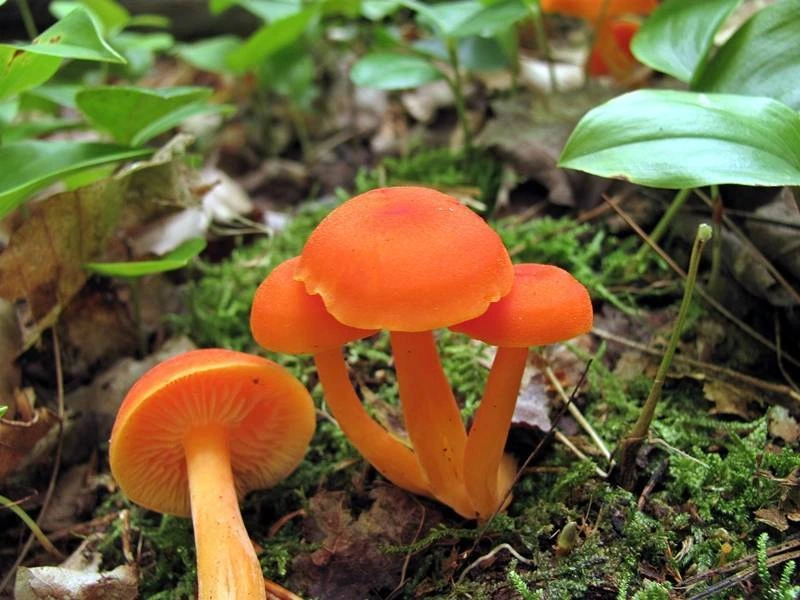
Hygrocybe miniata is a small waxcap with a vivid orange-red to scarlet cap. The cap is usually only a few centimeters across and may become slightly depressed with age.
The gills are pale yellow to orange and have the thick, waxy texture typical of many waxcaps.
Habitat
Vermilion Waxcap is usually found in unimproved grassland, lawns, meadows, and other low-nutrient habitats.
It is especially associated with older grasslands that have not been heavily fertilized.
Main Identification Clue
The combination of a very small size, vivid orange-red cap, waxy gills, and grassland habitat strongly suggests a waxcap.
2. Hygrocybe reidii — Honey Waxcap
Honey Waxcap is another small orange grassland mushroom. It usually has an orange to reddish-orange cap with pale yellow-orange gills.
One of its most distinctive characters is a sweet smell sometimes compared with honey.
Habitat
It grows in grassland rather than directly from wood. As with other waxcaps, nutrient-poor lawns and old meadows are typical habitats.
Main Identification Clue
A small orange waxcap with a distinctly sweet smell can point toward Hygrocybe reidii.
Odor should still be used as a supporting rather than primary feature.
3. Hygrocybe ceracea — Butter Waxcap
Butter Waxcap is yellow to orange-yellow and often looks slightly greasy or waxy. It is usually small and delicate.
The gills are pale and thick compared with many ordinary gilled mushrooms.
Habitat
This species also prefers grassland. It can occur in lawns, meadows, and grassy woodland margins.
Main Identification Clue
Its butter-yellow to orange coloration and waxy texture distinguish it from many drier small orange mushrooms.
4. Laccaria laccata — Deceiver
The Deceiver is famous for changing appearance dramatically as it dries. Fresh caps can be orange-brown, reddish-brown, or cinnamon, while dry specimens may become much paler.
The gills are thick and widely spaced, often pale pinkish or flesh-colored.
Habitat
It grows from soil in woodland and is mycorrhizal with a variety of trees.
It is common in both coniferous and broadleaf forests.
Main Identification Clue
Widely spaced thick gills are more useful than cap color.
The mushroom’s variable appearance explains the common name “Deceiver.”
5. Laccaria amethystina — Faded Amethyst Deceiver
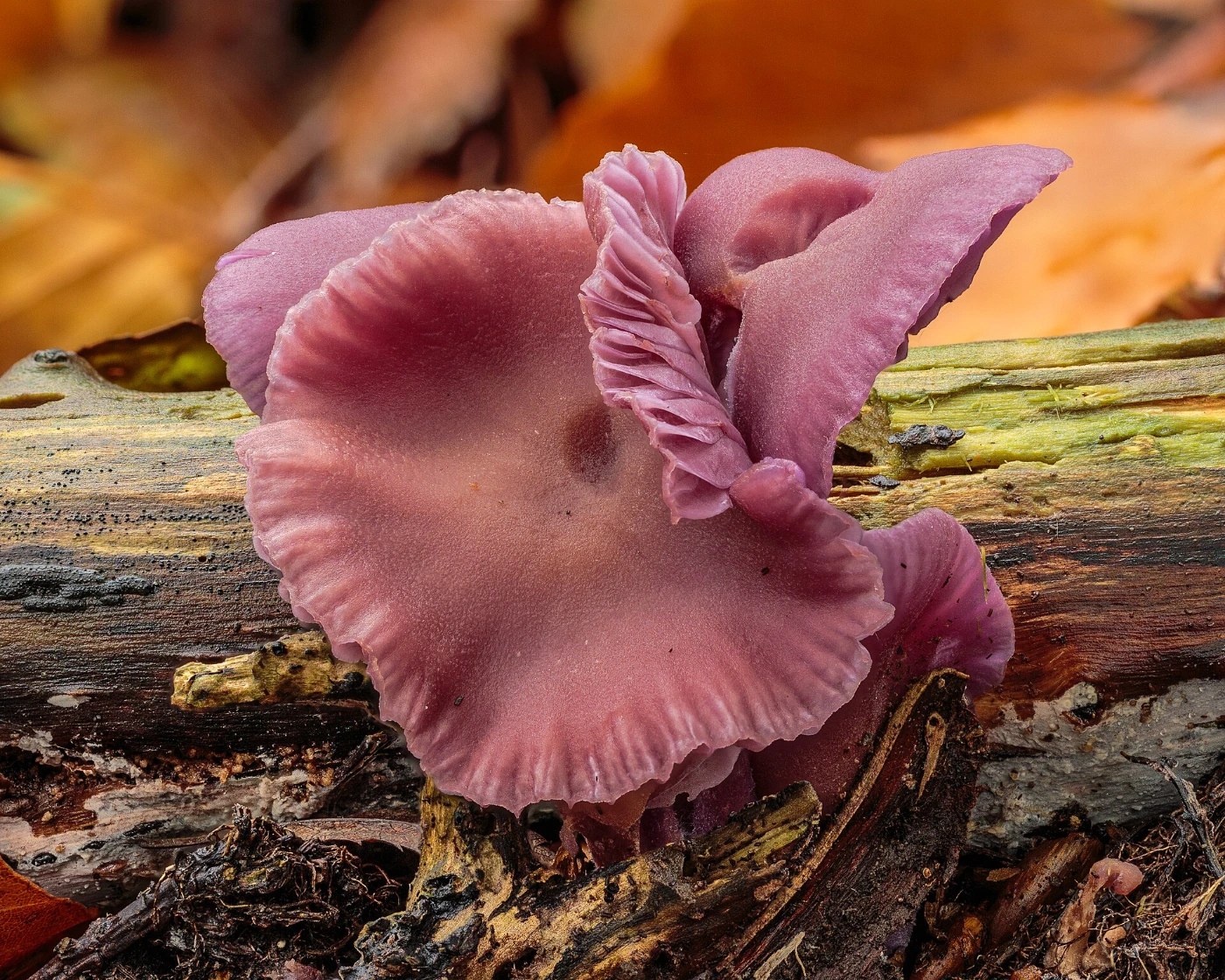
Fresh Laccaria amethystina is normally purple, but old or heavily faded specimens can lose much of that color.
They may become pale brown, tan, or occasionally warm orange-brown, especially on the cap.
Habitat
It grows in woodland, often with beech and other trees.
Main Identification Clue
Look for remaining violet tones in the gills or protected areas of the stem.
A truly orange mushroom with no trace of purple is more likely to be another species.
6. Leratiomyces ceres — Redlead Roundhead
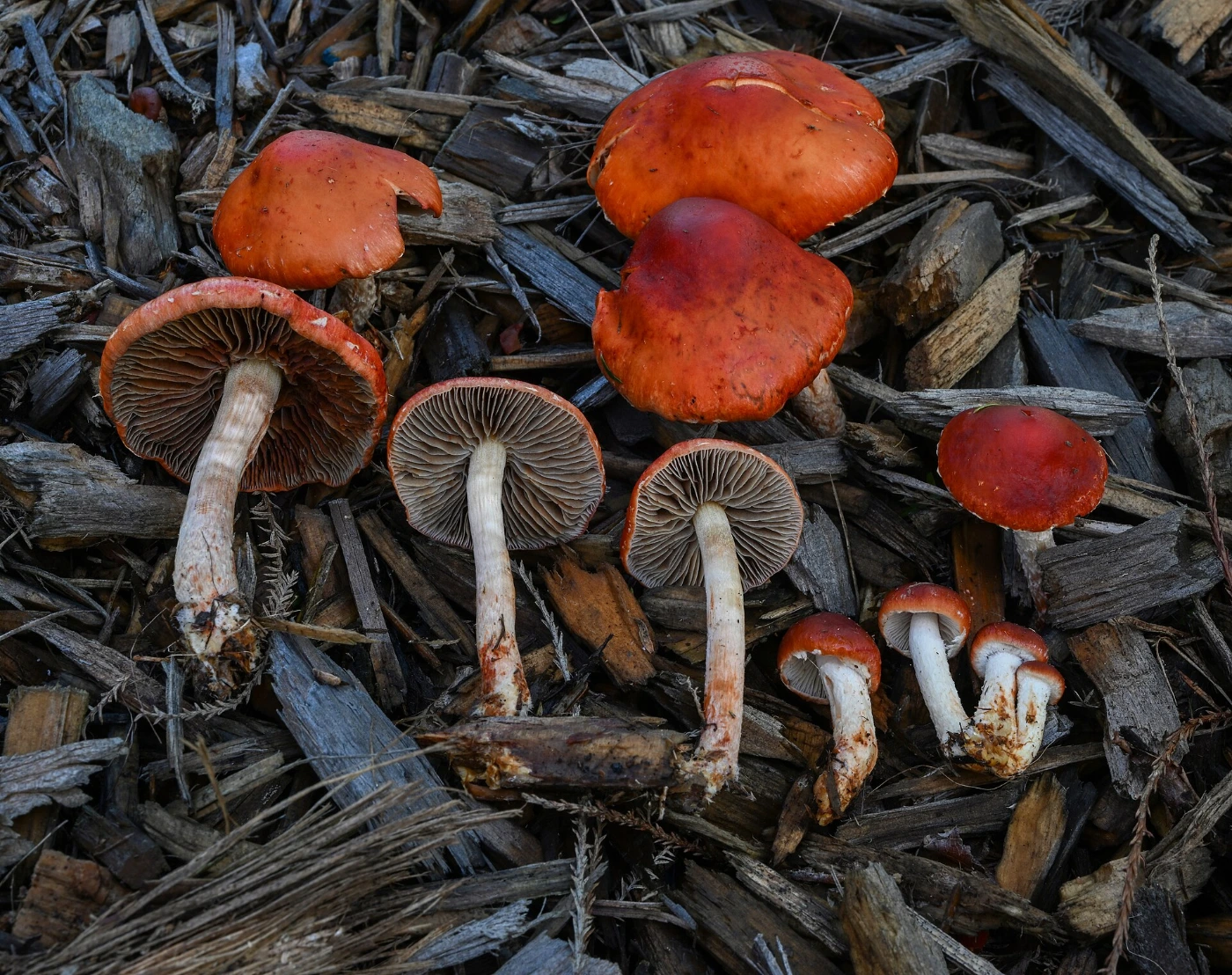
Leratiomyces ceres is a small to medium orange-red mushroom commonly found in wood-chip beds and landscaped areas.
The cap can range from bright orange-red to brick-red, while the gills darken as the spores mature.
Habitat
Wood chips, mulch, garden beds, and landscaped urban areas are classic habitats.
It can occur in large groups after rain.
Main Identification Clue
The combination of an orange-red cap and growth from wood chips is highly characteristic.
7. Hygrophoropsis aurantiaca — False Chanterelle
False Chanterelle is often orange to deep orange and can be smaller than many true chanterelles.
The underside has thin, crowded, strongly forked true gills, unlike the thick blunt ridges of real chanterelles.
Habitat
It often grows in coniferous woodland, especially among needles or decaying woody debris.
Main Identification Clue
Thin forked gills are the key feature.
A true chanterelle has thick blunt false gills instead.
8. Mycena leaiana — Orange Mycena
Mycena leaiana forms small bright orange to yellow-orange mushrooms, often in dense clusters.
The caps are small and delicate, while the gills are pale yellowish to orange.
Habitat
This species grows directly from decaying hardwood.
Logs, fallen branches, and stumps are typical substrates.
Main Identification Clue
Bright orange clusters growing directly from hardwood strongly suggest this species.
9. Rickenella fibula — Orange Mosscap
Orange Mosscap is extremely small. The cap may be only a few millimeters to around a centimeter across.
It has a bright orange to orange-yellow cap and a thin stem.
Habitat
The species is closely associated with moss and commonly appears in mossy lawns, woodland, gardens, and damp grassy places.
Main Identification Clue
If the mushroom is truly tiny and growing directly among moss, Rickenella fibula is a strong possibility.
10. Xeromphalina campanella — Golden Trumpet
Golden Trumpet produces small orange-brown mushrooms in dense clusters.
The caps often become depressed or funnel-shaped, and the stems are thin and dark toward the base.
Habitat
This species grows from decaying conifer wood, especially old stumps and logs.
Large colonies can cover a section of rotten wood.
Main Identification Clue
A cluster of tiny orange-brown mushrooms on conifer wood with darker slender stems is characteristic.
11. Atheniella adonis — Scarlet Bonnet
Scarlet Bonnet is a tiny woodland mushroom with a vivid orange-red to pink-red cap.
Its slender pale stem gives the mushroom a delicate appearance.
Habitat
It is usually found among moss, litter, and damp woodland debris.
Main Identification Clue
The very small size and brilliant reddish-orange cap make it stand out, even though the mushroom itself is delicate.
12. Marasmius siccus — Orange Pinwheel
Orange Pinwheel is a tiny mushroom with a strongly pleated orange to reddish-orange cap.
The stem is extremely thin, wiry, and dark brown to almost black.
Habitat
It grows from leaf litter and small pieces of organic debris in deciduous woodland.
Main Identification Clue
The contrast between the bright orange pleated cap and the dark hair-like stem is highly distinctive.
Small Orange Mushrooms in Grass
Small orange mushrooms in grass are often waxcaps. Hygrocybe miniata, Hygrocybe reidii, and Hygrocybe ceracea are all good examples.
The cap may be brightly colored, but the thick waxy gills are a more useful identification feature.
Why Grassland Matters
Waxcaps are strongly associated with certain types of established grassland. A tiny orange mushroom growing from an old lawn is therefore more likely to be a waxcap than a wood-decaying Mycena.
The same-looking mushroom emerging directly from a stump should be identified along a completely different path.
Small Orange Mushrooms in Moss
Moss supports some exceptionally tiny mushrooms. Rickenella fibula is one of the most characteristic orange examples.
Small bonnet-like species can also occur among moss and damp litter.
The exact substrate matters. Check whether the mushroom is emerging from moss itself, underlying soil, or hidden wood.
Small Orange Mushrooms on Wood
If a tiny orange mushroom grows directly from a log or stump, species such as Mycena leaiana or Xeromphalina campanella become much more likely.
Wood type can help narrow the identification further. Xeromphalina campanella is particularly associated with conifer wood, while Mycena leaiana is commonly found on hardwood.
Small Orange Mushrooms in Wood Chips
Wood-chip beds have their own fungal community. Leratiomyces ceres is one of the most conspicuous orange-red species in landscaped areas.
Mulch can also support many brown, yellow, and reddish mushrooms, so the substrate alone does not prove the species.
The color of mature gills and spore deposit can become useful when separating similar wood-chip mushrooms.
Small Orange Mushrooms With Gills
Most species in this guide have true gills, but those gills can look very different.
Waxcaps have thick waxy gills, Laccaria has broad widely spaced gills, and False Chanterelle has many thin forked gills.
Examining the underside is therefore much more informative than simply noting “orange cap.”
Small Orange Mushrooms That Look Like Chanterelles
False Chanterelle is probably the most important example. It can have a funnel-shaped orange cap and grow in woodland, making the resemblance convincing from above.
The underside resolves the comparison.
True Chanterelle vs False Chanterelle
True chanterelles have thick blunt ridges that are part of the cap tissue. False Chanterelle has thin flexible true gills.
True chanterelles are also generally more substantial than the small delicate orange mushrooms covered by this article.
Are Small Orange Mushrooms Poisonous?
There is no general answer. Orange pigmentation occurs in edible, inedible, toxic, and poorly studied mushroom groups.
Some tiny mushrooms are also difficult to identify to species without microscopy. This makes them especially unsuitable for identification based only on appearance.
Small Does Not Mean Safe
A common misconception is that very small mushrooms cannot contain significant toxins. Size has no reliable relationship with toxicity.
Some dangerous mushroom genera contain species with relatively small fruit bodies.
How to Identify a Small Orange Mushroom Step by Step
The first step is to determine what the mushroom is growing from. Grass, moss, soil, hardwood, conifer wood, and mulch each point toward different groups.
Then examine the underside and stem.
Step 1: Check the Substrate
Grass suggests waxcaps. Moss strongly supports species such as Orange Mosscap, while direct wood growth points toward wood-decaying species.
Mulch and wood-chip beds strongly suggest a different group again.
Step 2: Check the Gills
Look at their thickness, spacing, color, and attachment to the stem.
Waxy thick gills, widely spaced gills, and thin crowded forked gills are very different structures.
Step 3: Look at the Stem
Check whether the stem is pale, orange, fibrous, dark, or almost hair-like.
Orange Pinwheel, for example, has a dark wiry stem that is very different from a waxcap stem.
Step 4: Check the Growth Pattern
A single tiny mushroom in moss suggests different possibilities from hundreds of orange mushrooms carpeting a log.
Clustered growth is especially useful with wood-decaying species.
Step 5: Consider Size
Measure the cap rather than relying on visual impression.
A cap only 5–10 mm wide belongs to a very different size class from a mushroom 4–5 cm across, even if both appear “small” in a photograph.
How to Photograph Small Orange Mushrooms
Small mushrooms are difficult to identify from distant images. Move close enough to show the gills, stem, and cap surface clearly.
Include at least one image showing the substrate. A macro photograph without any habitat context can remove one of the most valuable identification clues.
If the mushrooms are clustered, photograph the whole group before taking individual close-ups.
Can AI Identify Tiny Orange Mushrooms?
AI can often narrow the mushroom to a likely group when both structure and habitat are visible.
Tiny species are more challenging because the decisive characters may be very small, and many closely related mushrooms look nearly identical in ordinary photographs.
The best result may therefore be a genus or group rather than an exact species. In small orange mushrooms, that level of caution is often appropriate.
Common Identification Mistakes
One common mistake is assuming all small orange mushrooms are baby chanterelles. Many are unrelated gilled fungi.
Another is ignoring the substrate. The same orange color can appear in a grassland waxcap, a moss-associated Rickenella, and a wood-decaying Mycena.
A third mistake is using cap color more precisely than the mushroom allows. Orange, yellow-orange, red-orange, and brown-orange can shift dramatically with age and moisture.
Interesting Facts About Small Orange Mushrooms
Some of the smallest mushrooms can be ecologically very specialized. Orange Mosscap, for example, is closely associated with mossy habitats, while other tiny species specialize in particular types of decaying wood.
Waxcaps are also useful indicators of long-established low-nutrient grassland. Areas containing diverse waxcap communities can have considerable ecological value.
The Deceiver illustrates another challenge in mushroom identification: a single species can change color so dramatically while drying that young and old specimens may look like different mushrooms.
Tiny fungi are also easy to overlook in biodiversity surveys. A patch of moss or leaf litter that appears empty from standing height can contain numerous miniature mushroom species.
Frequently Asked Questions
Why do tiny orange mushrooms sometimes appear overnight?
Small fruit bodies can develop quickly once moisture and temperature become favorable. The fungal mycelium was already present in the substrate before the mushrooms appeared.
Why do some disappear after only one sunny day?
Tiny mushrooms have little water stored in their tissues. Dry, warm weather can dehydrate them very rapidly.
Can mowing cause orange mushrooms to appear in a lawn?
Mowing does not create them, but short grass can make existing fruit bodies easier to notice. Changes in moisture and grass management can also affect fruiting.
Why do mushrooms on the same log have different shades of orange?
They may be different ages or even different species. Hydration and light exposure also change the intensity of cap color.
Can small orange mushrooms grow indoors?
Occasionally, fungi associated with damp wood, potting material, or organic debris can fruit indoors. Indoor appearance does not make the species easier to identify.
Do all orange waxcaps feel waxy to the touch?
Not necessarily in an obvious way. “Waxy” often describes the texture and structure of the gills as much as the feel of the cap.
Are orange mushrooms more common in autumn?
Many are, because cool wet conditions favor fruiting. However, timing varies by species and climate.
Can one patch contain several different small orange species?
Yes. Woodland litter, moss, and grassland can support multiple species simultaneously, so each type should be examined separately.
Final Identification Notes
“Small orange mushroom” describes an appearance, not a biological group. Waxcaps, bonnets, wood-decaying mushrooms, false chanterelles, and tiny moss-associated fungi can all fit that description.
The most useful first question is therefore not “which orange mushroom is this?” but “what is this orange mushroom growing from?” Once the substrate is known, check the gills, stem, size, and growth pattern.
Upload a photo and get possible matches in seconds.