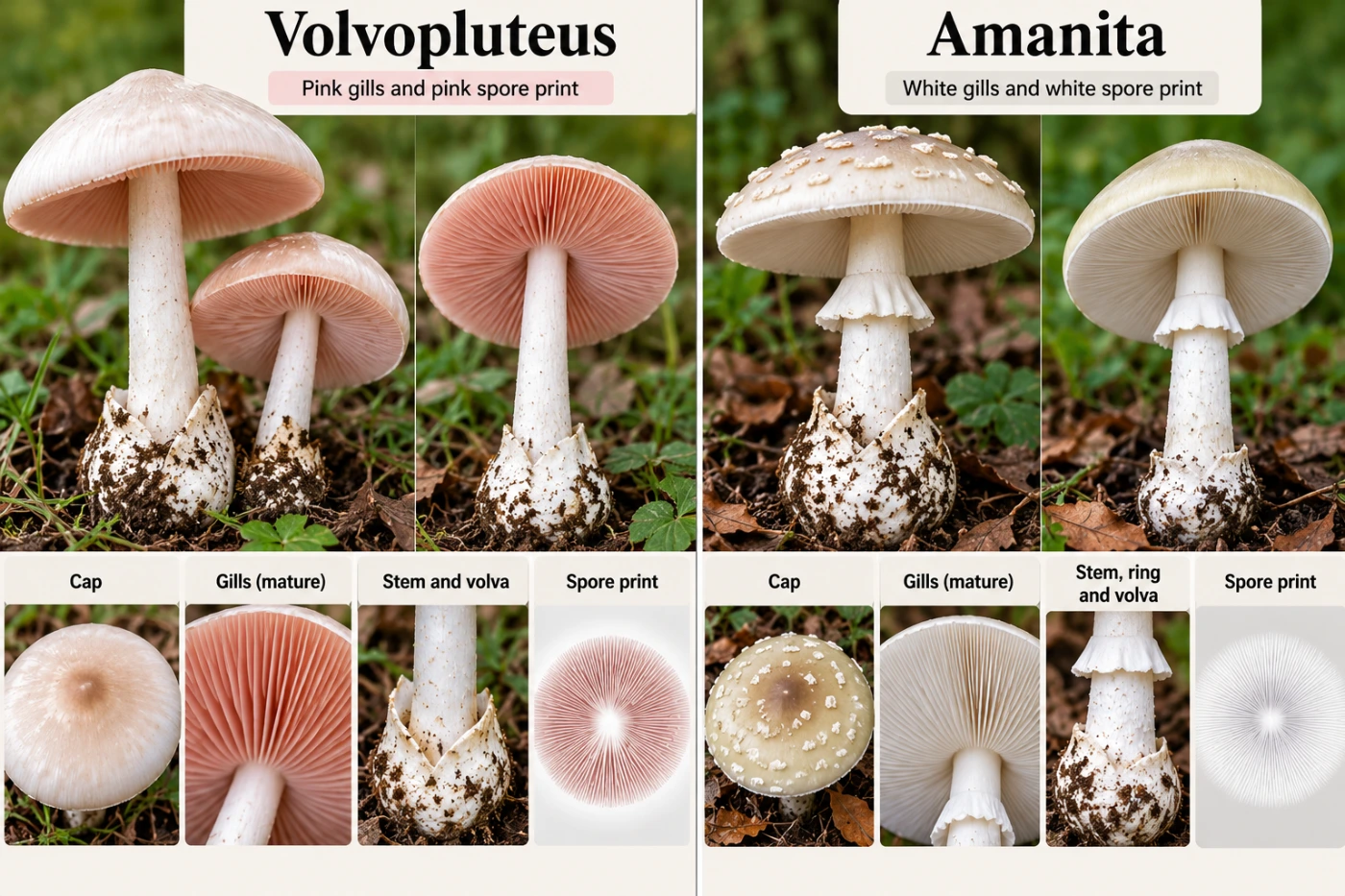
Volvopluteus and Amanita can look surprisingly similar, especially when the mushrooms are young. Both can have pale caps, white gills, and a sac-like structure called a volva around the stem base.
The key difference is that Volvopluteus develops pink gills and a pink spore print, while Amanita keeps white gills and produces a white spore print. Ring structure, habitat, and ecology provide additional clues.
⚠️ Important: This comparison matters because some Amanitas are deadly poisonous. Never assume a pale mushroom with a volva is safe to eat based on a photograph alone.
Quick Comparison
| Feature | Volvopluteus | Amanita |
|---|---|---|
| Mature gills | Pink to salmon-pink | White |
| Young gills | White to pale | White |
| Spore print | Pink | White |
| Gill attachment | Free | Free to narrowly attached |
| Volva | Present | Often present |
| Ring | Absent | Often present |
| Cap surface | Usually smooth | Smooth or with veil remnants |
| Ecology | Saprotrophic | Mycorrhizal |
| Typical habitat | Fields, gardens, compost-rich soil | Woodland near trees |
| Main danger | Confusion with Amanita | Some species deadly poisonous |
| Best clue | Pink spores + no ring | White spores + often ring |
Why They Are So Easy to Confuse
The problem is greatest with young mushrooms. A young Volvopluteus may still have white gills, so one of its most useful identifying features has not appeared yet.
At the same time, many Amanitas also have pale caps and a sac-like volva. If the mushroom is viewed only from above, the two groups can look almost identical.
Gill Color
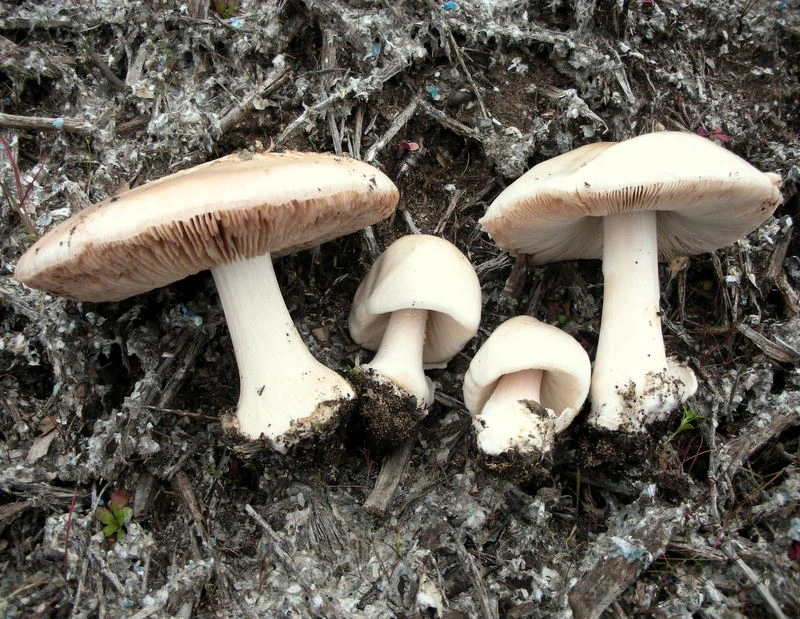
Gill color is one of the most important differences, but only when the mushroom is mature.
Volvopluteus Gills
Young Volvopluteus gills start white or pale. As the spores mature, the gills become flesh-pink, salmon-pink, or dull pink.
This color change is caused by the developing pink spores. Mature pink gills are therefore a strong clue.
Amanita Gills
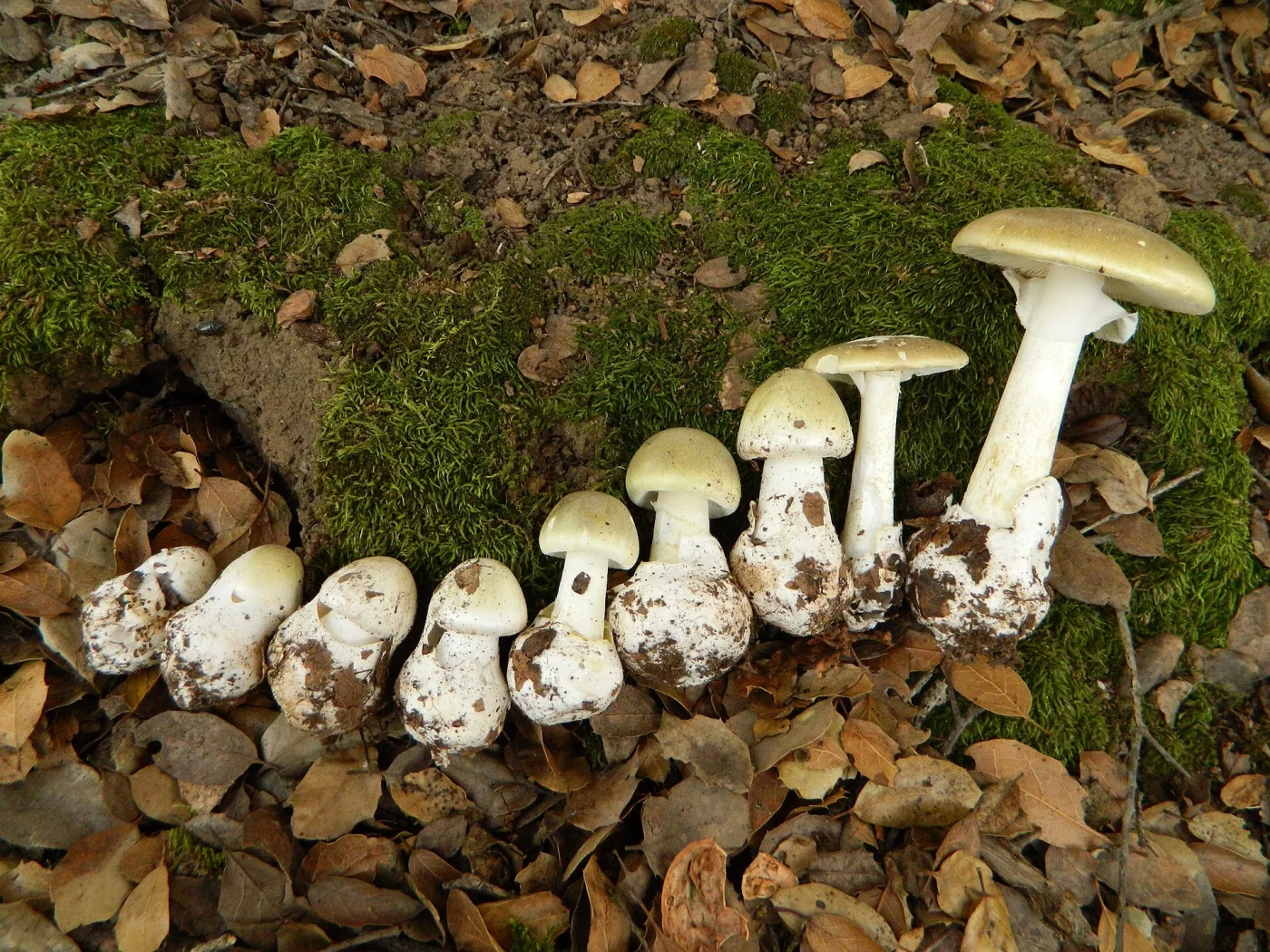
Amanita gills stay white or very pale even as the mushroom matures. They do not develop the characteristic salmon-pink color of Volvopluteus.
This makes mature specimens much easier to separate.
Spore Print
A spore print is one of the best ways to distinguish these groups when visual features are unclear.
Volvopluteus Spore Print
Volvopluteus produces a pink to salmon-pink spore print. This matches the pink color that develops on mature gills.
A pink spore print strongly supports Volvopluteus or another pink-spored group.
Amanita Spore Print
Amanita produces a white spore print. Even species with colored caps still have pale spores.
A white print from a volva-bearing mushroom should immediately make Amanita a serious possibility.
The Volva
Both groups can have a volva, which is why this feature does not separate them by itself.
The volva is a remnant of the universal veil that enclosed the mushroom when it was very young.
Volvopluteus Volva
The volva is typically loose, membranous, and sac-like. It may be white, cream, or grayish and can remain partly buried in the soil.
The stem emerges directly from this bag-like structure.
Amanita Volva
Amanita volvas are highly variable. Some form a deep sack, while others appear as rings, rims, zones, or fragmented tissue around a swollen base.
This variation is one reason Amanita identification requires close attention to the stem base.
Ring on the Stem
Ring presence is another useful difference.
Volvopluteus
Volvopluteus does not have a true ring. The stem is usually bare above the volva.
If you find a clear membranous ring together with a volva, Amanita becomes much more likely.
Amanita
Many Amanitas have a ring on the upper stem. The ring may be broad and hanging, thin, fragile, or partly lost in older specimens.
Because damaged mushrooms can lose their ring, absence of a visible ring should never be used alone.
Cap Surface
Cap texture can provide supporting clues.
Volvopluteus Cap
The cap is often smooth and may be slightly sticky or greasy when wet. Pale gray, cream, white, or gray-brown colors are common.
Prominent veil warts are usually absent.
Amanita Cap
Amanita caps can be smooth, but many species retain veil remnants as spots, patches, or warts.
Rain may wash these away, so a smooth cap does not rule out Amanita.
Stem Shape
Stem proportions overlap, but some tendencies are useful.
Volvopluteus Stem
The stem is usually long, relatively slender, and smooth. It often looks elegant rather than bulky.
There is no true ring.
Amanita Stem
Amanita stems are often thicker and may have a swollen or bulbous base. The ring and basal structures can be more complex.
However, species vary greatly, so stem shape alone is not reliable.
Habitat
Ecology is one of the most useful supporting differences.
Volvopluteus Habitat
Volvopluteus is saprotrophic. It feeds on decomposing organic material rather than living in partnership with tree roots.
Typical habitats include fields, gardens, compost-rich ground, disturbed soil, roadsides, vegetable beds, and agricultural land.
Amanita Habitat
Amanitas are mycorrhizal and usually grow near living trees. Woodland, forest edges, parks, and tree-lined grasslands are common habitats.
They form partnerships with roots of trees such as oak, beech, birch, pine, spruce, and others.
Volvopluteus vs Amanita: The Most Reliable Differences
The most reliable characters are not cap color. Instead, focus on spores, ring, and ecology.
A mature mushroom with pink gills, pink spores, no ring, and a sac-like volva strongly fits Volvopluteus. A mushroom with white spores, white gills, and a ring or structured bulbous base fits Amanita much better.
Why Young Specimens Are Dangerous to Identify
Young Volvopluteus mushrooms can have completely white gills. At that stage, the pink-spored character is not yet visible.
This makes them especially easy to confuse with white or pale Amanitas. If the mushroom is immature, identification should remain cautious until more features are available.
Volvopluteus gloiocephalus vs Pale Amanita
Volvopluteus gloiocephalus, the Stubble Rosegill, is the species most often involved in this comparison.
It can have a white to gray cap, white young gills, a long pale stem, and a bag-like volva.
Main Difference
As it matures, the gills turn pink and the spore print becomes salmon-pink. Pale Amanitas keep white gills and white spores.
This single color transition is one of the most useful identification clues.
Volvopluteus vs Amanita phalloides
The Death Cap, Amanita phalloides, is one of the most dangerous possible look-alikes.
Young Death Caps can have pale caps, white gills, a ring, and a sac-like volva.
Main Difference
The Death Cap keeps white gills and produces white spores. It usually has a distinct ring on the stem and often grows near broadleaf trees such as oak or beech.
Volvopluteus lacks a ring and develops pink spores.
Volvopluteus vs Destroying Angels
Several white Amanita species are known as Destroying Angels. These can be almost completely white and may have a deep sac-like volva.
They are among the most dangerous mushrooms to confuse with pale volva-bearing species.
Main Difference
Destroying Angels have white gills, white spores, and usually a ring. Volvopluteus matures toward pink gills and pink spores and lacks a ring.
Volvopluteus vs Amanita vaginata Group
Ringless Amanitas create a more difficult comparison because they may also lack a ring.
The Amanita vaginata group has a volva and generally no ring.
Main Difference
Spore color becomes especially important here. Ringless Amanitas still produce white spores, while Volvopluteus produces pink spores.
Habitat also helps because ringless Amanitas are usually associated with trees.
Look-Alikes
Other mushrooms can resemble one side of this comparison and cause additional confusion.
Volvariella Species
Identification
Volvariella species also have a volva, free gills, and pink spores. They are closely related in appearance to Volvopluteus.
Some species grow on wood, compost, or rich soil.
Main Difference
Separating Volvariella from Volvopluteus may require cap texture, habitat, size, and sometimes microscopic features.
Pluteus Species
Identification
Pluteus has free gills that become pink and also produces pink spores. Many species grow directly from wood.
The stem does not have a volva.
Main Difference
The absence of a volva is the easiest field difference. If a true sac-like volva is present, Pluteus becomes much less likely.
Agaricus Species
Identification
Young Agaricus mushrooms can have pink gills and may grow in grassland. They usually have a ring.
Their gills become dark chocolate-brown with age.
Main Difference
Agaricus lacks a volva and produces brown spores rather than pink spores.
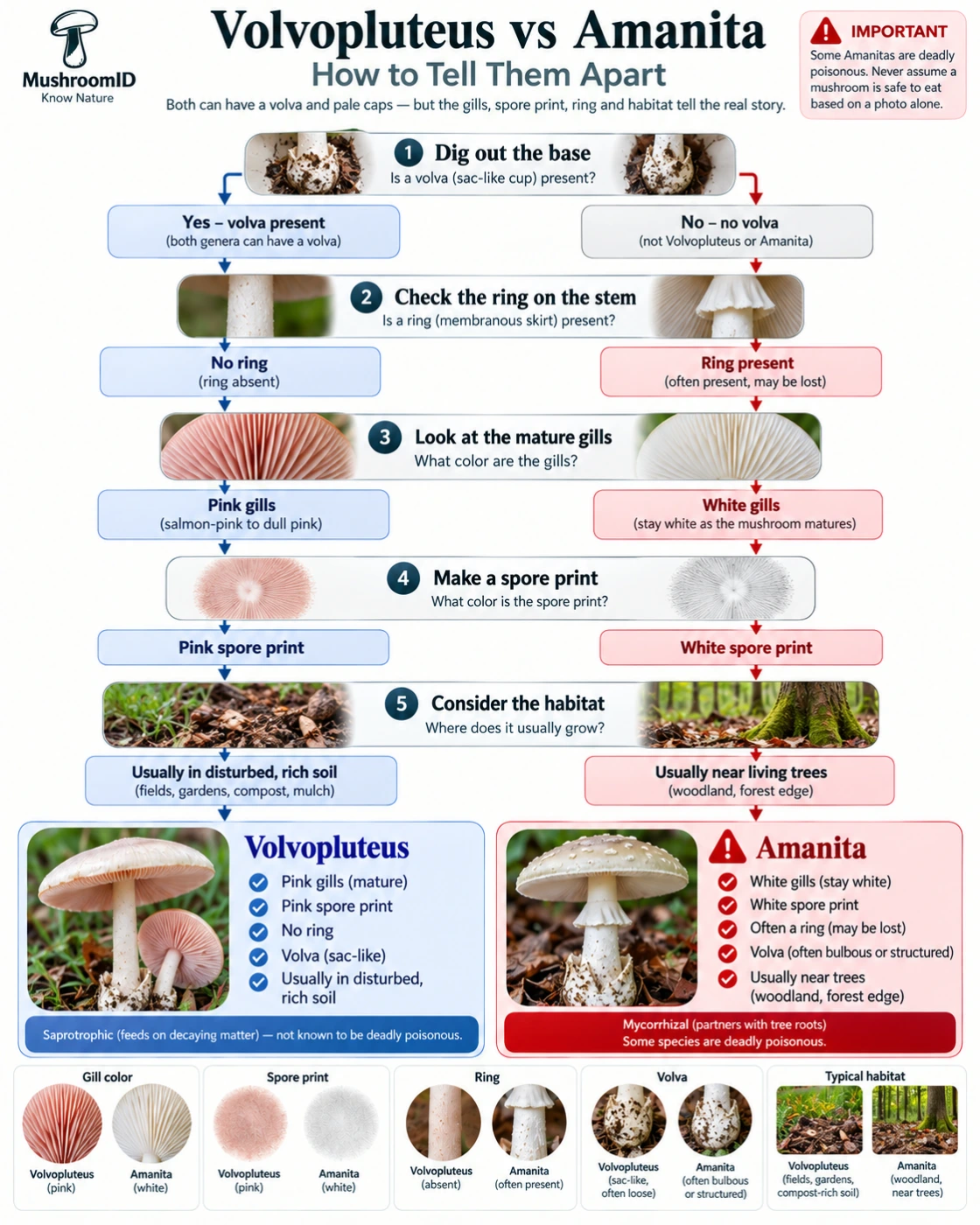
How to Tell Volvopluteus from Amanita Step by Step
The best approach is to examine the complete mushroom from base to cap.
Step 1: Dig Out the Stem Base
Do not cut the mushroom at ground level. Carefully expose the full base and look for a volva.
If the base is missing, one of the most important characters is lost.
Step 2: Check for a Ring
Look at the upper stem for a membranous ring.
A clear ring strongly favors Amanita, although some Amanitas can be ringless or lose the ring.
Step 3: Look at Mature Gill Color
Pink mature gills support Volvopluteus. White mature gills support Amanita.
Do not rely on this feature in very young mushrooms.
Step 4: Make a Spore Print
A pink print strongly supports Volvopluteus. A white print supports Amanita.
This is one of the most reliable differences.
Step 5: Consider the Habitat
Open fields, compost-rich ground, and disturbed soil fit Volvopluteus. Woodland or growth near living trees fits Amanita better.
Habitat supports the identification but should not replace structural features.
How to Photograph the Mushroom
Take one photo of the mushroom in place before picking it. Include surrounding grass, soil, trees, compost, or woodland.
Then photograph the complete stem base, ring area, underside, and cap. A mature specimen with visible pink gills is far easier to identify than a cap-only photo.
Can AI Tell Volvopluteus from Amanita?
AI can often separate mature specimens when the gills, ring, and volva are visible. A single top-down cap photo is much less reliable.
The biggest problem is immature Volvopluteus. If the gills are still white, AI should keep Amanita among the possible alternatives.
Common Identification Mistakes
One mistake is assuming that every mushroom with a volva is an Amanita. Several pink-spored genera also have volvas.
Another mistake is assuming that absence of a ring proves Volvopluteus. Some Amanitas are naturally ringless, and others can lose the ring.
The most dangerous mistake is ignoring spore color. Pink vs white spores is one of the strongest differences between these groups.
Interesting Facts
The resemblance between these groups comes from similar veil structures rather than close ecological behavior. Both can produce a volva, but one group is saprotrophic while the other is mycorrhizal.
Volvopluteus often thrives in human-disturbed environments. Agricultural fields, gardens, compost, and rich soils can all support it.
Amanitas, by contrast, depend on living tree roots. Their presence can therefore tell you something about the underground fungal partnership in the habitat.
The pink gills of Volvopluteus are not present from the start. They appear as spores mature, which is why mushroom age can completely change the identification process.
Frequently Asked Questions
Can Volvopluteus have white gills?
Yes, when young. The gills gradually become pink as the spores mature.
Can Amanita have no ring?
Yes. Some Amanita groups are naturally ringless, and rings can also be damaged or lost.
Can both have a sac-like volva?
Yes. That is exactly why the comparison can be difficult.
Is a pink spore print enough to rule out Amanita?
Yes, a true pink spore print points away from Amanita, which produces white spores. However, you still need to identify which pink-spored genus is present.
Can Volvopluteus grow in woodland?
It can occur near trees or woodland edges, but it is more strongly associated with rich soil and decomposing organic matter than with living tree roots.
Can Amanita grow in lawns?
Yes, especially if suitable trees are nearby. Roots can extend into lawns well beyond the tree canopy.
Should a young pale volva-bearing mushroom be eaten if it looks like Volvopluteus?
No. Young specimens are exactly where confusion with dangerous Amanitas is most likely.
Final Identification Notes
The safest way to separate Volvopluteus from Amanita is to focus on spore color, mature gill color, ring presence, and ecology.
The practical pattern is:
Volvopluteus: pink mature gills + pink spores + no ring + volva + rich disturbed soil.
Amanita: white gills + white spores + often a ring + volva or bulbous base + association with living trees.
The single most important warning is that young Volvopluteus may still have white gills, so immature pale mushrooms with a volva should always be treated with extra caution.
Upload a photo and get possible matches in seconds.