Birch trees support a surprisingly rich community of fungi. Some mushrooms form close mycorrhizal partnerships with birch roots, while others grow nearby because they prefer the same acidic soils, mossy ground, cool climates, or woodland conditions.
Finding a mushroom under birch does not identify it by itself, but tree association can be an extremely useful clue. In some groups, especially boletes and milkcaps, the host tree can narrow the possibilities dramatically.
⚠️ Important: Habitat is only one part of mushroom identification. Never eat a wild mushroom based solely on the tree it grows under, photographs, AI identification, or a single visible feature.
15 Common Mushrooms Found Under Birch Trees
| Species | Common name | Main clue | Relationship with birch |
|---|---|---|---|
| Leccinum scabrum | Brown Birch Bolete | Brown cap, scabrous stem | Strongly associated |
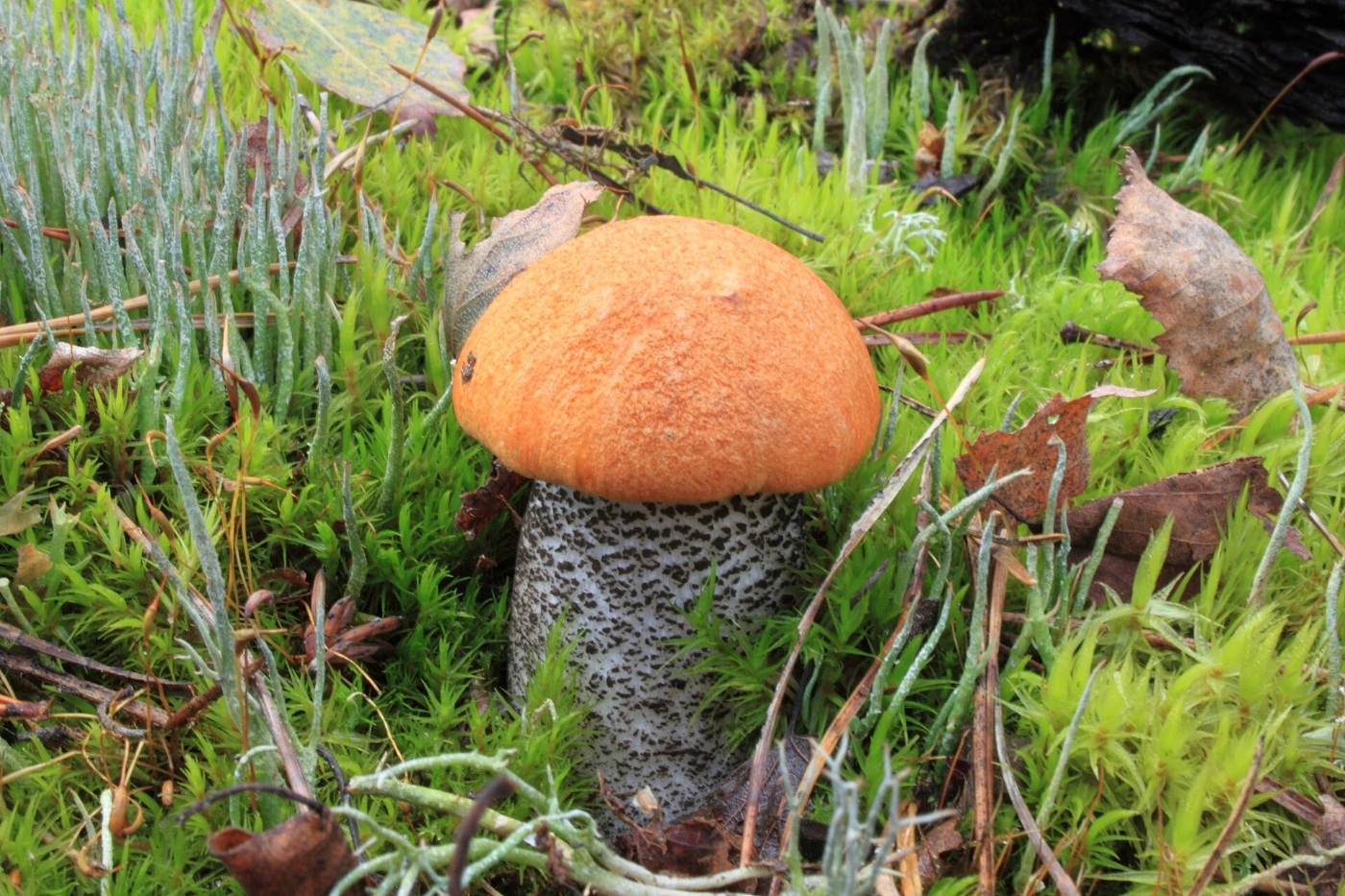
| Leccinum versipelle group | Orange Birch Bolete | Orange cap, dark stem scales | Strongly associated |
| Leccinum holopus | Ghost Bolete | Pale cap, wet birch habitat | Strongly associated |
| Lactarius pubescens | Bearded Milkcap | Pale pink woolly cap, white latex | Strongly associated |
| Lactarius torminosus | Woolly Milkcap | Pink zoned cap, woolly margin | Strongly associated |
| Russula betularum | Birch Brittlegill | Pale pink cap, brittle flesh | Strongly associated |
| Russula claroflava | Yellow Swamp Brittlegill | Bright yellow cap | Birch, wet soils |
| Amanita muscaria | Fly Agaric | Red cap, white warts | Common with birch |
| Amanita fulva | Tawny Grisette | Tawny cap, volva, no ring | Often with birch |
| Amanita crocea | Orange Grisette | Orange cap, volva, no ring | Can occur with birch |
| Cortinarius armillatus | Red-Banded Webcap | Red bands on stem | Often birch-associated |
| Paxillus involutus | Brown Roll-Rim | Rolled cap margin, decurrent gills | Often with birch |
| Cantharellus cibarius group | Chanterelle | False gills, yellow body | Can grow with birch |
| Hydnum repandum group | Hedgehog Mushroom | Teeth under cap | Can grow with birch |
| Imleria badia | Bay Bolete | Yellow pores, blue bruising | Can occur near birch |
Why Birch Trees Have So Many Mushrooms
Birch forms ectomycorrhizal relationships with many fungi. In these partnerships, fungal hyphae wrap around or grow among the outer parts of tree roots and exchange minerals and water for sugars produced by the tree.
This relationship is especially important in nutrient-poor, acidic, or cool soils where birch often thrives. The fungi help the tree access resources that would otherwise be difficult to obtain.
Birch as a Mycorrhizal Host
Some fungi are strongly specialized on birch, while others can associate with birch and several other tree species. This difference matters when using habitat as an identification feature.
A mushroom that is strongly birch-associated becomes much more likely when several mature birches are present. A generalist mycorrhizal species, by contrast, may simply be sharing the same woodland.
1. Leccinum scabrum — Brown Birch Bolete
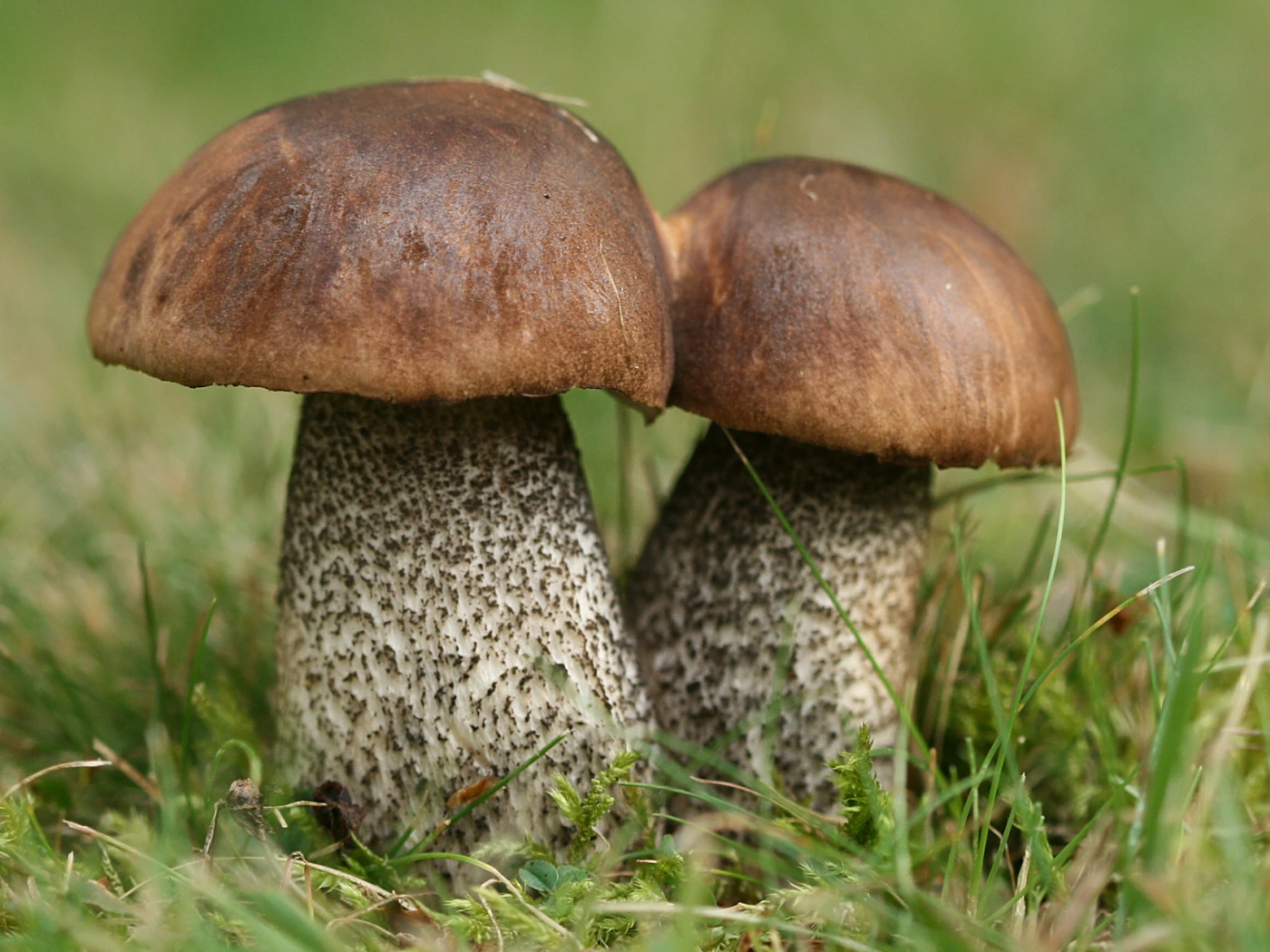
Brown Birch Bolete is one of the classic mushrooms associated with birch. It usually has a brown to gray-brown cap and a pale stem covered with numerous dark rough scales known as scabers.
The pore surface begins pale and may become grayish or duller with age. Strong blue bruising is generally absent.
Main Identification Clue
The stem is especially important. The dark scabers distinguish Leccinum from many other brown boletes.
If a brown-capped bolete with a scabrous stem is growing directly beneath birch, Leccinum scabrum becomes a strong possibility.
2. Leccinum versipelle Group — Orange Birch Bolete
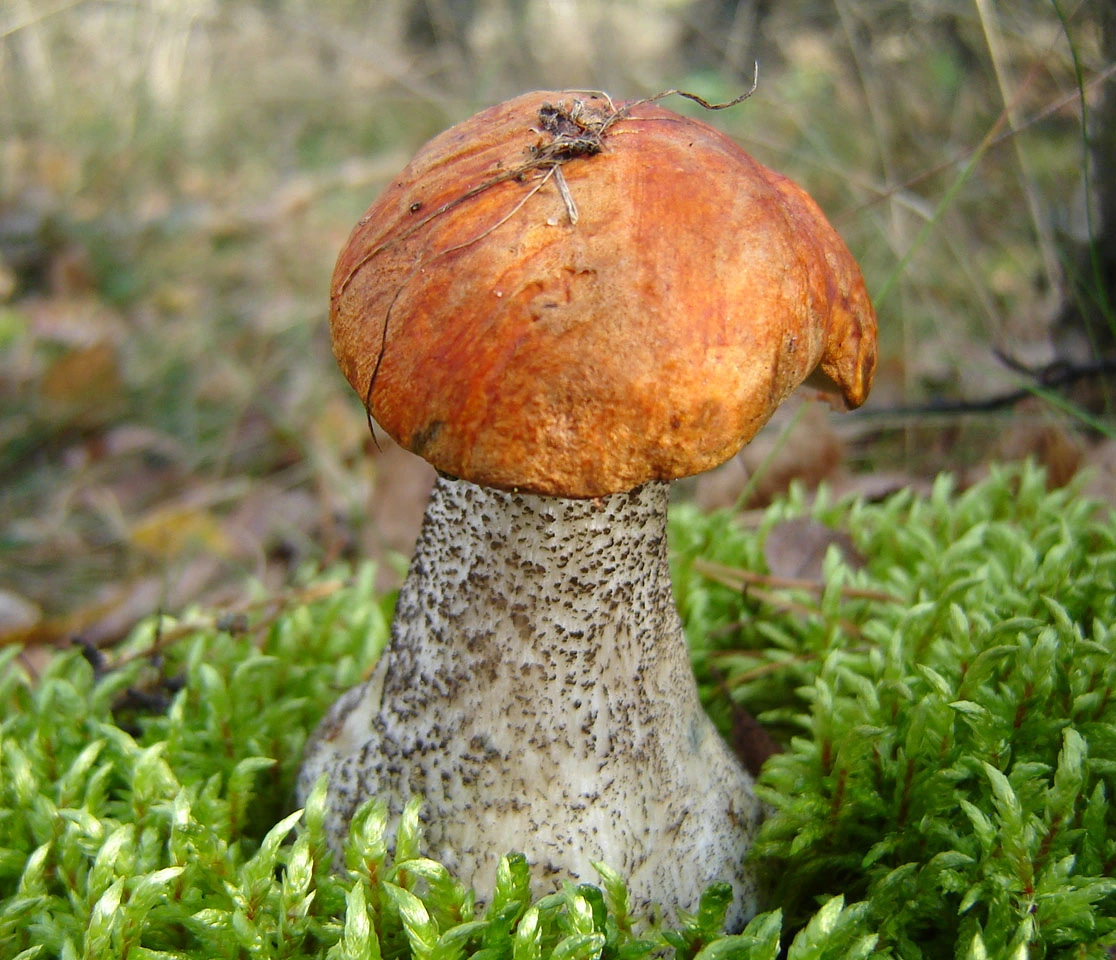
Orange Birch Boletes have orange to orange-brown caps and pale stems covered with dark scabers. Their appearance is often more vivid than that of Brown Birch Bolete.
Several closely related taxa may be involved depending on region, so group-level identification is sometimes more accurate than forcing an exact species name.
Main Identification Clue
The combination of an orange cap, scabrous stem, and birch association is highly characteristic. Flesh may darken or gray after cutting in some members of the group.
Host tree and geography are important for narrowing the exact taxon.
3. Leccinum holopus — Ghost Bolete
This pale bolete is usually whitish, cream, or very pale gray. It has the same scabrous stem structure typical of Leccinum.
It is especially associated with wet birch habitats and can occur in boggy or mossy ground.
Main Identification Clue
The pale coloration is the most striking feature. In wet birch woodland, a ghostly pale bolete with stem scabers is a strong clue toward Leccinum holopus.
Its habitat helps separate it from paler forms of other Leccinum species.
4. Lactarius pubescens — Bearded Milkcap
Bearded Milkcap has a pale pinkish to cream-pink cap with a woolly or hairy margin. The gills are pale, and damaged tissue releases white latex.
It is strongly associated with birch and often appears in grass, moss, or leaf litter near birch roots.
Main Identification Clue
Look for the pale hairy cap margin and white milk. The cap is usually less strongly zoned and less vivid than that of Lactarius torminosus.
The birch association makes this species much easier to interpret.
5. Lactarius torminosus — Woolly Milkcap
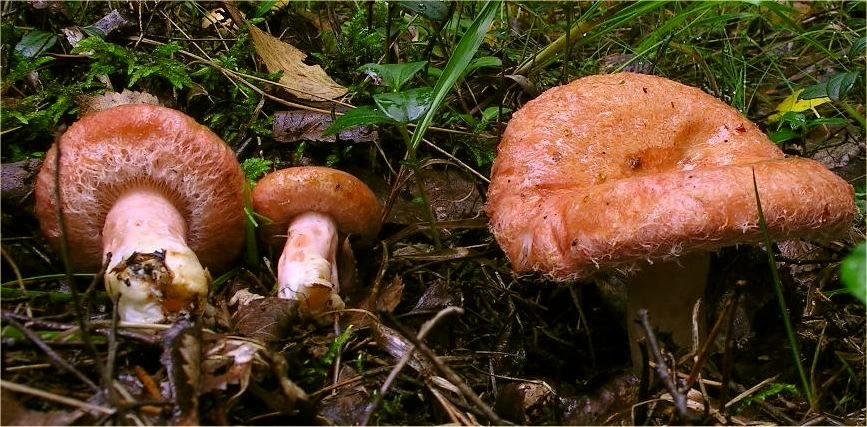
Woolly Milkcap is one of the most distinctive birch-associated milkcaps. The cap is pink to salmon-pink, often with concentric darker zones and a strongly woolly margin.
The gills are pale and release white latex when damaged.
Main Identification Clue
A pink zoned cap with a thick woolly edge beneath birch is highly characteristic. Young mushrooms often have particularly obvious rolled-in hairy margins.
This species should not be confused with edible orange milkcaps simply because both produce latex.
6. Russula betularum — Birch Brittlegill
As the name suggests, this small pale russula is closely associated with birch. The cap is usually pinkish, pale red, or faded almost white.
The gills and stem are pale, and the flesh is brittle in the classic Russula manner.
Main Identification Clue
The small size, pale pink cap, brittle structure, and birch habitat are the best field clues. Exact identification among pale russulas can still be difficult.
Acrid taste is often mentioned in specialist descriptions, but beginners should not rely on taste testing.
7. Russula claroflava — Yellow Swamp Brittlegill
This species has a bright yellow cap, pale gills, and a white stem. It often grows with birch in damp or boggy ground.
The color can be striking, especially against dark moss and wet soil.
Main Identification Clue
The combination of a vivid yellow cap and wet birch habitat is particularly useful. The flesh and gills may darken somewhat with age or damage.
It is one of the more visually distinctive birch-associated russulas.
8. Amanita muscaria — Fly Agaric
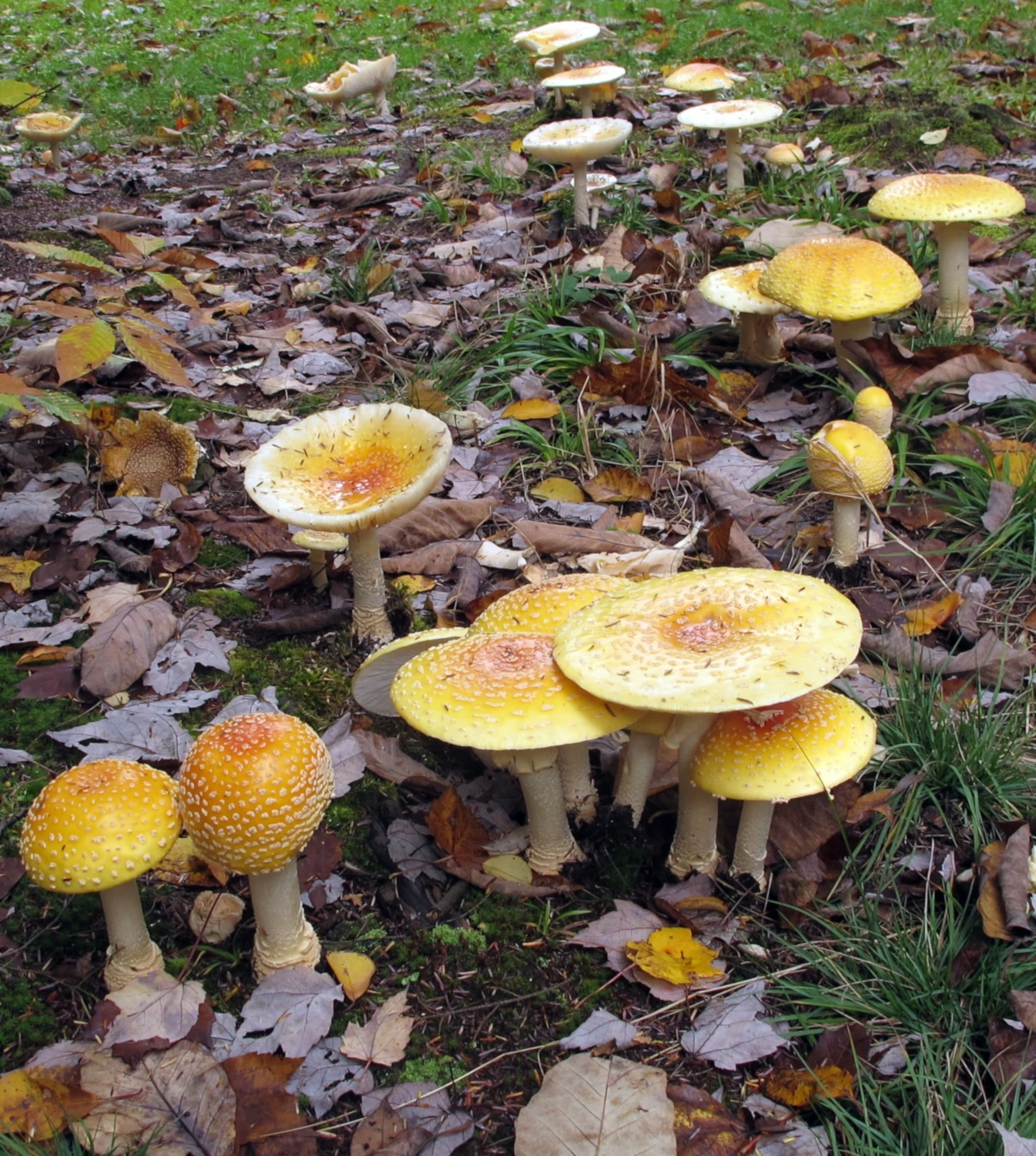
Fly Agaric is strongly associated with birch in many regions. Its classic red cap with white veil warts makes it one of the easiest mushrooms to recognize when fresh.
It also has white gills, a white ringed stem, and a bulbous base with veil remnants.
Main Identification Clue
The red cap and white warts are obvious, but the full Amanita structure should still be checked. Rain can wash the warts away.
Birch woodland is one of the classic habitats for this toxic species.
9. Amanita fulva — Tawny Grisette
Tawny Grisette has a tawny to orange-brown cap with a clearly striate margin. The stem is pale and lacks a ring.
At the base is a distinct sack-like volva, which is one of the key features of the grisette group.
Main Identification Clue
The absence of a ring plus a volva and strongly striate cap margin is important. This separates it from many ringed Amanitas.
It is often associated with birch and can occur in damp woodland.
10. Amanita crocea — Orange Grisette
Orange Grisette resembles Tawny Grisette but usually has a brighter orange or saffron-colored cap. Like other grisettes, it has a striate margin, no ring, and a basal volva.
The stem may show orange or yellowish fibrous markings.
Main Identification Clue
A bright orange Amanita with no ring and a volva should suggest the grisette group. Birch can be one of several associated trees.
Exact separation from related grisettes may require regional knowledge.
11. Cortinarius armillatus — Red-Banded Webcap
This webcap has a brown to orange-brown cap and a pale to brownish stem marked with conspicuous red or reddish bands. Young specimens may also show remnants of the cobweb-like cortina typical of Cortinarius.
It is frequently associated with birch.
Main Identification Clue
The red bands around the stem are particularly useful. Few common birch-associated mushrooms combine this feature with a brown cap and rusty spores.
As with many Cortinarius, exact identification should be cautious.
12. Paxillus involutus — Brown Roll-Rim
Brown Roll-Rim has a brown cap with an inrolled margin, especially when young. The gills run down the stem and can bruise brown when handled.
It often grows with birch and other trees and can appear in large numbers.
Main Identification Clue
The rolled cap margin and strongly decurrent gills are important. The gills can also be peeled or separated unusually easily from the cap flesh.
This species is poisonous and should not be eaten.
13. Cantharellus cibarius Group — Chanterelles
Yellow chanterelles can occur in birch woodland, although they are not restricted to birch. Their thick blunt false gills run down the stem and are very different from thin blade-like true gills.
The cap and stem are usually yellow to golden.
Main Identification Clue
The false gills are the best character. They appear as thick ridges rather than delicate plates.
Host tree helps support the identification but is less decisive here than in birch-specialist boletes or milkcaps.
14. Hydnum repandum Group — Hedgehog Mushrooms
Hedgehog Mushrooms are easy to recognize because the underside of the cap is covered with soft downward-pointing teeth instead of gills or pores.
The cap is usually cream, pale ochre, or light orange.
Main Identification Clue
The teeth are decisive. Very few common woodland mushrooms with this overall shape share the same underside.
They can occur with several broadleaf and conifer trees, including birch in suitable habitats.
15. Imleria badia — Bay Bolete
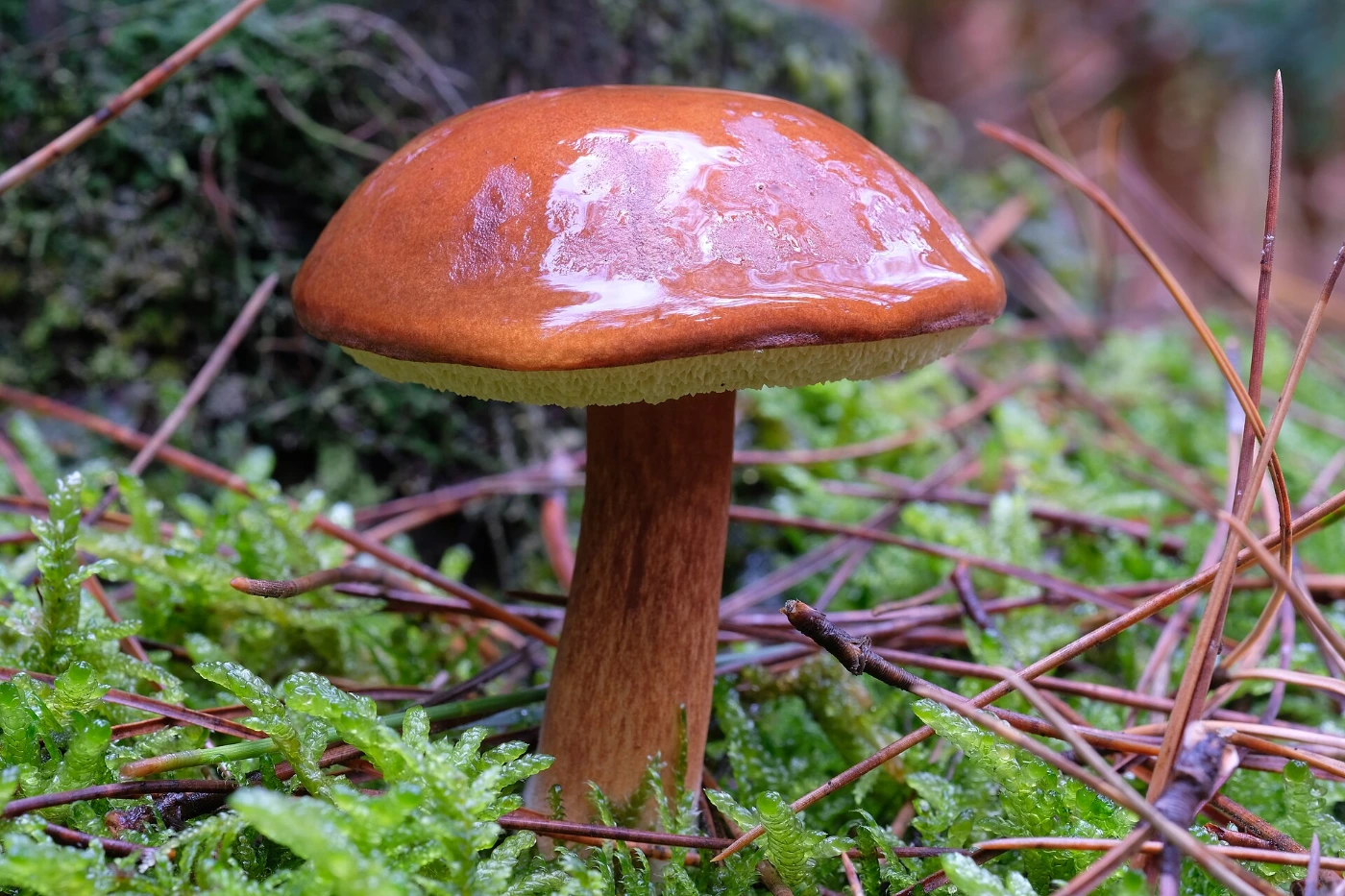
Bay Bolete has a chestnut-brown cap and yellow pores that often turn blue when pressed. The stem is brownish and lacks the strong pale reticulation of Porcini.
It is most strongly associated with coniferous and mixed woodland, but birch can be present in mixed stands where the species fruits.
Main Identification Clue
Yellow pores that bruise blue are one of the fastest clues. The smooth chestnut cap and relatively plain stem help support the identification.
Because it is not a birch specialist, nearby conifers should also be checked.
Birch Specialists vs General Woodland Species
Not every mushroom beneath birch is actually partnered with birch. Some species are tightly associated with the tree, while others simply occur in mixed woodland where birch happens to be present.
This distinction is important when using habitat as an identification feature.
Strong Birch Associates
Species such as Leccinum scabrum, Lactarius torminosus, Lactarius pubescens, and several birch-associated russulas are especially informative when birch is nearby.
Their ecology can be one of the strongest clues in the entire identification.
Broader Woodland Species
Fly Agaric, chanterelles, Hedgehog Mushrooms, and Bay Bolete can occur with multiple tree species. In mixed woodland, it may be unclear which tree is the actual mycorrhizal partner.
Always look around the entire area rather than assuming the nearest trunk is responsible.
Mushrooms Under Birch in Wet Ground
Birch often grows in damp, acidic soils, and several characteristic fungi share this preference. Leccinum holopus, Russula claroflava, and Russula emetica-like brittlegills are especially associated with wet or boggy environments.
Moss and sphagnum can therefore become useful ecological clues. A mushroom growing in a dry ornamental birch planting may belong to a very different community.
Mushrooms Under Birch in Dry Woodland
Drier birch woodland can support Brown Birch Bolete, Orange Birch Boletes, Fly Agaric, chanterelles, and several Cortinarius species.
The exact community depends on soil type, climate, elevation, and the presence of other trees.
Mixed birch-pine or birch-spruce woodland can be especially species-rich because fungi associated with several host trees may overlap.
Which Birch Mushrooms Have Pores?
The best-known pore-bearing birch mushrooms are boletes, especially species of Leccinum. Their underside looks sponge-like rather than gilled.
Brown Birch Bolete and Orange Birch Boletes are among the most typical examples. Bay Bolete may also appear in mixed birch woodland.
Why the Stem Matters in Leccinum
Leccinum stems are covered with small rough projections known as scabers. These may be brown, gray, or nearly black.
This feature is far more useful than cap color alone. Several Leccinum species can have overlapping brown or orange caps.
Which Birch Mushrooms Have Gills?
Milkcap, russula, Amanita, webcap, and Brown Roll-Rim species all have gills. Their structures, however, are very different.
Milkcaps produce latex, russulas are brittle, Amanitas may have rings or volvas, and webcaps often develop rusty spores.
This is why “gilled mushroom under birch” remains a very broad description.
How to Identify Mushrooms Under Birch Step by Step
Start with the underside rather than cap color. Determine whether the mushroom has pores, true gills, false gills, or teeth.
Then inspect the stem for scabers, rings, volvas, bands, or latex-producing tissue. Finally, consider whether the mushroom appears to be a birch specialist or a broader woodland species.
Step 1: Check the Underside
Pores suggest boletes such as Leccinum. Teeth suggest Hydnum, while false gills suggest chanterelles.
True gills lead toward a much wider set of groups.
Step 2: Inspect the Stem
Dark scabers strongly suggest Leccinum. A ring and bulb may indicate Amanita, while red bands may suggest Cortinarius armillatus.
A sack-like volva without a ring points toward a grisette.
Step 3: Test for Latex
If damaged gills release white or colored milk, consider Lactarius or related milkcaps. This is especially useful with the pink birch-associated milkcaps.
No latex points toward russulas or other gilled groups.
Step 4: Check Habitat Moisture
Wet boggy birch ground favors a different set of species than dry woodland. Moisture level is especially useful with russulas and some Leccinum.
Sphagnum moss can be an important clue for wet-habitat specialists.
Step 5: Look for Other Trees
Pine, spruce, oak, and beech may be present close enough to form mycorrhizal relationships with the mushroom you found.
This is especially important before assigning a generalist species to birch.
How to Photograph Birch-Associated Mushrooms
Take a photograph showing the complete mushroom and surrounding ground. Include birch leaves, bark, roots, or nearby trunks if possible.
Then photograph the underside, full stem, and stem base. For milkcaps, include a damaged gill showing latex; for boletes, photograph pore bruising; for Amanitas, expose the entire bulb and volva.
A wider habitat image is especially valuable for mycorrhizal species. It can reveal other nearby host trees that are easy to miss in a close-up.
Can AI Identify Mushrooms Growing Under Birch?
AI can use birch habitat as a valuable contextual clue, especially for recognizable species such as Brown Birch Bolete or Woolly Milkcap. It becomes much more useful when combined with detailed images of the underside and stem.
The main risk is overvaluing the nearest tree. A mushroom growing beneath birch may actually be associated with nearby pine, spruce, oak, or another host.
The best AI identification therefore combines morphology with habitat rather than treating “under birch” as the answer by itself.
Common Identification Mistakes
A common mistake is calling every scabrous-stem bolete Brown Birch Bolete. Orange-capped and pale wetland Leccinum species can occur under the same tree genus.
Another mistake is assuming every pink woolly milkcap is the same species. Lactarius pubescens and Lactarius torminosus overlap strongly but differ in color intensity, zoning, and other details.
A third mistake is ignoring mixed woodland. Several fungi found “under birch” may actually be partnered with another nearby tree.
Interesting Facts About Birch-Associated Mushrooms
Birch is a pioneer tree that quickly colonizes disturbed ground, abandoned land, burned areas, and young woodland. Mycorrhizal fungi help birch survive in these nutrient-poor environments, which is one reason the tree supports such a rich fungal community.
Some Leccinum species are so closely tied to particular tree groups that host identification becomes central to naming them. Birch, aspen, and other trees can support visibly similar boletes that differ mainly in ecology and subtle morphology.
Fly Agaric is also famously associated with birch in northern Eurasia. The repeated appearance of red-and-white Fly Agarics beneath white-barked birches has become one of the most recognizable woodland scenes in mushroom photography.
Birch fungi can also reveal hidden root systems. A mushroom several meters from a trunk may still be connected to that tree underground, showing how much larger a mycorrhizal partnership is than the visible fruit body.
Frequently Asked Questions
Why do mushrooms sometimes appear under a birch that was planted only a few years ago?
Mycorrhizal fungi can establish quickly if suitable fungal partners are already present in the soil or arrive with the tree’s root system. Young birches can therefore develop fungal partners surprisingly early.
Can mushrooms under ornamental birch trees be different from those in natural woodland?
Yes. Soil, irrigation, mulch, nearby introduced trees, and nursery fungi can all change the fungal community around planted birches.
Why are there more mushrooms under some birches than others?
Tree age, root health, soil moisture, acidity, and fungal colonization all matter. Two birches growing close together can support noticeably different visible fruiting patterns.
Can birch mushrooms grow after the tree has been cut down?
Mycorrhizal species depend on living roots, so they eventually decline after the host dies. Fruiting may continue briefly while parts of the root system remain alive, but long-term persistence is unlikely without another compatible host.
Do fallen birch leaves help identify the host tree reliably?
They are useful, but leaves can blow considerable distances. Bark, live branches, and multiple nearby trunks provide better confirmation.
Can the same birch support several mushroom species at once?
Yes. A single tree can have relationships with multiple mycorrhizal fungi simultaneously, and visible fruit bodies from several species may appear during the same season.
Why do some birch-associated mushrooms appear only in wet years?
The mycelium can remain underground for long periods without producing mushrooms. Fruiting depends strongly on soil moisture, temperature, and seasonal weather patterns.
Are mushrooms growing directly from birch wood also mycorrhizal?
Usually not. A mushroom emerging directly from dead birch wood is more likely to be a decomposer, while the species in this guide mostly grow from soil in association with living roots.
Final Identification Notes
Birch trees support many distinctive fungi, including Brown Birch Bolete, Orange Birch Boletes, Woolly Milkcap, Bearded Milkcap, Birch Brittlegill, Fly Agaric, grisettes, and several wetland russulas.
The strongest birch specialists are particularly useful for field identification, but not every mushroom beneath a birch belongs to the tree. Mixed woodland can contain fungi associated with several overlapping hosts.
Start with the underside, examine the full stem, note latex or bruising, and then use the birch association to narrow the possibilities. Tree identification is a powerful clue, but it works best after the mushroom’s structure has already been established.
Upload a photo and get possible matches in seconds.