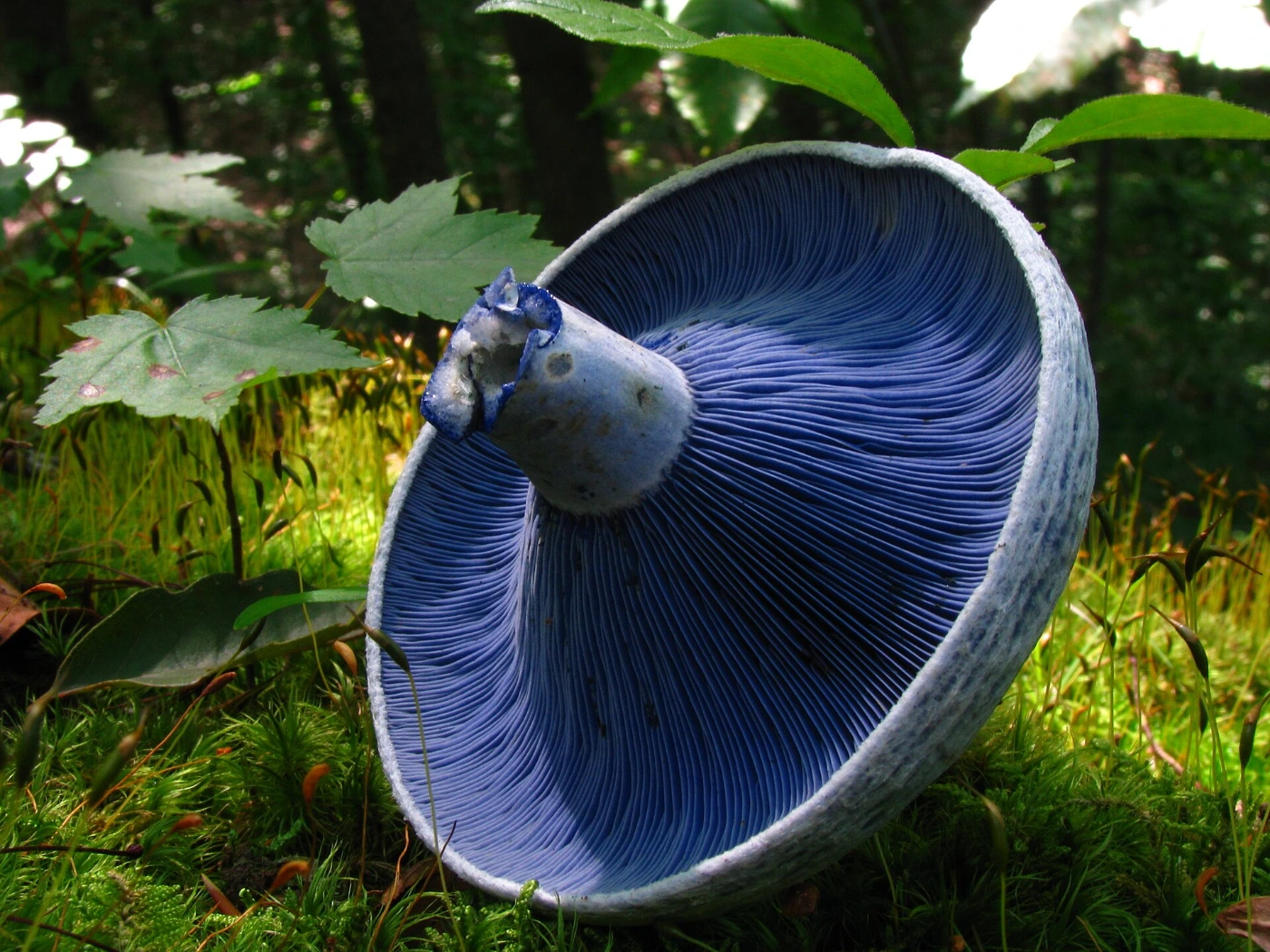
Lactarius indigo, commonly known as the Indigo Milk Cap, is one of the most distinctive mushrooms in the world. Its deep blue cap, blue gills, and vivid blue latex make it look almost unreal compared with the browns, whites, and reds of most woodland fungi.
Despite its unusual appearance, correct identification still requires more than color alone. The mushroom belongs to the milkcap group, so the presence of latex, the structure of the gills, the way damaged tissue changes color, and the surrounding trees all help confirm the identification.
⚠️ Important: This guide is for identification and education only. Never eat a wild mushroom based solely on photographs, AI identification, or a single visible feature.
Quick Identification
| Feature | Lactarius indigo |
|---|---|
| Scientific name | Lactarius indigo |
| Common name | Indigo Milk Cap |
| Family | Russulaceae |
| Cap color | Deep blue to blue-gray |
| Cap pattern | Often concentrically zoned |
| Gills | Blue, decurrent |
| Latex | Bright blue |
| Bruising | Damaged areas often turn greenish |
| Stem | Blue to blue-gray |
| Flesh | Pale blue to blue |
| Spore print | Cream to pale yellowish |
| Ecology | Mycorrhizal |
| Main hosts | Oak, pine and other trees depending on region |
| Season | Summer through autumn |
| Distribution | Mainly North America, also parts of Central America and Asia |
| Edibility | Generally considered edible when correctly identified |
| Main look-alikes | Other blue or greenish milkcaps, faded milkcaps, unrelated blue mushrooms |
What Does Lactarius indigo Look Like?
The Indigo Milk Cap is usually unmistakable when fresh. The cap is blue to blue-gray, the gills are also blue, and damaged tissue releases blue latex.
As the mushroom ages, some of that intense color can fade. Old specimens may become dull gray-blue or develop greenish areas where the tissue has been damaged.
Cap
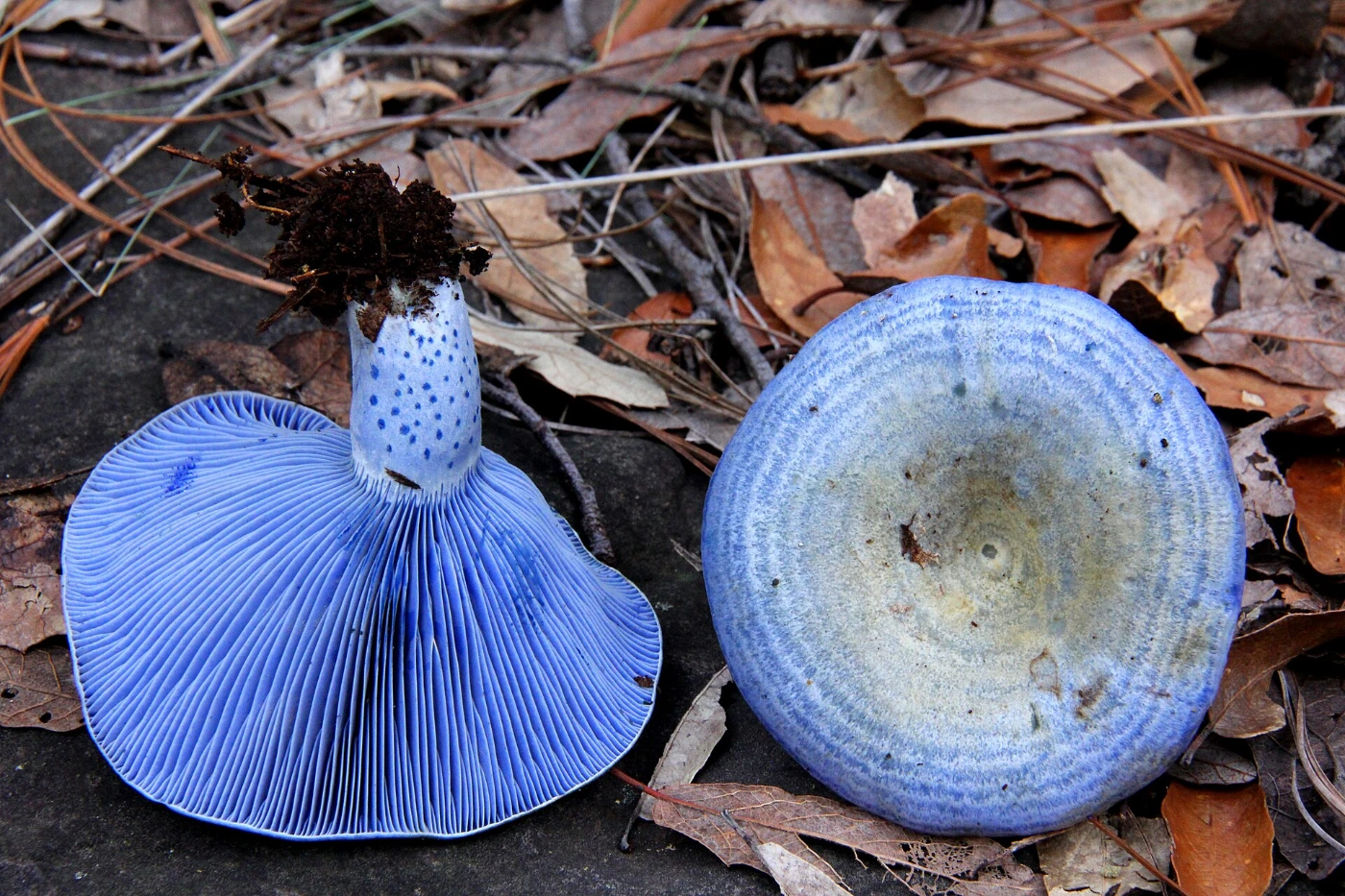
The cap usually begins convex and later becomes flat or slightly depressed in the center. Mature specimens may develop a broad funnel-like shape.
Color ranges from rich indigo and cobalt-blue to paler blue-gray. Concentric rings or zones are often visible across the cap surface.
Cap Surface
The surface is smooth and may feel slightly sticky or moist in wet weather. Young mushrooms can have especially vivid blue coloration.
With age and exposure, the cap may fade substantially. Greenish staining often appears where insects, rain, or handling have damaged the tissue.
Gills
The gills are attached to the stem and typically run slightly downward, a condition known as decurrent gills. Their color ranges from blue to bluish-gray.
When cut or broken, the gills release the same blue latex found elsewhere in the mushroom. This is one of the strongest identification clues.
Gill Bruising
Damaged gills may gradually shift from blue toward greenish tones. The reaction becomes especially noticeable on older fruit bodies.
This green staining is not a sign of decay by itself. It is part of the normal chemical response of the mushroom’s pigments.
Latex
The latex is the defining feature of Lactarius indigo. Fresh cuts typically release a striking blue liquid. This immediately separates the mushroom from many unrelated blue species that do not produce milk at all.
Does the Latex Change Color?
The latex may darken or become greener as it oxidizes and dries. The surrounding tissue can also develop greenish staining. Because latex production can be reduced in old or dry mushrooms, young fresh specimens show this character best.
Stem
The stem is usually blue to blue-gray and fairly solid when young. It may be slightly paler than the cap. Its surface can show small pits or uneven color zones, especially in mature specimens.
Stem Shape
The stem is usually cylindrical or slightly tapered. It lacks a ring and does not have a volva. This plain structure fits the milkcap group and helps separate the mushroom from ringed or volva-bearing blue fungi.
Flesh
The flesh is pale blue to bluish-white and fairly firm in young mushrooms. Like other members of the Russulaceae, it has a somewhat brittle texture. Cut tissue may slowly turn greenish. This color change is especially useful when paired with the blue latex.
Smell
The smell is usually mild and not especially diagnostic. It may be described as faintly mushroom-like or earthy. Odor should not be used as a primary identification feature here. The color and latex are far more informative.
Spore Print
The spore print is pale cream to yellowish-cream. This may seem surprising given the intense blue fruit body. Spore print color helps confirm that the mushroom belongs in the broader milkcap/russula group. It is not blue.
Where Does Lactarius indigo Grow?
Lactarius indigo is mycorrhizal, forming symbiotic relationships with living trees. It grows from soil rather than directly from decaying wood.
Depending on region, it can be associated with oak, pine, and other trees. Mixed woodland is often productive habitat.
Oak and Pine Associations
In parts of North America, Indigo Milk Cap is often found under oaks or pines. The exact host relationship varies regionally. This makes tree identification a useful supporting clue. A blue milkcap growing from soil in suitable oak or pine woodland fits the ecology well.
When Does Lactarius indigo Grow?
The main fruiting season is summer through autumn, especially after periods of warm rain. Fruiting can continue for several weeks if conditions stay moist. Like many mycorrhizal mushrooms, visible fruit bodies may appear irregularly from year to year. The underground mycelium can remain active even when no mushrooms are present.
Distribution
Lactarius indigo is best known from North America. It is especially associated with eastern and southern regions but has a wider distribution. The species or closely related blue milkcaps have also been reported from parts of Central America and Asia. It is not a typical widespread European woodland species.
Geographic Caution
Blue milkcaps outside the best-known range of Lactarius indigo should not automatically be assigned this species name. Regional taxonomy can include related taxa.
Geography should therefore be considered together with morphology and host trees.
Is Lactarius indigo Edible?
Indigo Milk Cap is generally considered edible when correctly identified. Its unusual color does not indicate toxicity.
The texture can be somewhat firm or brittle, and culinary quality is described differently by different collectors. As with other wild mushrooms, only fresh, correctly identified specimens should ever be considered for food.
Color After Cooking
The striking blue color may fade, darken, or shift during cooking. This is normal and reflects changes in the pigments.
Appearance after heating should not be used as an identification test.
Lactarius indigo Look-Alikes
Very few mushrooms share the exact combination of blue coloration and blue latex. This makes Lactarius indigo easier to recognize than many brown or white milkcaps.
Still, faded specimens or regional relatives can cause confusion.
Other Blue Milkcaps
Identification
Some related milkcap species can show blue, violet, or greenish-blue colors. Depending on geography, they may resemble Lactarius indigo closely.
Latex color, host trees, spore features, and regional range become important in difficult cases.
Main Difference
A true Lactarius indigo-type mushroom should have strongly blue fruiting tissue and clearly blue latex when fresh.
If the latex is white, clear, or another color, another species is more likely.
Faded Lactarius indigo
Identification
Old specimens can lose much of their vivid blue color and become grayish, greenish, or dull blue-green. This can make them look less distinctive.
The gills, remaining blue tones, latex, and habitat then become much more important.
Main Difference
Look for residual blue in protected areas such as the lower gills or inner flesh. Fresh cuts may still reveal blue latex even when the cap has faded.
Lactarius deliciosus Group
Identification
Orange milkcaps such as Lactarius deliciosus also produce colored latex and may develop green stains after damage. Their orange caps and orange latex, however, are very different from the blue coloration of Lactarius indigo.
Both groups demonstrate how useful latex color can be in milkcap identification.
Main Difference
Lactarius indigo produces blue latex, while orange milkcaps produce orange to carrot-colored latex.
The overall cap and gill colors are also completely different in fresh specimens.
Blue-Green Stropharia and Other Blue Mushrooms
Identification
Some unrelated mushrooms can have blue or blue-green caps. Certain Stropharia species are good examples.
These mushrooms have true gills but do not produce blue latex and often have different stem structures and spore colors.
Main Difference
Breaking the gills provides a quick distinction. A true Indigo Milk Cap should release blue milk.
Lactarius indigo vs Orange Milkcaps
| Feature | Lactarius indigo | Orange Milkcaps |
|---|---|---|
| Cap | Blue to blue-gray | Orange to carrot-orange |
| Gills | Blue | Orange |
| Latex | Blue | Orange |
| Bruising | Often greenish | Often greenish |
| Habitat | Oak/pine depending on region | Often conifer-associated |
| Best clue | Blue latex | Orange latex |
The green bruising can look surprisingly similar in both groups. The original latex color is what separates them quickly.
How to Identify Lactarius indigo Step by Step
Start by confirming that the mushroom has true gills rather than pores or false gills. Then damage a small section of the gills and observe the latex.
A blue cap plus blue gills plus blue latex is a remarkably strong combination. Finally, check for greenish bruising and suitable woodland habitat.
Step 1: Check the Overall Color
Look for a predominantly blue fruit body. The cap, gills, and stem should all show some degree of blue coloration.
A mushroom with only a blue cap but white or brown gills is less likely to be Lactarius indigo.
Step 2: Cut the Gills
Fresh gills should release blue latex. This is the single most useful diagnostic feature.
If no latex appears, check a fresher specimen before ruling the species out. Old or dry mushrooms may produce less liquid.
Step 3: Watch for Green Staining
Damaged areas often become greenish over time. This can occur on the cap, gills, stem, or cut flesh.
The blue-to-green transition strongly supports the identification when the other features also match.
Step 4: Check the Stem
The stem should also carry blue or blue-gray tones and lack a ring or volva.
This helps keep the identification within the milkcap group rather than unrelated blue mushrooms.
Step 5: Check the Trees
Look for oak, pine, or other compatible host trees depending on region. The mushroom should be growing from soil in a mycorrhizal setting.
Direct growth from dead wood would point toward another species.
How to Photograph Lactarius indigo for Identification
Take one photograph showing the complete mushroom in natural light. Blue colors can shift dramatically under warm artificial lighting, so daylight is especially useful.
Then photograph the gills and make a small cut so the latex is visible. A second image several minutes later can document the greenish color change.
A habitat photo showing nearby oak or pine trees adds valuable ecological context. If several mushrooms are present, photograph both young and mature specimens.
Can AI Identify Lactarius indigo?
AI can often recognize a fresh Indigo Milk Cap quite well because the color pattern is so unusual. Blue cap, blue gills, and blue latex provide several independent visual signals.
The main difficulty comes from old faded specimens or related regional milkcaps. A cap-only photograph may also lead to confusion with unrelated blue mushrooms.
Including the latex reaction and host trees greatly improves identification. Dynamic features such as bruising are especially valuable because they are difficult to infer from a single image.
Common Identification Mistakes
One common mistake is assuming every blue mushroom is Lactarius indigo. Many unrelated species can have blue or blue-green caps.
Another mistake is ignoring latex. In this species, blue milk is far more diagnostic than the cap color alone.
A third mistake is calling every blue milkcap worldwide Lactarius indigo. Regional relatives and taxonomy should always be considered.
Interesting Facts About Lactarius indigo
The intense blue color of Lactarius indigo is unusual among mushrooms and comes from specialized pigments in the fruit body. These pigments can change chemically after injury, which helps explain the transition from blue to greenish tones.
The species is also a striking example of how mushroom color does not predict spore color. Despite its deep blue appearance, the spore print is pale cream rather than blue.
Like other milkcaps, Lactarius indigo belongs to the same broader family as brittlegills. Their flesh contains unusual rounded cells that contribute to the brittle texture of the mushroom.
The mushroom’s vivid appearance has also made it popular in nature photography. Few edible wild mushrooms are as visually distinctive in fresh condition.
Frequently Asked Questions
Why does the blue color become green after handling?
Damage triggers oxidation and chemical changes in the pigments. As the reaction develops, blue areas can shift toward green or blue-green.
Can the mushroom lose almost all of its blue color with age?
Yes. Old fruit bodies can become gray, greenish, or dull blue. Protected areas such as the lower gills may retain color longer.
Does the blue latex stain fingers?
It can temporarily discolor skin or surfaces, especially when several fresh mushrooms are handled. The intensity depends on how much latex is produced.
Can rain make the cap look much paler?
Yes. Water, age, and sunlight can all reduce the apparent intensity of the blue pigments.
Do young specimens produce more latex?
Usually they do. Fresh actively growing mushrooms tend to release more obvious latex than old dry ones.
Can Indigo Milk Caps grow in groups?
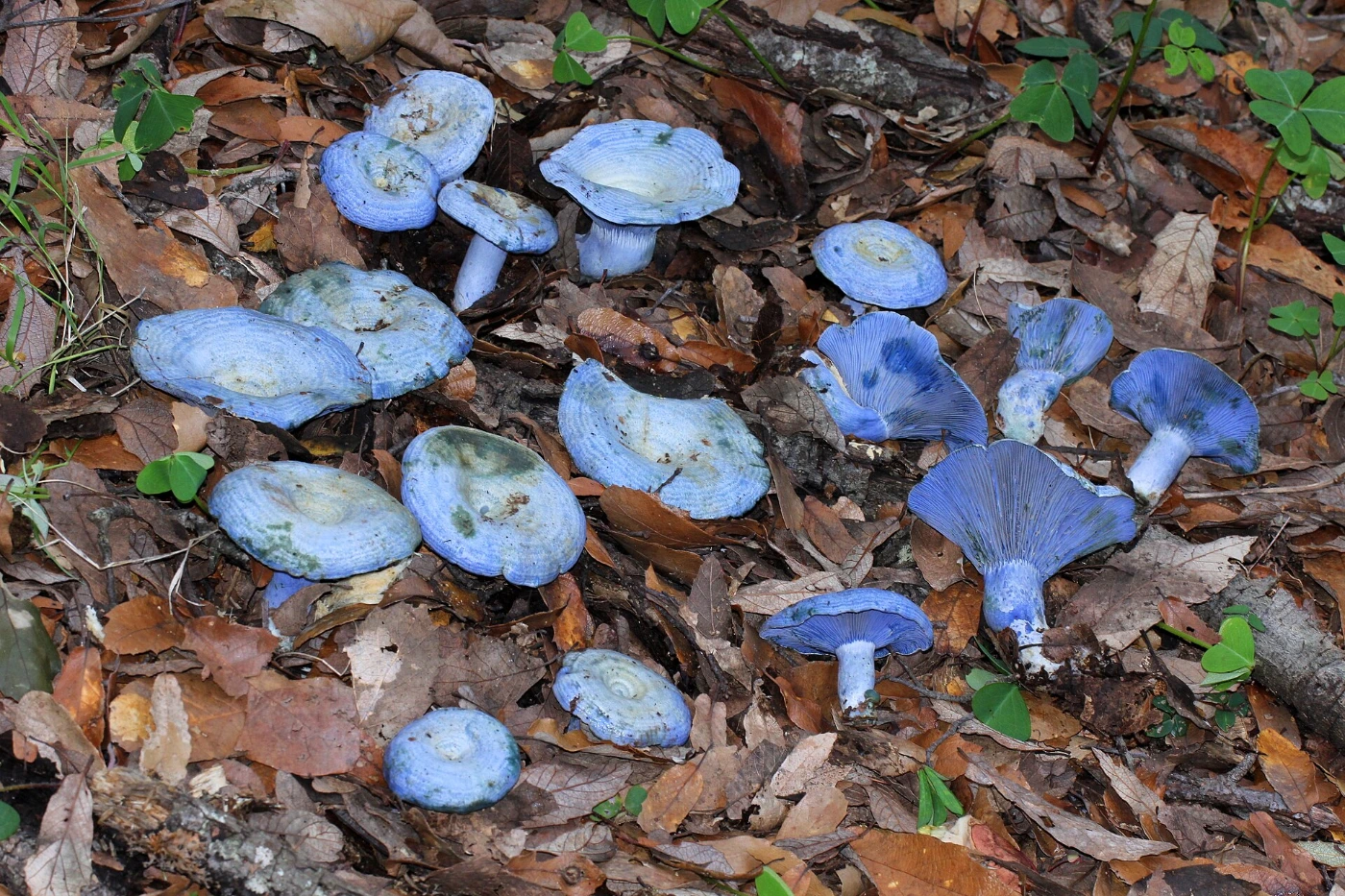
Yes. Several fruit bodies may appear scattered or clustered within the same mycorrhizal area.
Why is the spore print not blue?
The pigments responsible for the fruit body color are not the same as those determining spore color. The spores remain pale despite the blue mushroom tissue.
Can Lactarius indigo grow directly from wood?
No, it is a mycorrhizal soil-growing species. A blue mushroom emerging directly from a log should be reconsidered.
Final Identification Notes
Lactarius indigo is best recognized by the combination of a blue cap, blue decurrent gills, blue latex, blue-gray stem, and greenish staining after damage.
Its appearance is distinctive, but exact identification should still include habitat and geography. Similar regional milkcaps may exist, and old specimens can lose much of their original color.
The strongest rule is simple: blue color suggests the species, but blue latex confirms the direction of the identification.
Upload a photo and get possible matches in seconds.